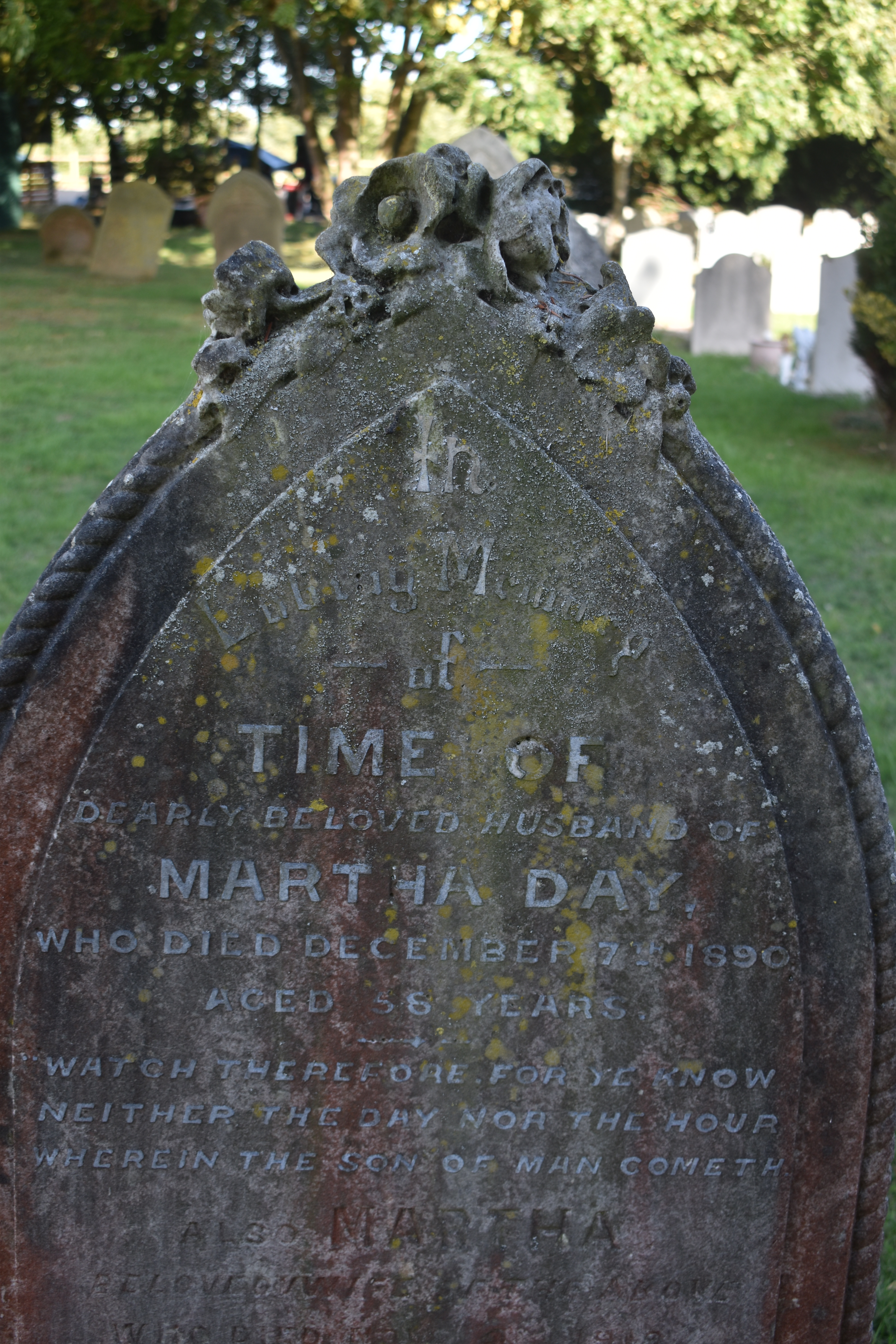
I tried to find this grave last year in the churchyard of Hoo St Werbergh but ran out of time. However, on a return visit this year I finally found it.
It’s dedicated to a man called ‘Time Of Day’ ( I kid you not). (1833-1890) with ‘Day’ being his surname. I did wonder if his siblings were called after days of the week with their surname providing the end as in ‘Sun – Day, Mon-Day etc.
He was a licenced victualler or publican who owned a pub in a nearby hamlet, Fenn Street, Hoo, called The Bell Inn from 1881. He died on 11 December 1890 and the headstone was erected by his wife, Martha, who was the executrix of his will. The value of his estate was £962.10s.3d which was a substantial sum at that time. There was no mention of any children.
The Fenn Bell Inn may have been named after one of several bells erected on nearby marshes. In poor weather they would ring to enable travellers to find a safe way to cross but The ‘Bell’ is a common name for pubs throughout Britain. The Fen Bell Inn has been in existence since the 17th century although it has been remodelled and restored since then. However, some of the original fabric still exists. Since 2014, it has housed the Fenn Bell Conservation project for rescued animals and a miniature railway. Recently, there has been controversy over the pub landlord’s plan to sell off land for housing but he has defended it saying that he needed to do it to keep his business going.
‘Time of Day’ is a very unusual name as you might agree but he was a man of some substance and is likely to remembered for many years to come.
The churches of the Romney Marshes are isolated and you’ll need your own transport to visit them. But there are hamlets and villages here and there and I could imagine how it must feel in mid-winter with dark short nights.
However it has long been one of my ambitions to explore the churches that are on the marshes. So when I was offered the chance I didn’t hesitate. It was a wonderful Spring day, sunny and bright, and we were all eager to explore the Marshes.
Our first church was St Eanswith in Brenzett. This was a plain little church with a candlesnuffer steeple on top of a small slope and was surrounded by a small churchyard dotted with daffodils. There was an azure blue sky and a hare was spotted racing across a bare field at the back of the church. It’s one of the smallest churches on the Marshes and is dedicated to a 7th Saxon princess who founded a nunnery in Folkestone in 630AD. There is now nothing left of the Saxon building and the present church can only be dated back to the 12th century when the Normans rebuilt it.
A large Maine Coon cat, who was obviously returning from a night out through the churchyard to its home in the little straggle of houses nearby, caught sight of us and tried to hide by running from patch after patch of daffodils. Then its owner came out of the house that it ran into with another Maine Coon cat!
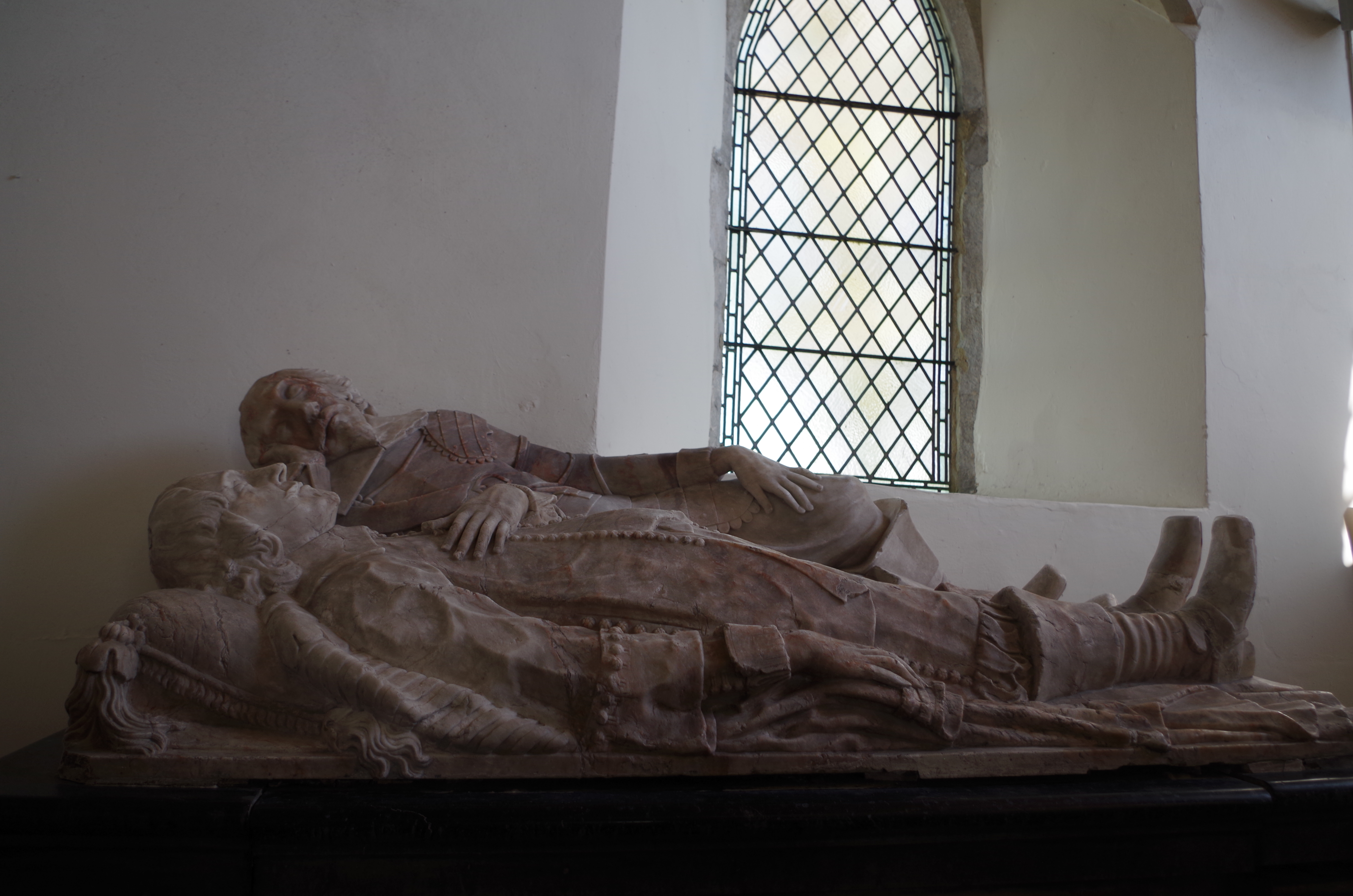
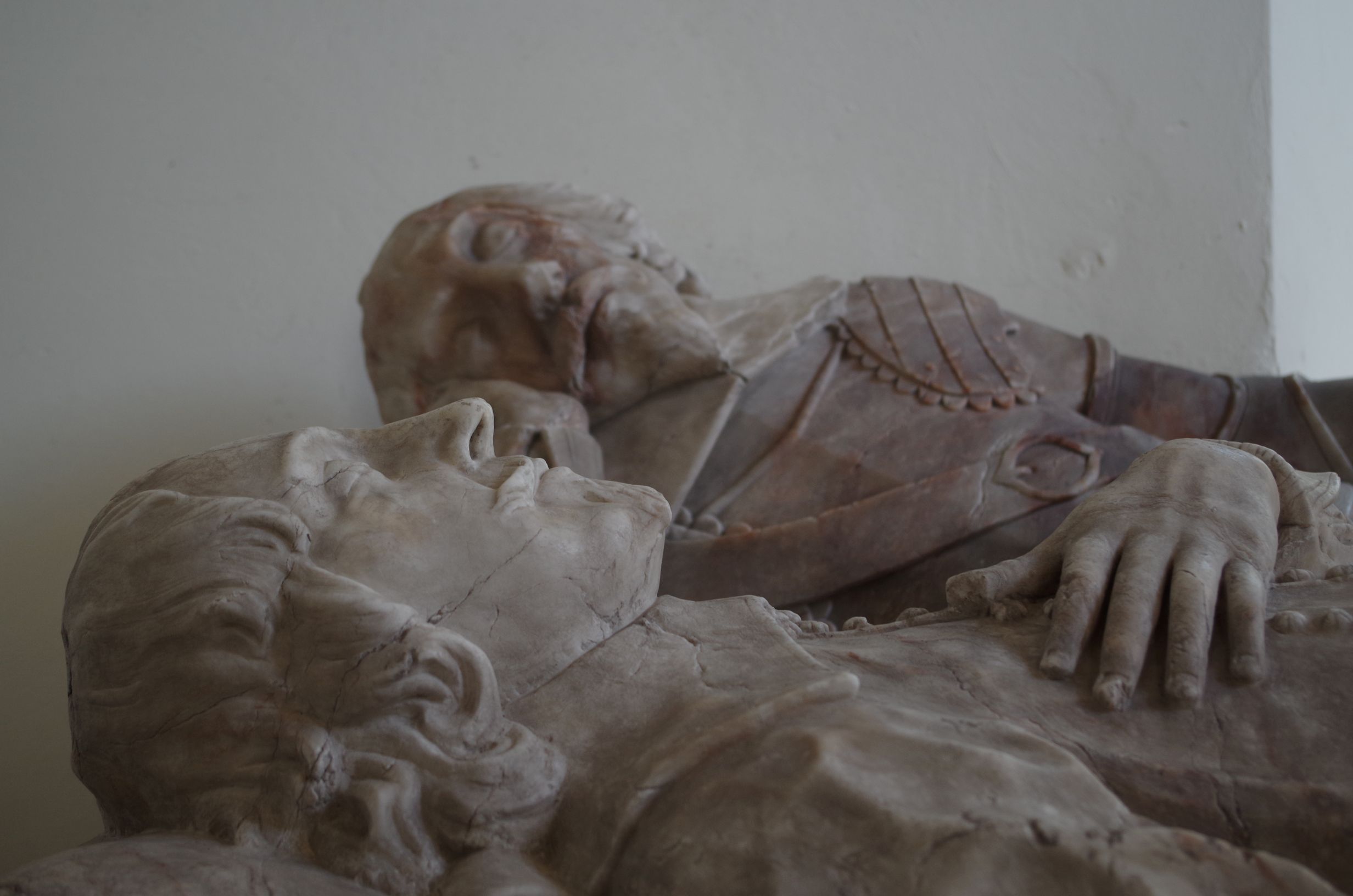
Inside St Eanswith it was plain, with white washed walls and dark wood pews. The pulpit had a raised roof panel which I’d not seen before and at the altar end of the church was the table tomb that we had come to see. This was the Fagge monument and is the only monument in the church. It is dedicated to a father and son, both confusingly called John, and it is a pair of alabaster sculptures of two men in fashionable 17th century clothes. The man in the foreground is portrayed as lying on his back on a sculpted cushion with his left hand on his chest while the man behind is lying on his elbow with his right hand under his chin and his left hand on his left leg. There are visible cracks and damage with repairs which you would expect over the centuries. They are beautifully sculpted. There are small coats of arms beneath the figures at corners which bring a small splash of colour. John Fagge the elder died in 1639 and his son and heir died in 1646.
This is the monument that inspired one of E Nesbit’s most famous stories, ‘Man Size in Marble’ which was adapted by Mark Gatiss for the 2024 BBC Christmas ghost story and retitled ‘the Stone Woman’. A young married couple have moved to the country and their housekeeper tells them of a certain night when something walks from a local church to their house. They take no notice of this but when the husband is called away and leaves his wife alone in the house….you can read the story here: The Project Gutenberg ebook of Grim Tales, by E. Nesbit.
This is English folk horror clashing with modern reasoning and belief. Nesbit creates the dark countryside so well and also the central characters incredulity at what they are being told. They are still in love with endearments such as ‘wifie’ and ‘dearest’ which makes the ominous events that are about to happen all the more shocking.
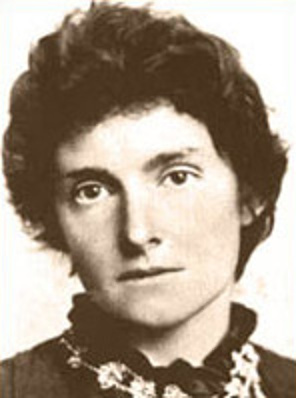
E Nesbit c. 1890 Shared under Wiki Commons
E Nesbit (1858-1924) is most known for ‘The Railway Children’ which was first published in 1905 and has never been out of print. It was also a classic and well loved childrens film. Some of her other children’s stories have also been adapted for TV. But she also wrote ghost stories, some of which were recently published by Handheld Press in the collection ‘The House of Silence.’
She was only 4 when her father, an agricultural chemist, died. Edith’s sister, Mary, suffered from ill health and as a result the family travelled in the UK and France. She died in 1871 of tuberculosis after becoming engaged to the poet Phillip Bourke Marston. After Mary’s death, Edith and her mother lived in Halstead Hall, Halstead in Kent which is considered to be a possible location for ‘The Railway Children’. When she was 17 they moved to Elswick Road in Lewisham.
She married Hubert Bland on 22 April 1880. They met when she was aged 18 and at 21 and 7 months pregnant they tied the knot. It was a difficult marriage to say the least as he was always being unfaithful. Edith had 3 children by him and adopted 2 more from one of his long term affairs. It was a complicated family. She and Hubert were both fervent socialists and joined the Fabian Society, jointly editing its journal ‘Today.’ But this work often took second place to Edith’s writing as she became more successful. The Fabian Society ultimately became part of the Labour party.
From 1899-1920 she lived at Well Hall Eltham. The house is long gone but the garden remains as a public park. She also had a second home at Crowlink, Friston, East Sussex when she entertained.
Bland died in 1918 and she married her second husband, Thomas ‘the Skipper’ Tucker in Woolwich where he was the captain of the Ferry. They both lived at St Mary’s Bay, Dymchurch at their house ‘The Jolly Boat’ where she died on 4 May 1924. It may have been from lung cancer as she was a great smoker. Tommy died at the same address on 17 May 1935. To read more about Edith and her life please visit: https://edithnesbit.co.uk
It was such a privilege to see the Fagge monument in the flesh so to speak and also a writer’s inspiration. I could easily imagine Brenzett on a winter’s night, the little terrace of houses with their curtains drawn and lights out as something stirs and moves within the small church and suddenly the top of the tomb is empty and something that shouldn’t be is walking…..
A Spring Saunter in the footsteps of E Nesbit Part 2 her late life on the Marshes
This is where Rev Jordan came in and he became known as the parson detective. Such was the feeling in the community that he became determined to find the murderer and bring them to justice. So he set about disproving George White’s alibi.
At the time, George had claimed to have met one of his father’s employees, Joseph Green, who he had invited him to come with him. But a few yards away from the house, George had said that he had to return home to fetch his handkerchief. As a result, he was gone at least ten minutes which would have given him enough time to put the hurdle in place for the perpetrator’s gun to rest on. Joseph attested that the hurdle had not been standing at the pantry window during the day. Afterwards they had walked to the Chequers pub and Joseph said that it was the last time he saw George that night. Joseph had added that he had seen George ‘sitting up about upon the stiles’ near the murder scene before it was dark. Even more damning was that George didn’t get the handkerchief that he had said he went back home to get as, when everyone was assembled in the house after the murder, he hadn’t got one and had to go and find one.
A gun had been found in a clover stack near William’s house about a month prior to the murder and an employee called Francis Smith had put it in the hayloft. A short time afterwards he couldn’t find it and was told by George that William had taken it away, destroyed it the stock and lock of it and thrown the barrel into a lumber room.
Rev Jordan meanwhile had preached a sermon on the matter and opened a book, asking everyone in the congregation and village to write down exactly where they were at 8pm on that fateful Sunday evening.
‘Rev Jordan persuaded George to make a vestry statement and a meeting was then held to clear him of suspicion. So, he stood before 40 people on Easter Monday, 3 April 1809 after a dinner at the Five Bells Inn. After the parish accounts were settled, Rev Jordan insisted that George make a public statement. He told the audience what George had said in his vestry statement and demanded that George bring in witnesses to confirm that they had seen him at any time between 7.45-8.15 to which he said that he couldn’t as he hadn’t seen anyone at that time. Some of the audience questioned him and none were satisfied with his answers.‘
The Five Bells Hoo from Facebook photographer unknown
The Rev was able to prove that George had not bought a bag of nuts at 7.45pm as a witness had said that he had seen him cracking and eating them at 7.40pm. Also, George had claimed to be standing at the Five Bells Inn when the hulks guns were fired at 8.15pm but it had actually happened at 8.00pm. He had been seen coming from the farm at 8.20pm with laboured breathing when he reached the vicarage door. He had had enough time to murder his father and then double back to the village.
So what happened next? Nothing. No one was ever charged with William’s murder and the case is still unsolved. George emigrated to Australia and that is the end of his story. There seems to be nothing more on the auction or the fate of William’s children. I could not find an image of William or of Cookham Farm House.
The only reminders are the newspaper reports in florid Victorian language such as;
‘Dastardly murder.’
And, of course, the headstone. It’s a reminder of an event that happened over 200 years ago which shocked a community. It’s not recorded if Rev Jordan went on to do more sleuthing but I think that he made a convincing case against George. William’s grave is situated 20 yards east of the main North church door and not faraway from Thomas Aveling’s resting place.
The Dastardly Murder of William – this site contains Victorian newspaper reports of the murder including 2 in London papers. Also Rev Jordan’s thought on the murder and possible perpetrators.
You never know what you will find in a country churchyard; crumbling mausoleums associated with royalty, a fine selection of skulls on headstones and poignant memorials.
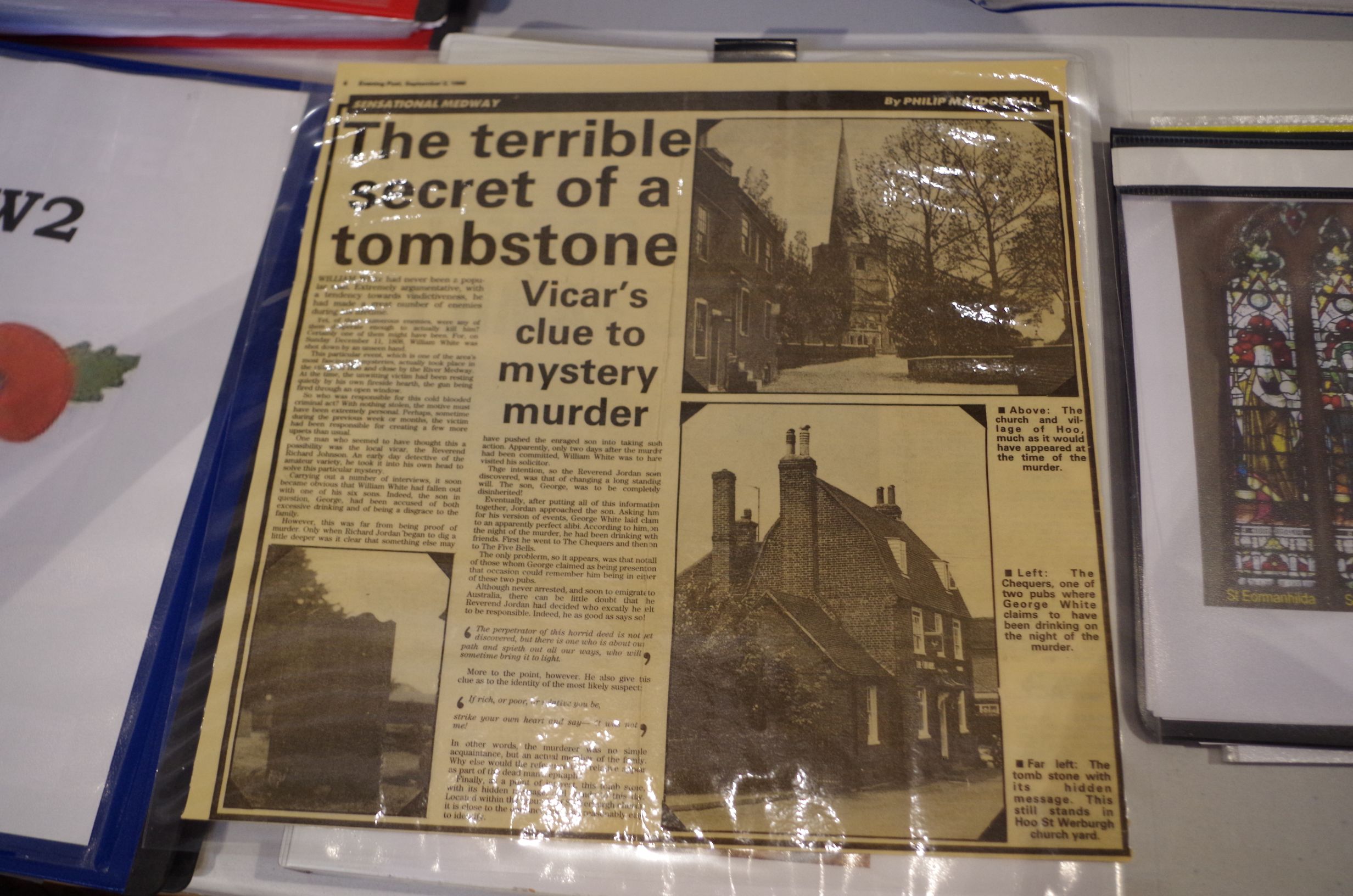
But what I didn’t expect at Hoo was to find one that revealed, positively shouted in fact, about a local unsolved murder from the early part of the 19th century. This is the headstone dedicated to William Walter White. This is the inscription:
‘IN MEMORY OF
WILLIAM WHITE OF THIS PARISH, YEOMAN
WHO WAS ON SUNDAY EVENING THE 11TH OF DECR.
1808 MOST INHUMANLY MURDERED
IN THE BOSOM OF HIS FAMILY
BY A GUN DISCHARGED AT HIM THRO A WINDOW
WHILST SITTING BY HIS OWN FIRESIDE
THE PERPETRATOR OF THIS HORRID DEED IS
NOT YET DISCOVERED BUT THERE IS ONE, “WHO
IS ABOVE OUR PATH AND ABOUT OUR BED
AND WHO SPIETH OUT ALL OUR WAYS”
WHO[O] [WI]LL SOMETIME BRING IT TO LIGHT
HE LIVED ESTEEMED BY ALL WHO KNEW HIM
[AND HIS] SAD END IS UNIVERSALLY REGRETTED HE
[LEFT ISSUE]6 SONSAND 5 DAUGHTERS TO BEWAIL
[HIS LOSS AND DIED [AT] THE AGE OF 58 YEARS
STONE WAS ERECTED JUNE THE 24TH 1809
“[By] whose Assa[ssinating} {H}and [I fell]
[Drop] Reader [o’er my Grave one] Silent Tear
[Live Well remembering that your God is Near]
[If Rich or Poor or Relative you be]
[Strike your own breast and say – It was not Me!]’
A more dramatic epitaph it would be hard to find and the stonemason certainly earned his money! The case shocked the farming community of Hoo especially as no one was ever brought to justice and suspicions ran rife. It even led to the local vicar of St Werbergh’s at the time, Rev Jordan, deciding to become an amateur sleuth and unmask the perpetrator.
Death had already visited the White family when William’s wife, Jane, dropped dead with no prior indication of illness on 24 March 1808 aged 44. The murder left the 11 children orphans within a short space of time and more about what happened afterwards later. William was a man of some standing in the village. He was a yeoman which meant that, although he was a farmer, he wasn’t part of the gentry. In 1790, he was one of only two franchised householders in the village and so was eligible to vote.
The facts are that, on Sunday 11th December 1808, William was sitting reading at home with his family when a shot rang out. A gun had been fired through an open pantry window which killed William outright. The shot entered the back of his head and exited under the right eye. The ‘cries and lamentations’ of his family could be heard in Hoo village a mile away after the body was found. An unsuccessful search was made immediately for the perpetrator. However, a recently discharged gun was found in a ditch roughly 200 yards away from the house near the River Medway which led to the assumption that the murderer had escaped by water.
Such was the notoriety of the case that reports of it appeared in London newspapers and the Bow Street Runners were called in. They were the forerunner of the modern police force.
Bow Street Runners c1800 from History UK website.
Whoever fired the fatal shot must have known the layout of the house and the family’s habits. It took place on a Sunday when there were no servants about and it would have been necessary for the pantry door to be open in order to have a good view from the window as the gun was fired at William sitting by the fire. It had been propped up on a hurdle in front of the window and this helped the murderer to have a good aim. The gun was an old musket-barrel which had nails in the breach fastening it to the stock. It was a very crude gun as the hammer would not hold at full cock but was fastened back by a piece of twine which was presumed to have been cut at the time of firing. The fatal shot was fired at the same as the nightly salvo of guns from convict hulks on the River Medway.
The suspects
The gun’s owner was a man called Driver and he and another man called Day were picked up in Bapchild near Sittingbourne, Kent. It was assumed that they were on the run. The Coroner, J Simmons Esq, questioned them but soon realised that he didn’t have enough evidence to prosecute them. He then had them removed to one of his Majesty’s ships which was a euphemism for being ‘press ganged’. The Kentish Gazette described it like this:
‘as they were unable to give a satisfactory account of their mode of obtaining a livelihood, they were sent to serve their country on board one of his Majesty’s ships of war.’
If that wasn’t enough, later on, they were marched back from Portsmouth to Rochester to be further questioned and then press ganged a second time before being finally released without charge.
As for motive, William had recently found a servant, possibly Driver, in the act of robbing a neighbour and had informed the appropriate authorities. He had sacked the man who had sworn to get his revenge. In fact, a week prior to the murder, the unnamed man, had purchased a gun:
‘for which he had no possible occasion, under some frivolous pretence’
according to newspaper reports at the time.
The inquest on William was held and a verdict was returned of:
‘Wilful murder against some per or persons unknown – Friday 23 December 1808.
Events began to gather pace as the executor of William’s will, Thomas Denton, was authorised to put William’s home, land, possessions and other assets up for auction. It was intended that the money raised would be distributed by him amongst the children as he thought best for them. Originally it had been intended that Jane White, William’s wife would be a joint executor but of course with her death it fell to Thomas alone. Understandably the children tried to stop him and suspicion began to fall on him. In the space of a few months they had been left orphans with the loss of both their parents and now they were to lose the family home as well.
But another suspect had appeared who was much closer to home. It was George White, William’s eldest son. He was known to be on bad terms with his father and had been seen to threaten him. George wanted the farm and the land but William was considering writing a new will leaving him and another relative out. However, his will dated 22 January 1808 did not indicate.
But George had convinced both the Mr Simmons, the coroner, and the Bow Street Runners that, during the vital thirty minutes between 7.45pm and 8.15pm he had been in Hoo village buying:
‘a penny’s worth of nuts.’
The shop was a good mile away from the farm. But someone else in the community had doubts about George’s alibi and was determined to disprove it as we shall see in Part 3.
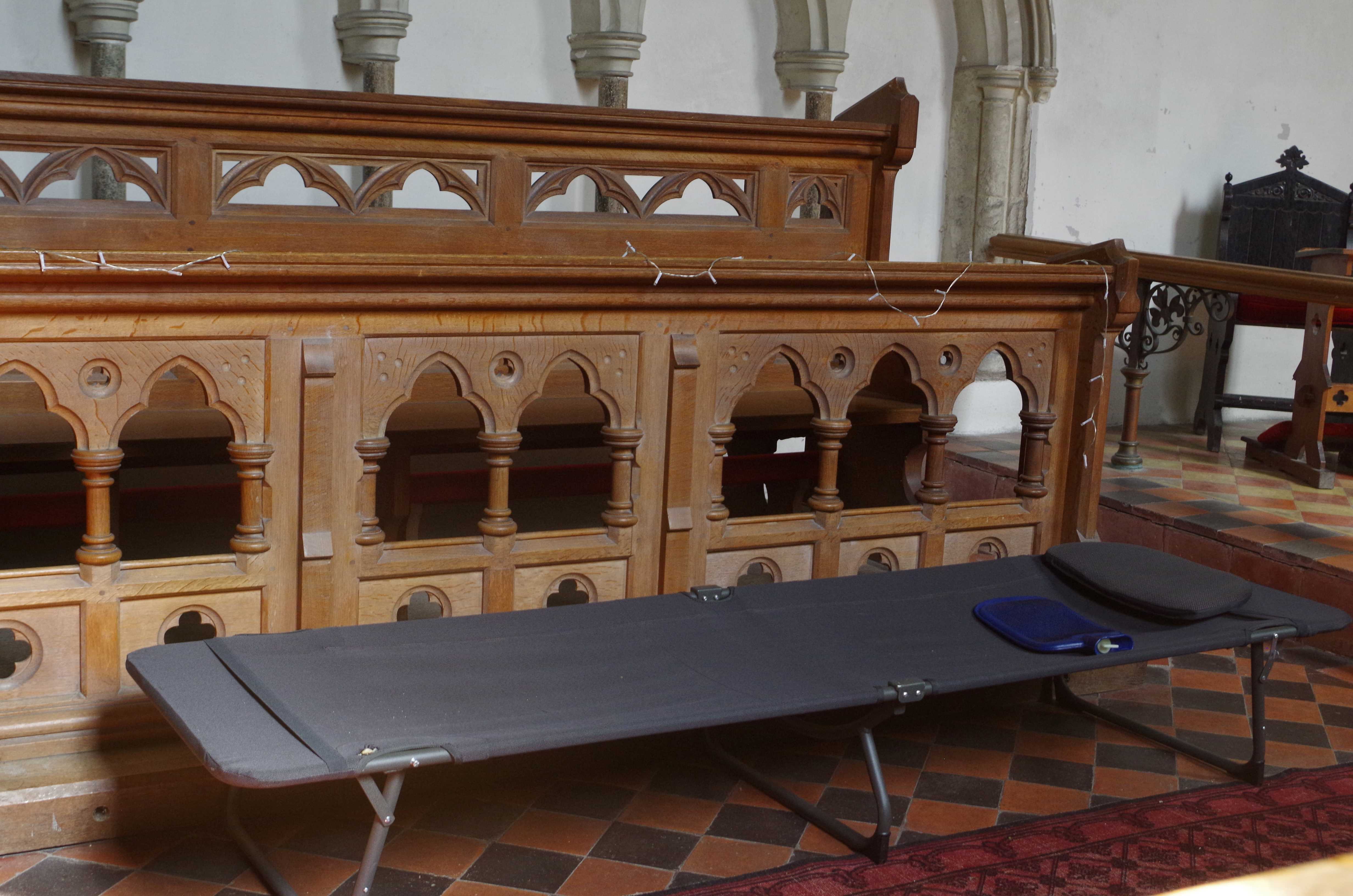
Maybe I just disturbed the nocturnal guests at St James’s and they felt compelled to hide but all appeared to be silent as I stepped inside the church. But they were given away by 2 vacant camp beds in front of the altar and the small refreshment area by the pulpit. I thought that the hot water bottle on one of the camp beds was a nice touch as I stood there for a moment and wondered what it must have been like staying overnight in an empty church in such an isolated place. There are houses around the church but not that many. ‘Champing’, is a euphemism for overnight ‘camping’ in churches looked after by The Churches Conservation Trust. Don’t worry they’re not pitching tents! The church provided the campbed and the usual amenities. It’s really caught on in recent years and I have been tempted to try it myself.
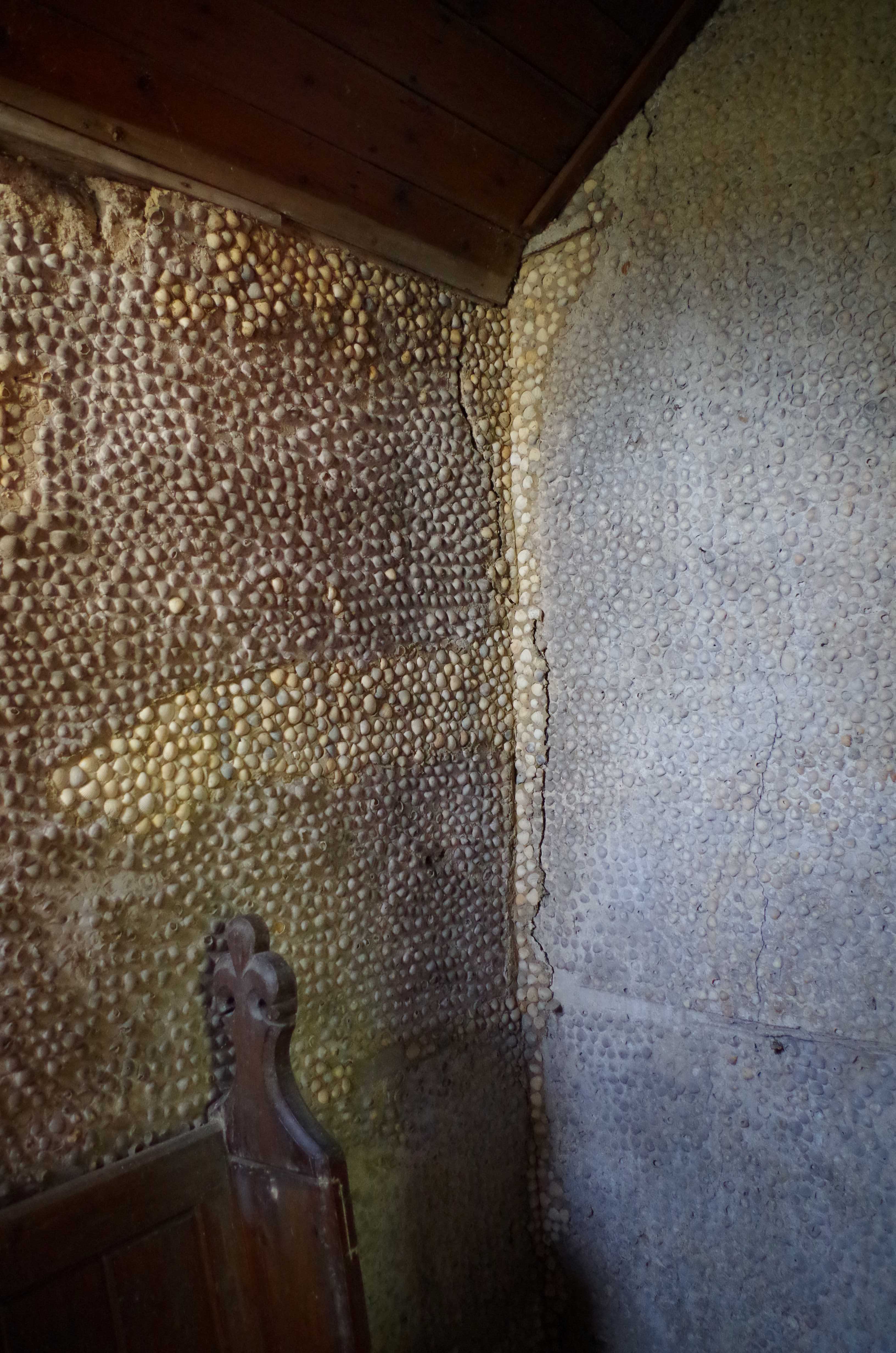
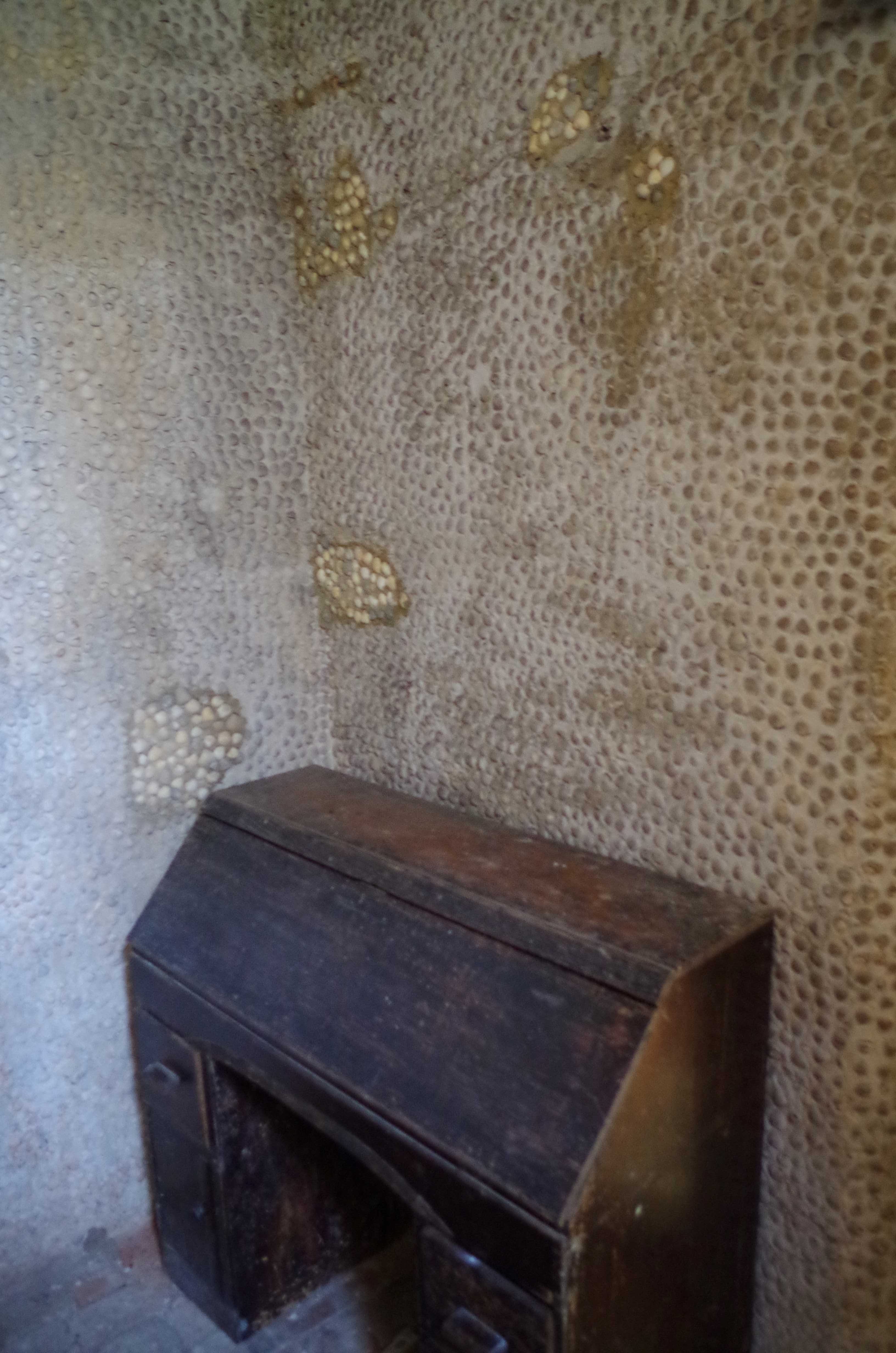
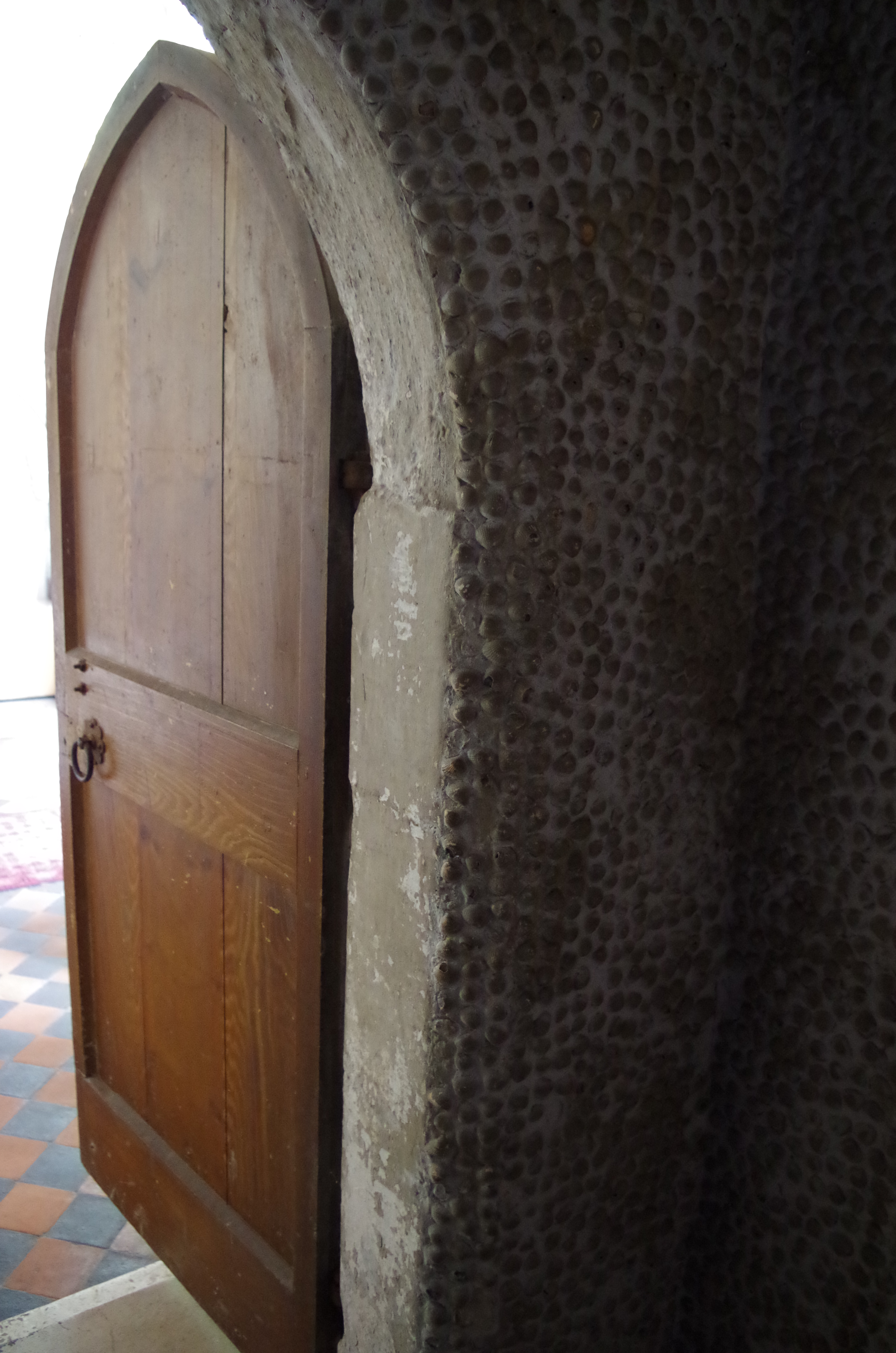
But I was at St James’s to see the cockleshell room which I’d missed on earlier visits. There wasn’t a sign advertising it but a quick look at the church map of the interior and I headed for the church organ. This time I found it! The door’s latch seemed to echo in the tranquillity as I pulled it open. The vestry is ‘compact and bijou’ as an estate agent would undoubtedly say – it is tiny and there was only a small open cobwebbed window, high up in the wall for ventilation. The room felt very warm and contained only a chair, possibly a recycled pew, and a bureau.
But it’s the thousands of cockleshells that made me catch my breath. They are floor to ceiling, arranged in patterns with newer ones being cemented in. I have to say that it did feel a little claustrophobic. The vestry dates back to the 19th century and is considered to be either a reminder or perhaps homage to the shell being the symbol of the saint, St James. Shells would be worn in pilgrims’ hats as they went on the trail to his shrine in Santiago de Compostela. Above the door, and supposed to be, are initials and a date which may be 1833 or 1838. The initials are I.M. and I.C. CWARDENS which could stand for John Murton and John Comport churchwardens. I was looking in the wrong place so didn’t spot it but perhaps on another visit…. you do need a few minutes just to take it all in and try not to touch them although it is a very tactile surface.
According to the Churches Conservation Trust, it’s considered to be
‘unique in an English church’.
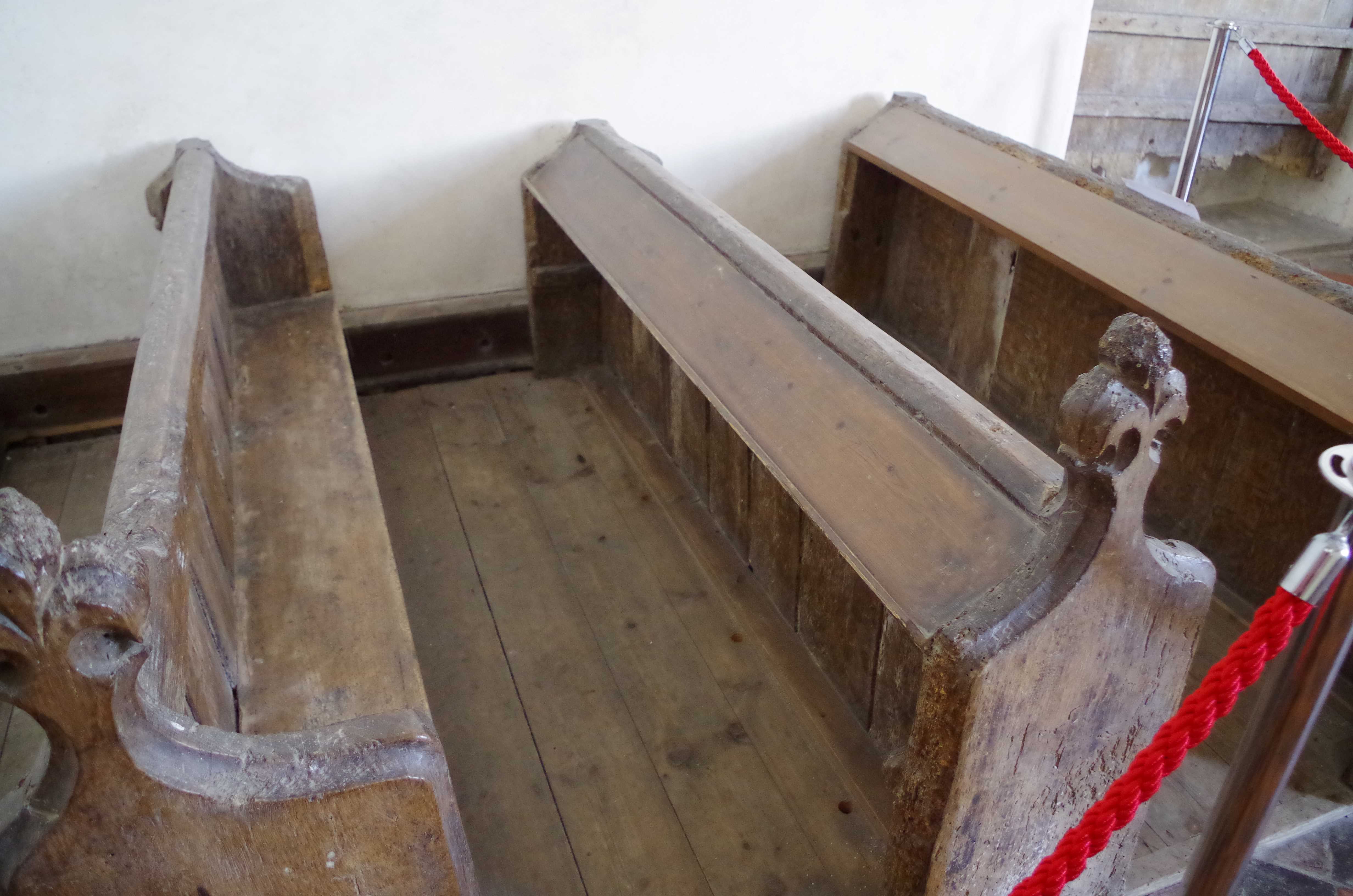
As I explored the nave after leaving the little room I saw the medieval benches that date back to the 14th century. They’ve evaded the iconoclasts of the 1600s and Victorian restoration but are now too fragile to be touched, much less sat on, and are now roped off.
The name Murton appeared again on an elegant and poignant wall memorial to a sailor, John William, eldest son of John Murton of nearby Cooling Castle. He died young, aged 28, after falling overboard from the Monarch off Rio de Janeiro during a voyage to Calcutta. The inscription on the marble tablet quotes from the ship’s captain’s log:
‘And so perished one of the finest and best hearted seamen who ever trod a ship’s deck. I have lost a trustworthy officer and valued friend. Peace be to his remains.’
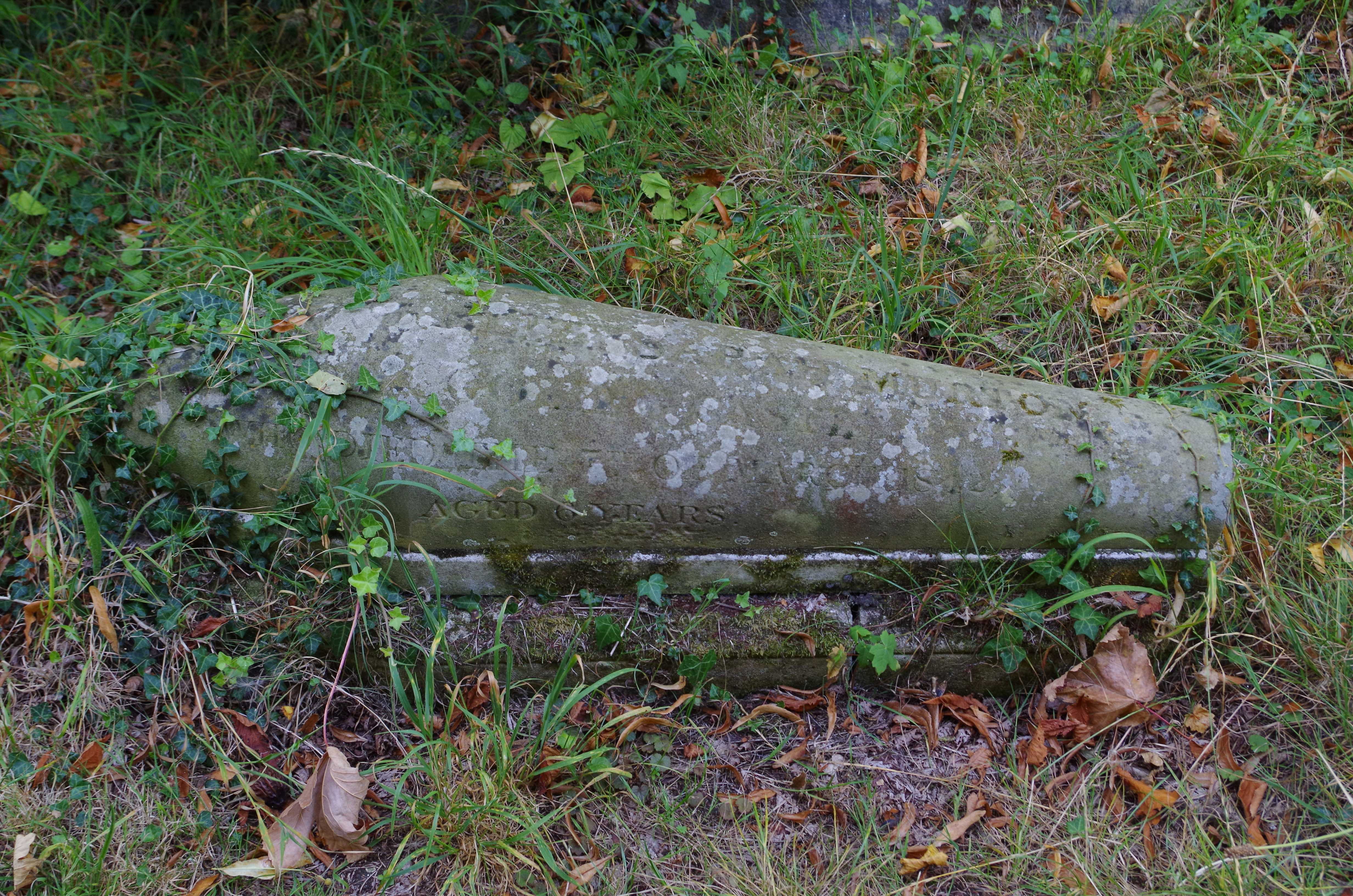
After that I went outside to see ‘Pip’s Graves’ and the table tomb on which Charles Dickens is reputed to have eaten his lunch. Across the marsh I could see docked ships and butterflies flitted about on the buddleia at one end of the churchyard. I found a clergyman’s grave denoted by a chalice and more childrens graves. One was dedicated to a six year old. I also pursued a Common Darter dragonfly until it posed obligingly and checked to see if the little grinning demon still kept watch over the outside loo. He did. I looked up as I left the churchyard and saw, glinting on the weathervane above the tower the representation of another cockleshell.
The 18th historian, Edward Hasted, described Cooling as
‘an unfrequented place, the roads of which are deep and miry, and it is as unhealthy as it is unpleasant.’
It certainly is unfrequented as I was alone as I walked along Cooling Road to and from the church with only passing cars for company. The remains of the 14th century Cooling Castle, which is in private hands, are still impressive. Dark blue sloe berries were still on several bushes and windfalls clustered beneath apple trees in a nearby orchard. I retraced my steps back to Cliffe for a wander round St Helen’s churchyard and then a very welcome cuppa in their café.
But how I envied the ‘champers’ enjoying a good night’s kip(I hope) in that little corner of Kent.

















 shadows fly away