Symbol of the Month – the Scallop Shell


Carved scallop shell on monument in Brompton Cemetery. Note Celtic cross type support for it.
©Carole TyrrellThis month’s symbol is the scallop shell and is traditionally associated with pilgrims. Since ancient times they have made the not inconsiderable journey to visit St James of Compostella’s shrine in Spain and proudly collected their scallop shell badge as evidence of their trip. But this humble mollusc has several other meanings especially in a funerary context.

However, despite it being a common shell and also an invaluable food source, I have only found it gracing 3 monuments so far.  There are several flat 2D versions on a tomb in Nunhead Cemetery and two examples within Brompton Cemetery; one is a more decorative touch and the other is this lovely 3D beauty.  So well carved and tactile – I just wanted to reach out and touch it.  But I’m keeping a look out for any other shells adorning memorials.

Shells have been with us since time immemorial and who hasn’t picked one up from a beach to take home as a souvenir?

A scallop on sand.
Shared under Wiki Creative Commons

The scallop is inextricably linked with the Christian religion and its use in funerary rites pre-dates the Egyptians.  In pre Christian times, the Celts in particular, used it as an emblem of the setting sun and note that in the above example it is placed in the centre of the supporting Celtic Cross.  The nimbus of the Cross is considered to be a sun symbol.  In Christianity baptismal fonts were often shell shaped and a shell was used to scoop water up and then pour it over the person being baptised’s head. This emphasises the shell’s association with water as it’s thrown up by the sea onto the shore.  But there is another link in that it’s seen as representing the final journey from the world of the living to that of the dead by the crossing of a body of water such as the River Styx and so is also a motif of rebirth.  This is how the early Christian church used it.

Another funerary use for the shell was being placed, often with stones and coins, on tombstones or at gravesites.  The artofmourning website says:

It has been suggested that this refers to the ancient tradition of burying the dead under a cairn of rocks as protection from scavenging animals or as a reminder of the deceased.’

But there’s also a more meditative side to the scallop as its grooves can also be seen as representing many paths leading to one point such as searching for God or a path in life.  So this ancient motif can be seen as representing a journey through life itself or indeed to St James’ shrine.

It’s also associated with fertility and, in particular, the goddess of love, Venus.  In Botticelli’s celebrated painting, ‘The Birth of Venus’, the goddess is portrayed as standing on a large scallop shell.

Sandro Botticelli The Birth of Venus shared under Wiki Creative Commons

Incidentally, it also features in Palladian architecture which flourished 1715 – 1760 which was built on the heritage from Greece and Rome.  Here the shell was used in a concave form and usually within a niche.  In this example, also from Brompton, the shell is less obvious and more of a decorative feature.

Stylised shell decoration on memorial in Brompton Cemetery.
©Carole Tyrrell

The link with St James is that scallop shells are very common in Galacia where the shrine is located.  But there are also 3 very famous myths and legends that reinforce the link.  According to the hillwalktours website:

St James, together with his brother John, one of Christs’  disciples. After Jesus’s death, James went to Iberia, which is now Galacia in the north of Spain with the intention of converting the pagans there to Christianity.  However, in roughly 44AD, after returning to Jerusalem, James was beheaded by order of King Herod.  This made him the first disciple to be martyred. James’s body was then carried by ship to Galacia where the three myths arose.

In the first, the ship carrying St James’ body was lost and destroyed in a severe storm. After an unspecified length of time, his body washed ashore completely covered in scallop shells.  In the second myth, a knight fell from a clifftop as St James’ ship passed beneath. The saint’s influence was felt as the knight emerged from the sea unharmed and covered in scallop shells.  The third and final one features a wedding in which the horse carrying the bride bolted into the ocean as St James’ ship passes by. But the bride and horse were saved as they emerged from the water covered in scallop shells.  Hence the link between St James and the shell.

Pilgrims were big business in medieval times and the scallop was a badge of honour for pilgrims to display that they had made the journey.  They often had their shells buried with them or carved on their tombs.

And so the humble scallop shell reveals itself as an important symbol with several significant meanings.   A fertility symbol, evidence of a seeker exploring many oaths towards their goal or a passenger on Charon’s boat towards eternity?  Myself, I would incline to the final river journey but I also like the idea of exploring many paths in life.   We will probably never know the actual significance of the shell to the deceased but it was important enough to be placed on their memorial to be enjoyed by any passer-by.

©Text and photos Carole Tyrrell unless otherwise stated. ©Carole Tyrrell

References and further reading:

https://artofmourning.com/2006/01/17/symbolism-meaning-objects

www.thecemeteryclub.com/symbols.html

https://www.gravestonestudies.org/knowledge-center/symbolism

www.waysidearteastanglia.me.uk/symbols.html

https://www.hillwalktours.com/…/camino-scallop-shell-symbolism

https://symbolsproject.eu

https://compostela.co/symbols/the-scallop-shell-was-the-emblem

https://en.wikipedia.org/wiki/The_Birth_of_Venus


The annual Mayday murder of Jack…..coming soon to a town near you!

Jack going to his doom at Hastings Castle, Mayday 2012
©Carole Tyrrell

There is a murderous tradition associated with Mayday or May 1st.  For on this day the Jack or Jack in the Green must be slain and his body torn apart and thrown to a waiting crowd. Of course it an also happen on May 7th if that’s the date that the Mayday bank holiday falls on.

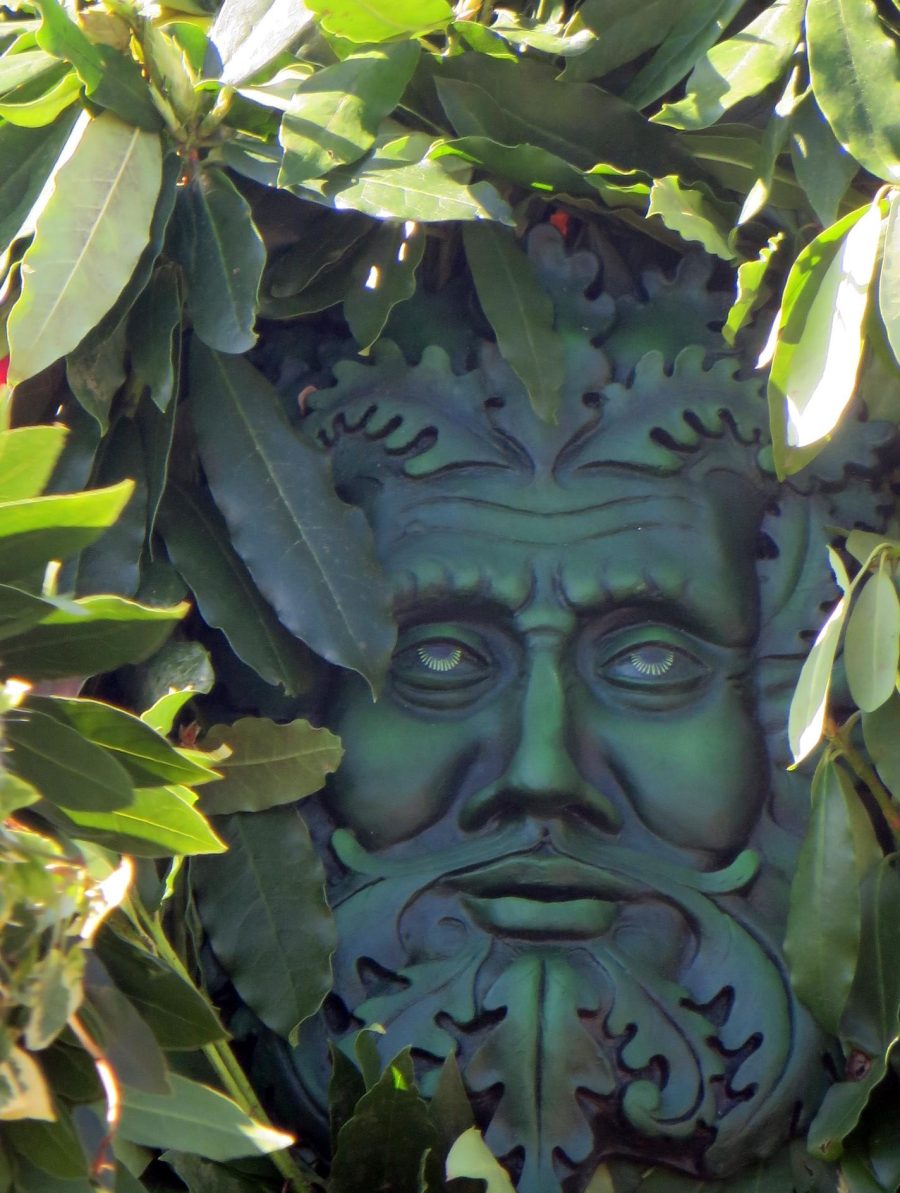
Jack’s murder marks the coming of Summer as  he is also seen as the Green Man or the embodiment of Nature.  There are also associations with Puck.  Mayday also coincides with the Celtic festival of Beltane which is a fire festival.  It burst forth with abundant fertility although Beltane is one of the names for the god of death. But there’s no blood spilt in Jack’s murder. Instead his large, tall body is formed from leaves and flowers which is why he’s known as Jack in the Green . You’ll find him being pulled apart at various locations within the UK.

According to The Living Myths Celtic Year website

‘Beltain is the origin of pagan May Day festivities such as that of the Padstow Hobby Horse, and maypole dancing, of the ‘Queen of the May’, and of ‘well dressing’ – decking holy wells with flowers, as still practised in some rural communities.’

The tradition carried on in England as, according to the Hastings Jack in the Green website:

‘In the 16th and 17th centuries in England people would make garlands of flowers and leaves for the May Day celebration, they became increasingly elaborate. Works Guilds would try to outdo each other, in the late 18th century this became a matter for competition, milkmaids in London carried garlands on their heads with silver objects on them, but the crown had to go to the chimney sweeps. Their garland was so big it covered the entire man. It became known as Jack in the Green.’

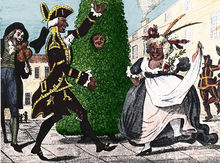
The Jack has a conical or pyramidal framework on which the greenery is entwined with a man inside to ‘walk’ it along streets and in procession.  Mayday celebrations were often rowdy, drunken affairs with the Maypole as a very obvious phallic symbol  in a festival dedicated to fertility.  It, the May Queen and the Jack are the only survivors.    I found this 17th century image of a Jack on Wikipedia.

A Jack in the Green from the 18th century – shared under Wiki Creative Commons


As you might imagine it was the Victorians who called time on Jack in the Green declaring it unruly and raucous (surely not).  They replaced the merry stumbling prance or stagger around the Maypole with a smaller one for children to skip round.  Then most of the celebrations vanished apart from the May Queen and well dressing in some regions.


But you can’t keep a good Jack down forever and in the 1980’s he was slowly brought back to life.

In 1983, the Hastings Jack in the Green was revived by Mad Jack’s Morris Men.  They take their name from Mad Jack Fuller with their symbol being that of his pyramidal mausoleum in Ditchling churchyard which is also known as the Sugarloaf.

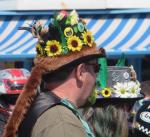
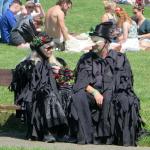
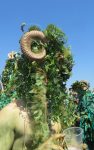
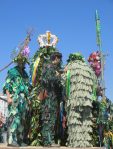
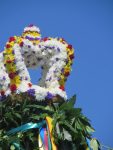
The festival is a 4 day event in the town culminating in a parade of giant figures and the releasing  of Jack before he takes centre stage in the procession along the High Street and onto West Hill.  The Jack stands in waiting on his own stage with his attendants, known as ‘bogies’ or Green Men as morris dancers and singers take to the centre stage.  Here is a selection of images from the Hastings Jack in the Green from 2012 and 2018:

Morris dancing has been around for over 600 years and there are several regional variants. He wears a beautiful crown of flowers on top. The costumes have become more ornate and decorative over the years since I first came upon the celebration by chance on a visit to Hastings in 2001.  Then it was within the grounds of Hastings Castle and I sat and listened to Maddy Prior singing as the sapphire sea below glittered under the afternoon sun. The Hastings Mayday also coincides with hundreds of bikers descending on the town but there’s not trouble as they are much more interested in buying insurance or bathrooms.


The final event is the slaying of Jack and he is walked to the stage surrounded by his entourage and spun round to the sound of massed drums. Then the ripping apart of him begins in earnest and sprigs and branches of evergreens are tossed out to the eager crowd as having a piece of Jack is meant to ensure you good luck for the coming year.

My piecee of Jack’s body.
©Carole Tyrrell


I am indebted to Sarah Hannant’s invaluable book Mummers, Maypoles and Milkmaids – a Journey through the English Ritual Year for the information on my local Jack in the Green which takes place around Deptford.  There Jack’s slaughter takes place on May 1st regardless of whether its’s a working day or not. The group are still known as Fowlers Troop and their version took place from roughly 1906 until 1924 when the police stopped it.  Again it was associated with chimney sweeps.  A local photographer of the time, Thankfull Sturdee, (now there’s a name) took photos of the 1906 Jack and his work can be found on the Fowlers Troop website and also in Lewisham Borough photos archives.

Fowlers Troop, Deptford Jack in the Green, 1900’s by Thankfull Sturdee.
Used without permission

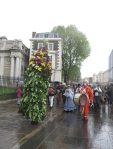
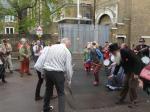
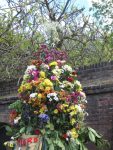
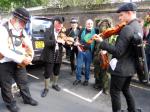
I saw it in 2017 and it followed a route through Greenwich which includes several pubs.  Outside each one there was morris dancing and singing and two old sea dogs relating various tall tales.  The Jack is very tall, roughly 3m, decorated with flowers at the top and has to have a guide to lead him forward as it must be difficult to see his way. I followed them through the wet grounds of the former Royal Naval College and enjoyed seeing the looks of amazement on car drivers and casual bystanders faces as we passed by.  Sadly, I missed the killing of Jack as I lost them at the Rose and Crown. Here is a selection of photos from the 2017 Deptford Jack – look at the size of the Jack!


A Jack in the Green is an event worth seeing as it’s always very lively and there’s a pub or two involved if that’s what you fancy. It’s a celebration of English culture, albeit slightly watered down these days, and an acknowledgement of the changing of the seasons.


So support your local Jack!

There are several Jack in the Greens in the UK:

Brentham, North Ealing, Guildford, Kuntsford, Oxford, Rochester, Whitstable, Bristol, Carshalton, Central London at Conway Hall, City of London, Highworth, Wilts, Ilfracombe, Knutsford, Oxford,,

©Text and photos Carole unless otherwise stated

 References and further reading

 Mummers, Mapypoles and Milkmaids, – A journey through the English ritual year,  Sarah Hannant,  Merrell Publishing, 2011

www.livingmyths.com/Celticyear.htm

http://www.deptford-jack.org.uk/

http://www.hastingsjitg.co.uk/

https://en.wikipedia.org/wiki/Jack_in_the_Green

https://www.tripsavvy.com/jack-in-the-green-festival-1662665

http://www.countryfile.com/may-day-guide-history-traditions-events