Symbol of the Month – The Boat

The first Symbol of the Month of 2020 – a little later than I planned but more to come….
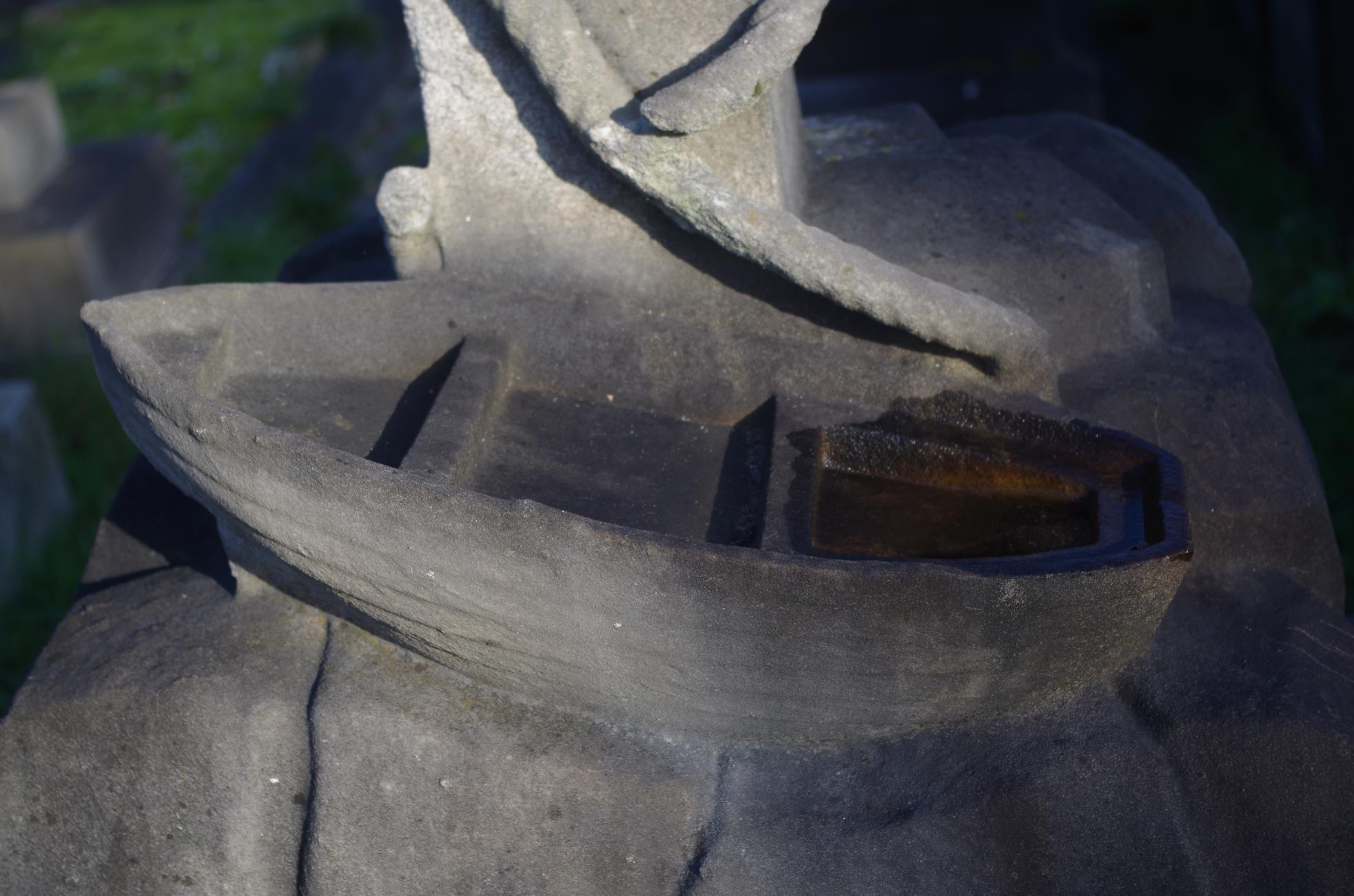
Close-up of boat, Caig monument Brompton Cemetery
Side view of boat

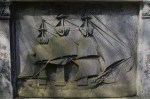
There are many sailing vessels in cemeteries. Ships, boats and the occasional yacht, becalmed on headstones or monuments forever sailing on a marble or granite sea.  Often they reveal the incumbent’s former occupation as on this fine example on the grave of Captain Edward Parry Nisbet in Brompton Cemetery.  Note the cross formed by the mast which is one of the central symbols of Christianity. There’s also the magnificent and exuberant monument to Captain Wimble  and his indomitable wife on the appropriately named Ship Path in West Norwood Cemetery.
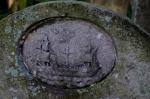
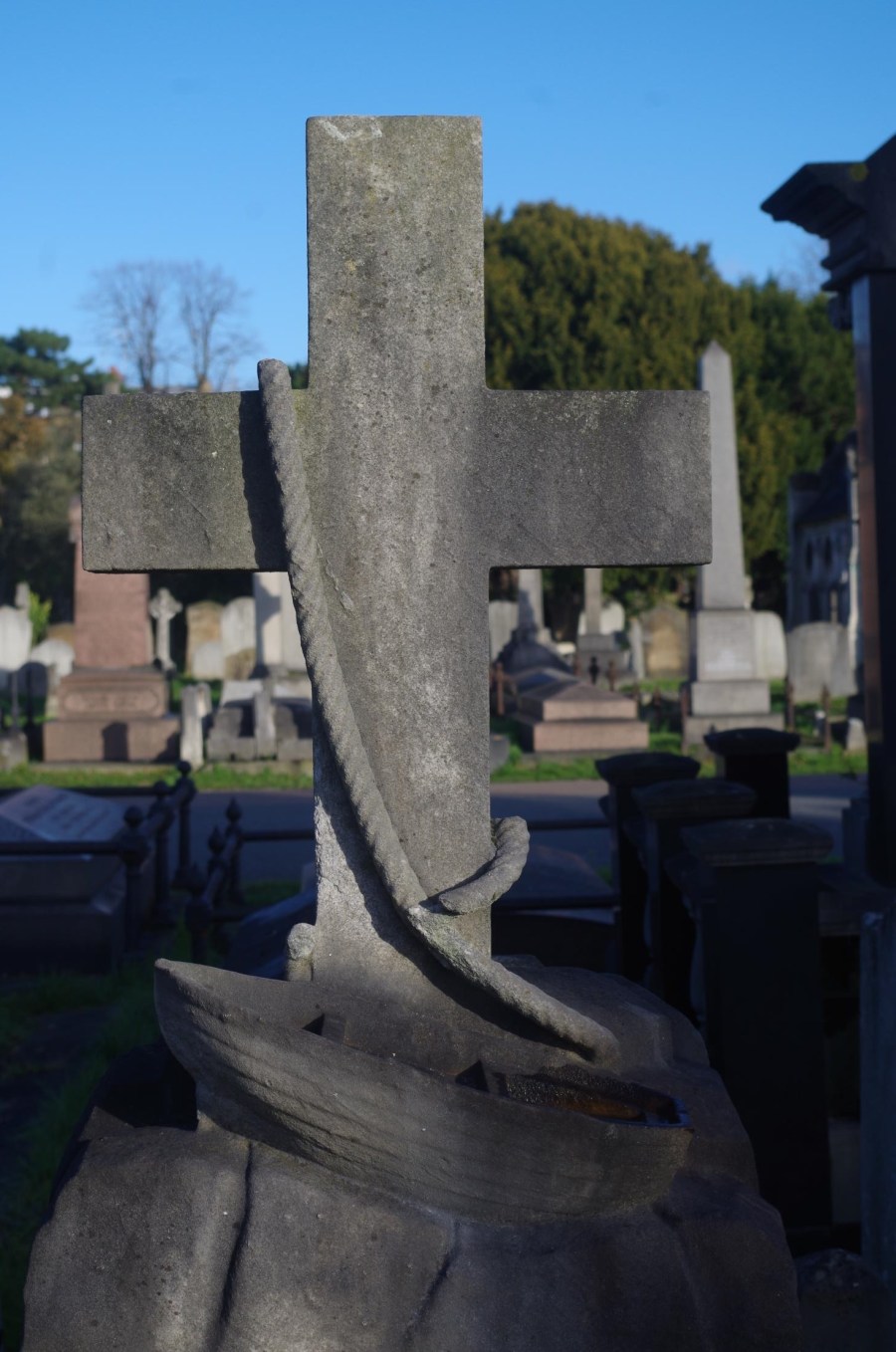
But this little boat tied up and apparently moored at the base of a large cross is symbolic of a journey that has reached its final destination.
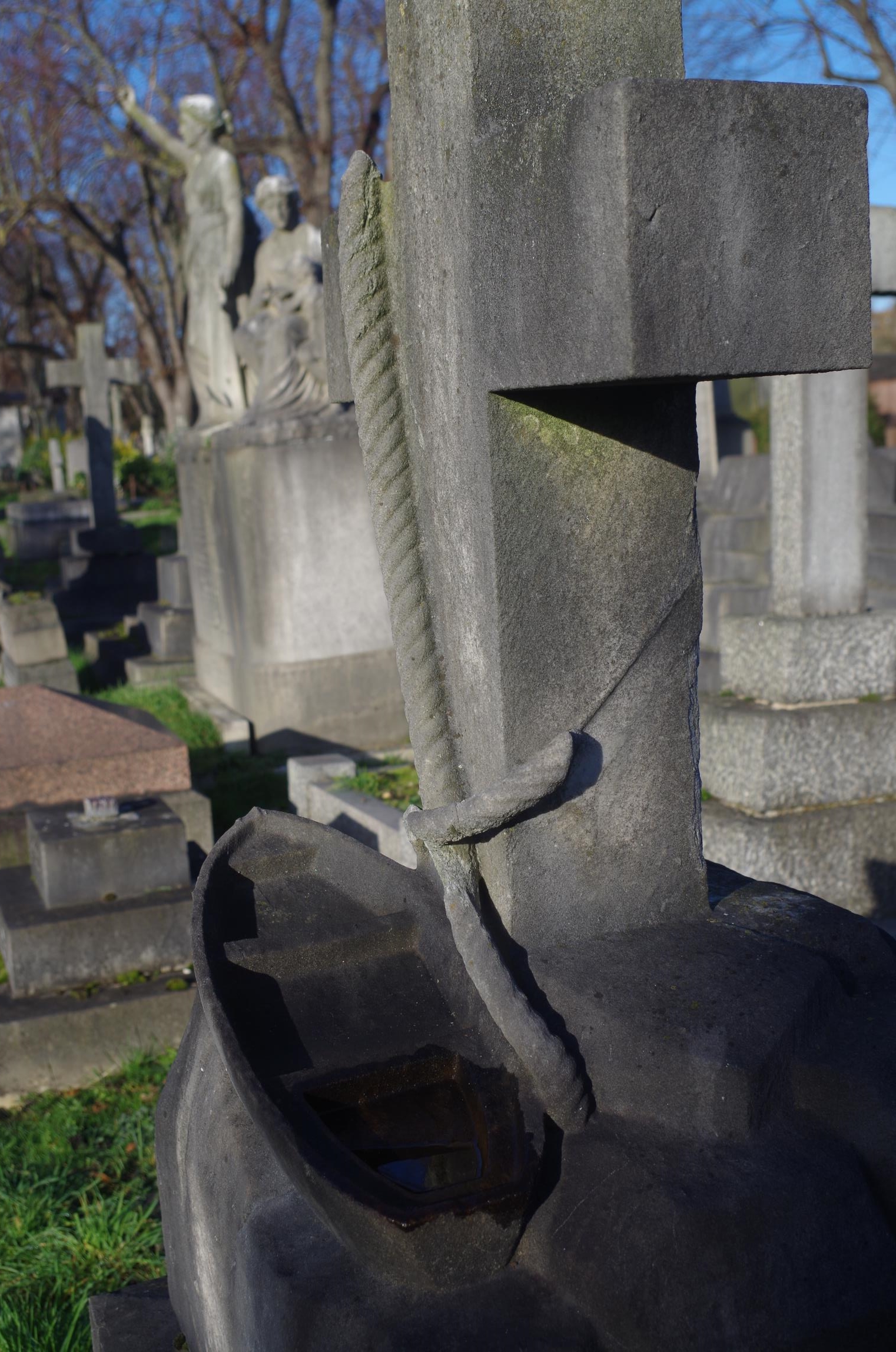
Side Side view of boatview of boat showing detail as it’s been carved to resemble a wooden boat.

The monument is located within Brompton Cemetery and is a representation of the journey of life.  This is a small sculpture of a rowing boat that has been carved to resemble a wooden one and there are seats inside but no oars. It could be interpreted as coming to the end of your life or journey and entering another life of eternity symbolised by the cross.  In other words, the crossing to the ‘other world’ as Douglas Keister calls it.   Also as www.stoneletters says:

‘…it’s a symbol of our last journey, it embodies the voyage of life, of coming full circle and taking us back to the waters of our beginning.’

However a boat can also be seen as an emblem of safety and refuge as it carries us over life’s often choppy seas and takes us home.  In this context, another boat that springs to mind is Noah’s Ark.  It protected and saved all that were on it and was a metaphor for the church as it weathered the storm against all odds.  However, Keister also suggests that the shape of a boat can resemble that of a cradle or a womb which would again emphasise shelter and protection. It holds us secure above the chaos of life.

Boats and death are a central theme in many other religions and cultures in that they carry the souls of the dead to eternity.  For example, King Arthur was transported by boat on death and, most famously, the Vikings people also used funerary boats. This was granted to important people of the tribe as they and their possessions would be sent out across the water in one after it had been set ablaze.  A symbolic mimicking of the soul’s journey to Valhalla.  Also in Greek mythology, Charon was the ferryman who took the souls of the dead by boat into the Underworld by crossing the River of Woe, Acheron.

But boats and death also feature in literature, especially poetry and there is the famous quotation by F Scott Fitzgerald:

‘So we beat on, boats against the current, borne back ceaselessly into the past.’ 

‘Crossing the Bar’ by  Alfred Lord Tennyson also features a sea voyage which will end in death,

Sunset and evening star,
And one clear call for me!
And may there be no moaning of the bar,
When I put out to sea,

But such a tide as moving seems asleep,
Too full for sound and foam,
When that which drew from out the boundless deep
Turns again home.

Twilight and evening bell,
And after that the dark!
And may there be no sadness of farewell,
When I embark;

For tho’ from out our bourne of Time and Place
The flood may bear me far,
I hope to see my Pilot face to face
When I have crost the bar.

There is also The Ship of Death by D H Lawrence amongst others.

I said earlier that a boat or ship is an important Christian symbol due to the mast forming a cross. Also, the Latin for ‘nave’ ,the central aisle of a church,  means ‘ship’ and there are several Biblical references to boats and ships.  After all, Christ told his disciples to “follow me and I will make you fishers of men”.

But let’s not forget that a boat or ship can also indicate a love of sailing and freedom.
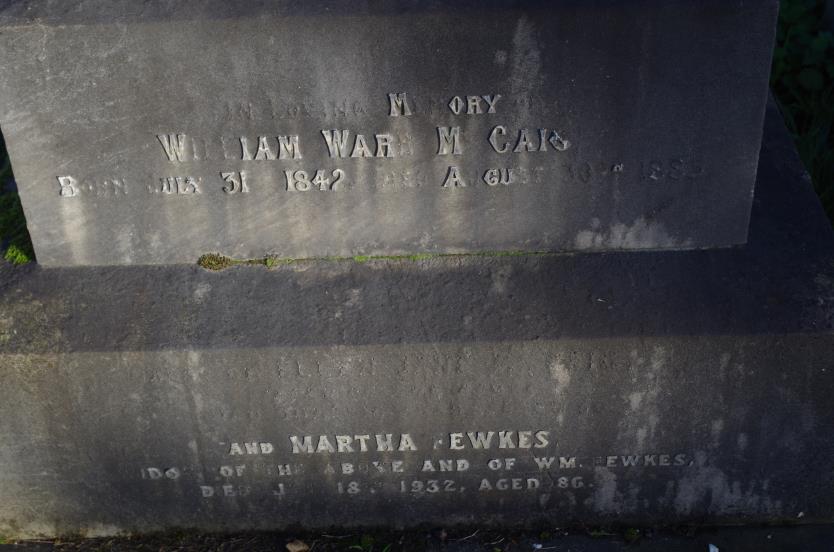
The epitaph beneath the boat – some of the letters are missing .
©Carole Tyrrell

Some of the letters on the epitaph beneath the boat and cross have worn away so I can only assume tha the name commemorated is Walter Ward M Cais but it seems incomplete. He died young at only 43 and his widow, Martha, married again and lived well into the 20th century. It must have been a message of comfort that Walter’s small boat was moored safely for eternity.

Full view of the boat and cross, Caig monument, Brompton Cemetery
©Carole Tyrrell


© Text and photos Carole Tyrrell unless otherwise stated

References:

Stories in Stone, Douglas Keister, Gibbs Smith, 2004

https://stoneletters.com/blog/headstone-symbols-the-boat

https://allaboutheaven.org/symbols/boat/123

http://www.historyofpainters.com/boat_symbolism.htm

http://imagesinthemind.blogspot.com/2008/08/boat-symbol.html


Symbol of the Month – the Scallop Shell


Carved scallop shell on monument in Brompton Cemetery. Note Celtic cross type support for it.
©Carole TyrrellThis month’s symbol is the scallop shell and is traditionally associated with pilgrims. Since ancient times they have made the not inconsiderable journey to visit St James of Compostella’s shrine in Spain and proudly collected their scallop shell badge as evidence of their trip. But this humble mollusc has several other meanings especially in a funerary context.

However, despite it being a common shell and also an invaluable food source, I have only found it gracing 3 monuments so far.  There are several flat 2D versions on a tomb in Nunhead Cemetery and two examples within Brompton Cemetery; one is a more decorative touch and the other is this lovely 3D beauty.  So well carved and tactile – I just wanted to reach out and touch it.  But I’m keeping a look out for any other shells adorning memorials.

Shells have been with us since time immemorial and who hasn’t picked one up from a beach to take home as a souvenir?

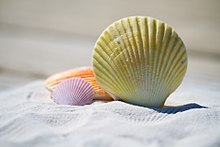
A scallop on sand.
Shared under Wiki Creative Commons

The scallop is inextricably linked with the Christian religion and its use in funerary rites pre-dates the Egyptians.  In pre Christian times, the Celts in particular, used it as an emblem of the setting sun and note that in the above example it is placed in the centre of the supporting Celtic Cross.  The nimbus of the Cross is considered to be a sun symbol.  In Christianity baptismal fonts were often shell shaped and a shell was used to scoop water up and then pour it over the person being baptised’s head. This emphasises the shell’s association with water as it’s thrown up by the sea onto the shore.  But there is another link in that it’s seen as representing the final journey from the world of the living to that of the dead by the crossing of a body of water such as the River Styx and so is also a motif of rebirth.  This is how the early Christian church used it.

Another funerary use for the shell was being placed, often with stones and coins, on tombstones or at gravesites.  The artofmourning website says:

It has been suggested that this refers to the ancient tradition of burying the dead under a cairn of rocks as protection from scavenging animals or as a reminder of the deceased.’

But there’s also a more meditative side to the scallop as its grooves can also be seen as representing many paths leading to one point such as searching for God or a path in life.  So this ancient motif can be seen as representing a journey through life itself or indeed to St James’ shrine.

It’s also associated with fertility and, in particular, the goddess of love, Venus.  In Botticelli’s celebrated painting, ‘The Birth of Venus’, the goddess is portrayed as standing on a large scallop shell.

Sandro Botticelli The Birth of Venus shared under Wiki Creative Commons

Incidentally, it also features in Palladian architecture which flourished 1715 – 1760 which was built on the heritage from Greece and Rome.  Here the shell was used in a concave form and usually within a niche.  In this example, also from Brompton, the shell is less obvious and more of a decorative feature.

Stylised shell decoration on memorial in Brompton Cemetery.
©Carole Tyrrell

The link with St James is that scallop shells are very common in Galacia where the shrine is located.  But there are also 3 very famous myths and legends that reinforce the link.  According to the hillwalktours website:

St James, together with his brother John, one of Christs’  disciples. After Jesus’s death, James went to Iberia, which is now Galacia in the north of Spain with the intention of converting the pagans there to Christianity.  However, in roughly 44AD, after returning to Jerusalem, James was beheaded by order of King Herod.  This made him the first disciple to be martyred. James’s body was then carried by ship to Galacia where the three myths arose.

In the first, the ship carrying St James’ body was lost and destroyed in a severe storm. After an unspecified length of time, his body washed ashore completely covered in scallop shells.  In the second myth, a knight fell from a clifftop as St James’ ship passed beneath. The saint’s influence was felt as the knight emerged from the sea unharmed and covered in scallop shells.  The third and final one features a wedding in which the horse carrying the bride bolted into the ocean as St James’ ship passes by. But the bride and horse were saved as they emerged from the water covered in scallop shells.  Hence the link between St James and the shell.

Pilgrims were big business in medieval times and the scallop was a badge of honour for pilgrims to display that they had made the journey.  They often had their shells buried with them or carved on their tombs.

And so the humble scallop shell reveals itself as an important symbol with several significant meanings.   A fertility symbol, evidence of a seeker exploring many oaths towards their goal or a passenger on Charon’s boat towards eternity?  Myself, I would incline to the final river journey but I also like the idea of exploring many paths in life.   We will probably never know the actual significance of the shell to the deceased but it was important enough to be placed on their memorial to be enjoyed by any passer-by.

©Text and photos Carole Tyrrell unless otherwise stated. ©Carole Tyrrell

References and further reading:

https://artofmourning.com/2006/01/17/symbolism-meaning-objects

www.thecemeteryclub.com/symbols.html

https://www.gravestonestudies.org/knowledge-center/symbolism

www.waysidearteastanglia.me.uk/symbols.html

https://www.hillwalktours.com/…/camino-scallop-shell-symbolism

https://symbolsproject.eu

https://compostela.co/symbols/the-scallop-shell-was-the-emblem

https://en.wikipedia.org/wiki/The_Birth_of_Venus