

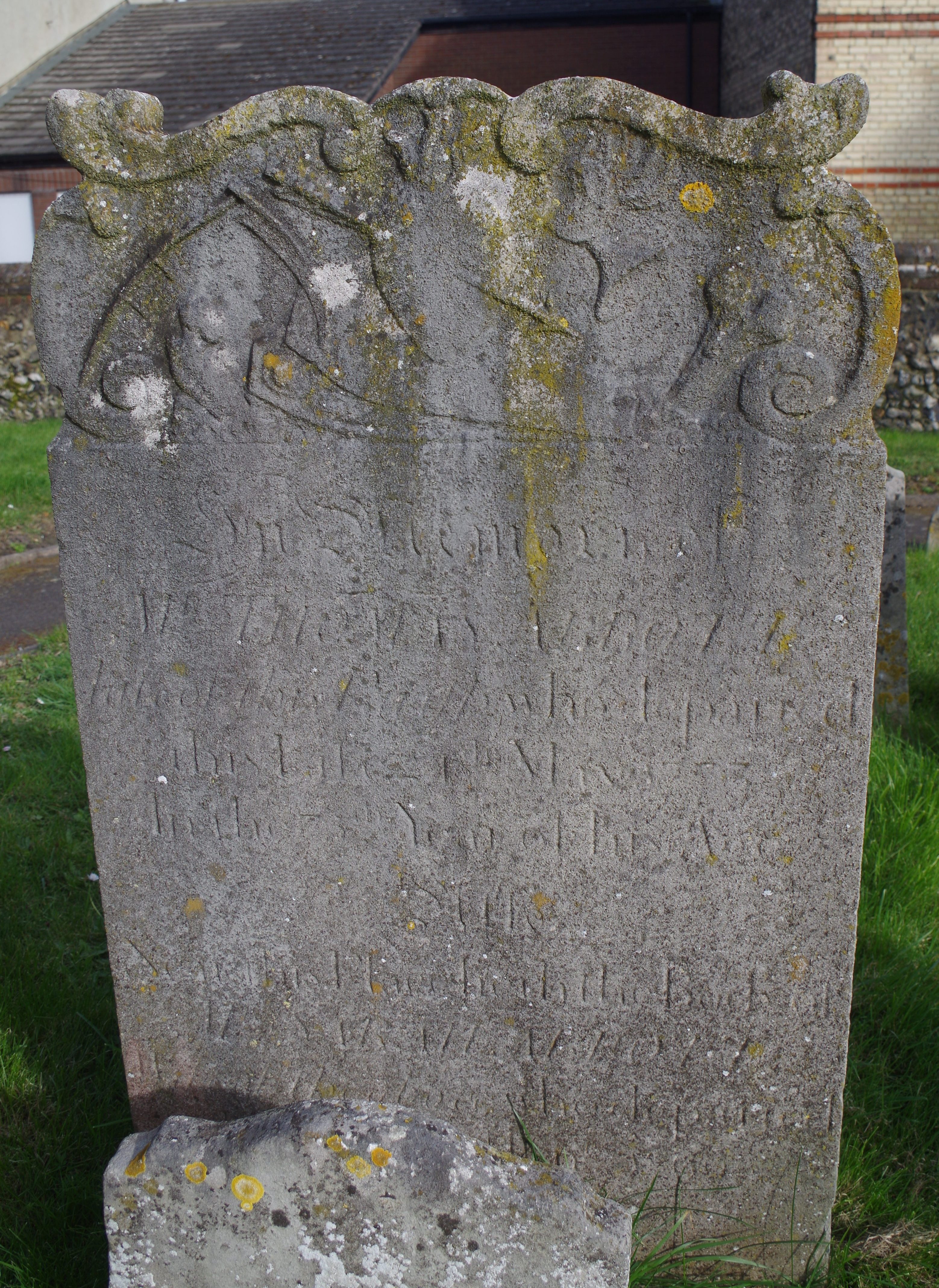
The distinctive ‘candlesnuffer’ steeple of St Mary’s church in St Mary Cray has long beckoned to me and I thought that it was time I paid a visit. I didn’t expect to find much and my first impression confirmed it. A few ivy clad altar tombs greeted me and then I wandered around the side of the closed church. What a surprise! A gallery of 18th century headstones placed in lines with some of the more familiar symbols depicted on them. Ouroboros’s, angel heads, skulls, crossbones and then the fine selection in the above photo.
As you can see, it boasts a large, sharp scythe, a half open coffin with the incumbent visible, a trumpet blowing from what seems to be a heavenly cloud and, in the centre, a heart pierced by an arrow. We usually associate a pierced heart with the ones found on millions of St Valentine’s cards as a representation of Cupid’s love darts. You may be thinking that it doesn’t have the usual heart shape but there may be how the stonemason interpreted it. This is the Symbol of the Month – the Pierced Heart
The headstone‘s epitaph reads:
‘In Memory of
Mr THOMAS ABBOTT
Late of this PARISH who departed this life
24 May 1773
In the 75th Year of his life
Also
Near lieth the body of
MRS SARAH ABBOTT his wife
,,,,who departed ….22 January 1769 aged 69’
Although there are other Abbotts buried in the same churchyard I couldn’t find any sign of a headstone or monument dedicated to Sarah Abbott and there was none recorded on the Kent Archaeological Society survey of the churchyard So whether it has vanished over time we will never know.
©Carole Tyrrell
On Thomas’s headstone, the heart is surrounded by symbols of resurrection and the Day of Judgement when all of the dead will rise. This is the meaning of the half open coffin lid. So is the pierced heart a symbol of everlasting love which means that the Abbotts will be reunited on that day? After all, Keister suggests that it’s a sign of matrimony which would fit in with both husband and wife being mentioned on the headstone. However, Cooper comments that the pierced heart is also a sign of contrition so perhaps Mr Abbott felt guilty or sad about outliving Sarah by 6 years.
But let’s discuss other representations and interpretations of the pierced heart as well as the heart in general. It’s one of the most powerful symbols and resonates through many cultures and faiths both ancient and modern. Without it, none of us would be alive as it pumps our lifeblood through our bodies. This is why it has been a central part of religions and cultures since the beginning of time.
Heart symbolism is significant in, Chinese, Hindu and most religions and cultures. For example, it is one of the eight precious organs of Buddha and also the Aztecs whose rituals involved human sacrifice. In these the chests of the victims were sliced open and their still-beating hearts were offered to the gods. The Aztecs believed that the heart was the seat of the individual and also a fragment of the Sun’s heart.

Shared under Wiki Creative Commons
In Ancient Egypt, the heart was considered to be the source of human wisdom and the centre of emotions and memory. It could reveal a person’s true character, even after death, and was left in the body after mummification. The ancient Egyptians believed that it would survive death where it would give evidence against or for its owner and so was integral to the afterlife. This culminated in the Weighing of the Heart which appears in the Book of the Dead. The heart was given to Osiris, the god of the dead and the underworld who placed it on one of a pair of great golden scales. On the other was a feather which represented Maat the goddess of order, truth and what was right. If the heart was lighter than the feather then the deceased passed on into eternal bliss. But if it was heavier, due to past misdeeds, then it was thrown onto the floor of the Hall of Truth where Amut, a god with the face of a crocodile, the front of a leopard and the back of a rhinoceros who was also known as ‘The Gobbler’. Once he had devoured the heart then the individual ceased to exist. The Egyptians concept of hell was non-existence.
But the heart has an even greater significance in the Judaeo-Christian tradition. There are many references to it in the Bible with over a hundred in Psalms alone. One of the most famous quotations is in 1 Samuel 16.7 in which it is seen as the seat of emotion:
‘But the Lord said unto Samuel, Look not on his countenance, or on the height of his stature; because I have refused him: for the Lord seeth not as man seeth; for man looketh on the outward appearance, but the Lord looketh on the heart.’ (King James Bible).
The heart is seen as revealing the inner person but not only as the centre of human life. It also expresses spiritual or emotional feelings, wisdom, piety and righteousness. There is also the famous quote from Matthew 5:8;
‘blessed are the pure in heart’
However, the heart also has a darker side as an evil person is often described as being ‘blackhearted.’ In Ecclesiastes 8:11 it’s seen as evil:
‘ Because sentence against an evil work is not executed speedily, therefore the heart of the sons of men is fully set in them to do evil.’ (King James Bible).
In Christian iconography the heart took on a symbolic role as an indication of God and piety particularly in the Catholic church where Christ displaying a heart in his hands or on his breast is a key image. It’s known as the Sacred Heart and is one of the most practiced and well known of the Catholic devotions. The sacred heart is seen as a symbol of ‘God’s boundless and passionate love for mankind.’ The pierced heart was also included in the five wounds that Christ suffered during the crucifixion.


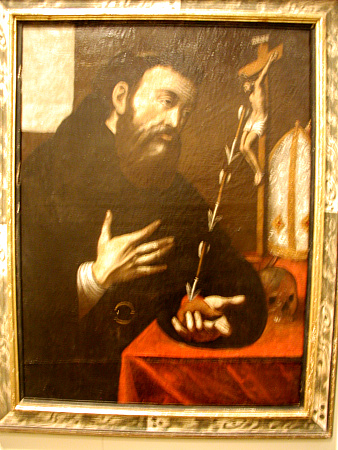
One saint in particular, St Augustine, seen above has a special relationship with the pierced heart. He is often shown holding a heart, in some cases topped by a flame and in others pierced by an arrow. Another passage from the Confessions IX, 2:3 may explain the significance of the pierced heart:
‘Thou hadst pierced (sagittaveras) our heart with thy love, and we carried thy words, as it were, thrust through our vitals.’
(The word sagittaveras means literally ‘ shot arrows’ into as in this 17th century painting.
St Valentine’s Day was originally derived from a much darker and bawdier Roman festival called Lupercalia. This took place in Rome from 13-15 February and was intended to avert evil spirits and purify the city. However, it didn’t involve the giving of chocolates and bouquets of roses. Instead there was animal sacrifice, random matchmaking and couplings which were intended to ward off infertility. In reality, it was a fertility festival dedicated to Faunus, the Roman god of agriculture and also to the founders of Rome, Romulus and Remus. It was finally outlawed as ‘unChristian’ in the 5th century by Pope Gelasius who declared the 14 February to be St Valentine’s Day. There were two actual St Valentines who were both martyrs.
However, the first person to mention the famous day for lovers was actually Geoffrey Chaucer in his 1375 poem, ‘A Parliament of Fowles (or Fowls)’. In this he says:
‘For this was sent on Seynt Valentyn’es day
When every fowl cometh here to choose his mate.’
During the Middle Ages it was believed in both France and England that February 14 was the beginning of the mating season for birds and so an ideal date for romance for all.
However, the heart also has a darker side as an evil person is often described as being ‘blackhearted.’ In Ecclesiastes 8:11 it’s seen as evil:
‘ Because sentence against an evil work is not executed speedily, therefore the heart of the sons of men is fully set in them to do evil.’ (King James Bible).
But it was during the early medieval and early Renaissance when the heart began to resemble the more stylised symbol that we know today. It took on the shape of a converted A and represented Amor or Love. Since the 19th century it has been associated with love and romance and the pierced heart has also been known as the wounded heart due to Cupid’s arrows.
But, due to its placing within other potent symbols of resurrection, I interpret the pierced heart on Mr Abbott’s headstone to be a token of love. Although he wasn’t buried with his wife he may have hoped that they would be reunited on the Day of Judgement when the angels trumpets sounded and the dead met the living again.
It was one of the most potent symbols that I have found in my explorations and I haven’t seen another one – yet. The pierced heart has also been one of the most fascinating symbols to research because of its many connotations and associations. Who would have thought that Chaucer might be the father of the St Valentine’s Day industry that we know so well today.
Was the pierced heart a token of love or a hope of a meeting in the after-life? We will never know but a fascinating collection of symbols for the passer-by to admire.
©Text and photos Carole Tyrrell unless otherwise stated.
References and further reading:
Stories in Stone, Douglas Keister, Gibbs Smith 2004
An illustrated Encyclopedia of Traditional Symbols, J C Cooper, Thames & Hudson, 1979
http://www.thecemeteryclub.com/symbols.html
https://www.kentarchaeology.org.uk/research/monumental-inscriptions/st-mary-cray
https://www.midwestaugustinians.org/the-augustinian-emblem
https://en.wikipedia.org/wiki/Sacred_Heart


 shadows fly away