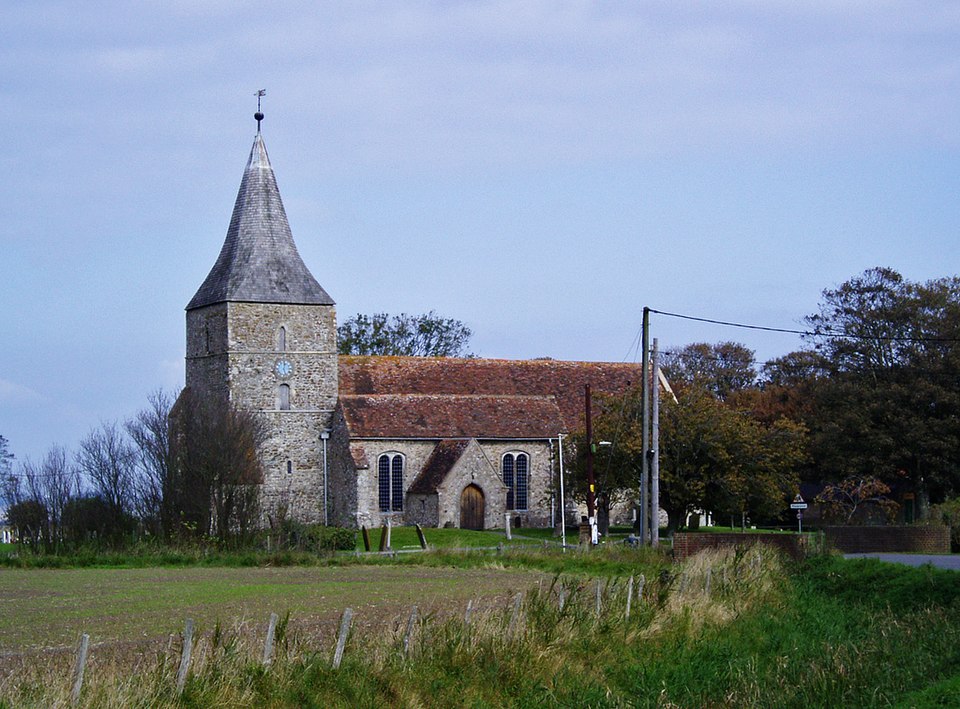
Edith Nesbit is buried in the churchyard of St Mary in the Marsh which was our next church. We left Brenzett and its attractive cats to travel through the wonderful Kent countryside. Blossom foamed over the hedgerows and the fields and marshes seemed to stretch on forever. There was a sense that Nature was beginning to stretch herself and come back to life after the winter.
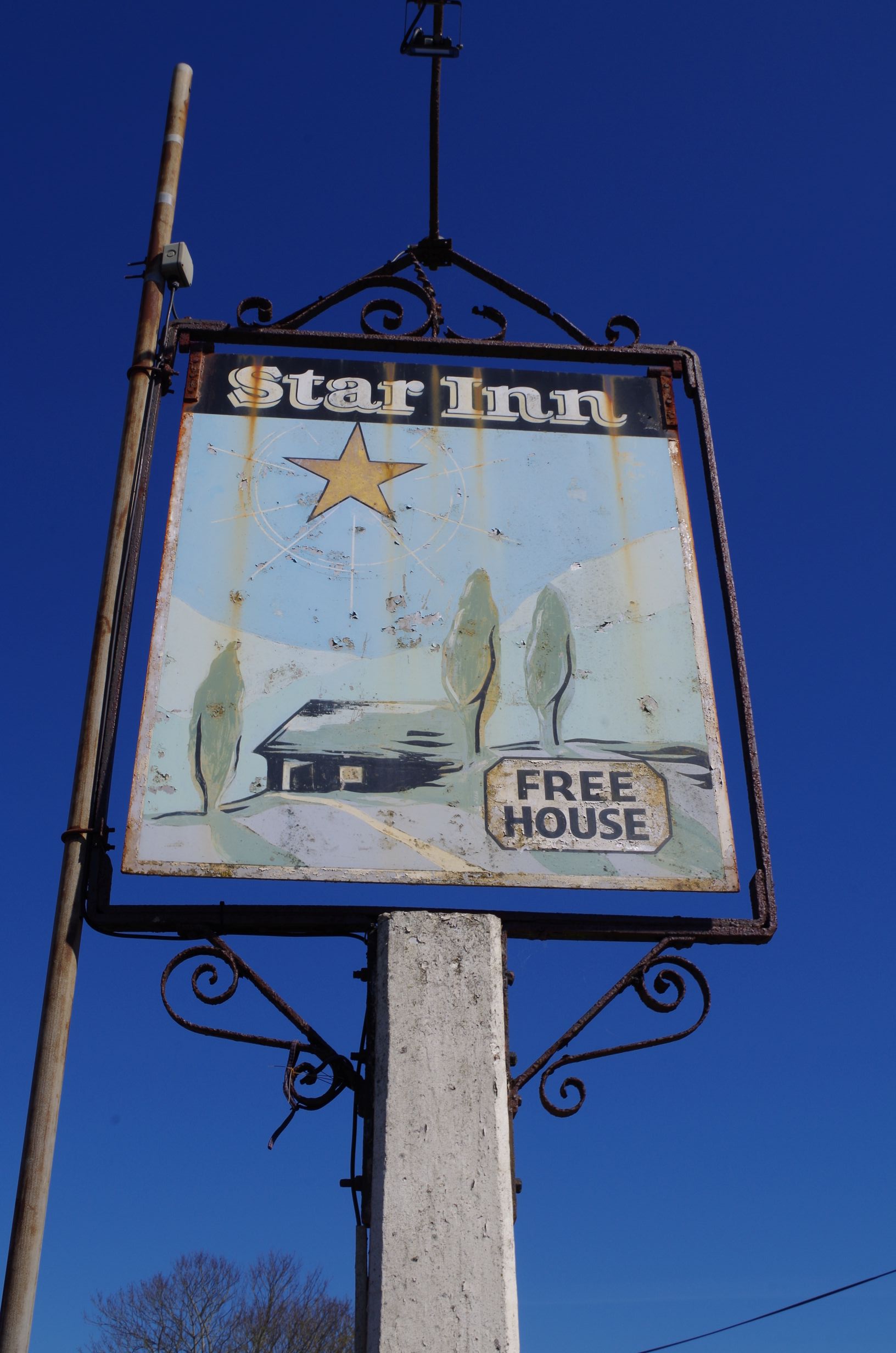
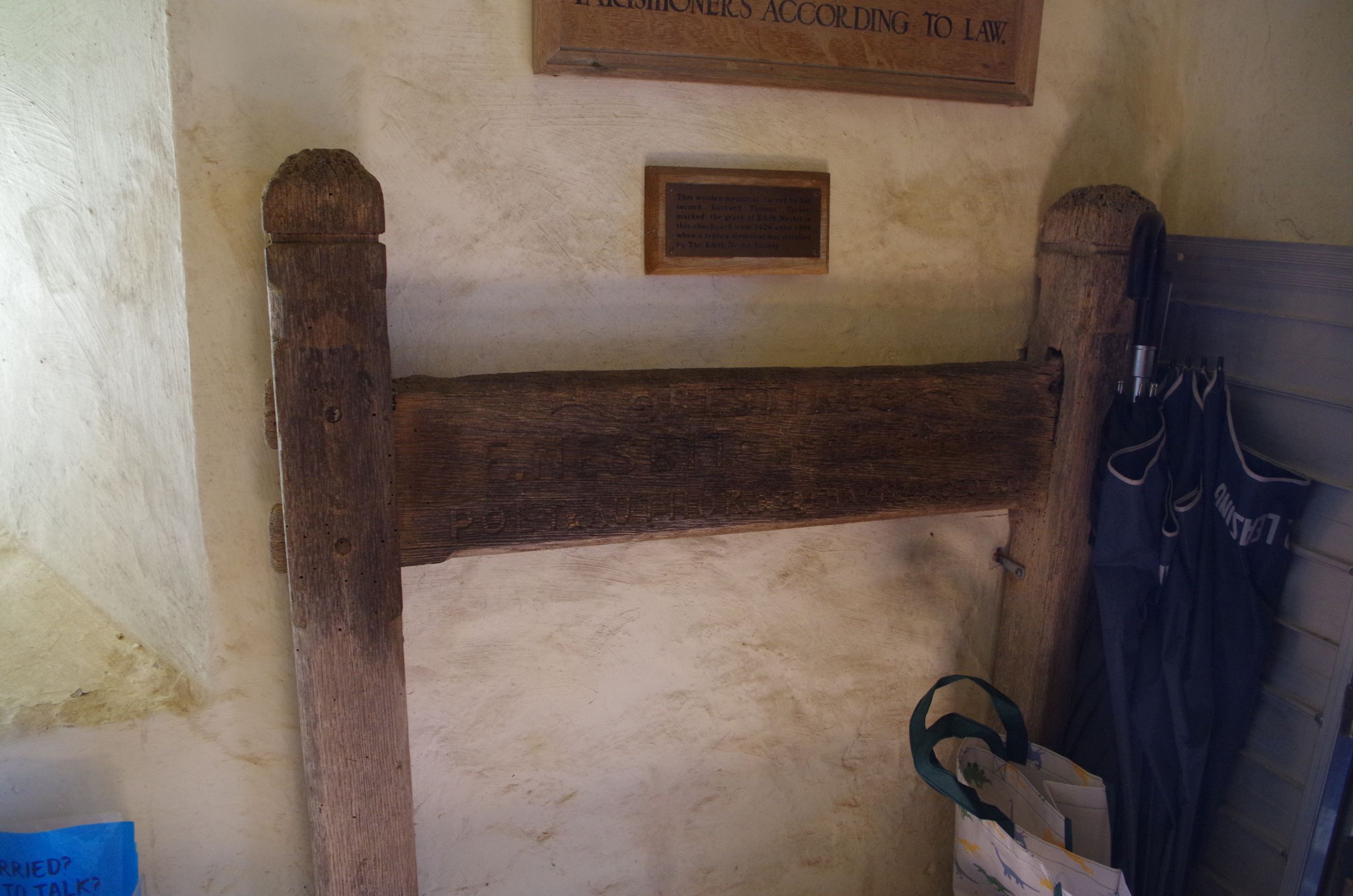
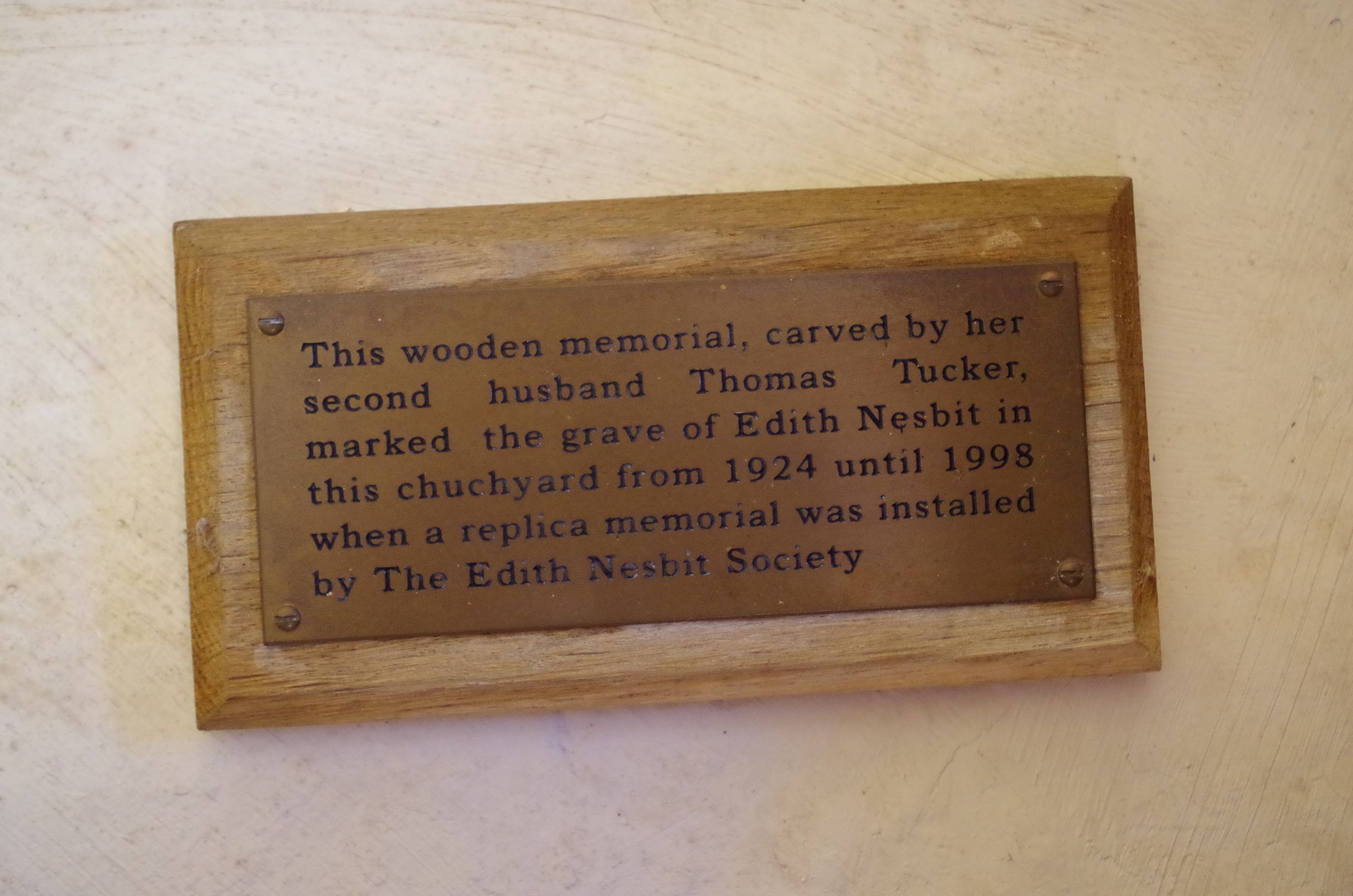
St Mary in the Marsh was a more substantial church and we were greeted by the Star Inn which ‘would have been Edith’s local’ but is now a private house. It’s a large, rambling building and was opposite the church. We soon found her last resting place in front of St Mary’s lying under the morning sun and with a simple wooden rail as a marker. It was Tommy, her second husband, who erected the first wooden rail commemorating Edith. This has suffered over the years and is now inside the church porch with a small plaque. The one in the churchyard today is a replacement put up by the E Nesbit Society.
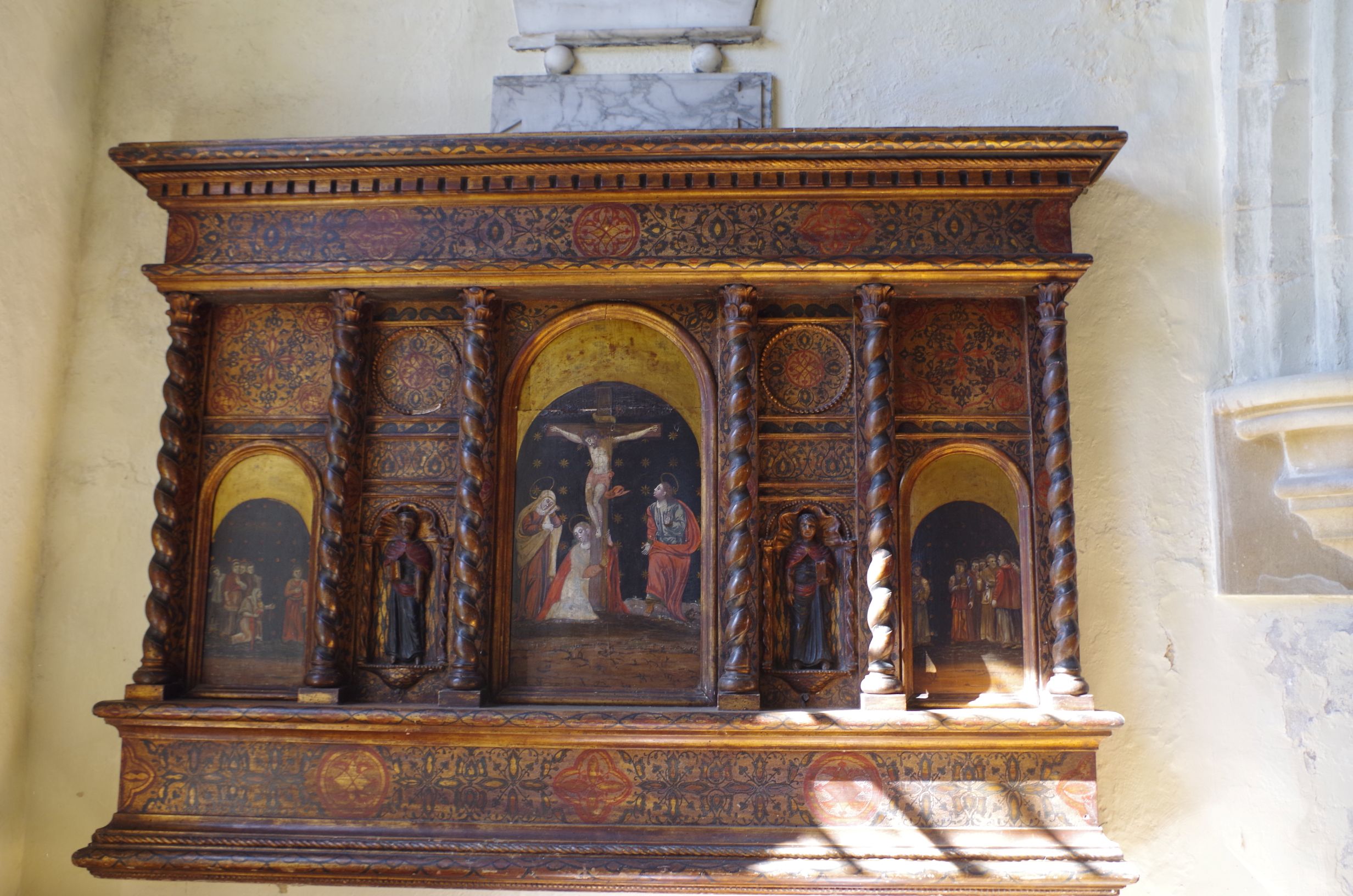
St Mary’s was less plain inside than St Eanswith although there were still box pews and whitewashed walls. There was a magnificent triptych on one wall and another little plaque inside the nave dedicated to Edith. Three pairs of eyes were watching us as we explored. There were two small heads attached to two pillars of a sedilia by the altar and another, larger one at the base of a column.
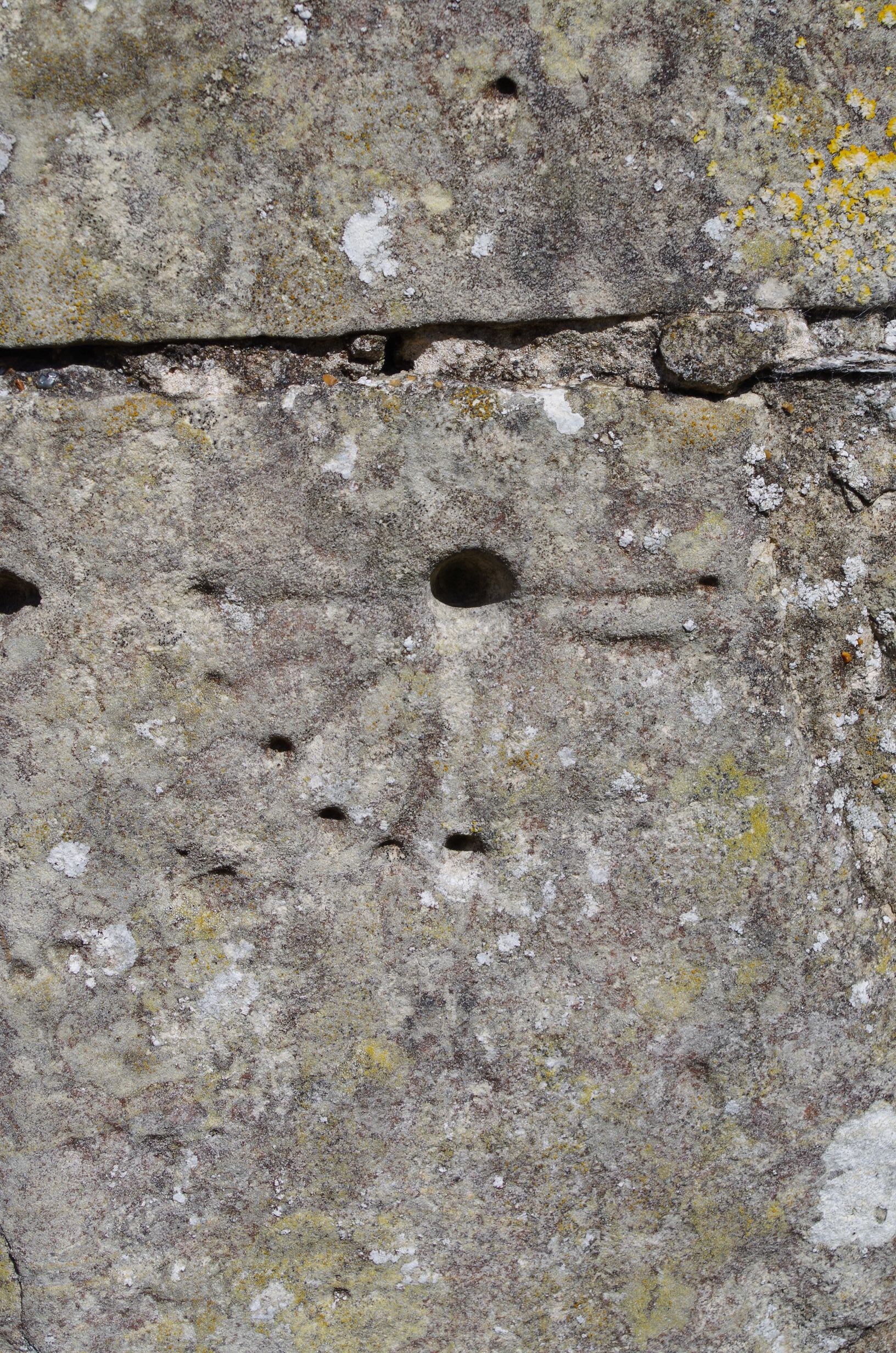
Outside early bluebells nodded in the breeze and we found a medieval mass dial set into a wall. (please see Symbol of the Month – The Mass Dial published 18/10/21)
Afterwards we went on to explore churches and other places associated with Russell Thorndike and his famous creation whose exploits took place on the Marshes, Dr Syn.
Our final port of call was St Mary’s Bay in Dymchurch where we saw the house known as ‘The Jolly Boat’ which was E Nesbit’s final home which she are with Tommy. It is now a holiday home and is situated at the end of Nesbit Road appropriately enough. As we admired it, we were lucky enough to see a steam train from the Romney and Hythe railway come puffing past as it steamed into the station nearby. In the town one of our party had spotted a blue plaque on a house called ‘The Cottage’ which commemorated its famous residents: the painter Paul Nash, Noel Coward and Edith all stayed there. We did wonder if it had been at the same time and one of our party commented that ‘it must have been quite a party!’
E Nesbit had a fascinating life with her strong Socialist views and published over 60 books, some of which are still in print today. The film version of ‘The Railway Children’ is a much loved classic although her ghost stories are less well known. They were reprinted last year in ‘The House of Silence’ by Handheld Press.
It was a wonderful day travelling the marshes and understanding how they inspired Edith where she is still remembered with such affection.
Poking about in churchyards as is my wont is how I discover symbols to write about. It was while exploring two churchyards in Kent, All Saints in Frindsbury and St Martin of Tours in Eynsford, that I discovered this month’s symbol.
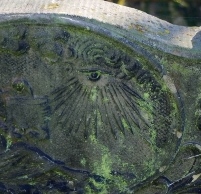
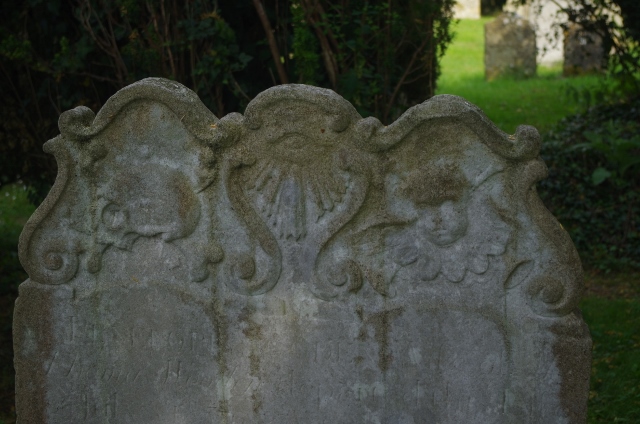
This is the All Seeing Eye, also known as The Eye of Providence, and is usually depicted as a single realistic eye within a triangle or within a burst of light. I’ve always associated it with Freemasons as it appears on their documents. But neither of these headstones had any other symbols linked with Freemasons such as the square and compass. So what was the story?
The one in the churchyard of St Martin of Tours in Eynsford was bordered by what looked like two snakes with a skull and crossbones and a winged spirit on either side, familiar memento mori symbols. Sadly the epitaph is now illegible.
The second one is in the churchyard of All Saints in Frindsbury and this intriguing version is on the grave of the Caryer family. The Kent Archaeological Society thought that it might represent the Woman of Samuria as featured in John 4.4-26 but I’m not sure about that. (see Symbol of the month – the womand from Samaria or a Greek goddess? 27 January 2021) The epitaph reads: ‘Sacred To the memory of Hannah wife of John Caryer Died 9th Sept 1809 aged 30 years Also Robert her son Died 28th June 1801 aged 8 years Also the above John Caryer Died 11th March 1814 aged (4)2 years.’
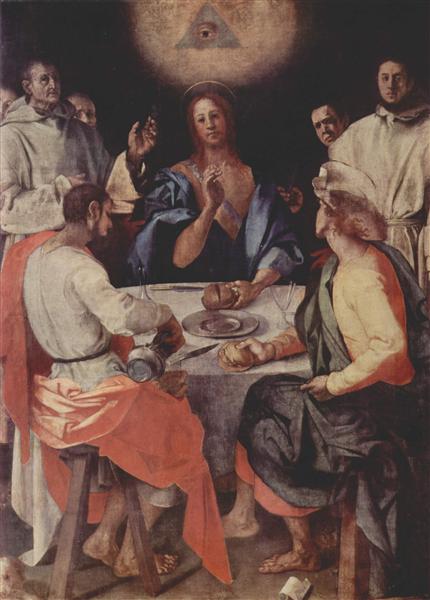
The earliest known representation of The Eye is in a painting called ‘The Supper at Emmaus’ by the Italian painter Jacopo Pontormo in 1525. This was painted during the Renaissance and it depicts the second part of the Second Appearance story in Luke 24: verses 13.35:
‘And they drew nigh unto the village, whither they went: and he made as though he would have gone further. But they constrained him, saying, Abide with us: for it is toward evening, and the day is far spent. And he went in to tarry with them. And it came to pass, as he sat at meat with them, he took bread, and blessed it, and brake, and gave to them. And their eyes were opened, and they knew him; and he vanished out of their sight. And they drew nigh unto the village, whither they went: and he made as though he would have gone further. But they constrained him, saying, Abide with us: for it is toward evening, and the day is far spent. And he went in to tarry with them. And it came to pass, as he sat at meat with them, he took bread, and blessed it, and brake, and gave to them. And their eyes were opened, and they knew him; and he vanished out of their sight.’
As you can see the Eye is above Christ’s head which shows that God is watching the event and so can be seen as a Christian symbol. On the Ancient Origins website it’s claimed that
‘the elements surrounding the eye also have a Christian meaning. For example, the triangle surrounding the eye also have a Christian meaning in that it’s a clear reference to the Holy Trinity – the Father, the Son and the Holy Spirit. The burst of light is meant to symbolise divinity, holiness and God himself’
Within the Bible there are many references to The Eye in the context of God keeping watch and observing in Proverbs and Ecclesiasticus and also from Psalms 33: verse 18:
‘The LORD is in his holy temple, the LORD’s throne is in heaven: his eyes behold, his eyelids try, the children of men. Behold, the eye of the LORD is upon them that fear him, upon them that hope in his mercy . . . . The eyes of the LORD are upon the righteous, and his ears are open unto their cry.’
But older religions and faiths such as Hinduism and the Ancient Egyptians also had an important eye symbol.
In Egypt it was known as the Eye of Horus. Even today it’s still used as an emblem of protection and good health. The Eye was also known as a wadjet (the whole one), wedjat or udjat. Sailors would often paint the Eye of Horus on the prows of their ships to ensure a safe voyage. I’m sure that I’ve seen this on a boat or two in some of Hollywood’s classic sword and sandal epics! The depiction of the Eye of Horus is said to resemble the markings on a falcon’s eye due to the teardrop marking which is sometimes found below the eye as here. This would make sense as Horus is usually shown as a falcon. There are several myths about Horus and his eye. For instance, in one of them Horus fought with Set who gouged out Horus’s left eye which was later restored by a goddess.
The Eye also appears on the US one dollar bill. But it made its first appearance as a Freemason symbol on the personal seal of Robert Moray (1609-1673) who was a Scottish Freemason. Then during the 18th century it appeared again in two Freemason books, one of which was Thomas Smith Webb’s ‘Freemasonry Monitor’ and, by the 19th century, it had become part of the permanent hieroglyphical emblems of the Freemasons. There are other associations with the Illuminati and, if you’re interested, there is more information online.
But with these two All Seeing Eye symbols I think that they were meant, as they often are, to be a comforting message. The departed, and the bereaved, were all being watched over and supported at a time of sorrow and grief.
There are over 53 war graves and I found the plot containing most of them although there are others buried throughout the cemetery. The plot contains 18 German airmen, (one unidentified), and 50 British casualties. The others are Commonwealth service personnel of which 2 remain unidentified and I saw some of them as I explored.
The Hebrew section is near the crematorium and I found other notable permanent residents although a chill was beginning to make its presence felt as the afternoon wore on. Samual Courtauld and his wife’s headstone seemed quite modest considering his achievements. He was the great art collector who founded the Courtauld Institute of Art in 1932 which continues to this day and, after a series of gifts during the 1930’s, bequeathed his entire collection to the Institute on his death. He also created a £50k acquisition fund for the Tate and National Gallery in London which enabled them to acquire works that helped create national collections of Impressionist and Post-Impressionist art.
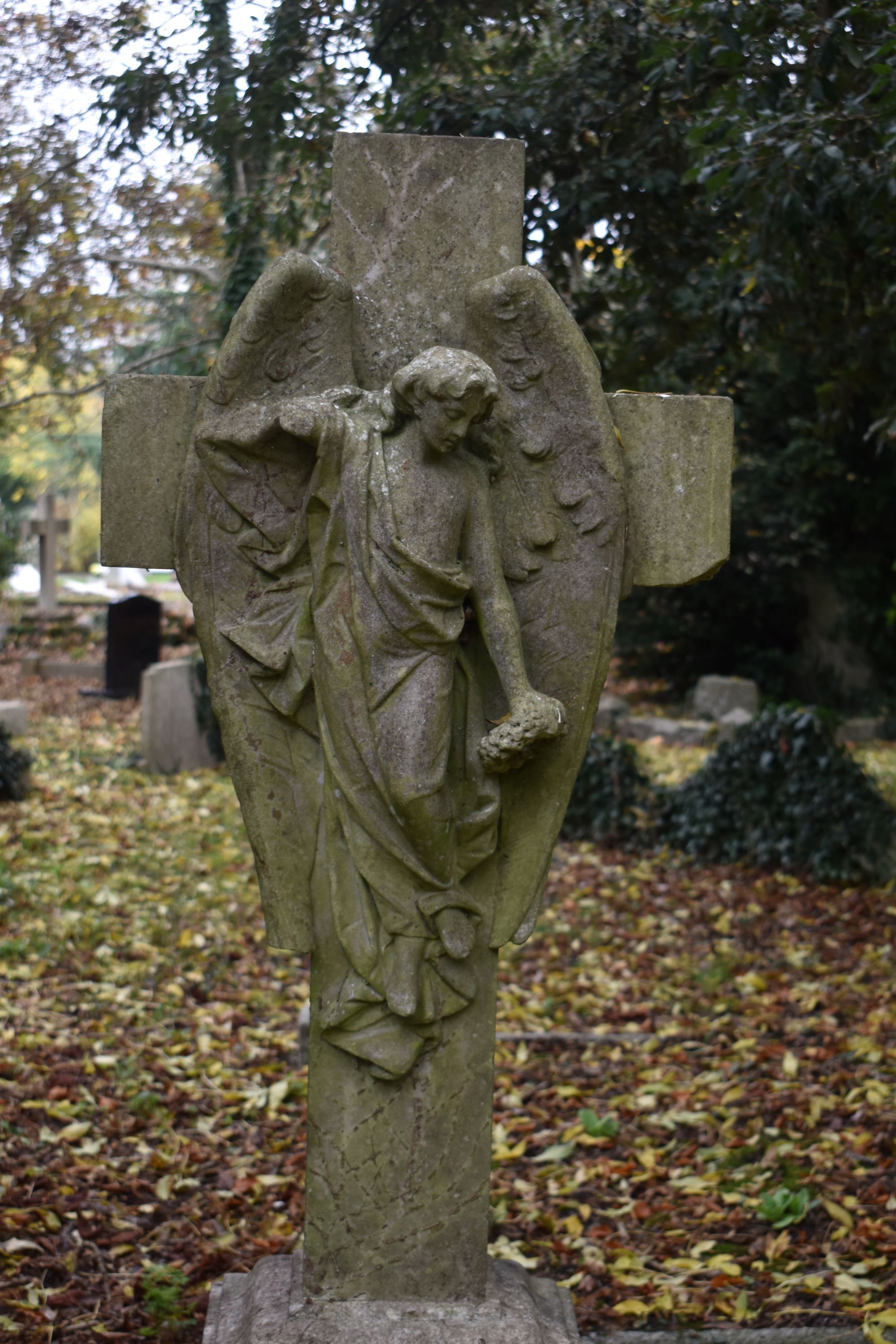
Another surprise was finding a definitely male angel draped in what could be described as a toga (it looked chilly) keeping watch over the grave of Arthur and Ethel Weston. It’s unusual as most angels in cemeteries and churchyards appear to be pretty, pensive young women.
There was a 2D representation of ‘Simply To Thy Cross I Cling’ on the Holness headstone. I found a metal Lourdes medal that had been placed on a stone cross.
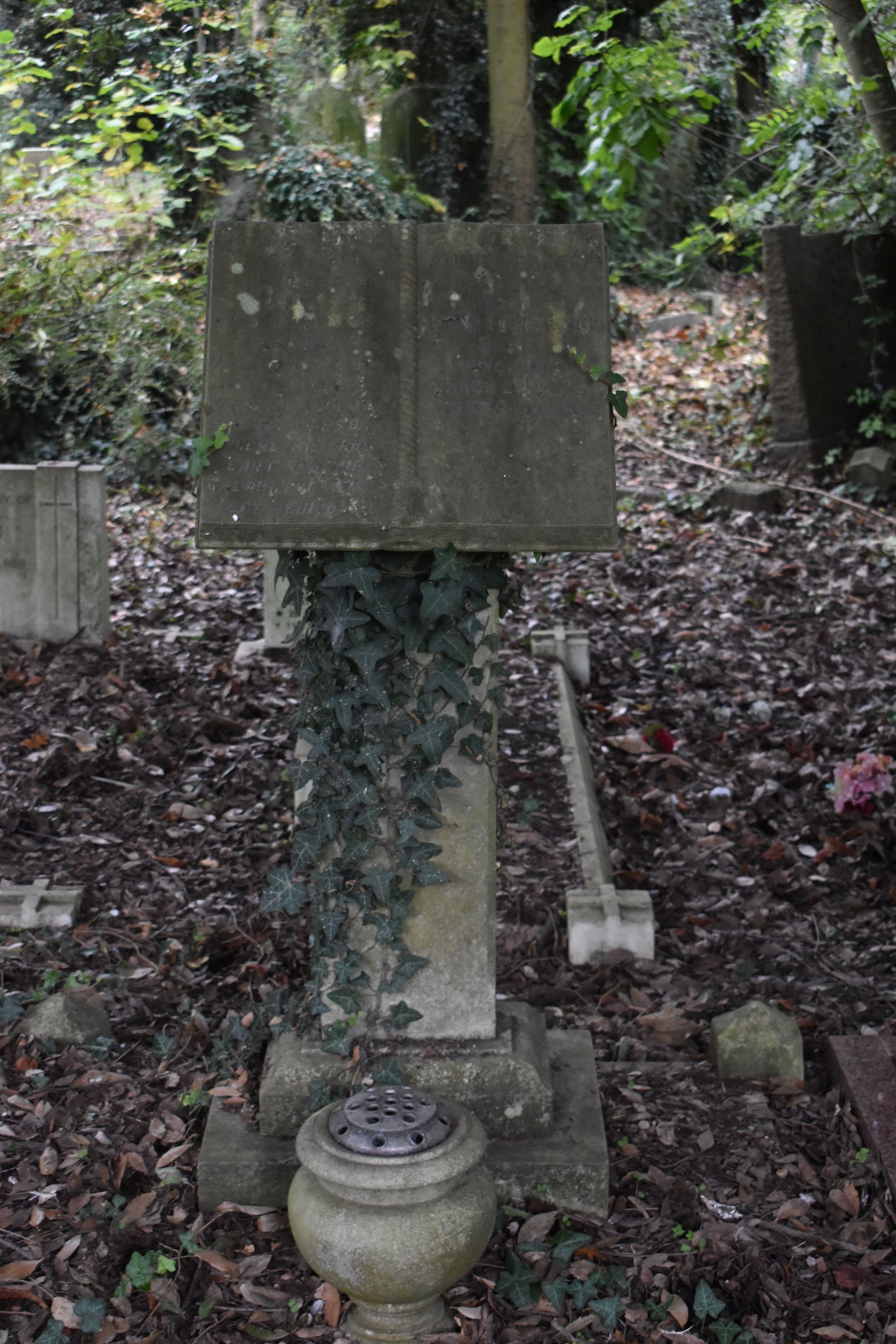
There was also a variant on the open book which was last month’s Symbol of the Month. Here it has been placed on a lectern style stand which made me think of the deceased standing up and telling all those around him of his or her good deeds or perhaps giving them a sermon.
On the elegant Devereux headstone dedicated to Thomas and his wife, Maria, I didn’t need to look at the epitaph to know that this was dedicated to a Royal Navy man. The two pillars have chains wrapped around them ending in two entwined anchors. There is also a Crown above them and the familiar shaking hands at the top.
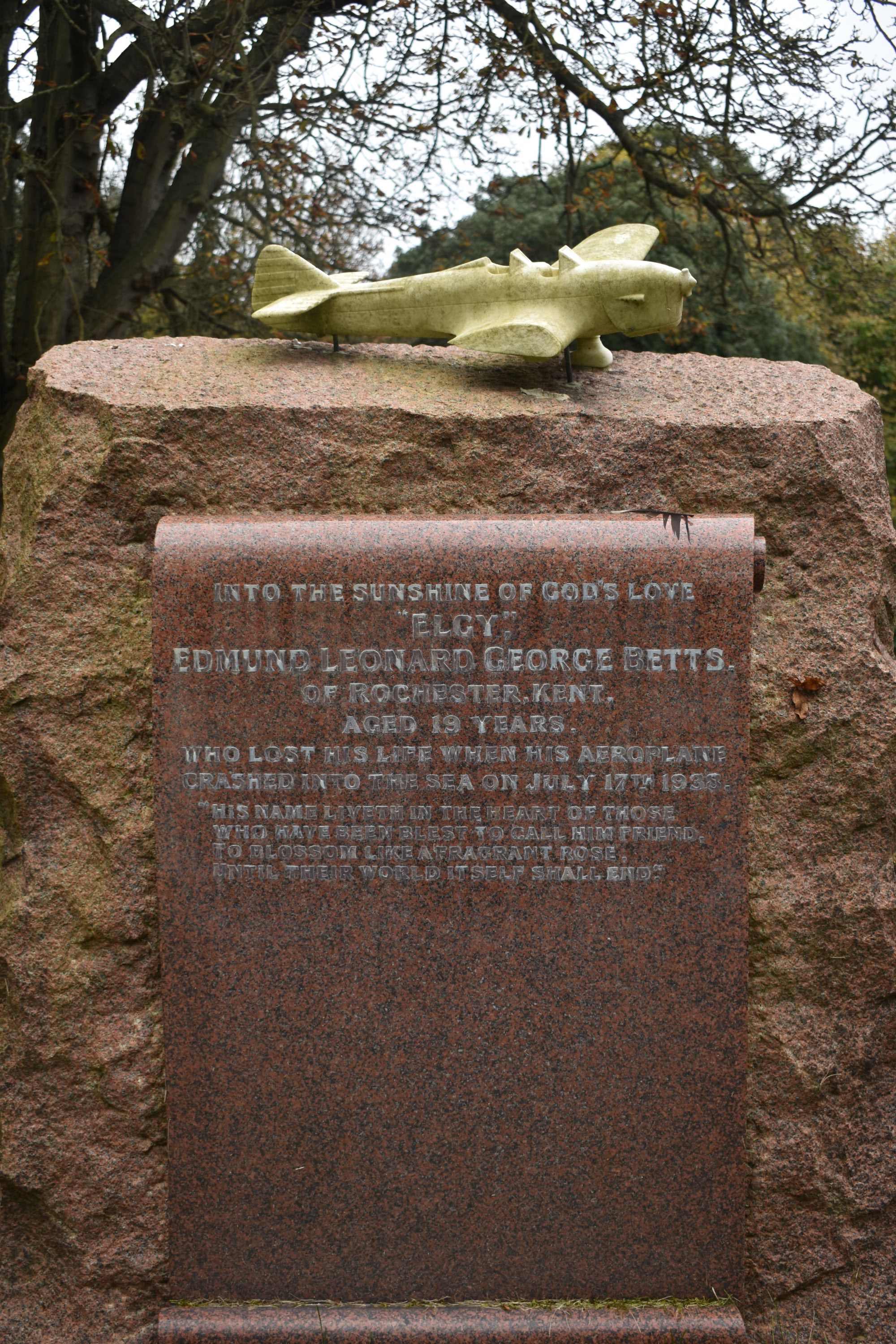
I then came across my other surprise of the day when I found another Grade II listed monument. I was surprised that the small model airplane on top of it hadn’t been stolen although I saw very little vandalism in the cemetery. The monument is dedicated to Edward Leonard George ‘Elgy’ Betts who died aged 19 on 17 July 1938. I am indebted to Findagrave for the information about him:
‘….crashed into the sea with a 2 seater light aircraft after taking off from Ramsgate airport. He was flying a Miles Hawk Trainer airplane belonging to Thanet Aero Club and it crashed into the sea off Cliftonville, Margate, Kent. He and his passenger, 16 year old Marjorie Wall, were killed….. She is also buried in Margate Cemetery with her parents. The sculpture of the plane is and accurate representation of the plane in which he died, including the registration letters G-AEFU.’
Ramsgate airport is long gone and has been replaced by an industrial. For a Sunday afternoon the cemetery was quite busy with visitors, mostly in cars, and a few like myself on foot. But I was aware that I didn’t have enough time on this visit to explore the entire cemetery so will do it in sections on future visits. I am already anticipating this although there is already plenty to write about!
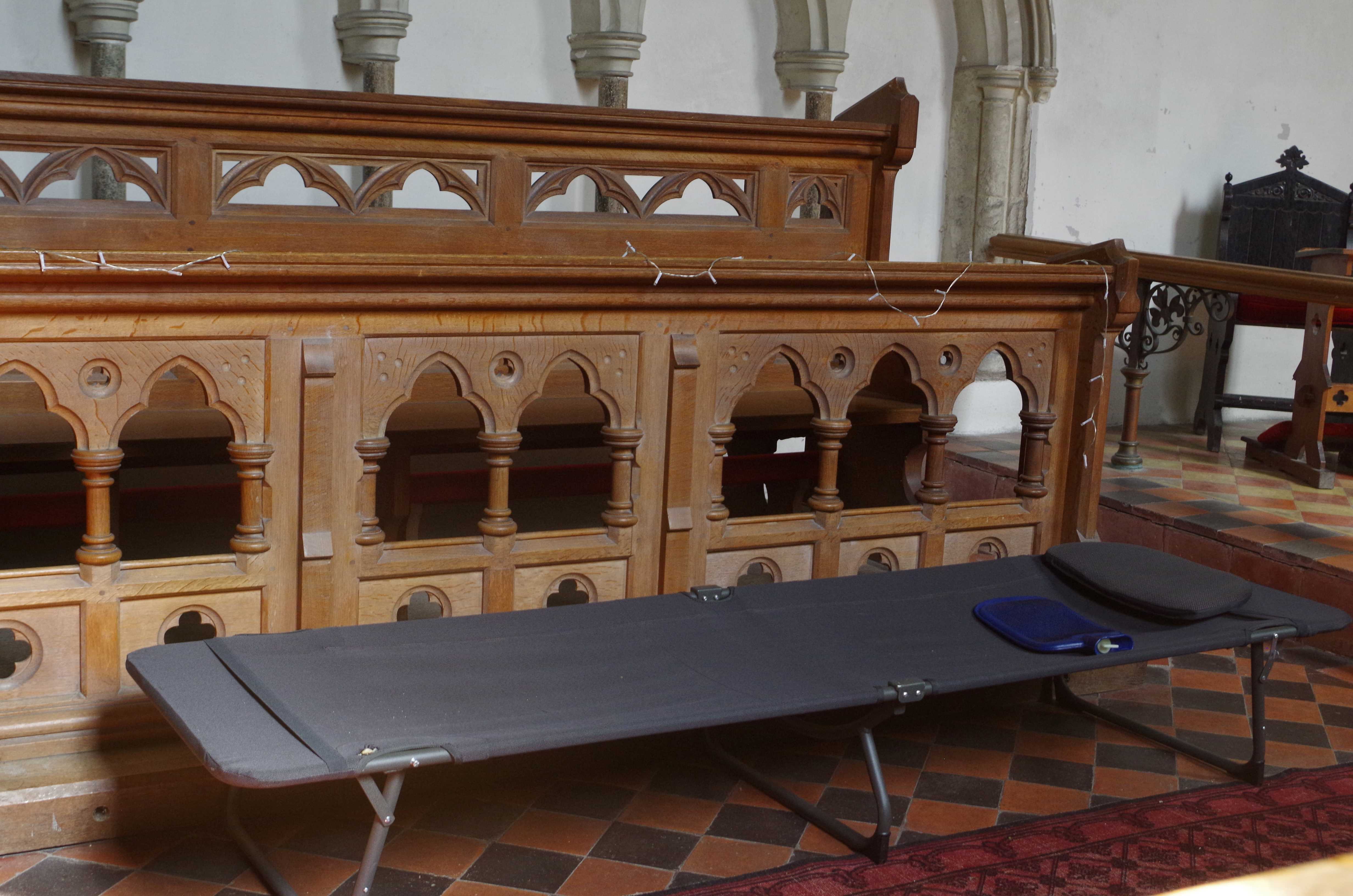
Maybe I just disturbed the nocturnal guests at St James’s and they felt compelled to hide but all appeared to be silent as I stepped inside the church. But they were given away by 2 vacant camp beds in front of the altar and the small refreshment area by the pulpit. I thought that the hot water bottle on one of the camp beds was a nice touch as I stood there for a moment and wondered what it must have been like staying overnight in an empty church in such an isolated place. There are houses around the church but not that many. ‘Champing’, is a euphemism for overnight ‘camping’ in churches looked after by The Churches Conservation Trust. Don’t worry they’re not pitching tents! The church provided the campbed and the usual amenities. It’s really caught on in recent years and I have been tempted to try it myself.
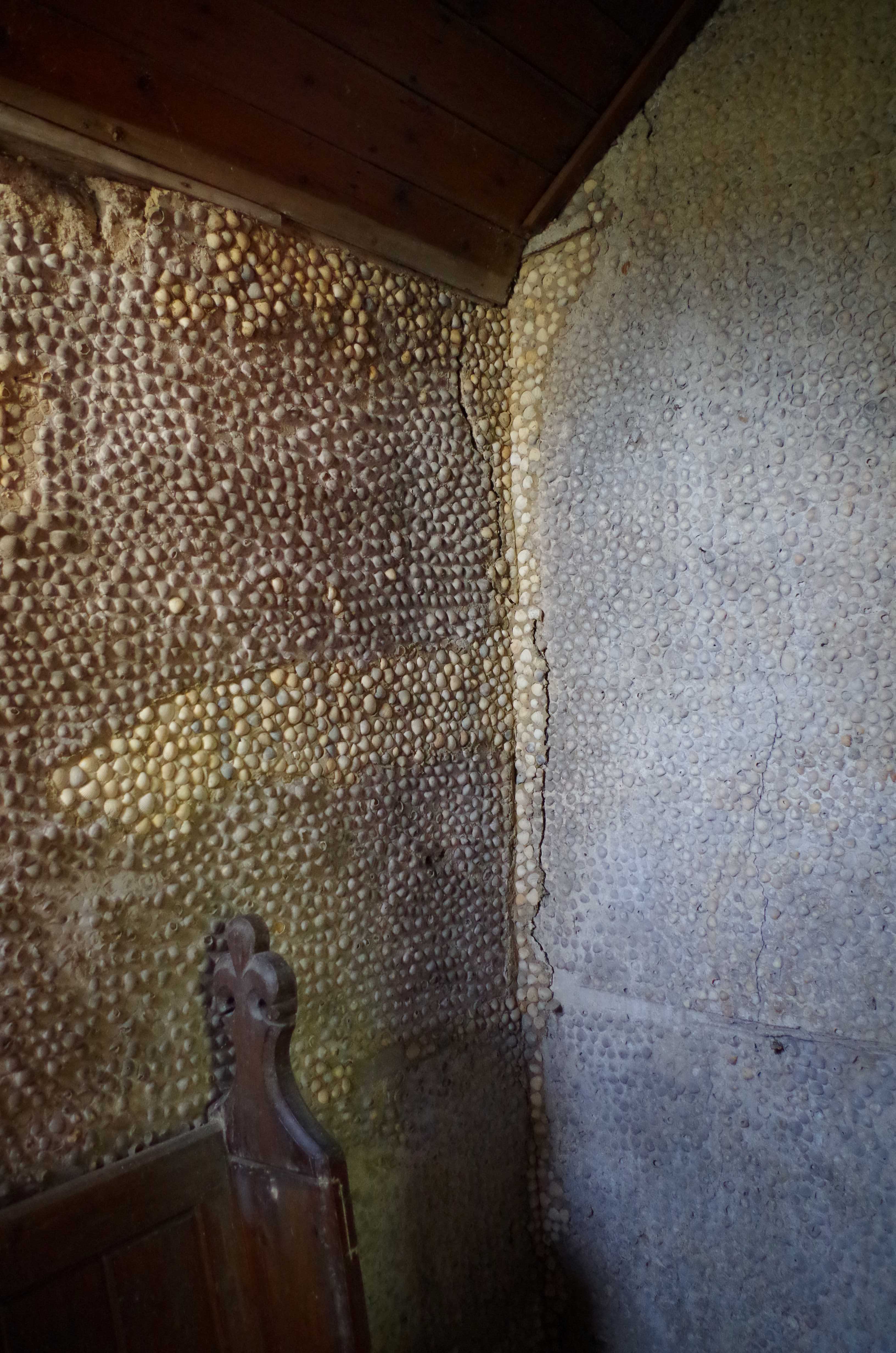
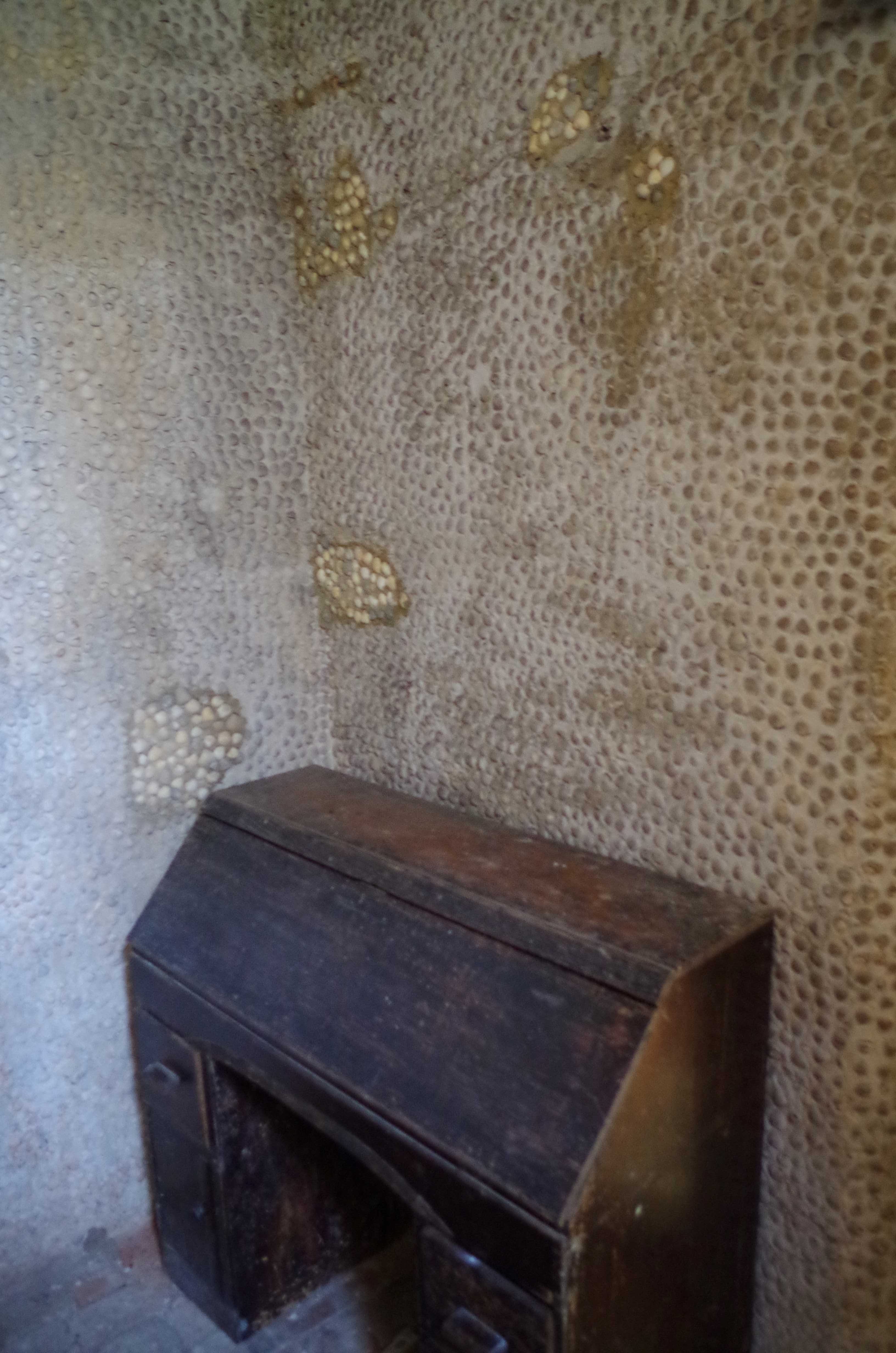
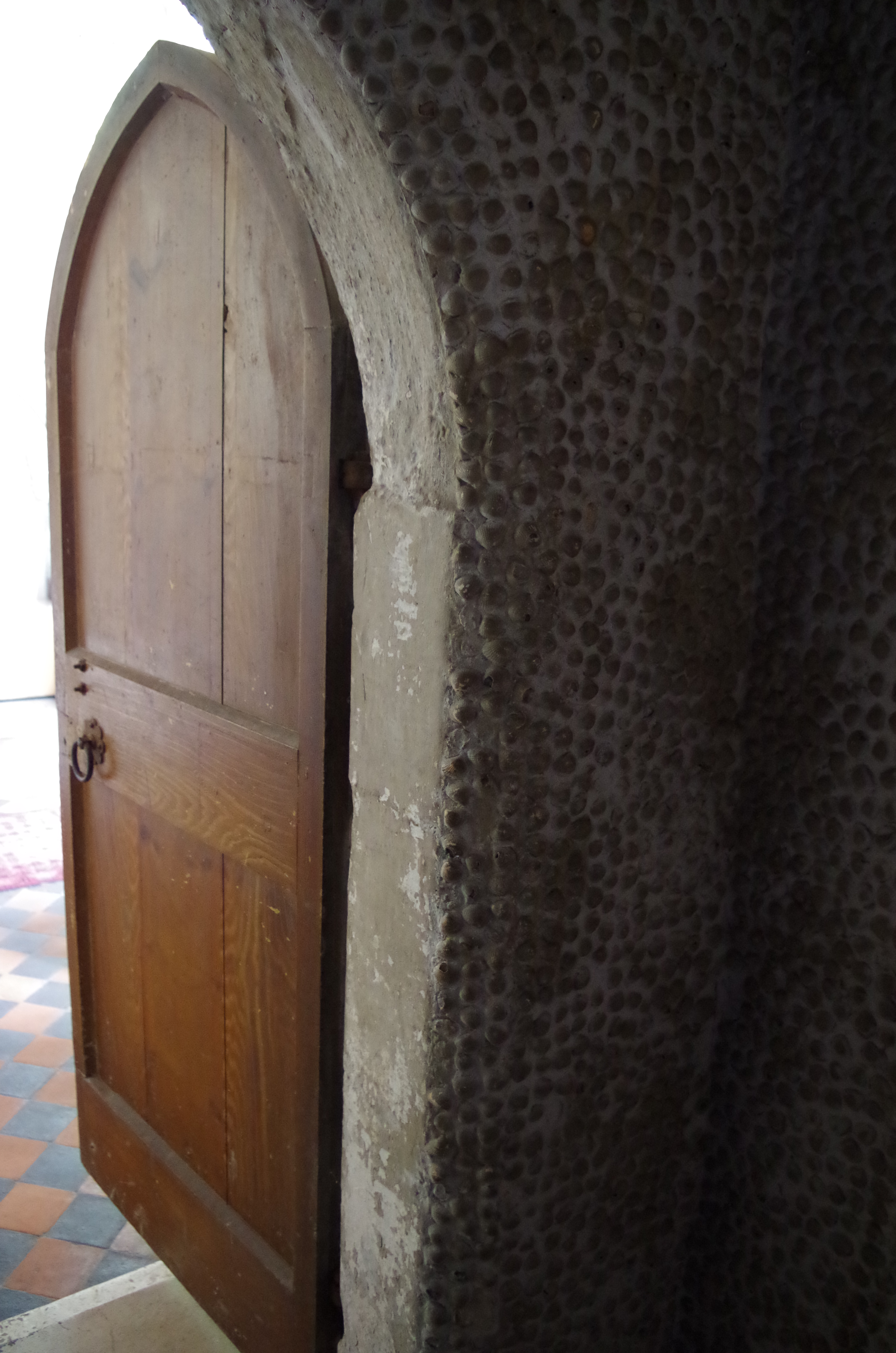
But I was at St James’s to see the cockleshell room which I’d missed on earlier visits. There wasn’t a sign advertising it but a quick look at the church map of the interior and I headed for the church organ. This time I found it! The door’s latch seemed to echo in the tranquillity as I pulled it open. The vestry is ‘compact and bijou’ as an estate agent would undoubtedly say – it is tiny and there was only a small open cobwebbed window, high up in the wall for ventilation. The room felt very warm and contained only a chair, possibly a recycled pew, and a bureau.
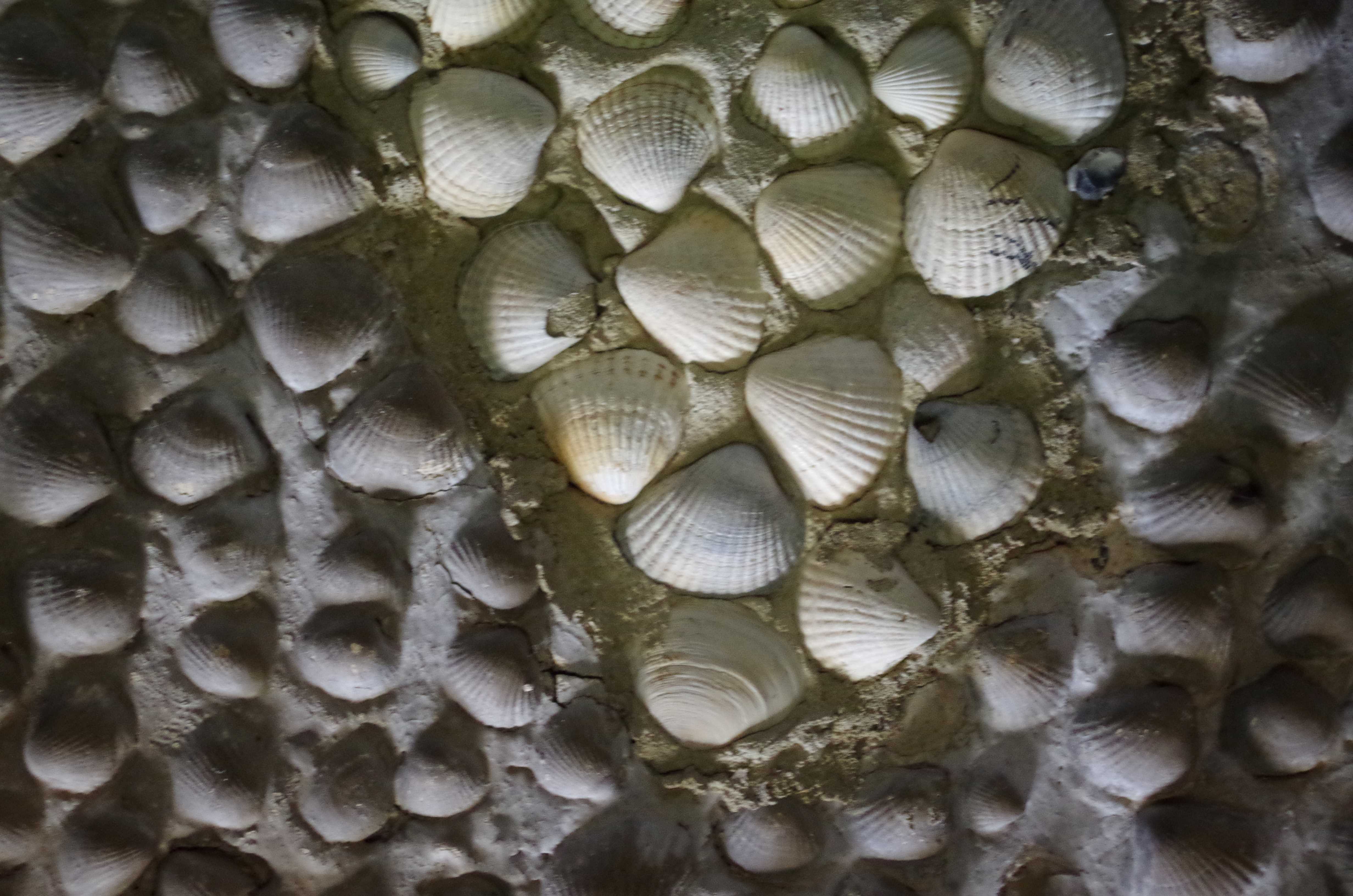
But it’s the thousands of cockleshells that made me catch my breath. They are floor to ceiling, arranged in patterns with newer ones being cemented in. I have to say that it did feel a little claustrophobic. The vestry dates back to the 19th century and is considered to be either a reminder or perhaps homage to the shell being the symbol of the saint, St James. Shells would be worn in pilgrims’ hats as they went on the trail to his shrine in Santiago de Compostela. Above the door, and supposed to be, are initials and a date which may be 1833 or 1838. The initials are I.M. and I.C. CWARDENS which could stand for John Murton and John Comport churchwardens. I was looking in the wrong place so didn’t spot it but perhaps on another visit…. you do need a few minutes just to take it all in and try not to touch them although it is a very tactile surface.
According to the Churches Conservation Trust, it’s considered to be
‘unique in an English church’.
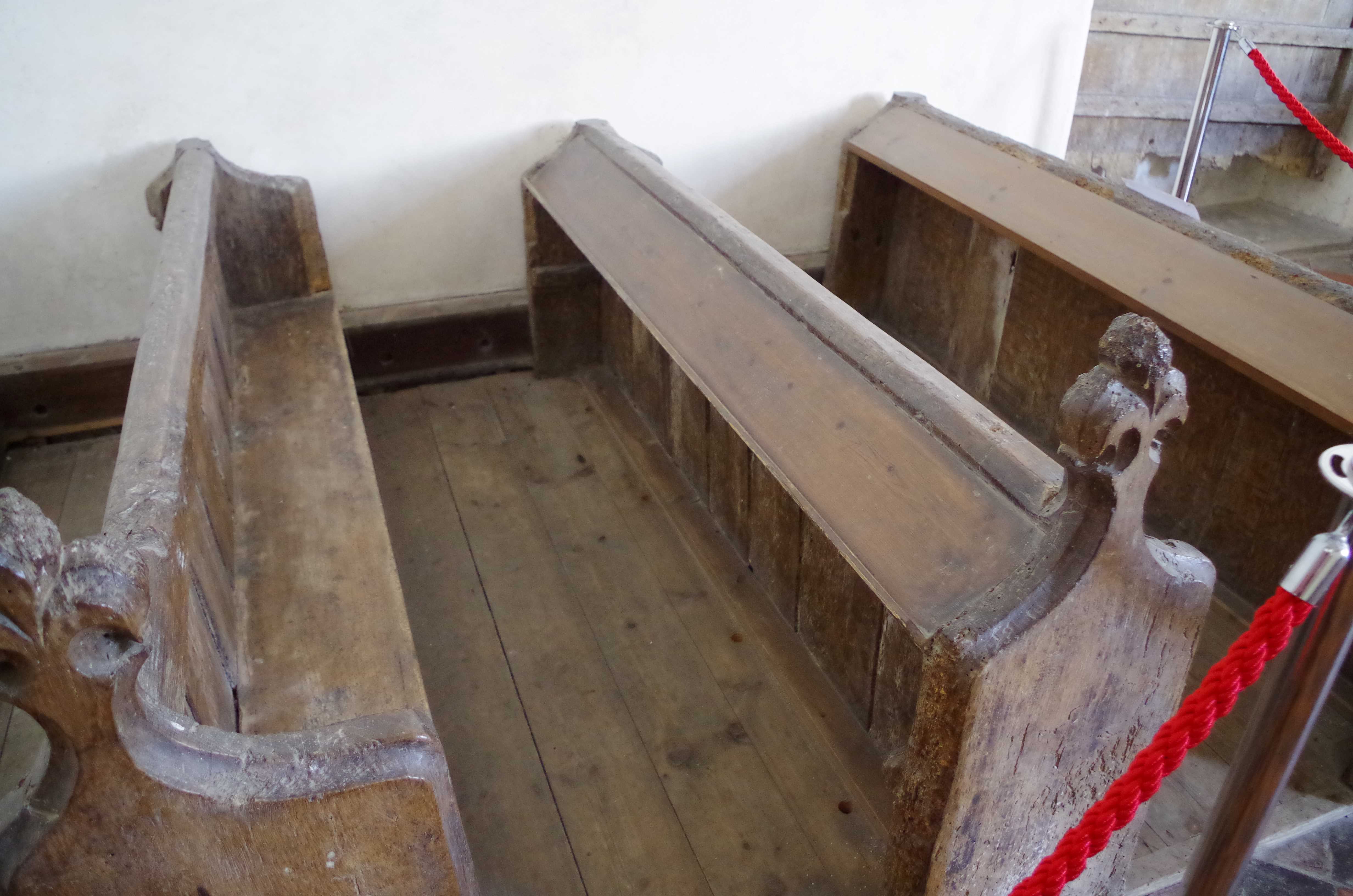
As I explored the nave after leaving the little room I saw the medieval benches that date back to the 14th century. They’ve evaded the iconoclasts of the 1600s and Victorian restoration but are now too fragile to be touched, much less sat on, and are now roped off.
The name Murton appeared again on an elegant and poignant wall memorial to a sailor, John William, eldest son of John Murton of nearby Cooling Castle. He died young, aged 28, after falling overboard from the Monarch off Rio de Janeiro during a voyage to Calcutta. The inscription on the marble tablet quotes from the ship’s captain’s log:
‘And so perished one of the finest and best hearted seamen who ever trod a ship’s deck. I have lost a trustworthy officer and valued friend. Peace be to his remains.’
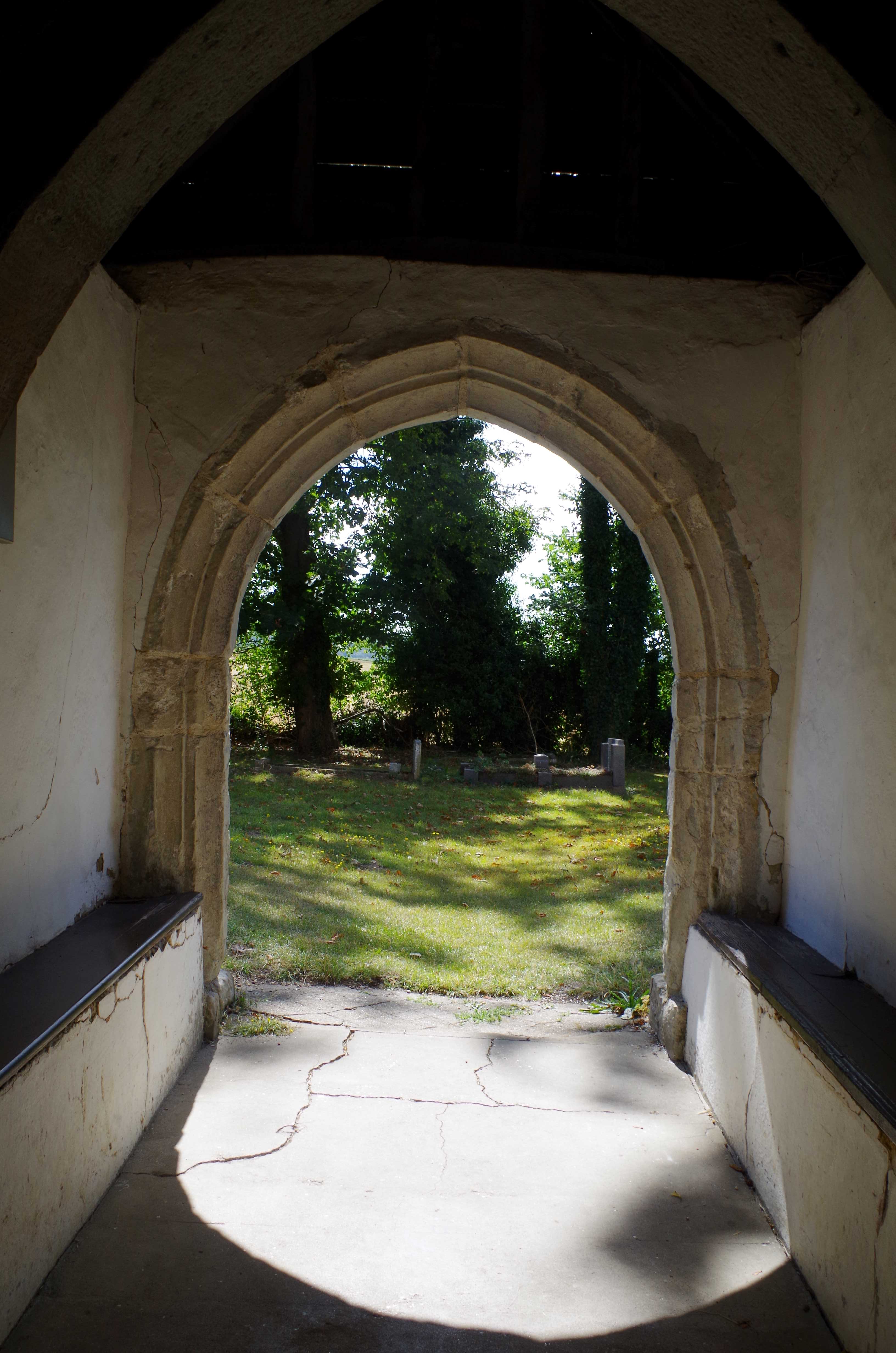
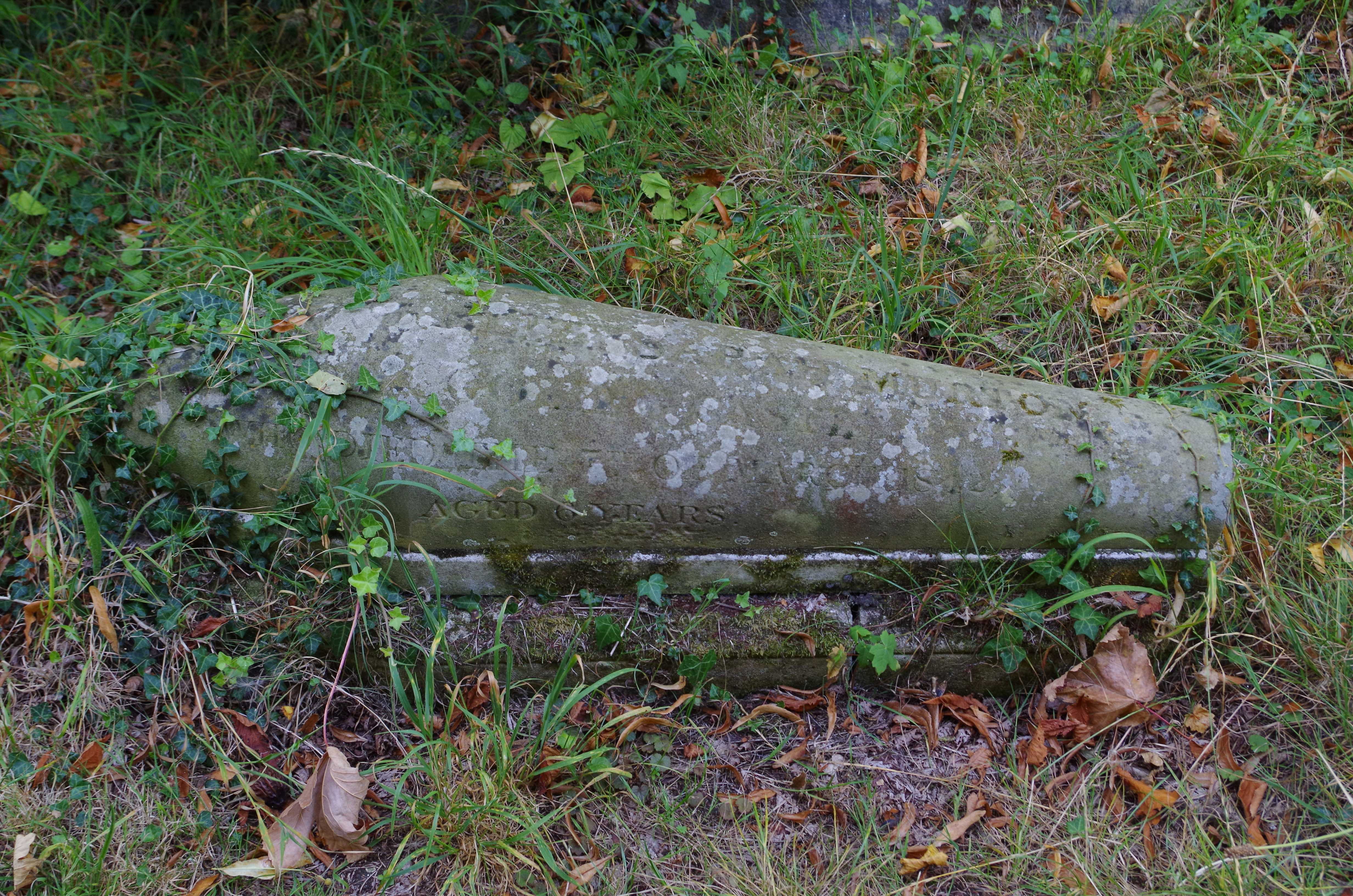
After that I went outside to see ‘Pip’s Graves’ and the table tomb on which Charles Dickens is reputed to have eaten his lunch. Across the marsh I could see docked ships and butterflies flitted about on the buddleia at one end of the churchyard. I found a clergyman’s grave denoted by a chalice and more childrens graves. One was dedicated to a six year old. I also pursued a Common Darter dragonfly until it posed obligingly and checked to see if the little grinning demon still kept watch over the outside loo. He did. I looked up as I left the churchyard and saw, glinting on the weathervane above the tower the representation of another cockleshell.
The 18th historian, Edward Hasted, described Cooling as
‘an unfrequented place, the roads of which are deep and miry, and it is as unhealthy as it is unpleasant.’
It certainly is unfrequented as I was alone as I walked along Cooling Road to and from the church with only passing cars for company. The remains of the 14th century Cooling Castle, which is in private hands, are still impressive. Dark blue sloe berries were still on several bushes and windfalls clustered beneath apple trees in a nearby orchard. I retraced my steps back to Cliffe for a wander round St Helen’s churchyard and then a very welcome cuppa in their café.
But how I envied the ‘champers’ enjoying a good night’s kip(I hope) in that little corner of Kent.
This is another older post about a symbol that is not common within churchyards and cemeteries and so I am always thrilled whenever I see an example. This gorgeous example is in below is in the interior of St Nicholas’ church in Chislehurst, Kent. It’s dedicated to a woman and perfectly illustrates the use of the butterfly as a symbol of transformation and resurrection.
As the lockdown edges closer to more restrictions being relaxed, I hope to be out exploring again very soon!
Butterfly on monement, interior of St Nichols church Chislehurst, Kent, copyright Carole Tyrrell
The Gordon monument butterfly motif in all its glory. Kensal Green Cemetery. copyright Carole Tyrrell
Cemeteries and graveyards can be happy hunting grounds for butterflies. But not just the bright, dancing summer jewels, borne on the breeze, but also the much rarer kind which perches in them for eternity.
So far I’ve only discovered two of this particular species which were both in London. One was in Brompton and the other was in Kensal Green. But I have also seen others online in American cemeteries.
But I’m surprised that the butterfly symbol isn’t more widely used as it is a deep and powerful motif of resurrection and reincarnation. It has fluttered through many cultures which include Ancient Egypt, Greece and Mexico.
In classical myth, Psyche, which translates as ‘soul’, is represented in the form of a butterfly or as a young woman with butterfly wings. She’s also linked with Eros the Greek God of love. It is also a potent representation of rebirth and in this aspect, the Celts revered it. Some of the Ancient Mexican tribes such as the Aztec and Mayans used carvings of butterflies to decorate their buildings as certain butterfly species were considered to be reincarnations of the souls of dead warriors. The Hopi and Navaho tribes of Native American Indians performed the Butterfly Dance and viewed them as symbols of change and transformation.
The butterfly is an archetypal image of resurrection in Christianity and this meaning is derived from the 3 stages of a butterfly’s life. These are: 1st stage = the caterpillar, 2nd stage = the chrysalis and 3rd and final stage = the butterfly. So the sequence is life, death and resurrection. The emergence of the butterfly from the chrysalis is likened to the soul discarding the flesh. It has been depicted on Ancient Christian tombs and, in Christian art, Christ has been shown holding a butterfly. It is supposed to appear chiefly on childrens memorials but the two that I’ve seen were on adult memorials.
Butterflies also feature in Victorian mourning jewellery and there is a fascinating article on this with some lovely examples at:
In the 20th century, butterflies appeared in the flowing, organic lines of Art Nouveau and often featured in jewellery and silverware.
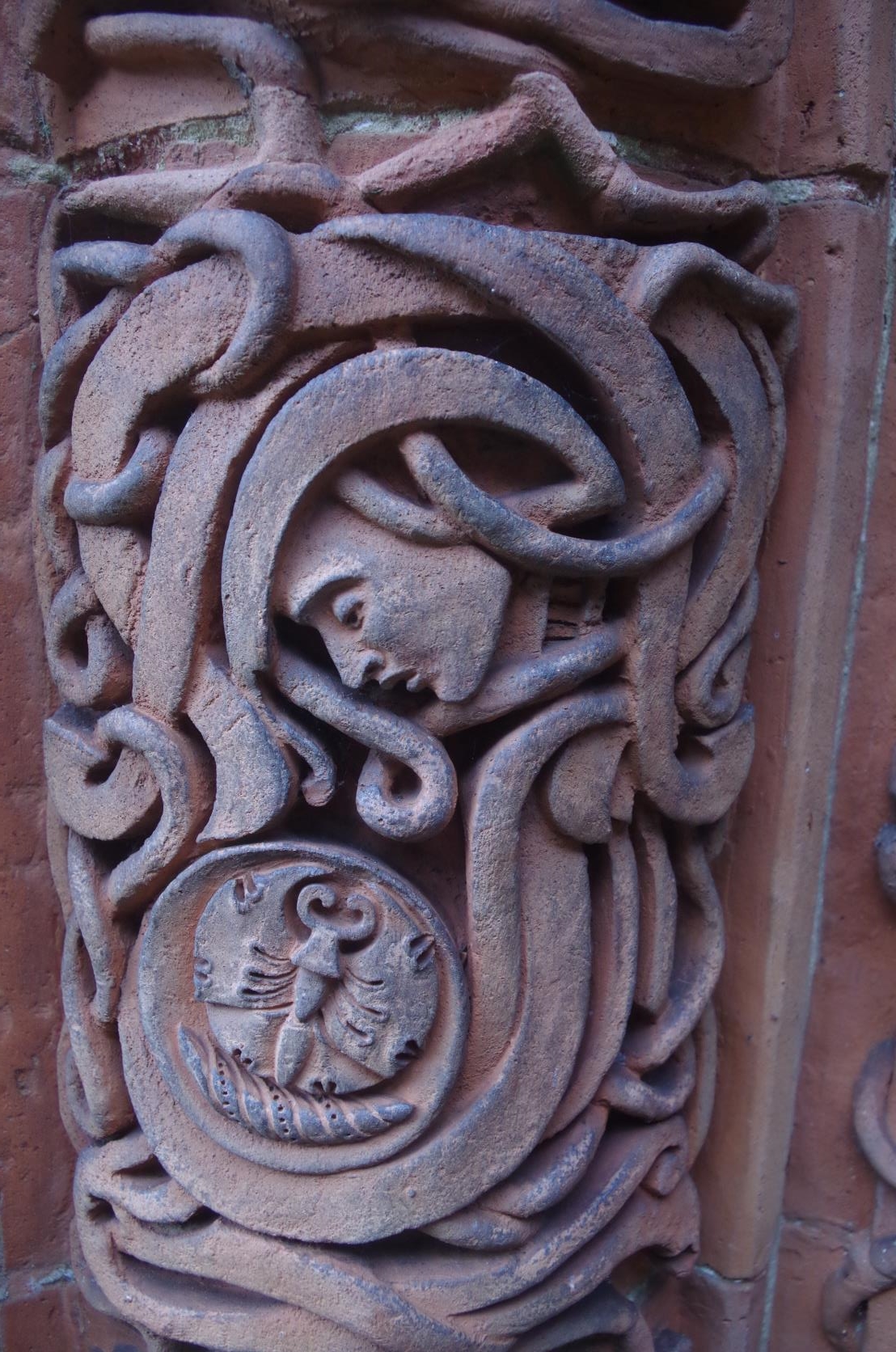
Face and butterfly on exterior of chapel. copyright Carole Tyrrell
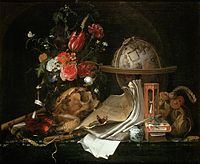
This example is from the Watts Chapel in Surrey and shows the flowing lines and stylised butterfly. They also appear in vanitas paintings, the name given to a particular category of symbolic works of art and especially those associated with the still life paintings of the 16th and 17th centuries in Flanders and the Netherlands. In these the viewer was asked to look at various symbols within the painting such as skulls, rotting fruit etc and ponder on the worthlessness of all earthly goods and pursuits as well as admiring the artist’s skill in depicting these. Butterflies in this context can be seen as fleeting pleasure as they have a short life of just two weeks.
Butterfly traditions
There are many superstitions and beliefs associated with butterflies. They are often regarded as omens, good and bad, or as an advance messenger indicating that a visitor or loved one is about to arrive. In Japan, they are traditionally associated with geishas due to their associations with beauty and delicate femininity.
Butterfly & Chinese wisteria by Xu Xi Early Sing Dynasty c970. By Xü Xi (Scanned from an old Chinese book) [Public domain], via Wikimedia Commons
The Chinese see them as good luck and a symbol of immortality. Sailors thought that if they saw one before going on ship it meant that they would die at sea . In Devon it was traditional to kill the first butterfly that you saw or have a year of bad luck as a result. In Europe the butterfly was seen as the spirit of the dead and, in the Gnostic tradition, the angel of death is often shown crushing a butterfly underfoot. In some areas in England, it’s thought that butterflies contain the souls of children who have come back to life. A butterfly’s colours can also be significant. A black one can indicate death and a white one signifies the souls or the departed. It’s also a spiritual symbol of growth in that sometimes the past has to be discarded in order to move forward as the butterfly sheds its chrysalis to emerges complete. So it can indicate a turning point or transition in life. There are also shamanistic associations with the butterfly’s shapeshifting and it has also been claimed as a spiritual animal or totem.
Brompton Cemetery, tomb unknown
This example with its wings outstretched is from Brompton Cemetery in London. Alas, the epitaph appears to have vanished over time and the surrounding vegetation was so luxuriant that I will have to return in the winter to investigate further. Note the wreath of ivy that surrounds it. Ivy is an evergreen and is a token of eternal life and memories. The wreath’s ribbons are also nicely carved.
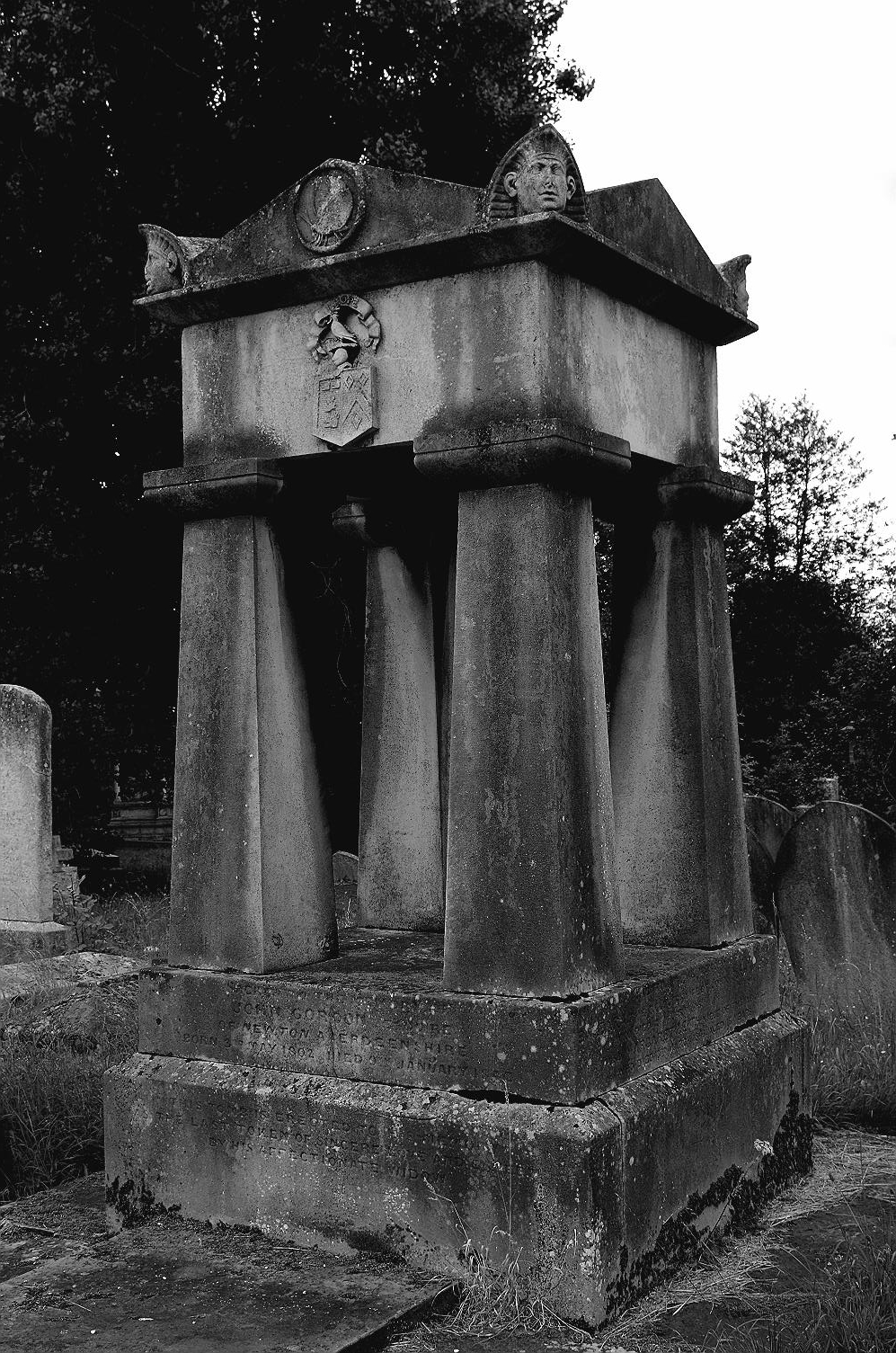
The Gordon monument, Kensal Green
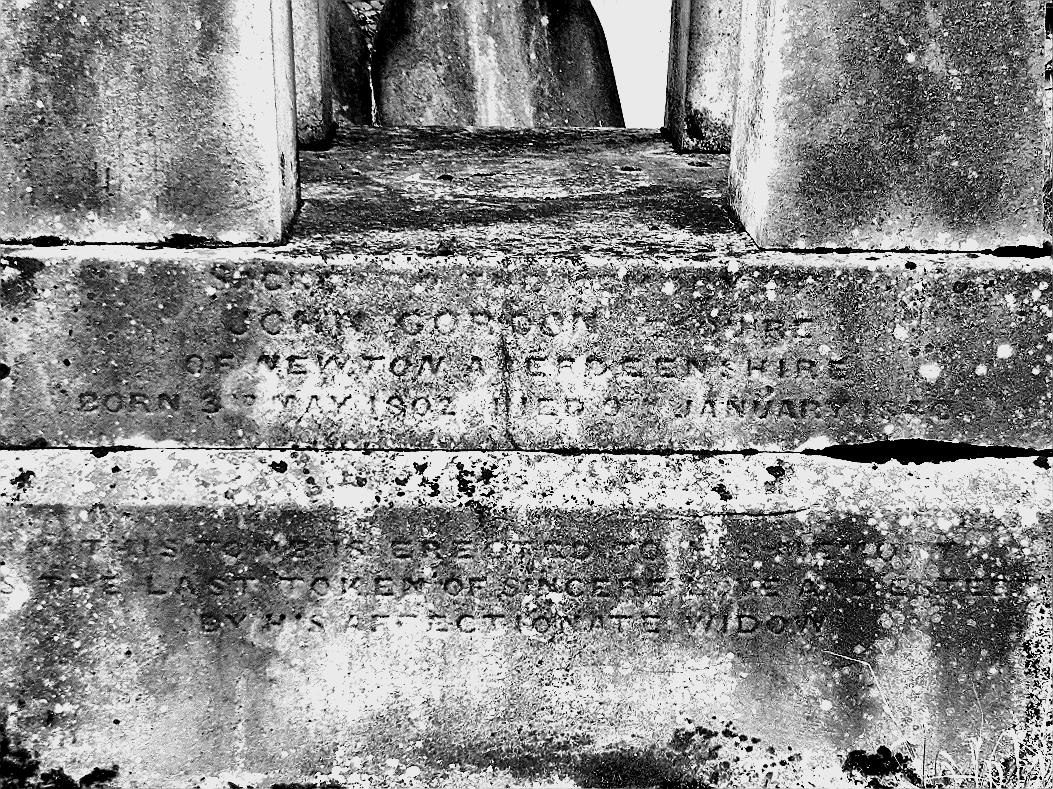
The second one is perched on the tomb of John Gordon Esquire, a Scotsman from Aberdeenshire who died young at only 37. As the epitaph states ‘it was erected to his memory as the last token of sincere love and affection by his affectionate widow’. Gordon came from an extended family of Scottish landowners who had estates in Scotland and plantations in Tobago amongst other interests. The monument is Grade II listed and is made of Portland stone with a York stone base and canopy supported by the pillars. There was an urn on the pedestal between the four tapering stone pillars but this was stolen in 1997.
The butterfly also has an ouroboros encircling it so, not only a symbol or resurrection, but also of eternity with the tail devouring snake. It is a little hard to see but it is there.
The butterfly symbol of the roof of the Gordon monument Kensal Green Cemetery. copyright Carole Tyrrell
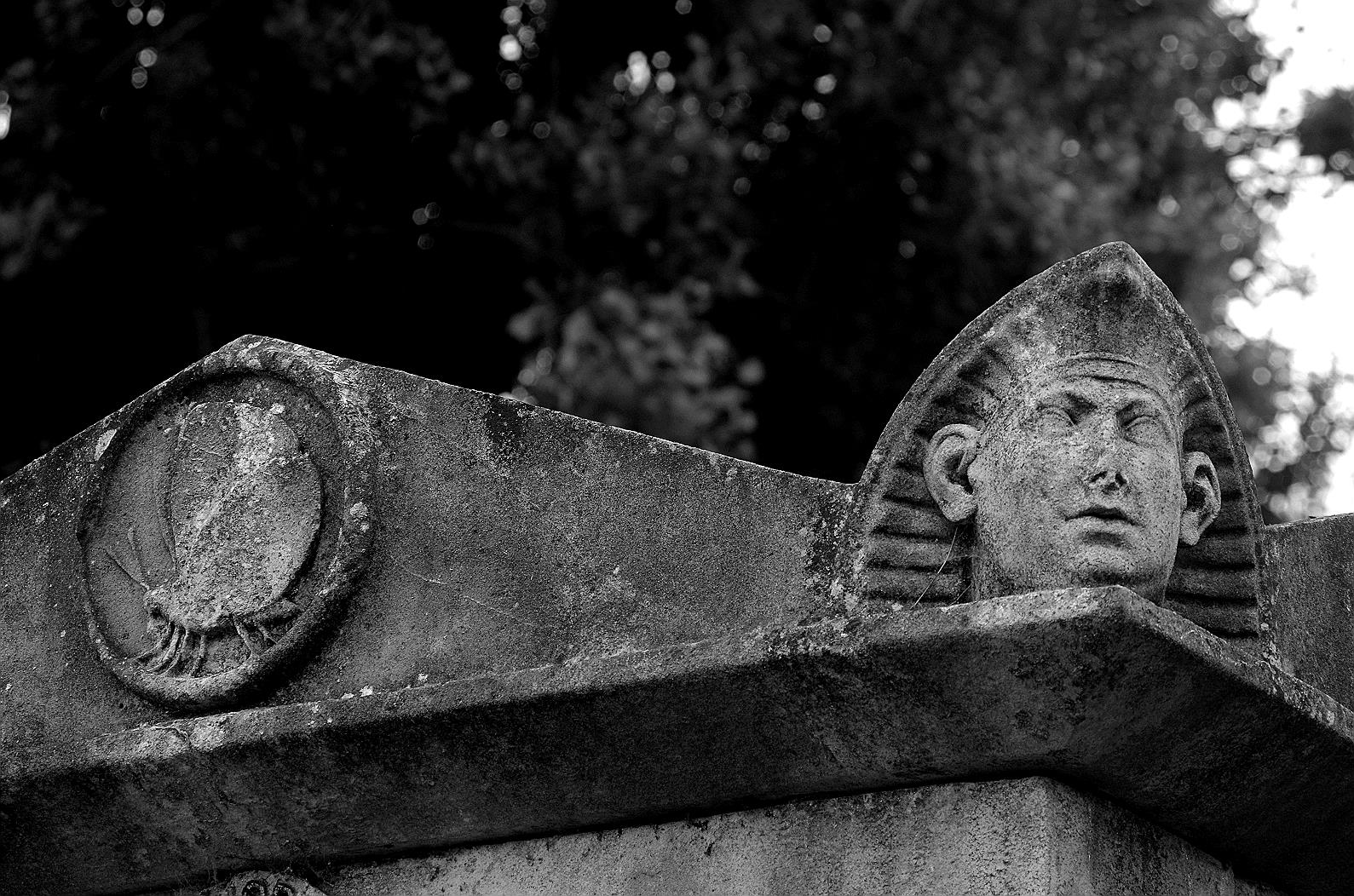
The pharaonic heads at each corner are Egyptian elements within an ostensibly classically inspired monument. Acroteria, or acroterion as is its singular definition, are an architectural ornament. The ones on this monument are known as acroteria angularia. The ‘angularia’ means at the corners.
The entire monument is based on an illustration of the monument of the Murainville family in Pugin’s Views of Paris of 1822 and also on Moliere’s memorial which are both at Pere Lachaise in Paris.
The Gordon memorial incorporates elements of the Egyptian style and symbolism that influenced 19th century funerary monuments after the first Egyptian explorations. Kensal Green contains many significant examples and there are others to be found in Brompton, Highgate and Abney Park. The Victorians regarded the Egyptians highly as it was also a cult of the dead.
So when you next see a butterfly fluttering on the breeze or even perched on a memorial for eternity remember its importance within the tradition of symbols, religions and cultures. Who knows it might be one of your ancestors…..
The Egyptian Avenue on a Highgate Cemetery ‘free range
One of the greatest cemeteries in London is Highgate in North London. Crammed with the great and good and also some of the not so good it contains some of the most dramatic funerary architecture to be found in the capital.
The cemetery is bisected by Swain’s Lane with Highgate West on one side and Highgate East on the other. Usually the West side can only be accessed by being on an official tour but this year it was a little different……
Social distancing, in this case, was a good thing! As The Friends of Highgate Cemetery Trust(FOHCT) were unable to hold tours during the summer they cunningly decided to offer ‘free range’ tours instead. For £10 you could book a time, agree to follow a few sensible rules on safety etc and then wander round the West side at will. And if you had the energy, as Highgate West is large, have a look round the East side as well. The West is very overgrown and FOHCT like their visitors to be safe. They didn’t want their visitors to have a nasty accident and then haunt them forever more.
Please note that I have covered Highgate in a previous post – 16/2/2016 to be exact so some memorials mentioned here will have been covered more fully in that post.
So, on 10 July, I entered through the arch of the chapel and into the green cathedral of the West side. The trees had linked arms above the graves, monuments and memorials to form a canopy over the entire site. It felt as if everything was bathed in green light as I walked up the hill. At its highest point Highgate is 375 feet above sea level. Cemeteries are often built on these as their permanent residents are nearer ‘my God to thee.’
I passed the empty chair memorial to a young actress and spotted a pelican in her piety symbol amongst the undergrowth. The overgrown nature of the West side gives it a real charm and mystery. A helpful steward directed me to the Rossetti group of graves which I’d always wanted to see but he also pointed out the grave of a woman who had died when her dress had caught alight. Apparently this only ceased with the coming of the mini-skirt and possibly central heating.
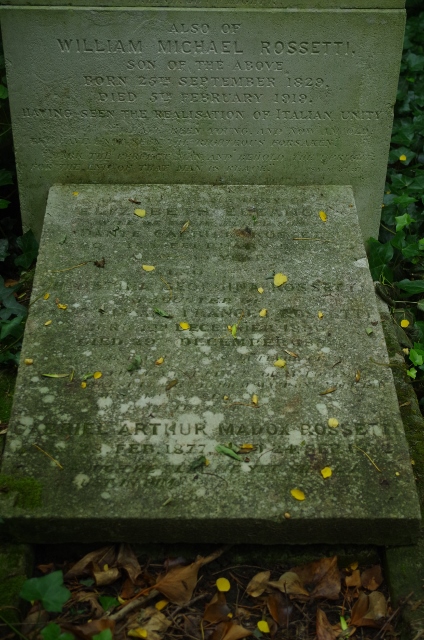
The Rossettis have their own path named after them but the Pre-Raphaelite painter, Dante Gabriel Rossetti is not buried with them. Instead his parents Gabriele (1783-1854) and Frances (1800-1886), his brother William (1829-1919) and William’s wife Lucy Madox Brown (1843-1894), who was the only daughter of Ford Madox Brown, his sister Christina Rossetti (1830-1894) and Dante’s wife Lizzie Siddal (1829-1862) occupy the plot.
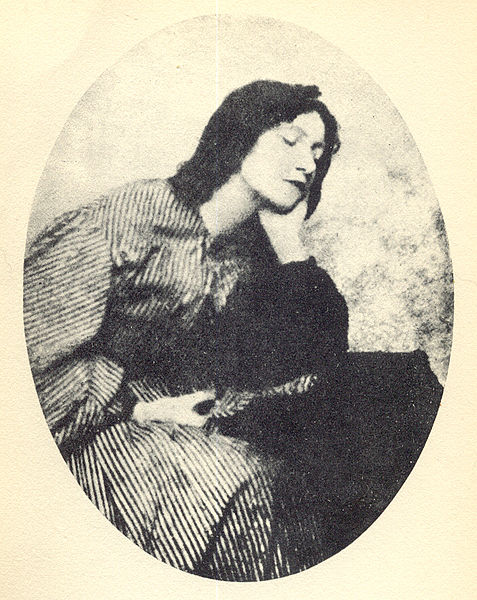
Lizzie features as the model in several of Dante’s paintings and the Victorian web points out that she died aged 32 instead of at 30. She was addicted to laudanum which was derived from opium and was a Victorian cure-all. Laudanum was prescribed for morning sickness and cranky infants amongst others. It was easy to become addicted and she succumbed. Lizzie was pregnant at the time of her death, although she may not have known it, and had already had a stillborn child with Dante. It is still not known if she died of an overdose or a deliberate act of suicide. However, she was a talented artist in her own right and some of her work was featured in the 2019 exhibition ‘Pre-Raphaelite Sisters.’
But Lizzie has also been commemorated by an act that occurred after her death. One of Dante’s early biographers recorded it:
On the day of the funeral Rossetti walked into the chamber in which the body lay. In his hand was a book into which at her bidding he had copied his poems. Regardless of those present he spoke to her as though she were still living, telling her that the poems were written to her and were hers, and that she must take them with her. He then placed the volume beside her face in the coffin, leaving it to be buried with her in Highgate Cemetery. This touching scene will some day doubtless be the subject of a picture. Time, after its wont, hallowed and sanctified the memory of loss, but the bereavement was long and keenly felt. Meanwhile, the entombment of Rossetti’s poems had an effect upon which the writer had not calculated. They were familiar to many friends, and passages of them were retained in the recollection of some. These poems were during subsequent years the subject of much anxiety and wonderment, and the existence of the buried treasure was mentioned with reverence and sympathy, and with something of awe. Seven years later Rossetti, upon whom pressure to permit the exhumation of the volume had constantly been put, gave a reluctant consent With the permission of the Home Secretary the coffin was opened” by a friend of Rossetti and the volume was withdrawn. [Knight 76] from the Victorian Web site
It would haunt Dante for the rest of his life. In one of his most famous paintings ‘Beata Beatrix’ painted in 1869, which is an amalgam of several drawings of Lizzie, a white poppy features. The red dove represents their love and the poppy the laudanum that hastened her death. It’s derived from poppies. Dante died in 1882 and is buried at Birchington-on- Sea.
Elizabeth Siddal circa 1860 unknown photographer shared under Wiki CommonsBeata Beatrix Dante Gabriel Rossetti completed 1870.
William Rossetti was a founder member of the Pre-Raphaelite Brotherhood and wrote widely. He was also the biographer of his family. One of Christina’s most famous poems was ‘Goblin Market’ and she also featured in ‘Pre-Raphaelite Sisters.’
I returned to the path but discovered a selection of the rich and famous as I walked up to the Circle of Lebanon.
The epitaph says it allLucien Freud artistJean Simmons actress.- she starred with Kirk Douglas in Spartacus
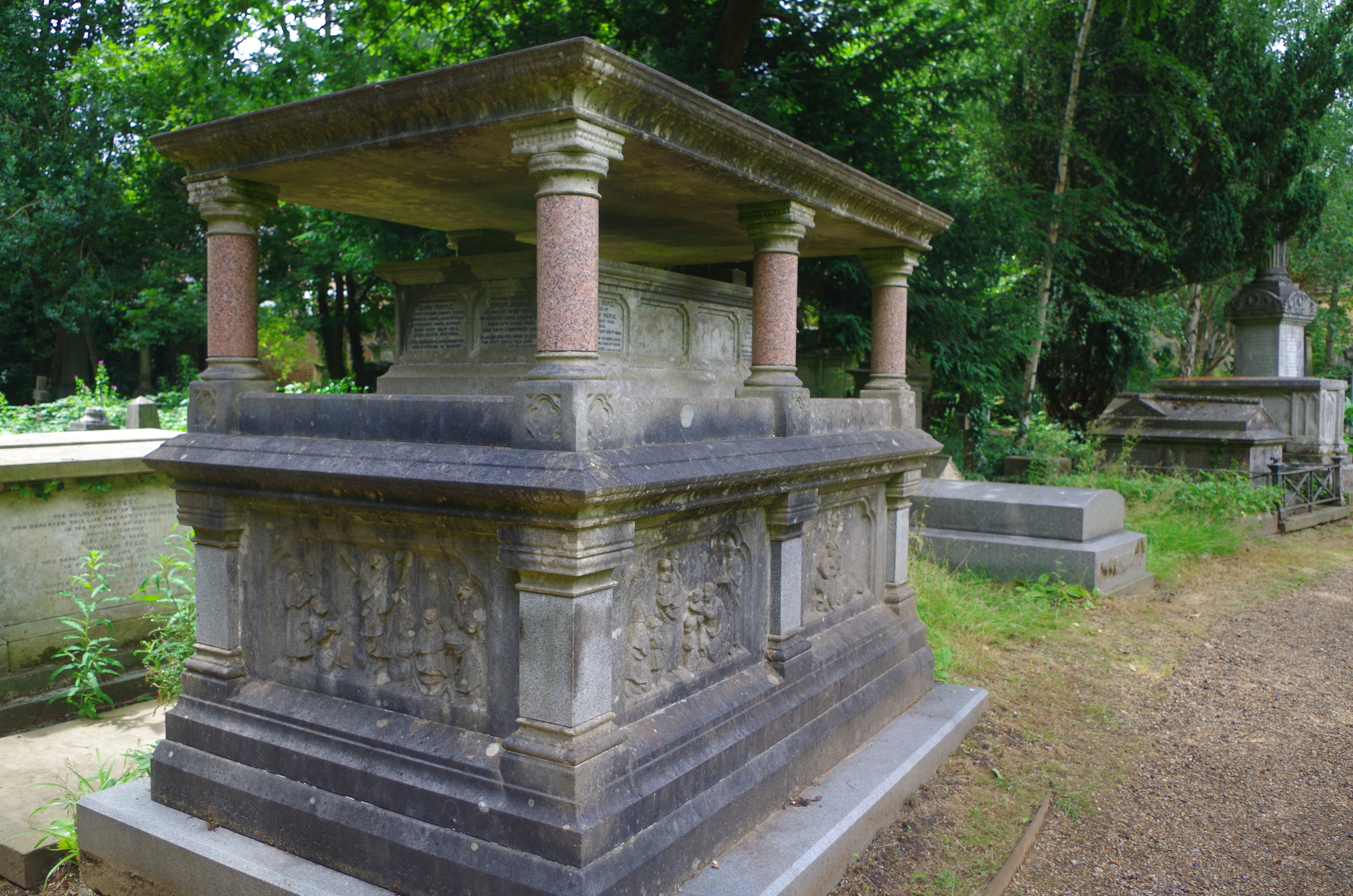
Alas, the venerable 250 year old Cedar of Lebanon after which it was named succumbed to old age in 2019. It was a survivor from the Ashurst estate on which Highgate West was built on and was an impressive sight. Now a wildflower garden stands on the spot. I had come out onto the upper terrace and from there I could see the layout of the Circle much more clearly. There are some impressive monuments here: Nero the lion eternally slumbers on the Wombwell monument. George Wombwell was a Victorian menagarist who owned 3 travelling animal shows. The monument to John Maple features low relief carvings from the life of Christ. He owned a very successful furniture business which occupied a large site on Tottenham Court Road. It no longer exists. The Circle is built in the Classical style and the inner circle contains 20 vaults and another 16 were added in 1870.
The Circle of Lebanon from the upper tier and note the wildflower garden that replaces the Cedar after which the Circle was named.Nero, the lion, guarding the Wombwell monument. The Maples monument on the upper tier of the Circle.
The Terrace catacombs were closed although I have been inside them on a previous visit. By contrast they are in the Gothic style and were built on an existing terrace from the Ashurst estate. The frontage is 8 yards long with room for 825 people in 55 vaults each containing 15 loculi or coffin spaces. I was reduced to peering through a doorway on this occasion before turning to the magnificent Beer mausoleum which was built for his 8 year old daughter, Ada.
The Gothic style terrace catacombsThe Beer mausoleum
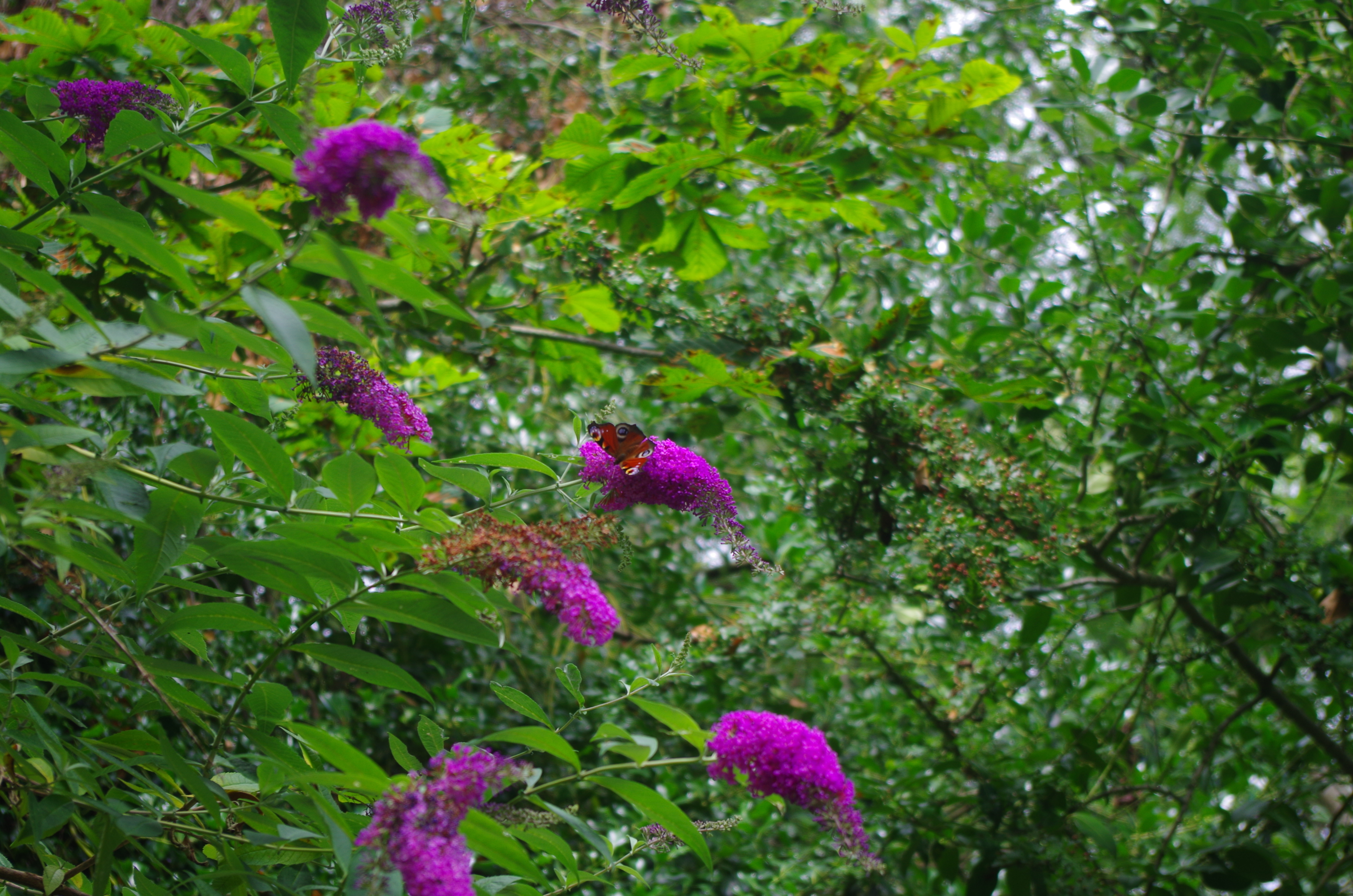
As it was a self-guided tour I had time to admire the summer wildflowers which were growing in profusion. Cemeteries are good places to find these; Acanthus, ragwort, verbena, Ladies Bedstraw, Vipers Bugloss, Rosemary Willowherb and also a buddleia in full bloom studded with Peacock butterflies on Faraday Path.
Peacock tucking into a Budleia blossom on Faraday path.Viper’s BuglossAcanthus
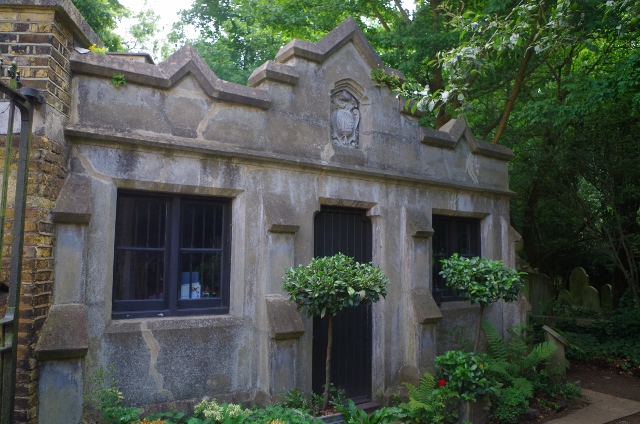
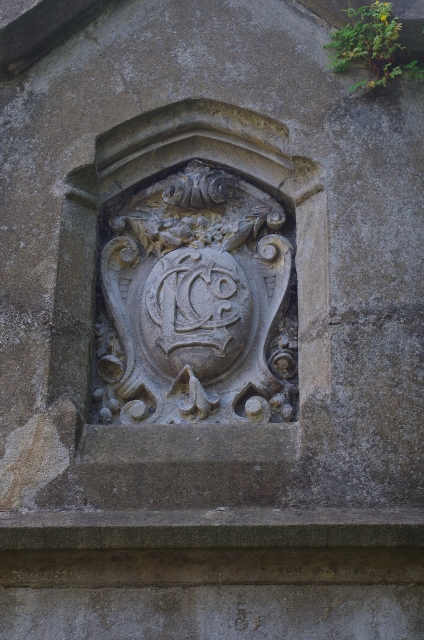
A sidepath from the Circle led me along another path which I’d not previously seen. The atmosphere seemed different and it was certainly darker, perhaps due to a thicker tree canopy, as I walked along it to a gate at the other end. This would have originally opened onto Swain’s Lane and there was what appeared to be a former gatekeeper’s lodge nearby. It still bore the monogram of the London Cemetery Company who were the original owners of Highgate cemetery. Time slips have been reported along this path and I wondered if it was the gate through which a man is reported to look out at unwary passers-by.
A possible former gatekeepers lodgeThe monogram of the London Cemetery Company
I retraced my steps towards the magnificent Egyptian Avenue one of Highgate’s highlights. Tom Sayer’s monument lay to my right with his faithful dog, Lion, eternally keeping guard and then the Sleeping Angel. This is dedicated to Mary Nichols who was a Londoner who died in 1909 from heart failure and diabetes. It’s a lovely tribute.
Lion guarding the gave of bare knuckle fighter Tom SayersThe Sleeping Angel on top of Mary NicholsThe Acheler memorial
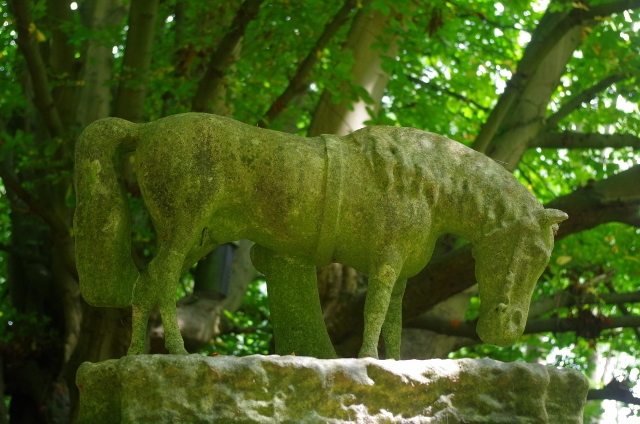
The horse on top of the Acheler memorial records John Acheler who became wealthy and well known as a ‘Knacker’. He called himself ‘horse slaughterer to Queen Victoria’.
The Egyptian Avenue!
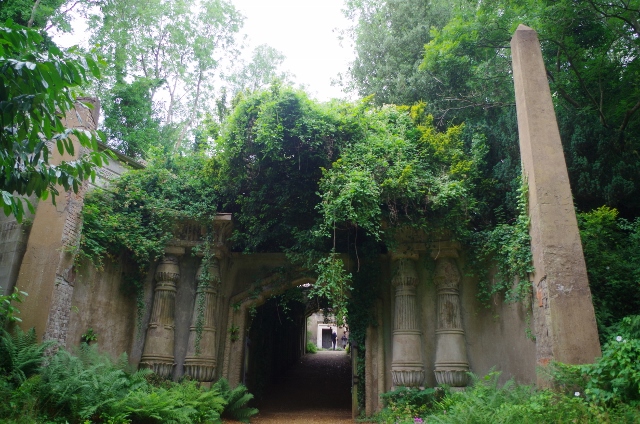
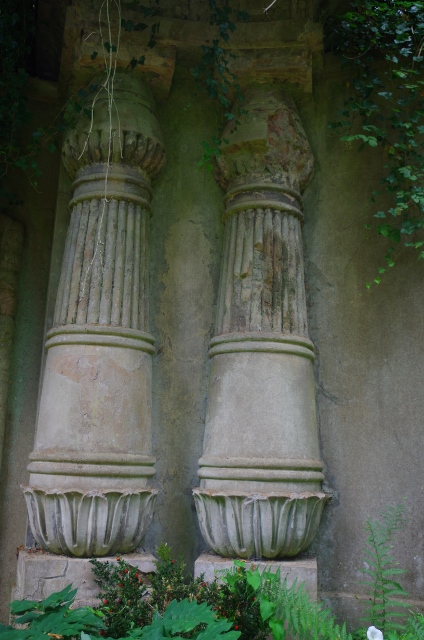
And then the Egyptian Avenue! The centrepiece of Highgate West in my opnion. It may be looking a little tired but it’s a magnificent example of how the Egyptian explorations of the 19th century influenced funerary architecture. Note the two large obelisks flanking the entrance and the stylised lotus flowers on the columns as you enter through the arch and into the passage that will take you into the lower tier of the Circle.
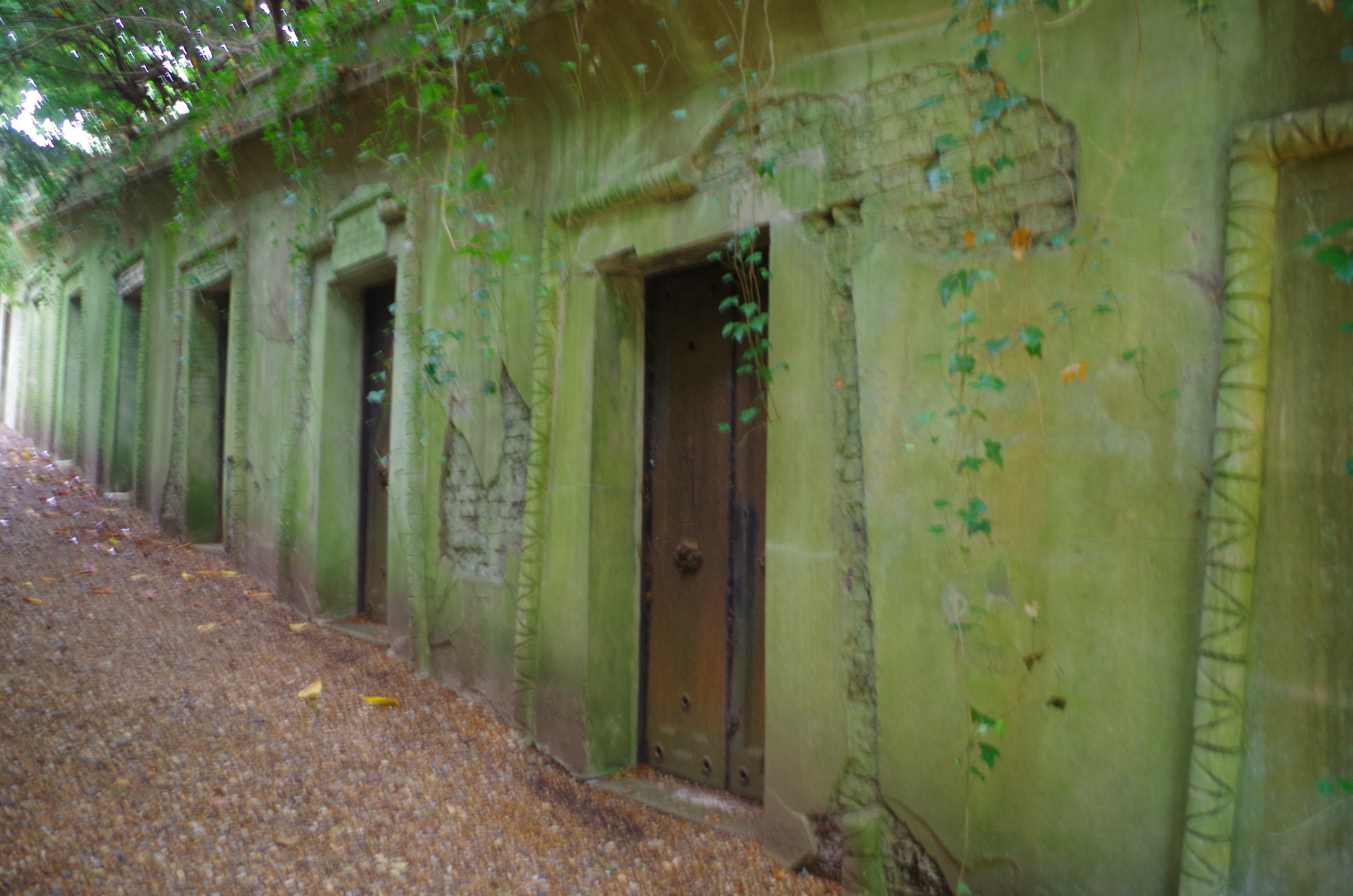
The Avenue was also a catacomb but they were never really popular as other London cemeteries soon realised. After all if Highgate couldn’t sell all theirs then who could? The passage contains 16 vaults on either side which were each fitted with shelves to hold 12 coffins. These were bought by individual families for their own use.
The passage from the Avenue entrance into the Circle of Lebanon.The vaults on either side of the passage.The Circle of Lebanon as you emerge from teh Egyptian Avenue.
By then I thought it was time to explore the East cemetery while I still had the energy.
Wildflowers were also in profusion here: clover, bird’s foot trefoil and vetch Butterflies flew about on the heat of a late summer afternoon.
Bird’s Foot Trefoil – Highgate East
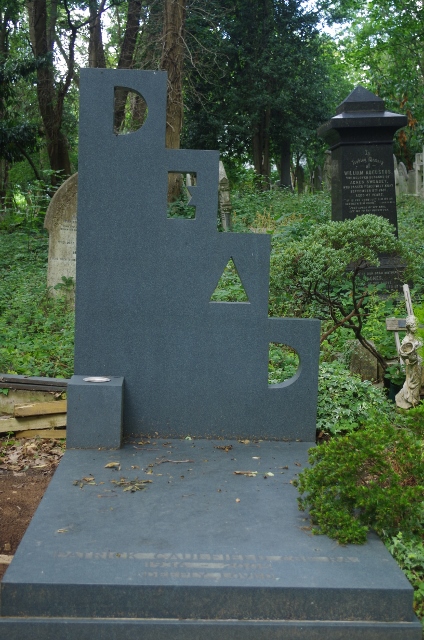
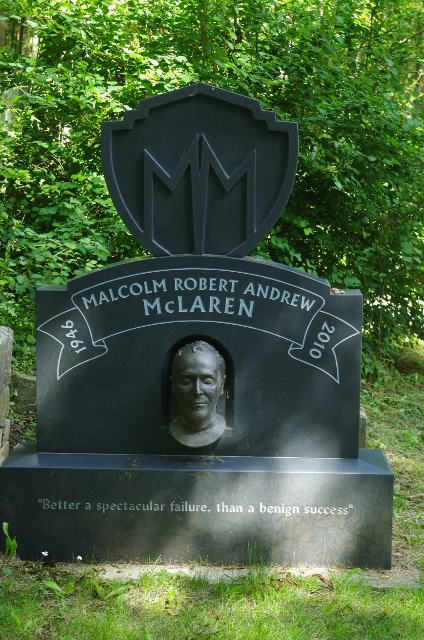
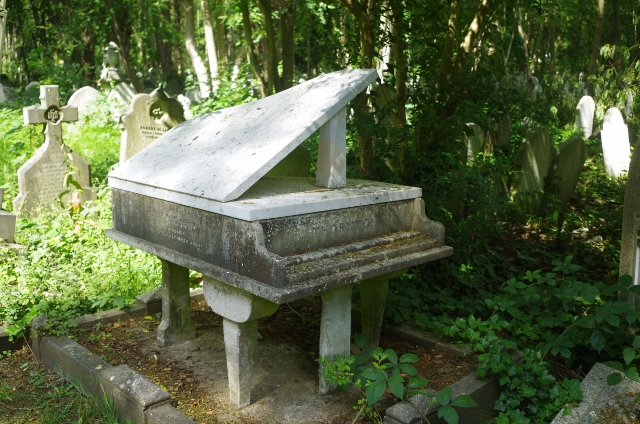
I saw my favourites; Jeremy Beadle, Malcolm McLaren, Karl Marx and Patrick Caulfield. There was also the grand piano dedicated surprisingly enough to a pianist, Henry Thornton, who died in 1918 during the ’flu epidemic.
Jeremy Beadle – Highgate EastPatrick Caulfield – a sense of humourMalcolm MclarenHenry Thornton, a pianist
The East side isn’t as overgrown as the West side and as I explored further I found a memorial which highlighted a dog. This was dedicated to Ann Jewson Crisp and her faithful dog Emperor.
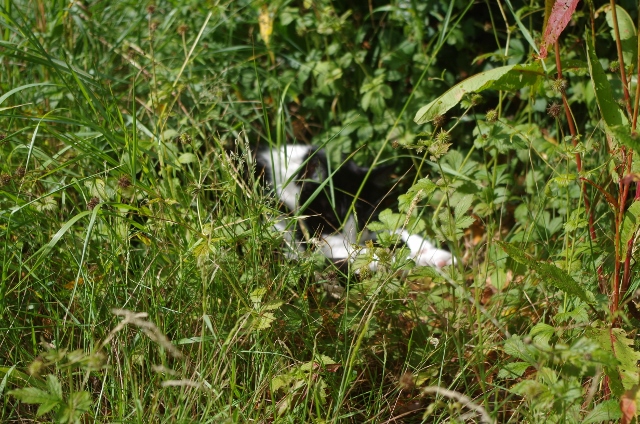
But as I left the East side I spotted another of its more celebrated residents settling down for a siesta behind the Great Train Robber, Bruce Reynolds’, memorial. It was a cemetery cat who was soon hidden deep in the grass and I didn’t want to disturb him or her. What a playground!
A cemetery cat having a kip in the last afternoon sunshine.
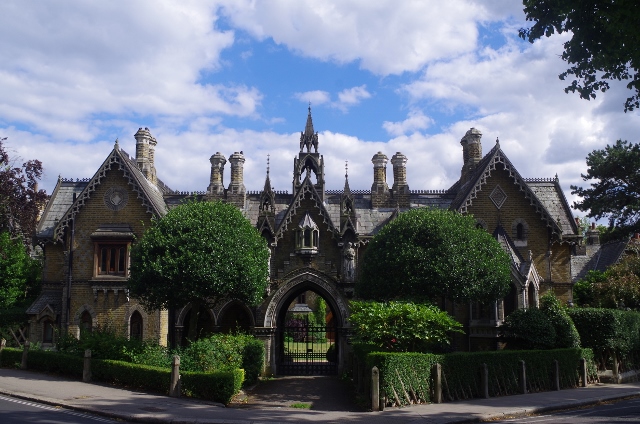
As I left the East Cemetery and walked down Swain’s Lane to Archway tube station I still had time to admire my ideal des res – Holly Village – which was built by Victorian philanthropist, Baroness Angela Burdett-Coutts. It is said that she planned it with Charles Dickens. She built the Burdett-Coutts Memorial Sundial in St Pancras Old Burying ground.
The skull and crossbones. One of the central motifs of 18th century Memento Mori and intended to be a stark and macabre reminder of the viewer’s inevitable destination. This would be all that would remain of you after death.
However it wasn’t a very comforting message to either the loved ones left behind or to the living.
But fashions and tastes change, even in funerary symbolism, and the skull and crossbones had served their purpose.
Instead they were replaced by the winged soul. This consisted of a small child’s head flanked by a pair of wings or a garland of leaves. They have the faces of babies with big, round eyes, plump cheeks and pouting lips and resemble Renaissance putti which are child-like. Putti represent the sacred cherub as they are known in England.
The winged soul may have been intended to be a more comforting image as the wings represented the soul of the deceased ascending to heaven. This could also give hope of a resurrection to those left behind. According to headstone symbols:
‘In the USA the winged soul is known as a soul effigy.’
It was immensely popular and in my explorations of medieval Kent churches and their churchyards I found many examples. In fact, in one or two churchyards they outnumbered the skull and crossbones symbol. They mainly had one winged soul on a headstone but there were sometimes two or three clustered together as in these examples:
In addition, every mason seemed to have his own interpretation of feathers as they can be carved as typical fluffy feathers, resemble broad leaves or be very stylised.
With wings in general they are an important symbol of spirituality. They express the possibility of flying and rising upwards to heaven. For example, in the Hindu faith, they are:
‘the expression of freedom to leave earthly things behind…..to reach Paradise.’
New Acropolis
However, as the full flowering of the Victorian language of death in the 19th century began to appear the emblems of memento mori were retired. Although a couple, such as the hourglass and ouroboros, were revived. But I did find two modern examples of the winged soul in the churchyard of St Martin of Tours in Eynsford, Kent.
I had always previously thought of the winged soul as being a more general symbol and just a decorative feature. I called them winged cherub heads or death heads and never considered that they might have had a specific meaning or purpose. It was exciting to see so many variations and interpretations sometimes within the same churchyard. But it depended on the skills of the mason as to how well they were carved and whether they were 2 dimensional or 3 dimensional.
But as a message of comfort it is one of the most poignant in memento mori. The other central motifs emphasise time running out, think about your life now and this is all that will be left. The winged soul suggests an eternal life and a more uplifting message.
When out exploring large Victorian cemeteries you may see the welcome sight of an empty chair on top of a grave. However, please don’t give into the urge to perch yourself on it for a quick rest but instead, ponder on its meaning.
An empty chair is intended as a reminder of loss, absence and a memory of someone dear who has now gone.
It’s one of the most poignant symbols of loss and is a staple of old Hollywood movies and also some soap operas. There’s a large family gathering, preferably at Christmas, and everyone’s round the table. Then, in the middle of all of the jollity, the camera pans down to an empty space set with cutlery and china and a vacant chair. Then it all grows quiet as everyone looks at it and remembers the absent family member.
Douglas Keister has suggested that these memorials can often be found on childrens graves with a tiny pair of shoes attached and one usually on its side. He considers that they are obviously associated with the death of a child or young person and, in his book, Stories in Stone, he cites a poem by Richard Coe, Jr that appeared in Godey’s Lady’s Book in January 1850.
THE VACANT CHAIR
by Richard Coe, Jr.
When we gather round our hearth,
Consecrated by the birth
Of our eldest, darling boy,
Only one thing mars our joy:
‘Tis the dreary corner, where
Stands, unfilled, the vacant chair!
Little Mary, bright and blest,
Early sought her heavenly rest.
Oft we see her in our dreams
Then an angel one she seems!
But we oftener see her, where
Stands, unfilled, the vacant chair.
But ’twere sinful to repine;
Much of joy to me and mine
Has the gentle Shepherd given.
Little Mary is in heaven!
Blessed thought! while gazing where
Stands, unfilled, the vacant chair.
Many parents, kind and good,
Lost to them their little brood,
Bless their Maker night and day,
Though he took their all away!
Shall we, therefore, murmur, where
Stands, unfilled, one vacant chair!
Little Mary! angel blest ‘
From thy blissful place of rest,
Look upon us! angel child,
Fill us with thy spirit mild.
Keep o’er us thy watchful care;
Often fill the vacant chair.
There is also a famous Civil War ballad dedicated to an 18 year old, John William ‘Willie’ Grant who was killed at Balls Bluff, Virginia in October 1861. This also mentions ‘the empty chair’ in the context of a departed loved one.
I haven’t yet seen one dedicated to a child or young person in my explorations of UK cemeteries. Instead, the examples that I have seen are dedicated to adults both men and women. But I’m sure that I will see one dedicated to a child sooner or later.
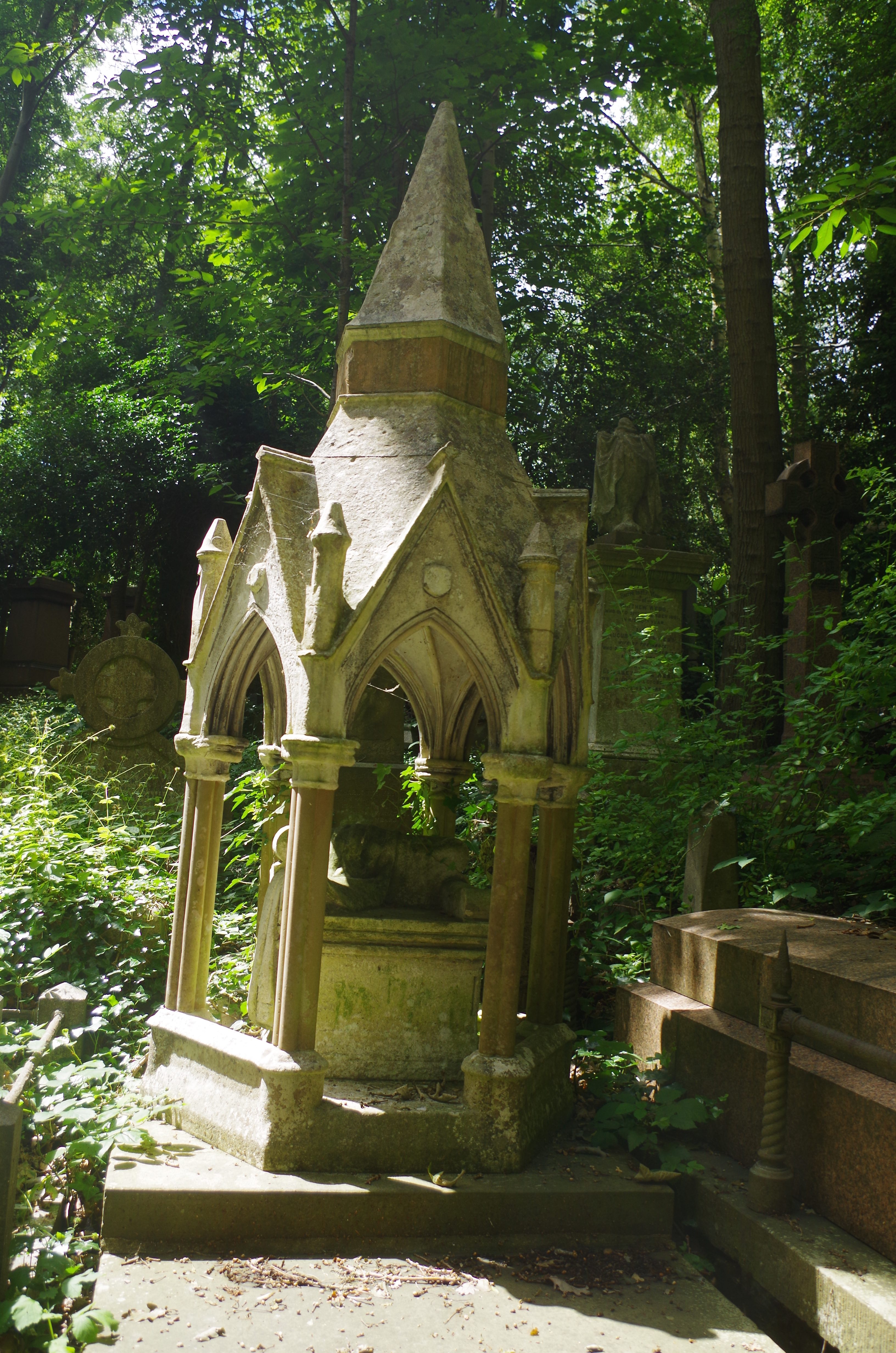
This is in Highgate West Cemetery in London and is dedicated to Mary Emden (1853-1872). She was a 19 year old soprano who died young of TB. Mary’s real name was Marie and she and her husband, Walter, had only been married a year and a glittering career would have lain ahead of her. He was a successful architect of theatres and these include the Royal Court, the Garrick and the Duke of York’s theatres which are still standing today. Mary’s chair sits under a Gothic canopy with a sculpted stole draped across it as if she had just got up out of the chair and left it there intending to return. To read more about Mary’s life please visit: https://misssamperrin.blogspot.com/search?q=mary+emden
These come from Kensal Green Cemetery in London and are on the graves of two distinguished men.
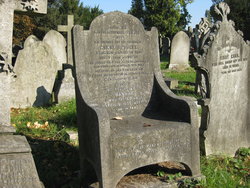
This is almost a magnificent throne it’s so large! Sadly the epitaph is long gone although there appears to be a coat of arms at the top. I have been told by the Friends of Kensal Green that it’s dedicated to Charles Middleton MP. However the only Charles Middleton MP that I have found so far died in 1813 which is long before Kensal Green Cemetery was created. But it is so imposing and dramatic. When things are easier I will go back and see if I can get a better picture of the coat of arms as that may help.
This elegant chair is on the grave of Henry Russell and his wife Hannah. He was a prolific composer and one of his most celebrated works is still performed today. He was born in Sheerness on Sea in Kent which seems appropriate for the composer of ‘A Life on the Ocean Wave’. Henry grew up in the Anglo-Jewish community of Blue Town and he started his musical carer early at the age of 3. However, at 10 he was working in a local apothecary’s shop. This didn’t last long as it’s rumoured that he
‘gave a customer sufficient Epsom Salts to bring down an elephant’ www.jtrails.org.uk/trails/henry-russell-and-life-on-the-ocean-wave-at-sheerness
Clearly the apothecary shop wasn’t his calling in life. But music was in his blood and, after his voice broke, he travelled to Italy to study under Rossini. On his return to England he took up the post of chorus master at Her Majesty’s Theatre.
Henry Russell. Print shows Henry Russell, half-length portrait, facing slightly right, with right hand resting on piano keyboard, open sheet music in the foreground and a shipwreck on storm tossed waves in the background. Includes six lines of text from poem “Wind of the winter night, whence comest thou?” Shared under Wiki Commons.
But America was tempting him and it was there that he would discover his songwriting talent. He would also be able to collaborate with the songwriters and poets who would provide him with the lyrics that he set to music. He arrived in Rochester, New York and became an organist and choirmaster at the First Presbyterian Church.
In total he composed 800 songs and another of his most well-known ones is ‘Woodman Spare That Tree’ which was based on an incident in the lyricist, Charles Wood’s life. Russell also collaborated with such luminaries as Longfellow, Tennyson, Dickens and Thackeray. However it was Dickens who re-arranged another of Russell’s well known compositions ‘The Fine Old English Gentleman’ into a parody and satire based on the Tory government at the time. You can read it here: https://www.theguardian.com/books/2012/may/14/charles-dickens-gentlemen-poem-week
But with no copyright protection Henry didn’t reap the rewards of his success and instead it was the publishers that made the money. He had already lost the £10,000 that he had made in America by investing in the United States Bank which collapsed and took all its investors’ money with it. However t was Henry’s performing that brought in the money as he was immensely popular.
Many of his works deal with social issues of the day such as slavery or private mental asylums and he raised over £7000 for victims of the Irish Famine. He returned to England in 1844, married twice and gave his final performance in 1891 when he sang at a concert given in his honour. Henry had 5 sons, two of whom followed him into the musical profession. Sir Landon Ronald Russell (1873-1938) became a conductor, pianist and composer and Henry Russell (1871-1937) who was an opera impresario.
Is it a coincidence that two of the empty chairs are on the graves of theatrical people? The throne would have suited Macbeth! I found Mary Emden’s memorial to be the most poignant with the air of someone who had just left.
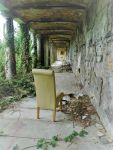
However there is a sinister side to the empty chair. They often appear in urban explorer photos of derelict hospitals and asylums. In these, for some reason, the chair looks menacing and if it’s lying in wait……….these two photos again come from Kensal Green and were taken by cemetery photographer, Jeane Mary. An elegant chair in the middle of decay and dereliction why is it there? A prop for a photo shoot? A discarded piece of furniture?
As I was writing this post I saw a series of photos by a photographer on the Folk Horror Revival Facebook page. She had been out walking on a lonely moor and found a recliner style armchair sitting in the middle of nowhere. It could have just been just dumped there but it seemed a long way to go to do that. The photographer emphasised that she had decided not to sit in it and it did look very creepy in her photos.
Next time I visit Kensal Green I may well be tempted to sit in the throne. I only hope that it’s not already occupied……
However there is a sinister side to the empty chair. They often appear in urban explorer photos of derelict hospitals and asylums. In these, for some reason, the chair looks menacing and if it’s lying in wait……….these two photos again come from Kensal Green and were taken by cemetery photographer, Jeane Mary. An elegant chair in the middle of decay and dereliction why is it there?
A prop for a photo shoot? A discarded piece of furniture?
As I was writing this post I saw a series of photos by a photographer on the Folk Horror Revival Facebook page. She had been out walking on a lonely moor and found a recliner style armchair
sitting there in the middle of nowhere. It could have just been just dumped there but it seemed a long way to go to do that. The photographer said that she had decided not to sit in it and it did look very creepy in her photos.
Next time I visit Kensal Green I may well be tempted to sit in the throne. I only hope that it’s not already occupied……
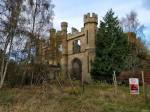
On windy nights, the derelict and romantic ruin that is Crawford Priory is reputed to have a familiar visitor. A wandering spirit walks through the estate which she once owned accompanied by a retinue of the per animals that she knew and loved. This is the ghost of Lady Mary Lindsay Crawford who is rumoured to walk the grounds when the wind is high.
Is she keeping a watch on the crumbling building or her crypt which is a mile away. Or does she see the Priory as it once was with its fine furnishings and decoration and a butler opening the front door to visitors as she, smiling, descends the sweeping staircase to meet them?
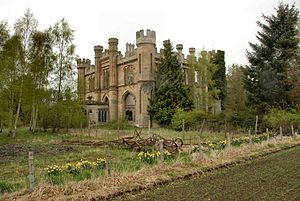
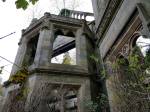
Deep in the Fife countryside lies the shell of a derelict, once grand country house. For over 25 years it has been abandoned to nature which is fast obscuring it from memory and the world. Ivy and saplings have thrust their way through broken windows and doors and a fire in 1995 was the final indignity. In 1997 its current owner applied to have it demolished but it may just eventually fall down by itself.
The cawing of crows or the wind whistling around what’s left of the Gothic styled Crawford Priory are the only sounds that the casual visitor will hear now.
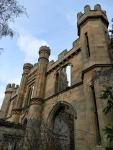
However, it was never actually a priory and no religious order ever lived there. But the name went with the romantic Gothic touches such as the pointed windows and the battlements and so it became one.
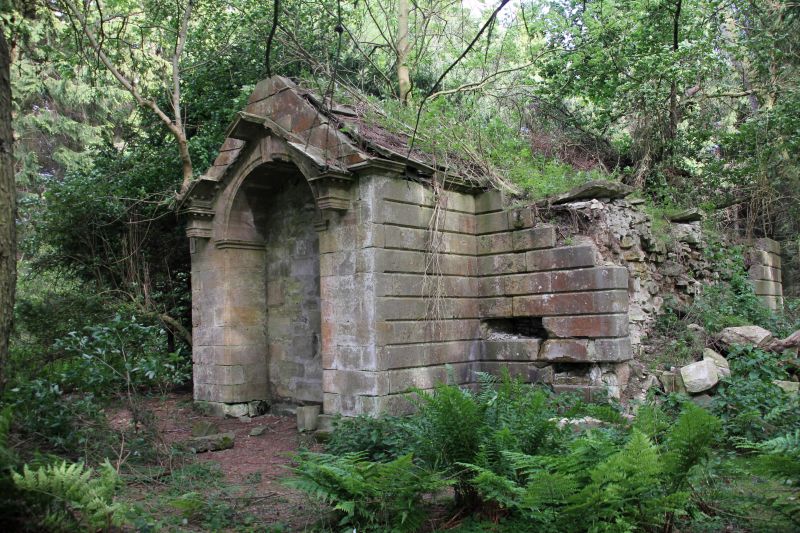
A mile away near Lady Mary’s Wood lies an equally ruinous crypt dedicated to the Priory’s creator and the last of her line, Lady Mary Lindsay Crawford. From urban explorers websites, the last great recorders and finders of the abandoned, the crypt is in no better state than the Priory. Its door is now bricked up although a hole has been made in it and the crypt is falling in on itself. The pet cemetery is rumoured to be still there but I haven’t seen any photos of that while researching this article.
To add to the romance of the place there is also a belief that the pale wraith of Lady Mary drifts across the site as she gathers her pet animals around her. She had the crypt built so that she would always have a good view of the Priory even in death.
I am indebted to a Facebook friend who lives in Scotland with her family. They like to go out and explore the local countryside and share their photos and adventures online. They have been kind enough to give me permission to use their photos to illustrate this article. Crawford Priory was a real gem as it’s the sort of place that I would like to explore myself.
Crawford Priory was originally merely a hunting lodge built by the Earl of Crawford in 1756 and then completely remodelled in the then fashionable style in the early 1800’s. Lady Mary employed well known architects of the time to create it. She died in 1833 and was known as a reclusive, religious woman. The pet cemetery was also created by her to remind her of her favourite animals. They flocked to her and she was frequently attended by tame foxes, birds, dogs, cats and even a pet deer. However, I have been unable to find any images of Lady Mary but she must have been formidable as well as kind. There is a tombstone near the outer wall of the Priory dedicated to a pet deer which is what caught my attention and intrigued me enough to research further.
Lady Mary lived alone, except for her servants, and administered a large country estate as well as the Priory. This included limestone kilns, coal mines and farms amongst other business interests. This was remarkable in the 19th century for a woman alone.
This keen business sense and her managerial abilities led to Lady Mary being regarded as odd and her obituary, according to alex cochrane’s blog, considered her eccentricities as
‘lean’d to the virtue’s side for the cause of humanity .’’
Also, according to adcochrane, a distant relative of the family, quotes from one of Lady Mary#s letters on his blog, in which she says:
‘this hall is raised under bad and awful auspices ‘
and then goes onto to describe how her dog:
‘howled in the most dreadful manner in the next room to the new building…yet in spite of its cries would not leave the dining-room’
It sounds like a page from a Gothic novel as the heroine eats her dinner at a candle-lit dining table while her dog howls and the wind picks up speed around the battlements.
Lady Mary left generous bequests to the local poor, friends, servants and her animals. The Priory then came into the possession of the Earls of Glasgow and the Cochranes The photos on adcochrane’s blog and now in the possession of the Royal Commission on the Ancient and Historical Monuments of Scotland (rcahms for short) reveal how lavishly decorated The Priory’s interior was:
‘The grand hall was magnificently decorated with fan vaulting and hanging pendants; suits of armour stood under canopied gothic niches; medieval style stained glass lit the hall. The drawing room and morning room opened off a rib vaulted chamber decorated with gargoyles, both with gothic fireplaces inlayed with coloured marbles. The principal staircase…was decorated with gilded armorial panels and armorial stained glass of the Earls of Glasgow.” adcochrane
ADcochrane also goes onto recall that
‘The grand bedroom was hung with panels of wallpaper depicting the life of Psyche from the ancient Latin story by Apuleius.’
He adds that in 1990 a lot of the internal decoration was still there but now it’s all gone. Even the sweeping staircase has finally collapsed. To see archive photos of the Priory in its glamorous heyday please visit his blog:
Eventually the Priory became just too expensive to maintain like many country houses. They usually required a retinue of servants to maintain them and after the Second World War these were in short supply. Adcochrane adds that both his godfather and cousin remembered exploring huge unused rooms and clambering about dusty piles of trunks.
In the 1960’s the Prior needed an expensive and major restoration but this never happened. No use has been found for it since and so it was left to lie empty until it fell into its current state.
If Lady Mary does walk in her wood and the Priory grounds then one hopes that she sees the Priory as it was and not how it is now.
Pottering about cemeteries, burial grounds and graveyards as I do while undertaking research can often lead to unexpected discoveries. As I search for symbols and epitaphs, and the occasional wildlife, I often find unusual names recorded on headstones and memorials, They’re often names that you don’t see every day and so, if you’re a writer like myself, cemeteries can often provide inspiration for naming characters especially if it’s a historical piece.
So here is a small selection from St Mary’s churchyard, Riverhead, near Sevenoaks, Kent that I saw earlier in February 2019 on a lovely Spring like day, Crocuses and snowdrops clustered around the headstones and seeing a name like Mercy Bellchambers on a headstone felt really appropriate. Now that’s a name really crying out to be used in a historical novel…..
























![Butterfly & Chinese wisteria by Xu Xi Early Sing Dynasty c970. By Xü Xi (Scanned from an old Chinese book) [Public domain], via Wikimedia Commons](https://shadowsflyaway.blog/wp-content/uploads/2016/07/butterfly-chinesewiki.jpg)





































 shadows fly away