Animals increasingly appear on modern memorials and I’ve often wondered if they are a totem for the deceased or maybe they just like them or maybe they had a pet. Cats are very common and I’ve seen them either in 2D carved on a headstone or in 3D form as a small statue.
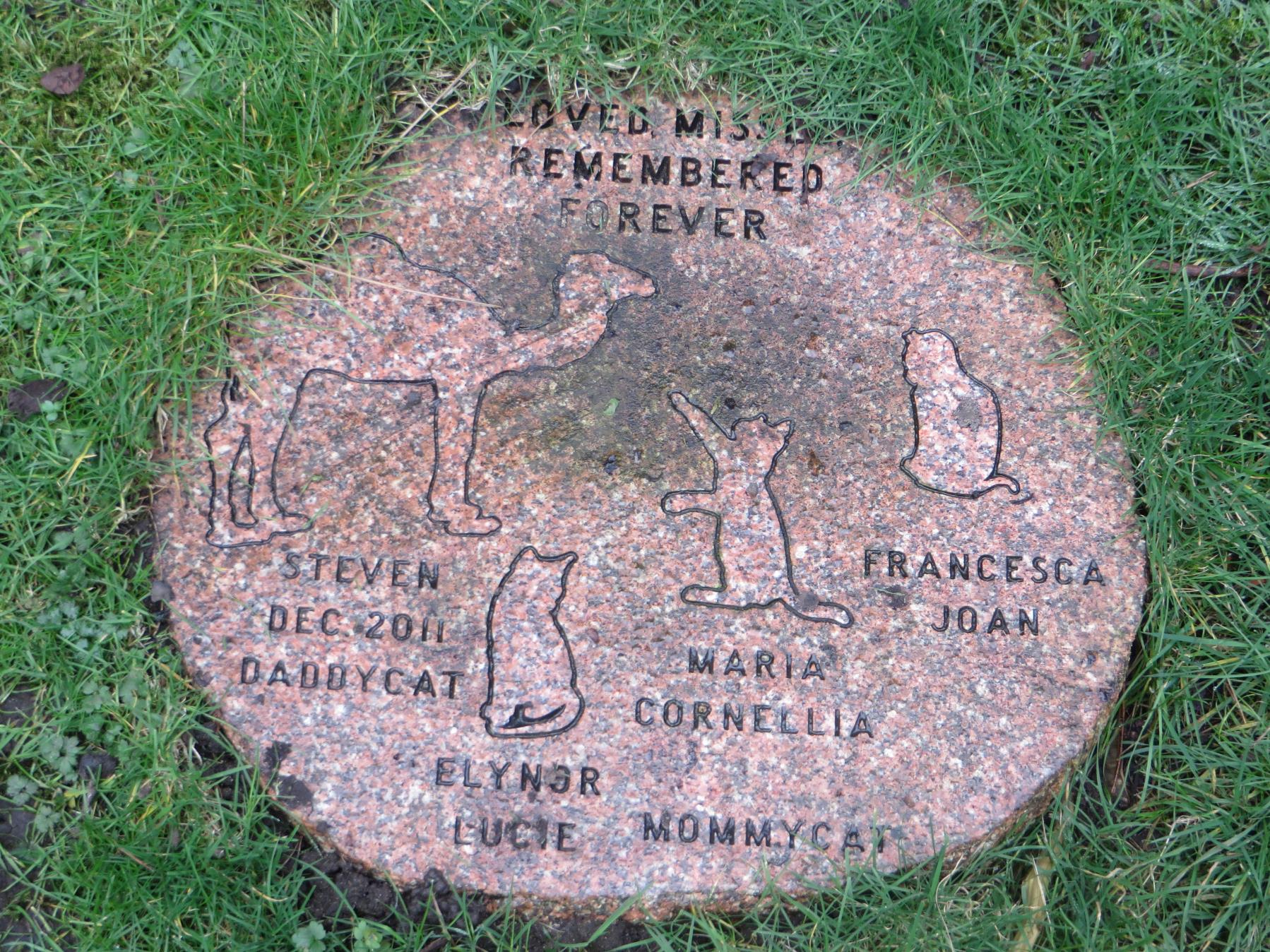
But this one is unusual as it’s very personal, almost in a code, and is on a memorial stone in Brompton Cemetery’s Garden of Remembrance. Most memorial stones are small and people use calligraphy or a very small motif due to the limited size. The family name isn’t stated on this stone and the images are almost playful.
I was lucky enough to meet the widow of the man commemorated on the plaque. She is Maria Kacandes-Kamil and the mommy cat represented her. The two her cats were her daughters and the camel depicted her husband, Steven, who died in 2011. The significance of the camel is a reference
to the family name (you may have guessed it already) which is Kamil. Also note that the mommy cat, Maria, is pointing at the camel to possibly denote the marital bond.
It was lovely to find a modern memorial which had a touch of humour as well as being very personal.
How many casual passer-bys like myself would have guessed the significance of the animals?
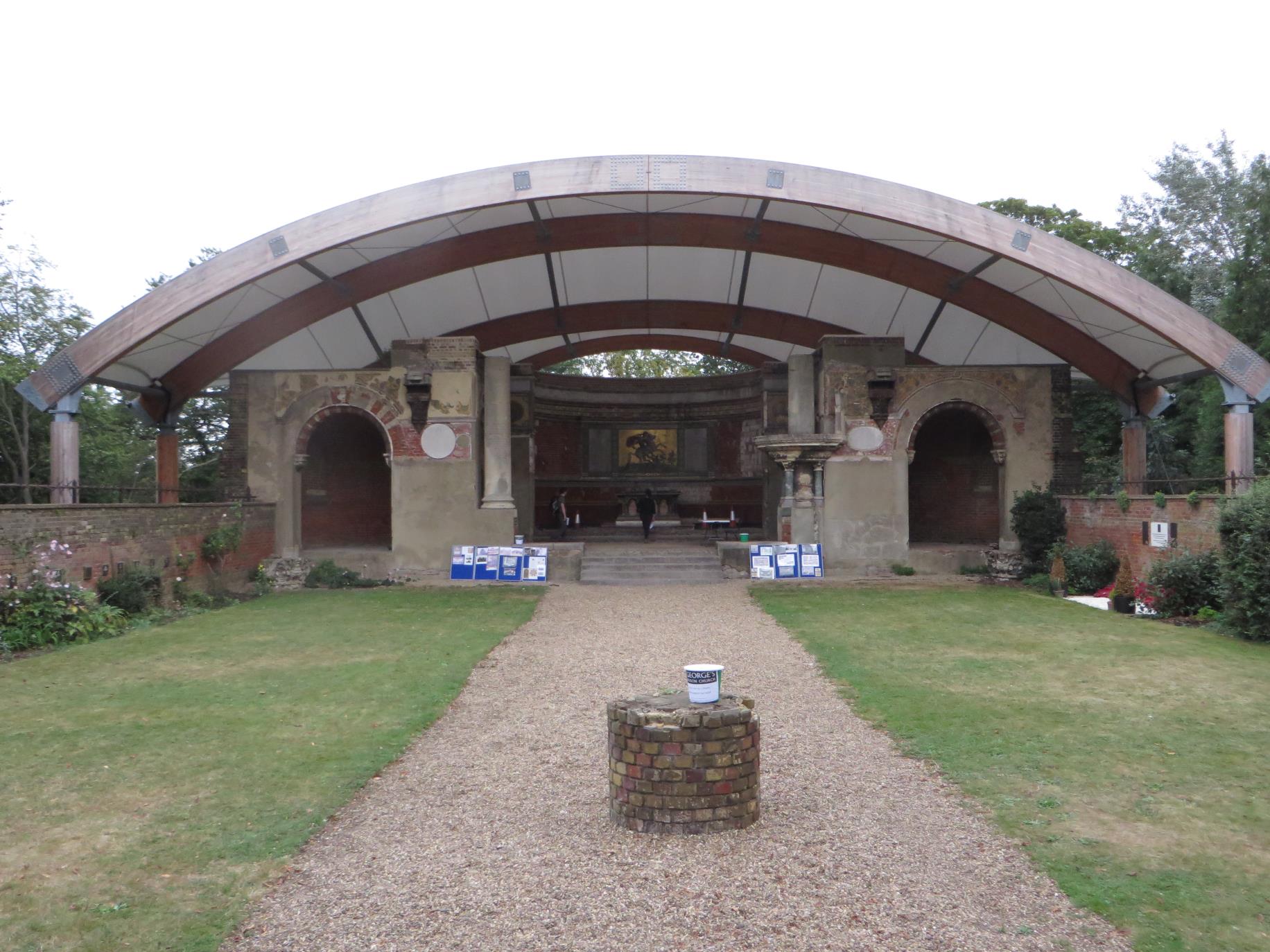
For years a romantic ruined church fascinated me whenever I saw it from the bus as we sped along Grand Depot Road in Woolwich. There seemed to be no reason for it to be there, standing quietly under spreading trees with an unlovely corrugated roof over part of it and no sign nearby. Sometimes I could see what I thought was a large mural at the very back of it and always meant to get off and have a closer look. Then the bus would move on and I would forget about it again.
Exterior view of St George’s which doesn’t indicate of the riches inside Shared under wiki Creative Commons
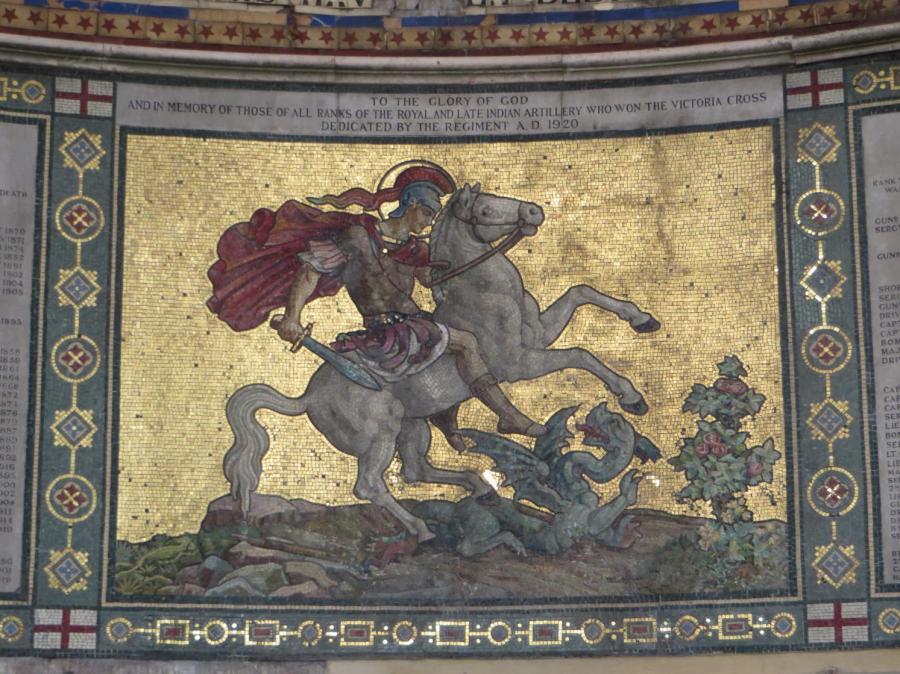
So it wasn’t until 2017, on an Open House weekend, that I finally visited it and discovered what makes this church, or what’s left of it, unique. The mural was actually a mosaic and one of the glittering, restored mosaics which is assumed to have been made by a famous workshop in Venice. They are the survivors of an interior which was once richly decorated with them. But why are they here in SE18?
The marching feet of the parade ground may have now become the marching feet of commuters on their way to the DLR but there’s still many reminders of Woolwich’s military past to be found. The church’s official name is St George’s Garrison Church and it was built to serve the Royal Artillery. Once an important and landmark building that could hold 1700 people inside, it didn’t always sit in solitude. When it was originally built in 1862-63 in the Italian-Romanesque style it was part of the Royal Artillery barracks with the parade ground before it.
St George’s in its heyday in front of the parade ground and showing its rose window.
Source unknown.
Interior view of St George’s Garrison Church, Woolwich, South East London, shortly after its completion in 1863. The drawing appeared in The Illustrated London News.
Sahred under Wiki Creative Commons. This is in the public domaIn in the USA.
St George’s was built as many other garrison churches, hospitals and barracks in response to the outcry about soldiers living conditions after the Crimean War of 1853-1856 and to improve the ‘moral wellbeing’ of the soldiers.
However, St George’s decline began in the First World War when it was bombed and its rose window destroyed. But, on 13 July 1944, a flying bomb started a fire that gutted the interior. During the 1950’s there were suggestions about it being rebuilt but these came to nothing. The widening of the Grand Depot Road in the 1960’s finally separated St George’s from the parade ground and it has sat marooned ever since.
Exterior view of St George’s which doesn’t indicate of the riches inside Shared under wiki Creative Commons
The upper levels were demolished during the 1970’s and the church became a memorial garden. This is when the functional corrugated roof was placed over the mosaics. The Royal Artillery moved to Wiltshire in 2007 and so they will forever be apart.
The corrugated roof has been replaced by a much more attractive canopy. However The Friends of St George’s Trust information leaflet warns visitors:
‘not to stand beyond the altar, the apse and to be ‘careful of fragile/falling fabric as you explore the sanctuary and chapel.’
That sounded scary but I was careful as I didn’t want to become one of the residents of the memorial garden just yet.
But it was the large central mosaic of St George and the Dragon that attracted me. I’ve always been fascinated by mosaics and have seen many in cemeteries. After years of glimpsing it from a bus it was wonderful to be able to see it close up and to admire the quality of its workmanship. According to the Friends of St George’s Trust website:
‘the mosaics are thought to be based on the Roman and Byzantine mosaics in Ravenna, Italy. St George and the Dragon and those around the chancel arches are assumed to have been made in Antonio Salviati’s workshops in Venice.’
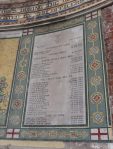
But who is Antonio Salviati? The St George and Dragon mosaic form the centrepiece of the impressive Victoria Cross memorial behind the altar. This was funded by subscriptions in 1915 with no expense spared. The importance of this monument, dedicated to the 62 Royal Artillery men who received the prestigious VC, is emphasised by the fact that they went to one of the 19th century’s leading Italian glassmakers to create it.
Antonio Salviati shared under wiki Creative Commons. Th is is in the public domain in the USA.
Antonio Salviati (1816-1890) is considered to be one of the leading figures in 19th century glassmaking. Originally a lawyer, he became involved in the restoration of St Mark’s Cathedral in Venice. This led to him becoming interested in glassmaking and establishing his own factory. Salviati also re-established the island of Murano, near Venice, as a major centre of glassmaking and it still has that reputation today. He also created a European interest in brightly coloured pieces of Italian glass as decorative objects. Salviati’s factory soon began receiving commissions from France and England and it’s credited with creating the mosaic glass on the altar glass of Westminster Abbey and part of the Albert Memorial. There are also other surviving works in many churches and cathedrals in the UK.
Restoration work on St George’s mosaics was carried out in 2015 and funded by the Heritage Lottery Fund. Although some of the tesserae from the mosaic – these are the small blocks of stone, tile, glass or other material used in its the construction – are missing, the conservators made the decision not to replace them
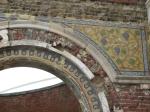
The chancel mosaics feature birds and vines. The lovely peacocks are appropriate symbols of immortality and rebirth and vines for abundance and as reminders of Christ and his followers. (see Symbol of the Month – the vine for more information.) There are also phoenixes which are traditionally associated with rising from a raging fire and are an ancient symbol of Christian resurrection. It felt appropriate as St George’s is a remarkable survivor of Woolwich’s military past and has risen again. But it’s still a building at risk.
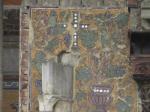
There are pieces of the church on site such as the capitals to two of the broken columns. These feature winged lions and winged griffins. I walked around the memorial garden and thought how lucky we were that its mosaics had survived for us to still enjoy.
St George’s remains consecrated and holds 4 services each year. It’s now open on Sundays and you can admire the newly installed iron entrance gates. Archive photos show what an imposing building it once was but imagine it when newly built as the sun shone through the rose window illuminating the beautifully decorated interior making St George and the Dragon dazzle.
Where do you go to grieve when there’s no memorial with which to remember them?
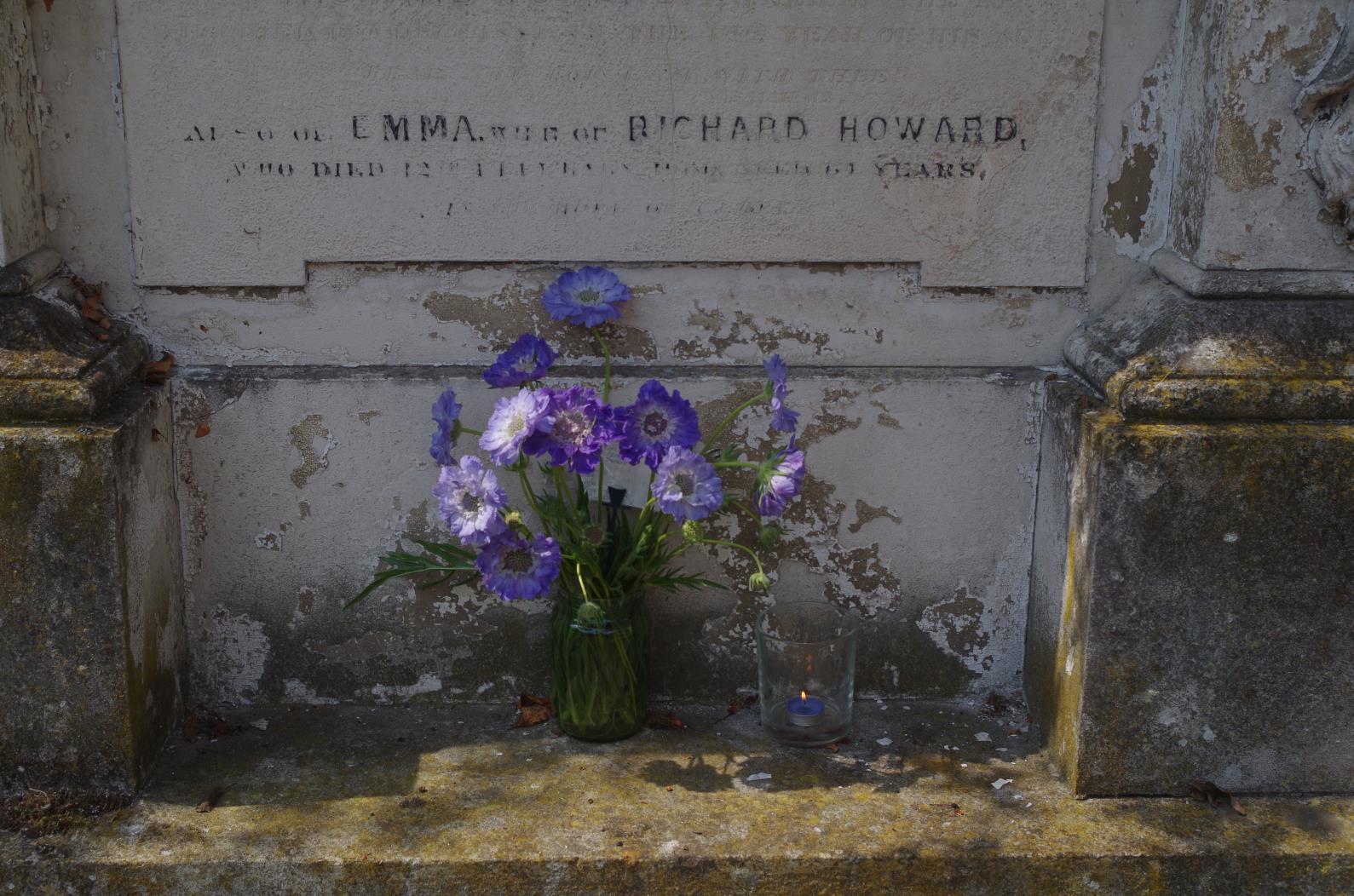
I can’t recall exactly when I first spotted the floral tribute in a jam jar placed on a ledge of the Howard monument in West Norwood Cemetery. The memorial is near the columbarium and over the last 2 or 3 years I began to make a habit of looking to see what flowers would be in the jam jar this time. There were never any accompanying cards or identification, just the flowers and sometimes a tea light. They were always fresh.
The bright colours of the flowers always stood out against the pale plaster on the monument behind them and often provided a wonderful photo opportunity.
The Howard monument is a handsome and large one with two magnificent downturned torches on each of its four sides and a fulsome epitaph above the flowers.
But who put them there? A mysterious mourner like the black clad visitor to Edgar Allan Poe’s grave? A descendant of the family marking a special day?
It was at the West Norwood Open Day in July 2018 I finally met the mystery mourner. As I walked past on my way to the columbarium, she was arranging a new bunch of flowers in their jam jar and we got chatting.
She was a local woman, let’s call her Mary, and was nothing to do with the Howards at all. Instead her flowers and tea lights commemorated a loved one who’d been cremated a long way away. We talked about where do you go to grieve if you have no permanent memorial or your deceased loved one is too faraway to visit.
She mentioned the mourning process and said that she used to come everyday but now it was less often. ‘It doesn’t mean that you don’t think about them but it’s not quite so raw. You start to move on.’ she said and added ‘You can get caught up in it.’ I mentioned Queen Victoria’s extended mourning period after Prince Albert died. At some point, at which only the mourning would know, they will become a cherished memory and the outward mourning begins to fade. I didn’t ask her why she’d chosen that particular monument but maybe she had her own reasons.
When my father unexpectedly died, it had been difficult for me to grieve as I had nowhere tangible to go and so, like Mary, I did adopt an angel in a nearby Victorian cemetery as my mourning place. There was something about being in a place where the outpouring of grief was unashamed and open with the need to have a permanent memorial that said I was here. It felt more appropriate that the neatly trimmed municipal cemeteries. I felt drawn to it although he’d never been there.
But the old cliché is true in that time is a great healer, life does go on and the dead live in our hearts in the ways in which we choose to remember them. With me I became a blood donor in my father’s memory as he had also been one.
One day Mary may no longer feel the need to leave a floral tribute to her departed friend and it will have served its purpose. I will miss passing the Howard monument to see what flowers are in the jamjar this time.
RIP Mary’s friend whoever and wherever you were. I hope you know that Mary always remembered you and that you were not forgotten.
Here’s another interesting piece from the BBC news website on murder memorials dating from the early 19th century. They are usually found in country areas as the victim and murderer would often be known to the community.
By Natalie GriceBBC News
26 October 2018
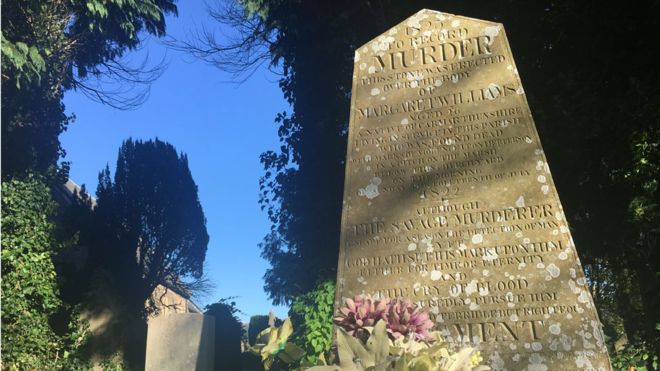
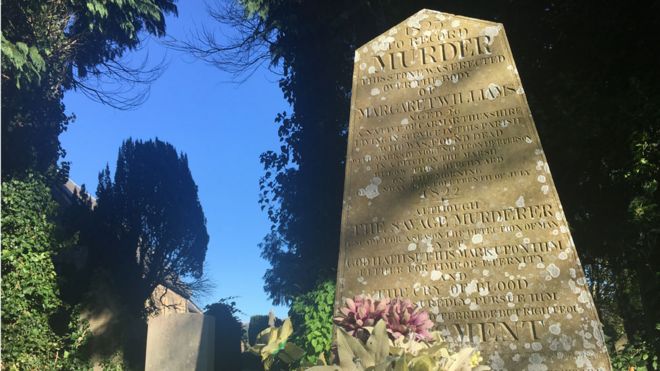
The tragic tale of Margaret Williams is hinted at on the stone which condemns her murderer
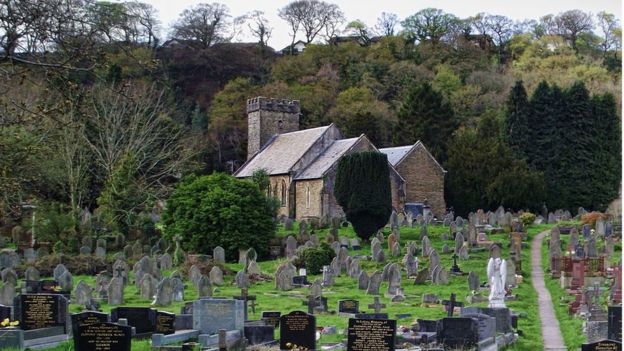
Wandering around the picturesque cemetery at St Catwg’s church in Cadoxton, Neath, a first-time visitor might be startled out of their gentle stroll by the stark message on top of one tall, weathered stone – MURDER.
This memorial in south Wales is one of a handful of “murder stones” erected around the UK, the majority over a period of about 100 years, to commemorate violent deaths that shocked the local communities.
The Cadoxton stone is dated 1823, and recounts the death of Margaret Williams, 26, who was from Carmarthenshire but was working “in service in this parish” and was found dead “with marks of violence on her person in a ditch on the march below this churchyard”.
Miss Williams’ story, such as is known from contemporary reports, tells of an unmarried young woman who had been working for a local farmer in Neath when she became pregnant.
Image copyrightCR LEWIS/GEOGRAPHImage captionThe peaceful graveyeard of St Catwg’s in Neath hides a harrowing tale in its midst
She had declared the father of the child was the farmer’s son, and when her apparently strangled body was discovered head down in a watery inlet in marshes near the town, he was the prime suspect.
But whatever local opinion may have believed, there was no evidence to tie him or anyone else to the crime, and her murder remained unsolved.
However, the murderer was left in no doubt as to the feelings of the local community after this stone, part gravestone and part warning, was erected over poor Margaret’s body.
Giving the details of her fate and the date of her death, the stone, erected by a local Quaker, continues: “Although the savage murderer escaped for a season the detection of man yet God hath set his mark upon him either for time or eternity, and the cry of blood will assuredly pursue him to certain and terrible righteous judgement.”
This unsolved killing is unusual in the history of the surviving murder stones in that the murderer escaped justice. Most of the other memorials are to people whose killers were quickly detected, sentenced and dispatched via the gallows.
Dr Jan Bondeson, a retired senior lecturer at Cardiff University and a consultant physician, has made a study of the history of crime alongside his medical career and has written a number of books on the subject.
He became interested in murder stones after editing a book which featured them.
He said: “The murder stone in Cadoxton is the only one in Wales. There are plenty of them in England.
“There was an instinct for the local people to erect them. There was a strong instinct to commemorate a tragic murder.”
Dr Bondeson has documented several further murder stones across the English counties, and one early example of the type in Scotland.
One murder stone has been immortalised by no less a writer than Charles Dickens himself. In the novel Nicholas Nickleby, the eponymous hero walks through the ominously named Devil’s Punch Bowl at Hindhead in Surrey.
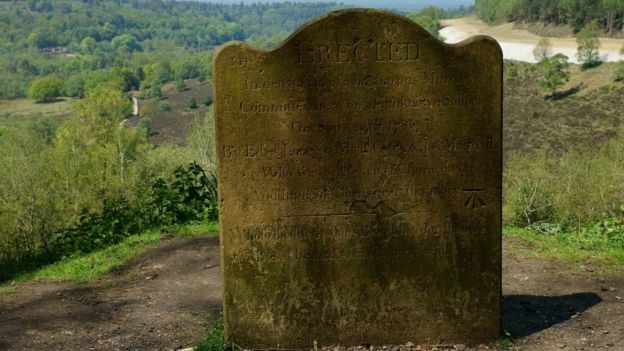
Image copyrightPETER TRIMMING/GEOGRAPHImage captionThe murder stone at the Devil’s Punchbowl, Surrey, features in Charles Dickens’ Nicholas Nickleby
There, he and his companion come across the real-life stone marking the 1786 murder of a man known only as the Unknown Sailor.
The unnamed man was en route to his ship in Portsmouth when he visited a local pub in Thursley. There he fell in with three fellow sailors, and paid for their drinks and food before leaving with them.
The sailor was repaid for his generosity in the following way: They “nearly severed his head from his body, stripped him quite naked and threw him into a valley”.
The three did not get far. The sailor’s body was found soon after, and James Marshall, Michael Casey and Edward Lonegon were chased and captured after trying to sell the dead man’s clothes at a pub.
They were hanged from a triple gibbet near the murder scene, and the unknown man was buried in Thursley with a stone paid for by local people.
But the local mill owner, James Stillwell, went a step further. He placed a stone in Devil’s Punch Bowl itself, with this grim warning to future generations:
“ERECTED, In detestation of a barbarous Murder, Committed here on an unknown Sailor, On Sep, 24th 1786, By Edwd. Lonegon, Mich. Casey & Jas. Marshall
“Who were all taken the same day, And hung in Chains near this place, Whoso sheddeth Man’s Blood by Man shall his, Blood be shed. Gen Chap 9 Ver 6”
Dr Bondeson said the majority of the stones appeared around the 1820s, adding “That was the high level for the erecting of murder stones. All of them are in the country – none are in urban areas.”
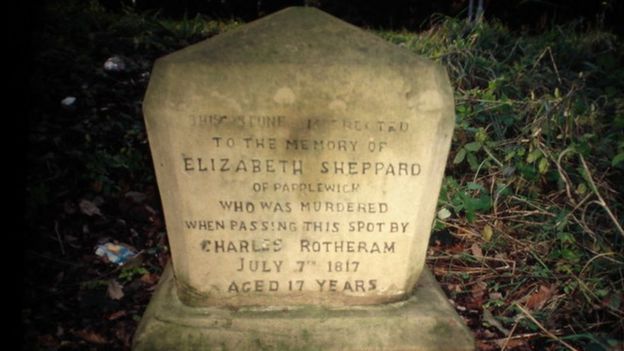
Image copyrightDEBORAH MCDONALD/GEOGRAPHImage captionBessie Sheppard was murdered on her way home after going to look for work
Elizabeth – Bessie – Sheppard was just 17 when she set out from her home in Papplewick, Nottingham, on 7 July 1817, to seek work as a servant in Mansfield, seven miles away. She found a job, but she never found her way back home, because on her return journey, a travelling knife grinder found her.
Charles Rotherham, a man in his early 30s, had served as a soldier in the Napoleonic wars for 12 years before beginning this new stage in his life.
He was seen on the road coming from Mansfield after drinking several pints where his path crossed Bessie’s.
Her severely battered body was found in a ditch by quarrymen the next day. Her shoes and distinctive yellow umbrella were missing and there was evidence her attacker had tried to remove her dress but had failed.
Rotherham had sold Bessie’s shoes and was on his way to Loughborough when he was arrested. He confessed to the crime and was returned to the scene where he showed a constable the hedge stake he had used to kill Bessie.
Like all murderers at the time, Rotherham swung for his crime. Local people, outraged by the attack, banded together to raise money for a stone to commemorate Bessie, which was placed on the site where she was attacked.
Bessie’s stone simply honours the memory of the dead girl, but another stone erected to a female victim of violence has more of a moral tone, seemingly warning women against certain behaviour as much as expressing anger with the killer.
“As a warning to Female Virtue, and a humble Monument to Female Chastity: this Stone marks the Grave of MARY ASHFORD, who, in the twentieth year of her age, having incautiously repaired to a scene of amusement, without proper protection, was brutally violated and murdered on the 27th of May, 1817.”
The story behind Mary Ashford’s death and its aftermath is one which left a permanent mark on English legal history.
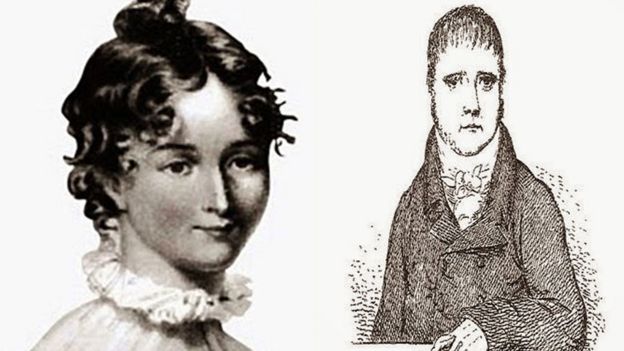
Mary Ashford and the man accused of her murder, Abraham Thornton
She had gone to a dance in Erdington, Birmingham, with her friend Hannah Cox, whom she planned to stay with overnight before returning to her place of work at her uncle’s house in a neighbouring village.
At the dance, she met a local landowner’s son, Abraham Thornton, and later reports confirmed the pair spent most of the night dancing together and having fun.
When they left the dance, Mary told her friend she would spend the night at her grandparents’ home – possibly a ploy to spend more time with Thornton – and Mary and he went off together.
Mary returned to Hannah’s house at 4am, changed her dancing clothes for her working clothes, collected some parcels and set out for her uncle’s home.
About two hours later a labourer found a bundle of clothing and parcels on the path leading to Mary’s home. The alarm was raised and her body was found submerged in a water-filled pit.
An autopsy showed she had drowned and had been raped shortly before her death.
People believed Thornton, having been rebuffed by Mary during their hours together, had lain in wait for her to return home and raped her before throwing her into the pit to drown.
He was duly arrested and tried, but a number of witnesses placed him at another location at the time of Mary’s death and he was acquitted.
But the story does not end there. Mary’s brother William Ashford began a private prosecution under an obscure ancient law, which allowed relatives of murder victims to bring an “appeal of murder” following an acquittal.
Thornton had a surprise up his sleeve though. In response, he demanded a trial by combat as was his right under that law, under which he could legally have killed Ashford, or if he defeated him, gone free.
Ashford was much smaller than Thornton, and declined the battle. Thornton was a free man, and the case was swiftly followed by a change in the law in 1819, banning such appeals and therefore trial by battle.
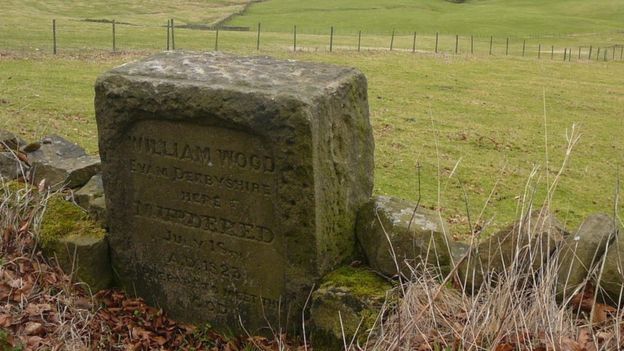
Image copyrightCOLIN PARK/GEOGRAPHImage captionThis murder stone at Disley in Cheshire commemorating William Wood was erected 50 years after the crime
Other victims include:
William Wood, of Eyam, Derbyshire, murdered by three men who robbed him of £100 in 1823 – his head was “beaten in the most dreadful manner possible”. Two men were caught, one escaped justice. A permanent memorial was erected over 50 years after the crime after earlier versions were destroyed or removed, which showed the strength of feeling still present in the community about the murder.
Father and son William and Thomas Bradbury, who were brutally attacked in William’s pub The Cherry Arms, known as Bill O’Jacks locally, on 2 April 1832 in Greenfield, Saddleworth. Their unsolved killings were recorded on a stone which noted their “dreadfully bruised and lacerated bodies”.
The Marshall family – the “special horror”, as noted in The Spectator at the time, of the Denham murders in Buckinghamshire, where a family of seven including three young girls were beaten to death at their home attached to their father’s blacksmith’s premises. The youngest, Gertrude, four, was found still clutched in her grandmother Mary Marshall’s arms. Killer John Jones was found a few days after the killings on 22 May 1870 and speedily tried and executed. They are buried in one grave in St Mary’s Church, Denham, where the original worn murder stone has been supplemented by a modern plaque to remember the victims.
The last word goes to those who chose to commemorate Nicholas Carter, a 55-year-old farmer from Bedale, Yorkshire, killed by a farm labourer as he rode home from market.
The stone laid at the murder site in Akebar – later to become a Grade II listed monument which hit the headlines earlier this year when it was badly broken in a car crash – had a very simple message, along with the date of his death, May 19, 1826.
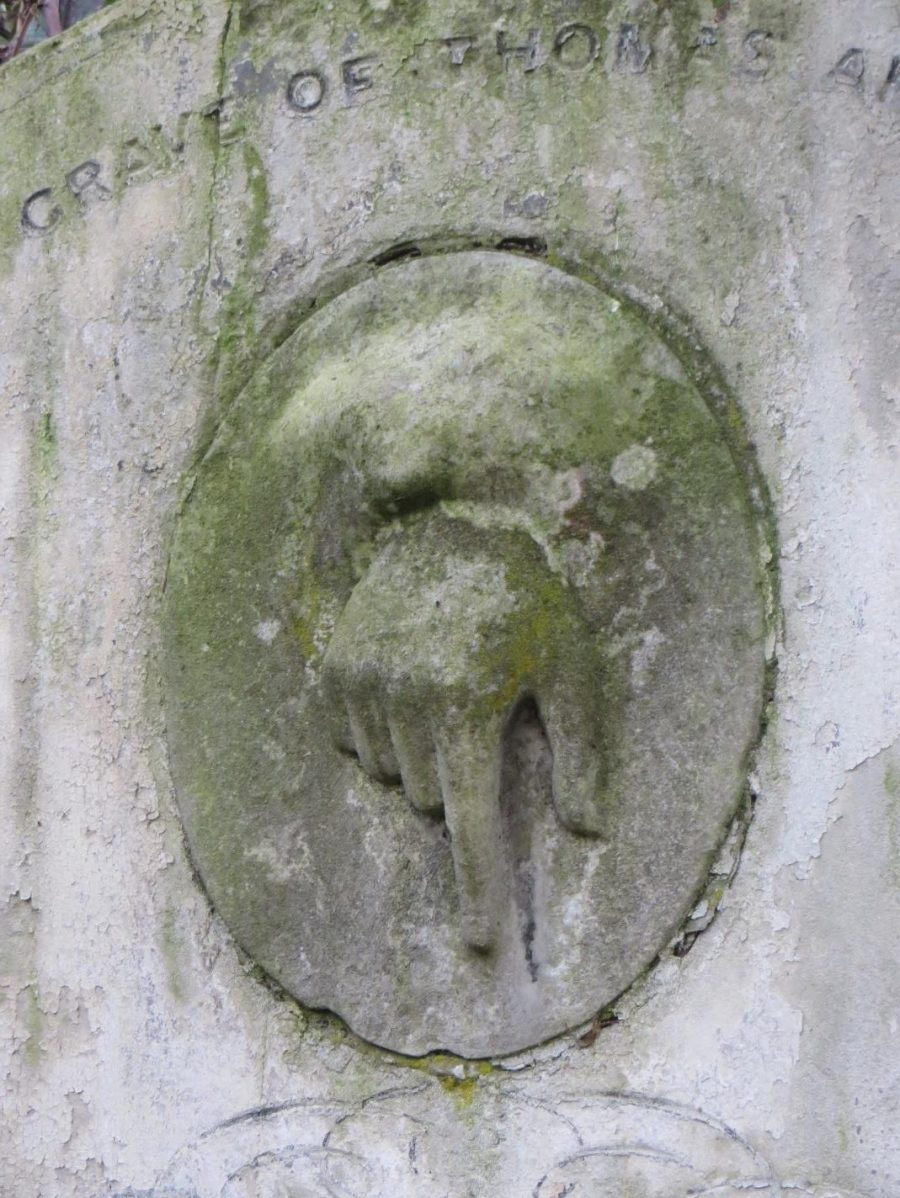
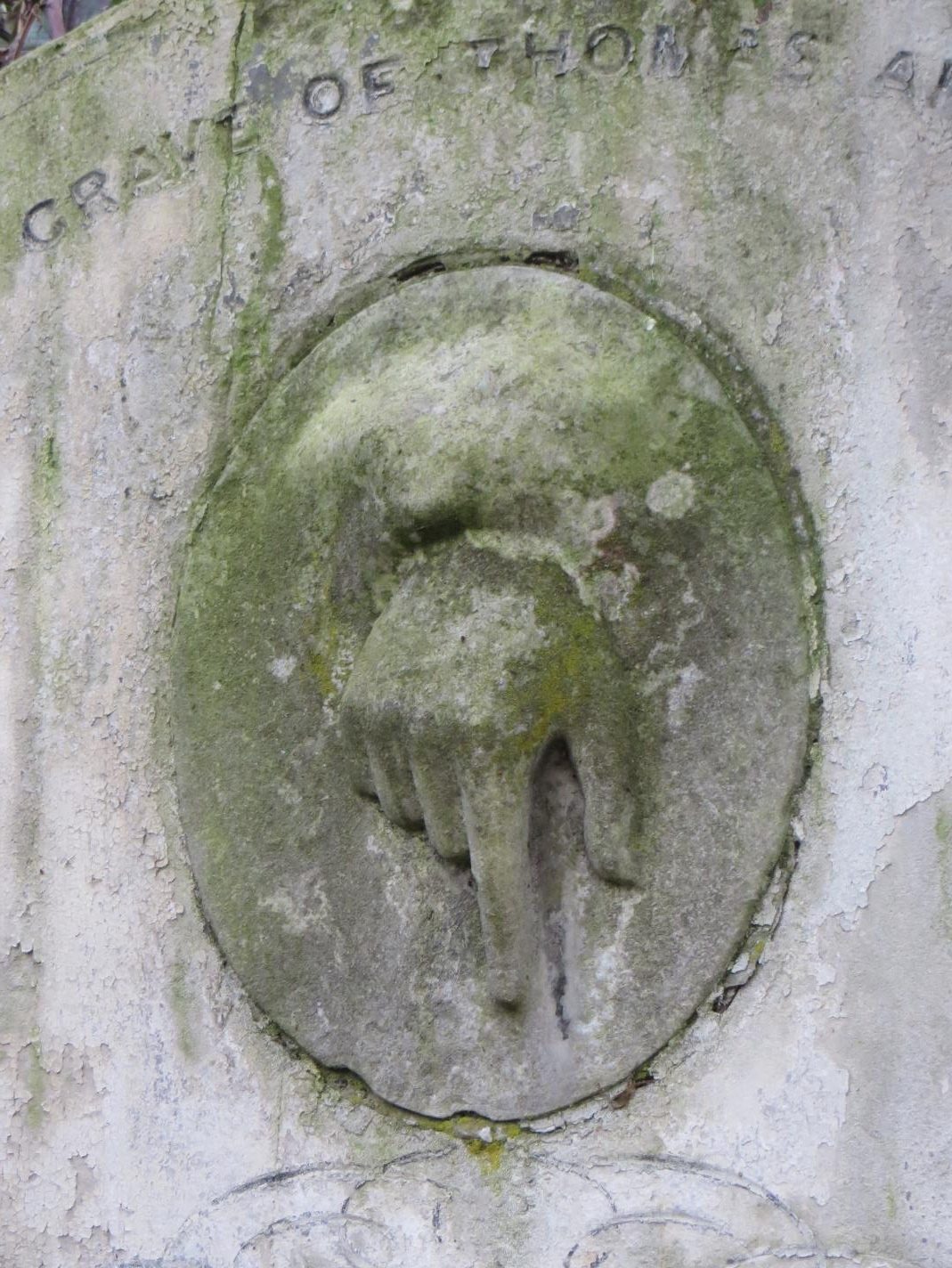
In my recent post on the Pointing Finger symbol I was bemoaning that I hadn’t found an example of the downward pointing version.
Someone must have heard me because, lo and behold, as I was pottering through Brompton Cemetery I suddenly saw one. It was on a side path and set back from it in front of a thick clump of brambles which probably engulf it when they’re in high season. Winter is always a good time to look for symbols as the encroaching ivy; brambles and long grass will have died down and don’t obscure them.
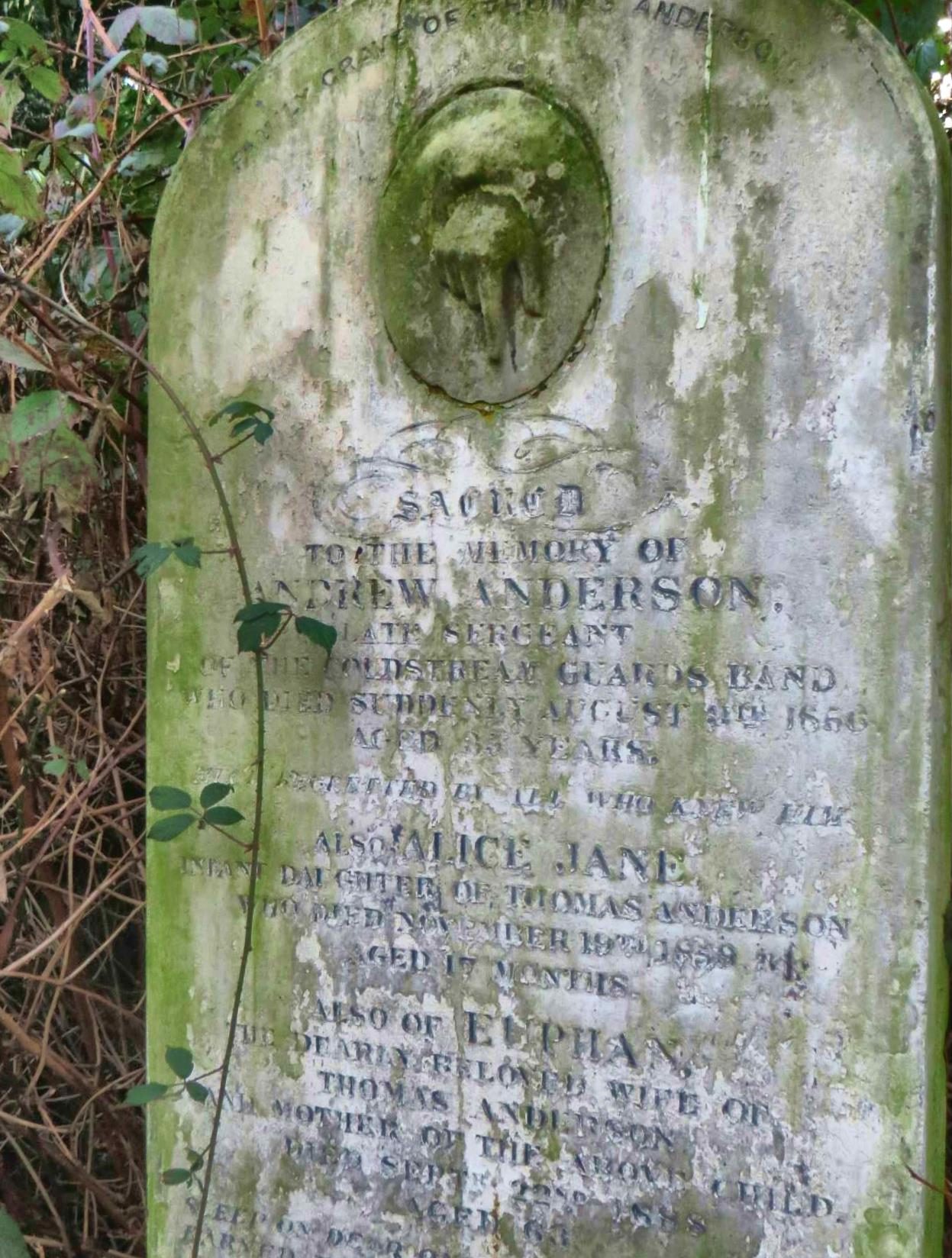
There is a fascinating story behind this memorial as it’s the tale of two Irish brothers who first enlisted together at the tender age of 11. They both had action packed lives in military service together until one died before the other at a young age. This confirms what I said in my previous post, that the downward pointing finger denotes an untimely, sudden or unexpected death.
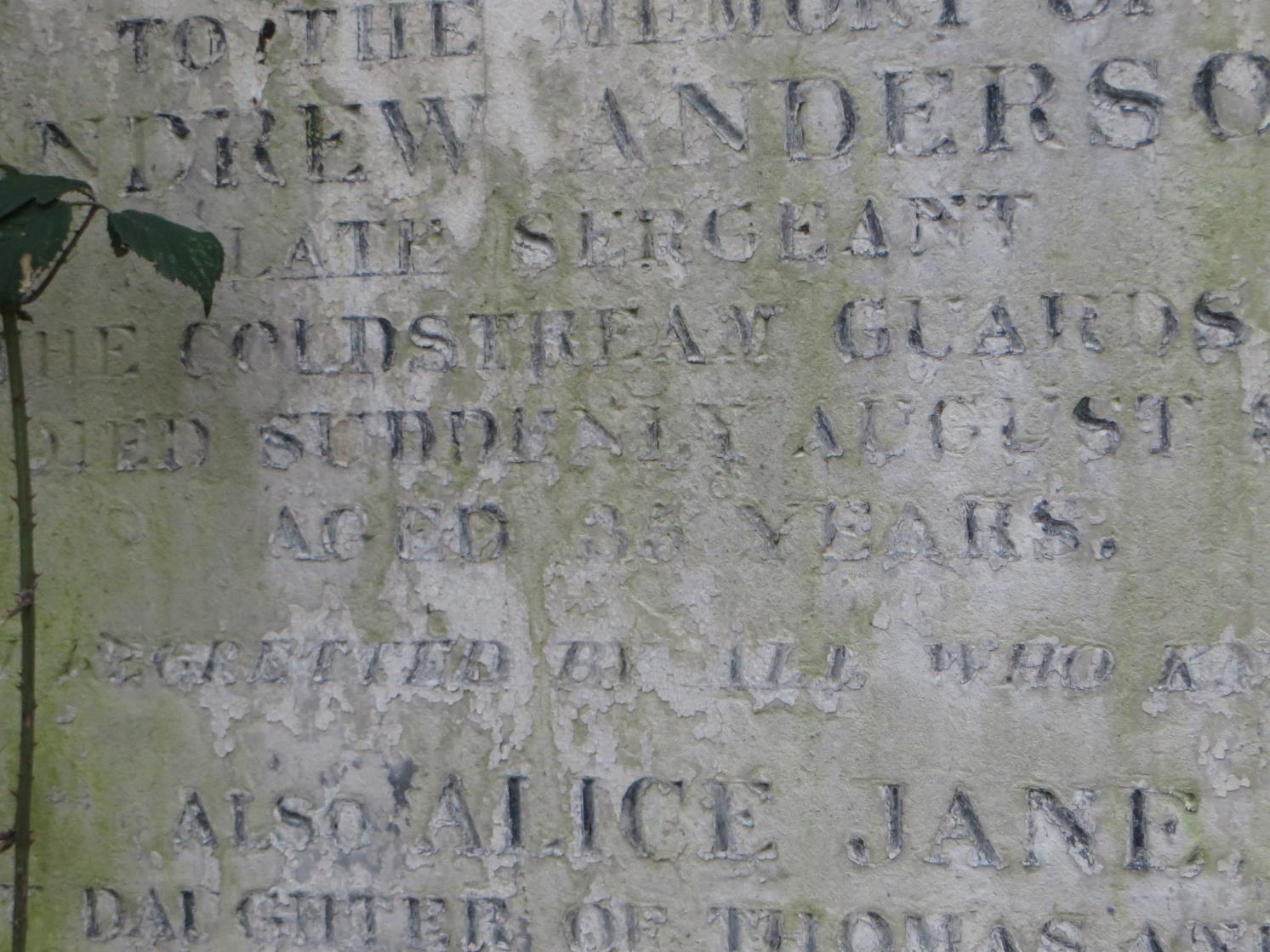
The headstone announced that it was the ‘Family Grave of Thomas Anderson’ and there are six members of the family commemorated on it. The first one was to Andrew Anderson, who was a sargeant in the Coldstream Guards Band until died suddenly, aged 35, on August 11th 1856. Sadly it doesn’t give the cause of death so we can only guess at what might have happened to Andrew. The epitaph also says that his death was ‘regretted by all who knew him’ so he was obviously popular and much missed. Accident? Heart attack? Murder? We may never know but I may do some further investigating.
Underneath Andrew’s epitaph are recorded two more members of the Anderson family. These are Thomas Anderson’s ‘infant daughter’, Alice Jane, who died at 17 months on November 19th 1859 and also his wife and Alice’s mother, Euphan. She died on September 22 1888 aged 63. The quotation underneath reads ‘Sleep on dear one and take thy well earned rest.’
And then underneath is Thomas himself. He died on 15 July 1891 aged 70 with the motto ‘His end was peace.’
Initially I presumed that Thomas was Andrew’s father. But, after doing some online delving, I discovered a post on an Irish library forum by a respondent who claimed to be Thomas’s great, great, great grandson. He was trying to carry out his own research into the family history.
According to him, Thomas and Andrew Anderson were actually brothers, probably twins, who were both born in 1821 and came from Ennis, County Clare. This would fit in with Andrew’s age at death and there were other coincidences between the information on the headstone and what the great, great, great grandson was saying. The unusual name of Thomas’s wife was helpful and this led me to the Clan McFarlane website as McFarlane was her maiden name.
The brothers were very close and, aged 11, they both enlisted in the 40th Regiment of Foot on February 2 1832 and were then both discharged on 7 September 1839 aged 18.
It was the Royal Navy that beckoned next and they set off for adventure on the high seas aboard HMS Wellesley when they enlisted in 1839. They both played their part in the Opium War of 1839 – 1842 and, as a result, they both received the China War Medal. This was awarded to members of the Royal Navy who had ‘served with distinction’ between 5 July 1840 – 29 August 1842.
Watercolour of HMS Wellesley sailing along a rocky coastline before a good wind. Note the red ensign and the single red flag flying from the top of the mizzen mast which indicates readiness for action.
Shared under wikipedia creative commons who have defined it as being in the public domain.
HMS Wellesley (second from left) in the second capture of Chusan on 1 October 1841. Painted by William Joy from a drawing by Captain Crawford. Shared from wikipedia Public Domain. The file has been indentified under copyright law,, including all related and neighbouring rights.
After that they moved on and back into the Army which is where the Coldstream Guards connection comes in. As you might expect they both signed up: Thomas on 8 May 1850 and Andrew on 8 May 1844. Thomas was discharged on 17 May 1860 after becoming a lieutenant. We know Andrew’s story but Thomas’s is less clear.
According to the family member he was living at 6 Hospital Street in Glasgow in 1845 and married Euphan McFarlane in 1863. She came from the Gorbals which always had a reputation as a really tough area and so good preparation for the life of an Army wife. She and Thomas had three more daughters; Elizabeth Euphan, Rosina Edith and Rosina Elizabeth. But there’s no mention of Alice Jane. Both Elizabeth and Rosina Edith married.
But the family member didn’t mention Alice Jane or John so one wonders where they fit in.
Thomas supposedly died in Middlesex but after his death he joined Andrew in Brompton Cemetery.
There are two more Anderson Family members recorded on the headstone; John, Thomas’s son, who died on 15 February 1925 aged 65 and John’s daughter, Isabella, but her dates were too indistinct to read.
Family stories can change over time as they’re handed down through the generations but this seemed to tally with the information on the headstone. I am trying to contact the great, great, great grandson via the County Clare forum for more information.
The Anderson brothers seemed to have led exciting lives in military service and certainly did their bit for King and Country. So rest in peace Andrew and Thomas – you have certainly earned it.
On another recent return visit to Beckenham cemetery in order to research symbols I discovered some more mosaics on memorials. They were mainly small colourful crosses, either at the corners of a memorial or, in the case of one larger cross, the centrepiece of the epitaph.
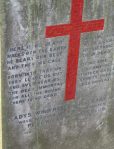
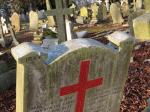
This is the simple but moving Denson memorial. It’s dedicated to Gladys Winifred and baby Mary who were ‘the well beloved wife and daughter of Percy Clifford Denson. The scarlet cross really stood out amid the other plainer granite tombstones. The verses that surround the cross read:
There is no death an angel shape
Walks over the earth with silent tread
He bears our best love thins away
And then we call them dead.
Born into that undying life
Thy leave us but to come again
And ever near us though unseen
The dear immortal spirits tread
For all the boundless universe is life
There is no dead’
This has been adapted from the well know 19th century poem ‘There is no Death’ by John Luckey McCreery (1835-1906) although it has been mistakenly credited to Sir Edward Bulwer-Lytton. It was written in 1863 and, in 1893, McCreery wrote to an Iowa newspaper to remind readers that it was his work.
This is the poem in full with the relevant quotations from the Denson epitaph marked in bold:
There is no death! The stars go down
To rise upon some other shore
And bright in heaven’s jewelled crown
They shine for evermore
There is no death! The dust we tread
Shall change beneath the summer showers
To golden grain or mellow fruit
Or rainbow-tinted flowers
The granite rocks disorganise
To feed the hungry moss they bear:
The forest leaves drink daily life
From out the viewless air.
There is no death! The leaves may fall,
And flowers may fade and pass away –
They only wait, through wintry hours,
The coming of the May.
There is no death! An angel form
Walks o’er the earth with silent tread
He bears our best-loved things away,
And then we call them “dead”.
He leaves our hearts all desolate –
He plucks our fairest, sweetest flowers,
Transplanted into bliss, they now
Adorn immortal bowers.
The bird-like voice, whose joyous tones
Made glad this scene of sin and strife,
Sings now an everlasting song
Amid the tree of life.
Where’er He sees a smile too bright,
Or soul too pure for taint of vice,
He bears it to that world of light,
To dwell in Paradise.
Born unto that undying life,
They leave us but to come again:
With joy we welcome them –the same
Except in sin and pain.
And ever near us, though unseen,
The dear immortal sprits tread,
For all the boundless universe
Is Life –there is no dead!
This is one of a pair of gold crosses that are on either side of Harold Chenowith’s (1898-1934) tombstone.
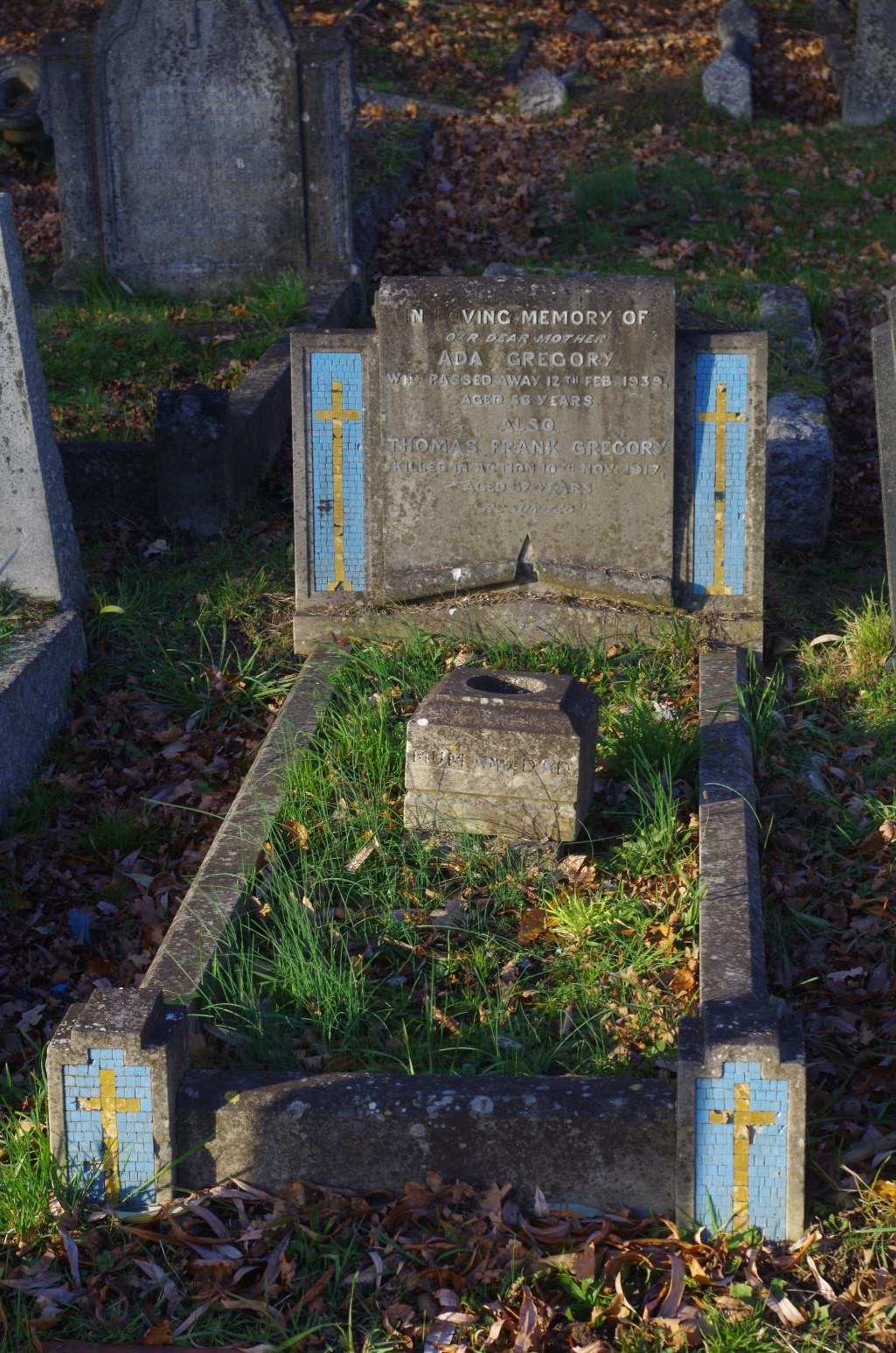
And more golden crosses on each of the corners of Ada Gregory’s monument. She died in February 1939 but her husband, Thomas, who was killed in action in November 1917 is also commemorated here. As the final line of the epitaph states ‘ Reunited.’
Finally, this is a vase which has been incorporated into the headstone of Margery Alice, ‘beloved wife of Frank Thompson, who ‘passed peacefully away on 6 October 1934 aged 39.’
These mosaics decorations all seem to date from the 1930’s and so are pre-Second World War. So far I have been unable to discover the reason behind the vogue for this embellishment and so I will continue to look for them whenever I visit a cemetery.
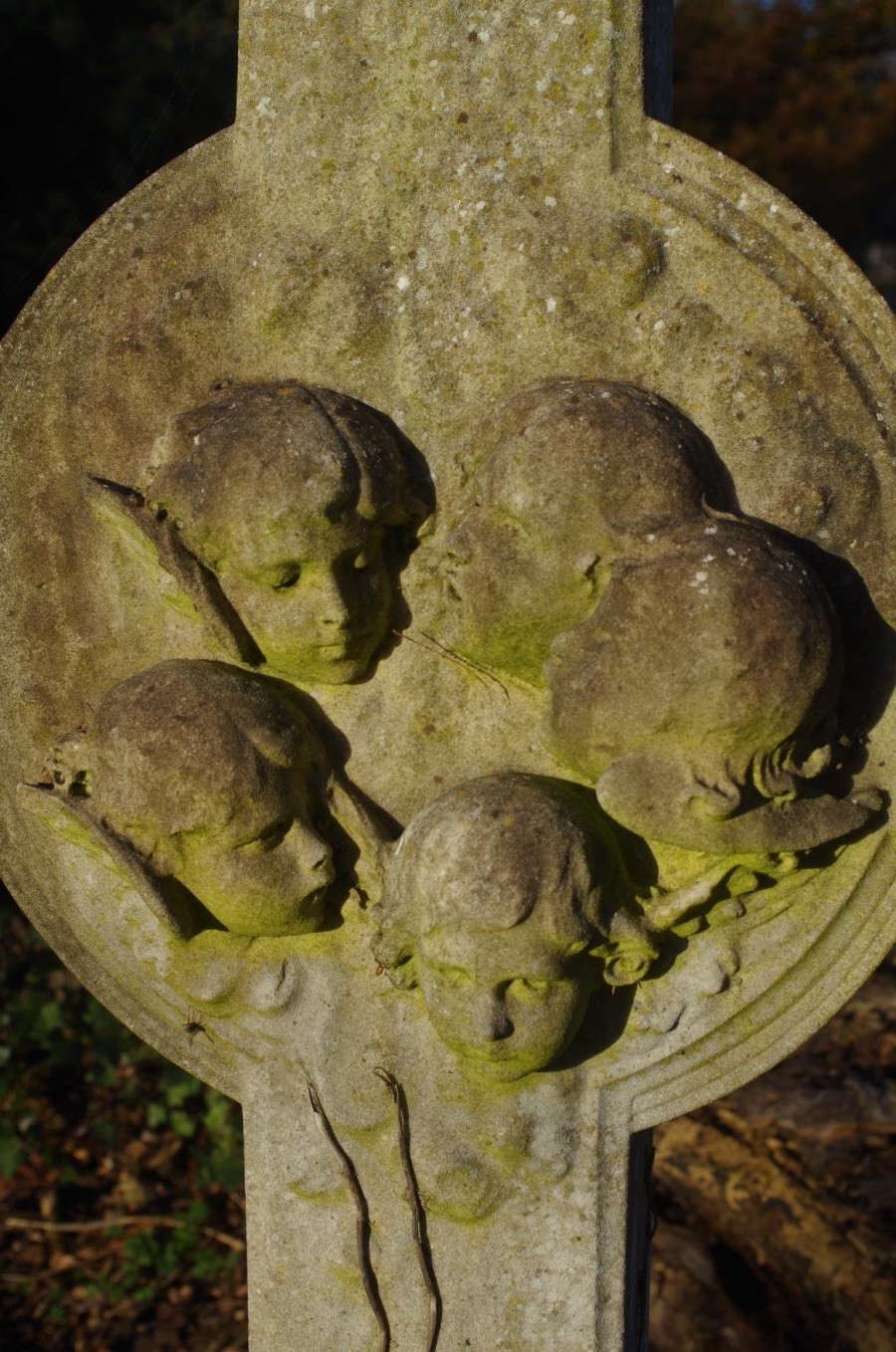
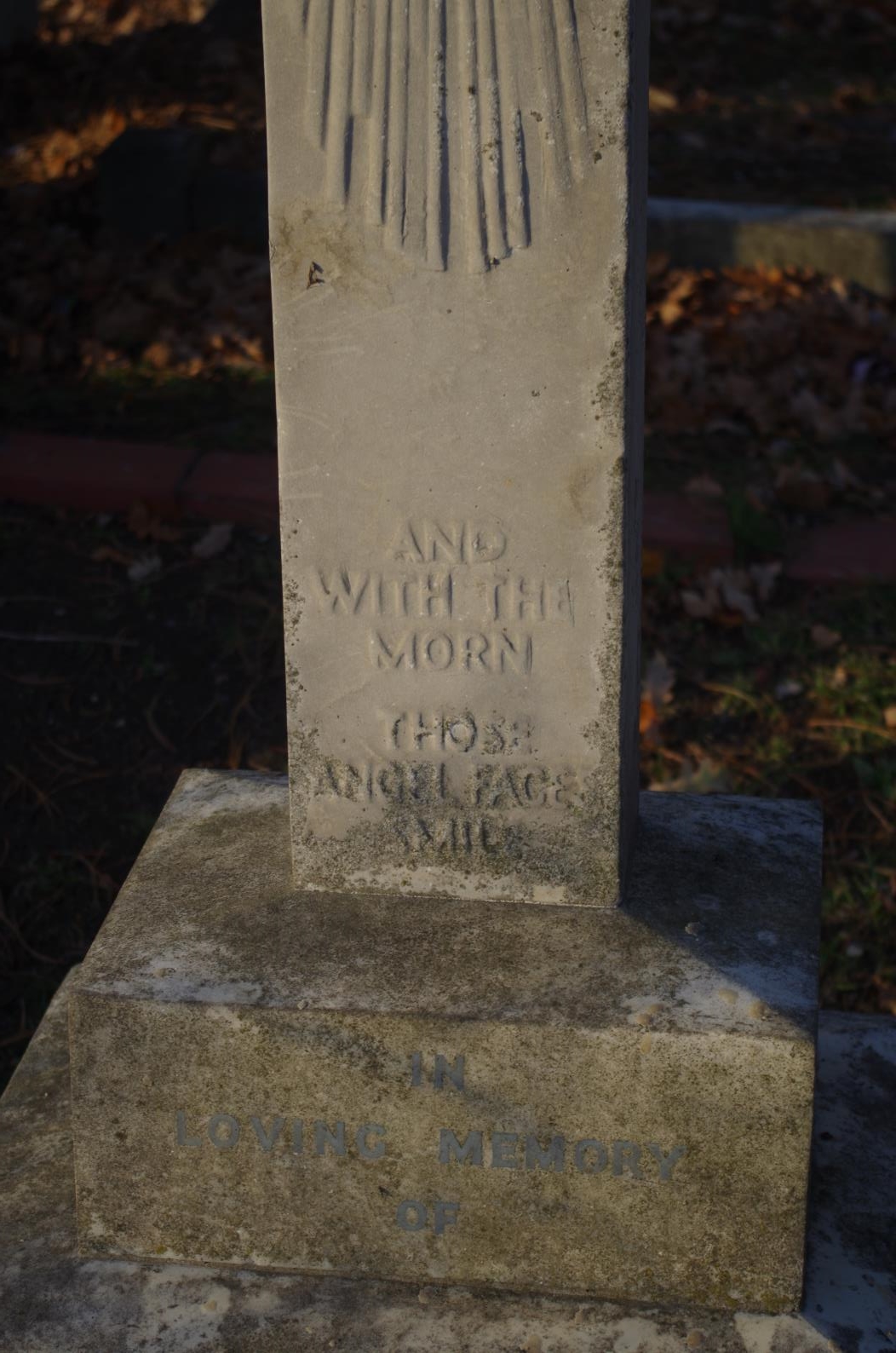
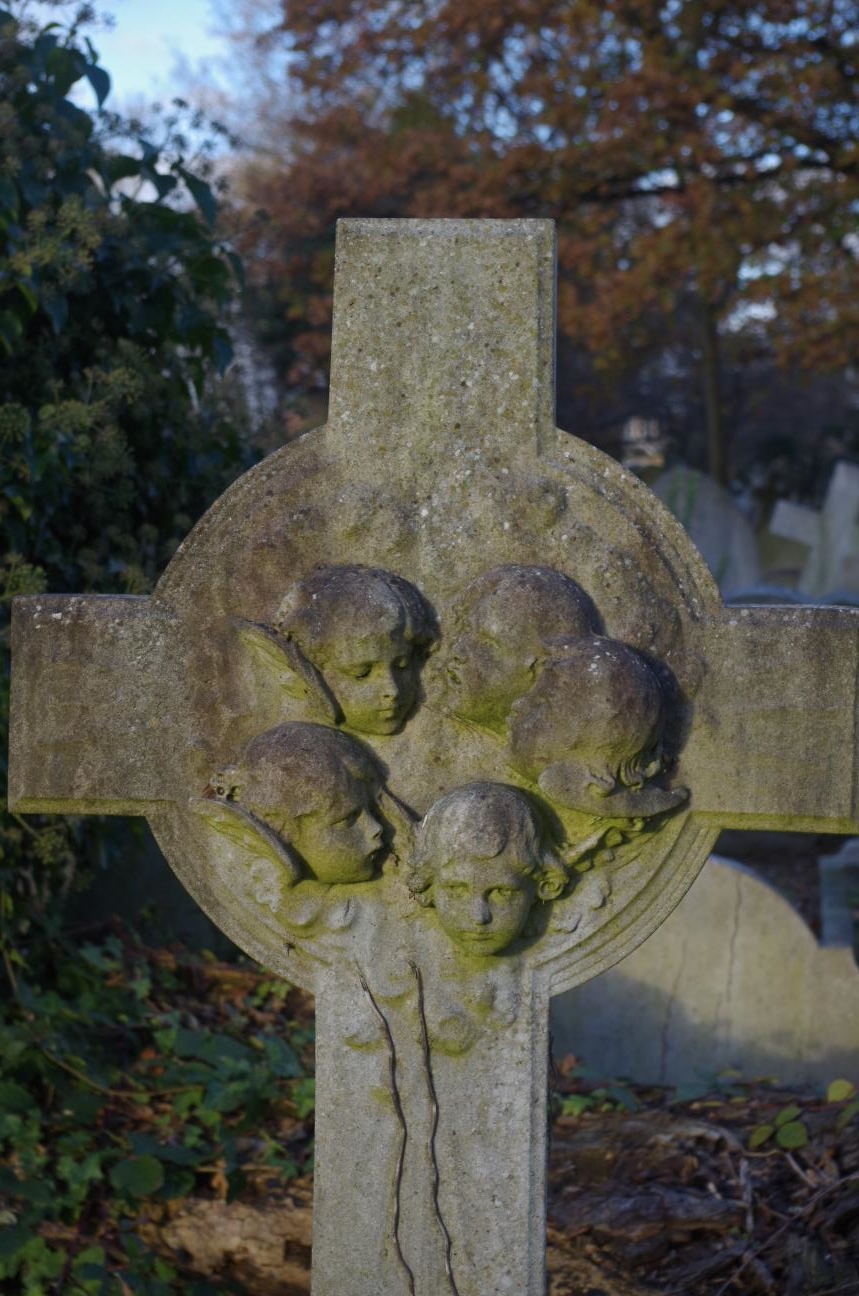
Five child angels, their faces turned to each other, framed by small wings, except for one that was staring out at me, I wanted to reach out and touch them but didn’t want to damage them. They formed a roundel at the centre of a tall cross with the phrase ‘And with the morn those angel faces smile’ inscribed at the base of its stem. I was on a tour of Beckenham Cemetery when I first saw them.
Our guide didn’t comment on them but the monument is in a prominent place on the main road through the cemetery and I often wondered about this pretty and poignant memorial.
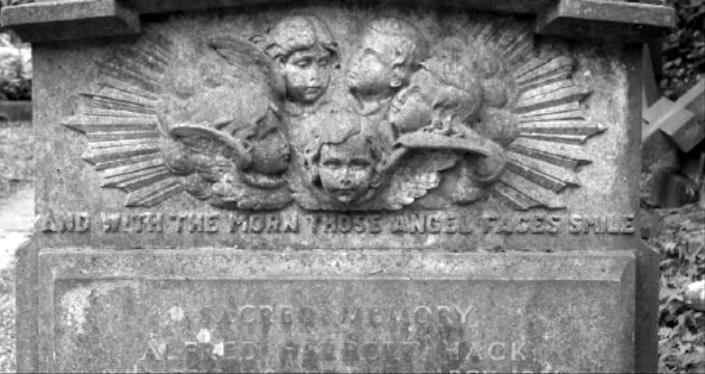
On a visit to Highgate East in 2014 I found another example but on a smaller scale on a tombstone in the name of Alfred Hack and dated 1956. There is a distinctly 1930’s look about the angels from their hairstyles.
I also found another version which featured cherubs faces instead of childrens on a visit to Knebworth this summer.
Then , on a more recent visit to Beckenham Cemetery, I found another similar one which was only a short distance away from the first. In this the child angels seem to have more definite, individual faces and the one that has her head towards the viewer is looking down instead of outwards. Now I wanted to find out more about the quotation and the angels and my research led me to a Victorian hymn that was sung on the Titanic at its final service on board and by the inmates of Ravensbruck concentration camp as the S.S led them in. The ‘angel faces’ is a quotation from ‘Lead, kindly Light’, in fact it’s the penultimate line and like ‘Rock of Ages’ it caught the mood of its time.
These are the lyrics:
‘Lead, kindly Light, amid the encircling gloom
Lead thou me on;
The night is dark, and I am far from home,
Lead thou me on.
Keep thou my feet; I do not ask to see
The distant scene; one step enough for me.
I was not for ever thus, nor prayed that thou
Shouldst lead me on;
I loved to choose and see my path; but now
Lead thou me on,
I loved the garish day, and, spite of fears,
Pride ruled my will: remember not past years.
So long thy power hath blessed me, sure it still
Will lead me on,
O’er moor and fen, o’er crag and torrent, till
The night is gone;
And with the morn those angel faces smile,
Which I have loved long since, and lost awhile.’
However, the writer John Henry Newman (1801-90), always refused to reveal the meaning of the ‘angels faces’ or what the ‘kindly light’ actually was.
Originally a poem, it was written by Newman in 1833. He was then a young theologian and Anglican vicar and was going through a challenging time in his life. Struck down by a fever which nearly killed him while travelling in the Mediterranean, Newman’s servant was so convinced that he would die that he asked him for his last orders. But in his autobiography, Newman told him ‘I shall not die, for I have not sinned against light’.
Newman recovered but that wasn’t the end of his troubles. Desperate to return to England he then took a boat from Palermo to Marseilles only to end up stranded and becalmed in the Straits of Bonifacio. Exhausted and frustrated Newman wrote the poem, ‘The Pillar of the Cloud’ that, in 1845, became ‘Lead, Kindly Light’. Newman was not happy about this as by then he’d converted to Catholicism and hymn singing wasn’t included as part of divine service. He went onto become Cardinal Newman, one of the most important figures in English Catholicism, and also an important writer. In 1900 Elgar set Newman’s poem ‘The Dream of Gerontius’ to music.
Cardinal Newman as John Newman eventually became after his conversion to Catholicism. This celebrated portrait is by Sir John Everett Millais. In the public domain in UK – from the National Portrait Gallery wkipedia
‘Lead, Kindly Light’ has struck a chord with those in danger or about to enter the endless dark realm and needed the comfort of a light leading their way through it. Miners awaiting rescue from deep underground during the 1909 Durham mining disaster sang it as did the passengers on one of Titanic’s lifeboats when the rescue ship, Carpathia, was sighted the morning after. It caught the Victorian mood perfectly as did ‘Rock of Ages’ and Queen Victoria asked for it to be read as she lay dying. It also inspired a celebrated painting by the Scottish artist, Sir Joseph Noel Paton in 1894 in which the angels are pensive young woman.
But why did one line from this song inspire two monuments in Beckenham Cemetery and one in Highgate East? I noticed that both of the Beckenham monuments were on children’s graves and that the carved angels were also children. Perhaps the mourning relatives left behind may have wanted the consolation that their beloved children would be waiting for them when their time came.
The first one is the Foster family monument. The epitaph is now virtually unreadable but I could make out the name ‘Francis Frederick’ carved along the base. There are two inscribed ‘Books of Life’ placed on top of the grave. One is dedicated to John Francis Foster and Alice Gladys Alice Chapman and the other is dedicated to John Francis Foster and Alice Emma Foster.
The second one is the Pace family monument and is to the two daughters of Henry William and Elizabeth Pace. These were Lilian Alice who died in 1888 and Grace Irene who died in 1903. Strangely enough they both died at the same age and Elizabeth herself is commemorated here as she died at 33 in 1912.
So, a line from a hymn that even its writer was unsure of its meaning, became a symbol of comfort to sorrowing families.
However the symbol has been adapted to feature cherubs as in St Mary’s, Knebworth’s churchyard. These are on the tombstone of the Lutyens family’s nanny, Alice Sleath.
But I am indebted to Douglas Keister’s Stories in Stone for the possible origins on the image of the angels.
The composition of the five heads may have been adapted from a painting by Sir Joshua Reynolds PRA entitled ‘Heads of Angels Miss Frances Gordon’ which was painted during July 1786 – March 1787. The sitter was the then 5 year old Frances Isabella Keir Gordon (1782-1831) who was the only daughter of illustrious parents. They were Lord William Gordon (1744-1823) and his wife Frances Ingram (1761-1841), second daughter of Charles, 9th Viscount Irvine (1727-78), who were married on 6 March 1781. Her uncle was Lord George Gordon (1751-93), whose political activities had sparked the anti-Catholic riots of 1780.
‘Heads of Angels Miss Frances Gordon’ by Sir Joshua Reynolds PRA 1786-1787. . This is in public domain wiki creative commons
Frances’ mother outlived her by 10 years and the painting was then presented to the National Gallery. It was enormously popular and was reproduced on numerous decorative items and photographic reproductions such as ‘The Cherub Choir.’
And so a poignant and powerful symbol was created from the combination of a great painting, an inspirational hymn and Victorian taste and led to these three lovely memorials to much missed children.
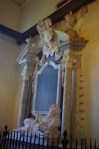
Everywhere I looked, as I stood in the Lytton Chapel, a well-upholstered, well dressed 18th century gentleman stared impassively back at me. They seemed to jostle for space in the small chapel and, although these past members of the Lytton family, couldn’t take it with them, you certainly knew that they’d had it when they were alive. These were powerful men and there’s plenty of beautifully sculpted marble on show in the Chapel. Nowadays, people would ask an artist or sculptor to make them look slimmer but here the subjects are unashamedly larger than life.
All three of the memorials are in the baroque style which was made fashionable by the Italian sculptor, Bernini. It was a technique that achieved effects in carving such as flesh, hair and textures that were remarkably realistic as well as other pictorial effects that had previously only been attempted in 2D paintings . And yet English Baroque was dismissed as mundane. However the three tombs in the chapel seem anything but that.
Both Pevsner and Simon Jenkins in ‘1000 Best Churches’ mention the Chapel. Indeed the latter describes it as having ‘the best of 17th and 18th century monumental art (is) on parade and ‘three of the Knebworth tombs are among the finest 18th century monuments In England.’ It was originally built in 1520 and then rebuilt 200 years later.
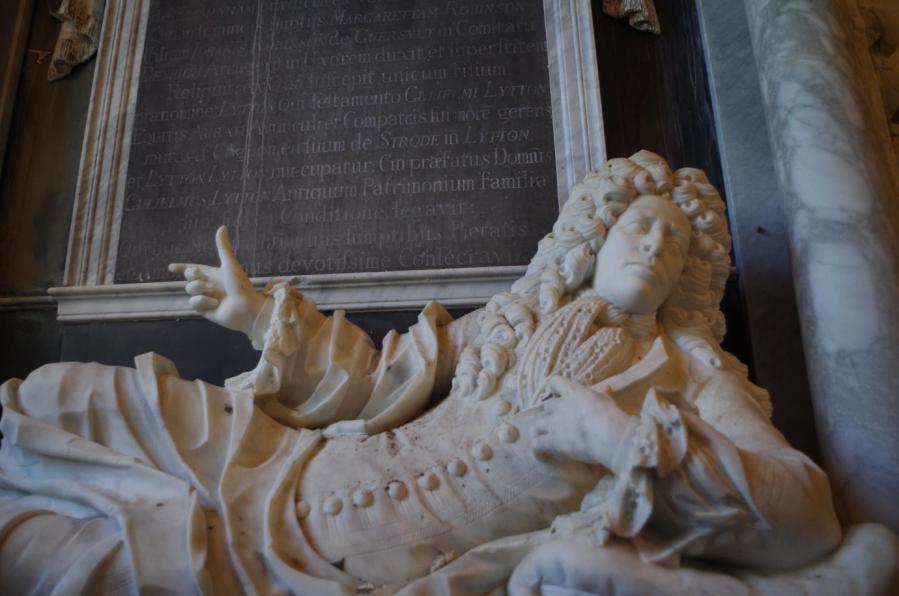
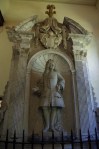
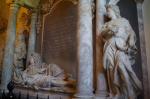
The first one as you enter is Lytton Strode Lytton who stands perfectly posed in his shell niche dressed fashionably in his coat and shoes with some of his coat buttons undone to display the buttoned up waistcoat beneath, Too many power lunches perhaps? He died young at 21 as his epitaph reveals but he looks older with an almost feminine face and full lips. Lytton is guarded on either side by winged cherubs, or Cupids, as Historic England describes them.. One is copiously weeping and the other is in prayer and the whole memorial has been attributed to Thomas Green of Camberwell.here is a helpful English translation of the Latin epitaph:
‘Here lies Lytton Strode Lytton Esq., sole son and heir of Sir George Strode (of Etchinham in the County of Sussex_ and also heir of Sir William Lytton of this parish, his great-uncle. He married Bridget Mostyn, the eldest daughter of Richard Mostyn, Eds., of Pembedwinthe county of Flint. He died without issue at the age of 21 in 1710. He left the ancient patrimony of the Lytton family to his dearly beloved relative William Robinson, who erected this monument at his own expense as a pledge of his own affection.’
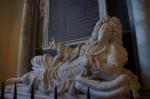
Then you turn and are almost crowded out by the other two: Sir William Lytton to the left and Sir George Strode on your right. Their heads are both inclined towards Lytton Lytton as they lie semi-recumbent on marble beds, sheets rumpled and you almost feel as if you’ve disturbed them in conversation. Sir George Strode was Lytton’s father and Sir William was his maternal great-uncle so it’s not surprising that they both look to their cherished heir and once the bearer of the Lytton dynasty hopes.
Both of these memorials are credited to Edward Stanton. (1681-1718). He was a very successful mason who carved 40 monuments between 1699-1718 and in 1720 became a mason to Westminster Abbey where he remained until his death. Stanton was married 3 times and one wondered where he found the energy. He has his name prominently displayed at the base of one of the pillars on Sir William Lytton’s huge monument.
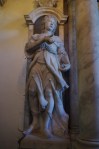
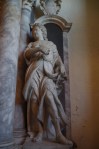
The carving on Sir William’s cravat, cuffs and wig as well as the delicate lacing of the Grecian style boots on two life size allegorical female figures or Virtues on either side of him is beautifully detailed. However, his opposite neighbour, Sir George Strode, has a wig that reminds me of waves of whipped cream. Both men face each other and lie in the fashion of old style glamorous Hollywood stars with their rumpled marble sheets and supporting cushions. But, perhaps in a feat of one-upmanship, William’s shrine is bigger than George’s as it’s laden down with figures and decoration such as the two Virtues dressed in flowing robes and showing a fair bit of leg. There are also 3 winged cherubs heads under the cartouche decorated roof with swags of fruit and flowers. But if you look up still further there are two small female figures, possibly children, perched on top of the roof and one appears to be playing an accordion. The English translation of the Latin epitaph is:
‘Here lies Sir William Lytton, Knight, son and heir of Sir Rowland Lytton, Knight of the ancient family of the Lyttons de Lytton in the County of Derby (which has flourished happily in this neighbourhood since the time of King VII) in the direct line of descent. He married first Mary the daughter of Sir John Harrison of Balls in the county of Hertford, then Philippa the daughter of Sir John Keyling of Southill in the county of Bedford; he died without issue, his second wife surviving him. 14th Jan AD 1704-5’
By contrast, his neighbour, Sir George Strode, Lytton Lytton’s father, is far more restrained as there wouldn’t have been enough room in the chapel for another tomb as large as William’s. George appears to be in mid-conversation with his hands making a gesture and one thumb indicating the epitaph above him. This translates in English as:
‘Sacred to the memory of Sir George Strode of the ancient family of the Strodes, the eldest son of Sir Nicholas Strode of Etchinham in the county of Sussex, and his wife Judithe the oldest daughter of Sir Rowland Lytton of Knebworth in the county of Hertfordshire, who piously and peacefully fell asleep in the Lord on the 9th of June, 1707, whose remains repose at his own wish in the Church at Etchinham aforesaid, who married Margaret Robinson (the daughter of John Robinson Esq., of Geursylt in the county of Denbigh). She survived him and from this union was born one son with the Christian name of Lytton, who by the will of Sir William Lytton his maternal great-uncle changed his family name from Strode to Lytton, and this became styled Lytton Lytton to whom the aforesaid Sir William Lytton bequeathed the ancient patrimony of his family. He has dedicated this monument at his own expense as a tribute of piety and affection.’
The motto underneath George’s figure reads:
‘Life is the gateway to death, and death in turn the gate of a new life and learn to die to the world, and live for God.’
Comforting words for a man who lost his only son at an early age.
And so I left them, perhaps in an eternal interrupted, silent conversation, after marvelling at the skill of the mason’s work. They are all behind iron railings, presumably to stop visitors touching them, but I also felt that the figures were so realistic that it might also be to stop them coming to life and lunging at sightseers.
Most people associate Knebworth with huge rock concerts and as a Gothic backdrop to many well-known films including The King’s Speech.
But it has other claims to fame apart from gargoyles and lovely gardens. It also has a wonderful mausoleum in its own field and the Lytton Chapel which, according to Pevsner and Simon Jenkins, has the finest 18th century memorials in England.
The Knebworth church is officially known as St Mary’s although it’s actually dedicated to the Virgin Mary and St Thomas of Canterbury or Thomas a Becket. It sits facing the House with its own small graveyard and surrounded by trees and railings. This is where many of the past owners of Knebworth are buried and you enter under a lovely lychgate. But why is it there?
St Mary’s was originally part of the medieval village of Knebworth and was first recorded in the Domesday Book. But when the village was moved after the creation of Knebworth Park in the late 1300’s , St Mary’s stayed in its place. It’s a church steeped in history and an architectural jigsaw as so much of it comes from different periods. The nave and chancel, for example, date from 1120 AD. When you first enter, the interior appears very plain but St Mary’s real glory is the Lytton Chapel in a side room near the altar.
However, amongst its impressive marble monuments was a memorial tablet mounted on a side wall, to the left as I entered.
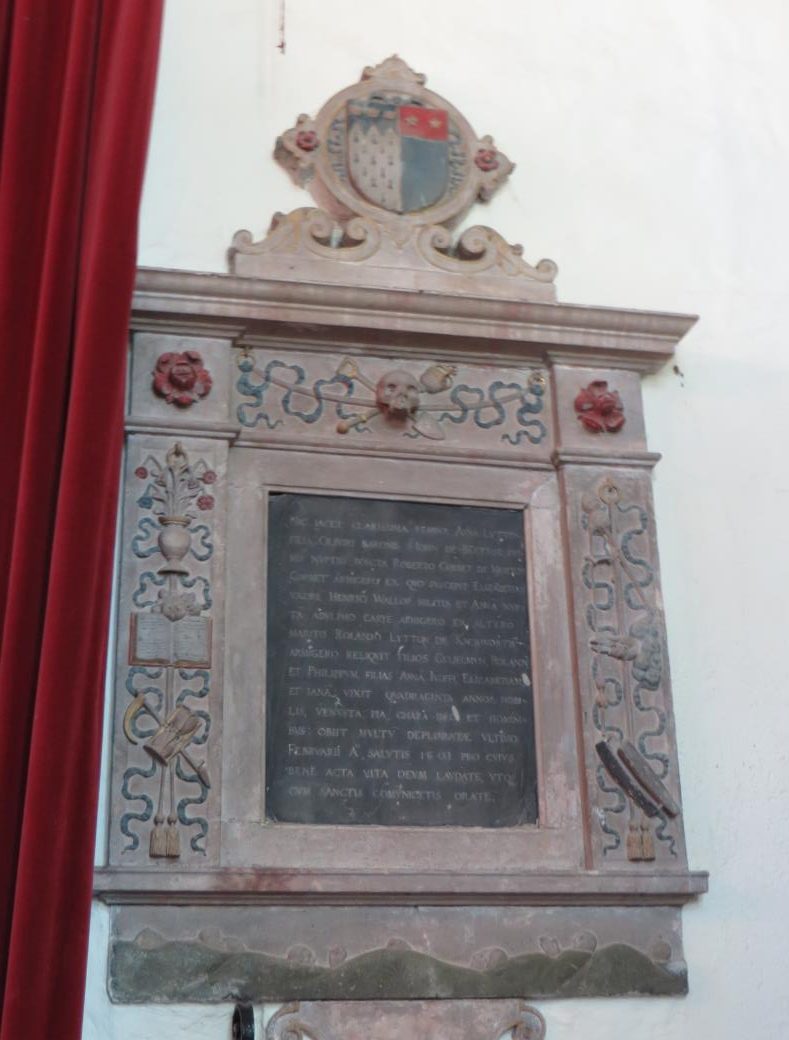
This is dedicated to a woman who died on the last day of February 1601, Anne St John, and for anyone fascinated by iconography it has a rich display of symbols. She was the wife of Sir Rowland Lytton who was her second husband. Sir Rowland’s memorial slab is on the church’s floor and he died in 1674 at 59. Anne died comparatively young at 40 and I wondered if this is why there are so many references to death on her tablet. The motifs on Anne’s memorial are beautifully carved and delicately coloured. It’s a wonderful example of a memento mori. According to J C Cooper:
‘This was an image or item that urged people to remember their death. It was a reminder that death was an unavoidable part of life and to be prepared at all times.’
Memento Mori is a Latin phrase which translates as: ‘Remember you must die’ and often expressed in art through symbols as in this memorial.
The epitaph is in Latin but, helpfully, there is an English translation provided. It reads:
‘Here lies the most illustrious Lady Anne Lytton, daughter of Oliver, Lord St John who had previously married Robert C – of Morton C—— Esquire, by whom she had two daughters, Elizabeth, who married Sir Henry Walop, and Anne, who married Adolphus Carye, Esqre, by her second husband, Rowland Lytton, Esqre of Knebworth, she had 3 sons, William, Rowland and Philip, and four daughters, Anne, Judith, Elisabeth and Jane. She lived 40 years, a noble, handsome and pious lady, beloved alike by God and men. She died, greatly d—– on the last day of February 1601 for the fulfilment of whose noble life give praise to God, and pray that you may be in communion with her among the blessed ones.’
NB: The gaps are where my camera decided to play up and rendered the words unreadable.
This was my favourite memorial in the Lytton Chapel because of its modest size and unusual iconography. I apologise for the quality of the photos – the light levels are low in the Chapel and I didn’t have much time.
It’s no accident that the skull takes centre stage, as it, Death. is the ultimate conqueror of life. There is no escape and one recalls Hamlet and Yorick’s skull. The crossed mace and spade beneath it are representations of both high and humble stations in life. The mace is a representation of absolute power whereas the spade indicates a labourer. This demonstrates that it doesn’t matter what your status was in life as Death makes us all equal.
Vase of broken or drooping flowers: According to Howgate, this signifies ‘the brief transience oflifebefore death intervenes, even in the first flowering of youth.’ I have discussed in a previous post the significance of roses in funerary iconography and broken rose blossoms also indicate a life cut short as the flower never blooms. But flowers are a representation of the brevity of life. Beneath is a Bible which is open at Daniel, chapter 10 which refers to Daniel going through 3 weeks of mourning. At the bottom of the panel is an Hourglass. This has been discussed in a previous post but it means that the ‘sands of time’ have run out. J C Cooper describes it as indicating
‘Time is passing quickly…everyday comes closer to the hour of their death, Life and Death is the attribute of the Grim Reaper, Death and Father Time.
When the Grim Reaper or Death is depicted as a skeleton he is often holding an hourglass and a scythe which is the next symbol. This is one of the most potent symbols of Death as the Grim Reaper is always depicted as holding one. He cuts down lives like cutting down crops or grass. Cooper adds:
‘…also symbolises the harvest which, in turn, implies death, rebirth, destructive and creative powers of the Great Mother.’
However, Keister says: ‘…form of a scythe is a union of the masculine, upright and cutting with feminine as curved and reaping.
At the top is a spindle on which is wound the thread of life. Beneath it, the Hand of God or, as one commentator has suggested, the Hand of Fate, emerges from a cloud with a fearsome pair of shears to cut the thread and indicate that life is at an end. He is in charge of making that decision. Underneath is an empty coffin with the lid slightly ajar awaiting its next incumbent.
Due to time constraints I didn’t look at the bottom of the memorial in detail. But Howgate reveals that it is an ‘image of the resurrection of the dead on the day of judgement.’ He goes onto to say that ‘The lumpy looking resurrected dead, some with hands joined in prayer, appear to be gasping for breath as they emerge with difficulty from the earth.’ Although this isn’t a very good photo I can see one person with their hands in prayer at least and I have to admit that when I saw the panel, it didn’t register as an image of people. A return visit to have a closer look is undoubtedly in the offing.
Two of Anne’s 4 daughters, Judith and Anne, are commemorated nearby in the church with floor memorials. They both lived to ripe old ages.
I am indebted to Revd Jim Pye who very kindly emailed me an informative article based on a talk given in 2008 by Michael E Howgate on the St John Memorial and the contentious panel on William Robinson Lytton Strode’s monument. My grateful thanks to him and to the 2 very helpful volunteers who were on duty in St Mary’s on my visit.
NB: Due to malicious thefts St Mary’s is only open during services and on Sundays 2-4pm during July and August – check the St Marys or Knebworth House websites for info in 2017.
The Gordon monument butterfly motif in all its glory. Kensal Green Cemetery. copyright Carole Tyrrell
Cemeteries and graveyards can be happy hunting grounds for butterflies. But not just the bright, dancing summer jewels, borne on the breeze, but also the much rarer kind which perches in them for eternity.
So far I’ve only discovered two of this particular species which were both in London. One was in Brompton and the other was in Kensal Green. But I have also seen others online in American cemeteries.
But I’m surprised that the butterfly symbol isn’t more widely used as it is a deep and powerful motif of resurrection and reincarnation. It has fluttered through many cultures which include Ancient Egypt, Greece and Mexico.
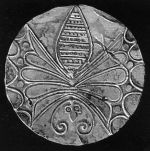
Gold disc found at Myceanae near Greece – possibly dating from 1350 BC
In classical myth, Psyche, which translates as ‘soul’, is represented in the form of a butterfly or as a young woman with butterfly wings. She’s also linked with Eros the Greek God of love. It is also a potent representation of rebirth and in this aspect, the Celts revered it. Some of the Ancient Mexican tribes such as the Aztec and Mayans used carvings of butterflies to decorate their buildings as certain butterfly species were considered to be reincarnations of the souls of dead warriors. The Hopi and Navaho tribes of Native American Indians performed the Butterfly Dance and viewed them as symbols of change and transformation.
The butterfly is an archetypal image of resurrection in Christianity and this meaning is derived from the 3 stages of a butterfly’s life. These are: 1st stage = the caterpillar, 2nd stage = the chrysalis and 3rd and final stage = the butterfly. So the sequence is life, death and resurrection. The emergence of the butterfly from the chrysalis is likened to the soul discarding the flesh. It has been depicted on Ancient Christian tombs and, in Christian art, Christ has been shown holding a butterfly. It is supposed to appear chiefly on childrens memorials but the two that I’ve seen were on adult memorials.
Butterflies also feature in Victorian mourning jewellery and there is a fascinating article on this with some lovely examples at:
In the 20th century, butterflies appeared in the flowing, organic lines of Art Nouveau and often featured in jewellery and silverware.
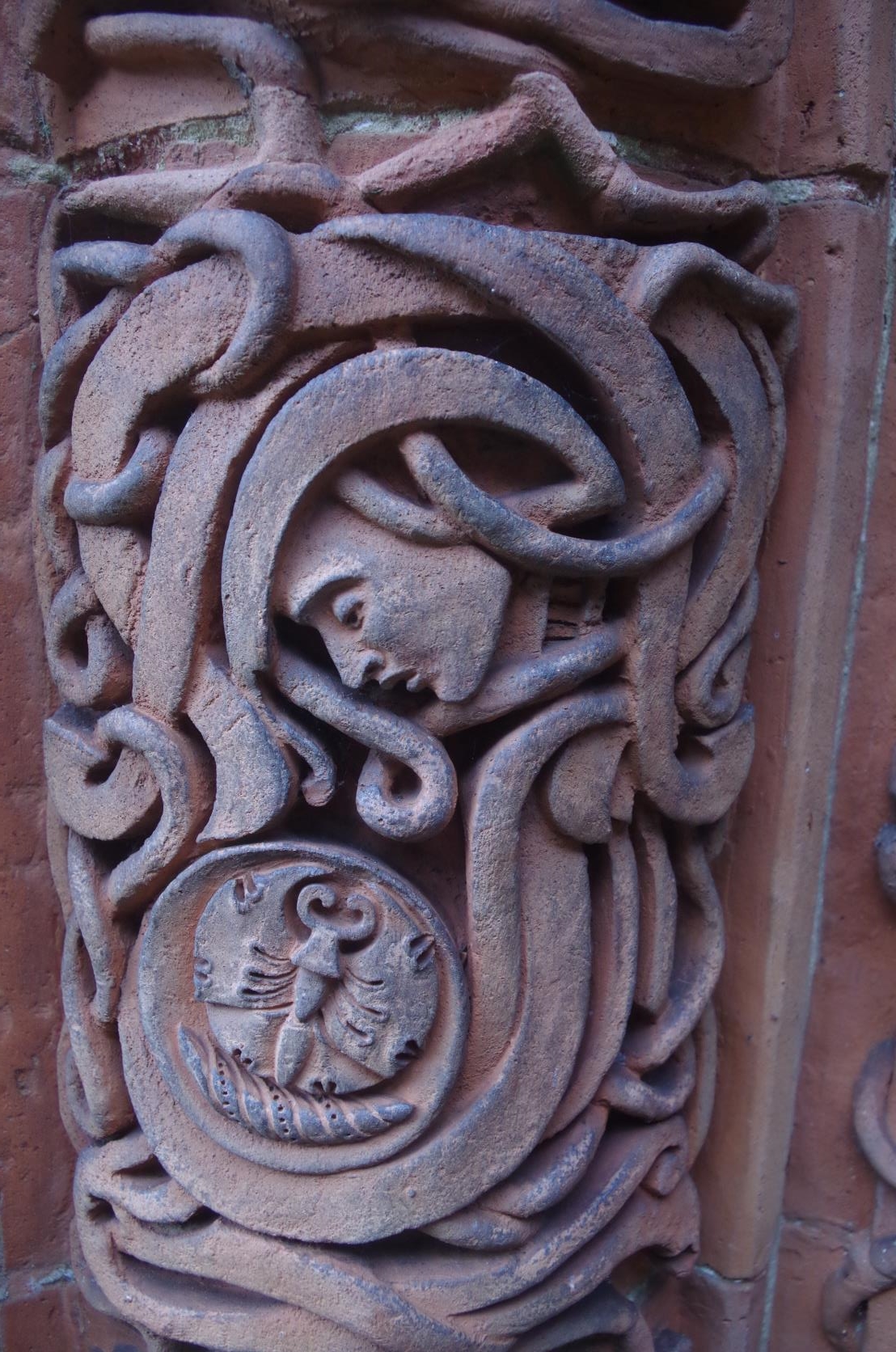
Face and butterfly on exterior of chapel.
copyright Carole Tyrrell
This example is from the Watts Chapel in Surrey and shows the flowing lines and stylised butterfly. They also appear in vanitas paintings, the name given to a particular category of symbolic works of art and especially those associated with the still life paintings of the 16th and 17th centuries in Flanders and the Netherlands. In these the viewer was asked to look at various symbols within the painting such as skulls, rotting fruit etc and ponder on the worthlessness of all earthly goods and pursuits as well as admiring the artist’s skill in depicting these. Butterflies in this context can be seen as fleeting pleasure as they have a short life of just two weeks.
Vanitas Still Life – Maria van Oosterwijck (1630-16930
Maria van Oosterwijck [Public domain], via Wikimedia Commons
The Nature as a Symbol of Vanitas Abraham Mignon created between 1665-1679.
Abraham Mignon [Public domain], via Wikimedia Commons
Butterfly traditions
There are many superstitions and beliefs associated with butterflies. They are often regarded as omens, good and bad, or as an advance messenger indicating that a visitor or loved one is about to arrive. In Japan, they are traditionally associated with geishas due to their associations with beauty and delicate femininity.
Butterfly & Chinese wisteria by Xu Xi Early Sing Dynasty c970. By Xü Xi (Scanned from an old Chinese book) [Public domain], via Wikimedia Commons
The Chinese see them as good luck and a symbol of immortality. Sailors thought that if they saw one before going on ship it meant that they would die at sea . In Devon it was traditional to kill the first butterfly that you saw or have a year of bad luck as a result. In Europe the butterfly was seen as the spirit of the dead and, in the Gnostic tradition, the angel of death is often shown crushing a butterfly underfoot. In some areas in England, it’s thought that butterflies contain the souls of children who have come back to life. A butterfly’s colours can also be significant. A black one can indicate death and a white one signifies the souls or the departed. It’s also a spiritual symbol of growth in that sometimes the past has to be discarded in order to move forward as the butterfly sheds its chrysalis to emerges complete. So it can indicate a turning point or transition in life. There are also shamanistic associations with the butterfly’s shapeshifting and it has also been claimed as a spiritual animal or totem.
Another view of the Brompton Butterfly surrounded by an ivy wreath.
copyright Carole Tyrrell
An example of a stylised butterfly on a tombstone in Brompton Cemetery in London. Unfortunately the epitaph is now unreadable. copyright Carole Tyrrell
Brompton Cemetery, tomb unknown
This example with its wings outstretched is from Brompton Cemetery in London. Alas, the epitaph appears to have vanished over time and the surrounding vegetation was so luxuriant that I will have to return in the winter to investigate further. Note the wreath of ivy that surrounds it. Ivy is an evergreen and is a token of eternal life and memories. The wreath’s ribbons are also nicely carved.
The Gordon monument, Kensal Green
The second one is perched on the tomb of John Gordon Esquire, a Scotsman from Aberdeenshire who died young at only 37. As the epitaph states ‘it was erected to his memory as the last token of sincere love and affection by his affectionate widow’. Gordon came from an extended family of Scottish landowners who had estates in Scotland and plantations in Tobago amongst other interests. The monument is Grade II listed and is made of Portland stone with a York stone base and canopy supported by the pillars. There was an urn on the pedestal between the four tapering stone pillars but this was stolen in 1997.
John Gordon’s epitaph – he was only 38 when he died and it was erected by his affectionate widow as ‘last token of sincere love and esteem.’ Kensal Green Cemetery
copyright Carole Tyrrell
The Gordon Monument in Kensal Green Cemetery. There are traces of something once being in place – perhaps an urn – on the platform between the pillars.
copyright Carole Tyrrell
The butterfly also has an ouroboros encircling it so, not only a symbol or resurrection, but also of eternity with the tail devouring snake. It is a little hard to see but it is there.
The butterfly symbol of the roof of the Gordon monument Kensal Green Cemetery. copyright Carole Tyrrell
The pharaonic heads at each corner are Egyptian elements within an ostensibly classically inspired monument. Acroteria, or acroterion as is its singular definition, are an architectural ornament. The ones on this monument are known as acroteria angularia. The ‘angularia’ means at the corners.
Detail of the rood of the monument – note the Pharaonic head, one at each corner, and another glimpse of the butterfly. Kensal Green Cemetry
copyright Carole Tyrrell
Close- up of one of the four Pharaonic heads on the Gordon monument. Kensal Green Cemetery
copyright Carole Tyrrell
The entire monument is based on an illustration of the monument of the Murainville family in Pugin’s Views of Paris of 1822 and also on Moliere’s memorial which are both at Pere Lachaise in Paris.
The Gordon memorial incorporates elements of the Egyptian style and symbolism that influenced 19th century funerary monuments after the first Egyptian explorations. Kensal Green contains many significant examples and there are others to be found in Brompton, Highgate and Abney Park. The Victorians regarded the Egyptians highly as it was also a cult of the dead.
So when you next see a butterfly fluttering on the breeze or even perched on a memorial for eternity remember its importance within the tradition of symbols, religions and cultures. Who knows it might be one of your ancestors…..



































![Butterfly & Chinese wisteria by Xu Xi Early Sing Dynasty c970. By Xü Xi (Scanned from an old Chinese book) [Public domain], via Wikimedia Commons](https://shadowsflyaway.blog/wp-content/uploads/2016/07/butterfly-chinesewiki.jpg)



 shadows fly away

