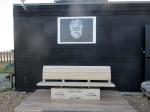
It was the striking monochrome photo that made me stop to look at this memorial on a day trip to Hastings this month. I’d admired the brand new pier and then wandered along the beach to the fishermen’s section commonly known as the Stade.
The photo was of a man whose tough outdoor life showed in his face and had obviously been a Hastings fisherman. He’d earned his livelihood from the sea in both calm and storm tossed waters with his boat as his only protection as it sailed its course, gulls shrieking overhead for any rejected catch. And then returning to the pebbled Stade at sunrise to offload the catch which would be sold at the Fishmarket later that day.
Beard died aged 68 and may have ended his days as ‘the boy on shore’ which meant that he was no longer able to go out on the boats but, instead, helped bring them ashore or sorted out the catch and nets. He looked quite a character in his photo and I felt that it really captured him.
Hastings fishermen have had the right to use the Stade free of charge for over 800 years. In fact, Stade comes from the Saxon for ‘landing place.’ There are usually 25 boats on the beach and it’s the largest beach launched fishing fleet in Britain. There’s always gulls here looking for any titbits and amidst the pebbles are the usual paraphernalia of fishing; nets, ropes and cuttlefish cages. Near the promenade and the Fishermen’s Museum are the unique tall, black tarred Grade II listed sheds used for storage. The boats have to be hauled from the sea after each trip so cannot be longer than 10 metres and care only able to travel a few miles. This makes for an ecologically friendly method of fishing.
But ask any fisherman and he’ll tell that, with quotas and costs, it’s becoming more and more difficult to make a living from the sea. In Hastings, there’s also the clash between an old established working community which occupies a large section of valuable land in the Old Town and property developers. The fishermen strongly opposed the building of the new Jerwood Gallery on part of the Stade. In fact, ‘No Jerwood’ was the message on one fisherman’s shed.
However, I couldn’t find out much about Beard apart from a brief obituary in the Hastings Observer dated 3 June 2016. It merely said that he’d died peacefully at home on 15 May 2016 and donations were to be given to either the RNLI or Cats Protection. Under the online condolences was one from a breakdown recovery service who described him as
‘a very jolly, helpful man who will be missed by the people who knew him…heartfelt condolences and sympathy to all the family.’
So he had a family and was obviously well liked but Beard may have been one of a vanishing breed. The photo that caught my attention made me wonder about Beard and his life. Memorial benches can often feel very anonymous as there’s usually only a small plaque with a few details but Beard’s photo gave you the man as well.
My local allotments are very popular and there’s always half a dozen people working away and getting their hands dirty. They’re watched closely by birds looking for worms in the dug over soil before swooping down for their meal. In summer the allotments burst forth with vegetables: lines of runner beans, rows of cabbages , lettuces and flowers and the occasional fox can be seen strolling through at dusk.
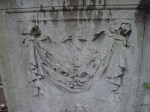
But, if you walk up the slope towards the chain link fence that divides the allotments from the park, you’ll come to a large stone plinth at the top. It nestles amongst the trees that have grown up around it. On one end there is a sculpted swag containing roses for remembrance so it once had a farh more illustrious past. I first saw the plinth from the other side of the fence while on the Kelsey park Woodland Trail looking for fungi to photograph. I wondered what it was. It was far too grand to be an allotment user’s display or flower pot stand. Maybe a small statue had been on top and had since disappeared as the empty pedestal was now in no man’s land. The plinth has also puzzled and intrigued the casual passer-by, dog walker and jogger as they go past. The local legend was that it marked the burial site of a horse which belonged to ‘one of the Burrell girls.’
But it wasn’t until I started researching this article that I managed to source a contemporary engraving of the plinth dating from the 1790’s which was entitled ‘Patch’s tomb’ that I had any evidence for the story. At last I had a name for the incumbent. It looks very grand in the picture with an elegant urn on top which is being admired by a fashionably dressed gentleman with an equally well dressed couple nearby. The perspective looks a little strange as the tomb looks larger than the onlookers. This was a serious monument both in cost and the determination to remember Patch. The location, on a small slope, was no idle choice and can be seen from the lakeside path 150 yards away below if you know where to look. Trees and vegetation have grown up on the small hill obscuring the tomb so it’s much easier to see during the winter die-off.
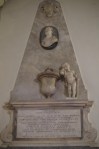
The Burrells were a prominent, land-owning family in Beckenham during the 16th -19th centuries and some of their descendants are still in the area. They have left a fine collection of monuments in the local church, St George’s.
The Burrells were also connected with Kelsey Park in Beckenham in that the site once formed part of Peter Burrell III’s 600 acre estate and it was a Burrell who built the first manor house there. Confusingly, there were four Peter Burrells and, after exploring their various family lineage, I decided that one of Peter Burrell III’s four daughters was probably the most likely owner of Patch. He also had a son who, strangely enough, became Peter Burrell IV but more of him later. The third Peter Burrell (27/08/1724 – 06/11/1775) was a politician and barrister and in 1748 he married Elizabeth Lewis, daughter of John Lewis of Hackney. There seem to be no pictures of him in existence and, instead, photos of Paul Burrell, Princess Diana’s ex-butler popped up!
Peter Burrell III was called to the bar in 1749, became MP for Launceston in Cornwall 1759-1768 and then MP for Totnes in Devon from 1774 – 1752. In 1769 Burrell was then appointed the Surveyor General of the Land Revenues of the Crown. So he was an ambitious man with considerable connections and wealth. He was also involved with other prominent local land-owning families in Beckenham such as the Cators after whom Cator Park is named. Burrell’s estate in Beckenham is now buried under roads and desirable detached houses with large gardens. But there is a local road called Burrell Row after the family. Peter Burrell I purchased the first Kelsey Park House and estate in 1690. It was extended several times as can be seen in the 1790 watercolour and then became incorporated into the far grander, rambling Victorian Scottish baronial style mansion which replaced it. The original house was a square, modest house which had several later additions.
The first Kelsey Park Manor House in the Georgian style. A square shape so easy to incorporate into the grander mansion that replaced it. This watercolour dates from 1790 and is the believed to be the earliest known picture of the Manor House which had been extended over the centuries. Friends of Kelsey Park newsletter Summer 2008
The four daughters were:
Elizabeth Amelia (1749-1837) – married a gentleman from Cambridgeshire. Richard Henry Alexander Bennett
Isabella Susanna (1750 – 1812) – married Algernon Percy, Ist Earl of Beverley, ancestor to the Dukes of Northumberland
Frances Juliana (1752 – 1820) – In 1779 she married Hugh Percy, 2nd Duke of Northumberland
Elizabeth Anne (1757 – 1837) – She married twice – firstly to Douglas Hamilton, 8th Duke of Hamilton and then secondly, to Henry Cecil, 1st Marquess of Exeter.
Marriages at that time were rarely for love but mainly for the joining of great houses, the exchange of land and also heirs. Frances had eleven children and Isabella had seven who all went onto more illustrious marriages and careers.
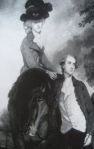
Elizabeth Anne Burrell (1757 – 1837) the youngest daughter of Peter Burrell II – I assume the man with her is her second husband Henry Cecil, 1st Marquess of Exeter.
I couldn’t find any further details on this image. https://www.wikitree.com/photo/jpg/Burrell-883
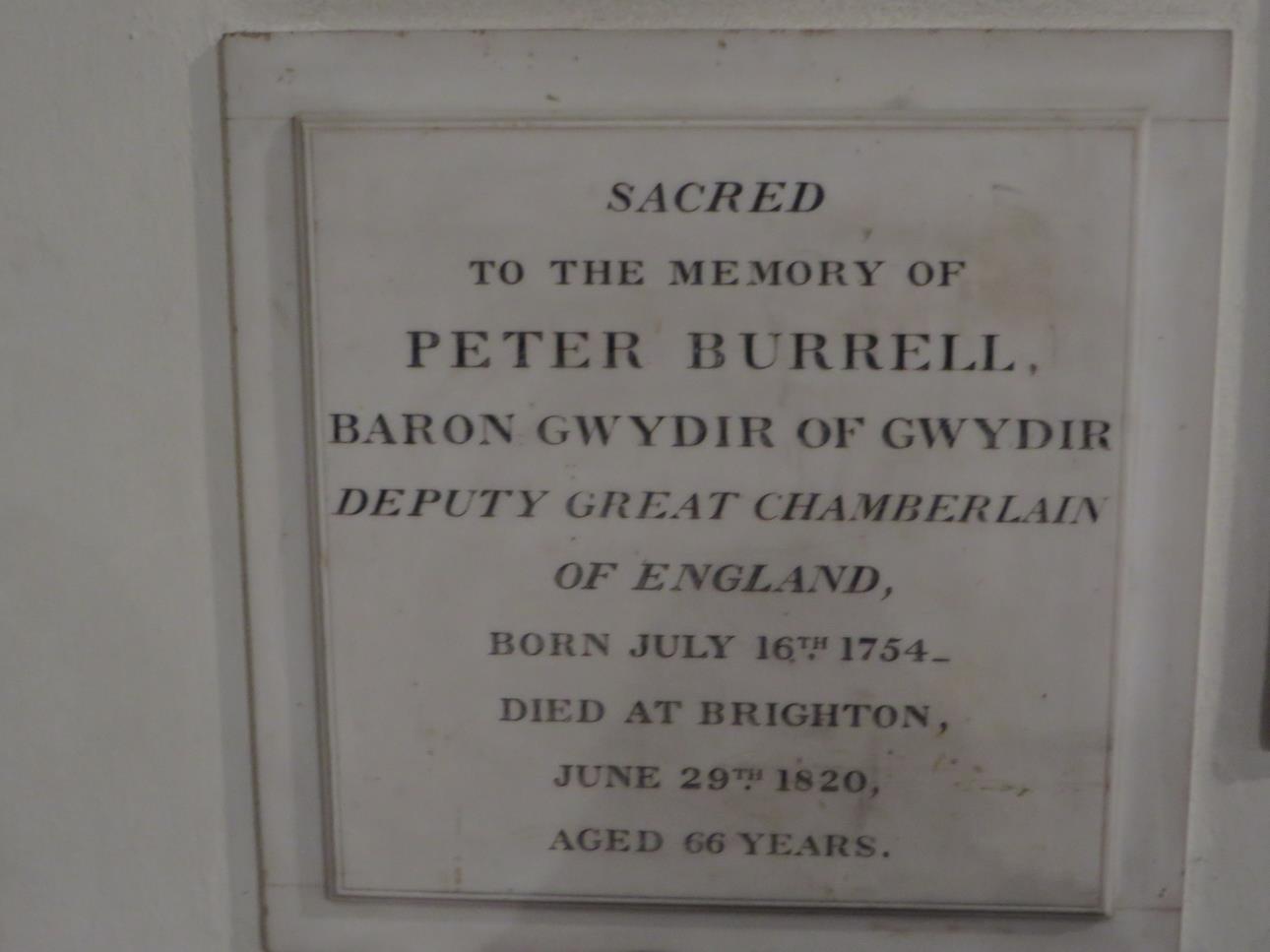
The Burrell girls seem to have been the ‘It’ girls of their day with their brilliant marriages into the aristocracy. Peter Burrell IV, the son, achieved even more dizzying heights as he became the Lord Chamberlain of England and the 1st Baron Gwydir of Gwydir Castle.
But it’s the eldest one, Elizabeth Amelia, who may have been Patch’s owner. Peter Burrell III built a house for her on his Kelsey estate where she lived with her husband, Richard Bennett. He was the MP for Newport from 1770-1774 but didn’t seem to have the same illustrious career as his father-in-law and the notes on his political career are brief. Elizabeth would have seen Patch’s last resting place from the house every day of her life as a reminder. I haven’t been able to find a picture of Elizabeth as it would have been interesting to see what she looked like. There’s no clue on the contemporary engraving as to the architect of the tomb and I wondered if Burrell paid for it or did Elizabeth?
So was Patch a young girl’s pet or a teenager’s source of freedom? We’ll never know and I was unable to source any pictures of Patch. It may seem strange to us to lavish such attention and money on a horse’s memorial. But in those days a horse almost certainly gave its owner a certain amount of freedom and independence. An earlier form of horsepower and being a good horsewoman at the time was a major attribute.
I like to think that, maybe when Kelsey Park’s closed and the lights have all gone out in the surrounding houses and apartment blocks, a spectral galloping can be heard. A passing badger or fox may prick up their ears at the sound as a young girl shouts ‘Hi, ho Patch and awaaay!’









 shadows fly away