Symbol of the Month – The King of Terrors!

The King of Terrors headstone, St Larence in Thanet, Ramsgate. © Carole Tyrrell

It was in the churchyard of St Laurence in Thanet, Ramsgate that I found this gleeful skull wearing a crown. The churchyard has a plethora of winged souls or children’s heads with wings but there is also a scattering of fine skulls as well.  This particular skull has bat wings on either side of its head but more on these later.  I consider it to be a personification of The King of Terrors which is another name for Death.

The left hand side of the headstone showing the word ‘Mary’. © Carole Tyrrell

The words on the righthand side of the headstone are unreadable. © Carole Tyrrell

The headstone is very weathered and most of the epitaph has now gone. According to the 1895 book published by Charles Cotton on ‘St Lawrence (Laurence), Thanet (Ramsgate)’, it could be either the last resting place of:

‘Mary, wife of Cornelius Martin, died 15th December 1728 aged 57 years’

Or

‘Mary, wife of George Martin, died 10th January 1727 aged 38 years.’

On closer inspection, the name Mary can still be seen but what remains on the right-hand side of the headstone is illegible although I did spot an ‘i’. This is what led to my supposition that it might be one of these ladies who is buried there.

On first glance it doesn’t look like a very comforting symbol with its stark representation of death. There is a very sobering verse written by the Rev. George Crabb (1754-1832) in which he mentions the King of Terrors:

‘Death levels man – the wicked and the just,

The wise, the weak, the blended in the dust,

And by the honours dealt to every name,

The King of Terrors seems to level fame.’

This reminds the reader that Death makes all men and women equal despite their rank when alive.

The King of Terrors is usually depicted as a skeleton brandishing a scythe, an arrow, a spear or a dart.  This magnificent example comes from Cralling Old Parish churchyard in the Scottish Borders. It’s a gleeful skeleton holding a scythe which is the symbol most associated with death.

The King of Terrors, Crailing Old Parish Churchyard. © Walter Baxter shared under Creative Commons Licence Geograph NT6820

Also in Scotland, Greyfriars Cemetery in Edinburgh abounds with macabre symbolism on its monuments and is well worth a visit if you’re ever visiting the city. I have seen it for myself and it is an amazing place.  The lively skeleton depicted on the headstone of Surgeon James Borthwick is known as ‘the dancing skeleton’ and is very impressive. Please follow the link below and scroll down to see it.

Greyfriars Kirkyard, Edinburgh: The Ultimate Guide | My Macabre Roadtrip

The monument is large and measures 4m x 2m so you won’t miss it and is the largest one in Greyfriars.  The skeleton is not only holding the Book of Destiny but also a large scythe. It is ultimately a ‘memento mori’ which is Latin for ‘Remember you must die.’

There is also one in the celebrated Rosslyn Chapel, near Edinburgh (don’t be put off by the Dan Brown associations) as it is such a fascinating place to visit.’

Click on this liGenealogy Tours of Scotland: A Month of Scottish Gravestones – The Dance of Death

All of these images emphasis the role of The King of Terrors as the King of Death or the Grim Reaper.  For what else could Death be but a terror as it’s the unknown.

However, in this detail from Alice Stone’s headstone in the churchyard of All Saints, Staplehurst, Kent, a winged figure, presumably the Devil, is triumphantly holding a dart, is standing over a fallen skeleton whose crown has fallen from his head.  Has the Devil beaten Death? Is the incumbent doomed to a life in hell?
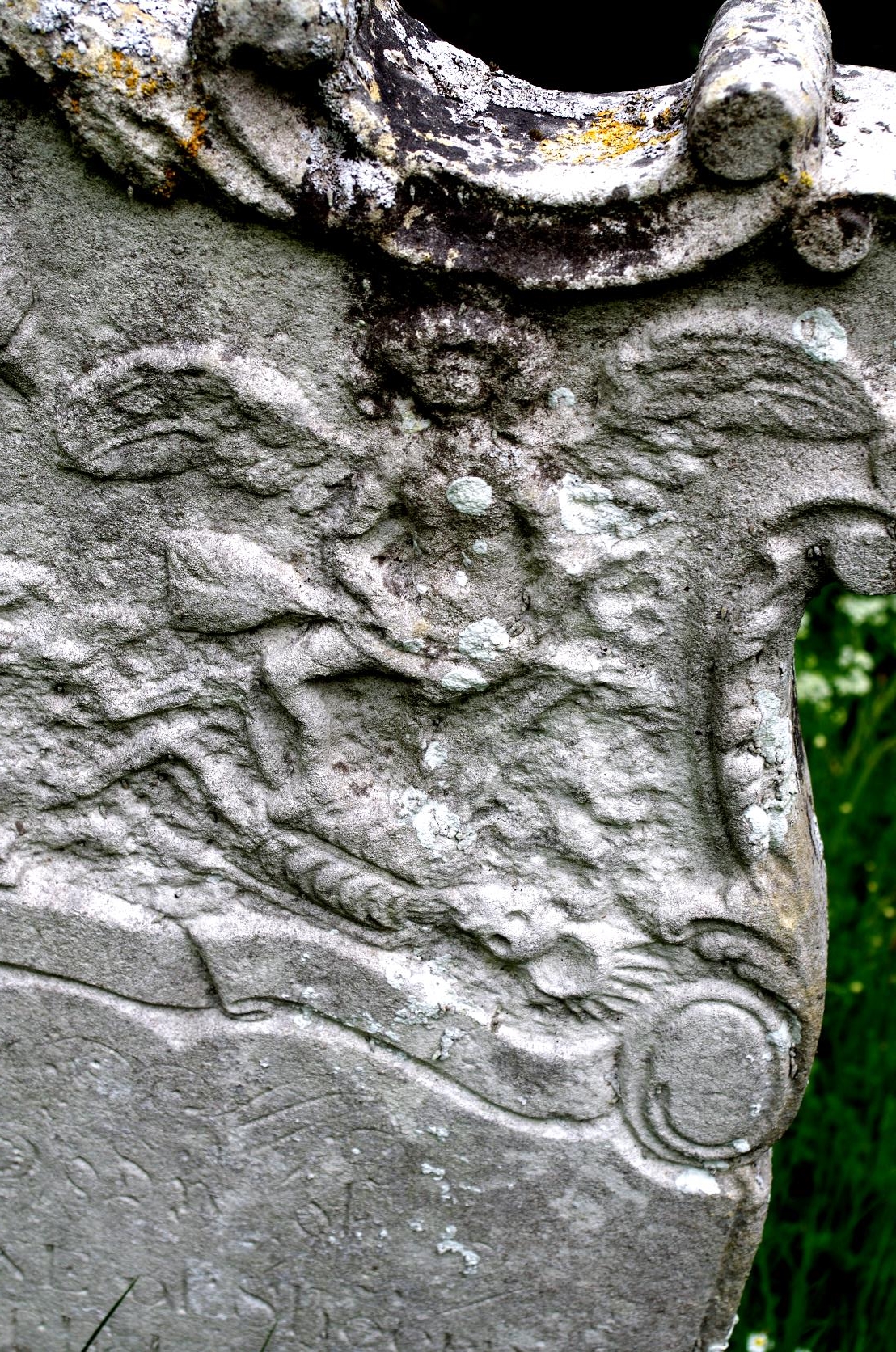
The Devil holding Death’s Dart standing over a skeleton that’s lost its crown. Could it be the King of Terrors? ©Carole Tyrrell

The King of Terrors is also a psychopomp. This comes from the Greek word, ‘psychopompos’ which means ‘the guide of souls.’ They appear in many religions and forms such as spirits, angels, demons and gods to guide the deceased to the afterlife.

Anubis and the King – tomb of Horemheb 1323-1295 BC Metropolitian Museum of Art. Shared under Wiki Creative Commons

Charon and his boat on a funerary relief ca 320s BC shared under Wiki Creative Commons.

The most obvious examples are Anubis, the ancient Egyptian god of the underworld, Charon the Greek ferryman, the Goddess Hecate and the Norse Valkyries amongst a host of others.  The psychopomp is also a personification of death and often represented with a scythe and given the title of ‘The Grim Reaper’ – the reaper of souls. This is one of the earliest images of him and dates from 1460.

One of the oldest paintings with conventional ‘Grim Reaper’ elements, a skeletal character with a scythe (circa 1460 by Jean Fouquet) shared under Wiki Creative Commons.

The King of Terrors first appears in the Bible in the Book of Job 18:14:

‘His confidence shall be rooted out of his tabernacle, and it shall bring him to the king of terrors.’

This is part of a chapter emphasising destruction and death for those who do not keep to the righteous path. However, I am indebted to the vastpublicindifference blog for the next earliest use of the name in a printed pamphlet. He is mentioned in William Prynne’s ‘Perpetuite of a Regenerate Man’s Estate’ in 1626:

‘If once you have the smallest dram of time and saving grace, you need not feare the very King of Terrors, hell and death, you need feare the most that men or divells (devils) can do to you. They cannot seuer (sever) you from the love of God, which is Christ Iesus (Jesus) your lord, not yet disturbe you from the state of Grace.’

He also appears in nearly 200 books in English pre-1700.

However, the King of Terrors, the Grim Reaper or whatever you choose to call him is not a very comforting image for those left behind. So, it’s no wonder that, as the years went on, these very stark symbols began to be replaced by the ‘winged souls’. They gave a more hopeful image of another life after death. There’s also the batwings on either side of the skull to consider.

Bats were considered to be the spirits of the dead and associated with evil as the Devil traditionally had the same type of wings. Sometimes the skulls are given two different types of wings; on one side they are feathered and on the other is the batwings.

Bats can also be seen as guardians between physical and spiritual worlds. They were supposed to guide souls through transformation or metamorphosis: renewal, death and rebirth.  So, the use of them is very appropriate on a funerary monument. In China, for example, they are seen as symbols of good luck, longevity and rebirth.

So, within this one symbol there are two meanings.  One is that the person has encountered the Grim Reaper and has died whereas the other suggests that they are going to be reborn to everlasting life. It was an interesting symbol to see on my churchyard visit although the skull does look a little too enthusiastic!

Text and photos © Carole Tyrrell unless otherwise stated

References and further reading

The History and Antiquities of the Church and Parish of St Laurence (Lawrence), Thanet (Ramsgate) Charles Cotton, 1895 via Kent Archaeological Society

King of Terrors | Gravely Speaking

King of Terrors Gravestone © Walter Baxter cc-by-sa/2.0 :: Geograph Britain and Ireland

Vast Public Indifference: Death: “King of Terrors”

Greyfriars Kirkyard, Edinburgh: The Ultimate Guide | My Macabre Roadtrip

The King of Terrors takes a rest | Gravely Speaking

Psychopomp – Wikipedia

Job 18 KJV – Then answered Bildad the Shuhite, and – Bible Gateway

Genealogy Tours of Scotland: A Month of Scottish Gravestones – The Dance of Death

Bats, a funerary fascination

What’s The Meaning Of Bat Symbol? – Ourspiritanimal.com

A Cheshire cat grin from out of the darkness – St John the Evangelist, Margate

Close up of head, ‘monumental’ brass, St John the Evangelist, Margate. ©Carole Tyrrell

It was dark in the chancel as I explored St John’s and then five small figures set into stones in the floor glinted at me.  Four of them were dressed in the clothes or armour of their time and one depicted a former priest, Sir Thomas Cardiff who was in post from 1460-1415. In fact Kent has the largest number of remaining monumental brasses depicting the human form than any other county. These total 400. But one in particular caught my eye.  How could I resist its smiling, gleeful face?

A knight in full armour, St John’s the Evangelist, Margate. ©Carole Tyrrell

Monumental brass of a priest in his vestments, Sir Thomas St John’s the Evangelist, Margate.©Carole Tyrrell

View of skeleton showing depiction of bones.©Carole Tyrrell

It was a skeleton, standing upright and tall with its arms at its sides facing the viewer, and a label underneath in Latin. This was the language of the church pre-Reformation.

The inscription reads:

‘Orate pro anima Ricardi Notfelde qui obiit penultimo die mensis marcii anno domini millesimo ccccxlvi.’

which translates as:

‘Pray for the soul of Richard Notfelde, who died on the last day of March 1446 AD

 The skeleton’s creator has some knowledge of anatomy as the ribs have been sketched in and there are also leg and arm bones. There is a rubbing of the brass in the Wellcome Collection that dates from 1880 and depicts the bones much more clearly.

Wellcome Collection rubbing of the skeleton. Shared under Wiki Commons Brass rubbing by F.Q. Hawkes Mason, 1880.

But it was its face that caught my attention. That grin! The little eyes and nose! It’s obviously not intended to resemble a proper skull but the effect was impressive. As the brasses are in such a dark place within the church, when I stood over the skeleton to take my photos, my shadow fell on it and the grin would disappear. So it was quite difficult to take a decent picture of any of the brasses.

The skeleton is a memento mori which derives from the Latin, ‘remember you must die.’  It is intended to remind the viewer that the skeleton is all that will remain of them after death. Rich or poor, high or low, all will be the same.  

According to the guide on duty, the brasses and their labels have been moved and it’s not known where they originally were within the church. But they also have a secret.  They’re not actually made of brass. Instead, they were made from a cheap alloy called ‘Latten’.  The guide helpfully reminded me of Chaucer’s Pardoner’s Tale in which he sold fake relics to simple, innocent people to extort money from them.  These included a cross made of ‘Latoum’ a cheap alloy that he pretends is made of gold.

Latten was an alloy that

‘contained varying amounts of copper, tin, zinc and lead which gave the characteristics of both brass and bronze.’   Wikipedia.

These alloys were used for monumental brasses in churches, decorative effects on borders, rivets or other metalwork details as on armour for example. They were also used for livery and pilgrim badges. Canterbury Museums have the largest collection of pilgrims badges in the UK so please follow the link to see a selection.

Pilgrim Badges – Canterbury Museums & Galleries

The skeleton was an unexpected find on a Heritage Open Day and I enjoyed making its acquaintance. A rare survivor in any church although I have seen other brasses made from Latten when visiting other Kent churches.

In this case, all that glitters is not brass!

© Text and photos Carole Tyrrell unless otherwise stated.

References and further reading

Latten – Wikipedia

Latten: The Definition and Meaning

Monumental Brasses in Kent — Kent Archaeological Society

Richard Notfield, St John’s, Margate, Kent, 1446. Brass rubbing by F.R. Hawkes Mason, 1880. | Wellcome Collection

Symbol of the Month – The Choice

The Full view of Alice Stone’s headstone in All Saints churchyard, Staplehurst, Kent
©Carole Tyrrell

You never know what little gems you might find in a country churchyard and I discovered one while exploring in Staplehurst.  All Saints has a commanding hilltop position and looks down on pretty half-timbered houses.  Since 1100 it has stood on this site and has several ancient features such as the remain s of an anchorite’s cell..

The churchyard was far larger than I expected and led to a more modern section at the back of the church.  But as I explored the older part of the churchyard I turned around and came face to face with this unusual symbol on a white headstone.

Alice’s epitaph – a little ineligible in parts.
©Carole Tyrrell

It’s dedicated to Alice Stone, wife of James Stone of Sheerness.  There is no date of birth recorded but she died on 5 February 1787 aged 27.  Alice may have died in childbirth which was a frequent cause of death for women in past eras or maybe she was a victim of an epidemic. We’ll never know.  However, there is some barely legible lettering above the inscription which I have been unable to sufficiently enhance in order to read it so this may well warrant a second visit.

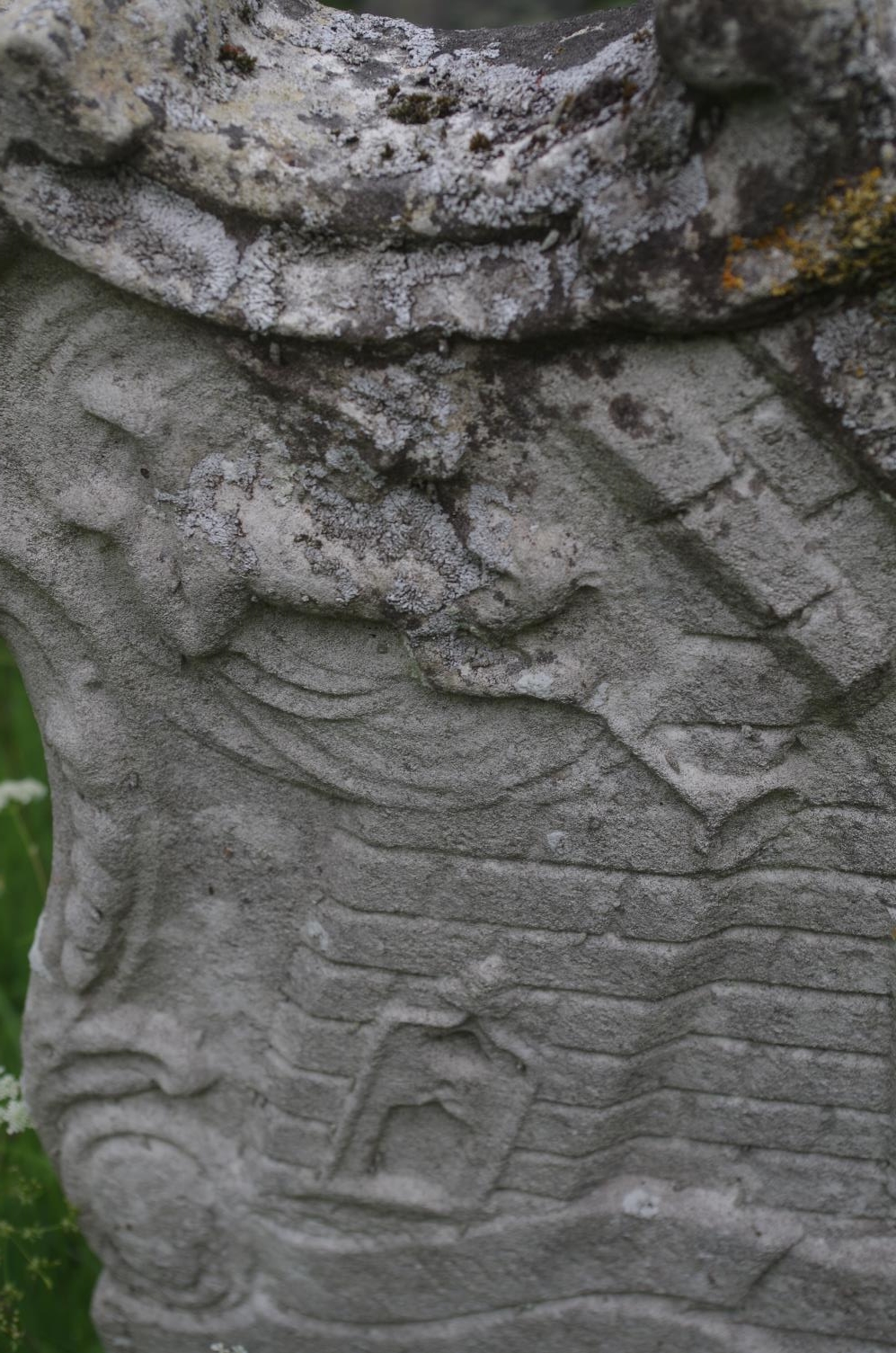
The deceased arises and casts off their shroud.
©Carole Tyrrell

The scene at the top of the tombstone is almost like a miniature Doom painting.  My interpretation of it is that it’s Judgement Day and the deceased has awoken from their eternal slumber.  They appear to be in a burial chamber and lying on a ledge or on a shelf within a vault.  They have partly cast off their burial clothes and appear to be slightly decayed.  Ribs are visible and the head appears skull-like.

But where are they destined to go next?  What will be their fate?

There’s only the choice of two final destinations for them – Heaven or Hell which are depicted on either side of the figure.

The devil standing over a skeleton that’s lost it’s crown.
©Carole Tyrrell

On the right hand side is a magnificently winged demon, or The Devil himself, standing over a grinning skeleton whose crown has fallen from his head.   The crown is a very significant symbol in that it can indicate the passage from the earthly life into the divine and I have written it about in a previous Symbol of the Month.  The demonic figure appears to be holding what looks like a besom or maybe it is a three pronged fork or even a large arrow.  Although there are no flames, here the Devil is triumphant in his domain.


Closer view of the angel in the clouds and his trumpet.
©Carole Tyrrell

On the left-hand side, an angel appears to be floating within clouds while blowing a large trumpet in the direction of the newly awoken deceased.   Underneath the angel is a brick house with an entrance or a small narrow gateway (I have to say the entrance does resemble a fireplace).   I interpret this as being a depiction of God’s House and there are numerous references to it within the Bible such as Matthew 7:13-15:

‘Enter through the narrow gate,

For wide is the gate and broad is the road that leads to destruction,

And many enter through it’

 And also in Genesis 28: 16-17:

 ‘When Jacob awoke from his sleep, he thought,

“Surely the Lord is in this place, and I was not aware of it.”

 He was afraid and said, “How awesome is this place! This is none other than the house of God; this is the gate of heaven.”

 It was difficult to find a specific Biblical verse that mentioned the Devil and Hell but I did find a reference in Matthew 10:28 :

‘And fear not them which kill the body,

But are not able to kill the soul:

But rather fear him which is able to destroy both soul and body in hell.’

(King James Version)

 I am not a particularly religious person but the parishioners of All Saints at the time would have recognised the quotations.

The scene would have been a prompt to the passing viewer or mourner to live their lives in a righteous manner or face the alternative for eternity.   It’s very dramatic and, as Alice died at an early age, this reminder would have very pertinent at a time when the average life expectancy was far lower.

So far I have not been able to find out more about Alice or James but for now she rests within part of the quintessential English country churchyard.  She’s amongst ancient stones, some protected or obscured by mosses and lichens, and the bright wildflowers of late Spring.    However, I would like to know more about her and what may have inspired the little scene on her headstone.

R I P Alice Stone.

©Text and images Carole Tyrrell unless otherwise stated

https://www.kentarchaology.org.uk/Research/Pub/ArchCant/009%20-%201874/009-11.pdf

https://www.kentarchaeology.org.uk/Research/Pub/ArchCant/009%20-%201874/009-11.pdf

https://www.biblegateway.com/passage/?search=Matthew+10%3A28&version=KJV

Symbol of the Month: Gather ye rosebuds while ye may as Death is always waiting

At last the endless sorting out of boxes is over after the move.  I’ve found some money I’d forgotten about, family photos and a lot of books. The Cancer r Research charity shop in the High Street is groaning under the weight of my donations and I have recycled a lot of stuff.

And now down to the important things in life – shadowsflyaway!   I didn’t have an internet connection for a few weeks which was probably a good thing as it made me concentrate on emptying boxes and organising rooms.

But let’s begin with Symbol of the Month!

This month’s symbol comes from a post on Facebook’s Folk Horror Revival page and I was intrigued enough to make this one Symbol of the Month.  I would describe it as a memento mori which is Latin for ‘Remember you must die.’

Tombstone from St Peter’s Church Falstone ,Northumberland
©Stephen Sebastian Murray

It’s a carving on a tombstone featuring a skeleton and a woman or girl facing the viewer. She is holding three flowers in one hand.  In this photo, although the skeleton almost seems to be rising from the ground, he is actually holding a scythe in one hand and an hourglass in the other.  This can be seen more clearly in the clipping from Northumberland’s Hidden History by Stan Beckensall which another reader on the strand of the post kindly attached.

Clipping on headstone from Falstone churchyard, Northumberland. taken from Northumberland’s Hidden History by Stan Beckensall used without permission.

She is wearing a tightly belted dress, perhaps fashionable in her time, and seems carefree despite having Death standing next to her in all his glory. I had the impression that this might have been on the grave of a young girl due to her dress and the flowers.

They reminded me of roses and I immediately thought of the famous phrase, ‘Gather ye rosebuds while you may’ which is a quotation from a poem by Robert Herrick, a 16th century poet.

The poem is entitled: To the Virgins to make much of time and the quotation comes from the first verse:

Gather ye rosebuds while ye may,

   Old Time is still a-flying;

And this same flower that smiles today

   Tomorrow will be dying.

So this little scene could be saying Enjoy life while you can as death will soon be here.’   It sounds a little depressing but life was shorter in earlier times. In the 19th century, for example, the average life of a working man was until their late 40’s and women often died in childbirth.  I wander around cemeteries a lot as you can imagine and there are many monuments and memorials to wives and often children who have died young as a result.  On the other hand it can be seen as uplifting in that it encourages the onlooker to enjoy life to the fullest.

Sadly I don’t know who’s buried here but she or he was obviously much missed to have such an impressive scene carved on their tombstone.

© text Carole Tyrrell photos use  with permission.

Symbol of the Month   – The Cadaver tomb

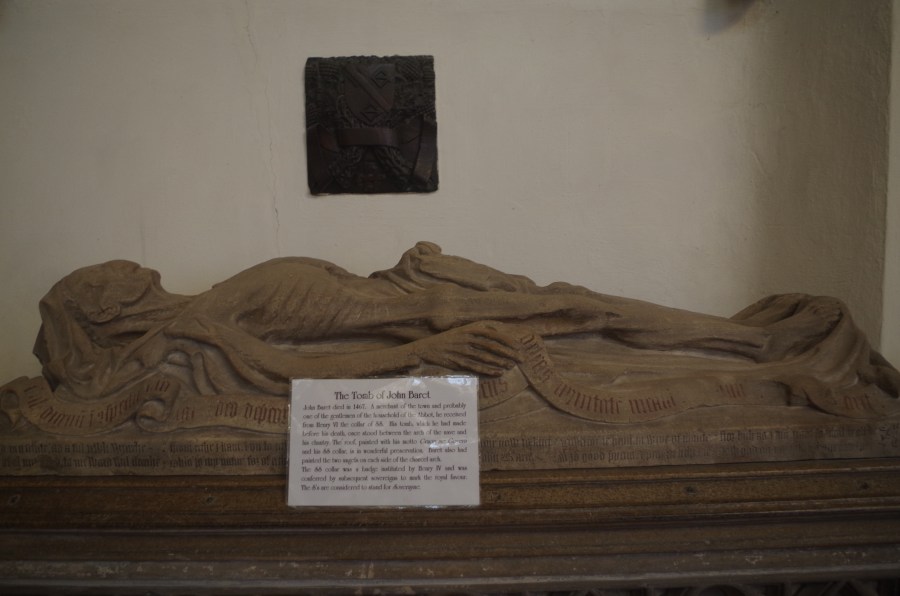
Full length view of John Benet’s cadaver tomb.
©Text and photos Carole Tyrrell

This month’s symbol is a cadaver or pardon tomb from St Mary’s in Bury St Edmunds.  These medieval tombs  were an extremely visual  way of reminding everyone that, despite what you had achieved during life, death would make you equal with all men.

It was as I stood in St Mary’s church, Bury St Edmunds after having  admired its magnificent hammerbeam with lifesize angels pinned to it like exotic butterflies that I saw John Benet’s tomb resting against a side wall.

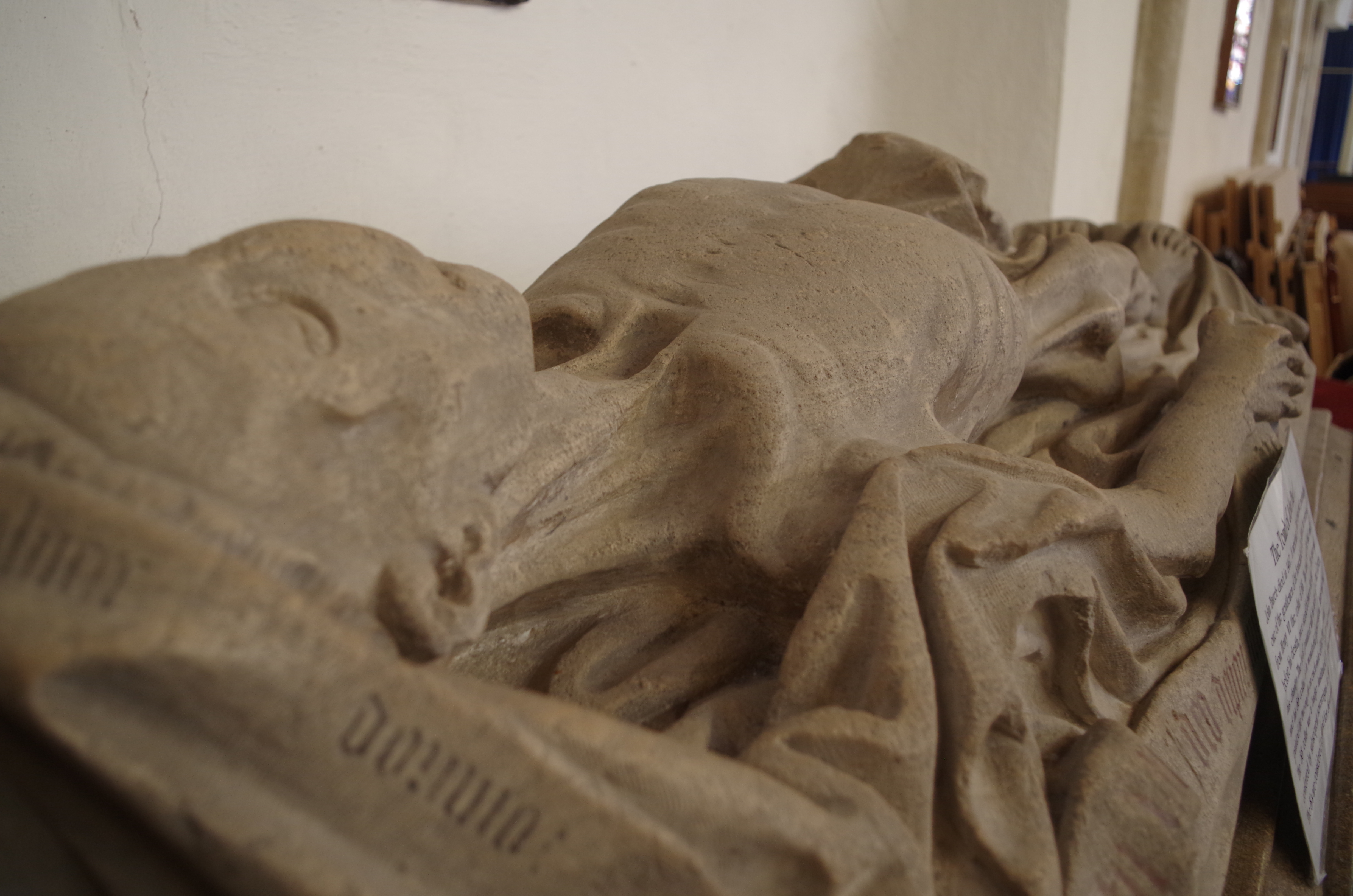
I’d seen two, somewhat worn, cadaver tombs in Winchester Cathedral but not one so close up and so well carved. Even now it’s still crisp and detailed but due to its current location it was difficult to take a full length photo. The tomb depicts John Benet lying on his back as a lifesize corpse with a shroud or towel protecting his modesty.

Another full length from the feet up of Benet’s cadaver tomb with the modesty cloth.
©Text and photos Carole Tyrrell

Although St Mary’s guidebook describes Benet’s tomb as a Pardon tomb, they are more often known as a transi or cadaver tomb.  This definition comes from Wikipedia who describe a transi or cadaver tomb, as a ‘memento mori’.  This is Latin for ‘remember you will die’ and a reminder of the inevitability of death.  Wiki goes onto add that this type of tomb is in the form of:

‘…a type of gisant or recumbent effigy tomb featuring an effigy in the macabre form of a decomposing corpse…’

This type of tomb is particularly associated with the Middle Ages which is roughly when Benet’s tomb was created and I’ve always known them as cadaver tombs. However, they’re not always in the form of a decomposing corpse as they can also be in the form of skeletons or the body of the deceased wrapped in a shroud. I am indebted to the flickeringlamps blog which featured transi tombs in the form of ‘double-deckers’.  This is where the top layer of the tomb portrays the gisant of the deceased as they were when alive and then below on the bottom layer as a decomposing corpse.  This is an extremely visual reminder of what the person once was and what they will inevitably become as earthly glory is fleeting and all must die.

Cadaver tombs can be found in several UK cathedrals and parish churches. The earliest surviving one is in Lincoln Cathedral and is dedicated to Richard Fleming. It dates from the 1430’s.  St Pauls’ cathedral has a later example from the 17th century which commemorates the poet John Donne.  Cadaver tombs are also known in Europe and particularly in Italy, France. Germany and the Netherlands.

But who was John Benet?

According to St Mary’s guidebook, John Benet was a medieval cloth trader and one of St Mary’s most important benefactors.  He financed the very ceiling that I’d been admiring and also his own private chancel chapel and tomb. Within his lifetime, Bury St Edmunds was a thriving town built on the local wool trade.  This led to the creation of a rising merchant class who were able to use their money to leave a lasting memorial to themselves in their local church as proof of their good and pious life.  Surely admittance to the Pearly Gates would be assured if you provided your church with some embellishments…. After they couldn’t take it with them but they could definitely prove that they’d had it while alive….

John Benet was a rich and powerful man within his local town  which is why he was able to afford to have a cadaver tomb made for him and one that was so well sculpted.   It originally lay in his own private chapel.  This has now gone but if you look up you can still see its glittering ceiling  which was restored in 1968.   You may just be fortunate enough to see the light glisten on the tiny pieces of concave mirror glass inserted into the gold stars to give the illusion of real stars twinkling.  Benet’s motto, ‘Grace me Governe’, his initials, coat of arms and SS collar are also part of the intricate decoration.  The latter, again from St Mary’s guidebook:

’….was a gift from the Lancastrian kings in recognition of a special or personal services.  It was in the form of a collar or chain in which the letter ‘S’ was engraved.  The letter ‘S’  which presumably stood for ‘Sovereign.’

The restored ceiling of what once was the ceiling of John Benet’s private chapel.
©Text and photos Carole Tyrrell

So Benet moved in high circles and wasn’t afraid to shout about it for all eternity.

There are Latin prayers on the ceiling’s edges which include ‘Pray for the soul of John Benet, ‘Let us praise the Lord gloriously’, Alleluia, Honour and glory to the only God.’, ‘My soul shall delight in the Lord’, ‘Seek only the highest’ and finally ‘May the pure Virgin Mary bless us with issue.’  Benet was not a man who stinted where his soul was concerned.

The tomb has moved around the church interior several times. But not of its own volition as far as I know. It has been surmised that the effigy of him portrayed as a decaying corpse was made during his lifetime.

Now there’s an  interior design feature for you…it would have been intended as a constant reminder of his own inevitable death and the need to make preparations for the afterlife. It’s in remarkable condition and is the best one that I’ve seen.  It may have been created in the  nearby Abbey’s master mason’s workshops.  This seems very likely given Benet’s powerful connections and the quality of the carving would also confirm this.

Originally he was positioned with his feet facing the east but, in 1884, the tomb was turned around so that the side inscription could be read.  In this, Benet’s motto is carved and a small figure of himself is in the middle of it, dressed in his finest clothes, and holding up the word ‘Me’.  Under one hand of the decaying corpse are the words:

‘He that will sadly beholde me with his ie, May he hyd own mirrour (and) lerne for to die. ‘

Full length view of John Benet’s cadaver tomb.
©Text and photos Carole Tyrrell

 A lifesize memento mori if you will. The guidebook, however, describes it as a Pardon Grave’ which isn’t a term that I’ve heard before. It’s meant to indicate that the person who was being commemorated has obtained a pardon or remission from purgatory.  Benet had also left instructions for his papal pardon to be displayed near his tomb for all to see.  I had the impression that Mr Benet was a bit of a show-off but if you don’t blow your own trumpet…. I sincerely hope that all this piety and expense achieved its aim.

The cadaver tomb iconography is based on the medieval Dance of Death or Danse Macabre.

Nobleman & Physician from the Lubeck Totentanz courtesy of UT Southwestern

This depicted a long line of people from Emperors to Popes right down to a beggar, each of whom had death in the form of a skeleton at their shoulder. This was a reminder that Death made all men equal.   The first one was recorded in St Paul’s Cathedral and in Long Melford, Suffolk, according to St Mary’s guidebook, long cloths were displayed depicting ‘the dance of Pauls’

It’s amazing that this survived the Reformation and Cromwell’s wrecking crews and still sits in St Mary’s reminding visitors of their inevitable fate.   But Mr Benet has a further claim to fame as, in 2003, he was loaned out to the Victoria and Albert Museum as part of their ‘Gothic: Art of England’ exhibition. Apparently, during conservation, traces of flesh coloured paint were discovered on the figure which included red and green veins especially in the neck.  So try and imagine Mr Benet in his original colouring – it must have quite a sight to see.    I think that he’d be very proud that his tomb, the hammerbeam ceiling and also his chapel ceiling are still in St Mary’s for all to enjoy and remember him.

©Text and photos Carole Tyrrell unless otherwise stated. 

References and further reading: 

St Mary’s, Bury St Edmunds A guidebook, Clive Paine, Honey Hill Publishing 1986.

Metamorphosis of a Death Symbol’ The Transi Tomb in the Late Middle Ages an d the Renaissance, Kathleen Cohen (Berkeley: University of California Press) 1973

https://flickeringlamps.com/2015/01/03/a-most-macabre-tomb-in-lincoln-cathedral/

https://en.wikipedia.org/wiki/Cadaver_tomb