Symbol of the Month – The King of Terrors!

The King of Terrors headstone, St Larence in Thanet, Ramsgate. © Carole Tyrrell

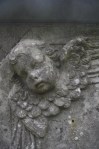
It was in the churchyard of St Laurence in Thanet, Ramsgate that I found this gleeful skull wearing a crown. The churchyard has a plethora of winged souls or children’s heads with wings but there is also a scattering of fine skulls as well.  This particular skull has bat wings on either side of its head but more on these later.  I consider it to be a personification of The King of Terrors which is another name for Death.

The left hand side of the headstone showing the word ‘Mary’. © Carole Tyrrell

The words on the righthand side of the headstone are unreadable. © Carole Tyrrell

The headstone is very weathered and most of the epitaph has now gone. According to the 1895 book published by Charles Cotton on ‘St Lawrence (Laurence), Thanet (Ramsgate)’, it could be either the last resting place of:

‘Mary, wife of Cornelius Martin, died 15th December 1728 aged 57 years’

Or

‘Mary, wife of George Martin, died 10th January 1727 aged 38 years.’

On closer inspection, the name Mary can still be seen but what remains on the right-hand side of the headstone is illegible although I did spot an ‘i’. This is what led to my supposition that it might be one of these ladies who is buried there.

On first glance it doesn’t look like a very comforting symbol with its stark representation of death. There is a very sobering verse written by the Rev. George Crabb (1754-1832) in which he mentions the King of Terrors:

‘Death levels man – the wicked and the just,

The wise, the weak, the blended in the dust,

And by the honours dealt to every name,

The King of Terrors seems to level fame.’

This reminds the reader that Death makes all men and women equal despite their rank when alive.

The King of Terrors is usually depicted as a skeleton brandishing a scythe, an arrow, a spear or a dart.  This magnificent example comes from Cralling Old Parish churchyard in the Scottish Borders. It’s a gleeful skeleton holding a scythe which is the symbol most associated with death.

The King of Terrors, Crailing Old Parish Churchyard. © Walter Baxter shared under Creative Commons Licence Geograph NT6820

Also in Scotland, Greyfriars Cemetery in Edinburgh abounds with macabre symbolism on its monuments and is well worth a visit if you’re ever visiting the city. I have seen it for myself and it is an amazing place.  The lively skeleton depicted on the headstone of Surgeon James Borthwick is known as ‘the dancing skeleton’ and is very impressive. Please follow the link below and scroll down to see it.

Greyfriars Kirkyard, Edinburgh: The Ultimate Guide | My Macabre Roadtrip

The monument is large and measures 4m x 2m so you won’t miss it and is the largest one in Greyfriars.  The skeleton is not only holding the Book of Destiny but also a large scythe. It is ultimately a ‘memento mori’ which is Latin for ‘Remember you must die.’

There is also one in the celebrated Rosslyn Chapel, near Edinburgh (don’t be put off by the Dan Brown associations) as it is such a fascinating place to visit.’

Click on this liGenealogy Tours of Scotland: A Month of Scottish Gravestones – The Dance of Death

All of these images emphasis the role of The King of Terrors as the King of Death or the Grim Reaper.  For what else could Death be but a terror as it’s the unknown.

However, in this detail from Alice Stone’s headstone in the churchyard of All Saints, Staplehurst, Kent, a winged figure, presumably the Devil, is triumphantly holding a dart, is standing over a fallen skeleton whose crown has fallen from his head.  Has the Devil beaten Death? Is the incumbent doomed to a life in hell?
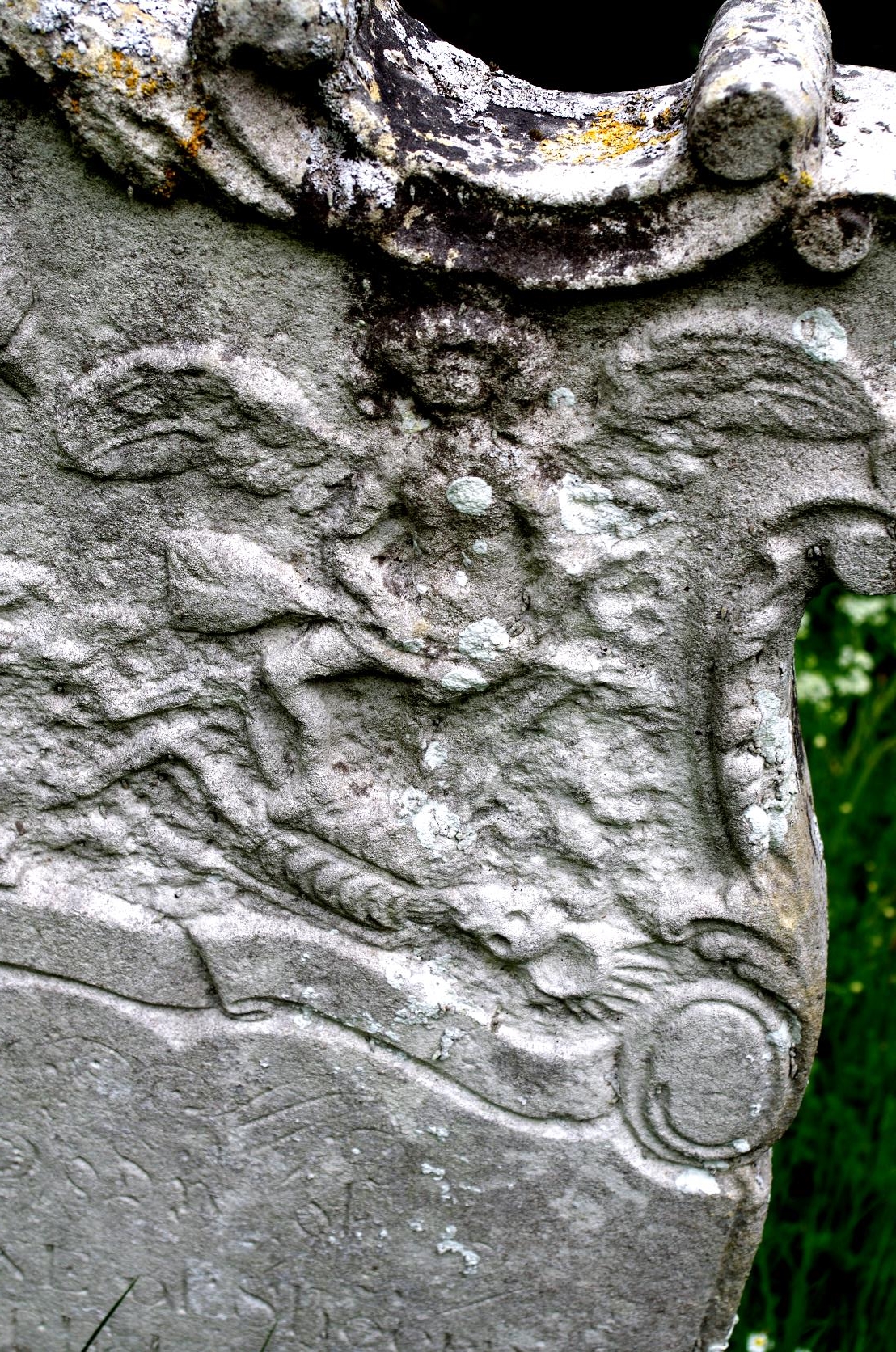
The Devil holding Death’s Dart standing over a skeleton that’s lost its crown. Could it be the King of Terrors? ©Carole Tyrrell

The King of Terrors is also a psychopomp. This comes from the Greek word, ‘psychopompos’ which means ‘the guide of souls.’ They appear in many religions and forms such as spirits, angels, demons and gods to guide the deceased to the afterlife.

Anubis and the King – tomb of Horemheb 1323-1295 BC Metropolitian Museum of Art. Shared under Wiki Creative Commons

Charon and his boat on a funerary relief ca 320s BC shared under Wiki Creative Commons.

The most obvious examples are Anubis, the ancient Egyptian god of the underworld, Charon the Greek ferryman, the Goddess Hecate and the Norse Valkyries amongst a host of others.  The psychopomp is also a personification of death and often represented with a scythe and given the title of ‘The Grim Reaper’ – the reaper of souls. This is one of the earliest images of him and dates from 1460.

One of the oldest paintings with conventional ‘Grim Reaper’ elements, a skeletal character with a scythe (circa 1460 by Jean Fouquet) shared under Wiki Creative Commons.

The King of Terrors first appears in the Bible in the Book of Job 18:14:

‘His confidence shall be rooted out of his tabernacle, and it shall bring him to the king of terrors.’

This is part of a chapter emphasising destruction and death for those who do not keep to the righteous path. However, I am indebted to the vastpublicindifference blog for the next earliest use of the name in a printed pamphlet. He is mentioned in William Prynne’s ‘Perpetuite of a Regenerate Man’s Estate’ in 1626:

‘If once you have the smallest dram of time and saving grace, you need not feare the very King of Terrors, hell and death, you need feare the most that men or divells (devils) can do to you. They cannot seuer (sever) you from the love of God, which is Christ Iesus (Jesus) your lord, not yet disturbe you from the state of Grace.’

He also appears in nearly 200 books in English pre-1700.

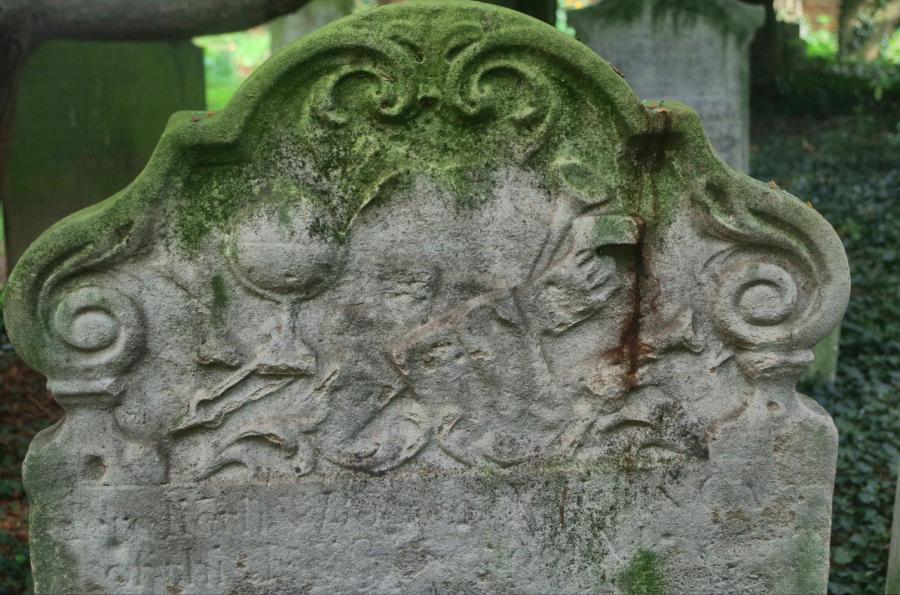
However, the King of Terrors, the Grim Reaper or whatever you choose to call him is not a very comforting image for those left behind. So, it’s no wonder that, as the years went on, these very stark symbols began to be replaced by the ‘winged souls’. They gave a more hopeful image of another life after death. There’s also the batwings on either side of the skull to consider.

Bats were considered to be the spirits of the dead and associated with evil as the Devil traditionally had the same type of wings. Sometimes the skulls are given two different types of wings; on one side they are feathered and on the other is the batwings.

Bats can also be seen as guardians between physical and spiritual worlds. They were supposed to guide souls through transformation or metamorphosis: renewal, death and rebirth.  So, the use of them is very appropriate on a funerary monument. In China, for example, they are seen as symbols of good luck, longevity and rebirth.

So, within this one symbol there are two meanings.  One is that the person has encountered the Grim Reaper and has died whereas the other suggests that they are going to be reborn to everlasting life. It was an interesting symbol to see on my churchyard visit although the skull does look a little too enthusiastic!

Text and photos © Carole Tyrrell unless otherwise stated

References and further reading

The History and Antiquities of the Church and Parish of St Laurence (Lawrence), Thanet (Ramsgate) Charles Cotton, 1895 via Kent Archaeological Society

King of Terrors | Gravely Speaking

King of Terrors Gravestone © Walter Baxter cc-by-sa/2.0 :: Geograph Britain and Ireland

Vast Public Indifference: Death: “King of Terrors”

Greyfriars Kirkyard, Edinburgh: The Ultimate Guide | My Macabre Roadtrip

The King of Terrors takes a rest | Gravely Speaking

Psychopomp – Wikipedia

Job 18 KJV – Then answered Bildad the Shuhite, and – Bible Gateway

Genealogy Tours of Scotland: A Month of Scottish Gravestones – The Dance of Death
Bats, a funerary fascination

What’s The Meaning Of Bat Symbol? – Ourspiritanimal.com

Symbol(s) of the Month – the exuberant 18th century symbols of St George’s churchyard

One of the skulls at base of blank cartouche on one side of large chest tomb, St George’s.
©Carole Tyrrell

It’s often on a winter’s night, just as dusk begins to fall and the lamp lights in St Georges churchyard come up, that  the fine selection of 18th century tombstones are at their best. Carved skulls leer at you, an hourglass emphasises time passing and the gravedigger’s tools stand ready for the next interment.  And perhaps there is still a phantom schoolteacher using his sculpted globe to teach geography to his spectral students.

There has been a church on this site since the 14th century and in one place in the graveyard  the number of burials over the centuries has made the ground rise up on both sides.  But, as well as 18th century examples of funerary symbolism, there are also some wonderful 19th century ones as well.  Inside the church there’s also a good selection of impressive wall monuments dedicated to prominent local families dating back to the 1600’s.  They are  buried in the vaults beneath the church.  St George’s also has the country’s oldest lych gate in that the current one incorporates elements from  a far older one. The churchyard is a pretty one for a short walk through to the bustling High Street  especially when the spring flowers begin to appear, carpeting the grass between the stones with bluebells and flitting butterflies.


However for this month’s Symbols post I will concentrate on the 18th century memorials within the churchyard. These  tombstones  are topped with classic memento mori symbols.  This is Latin for ‘remember me.’  They are the visual accompaniment to the immortal epitaph from Dundee’s Howff graveyeard:

Remember Man as you pass by

As you are now so once was I

As I am now so must you be

Remember man that you must die.’


Graveyard symbolism, according to Douglas Keister, began when the well to do  could no longer be buried with in their local church due to lack of space. Instead, they took up their eternal residence in the newly consecrated burial grounds outside and surrounding the church walls. These were often known as’God’s Acres’ and gave the wealthy the opportunity to erect a lasting memorial or tombstone in their memory.


St George’s churchyard became the last resting place of prominent local familes, some of whose descendants still live in the area. The oldest tombstone dates from 1668 and the 18th century ones  are nearest to the church walls which in effect meant that they were  ‘‘Nearer my God to Thee.’


I’ve always enjoyed walking through the churchyard as it can feel like walking through a gallery of funerary symbols.  There’s something very exuberant about these 18th Century motifs of mortality even though some have eroded and only one epitaph is still fully readable.  However, the skull and crossbones, the Death’s Heads and others have, in several cases, lasted better than the epitaph below them.


The skull and crossbones are an effective, if macabre, reminder of what is left of a body after it decomposes and there are several good examples in St Georges.


This one is near the church entrance and features a skull and crossbones with what appear to be protruding palm fronds.  It also seesm to be resting on something whch may be a shield.  All that can now be read on the epitaph is…who dep….’


The skull and crossbones, a winged hourglass and a set of sexton’s tool on the left hand side.
©Carole Tyrrell

Nearby is another skull and crossbones with a winged hourglass above it.  This is a reminder that ‘Time flies’ or ‘Tempus Fugit’ and that the onlooker will soon be bones and dust and it’s important to make the most of their time on earth. On the left hand side is a pick and shovel.  These are a sexton’s tools which made me wonder if this was a sexton’s grave but the epitaph is now illegible.  The sexton’s role not only encompassed maintaining and looking after the church but also the churchyard.  In larger graveyards the sexton would have been more of a manager but in smaller ones he would have had sole responsibility for preparing the ground, digging and closing the grave, mowing the lawn and also maintaining the lawn and paths.

Skulls also feature prominently on two other tombstones on the other side of the church very near the wall. One seems to have a very sharp pair of horns and a  definite smirk.  On each side of it there appear to be small trumpets but it’s too weathered to see if anyone’s blowing them.  Maybe he’s keenly anticipating the Last Day of Judgement.


Somersaulting skulls and hourglass
©Carole Tyrrell


Nearby is a large tombstone with what seem to be two somersaulting skulls on them although one is more eroded than the other.  Below them is a small worn hourglass.  I believe that these two examples of skulls may be unique to St Georges as I’ve haven’t yet seen them anywhere else.


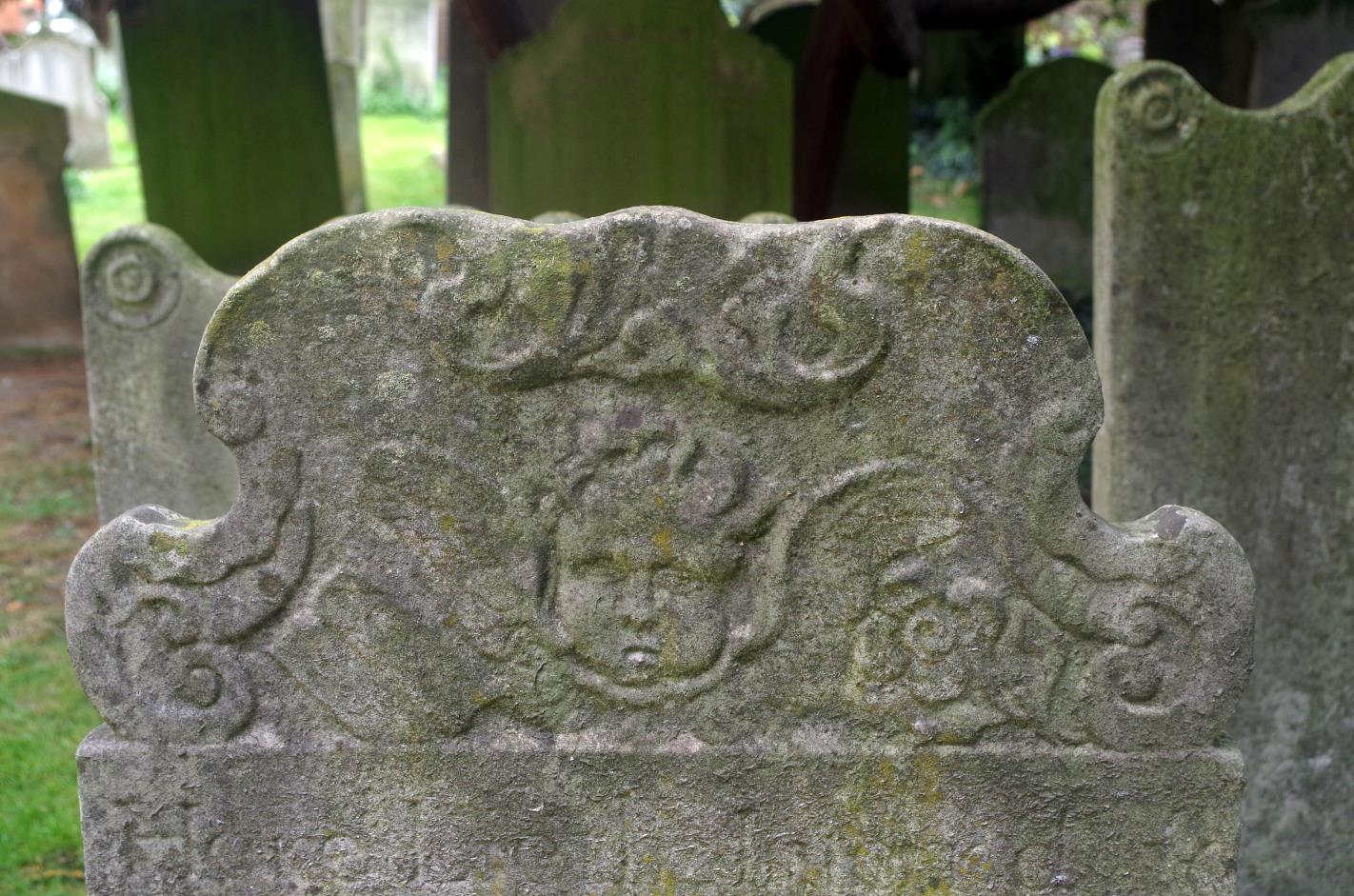
Douglas Keister has suggested that the skull and crossbones slowly began to be replaced by the much less stark and macabre  ‘Death’s Head.’  This is a human face with wings on either side of it.  I’ve always known it as the ‘winged cherub’ and there are also several good examples within the churchyard.

A closer view of the Saxby Angel with what appears to be a faded open book on one side and a stylised flower on the other side.
©Carole Tyrrell

I am also a huge fan of calligraphy having studied it for two years at evening classes and it has undergone a revival on late 20th and early 21st century tombstones.  However 18th century calligraphy has a style all of its own and is instantly recognisable.  The only legible 18th century epitaph in St Georges is the one dedicated to a John Saxby.  It reads:


‘               ‘Here lyeth the body of John Saxby of the Parish who Departed this life…year of May 1731 aged 41 years. ‘


A fine example of a Death’s Head is on top with an open book beside it which may be the Bible or the Book of Life and there’s a stylised flower on the other side.  The open book may be a depiction of the incumbent offering their life to God for judgement as an ‘open book’. People are sometimes described as an ‘open book’ as they have their feelings and thoughts open to the world with no attempt to hide them.

Crown in clouds with small faces, presumably angels, peeping out from either side.
©Carole Tyrrell

On another memorial two small faces, presumably from the angelic host, peer out from either side of the clouds surrounding a crown.  It’s a representation of the reward that awaits the faithful in heaven.  This verse from the Bible refers to it:


James 1:12 New International Version (NIV)

Blessed is the one who perseveres under trial because, having stood the test, that person will receive the crown of life that the Lord has promised to those who love him. https://www.biblegateway.com/passage/?search=James%201:12


A very plum faced Death’s Head with an open book on one side and a skull and a long bone on the other side.
©Carole Tyrrell

A plump faced death’s head is surrounded by another open book and what I think maybe a small skull in the far corner of the stone.


But one of the most unique and impressive tombstones in St George’s, or perhaps anywhere, is that of John Kay.  He was an 18th century schoolmaster and his life and talents are recorded by the tools of his trade that have been carved on his stone. There’s a globe on a stand, a trumpet, what appears to be a cornet, an artists palette, a pair of compasses and other items which are now too indistinct to read.  He was obviously very erudite and much appreciated by his students.  Sadly his fulsome epitaph is now virtually unreadable. He lies near Mr Saxby under a spreading yew tree.

On the other side of the graveyard is a large chest tomb.  There is a dedication and an armorial on its top and I feel that some patient research in St George’s burial registers may reveal the incumbent’s identity.  There are blank cartouches on each side with death’s heads on top and two skulls beneath each one.  At one end are palm fronds which are a Roman symbol of victory which were then adapted by the Christians as a martyr’s triumph of death.  The palm as a symbol originated in the ancient Near East and Mediterranean region  and is a powerful motif of victory, triumph, peace and eternal life.  It’s traditionally associated with Easter and Palm Sunday and Christs’ resurrection and victory over death. On the other end of the tomb are what appear to be olive flowers.  The olive’s association with wisdom and peace originally came from Greek mythology when the goddess, Athena, presented an olive tree to the city that was to become Athens.  Successive Greek ambassadors then continued the tradtion by offering an olive branch of peace to indicate their goiod intentions. The olive tree is also associated with longevity, fertility, maturity, fruitfulness and prosperity.  In the Bible, Noah sent the dove out after the Flood to see if the floodwaters had receded and when it returned with an olive leaf in its beak Noah knew that the Flood had ended.  Even today the phrase ‘ offering an olive branch’ means the someone wants to make peace. But in this context the olive branch may mwean that the soul has departed with the peace of God. So one memorial incorporates powerful  motifs of mortality and resurrection.


St George’s has also used old tombstones to pave two of the pathways within the churchyard of which some are still readable.  It always feels as if I’m walking over someone’s grave although they are buried elsewhere in the graveyard.  However, although the 19th and 20th century memorials are rather more restrained and far more legible I prefer the more ‘in your face’  18th century symbols.  But in the case of the horned skull I can only frustratingly only guess at its meaning and the person who lies beneath…..


©Text and photos Carole Tyrrell otherwise stated.

References

Stories in Stone; A Field Guide to Cemetery Symbolism and Iconography, Douglas Keister, Gibbs M Smith, 2008

St George’s Churchyard, St George’s Parish Church, Beckenham, Revised June 2005

St George’s Parish Church, Beckenham, information leaflet,, October 2003

http://www.thecemeteryclub.com/symbols.html

http://www.catholictradition.org/Saints/signs4.htm

http://www.planetgast.net/symbols/plants/plants.html

https://www.thoughtco.com/photo-gallery-of-cemetery-symbolism-4123061

https://stoneletters.com/blog/gravestone-symbols

http://www.graveaddiction.com/symbol.html


OLIVE: The olive is a true Biblical tree, a tree ‘full of fatness’ w

11 symbols for the price of one! – The Anne St John memorial, The Lytton Chapel, St Mary’s Church, Knebworth


St Mary's church Knebwoth, view from the House. © Carole Tyrrell
St Mary’s church Knebwoth, view from the House.
© Carole Tyrrell

Most people associate Knebworth with huge rock concerts and as a Gothic backdrop to many well-known films including The King’s Speech.

But it has other claims to fame apart from gargoyles and lovely gardens.  It also has a wonderful mausoleum in its own field and the Lytton Chapel which, according to Pevsner and Simon Jenkins, has the finest 18th century memorials in England.

The Knebworth church is officially known as St Mary’s although it’s actually dedicated to the Virgin Mary and St Thomas of Canterbury or Thomas a Becket.  It sits facing the House with its own small graveyard and surrounded by trees and railings.  This is where many of the past owners of Knebworth are buried and you enter under a lovely lychgate.  But why is it there?

St Mary’s was originally part of the medieval village of Knebworth and was first recorded in the Domesday Book. But when the village was moved after the creation of Knebworth Park in the late 1300’s , St Mary’s stayed in its place.  It’s a church steeped in history and an architectural jigsaw as so much of it comes from different periods.  The nave and chancel, for example, date from 1120 AD.   When you first enter, the interior appears very plain but St Mary’s real glory is the Lytton Chapel in a side room near the altar.

However, amongst its impressive marble monuments was a memorial tablet mounted on a side wall, to the left as I entered.

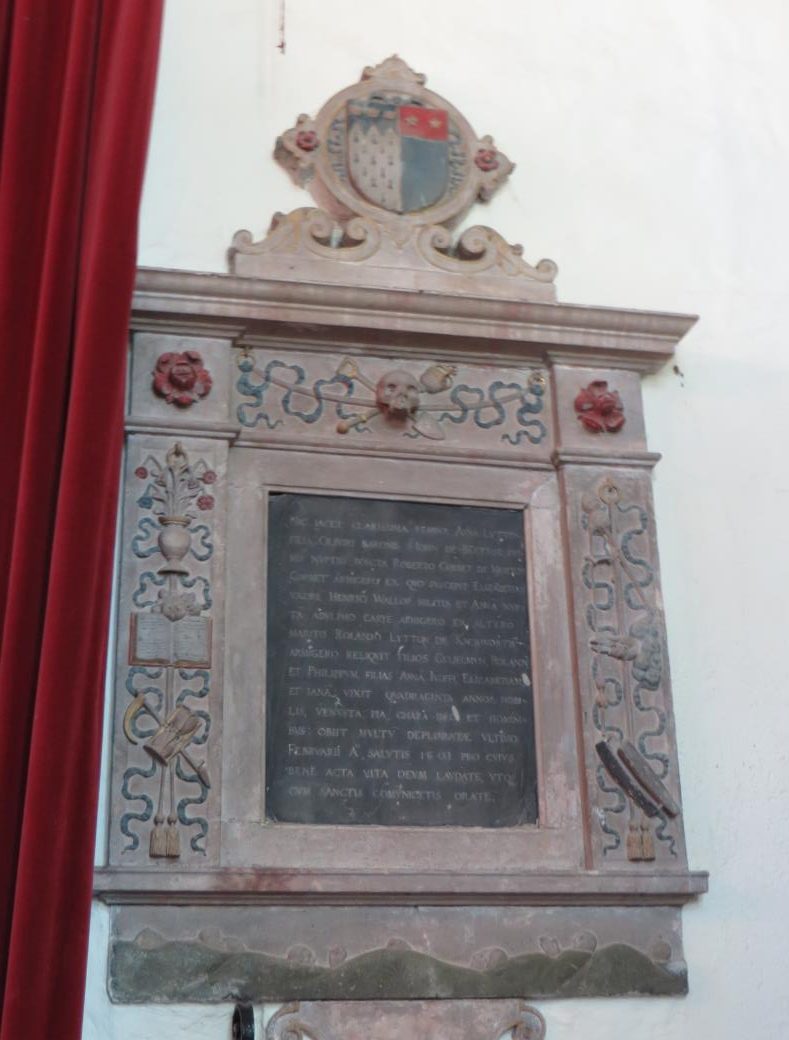
The Anne St John wall memorial, Lytton Chapel, Knebworth in it's entirety. One of the most fascinating examples of iconography I've ever seen. ©Carole Tyrrell
The Anne St John wall memorial, Lytton Chapel, Knebworth in it’s entirety. One of the most fascinating examples of iconography I’ve ever seen.
©Carole Tyrrell

This is dedicated to a woman who died on the last day of February 1601, Anne St John, and for anyone fascinated by iconography it has a rich display of symbols.  She was the wife of Sir Rowland Lytton who was her second husband. Sir Rowland’s memorial slab is on the church’s floor and he died in 1674 at 59.  Anne died comparatively young at 40 and I wondered if this is why there are so many references to death on her tablet.    The motifs on Anne’s memorial are beautifully carved and delicately coloured. It’s a wonderful example of a memento mori. According to J C Cooper:

This was an image or item that urged people to remember their death.  It was a reminder that death was an unavoidable part of life and to be prepared at all times.’

Memento Mori is a Latin phrase which translates as: ‘Remember you must die’ and often expressed in art through symbols as in this memorial.

The epitaph is in Latin but, helpfully, there is an English translation provided.  It reads:

‘Here lies the most illustrious Lady Anne Lytton, daughter of Oliver, Lord St John who had previously married Robert C – of Morton C—— Esquire, by whom she had two daughters, Elizabeth, who married Sir Henry Walop, and Anne, who married Adolphus Carye, Esqre, by her second husband, Rowland Lytton, Esqre of Knebworth, she had 3 sons, William, Rowland and Philip, and four daughters, Anne, Judith, Elisabeth and Jane.  She lived 40 years, a noble, handsome and pious lady, beloved alike by God and men.  She died, greatly d—– on the last day of February 1601 for the fulfilment of whose noble life give praise to God, and pray that you may be in communion with her among the blessed ones.’

NB:  The gaps are where my camera decided to play up and rendered the words unreadable.

This was my favourite memorial in the Lytton Chapel because of its modest size and unusual iconography. I apologise for the quality of the photos – the light levels are low in the Chapel and I didn’t have much time.

Let’s begin at the top of the tablet:

Anne St John wall memorial. The mace and the spade are meant to symbolise power and the humble labourer but Death levels them all. ©Carole Tyrrell
Anne St John wall memorial. The mace and the spade are meant to symbolise power and the humble labourer but Death levels them all.
©Carole Tyrrell

Top panel:

It’s no accident that the skull takes centre stage, as it, Death. is the ultimate conqueror of life.  There is no escape and one recalls Hamlet and Yorick’s skull.  The crossed mace and spade beneath it are representations of both high and humble stations in life.  The mace is a representation of absolute power whereas the spade indicates a labourer.  This demonstrates that it doesn’t matter what your status was in life as Death makes us all equal.

Detail of side panel of Anne St John wall memorial. Note vase of broken, dying flowers in vase at top with open Bible at Daniel chapter 10 with the hourglass and scythe at bottom. ©Carole Tyrrell
Detail of side panel of Anne St John wall memorial. Note vase of broken, dying flowers in vase at top with open Bible at Daniel chapter 10 with the hourglass and scythe at bottom.
©Carole Tyrrell

Left hand side panel.:

Vase of broken or drooping flowers:   According to Howgate, this signifies ‘the brief transience of life before death intervenes, even in the first flowering of youth.’    I have discussed in a previous post the significance of roses in funerary iconography and broken rose blossoms also indicate a life cut short as the flower never blooms. But flowers are a representation of the brevity of life.  Beneath is a Bible which is open at Daniel, chapter 10 which refers to Daniel going through 3 weeks of mourning.  At the bottom of the panel is an Hourglass.  This has been discussed in a previous post but it means that the ‘sands of time’ have run out.   J C Cooper describes it as indicating

Time is passing quickly…everyday comes closer to the hour of their death, Life and Death is the attribute of the Grim Reaper, Death and Father Time.

When the Grim Reaper or Death is depicted as a skeleton he is often holding an hourglass and a scythe which is the next symbol.  This is one of the most potent symbols of Death as the Grim Reaper is always depicted as holding one.  He cuts down lives like cutting down crops or grass. Cooper adds:

‘…also symbolises the harvest which, in turn, implies death, rebirth, destructive and creative powers of the Great Mother.’

However, Keister says: ‘…form of a scythe is a union of the masculine, upright and cutting with feminine as curved and reaping.

Right hand side panel:

Detail of side panel of Anne St John memorial. Note thread of life on spool with Hand of God about to cut it and the slightly ajar coffin waiting below. ©Carole Tyrrell
Detail of side panel of Anne St John memorial. Note thread of life on spool with Hand of God about to cut it and the slightly ajar coffin waiting below.
©Carole Tyrrell

At the top is a spindle on which is wound the thread of life. Beneath it, the Hand of God or, as one commentator has suggested, the Hand of Fate, emerges from a cloud with a fearsome pair of shears to cut the thread and indicate that life is at an end.  He is in charge of making that decision. Underneath is an empty coffin with the lid slightly ajar awaiting its next incumbent.

The bottom of the memorial – The Day of Judgement

Ann St John wall memorial. This is at the bottom of the memorial and depicts the resurrected dead on teh Day of Judgement. One of the shapes has their hands joined in prayer. ©Carole Tyrrell
Ann St John wall memorial. This is at the bottom of the memorial and depicts the resurrected dead on teh Day of Judgement. One of the shapes has their hands joined in prayer.
©Carole Tyrrell

Due to time constraints I didn’t look at the bottom of the memorial in detail.  But Howgate reveals that it is an ‘image of the resurrection of the dead on the day of judgement.’  He goes onto to say that ‘The lumpy looking resurrected dead, some with hands joined in prayer, appear to be gasping for breath as they emerge with difficulty from the earth.’    Although this isn’t a very good photo I can see one person with their hands in prayer at least and I have to admit that when I saw the panel, it didn’t register as an image of people.  A return visit to have a closer look is undoubtedly in the offing.

Two of Anne’s 4 daughters, Judith and Anne, are commemorated nearby in the church with floor memorials.  They both lived to ripe old ages.

I am indebted to Revd Jim Pye who very kindly emailed me an informative article based on a talk given in 2008 by Michael E Howgate on the St John Memorial and the contentious panel on William Robinson Lytton Strode’s monument.  My grateful thanks to him and to the 2 very helpful volunteers who were on duty in St Mary’s on my visit.

NB: Due to malicious thefts St Mary’s is only open during services and on Sundays 2-4pm during July and August – check the St Marys or Knebworth House websites for info in 2017.

© Text and photos Carole Tyrrell

References:

Remembrance of the Dead (based on a talk given at St Mary and St Thomas church on Sunday 5th October 2008 – Michael E. Howgate M.Sc

An Illustrated Encyclopaedia of Traditional Symbols, J C Cooper, Thams & Hudson, 1978

How to Read Symbols, Clare Gibson, Herbert Press, 2009

Stories in Stone: A Field Guide to Cemetery Symbolism and Iconography, Douglas Keister, Gibbs Smith, 2004


http://www.knebworthparishchurch.co.uk/worship/stmary.htm

http://www.knebworthhouse.com/