Symbol of the Month – the Ouroboros

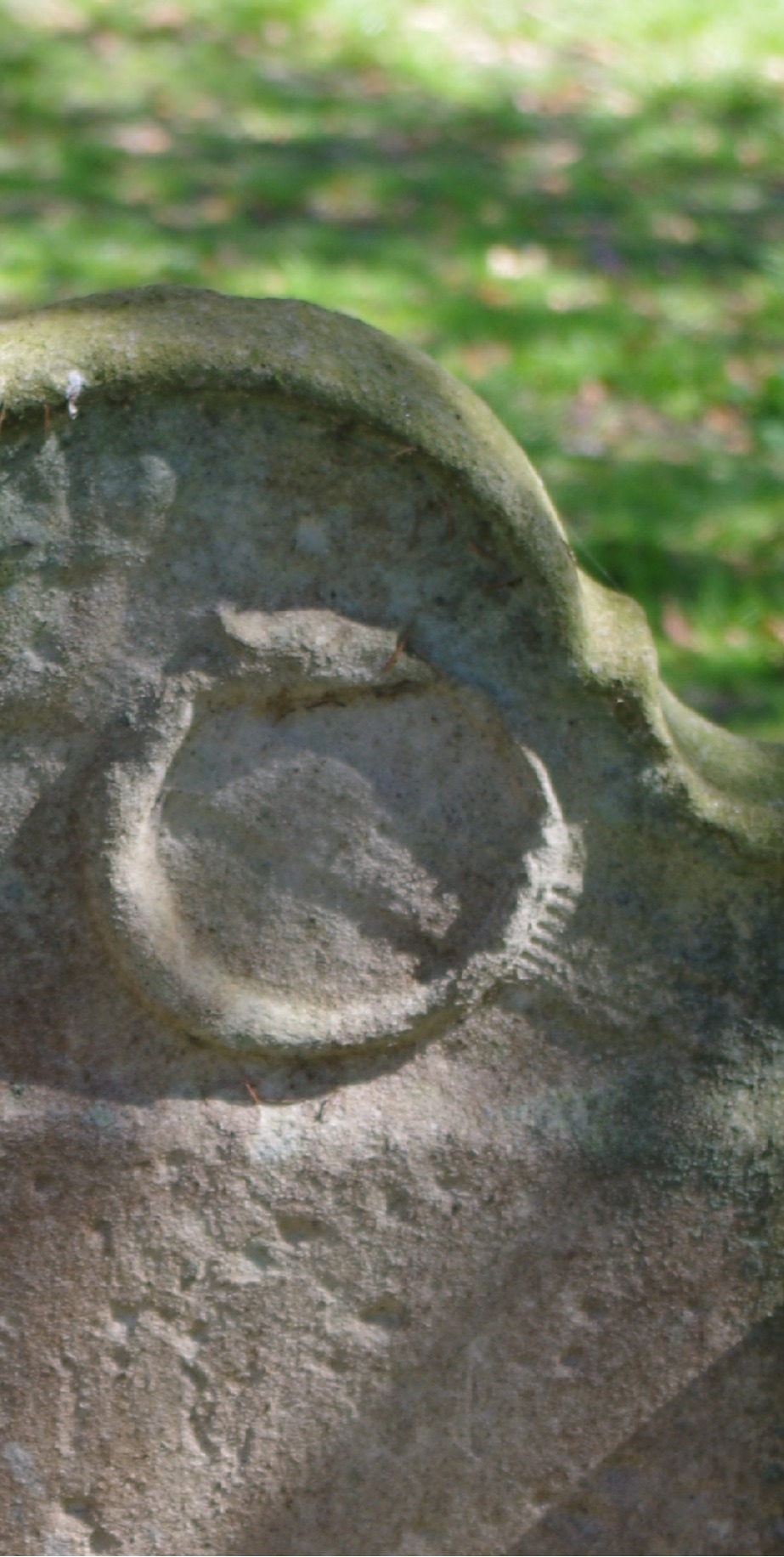
Ouroboros on 18th century headstone, St Mary’s churchyard, Rye, Sussex. ©Carole Tyrrell

For every end there is a beginning.

This is only one of the several positive and powerful meanings of the ouroboros which is one of the most ancient symbols known to man.  It’s depicted as a snake eating its own tail to sustain its life in an eternal cycle of renewal and it usually forms a full circle.  It occurs in many cultures, religions and beliefs.  The psychologist, Jung, called it an archetype which is best described as:

‘a primitive mental image inherited from the earliest human ancestors, and supposed to be present in the collective unconscious.
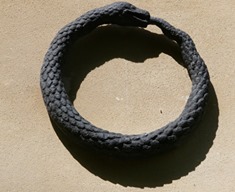
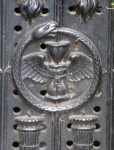
A lovely picture of an ouroboros on a mausoleum in Highgate West.
copyright Jeane Mary – used with kind permission
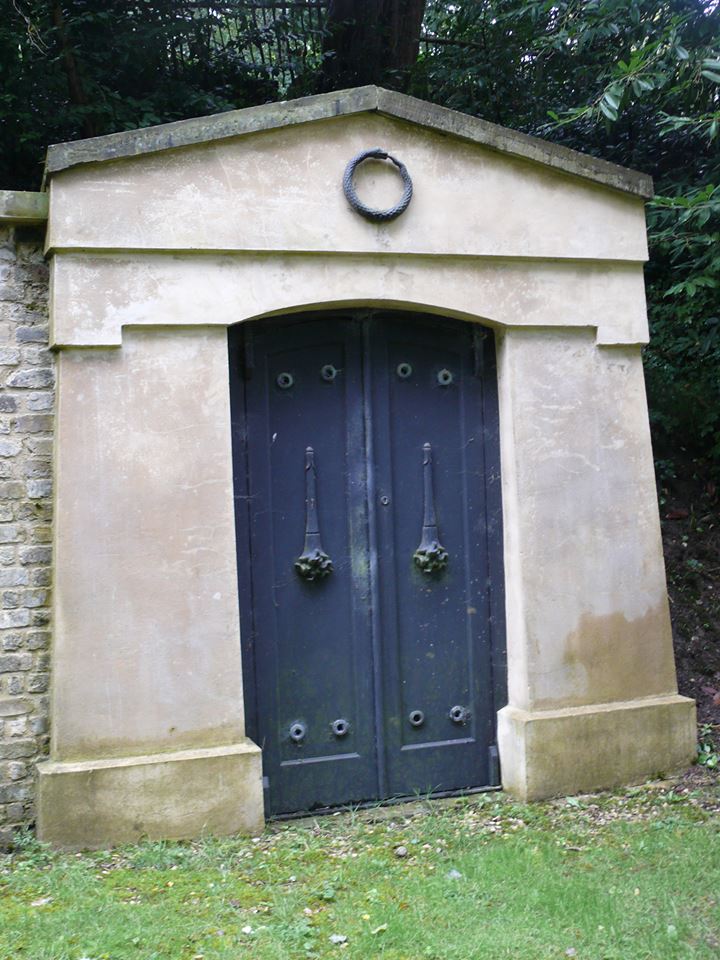
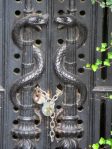
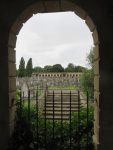
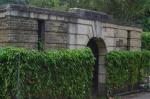
This is the mausoleum to which the ouroboros belongs.
Note downturned torches on doors which are a sign of life extinguished.
copyright Jeane Mary and used with kind permission.

The ouroboros appears in ancient churchyards and Victorian cemeteries as a symbol of resurrection.  The snake is reborn as it sheds its skin and this fine example is on a mausoleum in Highgate cemetery, London. Victorian visitors would have understood its meaning.   As a resurrection image it can be very positive as some of its other attributes are immortality, eternity and wisdom.  However, as with most symbols , it can have several meanings.  These include the Universe’s cyclic nature and life out of death and, as the snake sheds its skin it has a Phoenix-like cycle of life, death and rebirth. The Victorians revived several older symbols in a return to the classicism of ancient Greece and Rome.
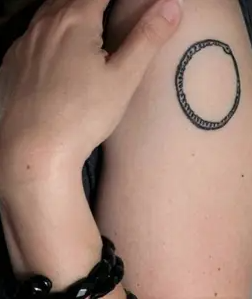
There is also a magnificent ouroboros on the gates of Sheffield General Cemetery. The Highgate one inspired the tattoo worn proudly above by Jeane Mary, a photographer and fellow cemetery explorer now sadly gone from us. She also wears a Whitby mourning bracelet based on the ouroboros in Highgate. Used with kind permission.

But the ouroboros origins lie in either ancient Greece or Egypt as both cultures have claimed it.  In Greece, Plato described it as:

‘the first living thing, a self-eating, circular being’. 

In fact, the Greek translation of ouroboros is ‘tail devouring snake’ and it’s associated with something constantly recreating itself and the eternal return.
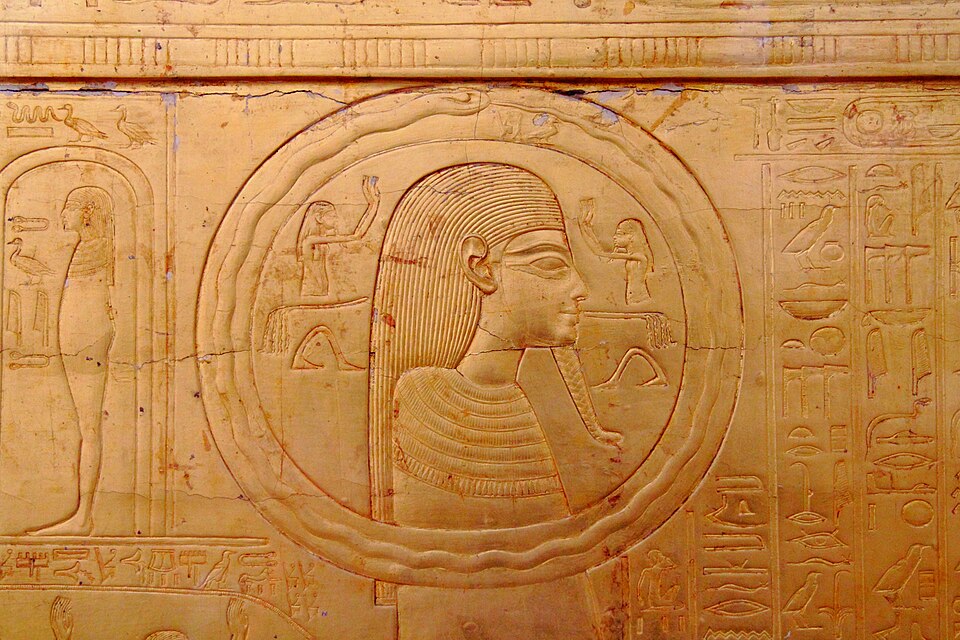
The earliest known depiction of an Ouroboros on one of the shrines enclosing the sarcophagus of Tutenkhamun. Shared under Wiki Commons. Egyptian Museum Cairo.

In Egypt, the ouroboros reputedly appears for the first time in the 14th century BC in Tutenkhamen’s tomb on an ancient funerary text. This depicts the Sun God Ra and his union with Osiris in the underworld and is illustrated with two serpents, holding their tails in their mouths, coiled around hands and feet. This may be a representation of the unified Ra-Osiris.  Both serpents are reputedly the manifestation of the god Mehen, who in other funerary texts protect Ra in his underworld journey.  I haven’t been able to find an image of this particular representation but I did find the one above which is claimed to be the earliest representation of an ouroboros.

The ouroboros also appears in Hindu, Norse, Aztec and Chinese religions.  In addition, it’s a significant alchemical symbo and features in Cleopatra the Alchemist’s work. There are also Masonic associations from numerous seals, frontispieces and other imagery dating from the 17th century such as the one below:
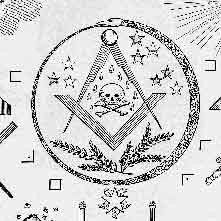
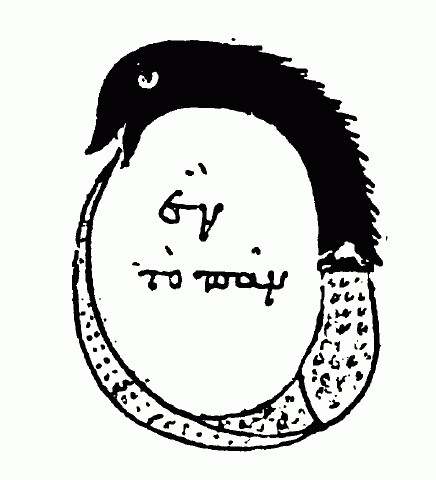
Alchemist ouroboros from Cleopatra the Alchemist Greco-Roman Egypt.
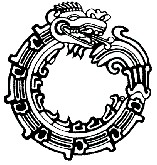
Aztec seven segmented ouroboros.

In China it can also take the form of a dragon and it features on the Magician card in the Rider- Waite deck of Tarot cards.

I found this quote online:

‘In other myths the ouroboros encircles the whole world, a circumference of the waters surrounding the earth.  It can support and maintain the world and also inject death into life and life into death.  Although apparently immobile, it’s actually in perpetual motion, forever recoiling upon itself.’

One of the many fascinating myths surrounding the ouroboros is the experience of the chemist, August Kekule, who was trying to discover the structure of benzene.   This is how he described his Eureka moment :

‘I was sitting, writing at my text-book; but the work did not progress; my thoughts were elsewhere. I turned my chair to the fire and dozed. Again the atoms were before my eyes. This time the smaller groups kept modestly in the background. My mental eye, rendered more acute by the repeated visions of the kind, could now distinguish larger structures of manifold conformation: long rows, sometimes more closely fitted together; all twining and twisting in snake-like motion. But look! What was that? One of the snakes had seized hold of its own tail, and the form whirled mockingly before my eyes. As if by a flash of lightning I awoke; and this time also I spent the rest of the night in working out the consequences of the hypothesis.’

As I said earlier, Jung would see this dream as evidence of the ouroboros and its effect on the collective unconscious.
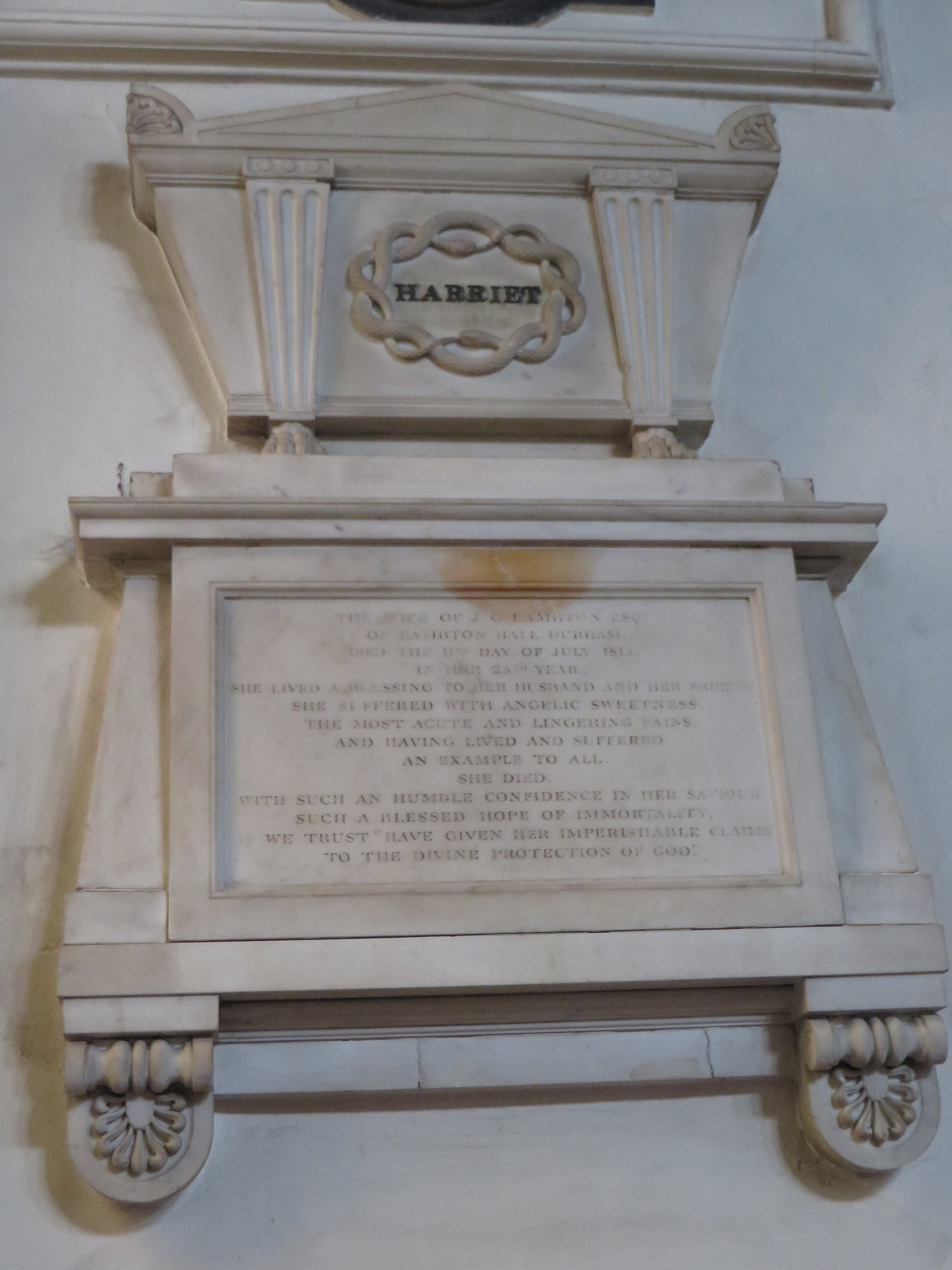
The monument dedicated to Harriet. St George’s church, Beckenham, Kent copyright Carole Tyrrell
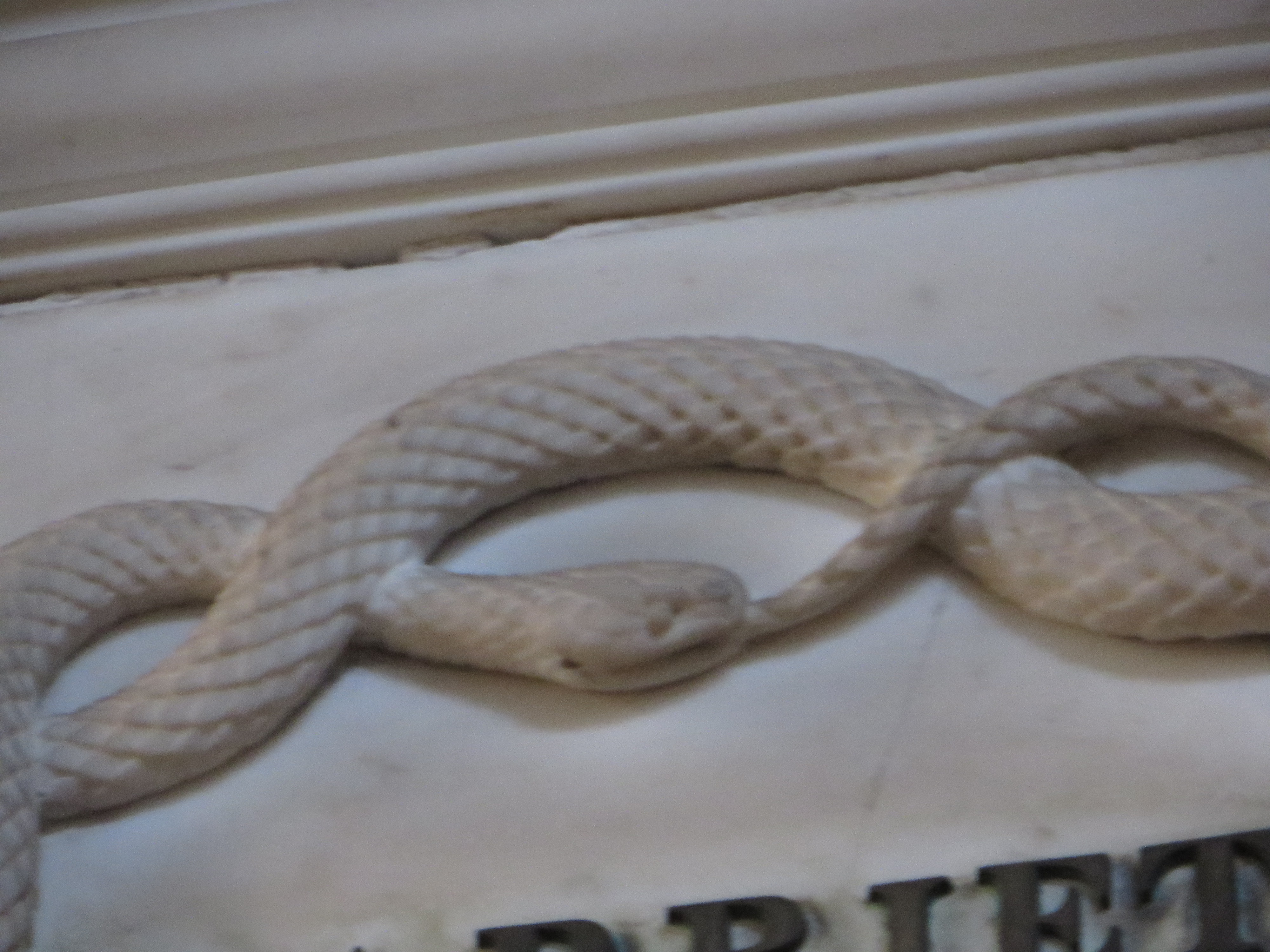
Close-up of the snakes. St George’s church Beckenham, Kent. copyright Carole Tyrrell
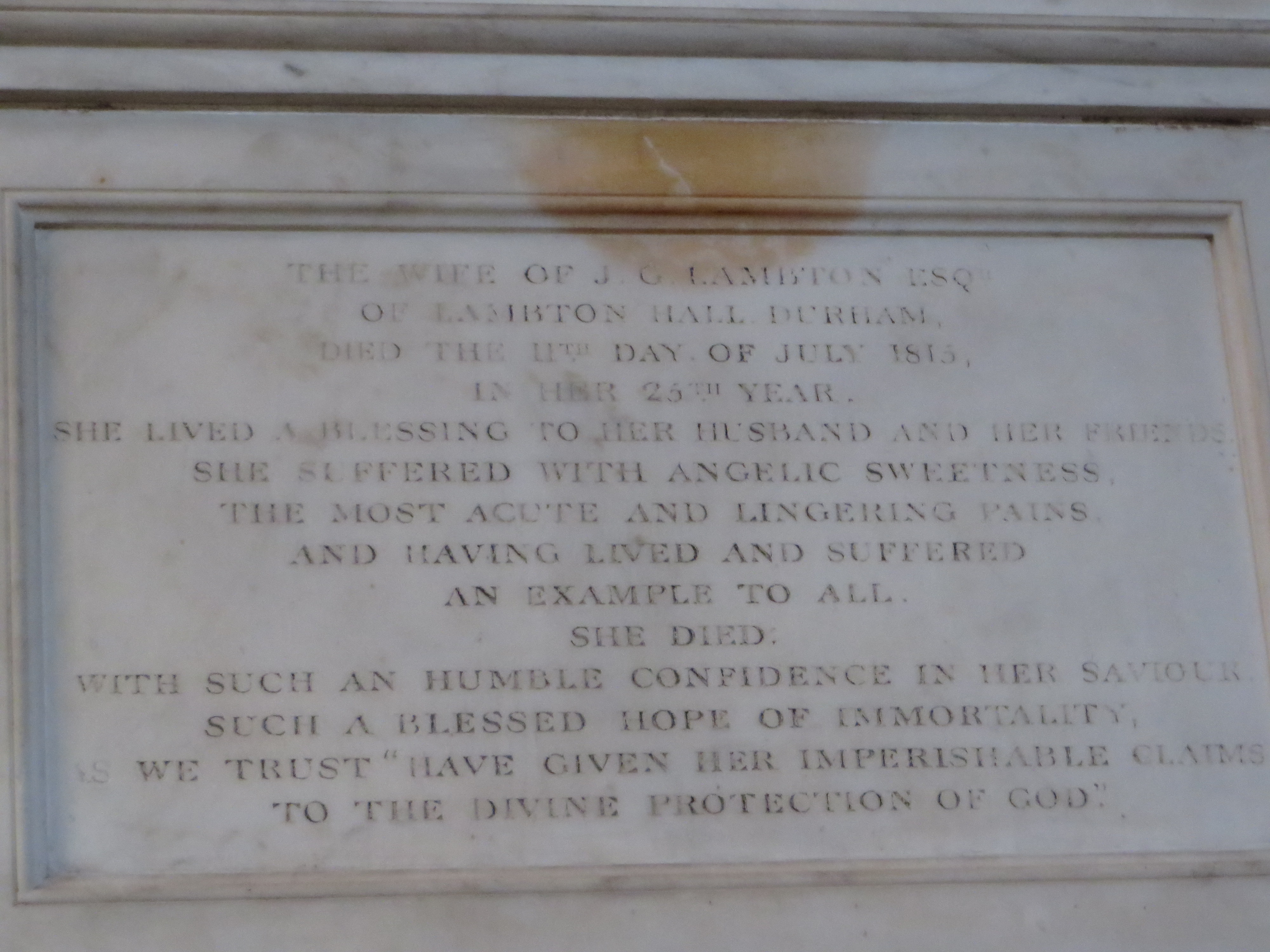
Harriet’s epitaph shows that she was obviously much missed. St George’s church, Beckenham, Kent. copyright Carole Tyrrell

Although the ouroboros is usually depicted as a full circle, this is one that I found in my local church, St Georges in Beckenham. On first glance, it merely looks like an attractive, rippling border around the name Harriet and it dates from 1815. But on a recent visit, I looked closer and realised that it was actually composed of 2 entwined snakes, each biting their own tail.  When I spoke to a churchwarden, she had always thought that, due to the patterning on the snakes’ bodies, that it was two entangled pieces of rope.   It is a poignant memorial to a young wife who died aged 25 after suffering the ‘most acute and lingering pains.’   So it would have been a potent reminder of resurrection. More recently, the ouroboros has also appeared as part of a crop circle.
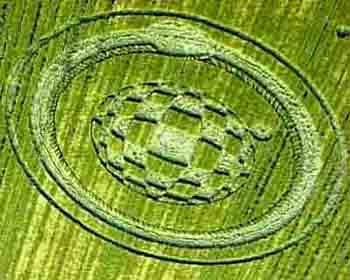
The ouroboros is one of the most intriguing and interesting symbols that I have researched.  It is a universal image of rebirth, hope and eternity.

© Text and photos Carole Tyrrell unless otherwise stated

Further reading and references:

Ouroboros – Token Rock

Ouroboros – Wikipedia

Ouroboros – Crystalinks

Ouroboros, the Infinity Symbol – Mythologian.Net

Stories in Stone – Douglas Keister, Gibbs Smith, 2004

How to Read Symbols, Clare Gibson and Claire Haworth-Maden, A & C Black publishers, 2009

An Illustrated Encyclopaedia of traditional symbols J C Cooper, Thames & Hudson originally pub 1979, reprinted 1993
By a candle’s flickering flame  – a visit to Brompton catacombs July 2017

The Western catacomb which runs along the western wall of Brompton Cemetery which faces out onto the railway.
©Carole Tyrrell

Shadows move on the coffins and walls. Above you the glass orbs set into the high ceiling admit a little light into the depths but you prefer the intimate illumination of the flame.  It reflects on the brass fittings and the patterns of the nails on the coffin on the shelf beside you. Your loved one now rests eternally in Brompton catacombs as you sit by the head of the coffin in its space or lochulus.  Family news, world events: you talk to them as if they were alive with your voice the only sound in the silence. Then you open the book that you have brought with you at the bookmarked page, and then read the next chapter of what was their favourite novel.  It’s almost like having your own private mausoleum.

Finally, almost reluctantly, you close the book, after having marked next week’s chapter and pick up the candleholder.  As you walk towards the cast iron entrance gates, your footsteps echo behind you and the candle finally goes out as you open them.   The sun outside temporarily blinds you as you pull the gate closed and then lock it with your own key. The symbols of eternity and mortality on them remind you of the other world behind.  Then you ascend the flight of steps and return into Brompton Cemetery and the noisy world again.   You have been ‘communing with the dead’ as our guide, Nick, explained.

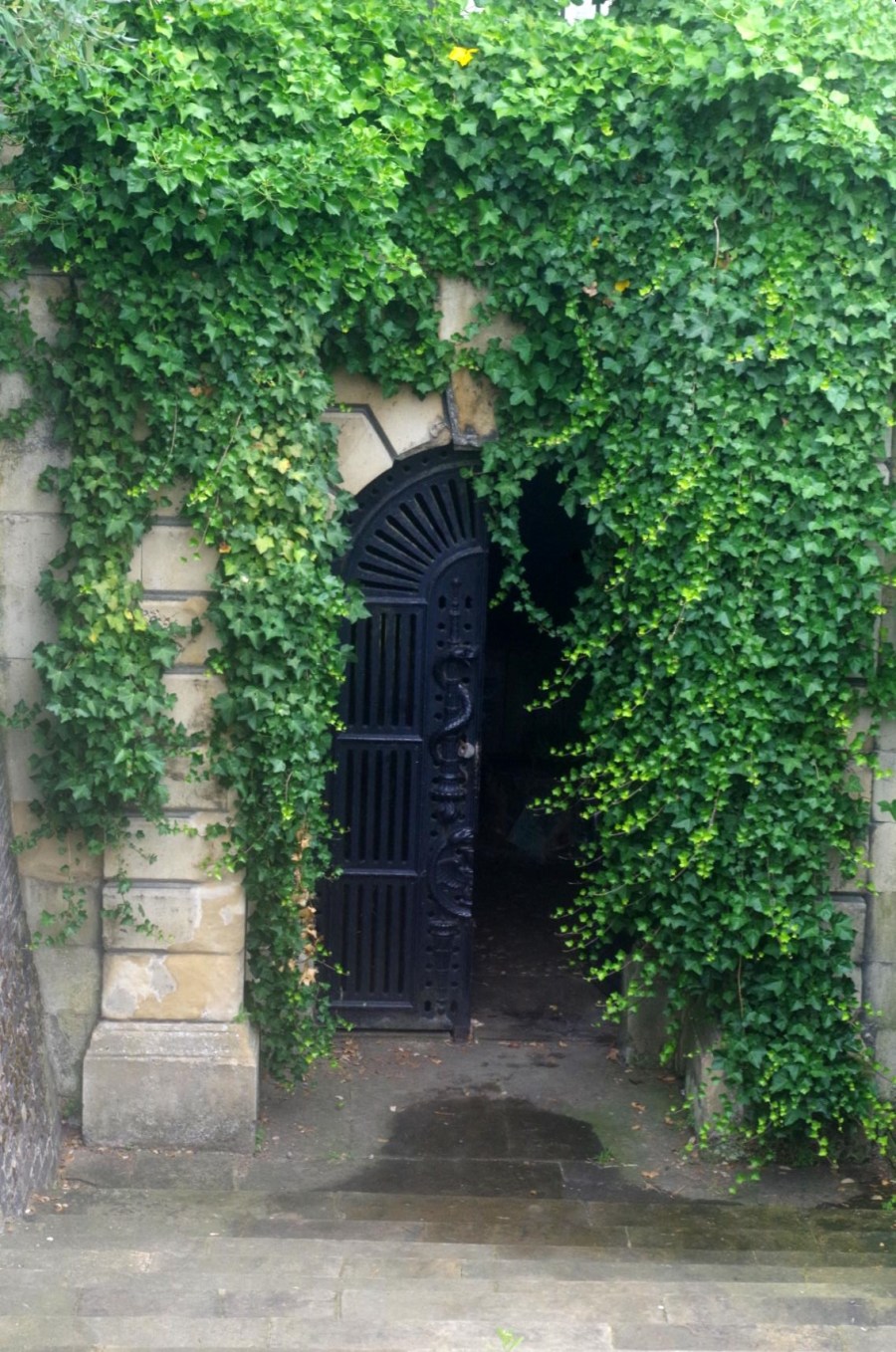
Brompton Cemetery isn’t holding an Open Day in 2017 due to the ongoing restoration project but, instead, on 15 July they held catacomb tours. These are not usually open and I haven’t visited these for some time so eagerly took up the opportunity. It was a drizzly day so it was good to be under cover. The catacombs have the most magnificent cast iron doors featuring snakes, downturned torches, an ouroboros and a winged hourglass – all symbols of mortality and eternity. You know that you are entering the realm of the dead once you step inside.

I have visited several catacombs located in large London cemeteries and what has always remained with me is the special and unique atmosphere that each one has: Kensal Green, Highgate, Brompton and the Valhalla that is West Norwood. One of Nunhead’s catacombs has now become the Anglican chapel crypt and is only open on certain days.

Catacombs never became popular in England and most of the coffin spaces available were destined to only have dust as an occupant. These are known as loculi or loculus in the singular. Even Highgate was unable to sell all theirs in the Egyptian Avenue and I would have thought that they would have been snapped up. However, there is reputed to be a cemetery in Cheshunt which is doing a roaring trade in selling them as they have an Italian and Greek community who view catacombs differently.

There is another set of catacombs under Brompton’s western colonnades with an identical set of doors on the other side of the circle but these have remained unused.  The other Western catacombs on the boundary side were never used and when reopened were crammed floor to ceiling with spoil which took a year to remove.

We were visiting the Eastern colonnade crypt and a flight of steps led to the iron doors.  As Nick said imagine six pallbearers carrying a coffin on their shoulders down them on a wet day.  The coffin would have been triple lined: wood, lead, wood so a heavy load indeed.  Brompton, unlike other catacombs, such as West Norwood or Kensal Green, didn’t have a chapel above the catacombs with a handy hydraulic catafalque to transport the coffin down into the darkness.

Nick indicated an interment in the first chamber behind the doors. This was sealed in with a plaque and epitaph dedicated to Captain Alexander Louis Ricardo of the Grenadier Guards.  For me, it was a reminder of the still unsolved Victorian Charles Bravo murder.  Captain Ricardo was Florence Bravo’s first husband who died young from alcoholism in Cologne. I noticed ferns growing from a family vault beneath him and wondered about damp as a perennial problem.

Lit candles had been placed on the coffin shelves to light our way which added to the ambience.  Victorians were fascinated with the idea of an afterlife and seances and mediums were big business. Sir William Crookes of the notorious Katie King case is also buried in Brompton.   Nick added the Victorians were a heady mix of hardheadiness and sentimentality.


The glass inserts that allowed some light into the catacomb have long gone and been bricked up.  Brompton’s original owners, The Westminster and West London Cemetery Company initially offered 4000 loculi for sale but of these only 700 were sold. So if you have a hankering for going underground they still have at least 3300 spaces available. Nick informed us that the last request for a catacomb space was in 1926.


English catacombs were based on the ones in Rome. Cremation was illegal until well into the 19th century so it was either under or over ground burial until then. Catacombs at Brompton were also called upon as a temporary mortuary when necessary. A visitor noticed that one coffin was just under the roof above four other coffins stacked on shelves and asked how the cemetery workers got it up there. Nick indicated the pulley blocks that they could have used to lift it up and manoeuvre it into place. Quite a feat.


Nick indicated the plumber’s diaper mark on the exposed side of one coffin which indicated that he had sealed it properly and there would be no leakages.  He also pointed out the wreaths, somewhat desiccated by now, that mourners often left by the coffins, and there was a small elegant urn containing ashes placed on a shelf next to one.


Our visit lasted 30 minutes and we filed out towards the light of the outside world again leaving Brompton’s catacomb’s incumbents to eternally sleep on.


The attractive colonnades of Brompton are above the catacombs and have plaques on their walls. These were to enable friends or other relatives without keys to pay their respects to the deceased at the plaque.  These are reputed to be affixed directly above the departed’s place within the chamber.


A word of caution for anyone considering visiting a catacomb for the first time: if you feel uncomfortable about seeing coffins, and a lot of people do, then don’t visit or think carefully about it first.

Please note:  Photography is not permitted in the Brompton catacombs.

©Photos and text Carole Tyrrell