Part 2: Betty, Jean, Gunner William, Jessica and a German POW – a return visit to Netherne Hospital Cemetery August 2017.


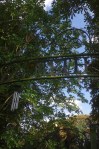
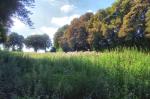
A familiar gap in the trees across field.
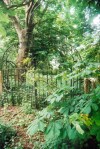
©Carole TyrrellThe Victorian iron gates were still in place and seemed to have been cleaned at least as I pushed one open and re-entered Netherne Hospital cemetery.  Someone had thoughtfully hung a wind chime from the other gate.

There had been  blue August skies above me as  I’d plodded up Woodplace Lane again.  The suburbs of Coulsdon and Hooley soon petered out to give way to fields.  I lost my bearings around the newly expanded Netherne on the Hill.   But I retraced my steps and found myself at the entrance of a large ploughed field and saw a gap in the trees on its opposite side.

I began to walk across the field towards it. As I did so 3 or 4 policemen and women walked past the entrance. ‘Yes, we’ve found her, she’s visiting the cemetery, it’s ploughed so no damage to crops otherwise we’d have suggested that she walk around the border.’ said one into his walkie-talkie.  ‘Doesn’t look like a ghoul.’ They walked on and I wasn’t sure whether to be flattered or insulted – me a dangerous person?  Obviously the neighbourhood watch had been on duty and I wondered what had been going on at the cemetery.

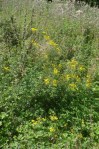
A defiant purple branch of buddleia stood tall over the wait high wildflowers as a white butterfly fluttered around it. Bright splashes of colour from ragwort, scarlet pimpernel, speedwell, red sorrel and fleabane stood out amongst them.  There were also fresh puffballs and older ones half hidden in the undergrowth.

The birdsong stopped as I stood inside the graveyard and looked around.  It didn’t look as forgotten as it had done in 2007. The cemetery had been cleared but was now rampant again with summer vegetation.  There was now a clear border around it which made it easier to explore. The horse chestnut trees still stood tall with bright shiny conkers here and there beneath them.  At the bottom of the cemetery was a luxuriant bush of ripe elderberries and I looked over the hedgerow to see two horses grazing in a nearby field.
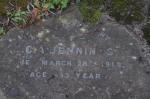
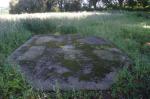
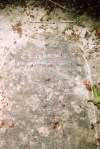
It still seemed incredible that 1350 people were buried here but now the cemetery felt less abandoned. I looked again at the 6 memorials set into the concrete plinth, presumably to preserve them, but at least I now knew why the 7 year old Betty Trotman had been buried there.

In 2010, the developers of the Netherne on the Hill site had claimed in a local newspaper that they had never been approached by any family members of the people buried there.  But in 2013, a Croydon paper reported on the 2 and a half year campaign by two local people, an amateur historian called Adrian Falks and a Ms Wendy Mortimer.  They had both called for the cemetery to be cleared and the graves within it to be maintained.

Ms Mortimer knew that she had a great-aunt, Frances, who had been buried there in 1915 and had been extremely upset when visiting the graveyard in 2008 to find her last resting place to discover how overgrown the site was. She had had to crawl under a fence to actually get inside to find 5 feet high brambles and no memorials.  Ms Mortimer’s great-aunt, Frances, had been an epileptic, which at the time wasn’t properly understood and appropriate treatment didn’t really exist.  Frances had become brain damaged after falling from a wall, presumably during an epileptic fit, and had subsequently been sent to Netherne where she was classed as ‘an idiot’ in the less than PC classification of the time. A photo in the paper shows Ms Mortimer kneeling in the middle of the then cleared cemetery beside flowers in memory of her great aunt. It was a tragic tale of a life ruined which nowadays with the correct medication would have been very different.

As I walked around the edge of the cemetery I could see holes dug by animals, presumably foxes. Again in 2010, it was alleged by another Croydon paper that burrowing animals had dislodged some of the remains buried there and that bone fragments had been found.

Due to the war hospital scheme which displaced the asylum population in order to treat nearly half a million wounded or shell- shocked soldiers, some of which are buried here.  There are also the children of serving soldiers interred there.

I am indebted to Adrian Falks’ research on the soldiers who were buried at both Cane Hill and Netherne Asylums.  However, the names of most of the servicemen remain hidden in closed records.  But here are the stories of two of them who are buried at Netherne.:

In 1914, Gunner William James Carpenter joined the army for a better life.  But he found Army discipline was too tough and  often went AWOL which led to constant disciplining.  William finally deserted just before being sent to France in 1915. But after an argument with his wife he left their Peckham home and vanished for nearly 90 years.  He had died alone in Netherne hospital but it’s unknown how he ended up there.

Until 1962 a German POW, Hermann Albert Schnid, was buried there.  He had contracted syphilis which was treated at the hospital and he’d died there in 1917.   In 1959, the German War Graves Commission wrote to the Netherne authorities requesting that his body be exhumed and moved to the Cannock Chase German military Cemetery in Staffordshire.

Mr Falks also discovered the names of a few of the children of serving soldiers who were buried in the cemetery. He was quoted in a newspaper article as saying that he thought the state of the  cemetery was ‘shocking’ and ‘that all but one of the children buried at Netherne had had fathers who were fighting in the First World War.’

Some of the children are:

Leslie Thomas Jackman aged 11 – died 11/12/1917 – whose father was a serving soldier

William Arthur Simmonds aged 15 died 15/10/1917 – his father was presumed killed at the Battle of Arras.

Sidney Peters aged 5 – died 03/10/1915 – had a soldier father.

Jessica Davis  – aged 11 who died from TB on 20/02/1915.  It’s not known if her soldier father survived the war.

 and these two:

Both of her parents, Dorothya m

William John Newland – aged 15 – died from pulmonary TB on 18/02/1918. I found his case particularly poignant as he was an orphan without next of kin who had been transferred from an Epsom workhouse infirmary. I hoped that someone was with him when he passed away.
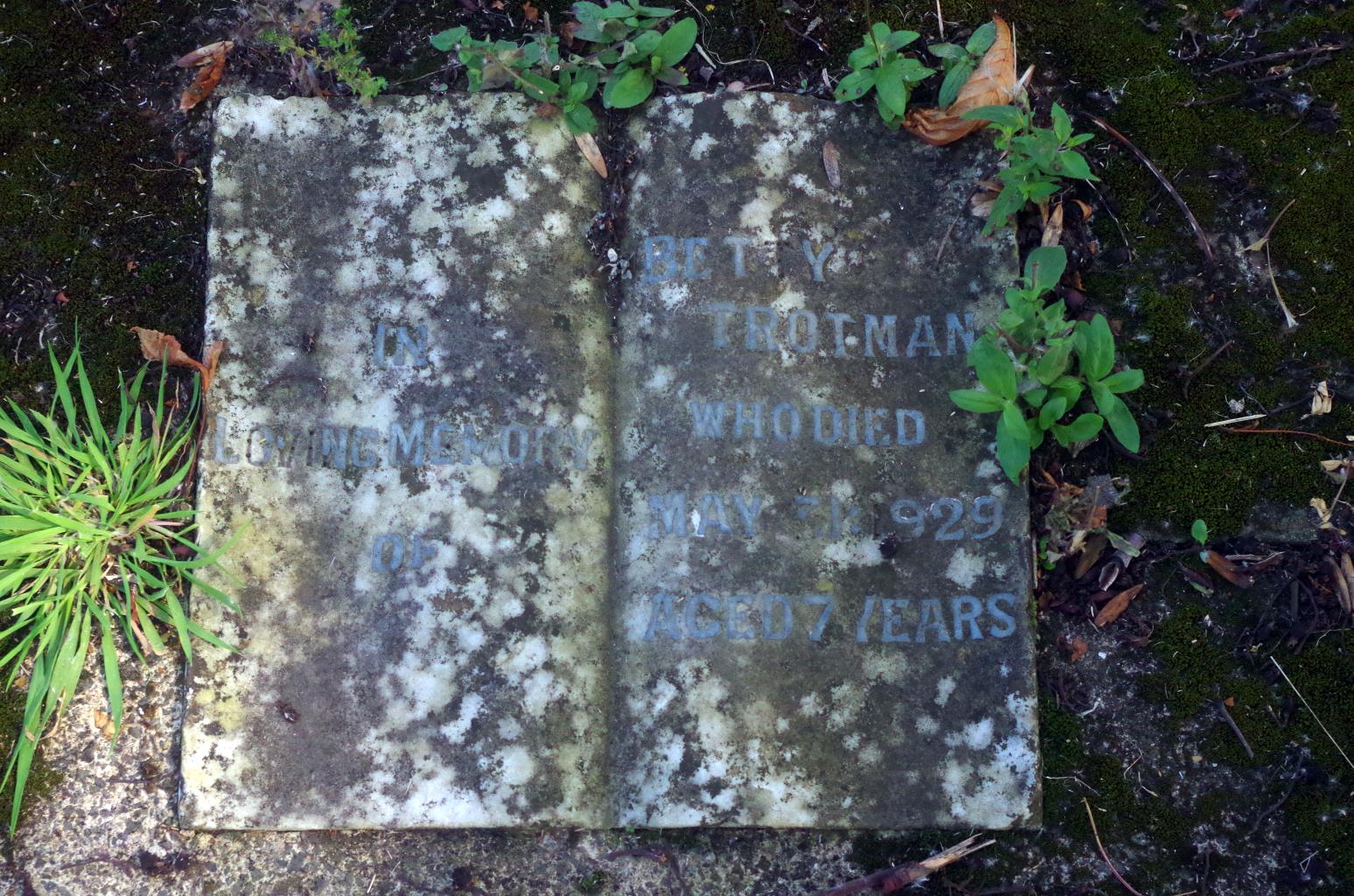
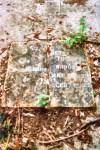
Book of Life dedicated to the 7 year old Betty Trotman.
©Carole Tyrrell


And finally Betty Trotman, aged 7, recorded on the Book of Life memorial as having died on 31/05/1929 after a 5 month stay in Netherne.  It had been surmised that her parents probably worked at the hospital.   I am indebted to a local resident who had searched for more information on Betty’s family via genesreunited.  Both of her parents, Dorothy and Charles were Londoners and have moved to Godstone in Surrey.  They married in 1921 but it’s not known if Betty had any siblings.  Dorothy died in 1991 aged 90 and Charles preceded her in 1959 aged 65.

 Asylums were often overcrowded and an epidemic such as influenza or TB would soon spread amongst patients.

I haven’t found any photos of these incumbents in Netherne cemetery which is sad as I would have liked to be able to put faces to the stories  I stood there in the hot August sunshine and realised that under the wildflowers were people with names, Jean, William, Betty, Frances, etc who had all ended up in Netherne often because there was nowhere else for them to go. But some of the once anonymous dead had been reclaimed by their relatives and they no longer rested alone and forgotten.

But one of the saddest and most moving stories is undoubtedly that of 8 year old Jean Barboni  who died in Netherne in 1915 and whose nurse mourned him for the rest of his life.

Part 3 – the nurse that never forgot the little boy she cared for and a patient’s remarkable artistic legacy.

©Text and photos Carole Tyrrell unless otherwise stated.

http://www.mendiphospitalcemetery.org.uk/history.html

 http://www.yourlocalguardian.co.uk/news/10494304.Campaign_victory_after_cemetery_with_war_dead_finally_cleared/

https://billiongraves.com/cemetery/Netherne-Asylum-Cemetery/292853

http://www.simoncornwell.com/urbex/hosp/n/e140106/1.htm

http://www.thisislocallondon.co.uk/indepth/nostalgia/8392020.Forgotten_graves_of_the_war_dead/

http://www.suttonguardian.co.uk/news/8437328.Diaries_of_Catholic_nun_reveal_tale_of_child_buried_at_Netherne_asylum/

 http://beyondthetrenches.co.uk/the-other-war-dead-asylum-patients-during-the-first-world-war/

 http://www.croydonguardian.co.uk/news/8421298.Developer_s_broken_promise_over_asylum_cemetery/

 https://www.genesreunited.co.uk/boards/board/ancestors/thread/1314646


As anonymous in death as they were in life? Part 1 of a visit to Netherne Hospital cemetery

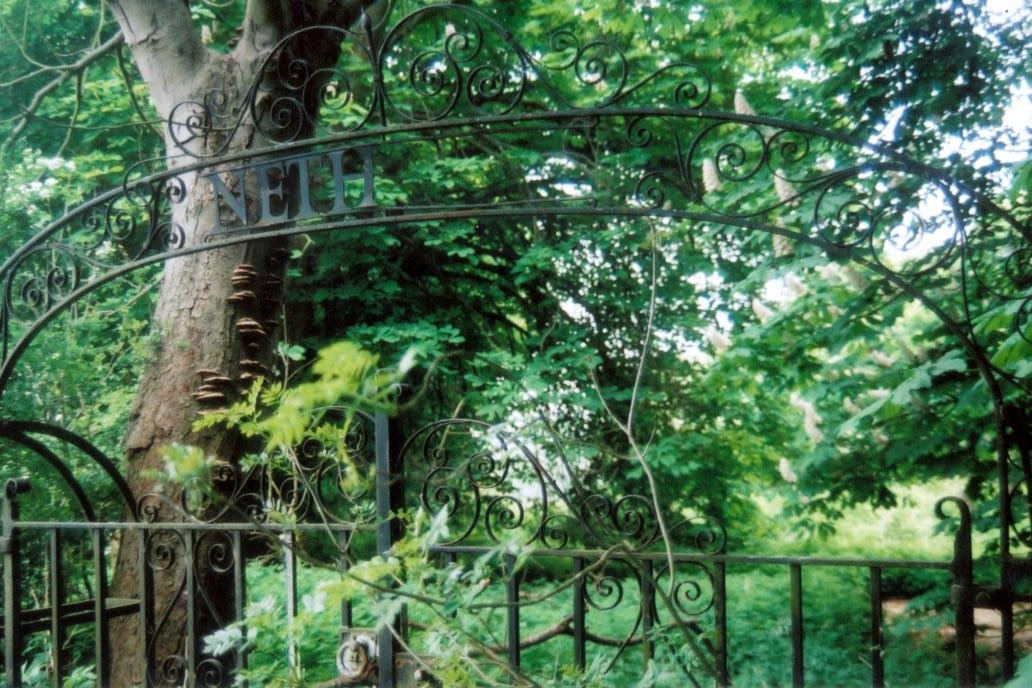
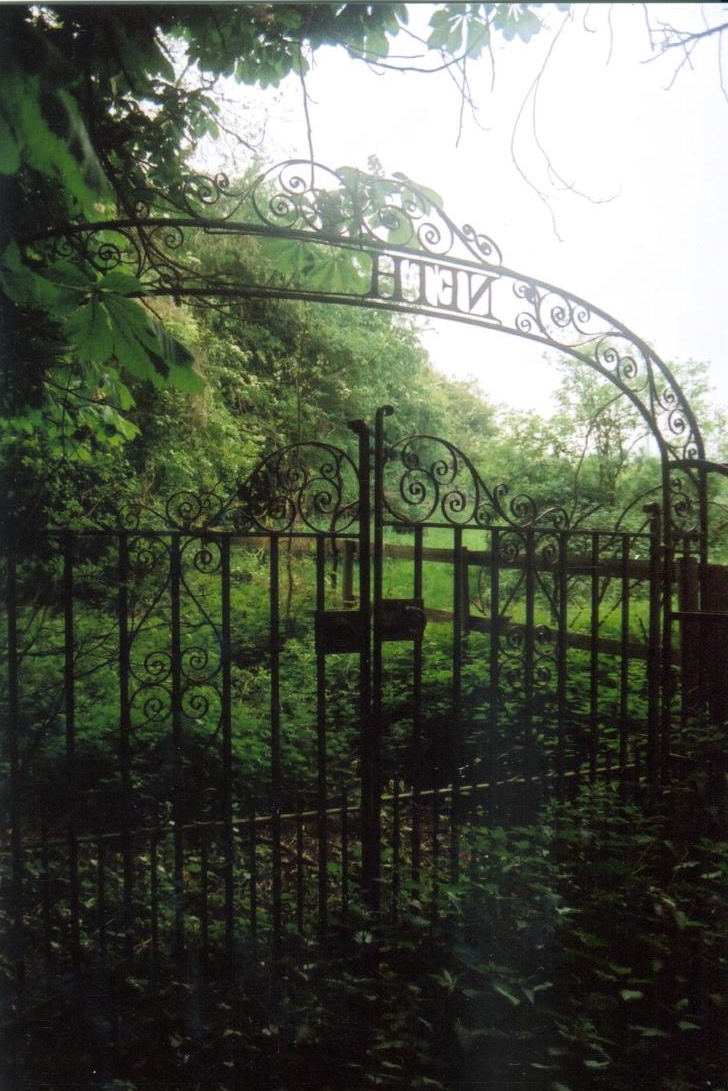
Close-up of the cemetery gates showing NETH over the top of them. May 2007.
©Carole Tyrrell

I first visited Netherne Hospital cemetery on an overcast day in May 2007.  It’s located at the edge of a large farmer’s field and is a broad, sloping strip of land bordered on three sides by huge, majestic, spreading horse chestnut trees.  You can look across the cemetery to the local beauty spot Farthing Downs in the distance. The trees were luxuriantly leafy on my visit and the graveyard certainly looked more appealing than in the photos I’d seen of it on an urban explorer’s website.  He had visited it in January when it looked very desolate and forgotten.  But on that day in May I saw large white candles of horse chestnut flowers in abundance as I peered through the two elegant, probably Victorian, iron gates.  Once they must have had Netherne Asylum in large iron capital letters over the top of them but now only ‘NETH’ remained.   They were almost being engulfed by large branches and leaves trying to force their way through. ‘Someone will steal them for scrap.’ I thought to myself as I pushed one of the gates open and entered.

Inside Nature had taken over with a thick carpet of green brambles and undergrowth covering the entire site and it looked as if no one had been there in a very long time.  Without the gates the cemetery would have just looked like a fallow field.  It was impossible to see any monuments or memorials but I did find a raised concrete plinth in which 2 tombstones and a smaller Book of Life memorial had been inserted possibly to preserve them. The Book of Life was dedicated to a 7 year old named Betty Trotman and I wondered why a child was buried here.  Little did I know as I closed the gate behind me that it would take me nearly 10 years to find out.

Netherne was sited at Hooley in Surrey  and was originally known as the Surrey County Asylum or Netherne Asylum before being renamed Netherne Asylum.. It closed in the 1990’s along with the other large asylums and hospitals in the county.  Surrey has always been seen as an affluent region with its exclusive golf clubs, Tudorbethan stockbroker houses and the rolling hills of the green belt. But it has another, less publicised claim to fame. For over a century at least it was also home to several lunatic asylums originally intended for paupers and also homes or children with learning difficulties.  It was felt that the incurable or mentally ill might improve if taken out of the city and into what was then countryside.

The creation of the asylums also reduced the workhouse population as they were designed for paupers.  Cane Hill in Coulsdon, Netherne in Hooley, the Epsom cluster, Earlswood in Redhill and St Lawrence’s Hospital in Caterham were amongst them.  Iain Sinclair in his book, London Orbital, described them as mandalas of madness. All now gone; either demolished or converted into upmarket housing estates.

In 2007 Netherne  Hospital as it later became known was still in the throes of being transformed into an instant village; Netherne on the Hill.  The developers later stated that they were ‘leaving the cemetery well alone and allowing the wildlife to take over.’   It would be another three years before relatives of those buried there would start to come looking for their last resting place. At that time I had no idea that there were 1350 people buried there and that these included children, ex-soldiers, epileptics, the elderly as well as the mentally ill and those who had nowhere else to go.  The people buried in the cemetery seemed to be as anonymous in death as they had been in life apart from the memorials embedded on the plinth.

The cemeteries and burial grounds attached to these asylums and hospitals can be difficult to find. Often the markers on the graves have gone and so there’s no sign of their original purpose and as a result they can often become overgrown and look abandoned.  For example, in 2000 the Somerset & Bath Lunatic Asylum, or the Mendip Hospital as it later became, burial ground in Wells was put up for sale by the NHS as a freehold development opportunity. Nearly 3,000 people, patients and staff,  are buried here with the last burial having taken place in 1963. The grave markers had long since been removed.  However there was a public outcry from the local populace, some of whom may have had relatives living or working in the hospital and they formed a group to stop it.  There is a now a thriving Friends of Mendip  Hospital Cemetery group and so the burial ground looks safe.

I started researching the cemetery and discovered that asylums had a varied population.  In Rachel Lichtenstein and Iain Sinclair’s book Rodinsky’s Room they go in search of a man, David Rodinsky, who vanishes suddenly from a room above a back garden synagogue in Spitalfields and discover that he ended up in Warlingham Hospital, another Surrey asylum, where he died.  They speculated that his Eastern European Jewish scholarly background and language of codes and cabbalism may have led to him ending up there as it would have been incomprehensible to anyone unfamiliar with it. Other patients may have suffered from what we now term learning difficulties which the Victorians classed ‘idiots’.  There were also the elderly with dementia or people with degenerative diseases such as syphilis.

The soldiers appeared in asylums after the First World War when the authorities devised a scheme to treat the almost half a million wounded and shell shocked soldiers.  This involved decanting the current patients elsewhere and then re-designating the asylums as ‘war hospitals’.  By 1920 over 250,000 soldiers had been treated with 9% of them with psychiatric problems.  It saved lives but caused upset and distress to the decanted patient population.  However, not only soldiers were admitted to the ‘war hospitals’ but also their families.

There was an asylum in every county and in 1914 there were 102 in the UK with a total population of 108,000 men, women and children living within them – some permanently.  The sexes were strictly segregated and only met at events such as dances or sports days. Men usually worked on the hospital farm and women in the laundry or kitchen.  Women could be admitted as a result of having an illegitimate baby, rape or post-natal depression.  Asylums were often overcrowded and an epidemic such as flu could kill many patients.

I’d read on the urban explorer website that Netherne that there had been a campaign by a local amateur historian to have the cemetery cleared and accusing the developers of neglect. It was time for a return visit especially as my research had enabled me to put names to some of those buried there and their poignant, often heart-breaking stories.

©Text and photos Carole Tyrrell unless otherwise stated

 Apologies for the quality of the colour photos of the cemetery.These were scans taken from hard copy film prints.

References and further reading:

London Orbital, Iain Sinclair, Penguin 2003

Rodinsky’s Room, Rachel Weinstein & Iain Sinclair, Granta Books, 2000

http://www.yourlocalguardian.co.uk/news/10494304.Campaign_victory_after_cemetery_with_war_dead_finally_cleared/

https://billiongraves.com/cemetery/Netherne-Asylum-Cemetery/292853

http://www.simoncornwell.com/urbex/hosp/n/e140106/1.htm the urban explorer site on which I found Netherne Cemetery.

http://www.thisislocallondon.co.uk/indepth/nostalgia/8392020.Forgotten_graves_of_the_war_dead/

http://www.suttonguardian.co.uk/news/8437328.Diaries_of_Catholic_nun_reveal_tale_of_child_buried_at_Netherne_asylum/

http://beyondthetrenches.co.uk/the-other-war-dead-asylum-patients-during-the-first-world-war/

http://www.croydonguardian.co.uk/news/8421298.Developer_s_broken_promise_over_asylum_cemetery/

http://www.mendiphospitalcemetery.org.uk/

Part 2: Betty, Jean, Gunner William, Jessica and a German POW – a return visit to Nethene Hospital Cemetery August 2017.