Ancient stones and new beginnings – a Spring saunter through St Nicholas churchyard, Sevenoaks


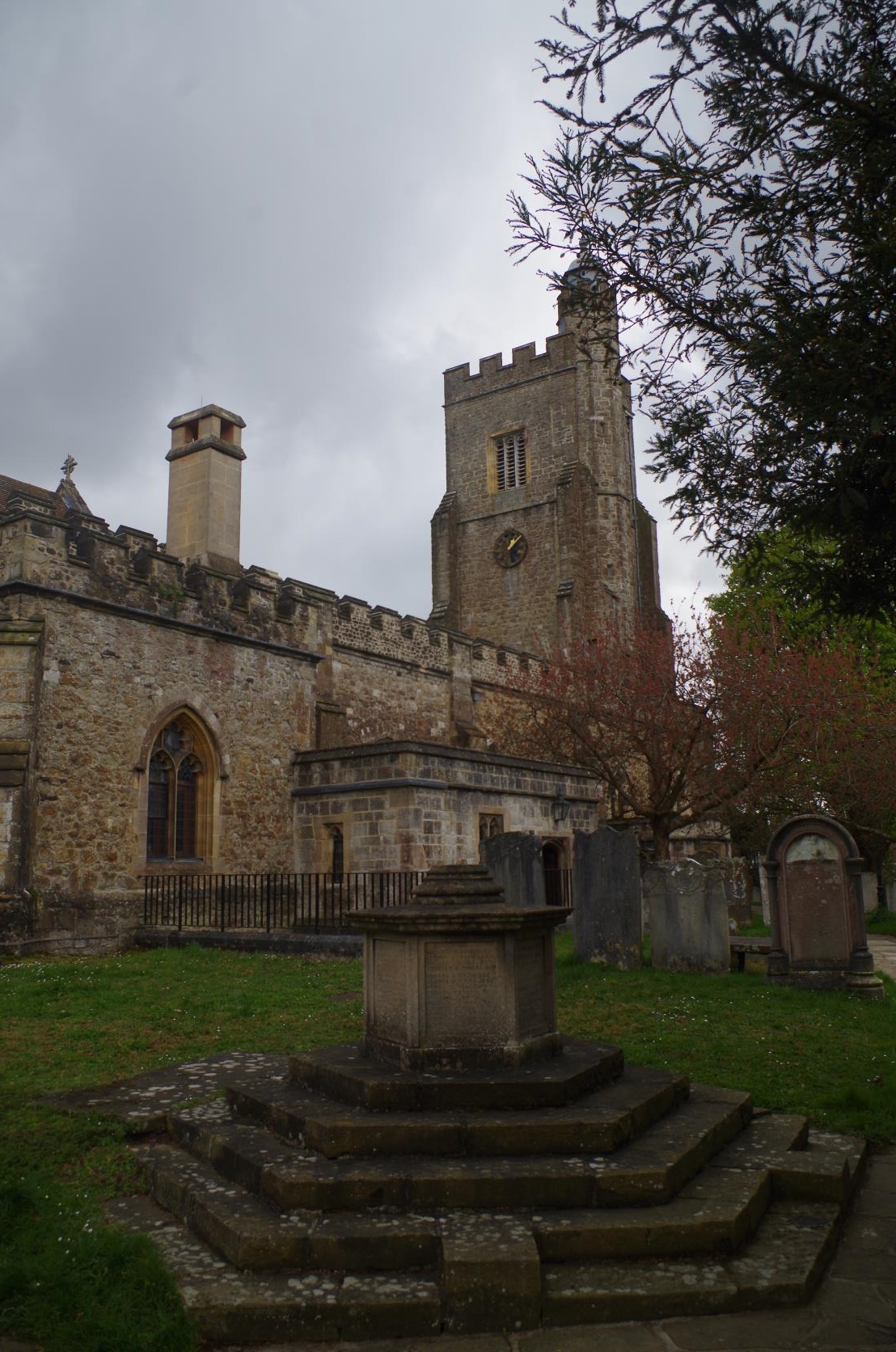
Another view of St Nicholas with a war memorial in the foreground.
©Carole Tyrrell

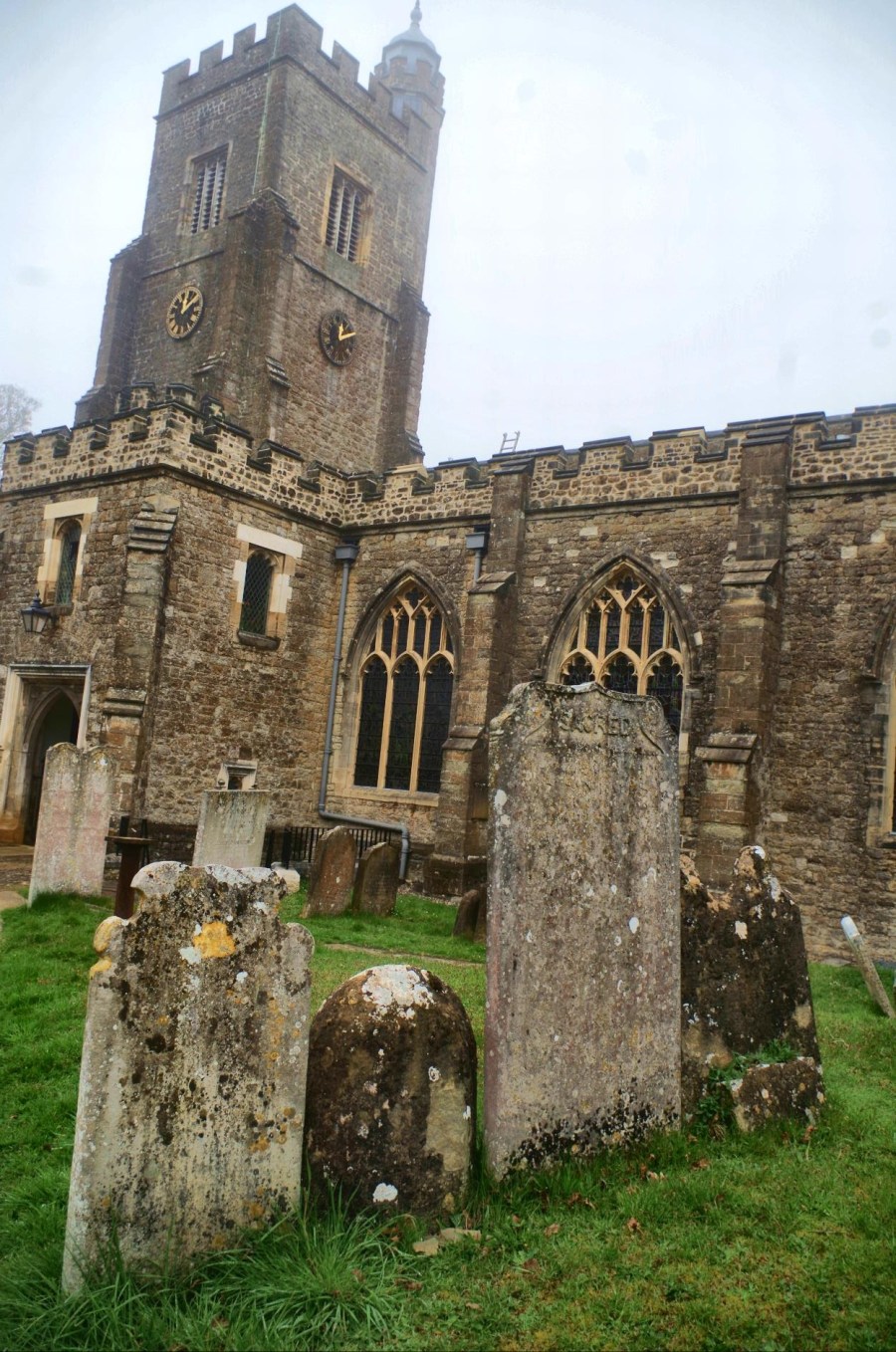
On my previous spring saunters I’ve wandered through two of London’s large, sprawling cemeteries; Kensal Green and West Norwood but this year I thought I’d stay nearer to home.    St Nicholas is my local church and within walking distance of my home.  It’s in a prominent position in the town as it’s at the top of the hill and  opposite the entrance to Knole Park, another local landmark.   One of its most famous Rectors was the preacher and poet, John Donne, who was in post from 1616 until 1631 and is commemorated with a metal plate on the pavement outside. Every time I visit its churchyard I find something new and at a time when Nature is beginning to awaken again what better excuse did I need?

The present building’s shape dates from the 13th century and in fact the present nave dates from 1270.  It replaces an earlier church.  The north aisle was added in 1320 and the chancel south aisle and tower around 1450.  There have been many later alterations but the basic 15th century structure and style remains.  In 1995 excavations took place to create more meeting rooms in what may have been the crypt.  The interior of the church has some monuments dedicated to prominent local families.

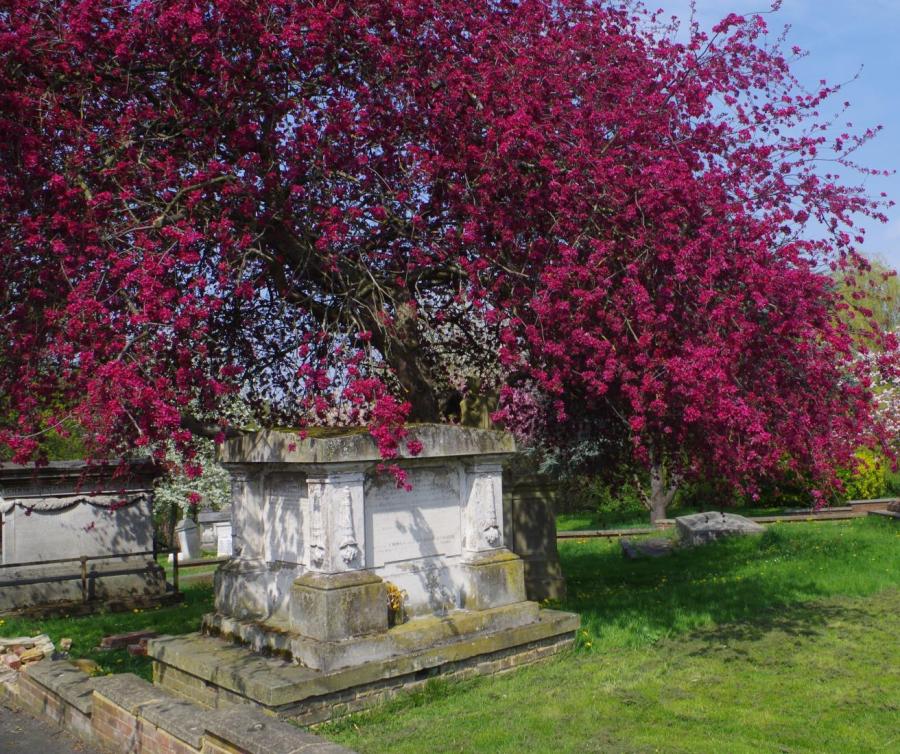
But it’s the churchyard that fascinated me.  Intertwined with plain Victorian headstones are some wonderful examples of 18th century tombstones adorned with memento mori.  A couple are naively executed but others are finely carved with the wonderful 18th century calligraphy accompanying them.

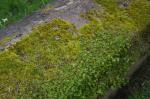
The Spring sunlight illuminated the thick patches of moss and lichens that had carefully draped itself over the monuments and memorials.  It made the subtle hues and shades really stand out; the combination of green and gold or browns seemed to gleam amongst more subtle hints.
Some of the lichens looked as if someone had taken a paintbrush loaded with colour and then dabbed it onto the stones.  Moss has the effect of softening the edges of stones and letters and, where it replaces letters completely, gives a more organic feel to the epitaph.
A spreading horse chestnut tree was laden with sticky buds already beginning to burst into leaf. ‘How many years has it stood near the church door marking the seasons and years?’ I thought.

The spreading horse chestnut is now into full leaf burst.
©Carole Tyrrell

A chaffinch called loudly for its mate from the closed part of the churchyard.  I had explored this in October and seen its large carpet of prickly sweet chestnuts as a fox had turned tail and run back to where it had come from.  There has been a piece of bone abandoned on top of a flat headstone and I hoped that the fox had brought it in from a nearby butchers rubbish bin…….now alas this part of the churchyard is closed due to Health and Safety as it’s so overgrown.  On this visit I disturbed a fluffy ginger and white cat who soon fled in the same direction as the fox.

The closed part of the churchyard.
©Carole Tyrrell

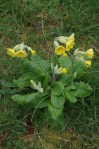
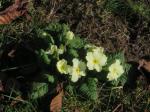
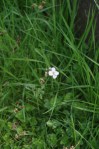
Three large patches of snowdrops clustered protectively around the base of a tree, their pristine heads nodding in the breeze as if deep in conversation.  Primroses had begun to stud the grass and I saw my first ever cowslip amid headstones.

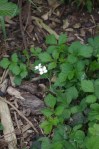
The tiny bright blue flowers of Speedwell blossomed beside a small tombstone and a red-tailed bee, one of the first signs of Spring, buzzed along the top of the grass.    Dog violets, a much underrated flowers in my opinion, frothed plentifully beside the iron entrance gate.


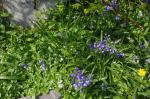
Nearby, was not so much a carpet of Spring flowers, but more of a small rug of them.  More Primroses, the bright yellow of Lesser Celandine, another harbinger of Spring, and more dog violets all combined to make a wonderful collection of green, yellow and purple.

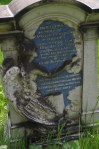
There are some remarkable epitaphs in St Nicholas churchyard and this one which has now been incorporated into the fabric of the church caught my attention.
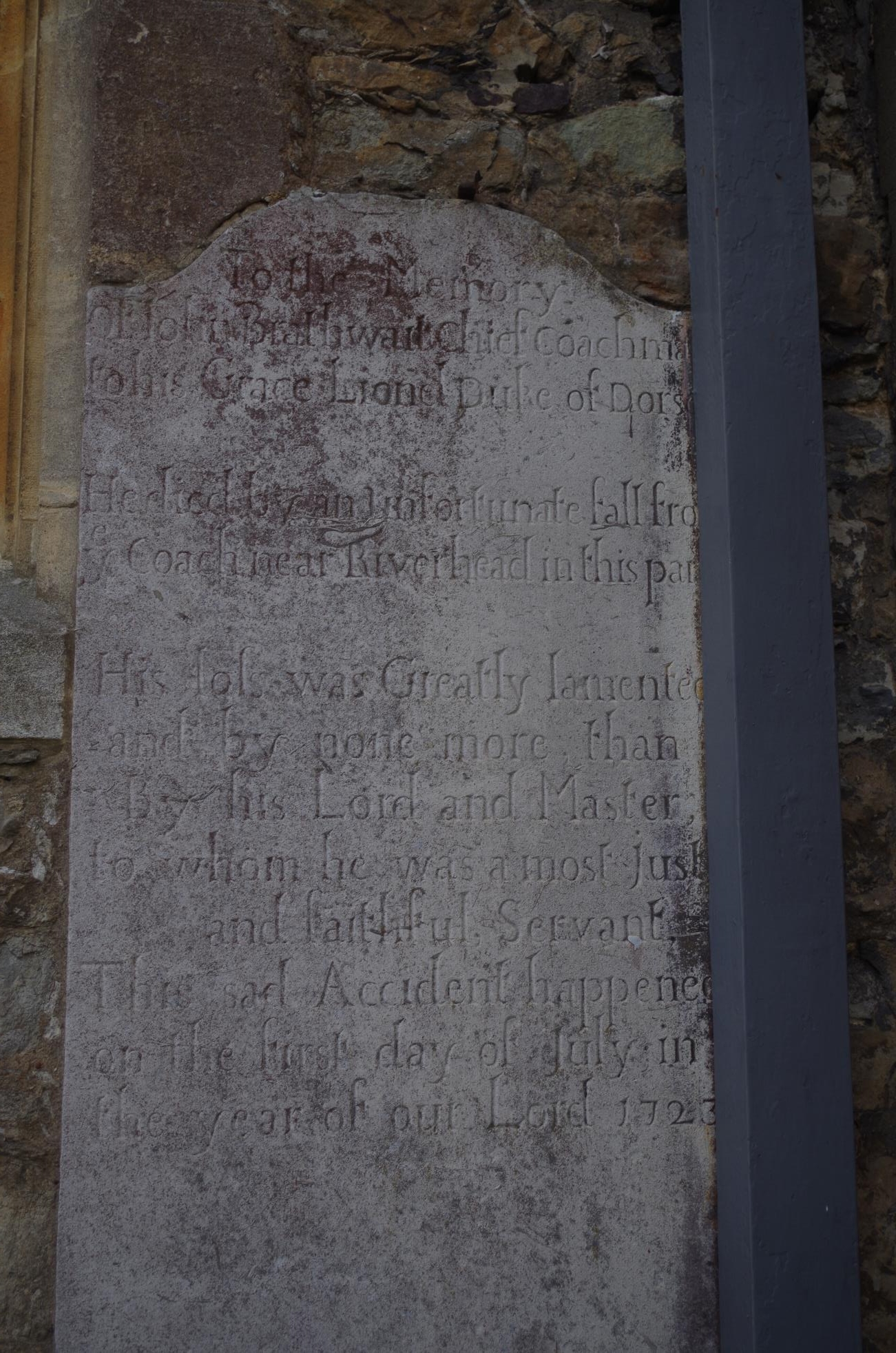
The epitaph reads:

To the Memory

of John Braithwaite Chief Coachman

to his Grace Lionel Duke of Dorset

He died by an unfortunate fall from

Ye coach near Riverhead in this parish.

His loss was greatly lamented

and by none more than

by his Lord and Master

to whom he was a most just and faithful servant

This sad accident happened

on the first day of July in

the year of our Lord 1723


With the Caring for God’s Acre project which is linked with the bio diversity recording site, irecord, biodiversity within cemeteries is being examined more closely. They are real havens for wildlife especially in big cities as they are an invaluable green space that’s accessible to everyone.  I’ve always enjoyed exploring cemeteries partly for this reason whether it be standing waist high in wild flowers on a hot July day in the meadow at Kensal Green cemetery or counting butterflies along the side paths leading to the Courtoy Mausoleum in Brompton Cemetery.

Sadly the Spring sunshine was replaced by April showers but Mother Nature ignored this and kept bursting forth regardless.  I’m already looking forward to my summer saunter within St Nicholas.

©Text and photos Carole Tyrrell

References and further reading

https://www.sevenoakssociety.co.uk/upper-high-street-west/255-st-nicholas-church
https://www.stnicholas-sevenoaks.org/

Wildflowers and wild animals – a spring saunter through West Norwood Cemetery

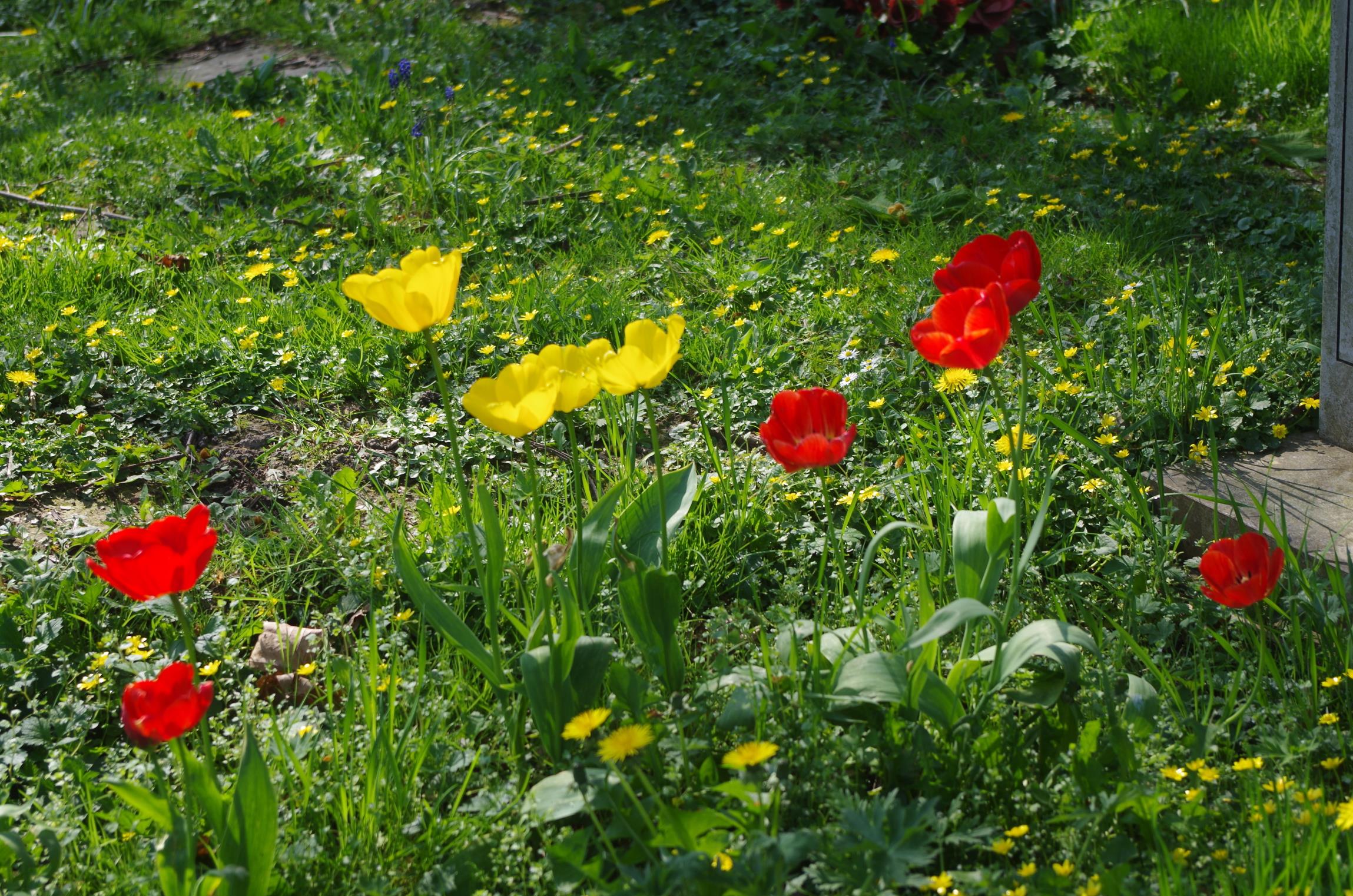
A lovely display of tulips along path.
©Carole Tyrrell

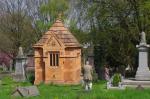
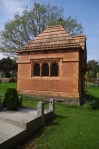
Nature has decided to burst forth now that the sun’s out and suddenly everything’s out at once.     West Norwood Cemetery basked in a warm glow and its two terracotta mausoleums; the Doulton and the Tate,  seemed to be glowing.  I walked along the path from the entrance towards Ship Path and realised again how beautiful a cemetery can be in spring as new life appears amongst death.

I admired the groups of brightly coloured red and yellow tulips as they gracefully lifted their cups to the sun as in homage and a perennial Spring flower, garlic mustard, clustered around the base of a hedge around a memorial.  I’ve seen plenty of it already this year and wondered if it was an omen of future weather.

A queen wasp flew indecisively above one group of primroses as if unable to choose which one to land on and so evaded my camera. A Queen wasp is one of the 7 signs of Spring as they awake from their winter slumber. Multi-coloured carpets of primroses were everywhere between monuments and memorials and butterflies were on the wing obeying the imperative being to mate.

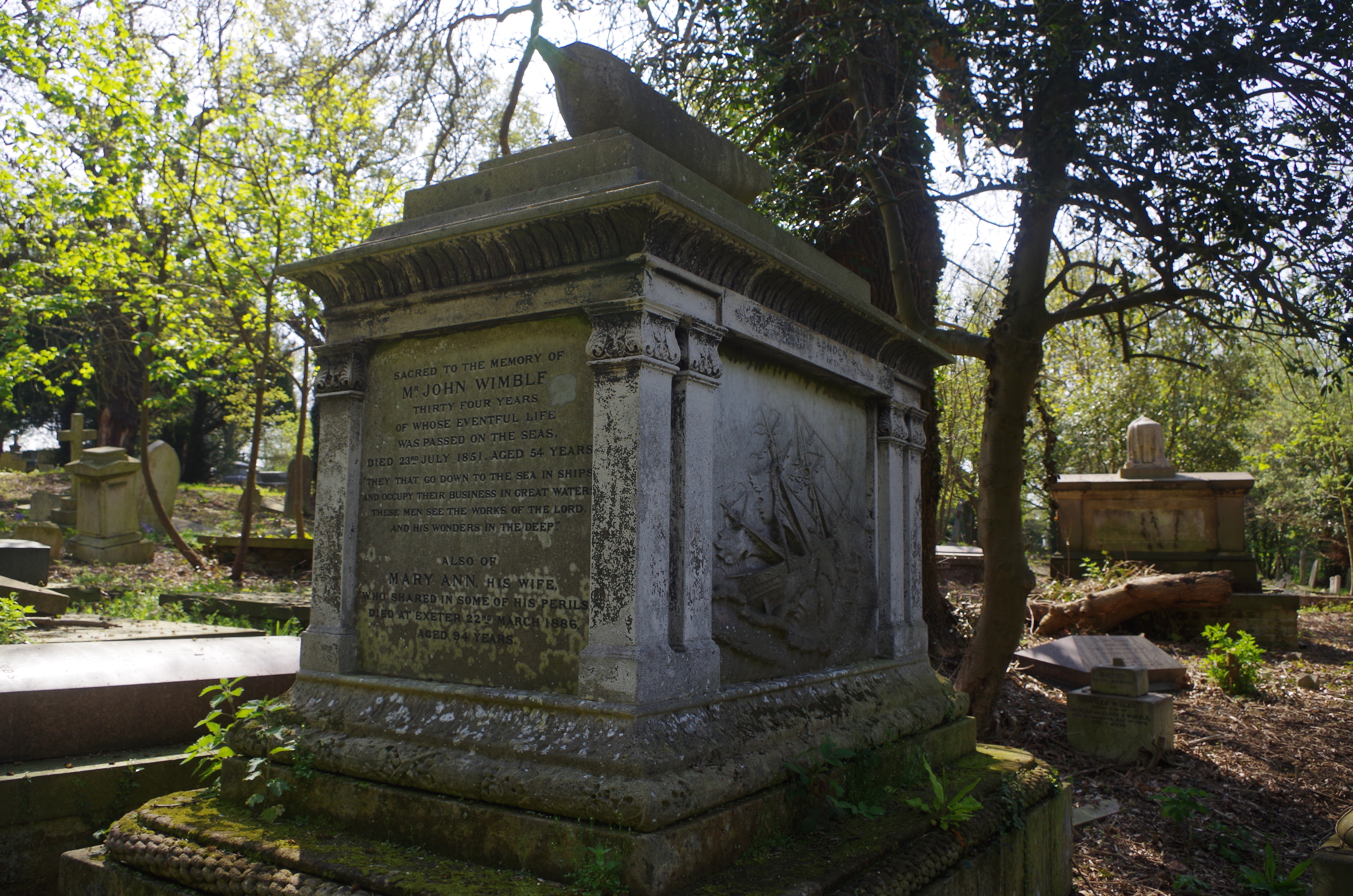
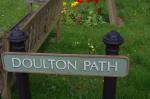
Orange Tips, Holly Blues and the odd Brimstone, the first butterflies of the year, impressed me with their speed and acrobatics.   One Holly Blue dived under a spreading rug of plants that covered last year’s forgotten or discarded horse chestnuts and dead leaves.    There has been a lot of clearing going on in West Norwood and it was like rediscovering it again as I found memorials and monuments that I had never previously seen as they’d been hidden under ivy, brambles and other vegetation. The clearances have made it much easier to get to the back of Captain Wimble’s exuberant and magnificent tomb to admire the still crisp carving of one the ships on which he sailed. But more about him and his indomitable wife in a later posting.  It is the reason that the grass path that runs past it is named, strangely enough, Ship Path.

Captain Wimble’s magnificent tomb – you’d never guess that he was a nautical man would you? It’s a shame that the stone model of a ship has lost its mast but there are carvings of 3 of the ships in which he sailed around the monument’s sides.
©Carole Tyrrell

In one clearing two drifts of wood anemones stood proud and nearby was a large patch of lesser celandine – another Spring time flower.  I’ve also seen so much of it this year and again is it an omen of a hard winter to come or a hot summer….

Another view of the wood anemones as they looked so impressive against the background of dead leaves.
©Carole Tyrrell

A flash of russet behind a group of headstones caught my attention and I saw an adult fox selecting a good place in a patch of foliage as his mattress in which to have an afternoon kip. After he tucked himself in he then spotted me and got to his paws and limped off with difficulty.  He appeared to have a bad problem with one of his front paws and I felt guilty for having disturbed him.

There is a part of West Norwood Cemetery which backs onto a small row of houses and so the occupants household pets, cats,  come into explore.  There’s often a good selection of them on a sunny afternoon; using the cemetery as an extension of their garden while checking each other out, going on the hunt or as their playground.  After having disturbed the fox, I caught sight of a fluffy back and white cat on his rounds trotting along a grass path.  I tried to keep a discreet distance as he passed Mrs Beeton’s modest memorial and the top of Ship Path.  However, as I galumped along, he began to pick up speed.  He trotted, more quickly now, across the main path in front of the catacombs and then leapt gracefully onto the wall above them. He looked back as if to say ‘Too late!’ and then vanished over it.

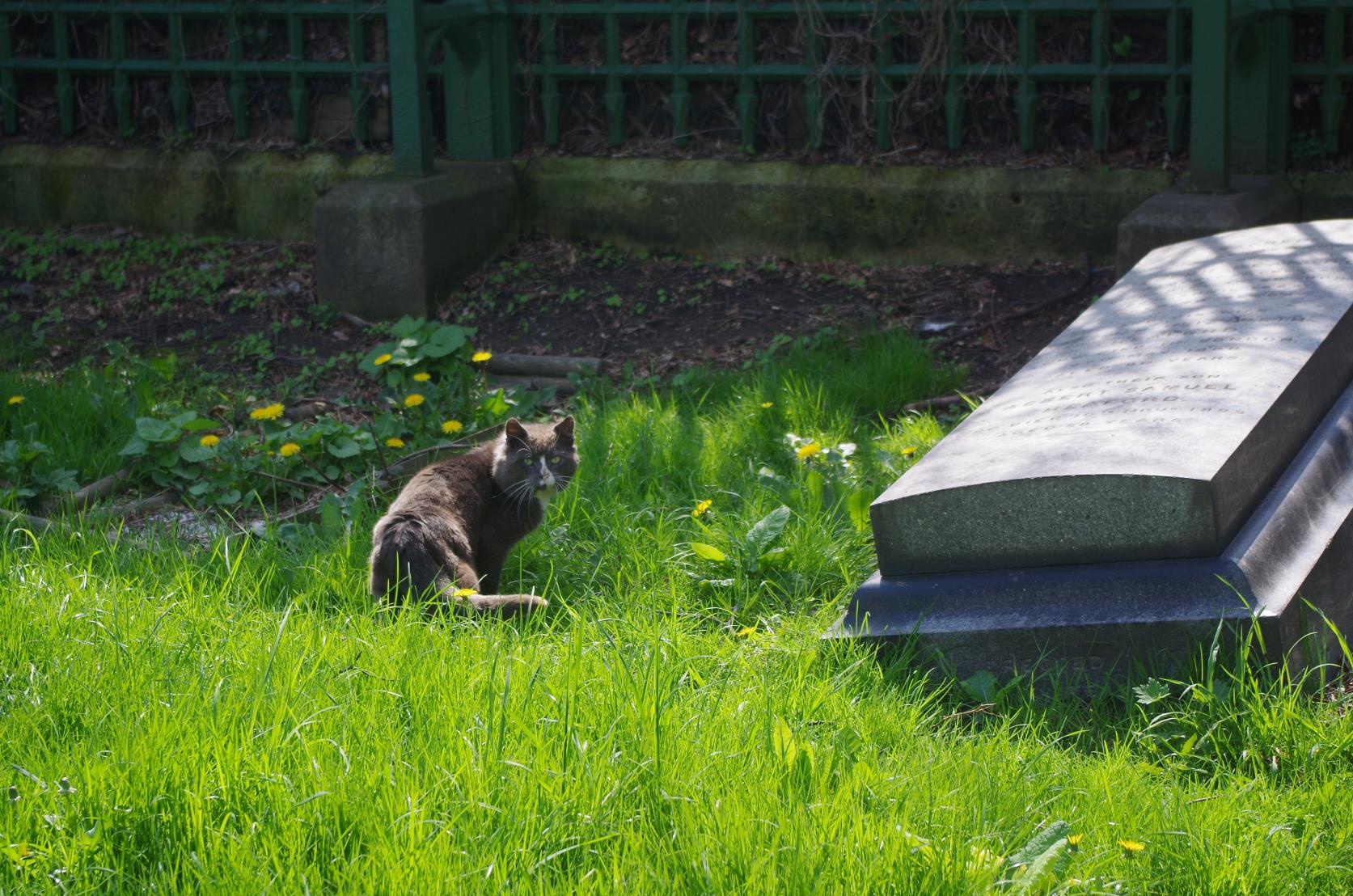
Nervous cat by railings – I tried not to come too close.
©Carole Tyrrell

A grey cat near the houses was quite timid and I didn’t want to come too close and frighten him away completely. I took a couple of photos from as close as I dared and moved on.

So many dandelions this year and there was a fine spread of them in between memorials. After all the recent murky weather it was encouraging to see their bright splashes of colour.

Bluebells, at their most effective when in great drifts in woodland, were clinging together in a patch opposite the crematorium.  It was just as if Mother Nature had brought everything into bloom at the same time instead of one after the other.

As I ate my lunch whilst admiring the crimson blossom on a tree nearby I could hear an old lawnmower in the distance.    As I got up and came around to explore another large cleared area I saw a descendant of the Doulton family mowing the grass around the mausoleum.  Terracotta always looks at its best in the sunshine and today it looked almost on fire.


A small statue of a praying child was almost being enveloped by lesser celandine and there’s been plenty of it everywhere I went this year,

Child angel statue surrounded by copious lesser celandine – it’s been everywhere this Spring – a hard winter or a good summer? We shall see.
©Carole Tyrrell

I descended from the columbarium admiring the speed of butterflies as they whizzed around tantalizingly out of reach of my camera.  It was then that I encountered the fox again. He lay draped over a grave like a fur stole and raised his head as I passed.

The fox again! Still trying to have an afternoon nap.
©Carole Tyrrell

A cuckoo flower was half hidden in the long grass near another glorious display of brilliantly coloured tulips.

As I walked I thought how lucky I was in to be in this oasis with the busy world kept at bay outside its magnificent Gothic gates.    I passed the Stonehenge inspired monument to John Britton which still looks as if it’s just landed from the opening scenes of 2001 and then to one of my favourite memorials in West Norwood or maybe any cemetery.

It’s a real gem and is the unashamedly Art Nouveau headstone dedicated to Amelia McKeown.  Its modest size and poignant dedication have always impressed me and the primroses beneath it emphasised its deep blue colouring.  This had been a chance discovery a few years ago when the main entrance had been closed for building works and visitors had had to enter via a side gate. Sometimes the road less travelled can bring the unexpected to your notice.

As I left the cemetery, feeling that I’d had almost a Spring walk in the countryside with some attractive monuments, I noticed the Unknown Mourner still grieving in a rose garden.  The elderly lawnmower and the sparse cars of visitors were behind me and I was back out onto the slow moving traffic of Knights Hill and Norwood High Street again. I nearly turned round and went back in again…….


©Text and photos Carole Tyrrell

Wildlife in cemeteries No 7 – dragonflies and damselflies

With gossamer wings which turn into tiny rainbows under the sun’s rays as they pose on trees and tombstones and incredible acrobatic flying displays dragonflies and damselflies are regular visitors to my local churchyard.  And 2017 has been an incredible year for spotting them.

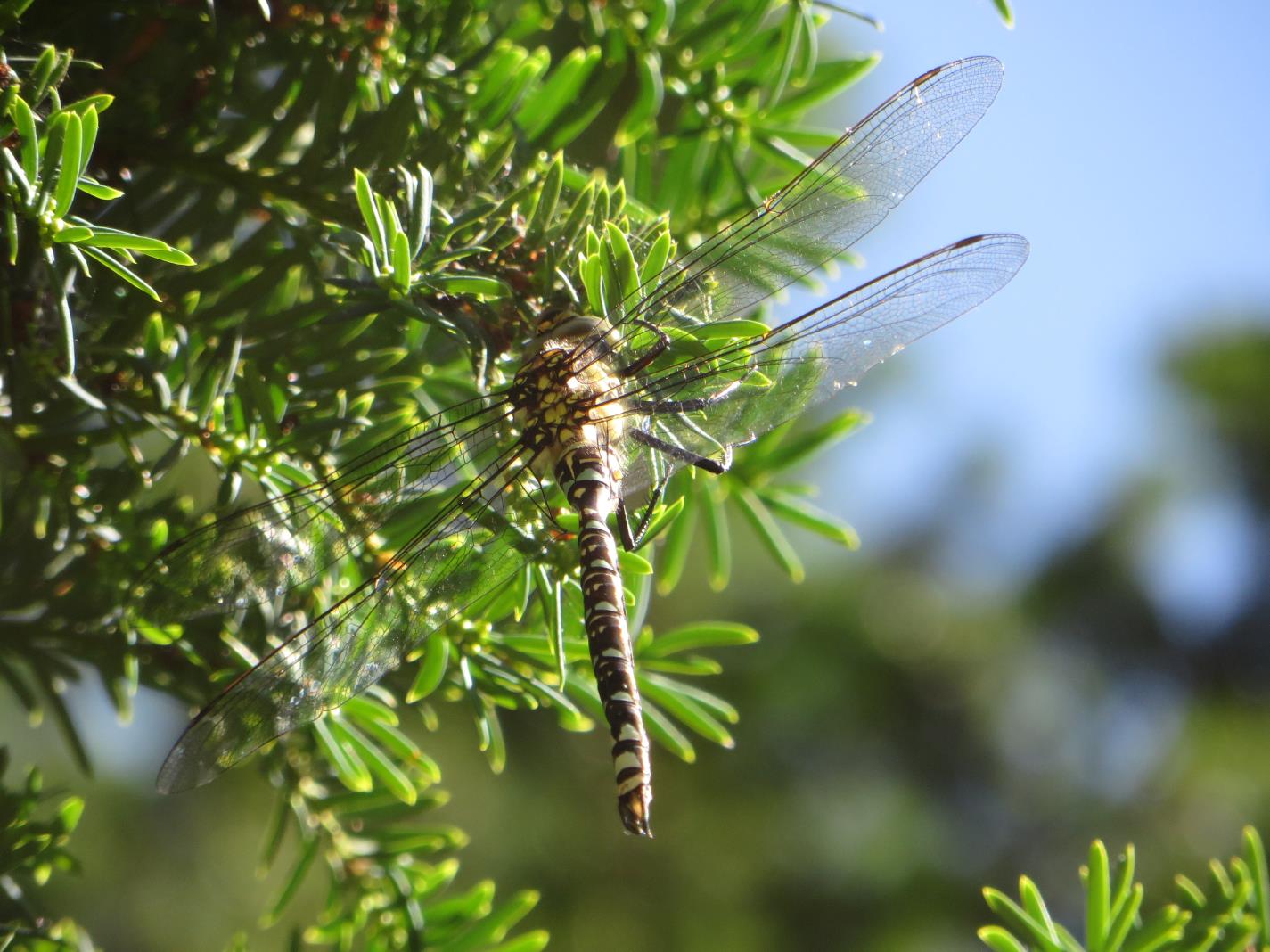
I don’t think that a chucrwarden in St George’s, Beckenham, believed me when, in 2016, she found me trying to capture a Southern Hawker  which was conveniently posing on a  lofty yew branch..   But this year, I have seen so many in there that it did become a regular part of my day to walk through and look for them.

I would watch in amazement at their aerodynamics and speed as their 4 wings whirled furiously like helicopter blades as they flew at speed.   However, they would also fly at a more leisurely pace around and around before, tantalisingly, they would veer off into the foliage of trees to vanish from sight.  It would often be the bigger dragonflies such as Southern Hawkers that I would see on the wing but also as the summer moved on, Common Darters began to appear.

Often a dragonfly would obligingly land on a tombstone or lower branch and I noticed that they were particularly attracted to evergreens such as yews.  This might account for their attraction to cemeteries and graveyards.

Here’s a selection of my favourite images of dragonflies and damselflies from both cemeteries and churchyards:

This is a Southern Hawker from 2016 and was seen it in St George’s churchyard, Beckenham.

Southern Hawker on yew, St George’s churchyard Beckenham August 2017
©Carole Tyrrell

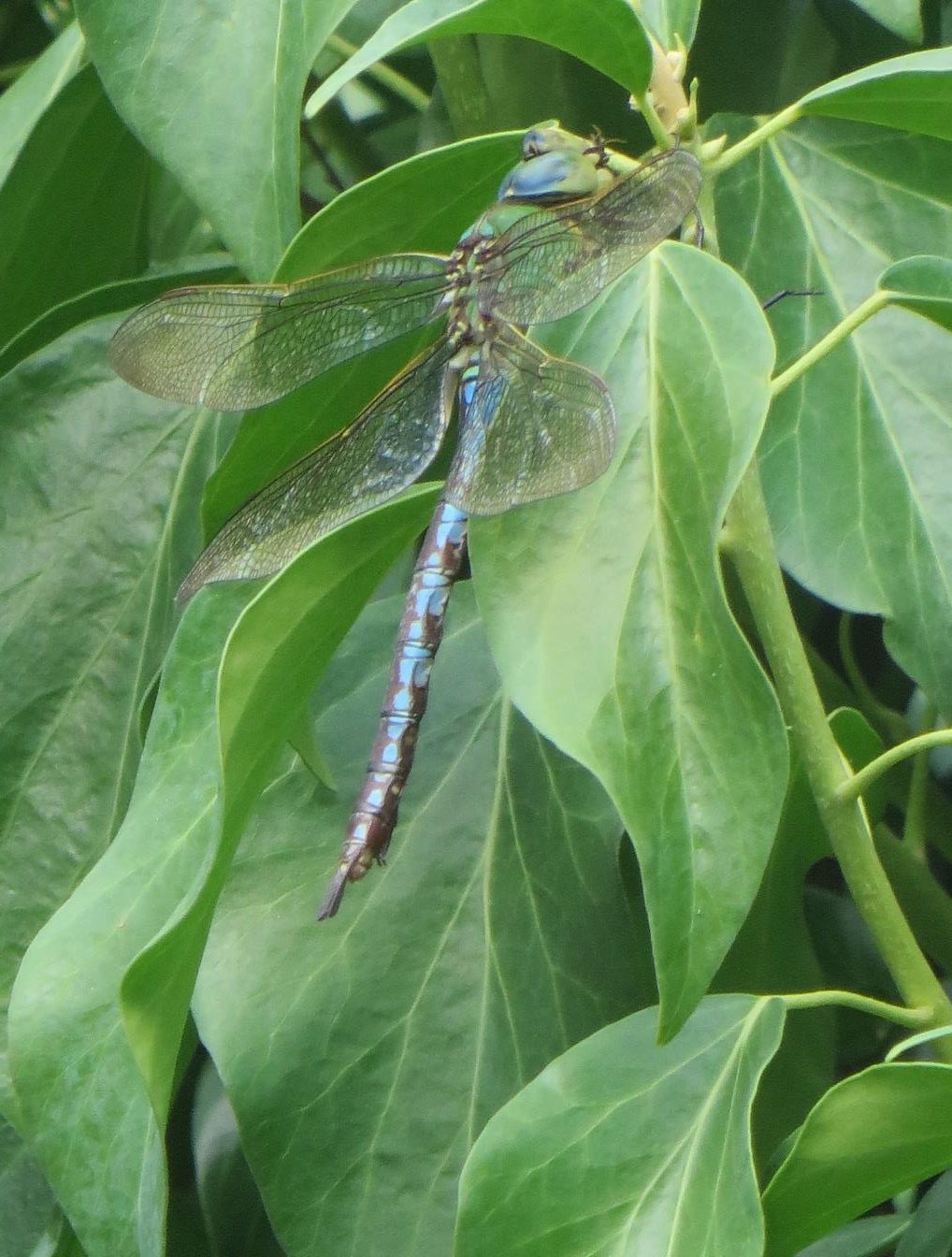
This is a male Emperor from Kensal Green cemetery, London in July 2017. I spotted him/her flying around above The Meadow section which is left uncut around the monuments and tombstones during the summer to encourage wildlife such as butterflies, In some parts it’s very damp underfoot hence the dragonfly I thought. It evaded my attempts to photograph it until, near the entrance as I was leaving, it landed temporarily on an ivy clad monument.

Male Emperor, Kensal Green cemetery July 2017
©Carole Tyrrell

These are two damselflies from Beckenham Cemetery’s Garden of Remembrance pool from July 2017. From July –August it is a magnet for red and azure damselflies.  They look almost like tiny, coloured sticks floating on the breeze and I caught these two ovipositing i.e. laying eggs.  The upright one is laying the eggs and the other is holding it steady.

Damselfiles ovipositing (laying eggs) Beckenham cemetery June 2017
©Carole Tyrrell

Again from St George’s but from 2017, I waited patiently until this beautiful male Southern Hawker landed and helpfully rested on a tombstone.  It stayed there for a few minutes until it got fed up and flew off again.

Male Southern Hawker on tombstone, St George’s churchyard, Beckenham August 2017
©Carole Tyrrell

This is a Common Darter and I saw several over the summer this year in the churchyard. For some reason they were particularly attracted to the pink granite monuments – a cool surface on a hot summer’s day?

Common Darter on pink granite monument, St George’s churchyard Beckenham August 2017
©Carole Tyrrell

I enjoy looking out for them and on one occasion last year the angle at which the dragonfly was perched on a yew branch and the way in which the sun shone through its wings made them look as if they were made from burnished copper.

So do look up when you’re next visiting a cemetery or churchyard on a warm summer’s day and you might be surprised.  I’m looking forward to what the summer of 2018 might bring already!

©Text and photos Carole Tyrrell