A ‘free range’ walk on the West side – Highgate Cemetery July 2020

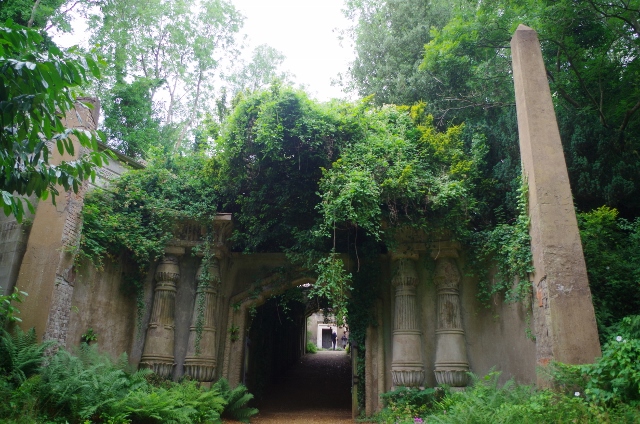
The Egyptian Avenue on a Highgate Cemetery ‘free range

One of the greatest cemeteries in London is Highgate in North London. Crammed with the great and good and also some of the not so good it contains some of the most dramatic funerary architecture to be found in the capital.

The cemetery is bisected by Swain’s Lane with Highgate West on one side and Highgate East on the other. Usually the West side can only be accessed by being on an official tour but this year it was a little different……

Social distancing, in this case, was a good thing!  As The Friends of Highgate Cemetery Trust(FOHCT) were unable to hold tours during the summer they cunningly decided to offer ‘free range’ tours instead. For £10 you could book a time, agree to follow a few sensible rules on safety etc and then wander round the West side at will. And if you had the energy, as Highgate West is large, have a look round the East side as well. The West is very overgrown and FOHCT like their visitors to be safe.  They didn’t want their visitors to have a nasty accident and then haunt them forever more.

Please note that I have covered Highgate in a previous post – 16/2/2016 to be exact so some memorials mentioned here will have been covered more fully in that post.

So, on 10 July, I entered through the arch of the chapel and into the green cathedral of the West side.  The trees had linked arms above the graves, monuments and memorials to form a canopy over the entire site.  It felt as if everything was bathed in green light as I walked up the hill.  At its highest point Highgate is 375 feet above sea level. Cemeteries are often built on these as their permanent residents are nearer ‘my God to thee.’

I passed the empty chair memorial to a young actress and spotted a pelican in her piety symbol amongst the undergrowth. The overgrown nature of the West side gives it a real charm and mystery.  A helpful steward directed me to the Rossetti group of graves which I’d always wanted to see but he also pointed out the grave of a woman who had died when her dress had caught alight. Apparently this only ceased with the coming of the mini-skirt and possibly central heating.

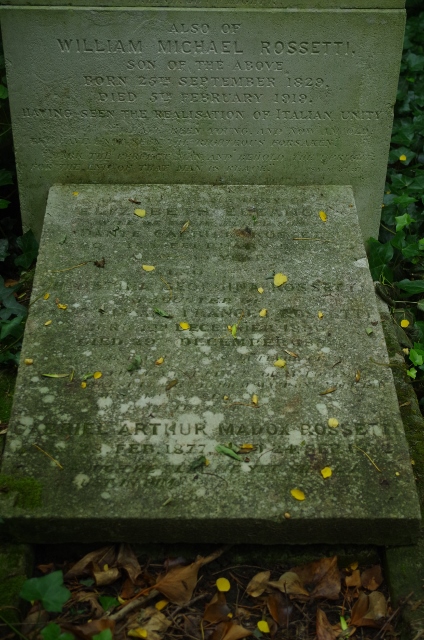
The Rossettis have their own path named after them but the Pre-Raphaelite painter, Dante Gabriel Rossetti is not buried with them.  Instead his parents Gabriele (1783-1854) and Frances (1800-1886), his brother William (1829-1919) and William’s wife Lucy Madox Brown (1843-1894), who was the only daughter of Ford Madox Brown, his sister Christina Rossetti (1830-1894) and Dante’s wife Lizzie Siddal (1829-1862) occupy the plot.  

Lizzie features as the model in several of Dante’s paintings and the Victorian web points out that she died aged 32 instead of at 30.  She was addicted to laudanum which was derived from opium and was a Victorian cure-all. Laudanum was prescribed for morning sickness and cranky infants amongst others.  It was easy to become addicted and she succumbed.  Lizzie was pregnant at the time of her death, although she may not have known it, and had already had a stillborn child with Dante.   It is still not known  if she died of an overdose or a deliberate act of suicide. However, she was a talented artist in her own right and some of her work was featured in the 2019 exhibition ‘Pre-Raphaelite Sisters.’

But Lizzie has also been commemorated by an act that occurred after her death.  One of Dante’s early biographers  recorded it:

On the day of the funeral Rossetti walked into the chamber in which the body lay. In his hand was a book into which at her bidding he had copied his poems. Regardless of those present he spoke to her as though she were still living, telling her that the poems were written to her and were hers, and that she must take them with her. He then placed the volume beside her face in the coffin, leaving it to be buried with her in Highgate Cemetery. This touching scene will some day doubtless be the subject of a picture. Time, after its wont, hallowed and sanctified the memory of loss, but the bereavement was long and keenly felt. Meanwhile, the entombment of Rossetti’s poems had an effect upon which the writer had not calculated. They were familiar to many friends, and passages of them were retained in the recollection of some. These poems were during subsequent years the subject of much anxiety and wonderment, and the existence of the buried treasure was mentioned with reverence and sympathy, and with something of awe. Seven years later Rossetti, upon whom pressure to permit the exhumation of the volume had constantly been put, gave a reluctant consent With the permission of the Home Secretary the coffin was opened” by a friend of Rossetti and the volume was withdrawn. [Knight 76] from the Victorian Web site

It would haunt Dante for the rest of his life.   In one of his most famous paintings ‘Beata Beatrix’ painted in 1869, which is an amalgam of several drawings of Lizzie, a white poppy features. The red dove represents their love and the poppy the laudanum that hastened her death. It’s derived from poppies. Dante died in 1882 and is buried at Birchington-on- Sea.
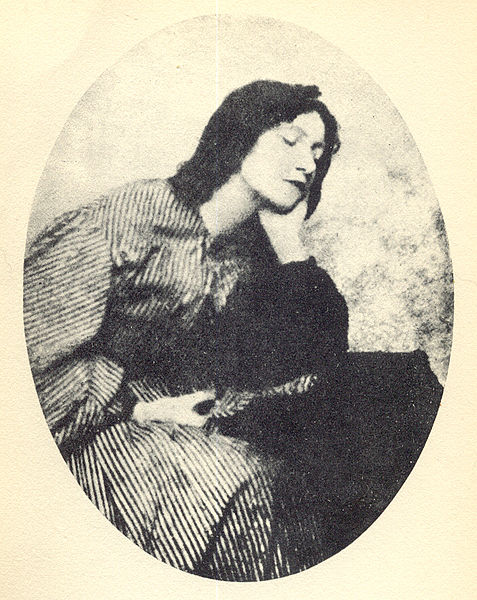
Elizabeth Siddal circa 1860 unknown photographer shared under Wiki Commons
Beata Beatrix Dante Gabriel Rossetti completed 1870.

William Rossetti was a founder member of the Pre-Raphaelite Brotherhood and wrote widely.  He was also the biographer of his family. One of Christina’s most famous poems was ‘Goblin Market’ and she also featured in ‘Pre-Raphaelite Sisters.’

I returned to the path but discovered a selection of the rich and famous as I walked up to the Circle of Lebanon. 

The epitaph says it all
Lucien Freud artist
Jean Simmons actress.- she starred with Kirk Douglas in Spartacus

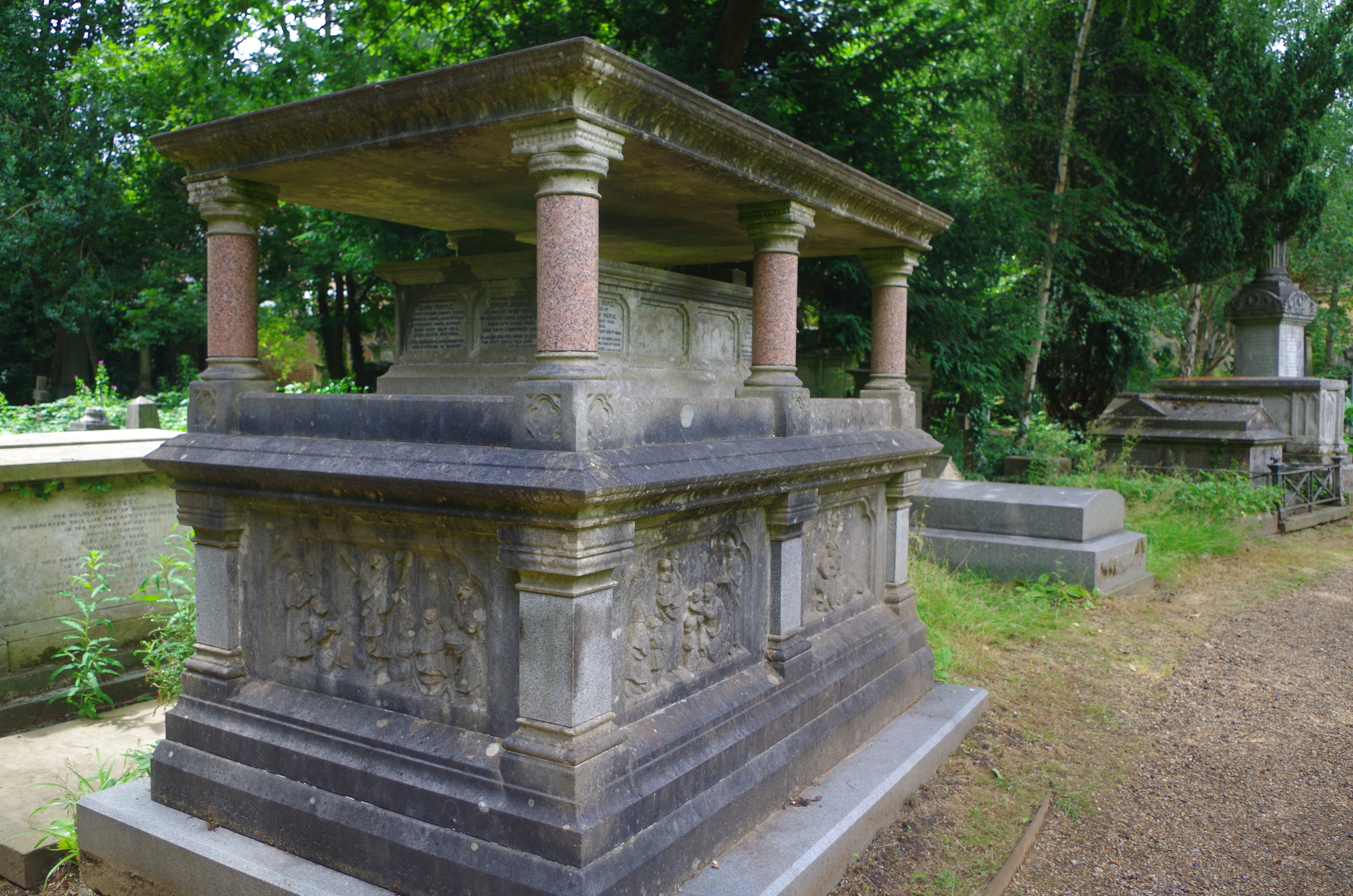
Alas, the venerable 250 year old Cedar of Lebanon after which it was named succumbed to old age in 2019.   It was a survivor from the Ashurst estate on which Highgate West was built on and was an impressive sight.  Now a wildflower garden stands on the spot. I had come out onto the upper terrace and from there I could see the layout of the Circle much more clearly. There are some impressive monuments here: Nero the lion eternally slumbers on the Wombwell monument. George Wombwell was a Victorian menagarist who owned 3 travelling animal shows.  The monument to John Maple features low relief carvings from the life of Christ. He owned a very successful furniture business which occupied a large site on Tottenham Court Road.   It no longer exists.   The Circle is built in the Classical style and the inner circle contains 20 vaults and another 16 were added in 1870.

The Circle of Lebanon from the upper tier and note the wildflower garden that replaces the Cedar after which the Circle was named.
Nero, the lion, guarding the Wombwell monument.
The Maples monument on the upper tier of the Circle.

The Terrace catacombs were closed although I have been inside them on a previous visit. By contrast they are in the Gothic style and were built on an existing terrace from the Ashurst estate.  The frontage is 8 yards long with room for 825 people in 55 vaults each containing 15 loculi or coffin spaces.  I was reduced to peering through a doorway on this occasion before turning to the magnificent Beer mausoleum which was built for his 8 year old daughter, Ada.

The Gothic style terrace catacombs
The Beer mausoleum

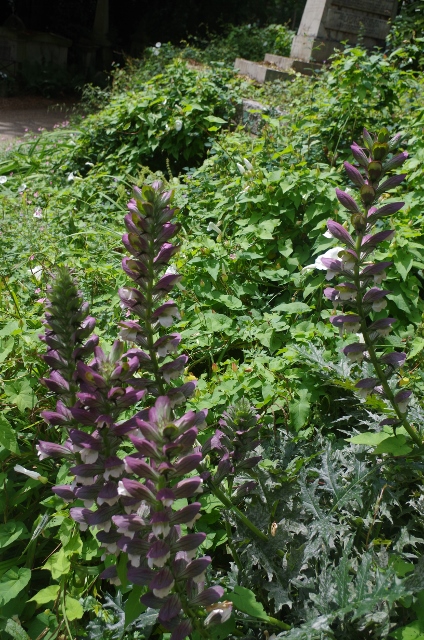
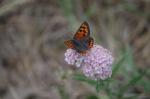
As it was a self-guided tour I had time to admire the summer wildflowers which were growing in profusion.  Cemeteries are good places to find these; Acanthus, ragwort, verbena, Ladies Bedstraw, Vipers Bugloss, Rosemary Willowherb and also a buddleia in full bloom studded with Peacock butterflies on Faraday Path. 
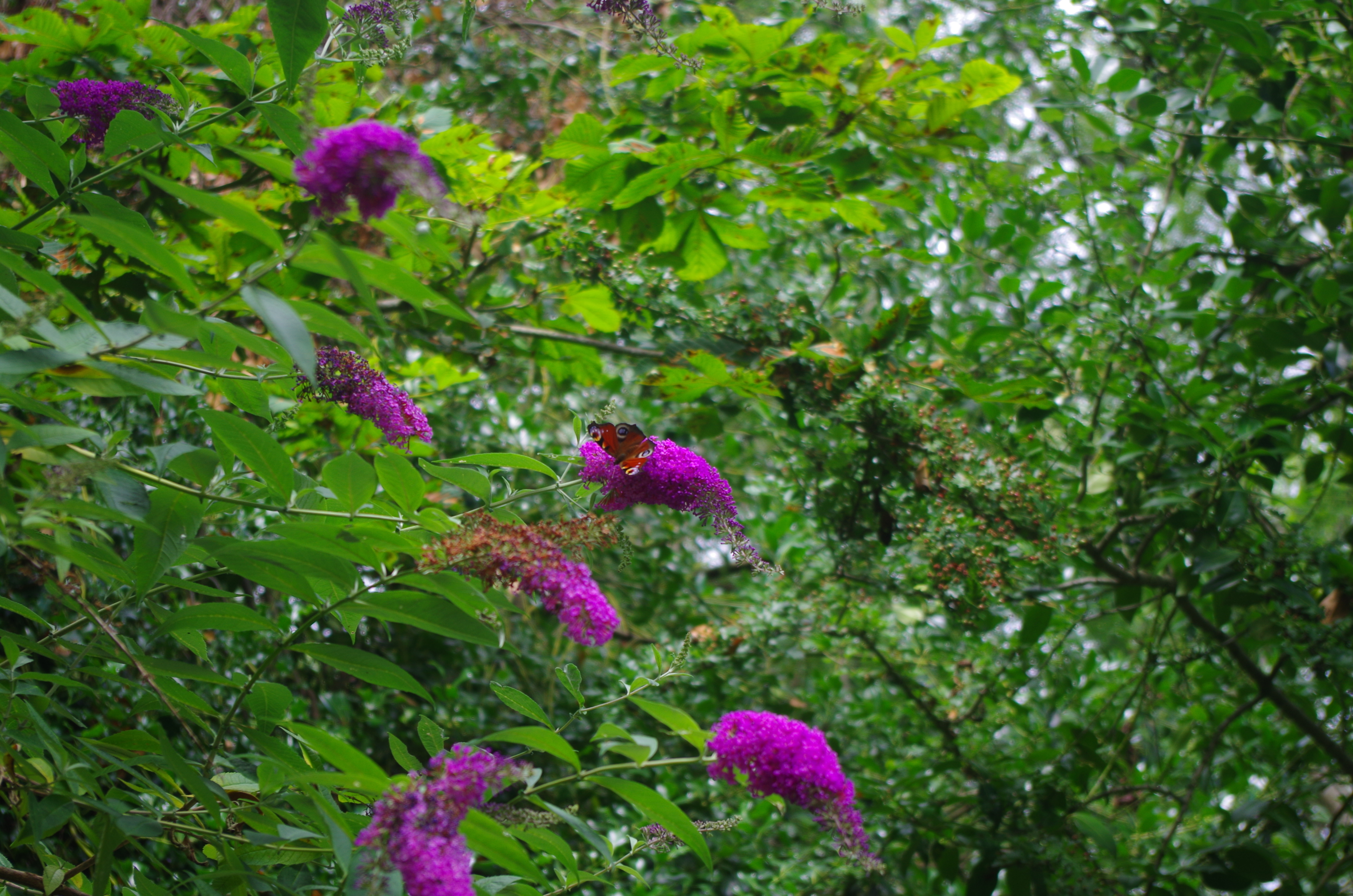
Peacock tucking into a Budleia blossom on Faraday path.
Viper’s Bugloss
Acanthus

A sidepath from the Circle led me along another path which I’d not previously seen.  The atmosphere seemed different and it was certainly darker, perhaps due to a thicker tree canopy, as I walked along it to a gate at the other end.  This would have originally opened onto Swain’s Lane and there was what appeared to be a former gatekeeper’s lodge nearby. It still bore the monogram of the London Cemetery Company who were the original owners of Highgate cemetery.  Time slips have been reported along this path and I wondered if it was the gate through which a man is reported to look out at unwary passers-by.
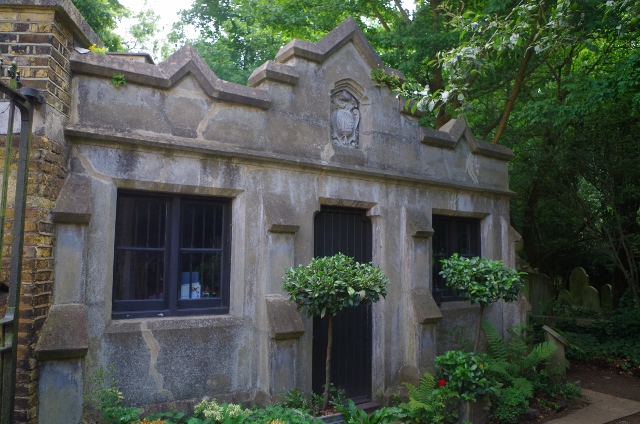
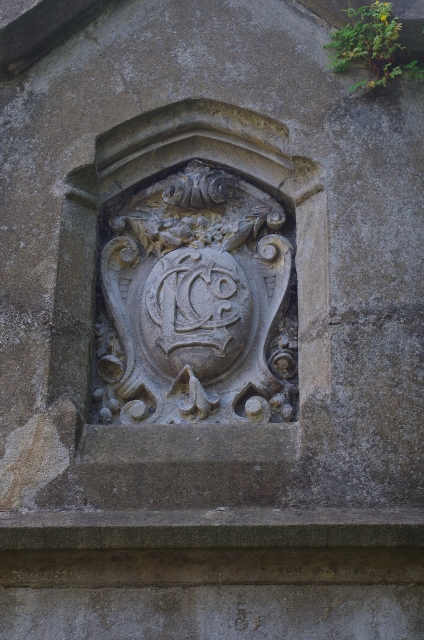
A possible former gatekeepers lodge
The monogram of the London Cemetery Company

I retraced my steps towards the magnificent Egyptian Avenue one of Highgate’s highlights. Tom Sayer’s monument lay to my right with his faithful dog, Lion, eternally keeping guard and then the  Sleeping Angel.  This is dedicated to Mary Nichols who was a Londoner who died in 1909 from heart failure and diabetes.  It’s a lovely tribute.

Lion guarding the gave of bare knuckle fighter Tom Sayers
The Sleeping Angel on top of Mary Nichols
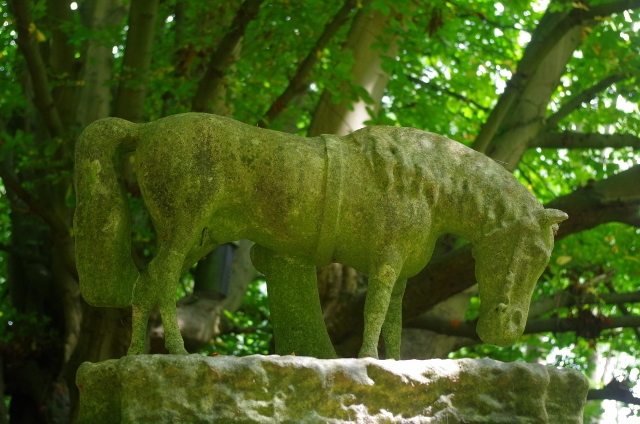
The Acheler memorial

The horse on top of the Acheler memorial records John Acheler who became wealthy and well known as a ‘Knacker’.  He called himself ‘horse slaughterer to Queen Victoria’.

The Egyptian Avenue!

And then the Egyptian Avenue!  The centrepiece of Highgate West in my opnion. It may be looking a little tired but it’s a magnificent example of how the Egyptian explorations of the 19th century influenced funerary architecture. Note the two large obelisks flanking the entrance and the stylised lotus flowers on the columns as you enter through the arch and into the passage that will take you into the lower tier of the Circle. 
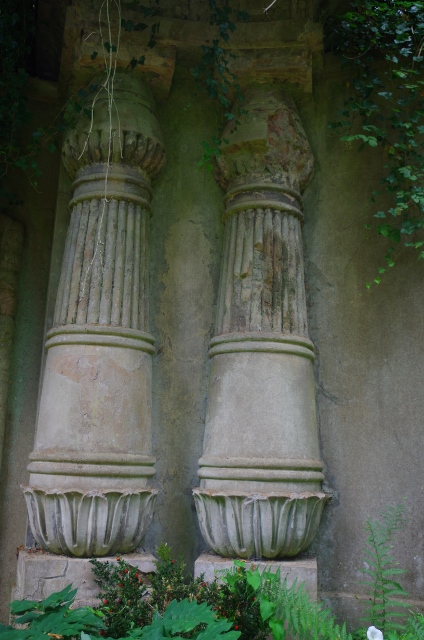
The Avenue was also a catacomb but they were never really popular as other London cemeteries soon realised. After all if Highgate couldn’t sell all theirs then who could? The passage contains 16 vaults on either side which were each fitted with shelves to hold 12 coffins. These were bought by individual families for their own use.

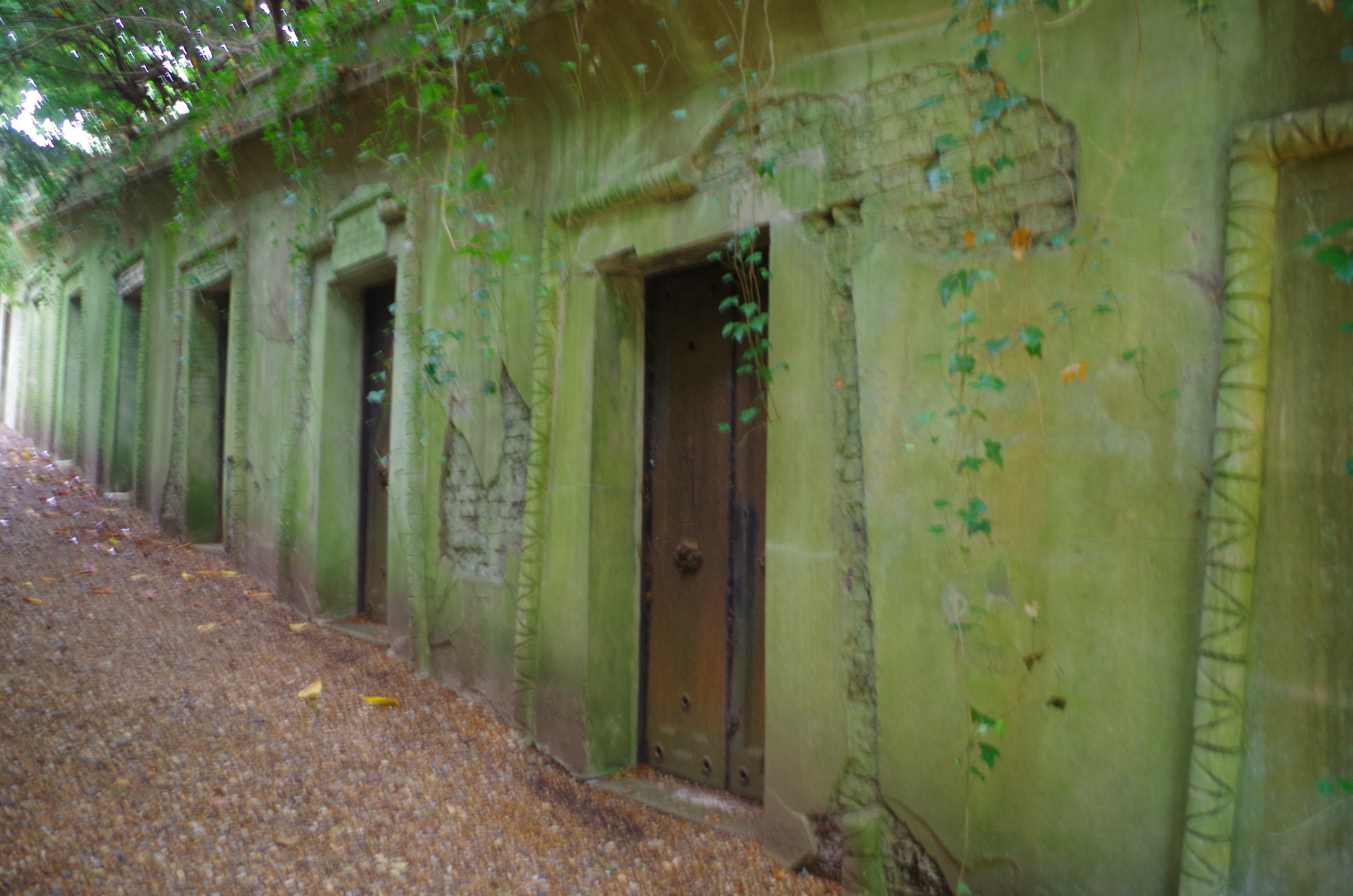
The passage from the Avenue entrance into the Circle of Lebanon.
The vaults on either side of the passage.
The Circle of Lebanon as you emerge from teh Egyptian Avenue.

By then I thought it was time to explore the East cemetery while I still had the energy.   

Wildflowers were also in profusion here: clover, bird’s foot trefoil and vetch Butterflies flew about on the heat of a late summer afternoon. 

Bird’s Foot Trefoil – Highgate East

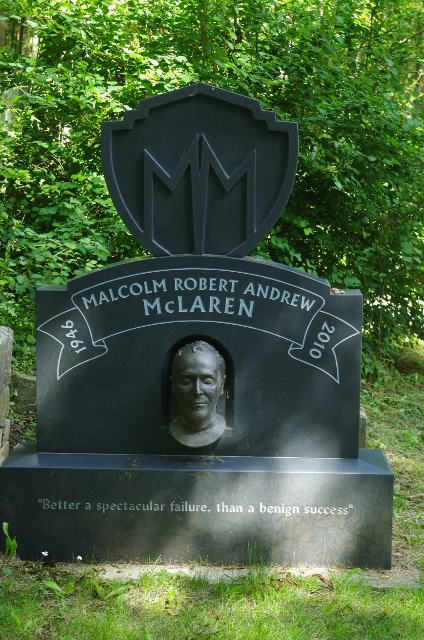
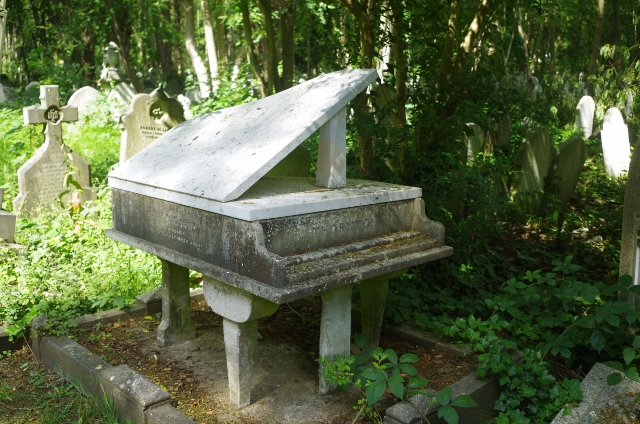
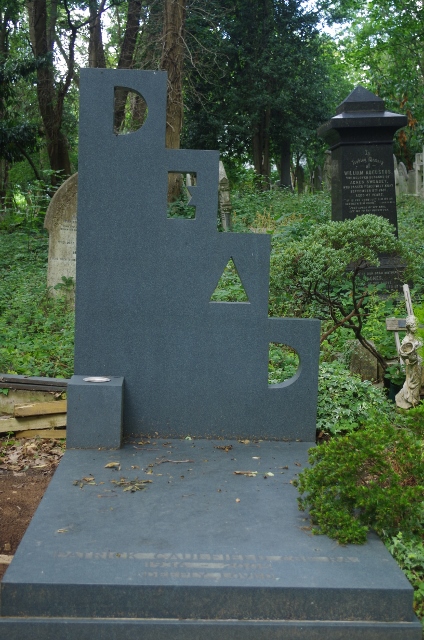
I saw my favourites; Jeremy Beadle, Malcolm McLaren, Karl Marx and Patrick Caulfield.   There was also the grand piano dedicated surprisingly enough to a pianist, Henry Thornton, who died in 1918 during the ’flu epidemic.

Jeremy Beadle – Highgate East
Patrick Caulfield – a sense of humour
Malcolm Mclaren
Henry Thornton, a pianist

The East side isn’t as overgrown as the West side and as I explored further I found a memorial which highlighted a dog. This was dedicated to Ann Jewson Crisp and her faithful dog Emperor. 

But as I left the East side I spotted another of its more celebrated residents settling down for a siesta behind the Great Train Robber, Bruce Reynolds’, memorial.  It was a cemetery cat who was soon hidden deep in the grass and I didn’t want to disturb him or her.  What a playground!
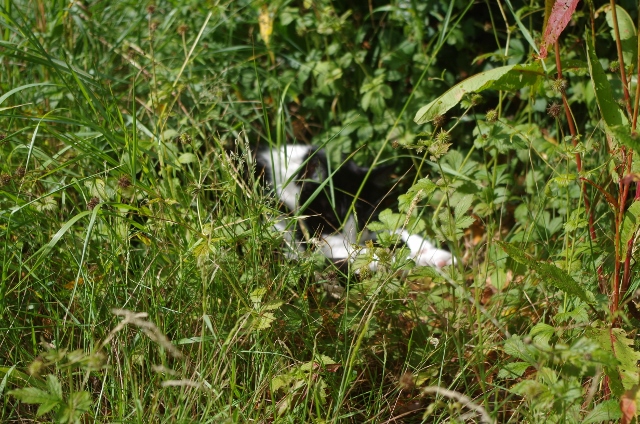
A cemetery cat having a kip in the last afternoon sunshine.

As I left the East Cemetery and walked down Swain’s Lane to Archway tube station I still had time to admire my ideal des res – Holly Village – which was built by Victorian philanthropist, Baroness Angela Burdett-Coutts. It is said that she planned it with Charles Dickens. She built the Burdett-Coutts Memorial Sundial in St Pancras Old Burying ground.
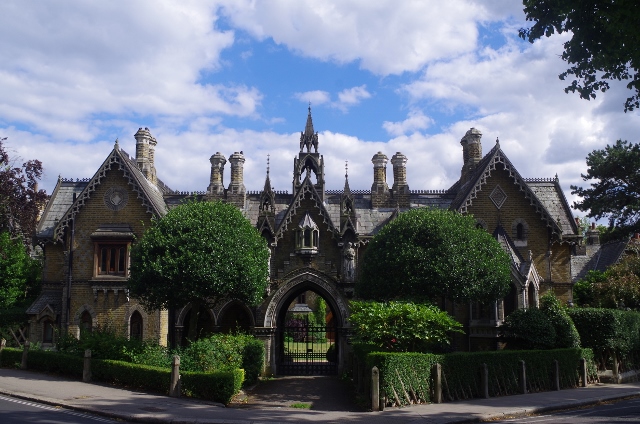
Thj Gothic beauty of Holly Village

©Text and photos Carole Tyrrell except where indicated

References and further reading

http://www.victorianweb.org/sculpture/funerary/216.html

https://highgatecemetery.org/about/the-friends

Highgate Cemetery – maps to East and West cemeteries.https://www.hamhigh.co.uk/news/fascinating-history-of-unique-village-within-a-village-1-628284

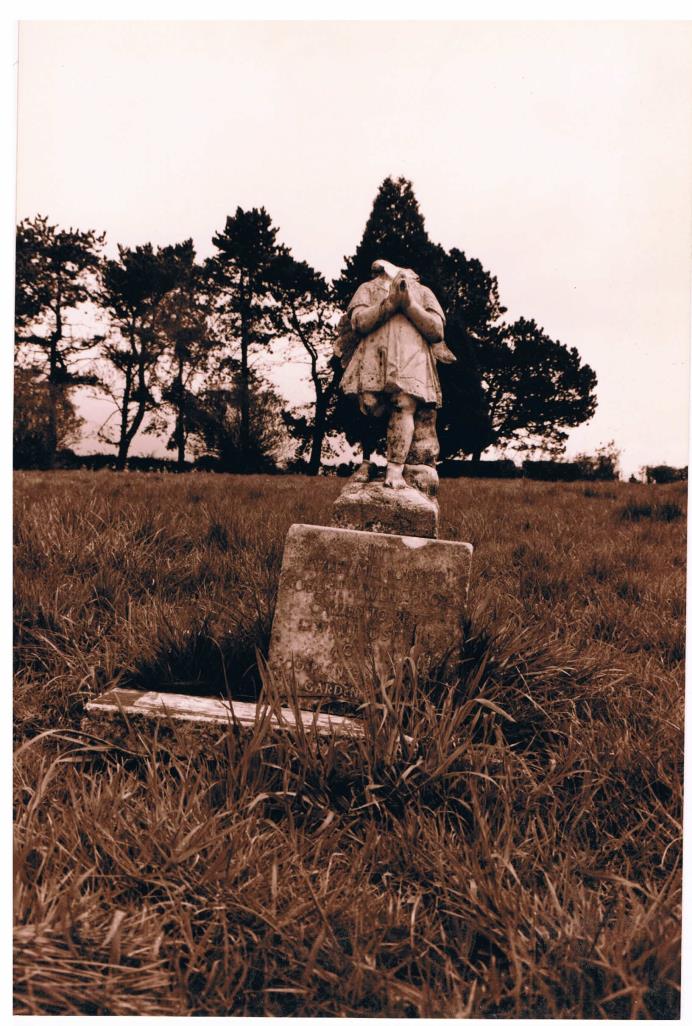
The place that haunted me for nearly 30 years – the return visit to St Lawrence’s hospital burial ground

Scan as on film camera.
copyright Carole Tyrrell


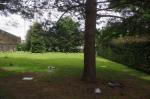
Where were we?  We’d come into a neatly mown clearing with a small statue of a headless angel on a plinth at its centre.  There were large stones arranged around the perimeter with names and ages inscribed on them. I don’t recall seeing any signs anywhere that indicated what it was.   The tall black trees seemed to whisper to each other around us but otherwise it was silent.  My companion wanted us to move on deeper into the surrounding countryside and so we did.  We’d already roamed around Happy Valley and he was keen to do more. But I had enough time to take one photo and it became an important, and the only, reminder of our visit.

The black pines that I remembered from my first visit.
©Carole Tyrrell

This was in 1990 and I had no idea where we were. In later years I discovered that we had been on Farthing Downs, near Coulsdon in Surrey.   Although I made several return visits and tried to retrace our walk I could never find the exact place. What was it? A farmer’s cemetery for beloved animals? The ages on the stones had been very young but I could never find it or any information online about it. Was it attached to one of the nearby asylums?  Cane Hill Asylum wasn’t that far away across the valley. I was nearly there.  In 2013 a magazine article and a map reference revealed it to be St Lawrence’s hospital burial ground. At last I knew where it was and what it was.

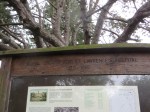
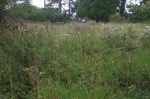
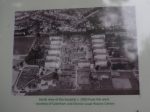
As the wind blew eerily through the bordering pine trees and passing, but invisible golfers, chatted to each other I knew that this was the place that had intrigued me for nearly 30 years.  No tidy clearing now and any memorials were half submerged in the overgrown undergrowth. But at last I knew that  I was standing in St Lawrence’s Hospital burial ground at Caterham which was now in the middle of a very upmarket golf course.  The golf course hadn’t been there in 1990 but its manicured lawns, water features and clubhouse surrounded the burial ground.  St Lawrence’s long, late summer overgrown grass, straggling and profuse bushes of blackberries and rose hips and uneven ground made a sharp contrast.  I trod very carefully. There were now two black painted metal gates at the entrance and an information board with photos and pictures of St Lawrence’s Hospital and the chapel.  This had long since been demolished, but the foundations and base could still be found amongst the long grass and clover.  An overcast day and spits of rain combined with the mournful wind made the burial ground feel abandoned.

As I stood there it seemed impossible that over 3100 people lay buried under my feet in this spot underneath the tussocks and unkempt long grass.  A burial register from 1916-1948 records 3100 people buried in 276 plots with 10-15 in each grave. However, the 1949 -1965 burial register is still missing so there may be 1000’s more buried here. The burial ground is the only surviving part of the Hospital as it closed in 1994 and was demolished to make way for a housing estate.
St Lawrence’s was originally the Caterham Metropolitan Asylum which opened in September 1870. It had a sister asylum at Leavesden, Herts.  They both took in the pauper insane from London’s workhouses as it was felt that the country air would be good for them and help improve their condition. This is probably why there is such a concentration of asylums in the Surrey area. However their location often led to staff shortages due to their remoteness.

According to Lost Hospitals of London:

 ‘There were 1560 patients which were housed in 6 three storey blocks for 860 females and 5 blocks for 700 males. The sexes were segregated as they were in all asylums. Children were also admitted and in 1881 St Lawrence’s also become known as the Caterham Lunatic Asylum for Safe Lunatics and Imbeciles.  The Victorians weren’t very PC and we would now say that these people had ‘learning difficulties’.  In 1913 under the Mental Deficiency Act it became responsible for mentally defective children pauper children or again children with learning disabilities. Children from another hospital and a Training Colony were also sent to Caterham.  It also had a large proportion of older patients who had no chance of improvement. 23.6% of its patients were epileptic. (Treatment for epilepsy was non-existent in the 19th century and even 40 years ago it was still in its infancy)

In 1981, St Lawrence’s and another hospital featured in a documentary called ‘Silent Minority’ which drew attention to the poor conditions in these places exacerbated by staff shortages. The media took an interest and patient care, amongst other areas, were investigated by government Inquiries.  It focused on the scant and impersonal natures of the wards, deficiencies in nursing care and staffing ratios for profoundly disabled patients. It was said that the hospital management had sanctioned the programme in the hope that public awareness of the extent of the problem might bring about change for the institution. Patients began to be moved out into homes and hostels and into the community.’

 When the burial ground was closed for burials in 1965 the memorial stones were removed from the main burial area and placed on the perimeter so that the grass could be mown. This is how it looked when I saw it in 1990 when the hospital was still in operation.  Like Netherne, the burial ground was almost forgotten and became overgrown and abandoned until in 2008, concerned locals took matters into their own hands and started tidying it up. Local residents, cub packs and schools all wanted to be involved and in 2010 13 memorials had been located either intact or in pieces.

Here is a selection of the memorials that I saw:

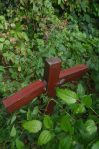
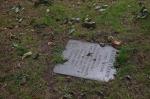
The overgrown uneven ground was obviously due for one of its two annual brush cuts and I trod carefully as I explored. I found a few memorials which were clustered in the overgrown memorial rose bed. I could make out dates and names on some of them and they were poignant reminders of the hospital’s patients.  According to the information board, these were the memorials that were found in 2011:

John                                                                  1945-1960

Valery Muriel Ann Howcroft                       1953-1962

Graham W Cleghorn                                     1936-1957

Brian W Udy                                                   1889-1917

Frederick Albert Houghton                        1948-1957

Ann Margaret Hazell

Bobby Wise

Terry                                                             aged 6 years

George Henry Hale                                    1884-1961

Edna Phyllis Millward                              1909-1953

Percy Herbert Goddard Barnes              1891-1963

Leslie Charles Alfred Nash                     1924-1963

Pattie (Patricia) Hill                                1912-1934

Donald Douglas Chamberlin                  1907-1924

Joseph H Wenderott                              1926-1942

Malcom Dow                                           1929-1938


I am indebted to The Downlander for information on two of the memorials:

‘Percy Barnes was in the 1890 Census where he was living at 98 Farringdon Road where his parents kept a coffee house.   By 1911 he was a kitchen porter and lived in Shoreditch with his parents, 2 sisters and 3 brothers.  But nothing is known of him from 1911-1963 so how did he end up being admitted to St Lawrence’s?

Leslie Nash’s memorial is under the black pines but I didn’t see it on my visit. ‘The burial ground restoration team were contacted by a cousin. He told them that Leslie’s brother was still alive and had been searching for Leslie’s memorial for many years. You can imagine how thrilled he was to know its location at last. Apparently Leslie had epilepsy and cerebral palsy and was sent to St Lawrence’s in 1938 when he had become too heavy for his parents to lift. They had three other children as well. Leslie’s epitaph reads:

Leslie Charles Alfred Nash

Born 6.6.24 – Died 20.9.63

Sweet the sleep you so much needed

Free from suffering care and pain on thy face so peaceful.’

The restoration team managed to make contact with a small number of relatives of those buried here so that they are not forgotten. As I wrote this, a relative was trying to trace her aunt who had been admitted to the hospital aged 18 and died there at 35. I was glad that the burial ground had been reclaimed by local people and that a few of the relatives had been located. As at Netherne they seemed to vanish once they were in the system unless a determined relative decided to look for them.

However, there would have been very few memorials and these would originally have been wooden markers which rot or simple metal markers bearing a number. Originally there were two angels marking the graves of two children and the one that I saw in 1990 may have been one of them. I found another one in the luxuriant undergrowth but it wasn’t the one in my photograph. .  The bodies of those who died without friends or family were given to the School of Anatomy to help doctors with medical research and training.

The information board also records:

‘that the Chapel was demolished in 1971 (and from the photo wasn’t a particularly decorative building). However it was large enough to house 8 coffins. The burial service took place in St Lawrence’s Hospital Chapel. A horse drawn hearse with a tarpaulin cover was led by the hospital porters through the gate at the back of the hospital farm and crossed the field to the burial ground. In later years the Head Gardener’s truck was used. It had an iron frame with a hood over the top and rollers for the coffin. But a former head Gardener recalled that the burials were ‘always done with dignity, never rushed.’

The burial ground is in an isolated spot and is reached by walking up a long, secluded lane. So unfortunately it attracts vandalism.

The memorial seat with the black pines behind it. I was able to confirm that this was the place by the trees.
©Carole Tyrrell

The lovely, very solid seat that I saw on my visit in 2017, surrounded by carved wooden animals, was set alight in an arson attack in 2019. It had been carved with a chainsaw by a local sculptor, Andris Bergs and weighed over a ton. The main seat was made from London Plane and its supports from oak wood. The animals were created from Douglas Fir and it seemed sad that these lovely creations were destroyed for no reason.  They had been part of the burial ground’s restoration.  It’s also seen as a haven for wildlife and newts have been found here.

However, I’m always surprised that asylum graveyards and burial places survive at all. Netherne Hospital Cemetery is also located in an out of the way place and maybe this is why it’s survived. The hospitals to which they were attached no longer exist and in time they might have been forgotten or just built over. In 1990 on my first visit all the big asylums in the area were about to close due to ‘care in the community’.  They had become too large, too overcrowded and once inside people seemed to find it difficult to get out of them and so became institutionalised.

But I had finally found the place that had haunted me since 1990. The Royal Surrey Golf Club didn’t open until 1999 and at that time it was just countryside for miles.  Paupers surrounded by posh golfers. It seemed almost ironic. Maybe after lockdown it’s time to make a return visit and pay my respects to the permanent residents of St Lawrence’s Burial Ground.

©Text and photos Carole Tyrrell unless otherwise stated.

References and further reading

The Downlander issue 51 Spring-Autumn 2011

http://www.caterham-independent.co.uk/latest-news/56-work-on-st-lawrences-hospital-burial-site-begins/

http://www.countyasylums.co.uk/caterham-mental-hospital/

http://www.aim25.ac.uk/cgi-bin/vcdf/detail?coll_id=11891&inst_id=118

http://www.caterham-independent.co.uk/latest-news/1466-nhs-gives-burial-ground-to-chaldon-village-council/

https://www.countyasylums.co.uk/caterham-mental-hospital/

https://ezitis.myzen.co.uk/stlawrence.html


Wildlife in cemeteries No 7 – dragonflies and damselflies

With gossamer wings which turn into tiny rainbows under the sun’s rays as they pose on trees and tombstones and incredible acrobatic flying displays dragonflies and damselflies are regular visitors to my local churchyard.  And 2017 has been an incredible year for spotting them.

I don’t think that a chucrwarden in St George’s, Beckenham, believed me when, in 2016, she found me trying to capture a Southern Hawker  which was conveniently posing on a  lofty yew branch..   But this year, I have seen so many in there that it did become a regular part of my day to walk through and look for them.

I would watch in amazement at their aerodynamics and speed as their 4 wings whirled furiously like helicopter blades as they flew at speed.   However, they would also fly at a more leisurely pace around and around before, tantalisingly, they would veer off into the foliage of trees to vanish from sight.  It would often be the bigger dragonflies such as Southern Hawkers that I would see on the wing but also as the summer moved on, Common Darters began to appear.

Often a dragonfly would obligingly land on a tombstone or lower branch and I noticed that they were particularly attracted to evergreens such as yews.  This might account for their attraction to cemeteries and graveyards.

Here’s a selection of my favourite images of dragonflies and damselflies from both cemeteries and churchyards:

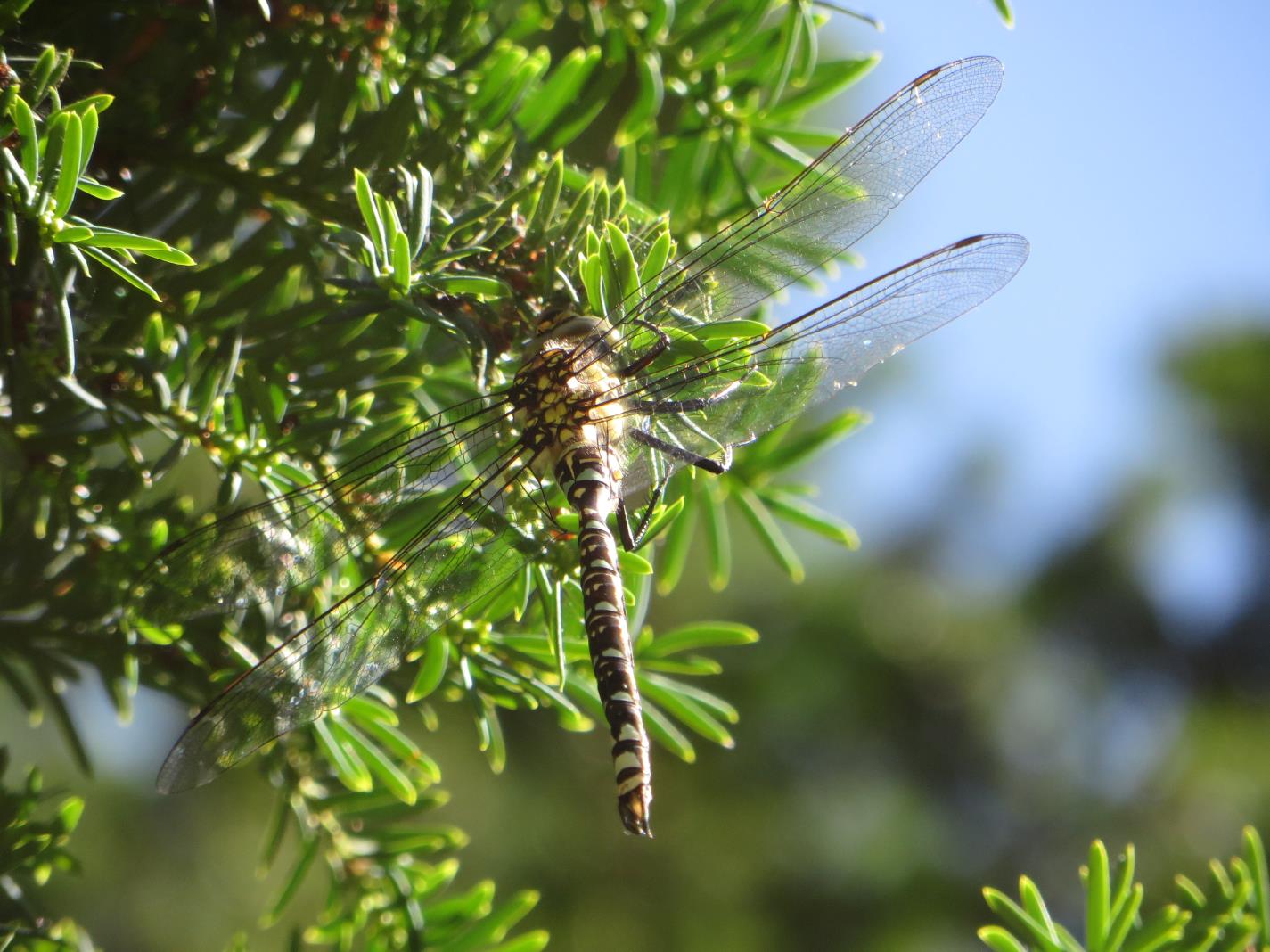
This is a Southern Hawker from 2016 and was seen it in St George’s churchyard, Beckenham.

Southern Hawker on yew, St George’s churchyard Beckenham August 2017
©Carole Tyrrell

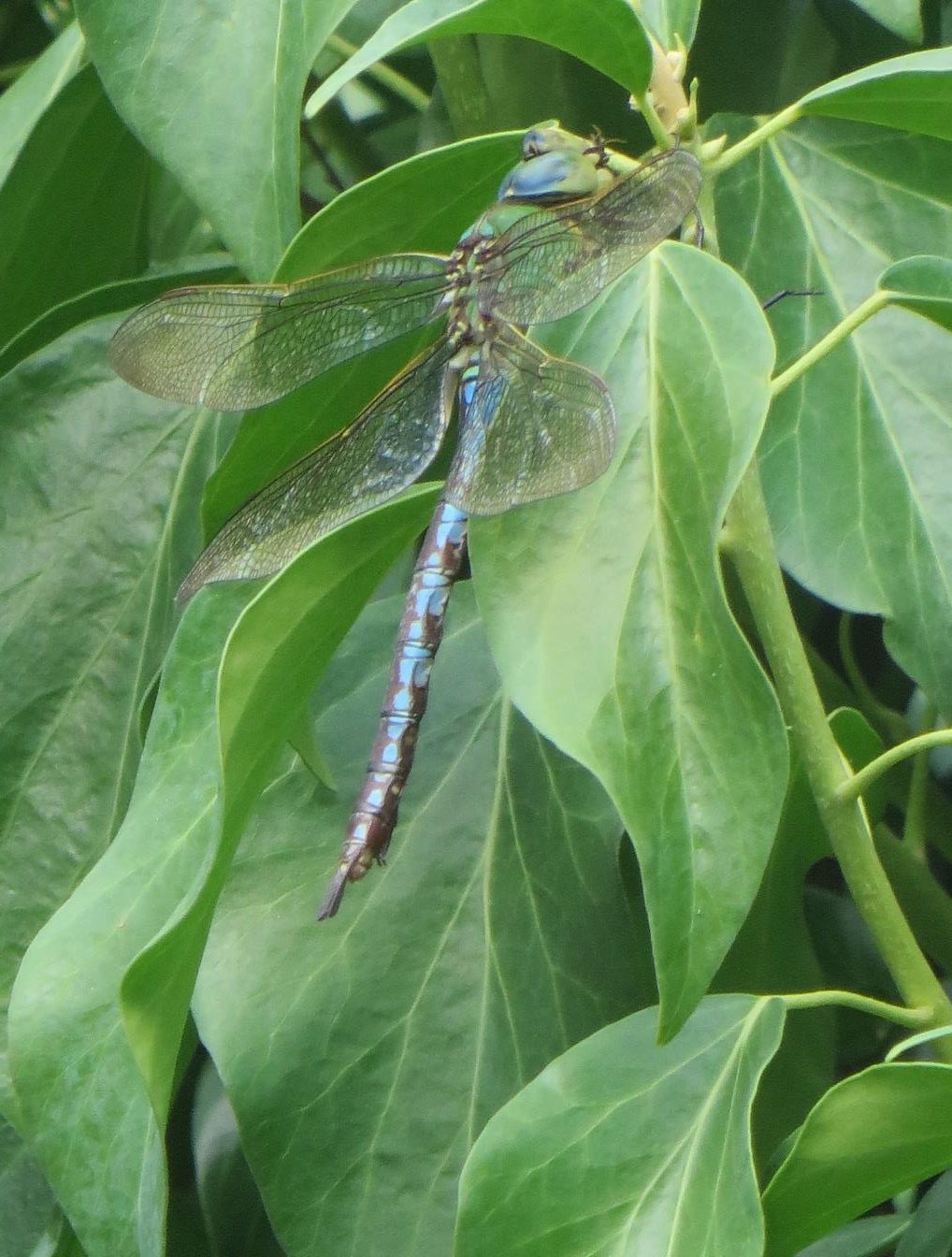
This is a male Emperor from Kensal Green cemetery, London in July 2017. I spotted him/her flying around above The Meadow section which is left uncut around the monuments and tombstones during the summer to encourage wildlife such as butterflies, In some parts it’s very damp underfoot hence the dragonfly I thought. It evaded my attempts to photograph it until, near the entrance as I was leaving, it landed temporarily on an ivy clad monument.

Male Emperor, Kensal Green cemetery July 2017
©Carole Tyrrell

These are two damselflies from Beckenham Cemetery’s Garden of Remembrance pool from July 2017. From July –August it is a magnet for red and azure damselflies.  They look almost like tiny, coloured sticks floating on the breeze and I caught these two ovipositing i.e. laying eggs.  The upright one is laying the eggs and the other is holding it steady.

Damselfiles ovipositing (laying eggs) Beckenham cemetery June 2017
©Carole Tyrrell

Again from St George’s but from 2017, I waited patiently until this beautiful male Southern Hawker landed and helpfully rested on a tombstone.  It stayed there for a few minutes until it got fed up and flew off again.

Male Southern Hawker on tombstone, St George’s churchyard, Beckenham August 2017
©Carole Tyrrell

This is a Common Darter and I saw several over the summer this year in the churchyard. For some reason they were particularly attracted to the pink granite monuments – a cool surface on a hot summer’s day?

Common Darter on pink granite monument, St George’s churchyard Beckenham August 2017
©Carole Tyrrell

I enjoy looking out for them and on one occasion last year the angle at which the dragonfly was perched on a yew branch and the way in which the sun shone through its wings made them look as if they were made from burnished copper.

So do look up when you’re next visiting a cemetery or churchyard on a warm summer’s day and you might be surprised.  I’m looking forward to what the summer of 2018 might bring already!

©Text and photos Carole Tyrrell

Coming attractions – Brompton Restoration walk – 19 July 2017

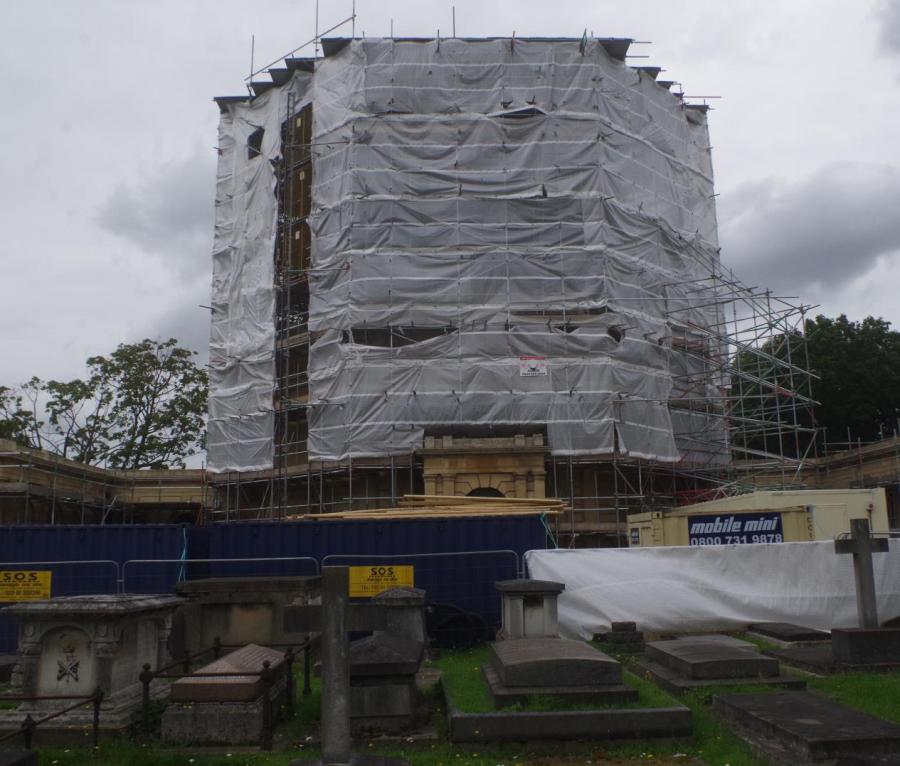
Back view of the chapel swathed in plastic – the East and West wings can be seen flanking it on either side.
©Carole Tyrrell

As part of its major restoration project , Brompton Cemetery held a short series of free walks  around the cemetery last month to discuss future plans.  I joined one which was led by Nigel Thorne, Project Manager and Halima Khanom, Partnership and Community Engagement Officer for the Royal Parks..

The weather had been dull and overcast all day but, as we gathered at the South entrance project office, blue sky suddenly burst through the clouds and it became a lovely golden summer evening bathing the chapel and monuments in a soft glow.  A relief really as we were out in the open throughout. Nigel was very enthusiastic and knowledgeable and began by revealing that Brompton had received an impressive grant of £6.2 of which £4.2 had come from the Heritage Lottery Fund (your £1 lottery ticket does something useful after all even if it doesn’t make you a millionaire) and the rest had come from Parks for People.

He added that he saw cemeteries as another form of public space which I’d not previously considered and an aspect that maybe isn’t emphasised enough.  Brompton is already well used as a cut through with joggers much in evidence and people on the edge of the group huddled in so as not to be entangled with cyclists.

South entrance.

  • This was to be updated. Apparently it hadn’t existed when Brompton had opened and had been just been land owned by British Gas. The ex -assistant cemetery manager’s accommodation and the Friends base  was now the Project Office.
  • Almost opposite was a bijou sized building which had been, of all things, a police box dating from when the Royal Parks had had their own police force. It was now hiding behind a temporary fence.

Monument restoration

  • Nigel stopped by the Robert Coombes monument. This is dedicated to a champion sculler and the upturned boat on top of it with his waterman’s coat draped across it had once had a set of oars attached. These were now long gone and so, sadly, were the heads of the four statues, one at each corner. Cemetery vandals always seem to go for the heads of statues.
  • Nigel revealed that this monument was to be restored at a cost of around £40k. However, although the HLF grant included £140k for monument restoration, a substantial legacy would instead pay for Mr Coombes.  We noticed that there was a tabletop grave very near to Coombes which was being propped up by blocks of wood.

Chapel – mysteries and surprises:

  • Nigel almost shuddered as he related stories of the horrors of 1970’s restoration. ‘They would have been better off leaving it alone!’ he said with feeling. There is a gap between the inner and outer dome which is accessible but a tight squeeze apparently.  A good opportunity I thought , to explore and record areas not normally accessible. It’s envisaged that the Chapel will be open more often once restoration is complete and visitors to a recent art exhibition were very pleased to have an additional opportunity to go inside.
  • There would be a disabled visitors’ ramp at the chapel entrance to increase access.
  • Nigel pointed up at the crumbling Bath Stone visible along the top of the East wing’s roof. ‘Very soft.’ he explained.

Crumbling Bath stone on one of the chapel’s wings.
©Carole Tyrrell

  • Two huge basements had been found under each of the East and West wings. The latter was originally the cemetery supervisor’s office. But there was a surprised in the West wing as there were no stairs making it inaccessible.
  • Another secret had been discovered when investigating the floor. It had always been assumed that it had been made from poured concrete but this was revealed to actually be lino. When that was taken up there was a lovely flagstone floor in a radial pattern – something to see when the chapel is reopened.

Nigel indicated where Brompton’s original owners had run out of money and the lonely cupola above a colonnade marked the spot.

The Western catacombs:

  • These were never used as catacombs but they form part of the boundary walls facing onto the rail and tube line. A gated and blocked entrance at either end still remains with a far grander one in the centre. Originally it had a promenade over the top on which visitors could walk and admire the fields and canal on the other side but these are obviously long gone. Parts of the promenade still remain but I wouldn’t fancy walking on it now. Some of the wall is now supported by buttresses and one end of the catacombs is now in the new Horticultural team’s area.
  • When opened the catacombs were found to full of spoil which took a year to dig out. This had to be done as it was pushing out the wall that faced onto the railway line.

Improved paths and access

  • Nigel told us that all of Brompton’s current paths are made of tarmac. This leads to a uniformity of paths that can be confusing for a visually impaired visitor. As a result, one blind woman had no idea where she was in Brompton. It was now hoped to have a hierarchy of paths to counteract this.

Cemetery maintenance:

  • We paused by a rampant area of long grass and wildflowers (or weeds depending on your point of view). Nigel commented that the area needed a tidy up and that grave owners in the area had been given Brompton’s policy and their obligations at the time of burial – no vertical tombstones or planting.
  • A perennial problem was the planting of small trees and shrubs on graves which are now huge. According to Nigel they reduce light and space as well as damaging and obscuring memorials and monuments. He indicated a somewhat spindly rose bush which looked very untended.
  • A huge laurel plant had had its lower branches lopped but regrowth had already started. There was a monument just underneath it which we could hardly see. I found others examples such as the Mary King grave by the chapel.

Wildlife:

  • There’s a debate between those who like cemetery to look messy to encourage wildlife and those who don’t. I personally like wild areas to encourage this as Brompton is known for its large crow population and I’ve disturbed the odd sunbathing fox.  The large bramble stands, in Nigel’s opinion, were of benefit only to the foxes as hiding places.

Garden of Remembrance:

  • The tall hedges surrounding it are to be reduced in size as they encourage anti-social behaviour.  Visitors can buy a 1m memorial tablet under which up to 4 urns can be buried.

Visitors café and centre:

  • Work on the visitors centre and café is well on schedule – I’ve been pleasantly surprised by the speed at which they are being built.  Nigel added that the café was intended to be a social enterprise and not another outpost of one of the chains. It would be staffed by local people and use local produce (blackberry jam anyone?).  The visitors centre opposite had all sorts of exciting plans such as allowing visitors access to Brompton’s records of the 200k people buried within it.

A fascinating walk – our thanks to Nigel and Halima – which covered not only Brompton’s ambitious restoration plans but also some of the problems of cemetery maintenance and restoration.


Wildlife in Cemeteries no 6 – a summer Sunday saunter

A wonderful and colourful display of hollyhocks over a grave in a clearing behind the Anglican chapel at Kensal Green Cemetery.
©Carole Tyrrell

Summer is when you can really appreciate the wild corners and places within cemeteries.  Often spaces between tombstones and monuments will be left unmown or unscythed which allows grasses to grow tall.  The rapidly expanding bramble stands are good hiding places for foxes to hide in or use to travel between.   Already ripe, plump blackberries are dessert for hungry birds and jam makers.

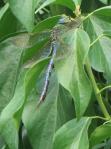
Wildflowers begin to stud the grass and undergrowth with bright dots of colour as they bud and begin to flower under the summer sun’s rays.  These create dazzling combinations of colour as they grow together. At Kensal Green one area near the closed catacomb terrace is designated as a meadow.  I stood inside it in early July of this year, almost waist high in grass and flowers,  surrounded by flitting butterflies and day flying moths, leaping grasshoppers and even a large blue Emperor dragonfly.  The latter was a complete surprise.  There was even a pair of courting Small White butterflies as well.  I just felt so happy to be there with the sun on my face and nature getting on with itself regardless of me.

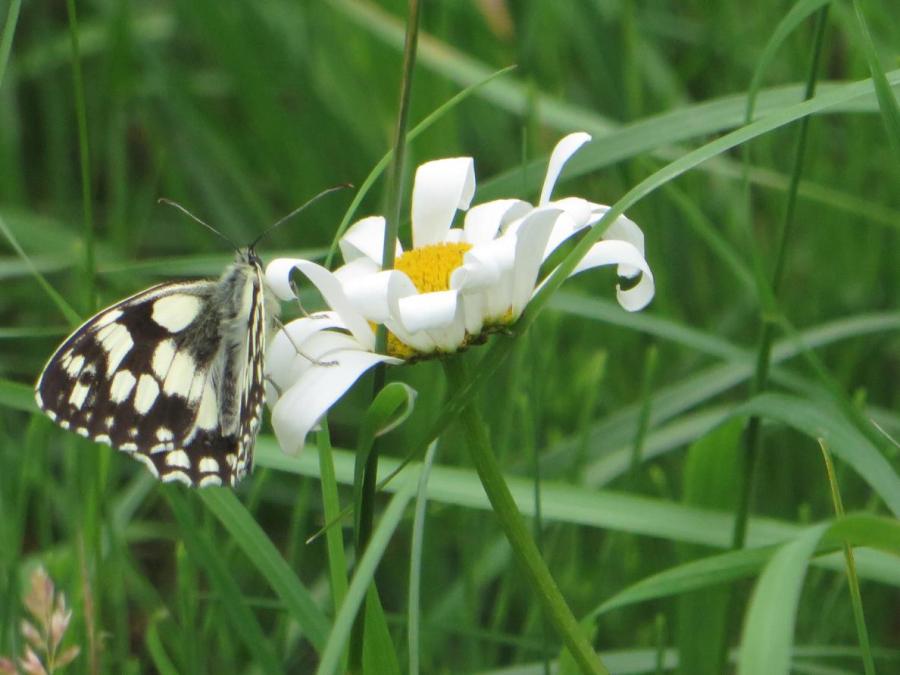
Ragwort, a bright yellow plant which is rampant at the moment, divides opinion in some quarters. It  has been described as a weed and a wildflower.  Butterflies love it but it’s poisonous to cattle and horses.  I counted 8 Gatekeepers on one Ragwort flower head munching away quite contentedly.  The cemeteries that I explored teamed with wildlife and sometimes unusual or uncommon specimens.

I am a Citizen Scientist (not the most catchiest of titles I must admit and it sounds somewhat po-faced)which means that I go about recording wildlife and what I see on my urban ramblings for various websites including irecord and the LondonButterflyProject. Cemeteries are highly recommended by the latter organisation as great places in which to find butterflies and now, I go to a cemetery or graveyard first, in order to do my count.

So here’s a gallery of what you might find on a sunny afternoon wander through a marble orchard.

NB: Be careful and take care if walking through or exploring areas of long grass and wildflowers as monuments can be camouflaged by them. So wear appropriate footwear – not flips-flops – and watch out for kerbstones and the edges of graves so that you don’t trip over them. Also, due to subsidence monuments can also be at odd angles so again take care.

©Photos and text Carole Tyrrell

©Photos and text Carole Tyrrell

Cosy cats and an Egyptian deity of the underworld – creating the Brompton Cemetery animal app.

Cemeteries are often great places to find wildlife. If you’re lucky you might see a bright little robin or blue tit flitting amongst the memorials as well as foxes, cats  and the odd dog out for a walk with his owner. The beginning of summer also heralds the arrival of insects such as butterflies and grasshoppers.

But app designer, Simon Edwards and I, were exploring Brompton Cemetery to find animals of the stone or granite variety either carved or perched onto tombstones.  Simon, a GP by trade, had the same enthusiasm as me and we began near the chapel.


The weather couldn’t have been better and my way down to meet Simon I saw a Great Spotted Woodpecker land on a memorial and then take off again before I could get my camera out.   I had a few suggestions as to where we might find some interesting examples and Simon already had some on his phone and so we began.  We also included insects and birds. However once you start looking for carved wildlife it suddenly catches your eye whereas you might not have noticed it before.   The afternoon became a treasure hunt as we found cats, a polar bear, a butterfly and a carving of an Egyptian deity amongst others. If you want to find out how many we found you will have to try the app at: https://ticl.me/West-Brompton/headlines/13317/view


However the most popular animal motif was undoubtedly the dove.  They were everywhere – both in 2D and 3D versions whether portrayed flying downwards or perched on a cross until eventually we decided that we were both ‘doved-out’.  Undoubtedly the best ones were the one on Susannah Smellie’s memorial near the chapel and the one on the headstone dedicated to a 6 month old baby near Hannah Courtoy’s  imposing mausoleum.

The app is intended to give you a pleasant way of spending an afternoon exploring the cemetery and finding the graves on which they are and perhaps wondering more about the people who chose them.  Don’t forget to let Simon or me know if you find any that we’ve missed!

© Text and images Carole Tyrrell