A Spring saunter in the footsteps of E Nesbit – Romney Marshes, Kent Part 1- Man size in Marble

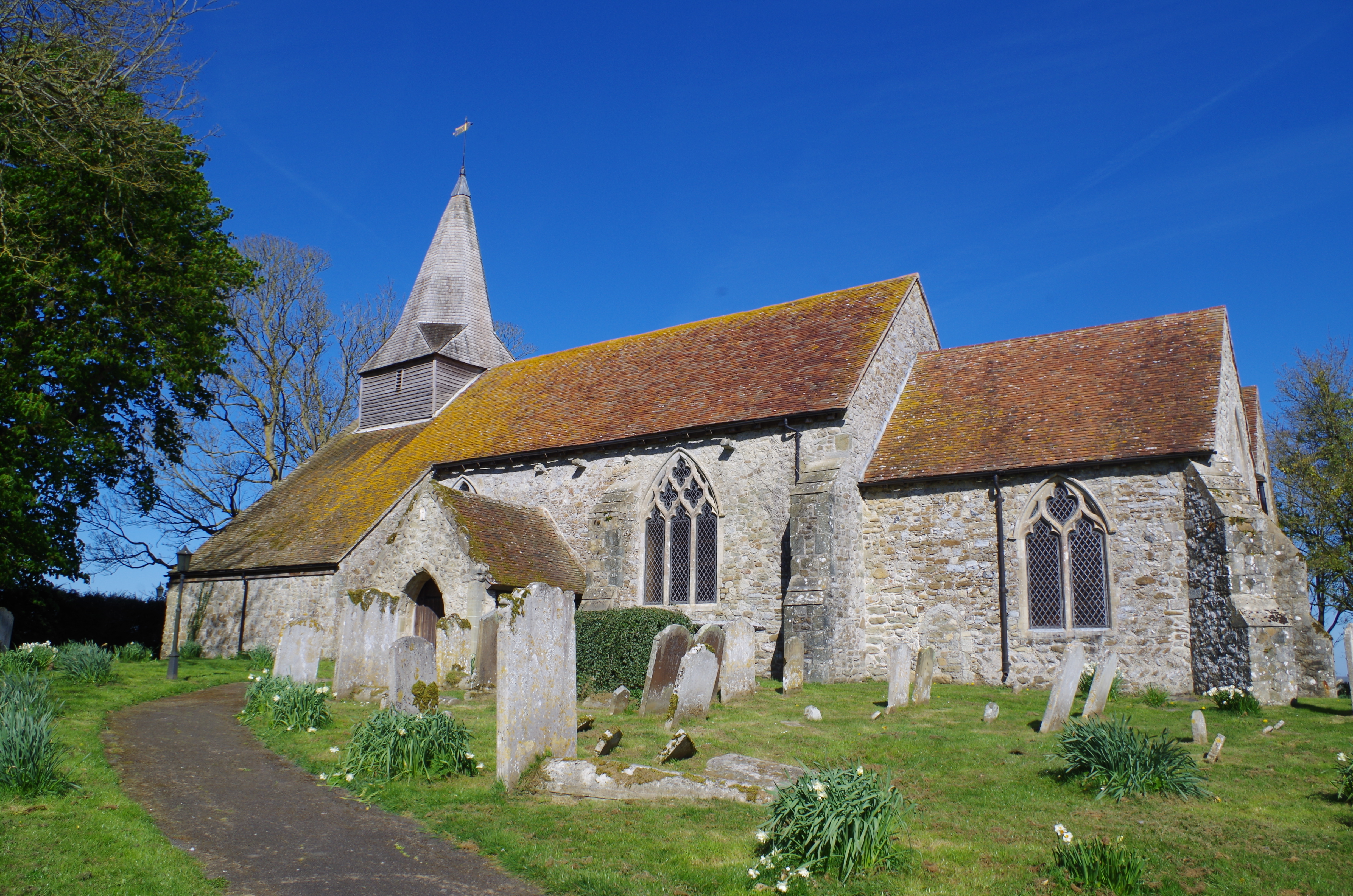
St Eanswith, Brenzett © Carole Tyrrell

The churches of the Romney Marshes are isolated and you’ll need your own transport to visit them. But there are hamlets and villages here and there and I could imagine how it must feel in mid-winter with dark short nights.

However it has long been one of my ambitions to explore the churches that are on the marshes. So when I was offered the chance I didn’t hesitate.  It was a wonderful Spring day, sunny and bright, and we were all eager to explore the Marshes.

Our first church was St Eanswith in Brenzett. This was a plain little church with a candlesnuffer steeple on top of a small slope and was surrounded by a small churchyard dotted with daffodils. There was an azure blue sky and a hare was spotted racing across a bare field at the back of the church. It’s one of the smallest churches on the Marshes and is dedicated to a 7th Saxon princess who founded a nunnery in Folkestone in 630AD. There is now nothing left of the Saxon building and the present church can only be dated back to the 12th century when the Normans rebuilt it.
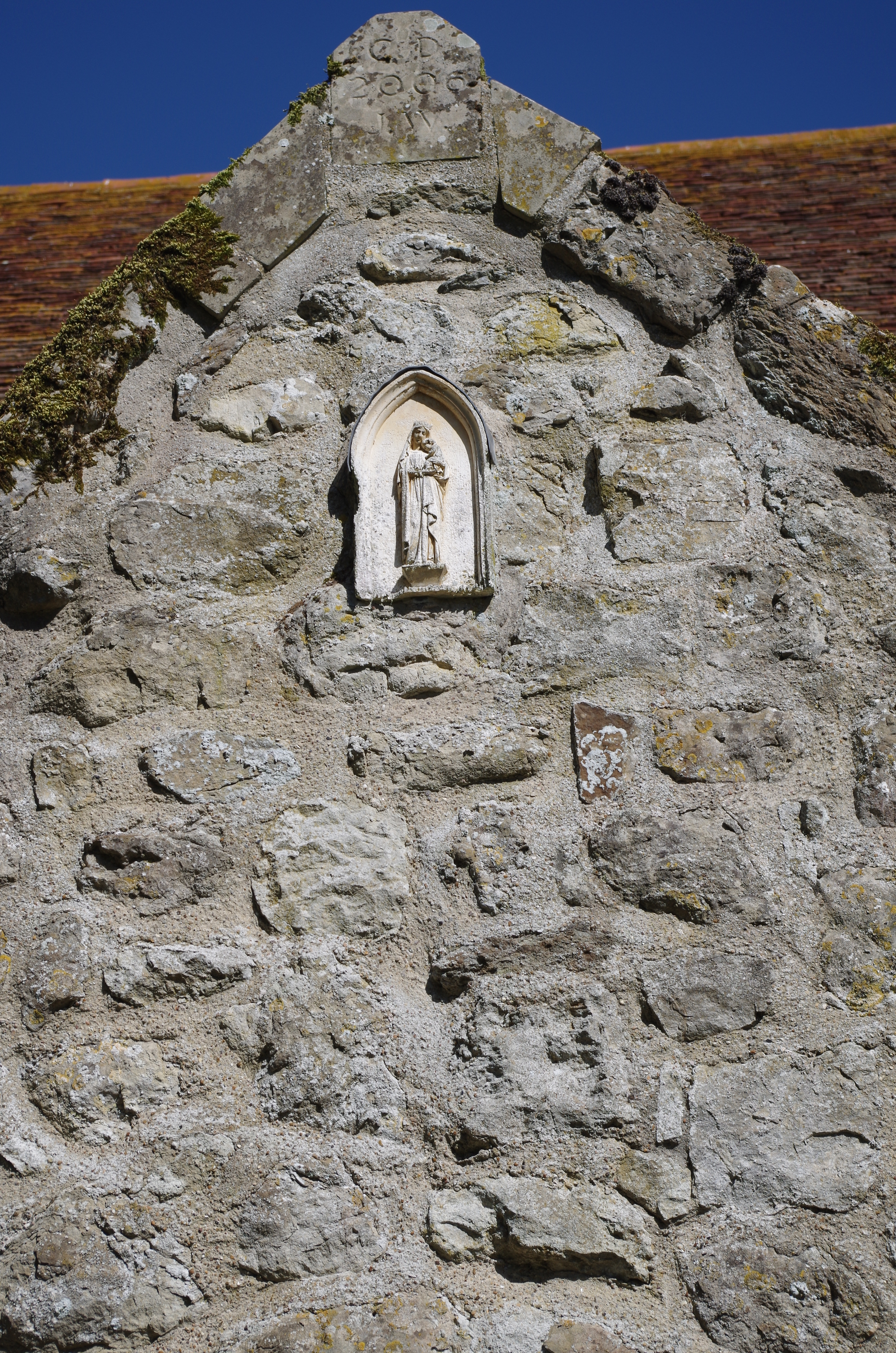
A small statue of St Eanswith over the top of the porch. © Carole Tyrrell

A large Maine Coon cat, who was obviously returning from a night out through the churchyard to its home in the little straggle of houses nearby, caught sight of us and tried to hide by running from patch after patch of daffodils. Then its owner came out of the house that it ran into with another Maine Coon cat!

Hide and seek © Carole Tyrrell

Inside St Eanswith it was plain, with white washed walls and dark wood pews. The pulpit had a raised roof panel which I’d not seen before and at the altar end of the church was the table tomb that we had come to see. This was the Fagge monument and is the only monument in the church. It is dedicated to a father and son, both confusingly called John, and it is a pair of alabaster sculptures of two men in fashionable 17th century clothes. The man in the foreground is portrayed as lying on his back on a sculpted cushion with his left hand on his chest while the man behind is lying on his elbow with his right hand under his chin and his left hand on his left leg. There are visible cracks and damage with repairs which you would expect over the centuries. They are beautifully sculpted. There are small coats of arms beneath the figures at corners which bring a small splash of colour. John Fagge the elder died in 1639 and his son and heir died in 1646.
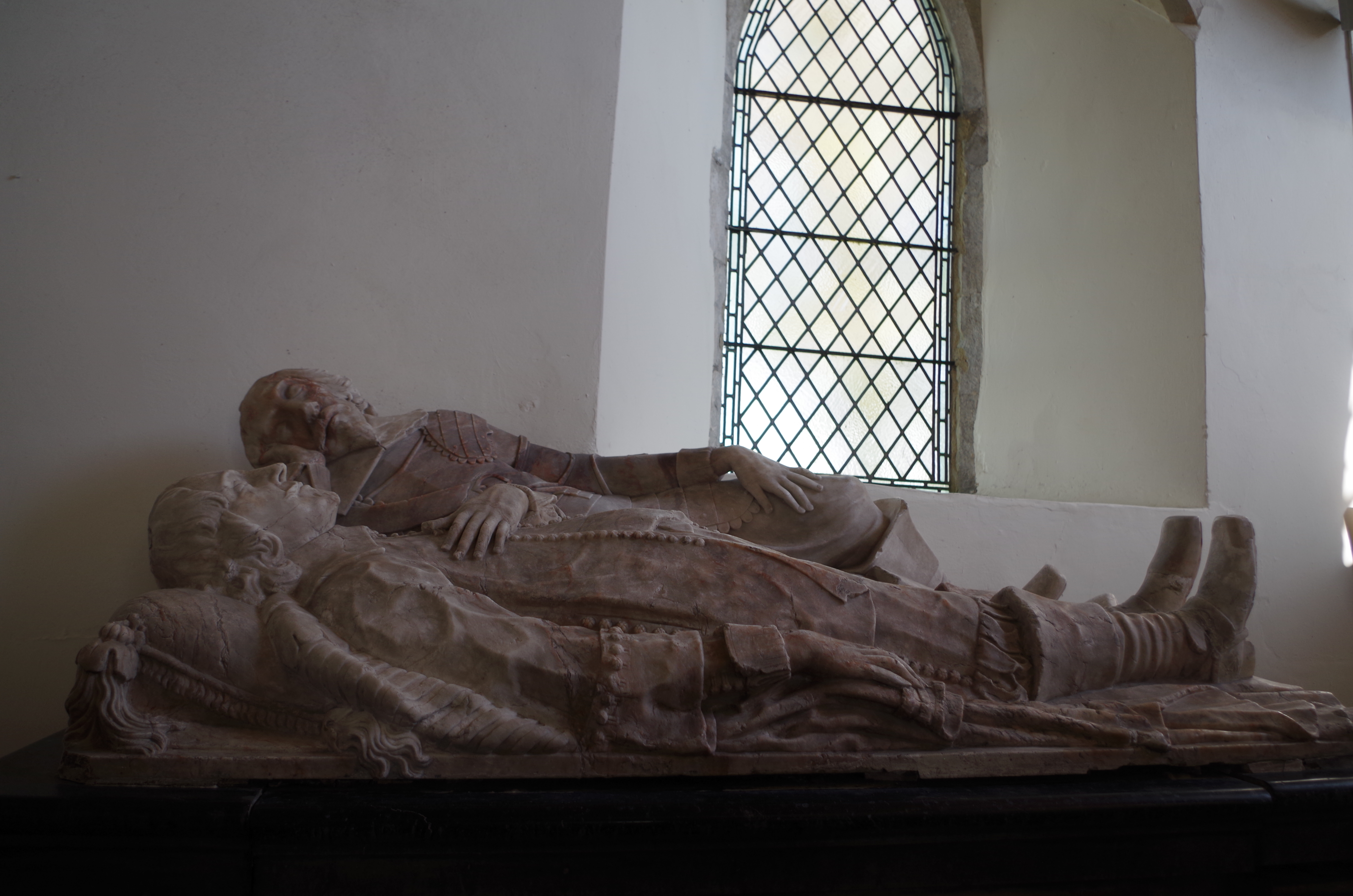
The Fagge monument, St Eanswith. © Carole Tyrrell
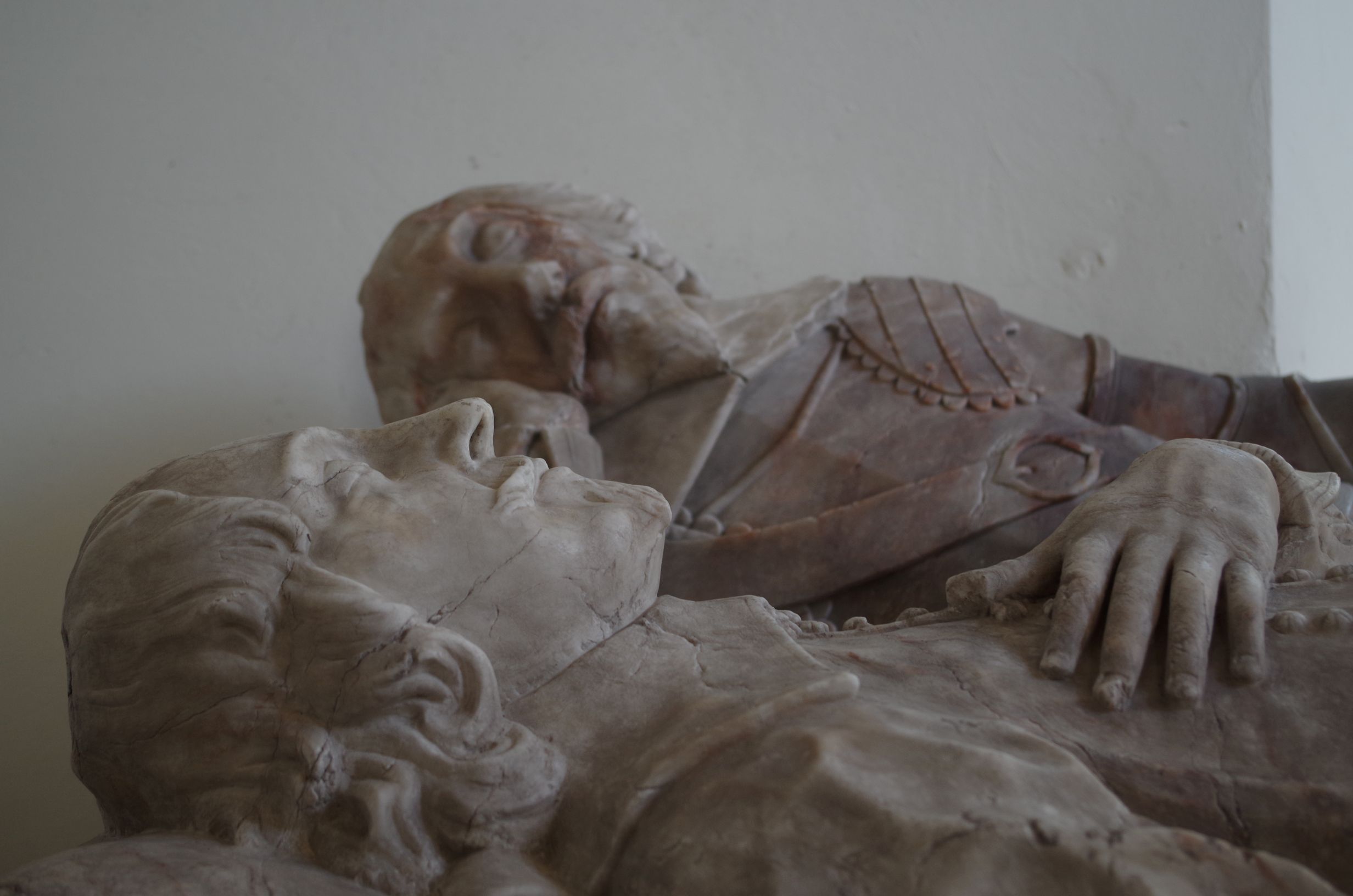
Close up of the Fagge monument. © Carole Tyrrell

Close up of hands showing the ravages of time. © Carole Tyrrell

Epitaph to the Fagges and one of their coat of arms.© Carole Tyrrell

This is the monument that inspired one of E Nesbit’s most famous stories, ‘Man Size in Marble’ which was adapted by Mark Gatiss for the 2024 BBC Christmas ghost story and retitled ‘the Stone Woman’.  A young married couple have moved to the country and their housekeeper tells them of a certain night when something walks from a local church to their house. They take no notice of this but when the husband is called away and leaves his wife alone in the house….you can read the story here:  The Project Gutenberg ebook of Grim Tales, by E. Nesbit.

This is English folk horror clashing with modern reasoning and belief. Nesbit creates the dark countryside so well and also the central characters incredulity at what they are being told. They are still in love with endearments such as ‘wifie’ and ‘dearest’ which makes the ominous events that are about to happen all the more shocking.
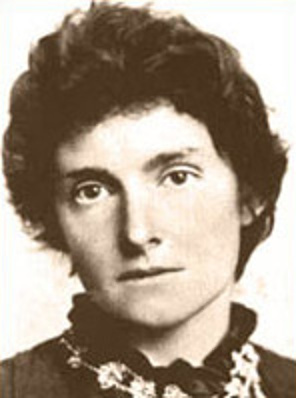
E Nesbit c. 1890 Shared under Wiki Commons

E Nesbit (1858-1924)  is most known for ‘The Railway Children’ which was first published in 1905 and has never been out of print. It was also a classic and well loved childrens film. Some of her other children’s stories have also been adapted for TV.  But she also wrote ghost stories, some of which were recently published by Handheld Press in the collection ‘The House of Silence.’

She was only 4 when her father, an agricultural chemist, died. Edith’s sister, Mary, suffered from ill health and as a result the family travelled in the UK and France. She died in 1871 of tuberculosis after becoming engaged to the poet Phillip Bourke Marston.  After Mary’s death, Edith and her mother lived in Halstead Hall, Halstead in Kent which is considered to be a possible location for ‘The Railway Children’.  When she was 17 they moved to Elswick Road in Lewisham. 

She married Hubert Bland on 22 April 1880. They met when she was aged 18 and at 21 and 7 months pregnant they tied the knot. It was a difficult marriage to say the least as he was always being unfaithful. Edith had 3 children by him and adopted 2 more from one of his long term affairs. It was a complicated family.  She and Hubert were both fervent socialists and joined the Fabian Society, jointly editing its journal ‘Today.’ But this work often took second place to Edith’s writing as she became more successful. The Fabian Society ultimately became part of the Labour party.

From 1899-1920 she lived at Well Hall Eltham. The house is long gone but the garden remains as a public park. She also had a second home at Crowlink, Friston, East Sussex when she entertained.

Bland died in 1918 and she married her second husband, Thomas ‘the Skipper’ Tucker in Woolwich where he was the captain of the Ferry.  They both lived at St Mary’s Bay, Dymchurch at their house ‘The Jolly Boat’ where she died on 4 May 1924. It may have been from lung cancer as she was a great smoker.  Tommy died at the same address on 17 May 1935. To read more about Edith and her life please visit: https://edithnesbit.co.uk

It was such a privilege to see the Fagge monument in the flesh so to speak and also a writer’s inspiration. I could easily imagine Brenzett on a winter’s night, the little terrace of houses with their curtains drawn and lights out as something stirs and moves within the small church and suddenly the top of the tomb is empty and something that shouldn’t be is walking…..

A Spring Saunter in the footsteps of E Nesbit Part 2 her late life on the Marshes

© Carole Tyrrell photos and text unless otherwise stated

Brenzett, Church of St Eanswith — Romney Marsh Historic Churches Trust

St Eanswith’s Church, Brenzett, Kent

The Project Gutenberg ebook of Grim Tales, by E. Nesbit.

https://edithnesbit.co.uk  The Edith Nesbit Society

E. Nesbit – Wikipedia

Epitaph Exploring in East Anglia! The Great Churchyard in Bury St Edmunds

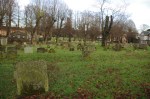
The Great Churchyard in Bury St Edmunds is big. Very big and forms a useful shortcut for the locals from an uninspiring car park (aren’t they all I hear you say) to Honey Hill. But the Great Churchyard is steeped in history and, according to a volunteer in nearby St Mary’s church, some of its pathways date back to Saxon times.  The church sits perched further up the hill and so looks  down and over the churchyard’s permanent residents.

St Mary’s and its elongated shape overlooking its part of the Great Churchyard.
©Carole Tyrrell

I came upon the Great Churchyard by chance on a day trip in 2006 while exploring the extensive Abbey ruins.  The Abbey’s ruins have eroded into strange shapes over the centuries and now look like lumpy fingers pointing accusingly at the sky.  But after Henry VIII dissolved the Abbey in 1539, much of its flint and mortar has been ‘recycled’  by the locals and can be seen in walls and nearby houses.   But it was the Churchyard’s memorable epitaphs that stayed  with me and so on a bright December day last year I returned.

There is a plethora of 18th century symbols on display: skull and crossbones, winged angels, open books and one memorial had its own duvet of moss on the coffin lid shaped top.

As I explored, I found this tombstone  and remembered that M R James had written  a book on the Abbey’s history. Ann Clarke is the name of the unfortunate character in his story ‘Martin’s Close. I did wonder if this was his inspiration……

An M R James connection? The Great Churchyard.
©Carole Tyrrell

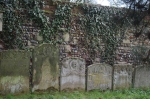
But the real jewel of the Churchyard is undoubtedly the 13th century roofless Charnel House.  A rare survivor and its flint walls were lucky not to have suffered the same fate as the Abbey’s.  The Charnel House was where all the disinterred bones from the Churchyard were stored.  It’s empty now and is protected by iron railings.   The Charnel House  now acts as a roost for birds and also as a backdrop or gallery for the epitaphs that I remembered from 2006.


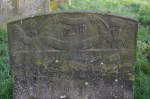
Amongst the collection are two 17th century tombstones placed on the walls. One is illegible although the symbols are still clear and the other is to a Sarah Worton, wife of Edward.  Under the epitaph is the verse:

Good people all as you

Pas by looked round

See how Corpes de lye

For as you are from time ware we

And as we were f(s)o must you be.

If you take a closer look you can see how the mason had to slightly squash the letters to get all the words in.

But there  are 4 significant epitaphs on the Charnel House walls and these are  dedicated to the good, the bad and the just plain unlucky.

Firstly, the unlucky……..

Henry Cockton (1807 – 1853)

Engraving of Henry Cockton from 1841 by James Warren Childe (1780 – 1862)
Shared under Wiki Creative Commons

No. I’d never heard of him either until I started researching this post.  This is not a name widely known today although his first and most successful novel, ‘The Life and Adventures of Valentine Vox the Ventriloquist ‘ is still available from various online booksellers.  Note the symbol of a blank scroll of paper and  quill pen above the epitaph which is the sign of a writer.

According to Wikipedia. Cockton was born in Shoreditch but ended up working in Bury St Edmunds where he married a local girl whose family were involved in the local pub trade. They had two children, Eleanor and Edward.  As we shall see alliteration was a theme of Henry’s life.  Valentine Vox  was a largely comic novel about a man who teaches himslef ventriloquism  and the jolly japes that ensue from this. It also involved social issues as, at one point,  the hero is incarcerated  in a private lunatic asylum and in the book’s preface Cockton rails against these places. Valentine Vox was a huge success and sold over 400, 000 copies and was published, like Dickens, in serial form.  After this Cockton should have gone onto greater things but he was destined never to make any money from his writing. Editors cheated him, publishers went out of business and  he was imprisoned for debt after being declared bankrupt.  In 1843 he wrote ‘Sylvester Sound, the Sonanambulist’ which was about a sleepwalker who performed daring feats during his sleep but it didn’t enjoy the success of its predecessor – see what I mean about alliteration?

But he kept on writing until 1845 when he announced to his readers that The Love Match would be his final novel.  Unfortunately bad luck continued to dog him – he was like King Midas in reverse as the song goes –  everything he touched turned to mud. He stood surety for his brother who thanked him by fleeing to Australia and a speculative malting venture collapsed and ruined him.  He and his family moved into his mother-in-law’s house and he wrote a further 3 unsuccessful novels.  Sadly, aged 46, he died of consumption and 4 days later was buried in an unmarked grave in the town churchyard without any obituaries.  Its exact location is still unknown.  The plaque was put up by admirers and friends.

Henry’s widow petitioned the Royal Literary Fund for financial assistance and in 1856 a local paper printed another appeal for his family. But Valentine Vox, his most successful novel. has enjoyed a life beyond its creator. Jack Riley, a performer and writer on ventriloquism uses it as his stage name and Chris Jagger’s 1974 album also borrowed it.   So a tragedy all round?  It certainly was for Henry but not so much for his family…….

While researching online  I found a blog on which there was a lively dialogue between the blogger and respondents who claimed to be Henry’s descendants.  According to them, Henry’s widow remarried, Eleanor became a teacher and Edward eventually became Professor of Music at the Greenwich Royal Naval College.

And the the victim of a somewhat unkind Act of God……

Mary Haselton (1776-1785)

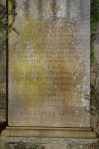
This fulsome eptaph is dedeicated to the unfortunate Mary Haselton who, in 1785, was struck by lightning while saying her prayers. There was virtually nothing about her online but I may contact the town’s Local Studies department. The epitaph reads:

Here lies interred the Body

MARY HASELTON

A Young Maiden of this Town

Born of Roman Catholic Parents

And Virtuously brought up

Who being in the Act of Prayer

Repeating her Vespers

Was instantaneously killed by a flash

Of lightning August the 16 1785

Aged 9 years

Not Silom’ (?) ruinous tower the Vicoms slew

Because above the many sinn’d  the few

Nor here the fated lightning wreak its rage

Its Vengeance sent for crimes manned by age

For while the Thunder’s awful voice was heard

The little supplicant with its hand upraised

Answered her God in prayers the Priest had taught

His mercy (?) and his protection sought

The last 4 lines are unreadable even on Zoom view.  But it’s an amazing piece of verse and the mason who carved it really earned his money if he was paid by the letter.

It’s interesting that Mary’s parents religion is so openly stated. There had been a relaxing of attitudes towards Catholics in the 18th century despite the 1780 anti-Catholic Gordon Riots.

However there’s no way of knowing Mary’s actual burial place within the Great Cemetery but her memorial is in safekeeping on the wall of the Charnel House.


Part 2: The good and the bad…a Founding Father and a notorious crime.

 ©Text and photos Carole Tyrrell unless otherwise stated. 

 Further reading and references.


 https://bradspurgeon.com/brads-rejected-writings/impeccable-intuition-robertson-davies-on-henry-cockton/


https://en.wikipedia.org/wiki/Henry_Cockton

https://www.buryfreepress.co.uk/news/hidden-treasures-brought-into-view-1-399134