

Copyright Carole Tyrrell
I visited Wrest Park on a beautiful summers’ day and it is one of the most beautiful stately homes and gardens that I’ve visited. Located at Silsoe, near Luton in Bedfordshire, its 90 acres of formal gardens are impressive and contain features such as the elegant Long Water and the Chinese Bridge.
For over 600 years it belonged to the de Grey family. It was Edward IV (1461-83) who made Edmund Grey the first Earl of Kent. The formal gardens and Long Water were created during the 18th century by Annabel Benn with the 11th Earl of Kent, her son Anthony, and his wife Mary. These were all the rage at the time and the celebrated Capability Brown, amongst others, helped design them.
In the 1830’s, Thomas Earl de Grey, a keen amateur architect decided to rebuild the house in the fashionable French style but retained the garden layout instead of replacing it with the style of the day. He later became the first President of the Royal Institute of British Architects or RIBA. Since 1900, like most stately homes and country houses, Wrest has had mixed fortunes. It was sold in 1917 and in 1948 became the National Institute of Agricultural Engineering and later the Silsoe Research Institute. Historic England, previously English Heritage, now own Wrest Park and have embarked on a 20 year restoration programme of the house and grounds.
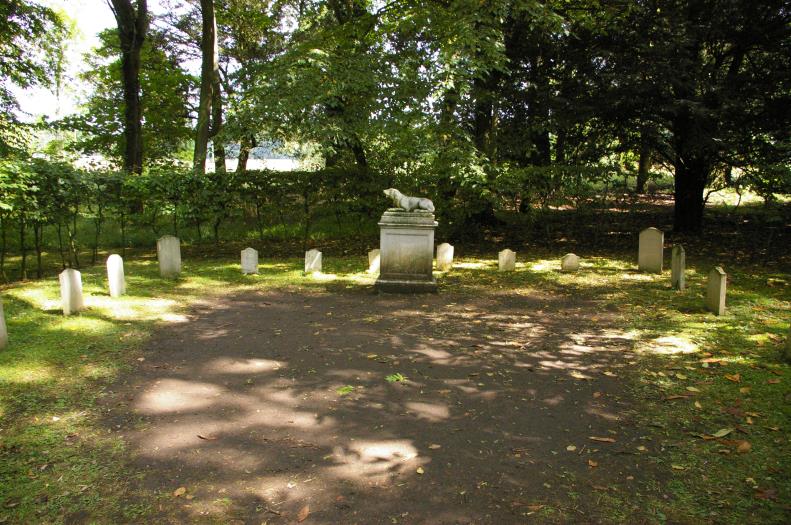
The de Grey family’s dogs’ cemetery is a distance from the house and near the Long Water. A grassed pathway bordered on each side by saplings leads you to a secluded glade. A statue of a dog, the Dog Monument, made from Ketton stone rests on a stone pedestal surrounded by 16 headstones. They are no longer in their original positions and the cemetery was officially Grade II listed on 10 January 1985.
copyright Carole Tyrrell
According to the guidebook, the area was first recorded on a 1735 surveyor’s plan of the gardens. It was a square clearing at the end of a straight path leading from the Lady Duchess’s Walk. The cemetery itself dates from 1829 when Earl Grantham, later to become Earl de Grey, erected the Dog Monument. The headstones date from 1830-1860 and the dogs commemorated are:
Douban who died 24/11/1876 aged 17
Freuah who died in 1878 aged 10 and belonged to Countess Cowper
Una who died in 1891 and was the favourite dog of Lady Florence Cowper
Little Dick – the favourite dog of Lady Amabel Cowper
Lancey who died in 1875
Busy
Fury
Dorrock
Phedra
Tiger
Nissy who died in 1816
Kelpie
Tottie who was a favourite dog
Dandy
Petsy
Pet – a favourite dog
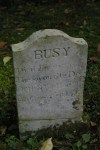
The de Grey family’s love of their dogs can be seen in an 1865 photograph in the guide book. Lady Amabel Cowper, the youngest daughter of Anne Florence, dowager Countess Cowper is standing on the terrace at Wrest with three of the family’s dogs who look like terriers. One dog is obediently posing, lying at her feet, another is on his hind legs with his back to the camera looking up at her and a third, a small dog, is perched on her shoulder. I did wonder if the one on her shoulder was Little Dick whose headstone records that he was her favourite dog. Some of the stones are now partly illegible but the cemetery is still a poignant place to visit. Two of the dogs, Dandy and Little Dick, are further commemorated as statues on two sculptures of the de Grey children.
However, dog cemeteries weren’t a Victorian invention. Instead they date back to the ancient Egyptians who created vast cemeteries containing 1000’s of mummified dogs. These were linked to the cult of the jackal headed deity Anubis. He was the god of embalming and the guide of the dead. The City of Dogs was known as Hardai or Cynopolis to the Greeks. The early Chinese emperors also established a palatial canine necropolis near Beijing in which the marble tombs were lavishly decorated with precious stones and metals such as gold and lapis lazuli. It makes the Victorian version look very modest in comparison. However, dog cemeteries were also seen as symbols of oppression by Russian Communists who denounced them. According to them, the ruling classes were lavishing money on these while their workers starved.
Dog cemeteries were most popular during the 19th century once Queen Victoria had established one at Osborne House on the Isle of Wight. You can still find them at these houses:
Glamis Castle, Scotland
Haddo House, Aberdeenshire
Himley Hall, Stourton
Polesden Lacey, Great Bookham, Surrey
Mottisfont Abbey, Hampshire
Sandringham, Norfolk (where the Queen buries her corgis)
There may be others out there – I’ll have fun looking for them – but this is what I found on a quick look round the web.
Whatever your opinion of dog or pet cemeteries, I’ve always found them very touching. The incumbents were obviously much loved and someone missed them enough to erect a stone in their memory and to record their passing. RIP little ones you are not forgotten.
Sources:
Wrest Park guidebook, English Heritage, 2011
http://www.georgianindex.net/dogs/dogs.html
https://www.history.org/Foundation/journal/Autumn04/dogs.cfm
https://uk.pinterest.com/gravedetective/pet-cemetery/
http://www.waymarking.com/waymarks/WM9DM0_Dog_Cemetery_Wrest_Park_Silsoe_Bedfordshire_UK
copyright and photos Carole Tyrrell
 shadows fly away
Oh, how sweet to have such a lovely place for your dogs! And they are like family to most of us. I have a friend who has cremated four of her five dogs and keeps their ashes in urns. Very interesting facts about dog cemeteries. Thanks for the links!
LikeLike
Hi there Coastal Crone
I think that the dog cemetery shows how important their pets were to the family. It was a shame that I couldn’t reproduce the photograph of Lady Amabel Cowper with her three little dogs and I couldn’t find it on the web. There is a good page on pinterest on pet cemeteries and that pointed me to some more.
LikeLike
Park Cemetery, Bloomington, IL, USA has a section for pets with a tall monument labelled “Our Companions.” It is a public cemetery and the pet addition is about 30 years old.
Also, Arlington Cemetery, Rockford, IL has a section for pets and a pet crematorium.
Our decision is that our pets’ cremains will be placed in the casket of whoever dies last, along with the cremains of whoever dies first. In CA, where we live, the only requirement for me to be put in Hubby’s casket-sized niche in the Mausoleum is that my name must appear on the marker (I have a terminal blood cancer, multiple myeloma, and will probably die first). We have nine deceased pets in urns and one living. All were rescued or inherited, and loved. We promised them we would care for them forever.
LikeLike
Dear Nicholas
Thank you for your comment and I apologise for the delay in replying.
I wasn’t aware that some US cemeteries have sections for pets and pet crematoriums so thank you for letting me know. I have heard of the Hartsdale pet cemetery which has had over 70,000 burials within it. Over here the pet cemeteries are only for pets or are family pet burial areas in the grounds of big stately houses. The Hyde Park pets cemetery in central London is quite a sight to see with so many tiny headstones in such a small space.
It’s very sensible of you to have already decided what will happen to your pets when you both pass on and I am sorry to hear of your health problems. I also have my pets in little wooden boxes and they travel with me whenever I move house. I have had to leave 2 behind buried in gardens and I hope they will be safe. Mine were all inherited and rescued and yes I also promised to take care of them for life and beyond.
Many thanks for getting in contact.
Best wishes
Carole
LikeLike