
Copyright Carole Tyrrell
I found this month’s symbol while exploring the churchyard of St Margaret’s church in Lee, South East London. This is a large Victorian church with some lovely stained glass and, more unusually, wall paintings. These are Pre-Raphaelite in style and well worth seeing if you’re in the area. The church is open on the 1st Saturday of every month 10.30am to 4.30pm. There are also windows created from broken pieces of stained glass, like a jigsaw, and which create kaleidoscope patterns on the floor when the sun shines through.
But St Margaret’s is a church in two halves. Across the road is the ruined, older church. It was not constructed well and fell down eventually. What was left was mostly demolished in 1813 and only the ruined west tower remains. This is surrounded by 18th century headstones which include no less than three Astronomers Royal. They are Nathaniel Bliss, John Pond and Edmond Halley (1674-1742) who computed the orbit of Halley’s Comet. They all keep company with, amongst others, a parachutist that fell to earth and a Restoration actress. There is also a poignant grave of a mother and her infant child. An interpretation board by the entrance lets visitor know who is buried where in the churchyard. The churchyard is English Heritage listed and , due to restoration, is open by appointment only. Enquiries via: office@stmargaretslee.org.uk.
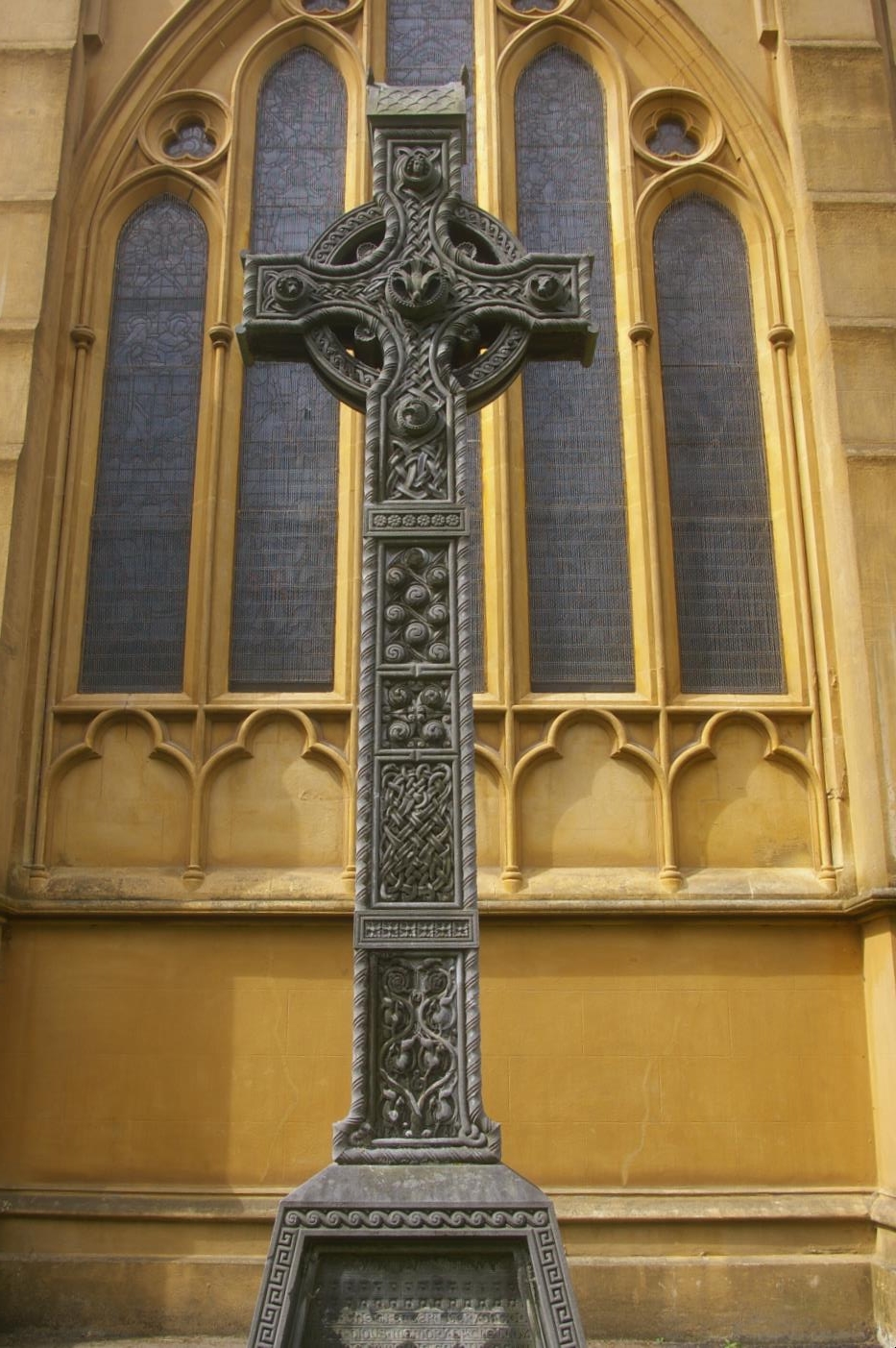
But, while exploring the churchyard of the larger St Margaret’s, I discovered this imposing and beautiful monument in memory to a deceased wife. The epitaph is written in sinuous Art Nouveau style writing which was well worn and, as a result, almost indecipherable.
It’s the largest and tallest memorial in the churchyard and is in the form of a Celtic Cross. This was a reminder of the Celtic Revival that was popular from 1880-1910. But it was the symbols that intrigued me. There were four of them in the form of a head at each point of the cross. They were a human or angel, a lion, an ox and an eagle. I felt sure that they had meaning and were not just decoration. After posting my photos on a cemetery related Facebook page, I received a reply (who says that social media isn’t educational?) from a lady who thought that they might represent the four evangelists. This would be:
Human/Angel Matthew
Lion Mark
Ox Luke
Eagle John
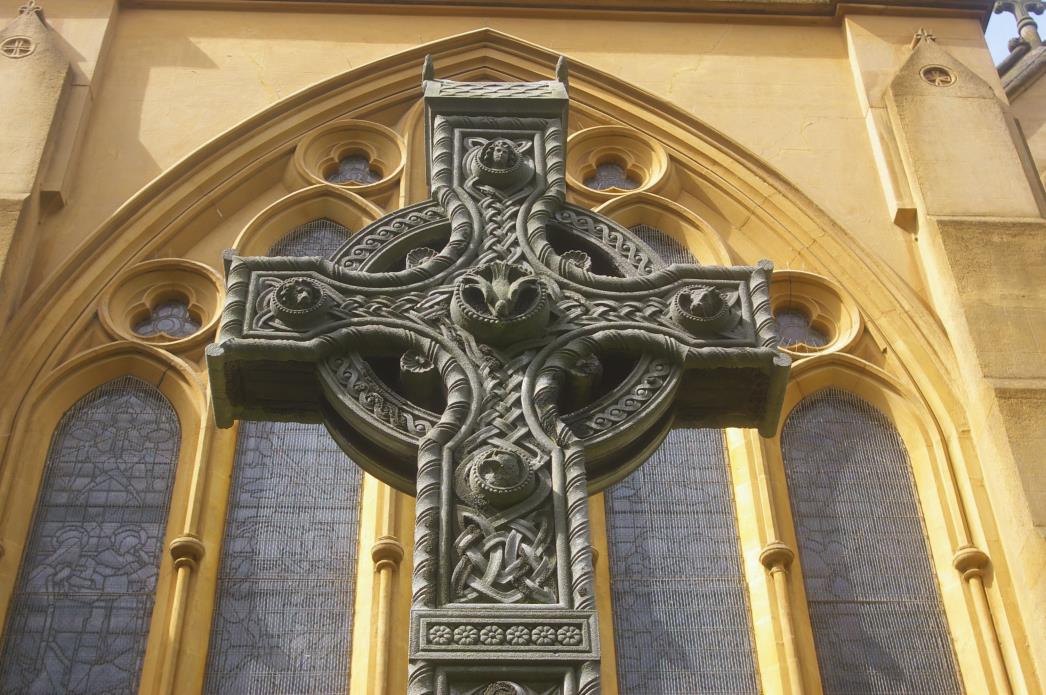
The arrangement of the symbols is known as a tetramorph. It references the four Gospels of the Evangelists and the four living creatures that surround the throne of God. There are several Biblical references to them. For example, in the Book of Revelations chapter 4: verses 6-7:
‘And before the throne there was a sea of glass like unto crystal: and in the midst of the throne, and round about the throne, were four beasts full of eyes before and behind.
And the first beast was like a lion, and the second beast was like a calf, and the third beast had a face as a man and the fourth beast was like a flying eagle.’ King James version
The four living creatures are also mentioned in Ezekiel Chapter One verses 1-14, Ezekiel, Chapter 10, verses 1-22 and Daniel Chapter 7, verses 1-8. In addition, the creatures are featured in other religious texts such as St Irenaeus of Lyons and St Augustine of Hippo.
Wikipedia defines a tetramorph as :
‘ ………a symbolic arrangement of four different elements. Tetramorph is derived from the Greek tetra, meaning four, and morph, which means shape.
In Christian art, the tetramorph is the union of the symbols of the Four Evangelists, the four living creatures derived from the Book of Ezekiel into a single figure, or more commonly, a group of four figures. The Evangelists portraits are often accompanied by the tetramorphs or the symbols often used to represent them. Each symbol can be described as a tetramorph in the singular, and a group as ‘the tetramorphs but usually only when all four are together. Tetramorphs were very common in early medieval art especially in illuminated Gospel books, They are still common in religious art up to the present day.
Other examples of the combination of different elements are the Sphinx in Egypt which has the body of a lion and the head of a human.’
There are two more examples below:

Fresco, Meteora c.1550 shared under Wiki Commons.

Ivory plaques on a wooden coffret early 13th century. Musee de Cluny. Shared under Wiki Commons.
The animals associated with the Christian tetramorph originate in the Babylonian symbols of the four fixed signs of the zodiac; the Ox representing Taurus; the lion representing Leo, the eagle representing Scorpio; the man or angel representing Aquarius. In Western astrology the four symbols are associated with the elements of, respectively Earth, Fire, Water and Air. The creatures of the Christian tetramorph were also common in Egyptian, Greek and Assyrian mythology. The early Christians adopted this symbolism and adapted it for the four Evangelists as the tetramorph, which first appears in Christian art in the 5th century
The evangelistic symbols on the cross in St Margarets are beautifully carved and it really stood out in the churchyard due to its size and position.
Since seeing this one I have found other tetramorphs. There is one over the entrance to the imposing church of St Augustine’s in Kilburn and another one in Ely Cathedral. Gaudi also featured prominent winged versions of the evangelists on his unfinished masterpiece, The Sagrada Familia in Barcelona.
©Text and photos copyright Carole Tyrrell
References and further reading:
https://www.kingjamesbibleonline.org/Revelation-Chapter-4
The lion, the bull, the eagle and the angel: the Tetramorph | Museu Nacional d’Art de Catalunya
The pinnacles of the Evangelists: the symbolism – Blog Sagrada Família (sagradafamilia.org)
Ox, eagle, lion, man: Why and how are the Evangelists associated with these creatures? (aleteia.org)
St Margaret’s Church – Old Church Yard (stmargaretslee.org.uk)
 shadows fly away