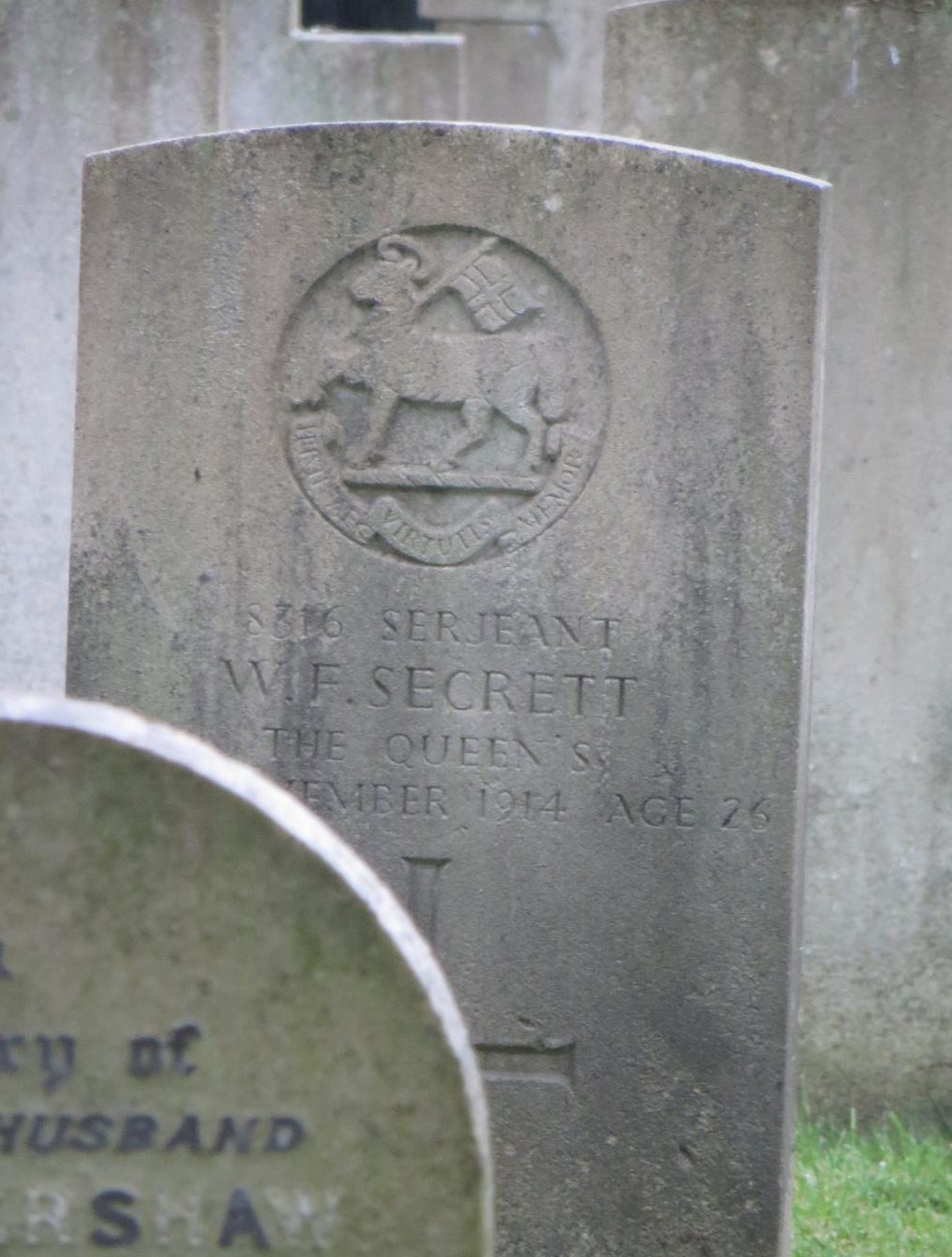
This month’s symbol is the Agnus Dei, which is a Latin term and can be translated as The Lamb of God. The Lamb is usually portrayed sideways on and is often depicted with a variety of accoutrements such as a cross, a banner and a halo or a combination of these elements. In the example above, the Lamb is carrying a cross which represents the Crucifixion as well as a banner which, according to J C Cooper, is an emblem of the Resurrection. It has also be depicted with other motifs such as a shepherd’s crook, Chi-Rho crosses and the alpha/omega.
I have seen The Lamb several times as it is common throughout Christian art and I saw a fine example within a stained glass window in Augustus Pugin’s private chapel at his former home at Ramsgate, Kent. William Morris also created a memorable one, now sadly faded, in a window at St Martin’s church, Scarborough. The Agnus Dei is known as a Paschal Lamb within heraldry and is the regimental emblem of the Queens Royal Surrey Regiment. I found this example in the military war graves section of a London cemetery..
But the origins of the Lamb go back much further into antiquity. In John 1:29, it’s seen as a direct allusion to Jesus:
‘The next day John seeth Jesus coming unto him, and saith, Behold the Lamb of God, which taketh away the sin of the world.’
This verse emphasises Christ’s sacrifice for humanity’s sins and there are several references in the Old Testament to lambs as sacrificial objects. For example, the Israelites sacrificed one as a representation of a human sinner. In this way, its death signified the absorbing of original sin. This painting, The Sacrificial Lamb, is by the 16th century artist, Francisco Zurbaran.
Francesco Zurbaran (1598 – 1664) The Lamb of God, Prado Museum, Madrid shared under Wiki Commons
Sheep have been also been worshipped as deities by several ancient civilisations including he Sumerians. The Bible contains numerous references to sheep with God being seen as the shepherd of a vast flock of sheep that represents humanity.
But as a funerary symbol within cemeteries and graveyards the Lamb represents gentleness, innocence and the unblemished life of the deceased. In this context, it is supposed to mark the grave of an infant or child. However, the epitaph on the example that I found in Brompton Cemetery had completely vanished which made it difficult to disprove or support this theory. However, I particularly like this one with its black background emphasising the light rays emanating from the Lamb. These highlight its divinity within the unusual lozenge shaped tombstone. But it’s a real shame that we don’t know whose buried there.
The Lamb is also associated with resurrection and there is an example at the back of the Doulton mausoleum in West Norwood Cemetery.
I’m surprised that it doesn’t appear more often within cemeteries and graveyards and I will be looking out for more examples. Although I was aware that the symbol was called the Lamb of God I didn’t know of its association within major religions and civilisations. It has been fascinating to research this.
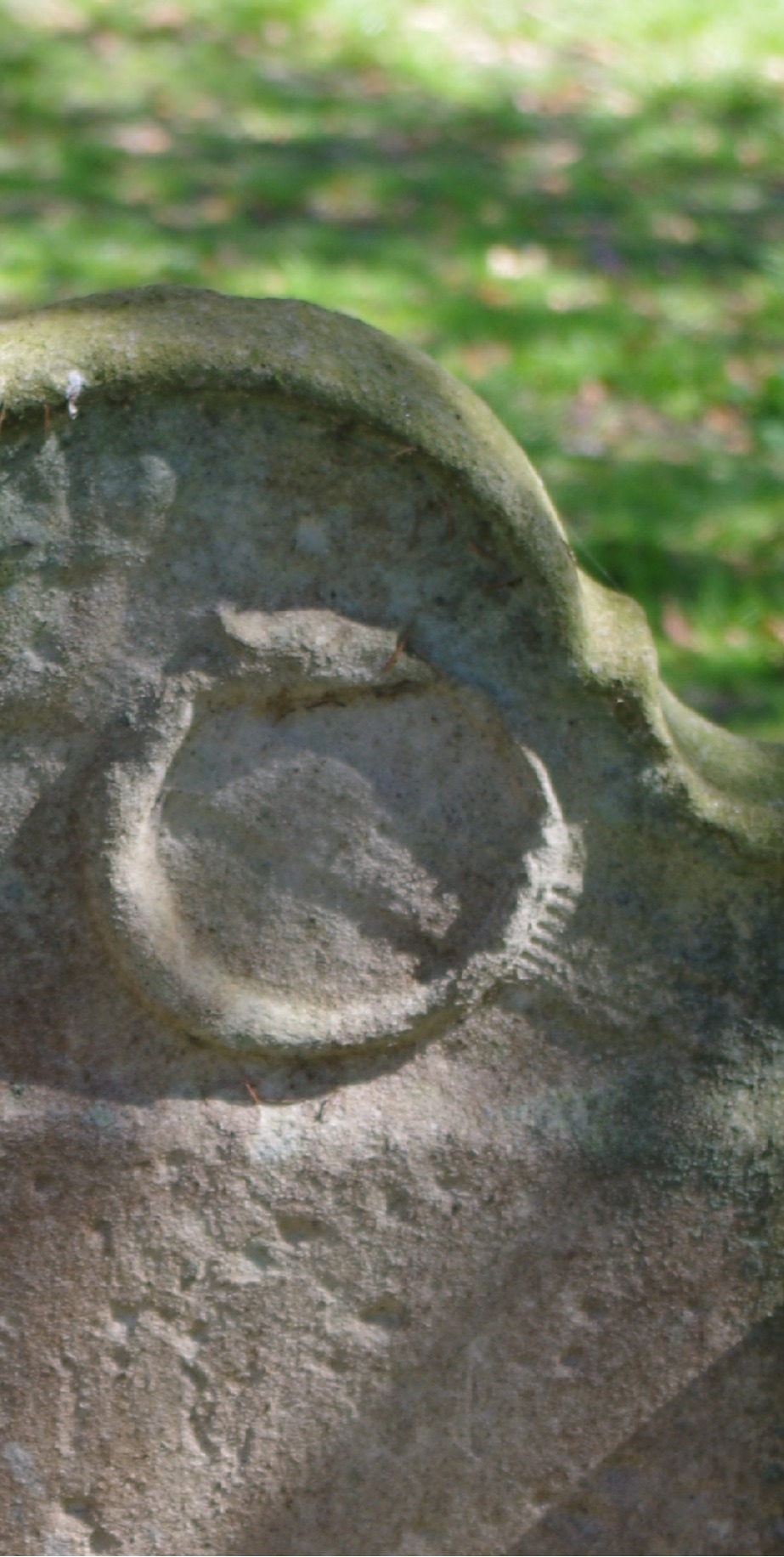
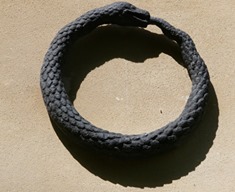
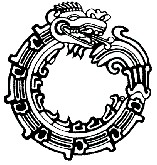
This is only one of the several positive and powerful meanings of the ouroboros which is one of the most ancient symbols known to man. It’s depicted as a snake eating its own tail to sustain its life in an eternal cycle of renewal and it usually forms a full circle. It occurs in many cultures, religions and beliefs. The psychologist, Jung, called it an archetype which is best described as:
‘a primitive mental image inherited from the earliest human ancestors, and supposed to be present in the collective unconscious.
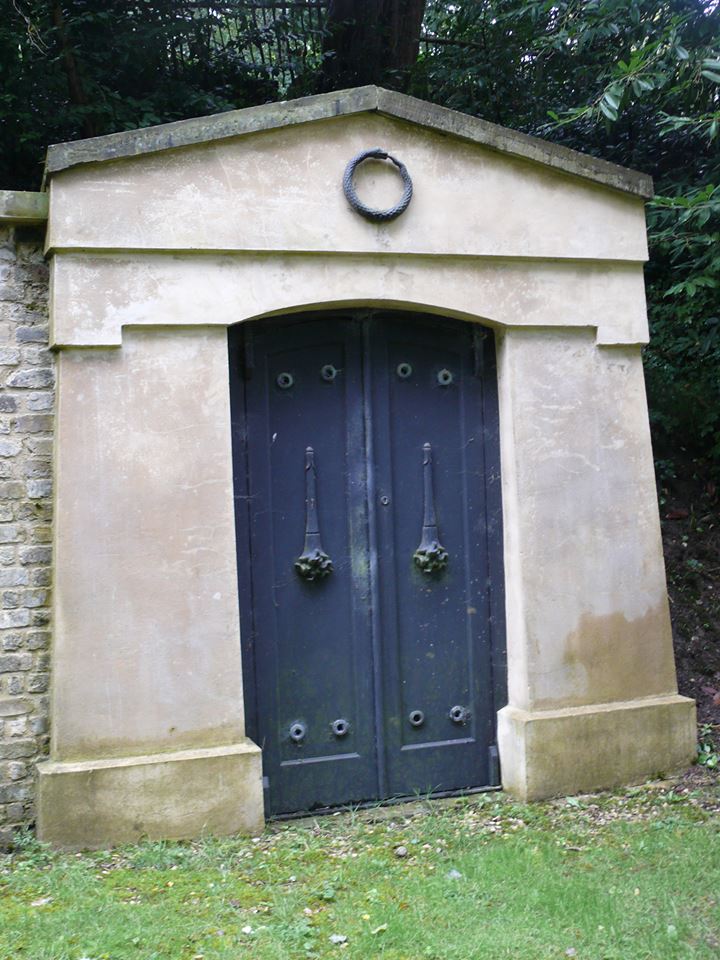
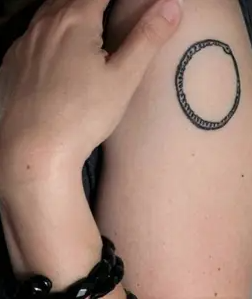
A lovely picture of an ouroboros on a mausoleum in Highgate West. copyright Jeane Mary – used with kind permissionThis is the mausoleum to which the ouroboros belongs. Note downturned torches on doors which are a sign of life extinguished. copyright Jeane Mary and used with kind permission.
The ouroboros appears in ancient churchyards and Victorian cemeteries as a symbol of resurrection. The snake is reborn as it sheds its skin and this fine example is on a mausoleum in Highgate cemetery, London. Victorian visitors would have understood its meaning. As a resurrection image it can be very positive as some of its other attributes are immortality, eternity and wisdom. However, as with most symbols , it can have several meanings. These include the Universe’s cyclic nature and life out of death and, as the snake sheds its skin it has a Phoenix-like cycle of life, death and rebirth. The Victorians revived several older symbols in a return to the classicism of ancient Greece and Rome.
There is also a magnificent ouroboros on the gates of Sheffield General Cemetery. The Highgate one inspired the tattoo worn proudly above by Jeane Mary, a photographer and fellow cemetery explorer now sadly gone from us. She also wears a Whitby mourning bracelet based on the ouroboros in Highgate. Used with kind permission.
But the ouroboros origins lie in either ancient Greece or Egypt as both cultures have claimed it. In Greece, Plato described it as:
‘the first living thing, a self-eating, circular being’.
In fact, the Greek translation of ouroboros is ‘tail devouring snake’ and it’s associated with something constantly recreating itself and the eternal return.
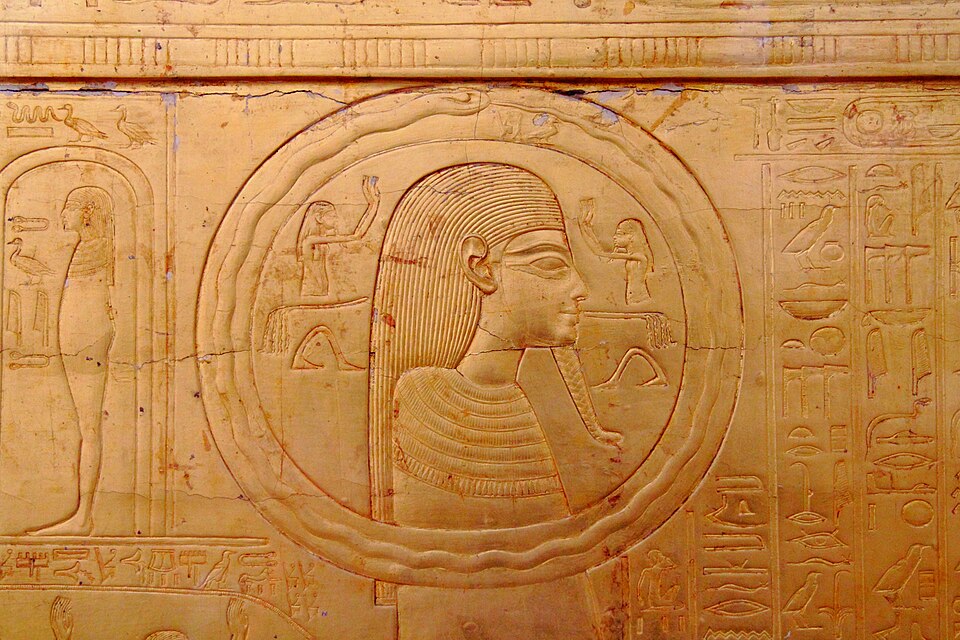
The earliest known depiction of an Ouroboros on one of the shrines enclosing the sarcophagus of Tutenkhamun. Shared under Wiki Commons. Egyptian Museum Cairo.
In Egypt, the ouroboros reputedly appears for the first time in the 14th century BC in Tutenkhamen’s tomb on an ancient funerary text. This depicts the Sun God Ra and his union with Osiris in the underworld and is illustrated with two serpents, holding their tails in their mouths, coiled around hands and feet. This may be a representation of the unified Ra-Osiris. Both serpents are reputedly the manifestation of the god Mehen, who in other funerary texts protect Ra in his underworld journey. I haven’t been able to find an image of this particular representation but I did find the one above which is claimed to be the earliest representation of an ouroboros.
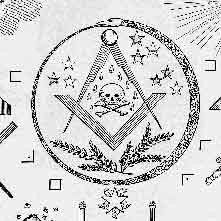
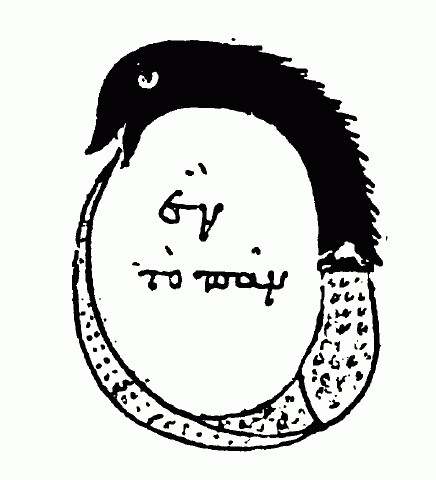
The ouroboros also appears in Hindu, Norse, Aztec and Chinese religions. In addition, it’s a significant alchemical symbo and features in Cleopatra the Alchemist’s work. There are also Masonic associations from numerous seals, frontispieces and other imagery dating from the 17th century such as the one below:
Alchemist ouroboros from Cleopatra the Alchemist Greco-Roman Egypt.
Aztec seven segmented ouroboros.
In China it can also take the form of a dragon and it features on the Magician card in the Rider- Waite deck of Tarot cards.
I found this quote online:
‘In other myths the ouroboros encircles the whole world, a circumference of the waters surrounding the earth. It can support and maintain the world and also inject death into life and life into death. Although apparently immobile, it’s actually in perpetual motion, forever recoiling upon itself.’
One of the many fascinating myths surrounding the ouroboros is the experience of the chemist, August Kekule, who was trying to discover the structure of benzene. This is how he described his Eureka moment :
‘I was sitting, writing at my text-book; but the work did not progress; my thoughts were elsewhere. I turned my chair to the fire and dozed. Again the atoms were before my eyes. This time the smaller groups kept modestly in the background. My mental eye, rendered more acute by the repeated visions of the kind, could now distinguish larger structures of manifold conformation: long rows, sometimes more closely fitted together; all twining and twisting in snake-like motion. But look! What was that? One of the snakes had seized hold of its own tail, and the form whirled mockingly before my eyes. As if by a flash of lightning I awoke; and this time also I spent the rest of the night in working out the consequences of the hypothesis.’
As I said earlier, Jung would see this dream as evidence of the ouroboros and its effect on the collective unconscious.
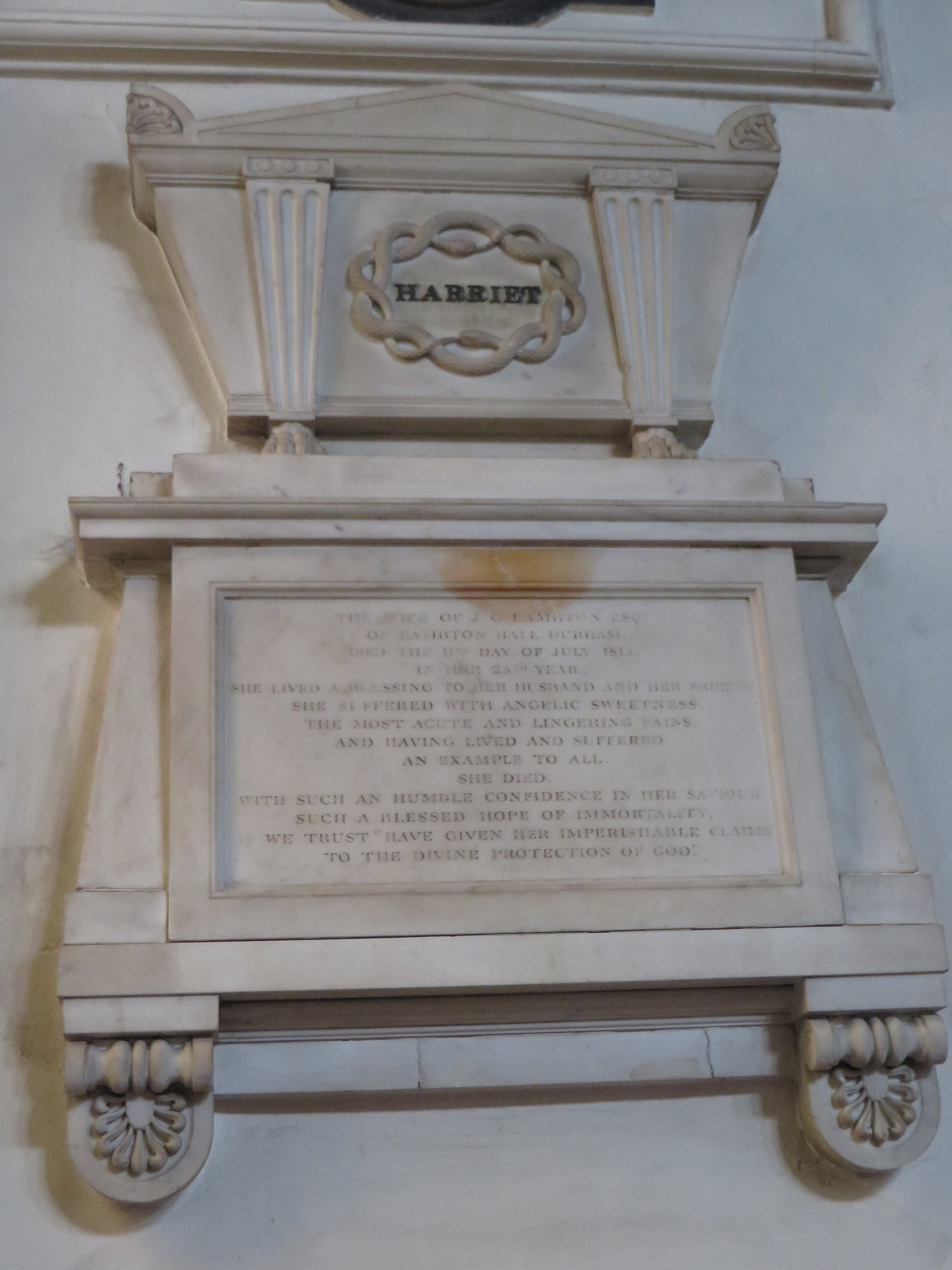
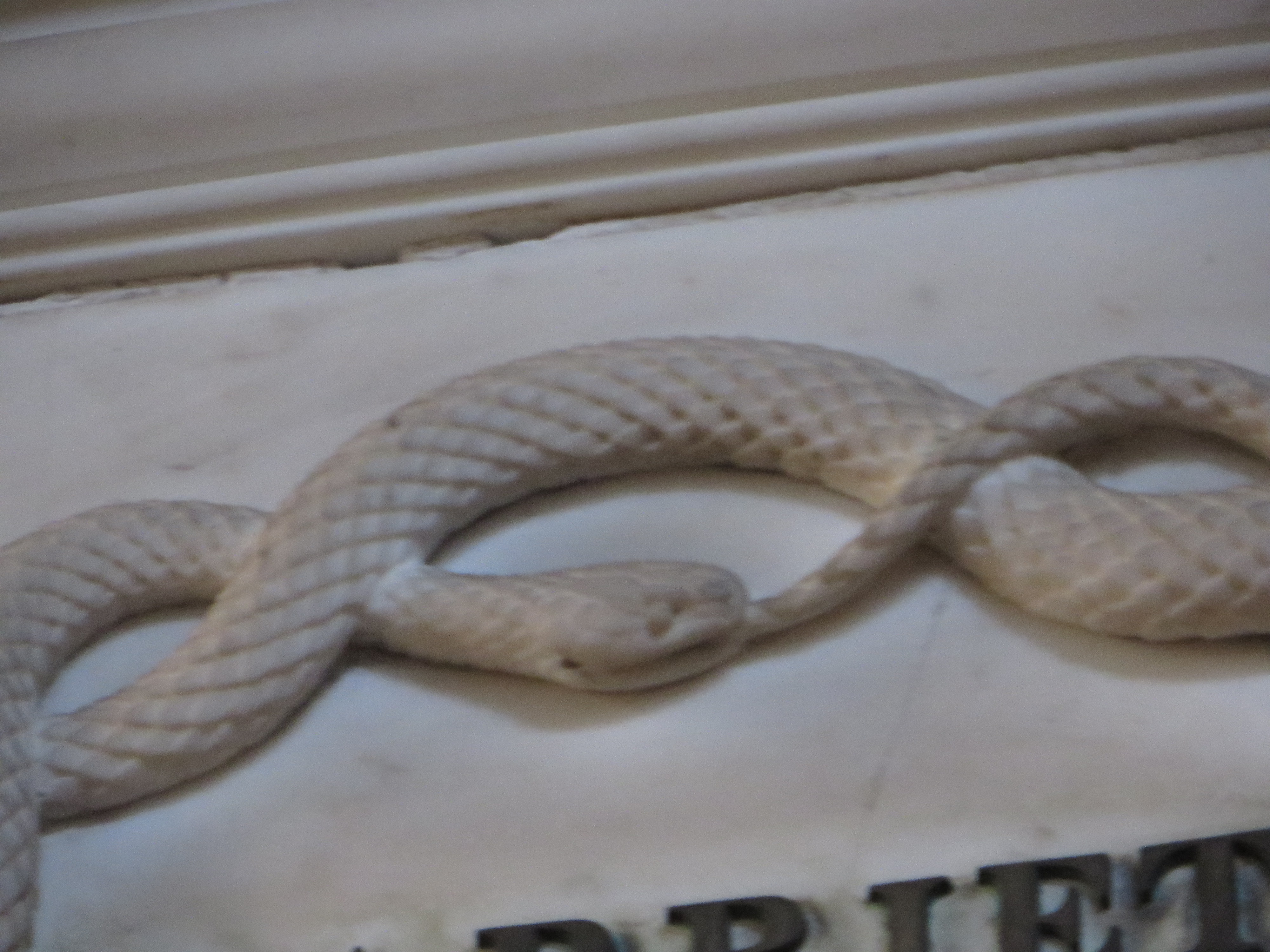
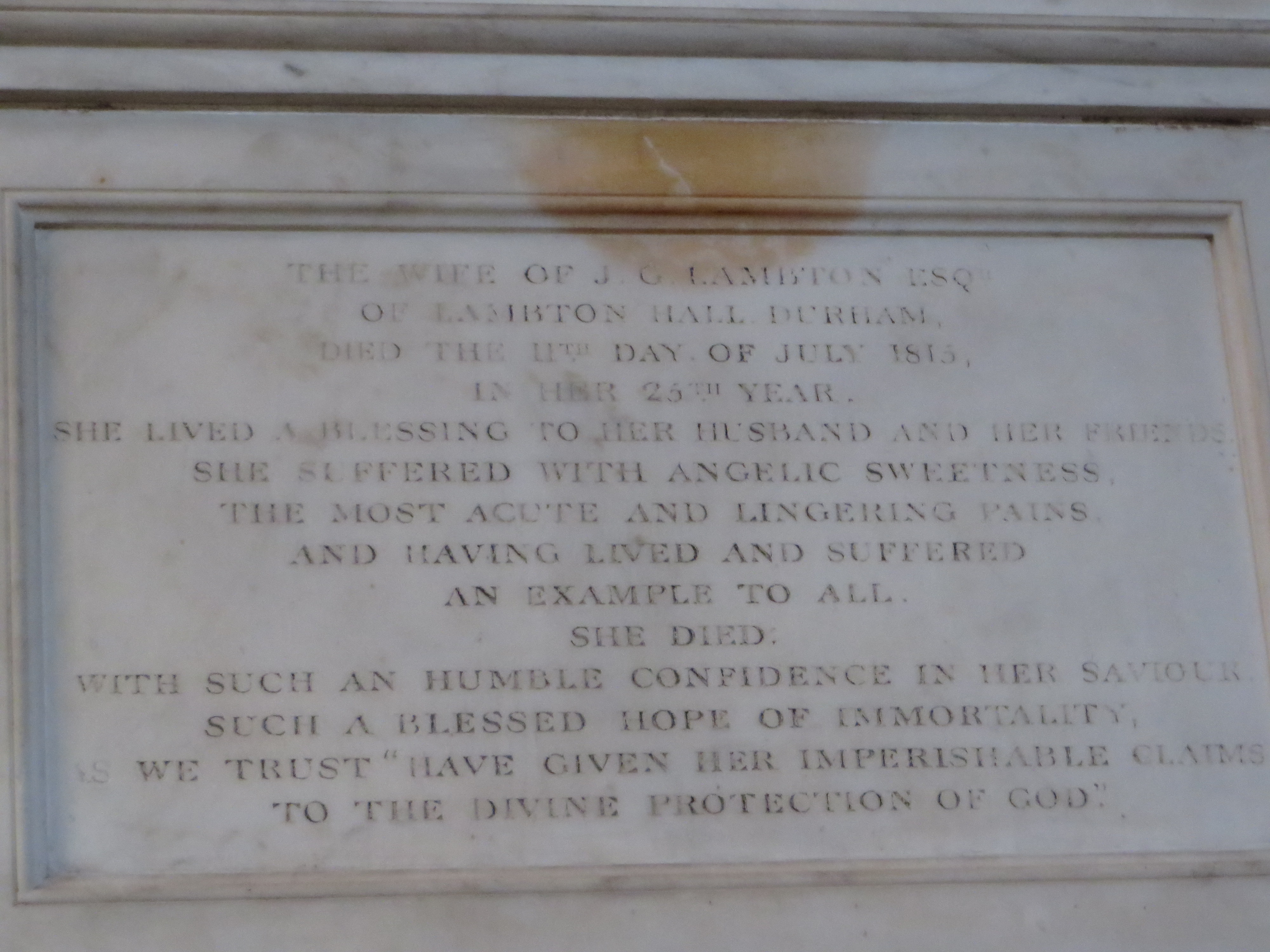
The monument dedicated to Harriet. St George’s church, Beckenham, Kent copyright Carole TyrrellClose-up of the snakes. St George’s church Beckenham, Kent. copyright Carole TyrrellHarriet’s epitaph shows that she was obviously much missed. St George’s church, Beckenham, Kent. copyright Carole Tyrrell
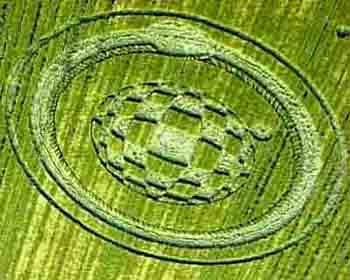
Although the ouroboros is usually depicted as a full circle, this is one that I found in my local church, St Georges in Beckenham. On first glance, it merely looks like an attractive, rippling border around the name Harriet and it dates from 1815. But on a recent visit, I looked closer and realised that it was actually composed of 2 entwined snakes, each biting their own tail. When I spoke to a churchwarden, she had always thought that, due to the patterning on the snakes’ bodies, that it was two entangled pieces of rope. It is a poignant memorial to a young wife who died aged 25 after suffering the ‘most acute and lingering pains.’ So it would have been a potent reminder of resurrection. More recently, the ouroboros has also appeared as part of a crop circle.
The ouroboros is one of the most intriguing and interesting symbols that I have researched. It is a universal image of rebirth, hope and eternity.
The distinctive ‘candlesnuffer’ steeple of St Mary’s church in St Mary Cray has long beckoned to me and I thought that it was time I paid a visit. I didn’t expect to find much and my first impression confirmed it. A few ivy clad altar tombs greeted me and then I wandered around the side of the closed church. What a surprise! A gallery of 18th century headstones placed in lines with some of the more familiar symbols depicted on them. Ouroboros’s, angel heads, skulls, crossbones and then the fine selection in the above photo.
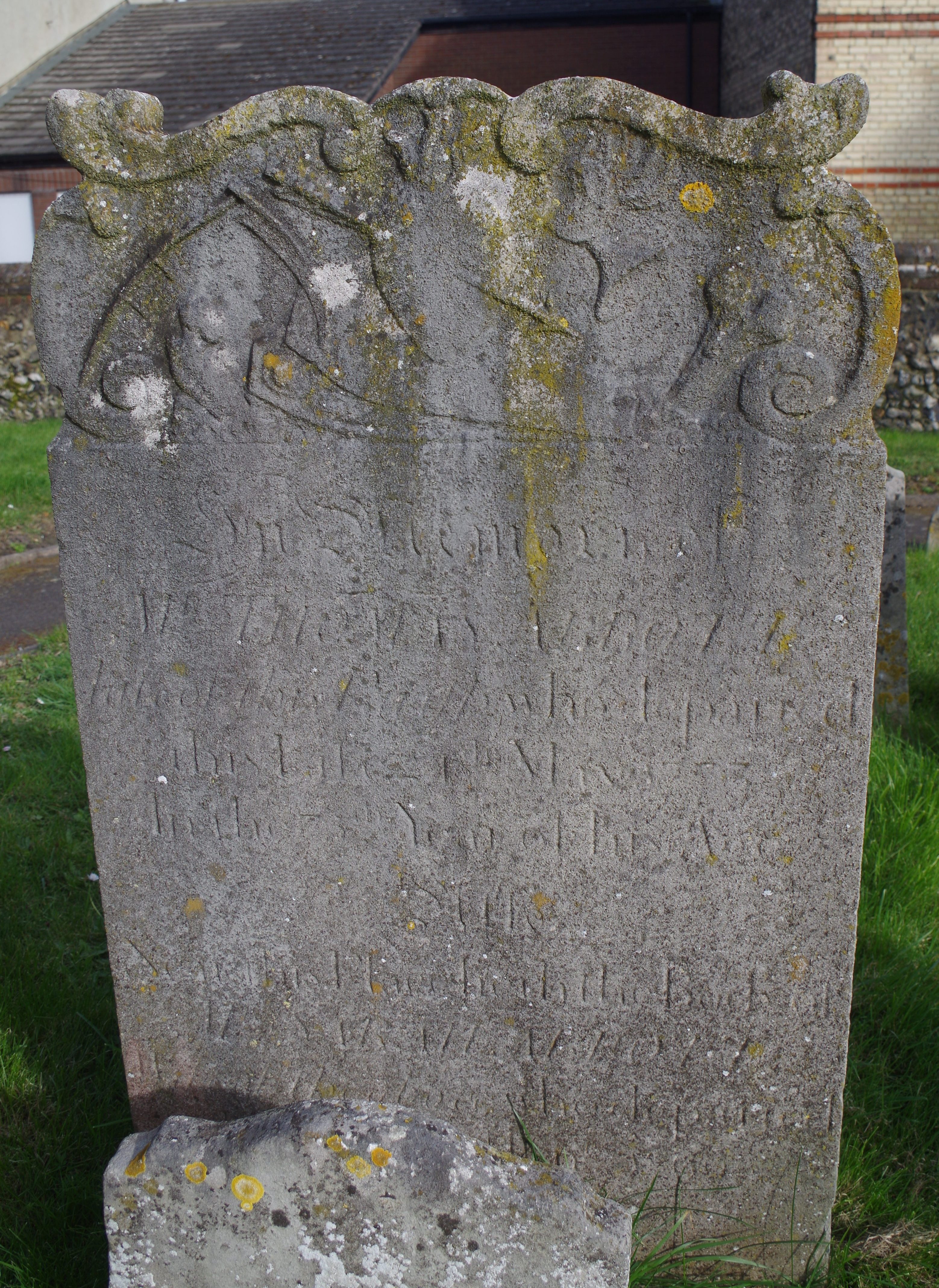
As you can see, it boasts a large, sharp scythe, a half open coffin with the incumbent visible, a trumpet blowing from what seems to be a heavenly cloud and, in the centre, a heart pierced by an arrow. We usually associate a pierced heart with the ones found on millions of St Valentine’s cards as a representation of Cupid’s love darts. You may be thinking that it doesn’t have the usual heart shape but there may be how the stonemason interpreted it. This is the Symbol of the Month – the Pierced Heart
The headstone‘s epitaph reads:
‘In Memory of
Mr THOMAS ABBOTT
Late of this PARISH who departed this life
24 May 1773
In the 75th Year of his life
Also
Near lieth the body of
MRS SARAH ABBOTT his wife
,,,,who departed ….22 January 1769 aged 69’
Although there are other Abbotts buried in the same churchyard I couldn’t find any sign of a headstone or monument dedicated to Sarah Abbott and there was none recorded on the Kent Archaeological Society survey of the churchyard So whether it has vanished over time we will never know.
On Thomas’s headstone, the heart is surrounded by symbols of resurrection and the Day of Judgement when all of the dead will rise. This is the meaning of the half open coffin lid. So is the pierced heart a symbol of everlasting love which means that the Abbotts will be reunited on that day? After all, Keister suggests that it’s a sign of matrimony which would fit in with both husband and wife being mentioned on the headstone. However, Cooper comments that the pierced heart is also a sign of contrition so perhaps Mr Abbott felt guilty or sad about outliving Sarah by 6 years.
But let’s discuss other representations and interpretations of the pierced heart as well as the heart in general. It’s one of the most powerful symbols and resonates through many cultures and faiths both ancient and modern. Without it, none of us would be alive as it pumps our lifeblood through our bodies. This is why it has been a central part of religions and cultures since the beginning of time.
Heart symbolism is significant in, Chinese, Hindu and most religions and cultures. For example, it is one of the eight precious organs of Buddha and also the Aztecs whose rituals involved human sacrifice. In these the chests of the victims were sliced open and their still-beating hearts were offered to the gods. The Aztecs believed that the heart was the seat of the individual and also a fragment of the Sun’s heart.Section from the Book of the Dead depicting the Weighing of the Heart showing the heart on one side of the scales and the feather of Maat in the other. Osiris is between them. Shared under Wiki Creative Commons
In Ancient Egypt, the heart was considered to be the source of human wisdom and the centre of emotions and memory. It could reveal a person’s true character, even after death, and was left in the body after mummification. The ancient Egyptians believed that it would survive death where it would give evidence against or for its owner and so was integral to the afterlife. This culminated in the Weighing of the Heart which appears in the Book of the Dead. The heart was given to Osiris, the god of the dead and the underworld who placed it on one of a pair of great golden scales. On the other was a feather which represented Maat the goddess of order, truth and what was right. If the heart was lighter than the feather then the deceased passed on into eternal bliss. But if it was heavier, due to past misdeeds, then it was thrown onto the floor of the Hall of Truth where Amut, a god with the face of a crocodile, the front of a leopard and the back of a rhinoceros who was also known as ‘The Gobbler’. Once he had devoured the heart then the individual ceased to exist. The Egyptians concept of hell was non-existence.
But the heart has an even greater significance in the Judaeo-Christian tradition. There are many references to it in the Bible with over a hundred in Psalms alone. One of the most famous quotations is in 1 Samuel 16.7 in which it is seen as the seat of emotion:
‘But the Lord said unto Samuel, Look not on his countenance, or on the height of his stature; because I have refused him: for the Lord seeth not as man seeth; for man looketh on the outward appearance, but the Lord looketh on the heart.’ (King James Bible).
The heart is seen as revealing the inner person but not only as the centre of human life. It also expresses spiritual or emotional feelings, wisdom, piety and righteousness. There is also the famous quote from Matthew 5:8;
‘blessed are the pure in heart’
However, the heart also has a darker side as an evil person is often described as being ‘blackhearted.’ In Ecclesiastes 8:11 it’s seen as evil:
‘ Because sentence against an evil work is not executed speedily, therefore the heart of the sons of men is fully set in them to do evil.’ (King James Bible).
In Christian iconography the heart took on a symbolic role as an indication of God and piety particularly in the Catholic church where Christ displaying a heart in his hands or on his breast is a key image. It’s known as the Sacred Heart and is one of the most practiced and well known of the Catholic devotions. The sacred heart is seen as a symbol of ‘God’s boundless and passionate love for mankind.’ The pierced heart was also included in the five wounds that Christ suffered during the crucifixion.
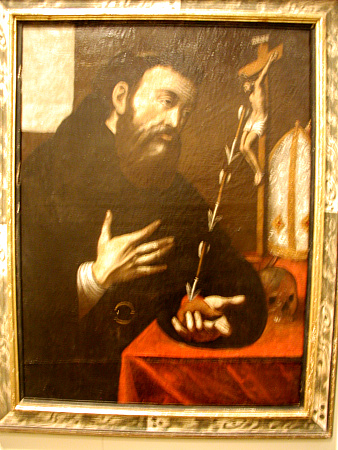
Catholic Holy card depicting the Sacred Heart of Jesus circa 1880. shared under Wiki Creative CommonsThe Pierced Heart of Jesus 19th century Portuguese painting. Shared under Wiki Creative CommonsSt Augustine 17th century Portuguese painting Museum of Church Paio of San Santiago de Compostela, Spain. Shared under Wiki Creative Commons
One saint in particular, St Augustine, seen above has a special relationship with the pierced heart. He is often shown holding a heart, in some cases topped by a flame and in others pierced by an arrow. Another passage from the Confessions IX, 2:3 may explain the significance of the pierced heart:
‘Thou hadst pierced (sagittaveras) our heart with thy love, and we carried thy words, as it were, thrust through our vitals.’
(The word sagittaveras means literally ‘ shot arrows’ into as in this 17th century painting.
St Valentine’s Day was originally derived from a much darker and bawdier Roman festival called Lupercalia. This took place in Rome from 13-15 February and was intended to avert evil spirits and purify the city. However, it didn’t involve the giving of chocolates and bouquets of roses. Instead there was animal sacrifice, random matchmaking and couplings which were intended to ward off infertility. In reality, it was a fertility festival dedicated to Faunus, the Roman god of agriculture and also to the founders of Rome, Romulus and Remus. It was finally outlawed as ‘unChristian’ in the 5th century by Pope Gelasius who declared the 14 February to be St Valentine’s Day. There were two actual St Valentines who were both martyrs.
However, the first person to mention the famous day for lovers was actually Geoffrey Chaucer in his 1375 poem, ‘A Parliament of Fowles (or Fowls)’. In this he says:
‘For this was sent on Seynt Valentyn’es day
When every fowl cometh here to choose his mate.’
During the Middle Ages it was believed in both France and England that February 14 was the beginning of the mating season for birds and so an ideal date for romance for all.
However, the heart also has a darker side as an evil person is often described as being ‘blackhearted.’ In Ecclesiastes 8:11 it’s seen as evil:
‘ Because sentence against an evil work is not executed speedily, therefore the heart of the sons of men is fully set in them to do evil.’ (King James Bible).
But it was during the early medieval and early Renaissance when the heart began to resemble the more stylised symbol that we know today. It took on the shape of a converted A and represented Amor or Love. Since the 19th century it has been associated with love and romance and the pierced heart has also been known as the wounded heart due to Cupid’s arrows.
But, due to its placing within other potent symbols of resurrection, I interpret the pierced heart on Mr Abbott’s headstone to be a token of love. Although he wasn’t buried with his wife he may have hoped that they would be reunited on the Day of Judgement when the angels trumpets sounded and the dead met the living again.
It was one of the most potent symbols that I have found in my explorations and I haven’t seen another one – yet. The pierced heart has also been one of the most fascinating symbols to research because of its many connotations and associations. Who would have thought that Chaucer might be the father of the St Valentine’s Day industry that we know so well today.
Was the pierced heart a token of love or a hope of a meeting in the after-life? We will never know but a fascinating collection of symbols for the passer-by to admire.
It wasn’t until late in the 19th century that angels fluttered into large Victorian cemeteries and there is undoubtedly a story to be written as to how they changed sex once they had perched themselves on top of monuments. Prior to that they had been seen as ‘Popish’ symbols and I have visited cemeteries where there is a lone angel or maybe just a scattering of them. There is a hierarchy of angels and they can be identified by what they hold in their hands; a sword, shield, a book or, in this case, a trumpet. The angel holding a trumpet is the one that features as this month’s Symbol.
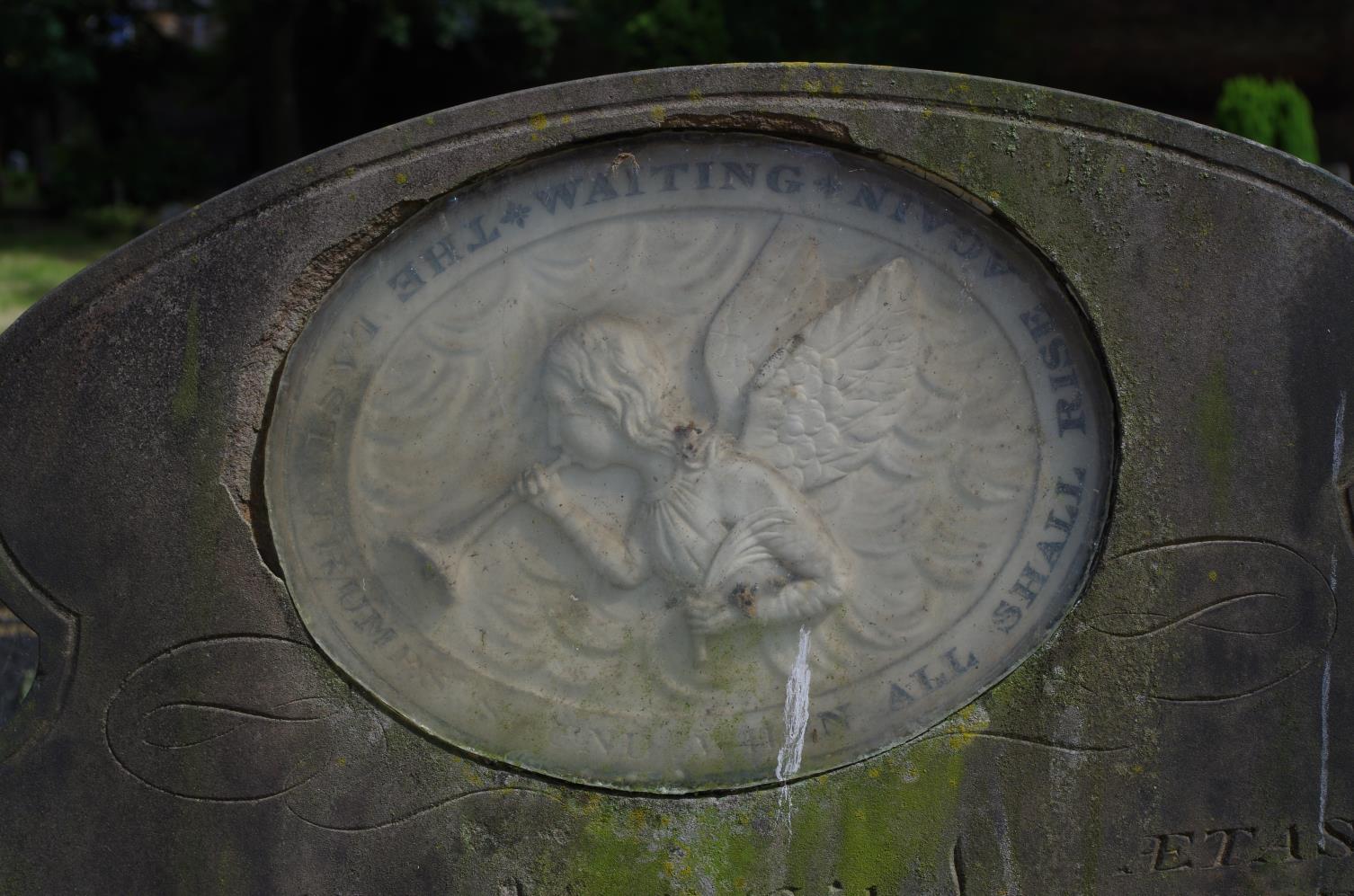
I have seen several examples and this one comes from West Norwood Cemetery. It’s on the headstone dedicated to Edward who died aged only 13 years. As the epitaph states,
‘Edward
THE ONLY SON
E. du Bois Esq
BARRISTER OF LAW’
I’ve always considered it to be a very striking, almost 3D image, with the detail on the angels wings, clothes and the clouds that surround her. It depicts an angel blowing on a trumpet with a Biblical quotation surrounding her. The angelic figure is definitely a woman. and it’s always intrigued me how angels which are traditionally male in the Bible became pretty, pensive young women when they appeared in cemeteries and churchyards. The quotation reads:
‘WAITING
THE LAST TRUMPET (words unreadable)………
ALL SHALL RAISE AGAIN
In this case, the angel trumpeter on this headstone is a representation of the Last Judgement Day as she is the herald of the resurrection.
There are many references to angels blowing trumpets in the Bible and their association with the dead rising on the Day of Resurrection. For example in Corinthians 15:32, it says:
‘in a moment, in the twinkling of an eye,
At the last trumpet.
For the trumpet will sound, and the
Dead will be raised imperishable,
And we shall be changed.’
There are also references in the Book of Revelation and Matthew 24:32.
However, it is the archangel, Gabriel, who is most associated with blowing a trumpet to announce the resurrection of the dead and images of this began to appear in the 14th century. There is a very stern and definitely male angel figure holding a trumpet at the entrance to Queen Victoria’s mausoleum at Frogmore. There is also a geometric figure known as Gabriel’s horn or Torricelli’s trumpet. It has infinite surface area but finite volume. According to Wikipedia:‘The name refers to the Abrahamic tradition identifying the archangel Gabriel as the angel who blows the horn to announce Judgment Day, associating the divine, or infinite, with the finite. Theproperties of this figure were first studied by Italian physicist and mathematician Evangelista Torricelli in the 17th century.’
Angels appear in most religions and it’s appropriate that one of the most well-known is associated with communication. In fact angels are usually seen as messengers as the word ‘angel’ is derived from the Greek word, ‘angelos’, which means ‘messengers.’ They also appear in Islam as the word for messenger, Mala’ika, is the Islamic term for angel. The Koran, like the Bible, also has references to angels especially Djibril or Gabriel nd Mikhail or Michael. According to Douglas Keister:
‘Angels appeared to grow wings in a 5th century mosaic in Rome. After all they are seen as messengers between heaven and earth.’
Gabriel is also associated with the Annunciation. He is, with his trumpet blowing, an obvious choice for announcing the departure of a soul and its arrival in Heaven.
I have seen an example of an angel blowing a trumpet in Tower Hamlets Cemetery and this lovely example above comes from St Mary’s Catholic cemetery which nestles beside its larger neighbour, Kensal Green.
While exploring Kent churchyards prior to the Coronavirus outbreak I found 17th headstones with angel heads on them with trumpets surrounding them. In this one the trumpets are crossed like long bones beneath the angel head. So, in many ways this is a very ancient symbol which has come down through the centuries as a message of comfort to those left behind. The one dedicated to Edward du Bois has an epitaph that expresses his father’s grief as well as his anger at his son’s untimely death.
Poking about in churchyards as is my wont is how I discover symbols to write about. It was while exploring two churchyards in Kent, All Saints in Frindsbury and St Martin of Tours in Eynsford, that I discovered this month’s symbol.
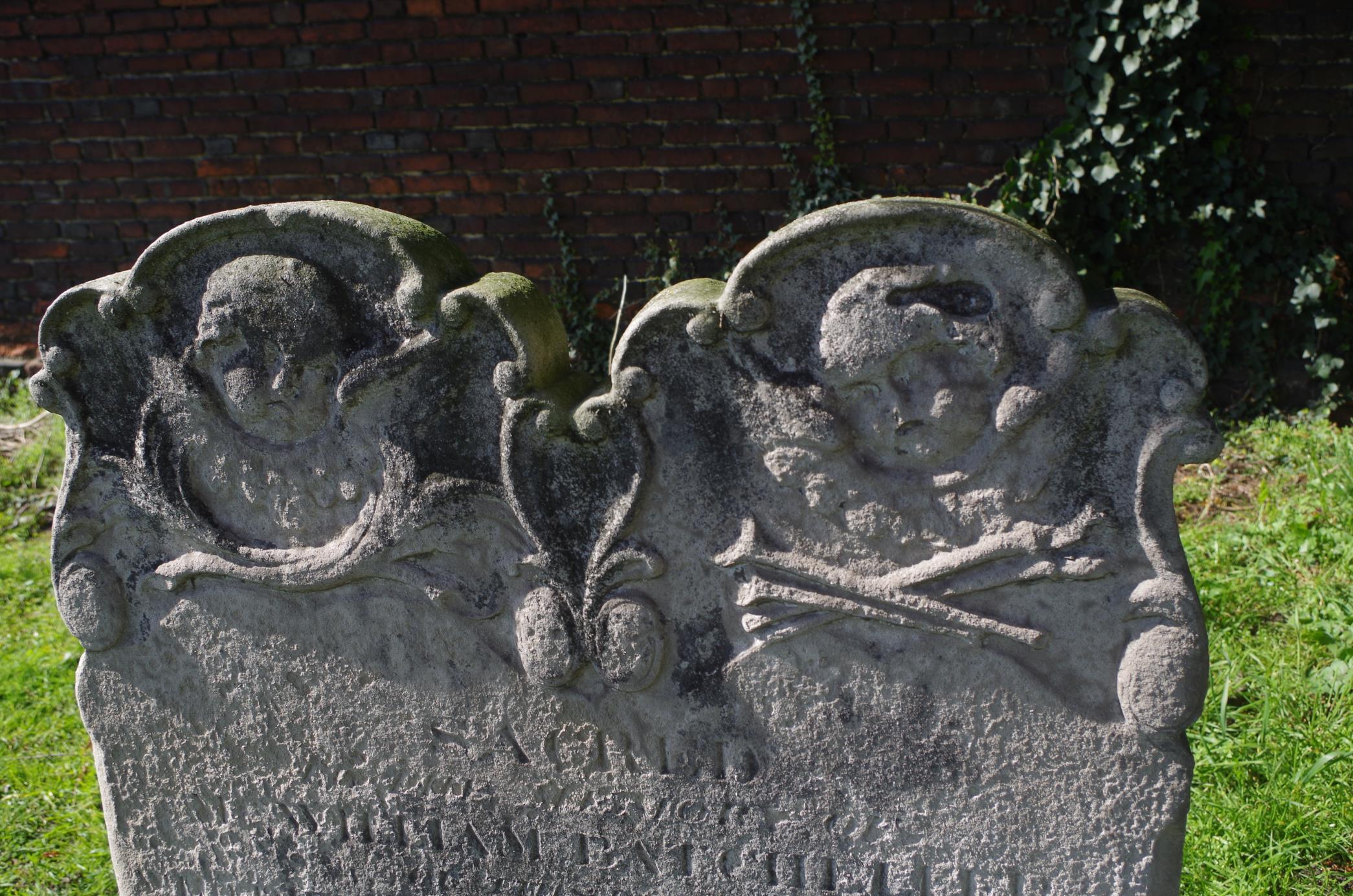
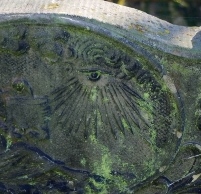
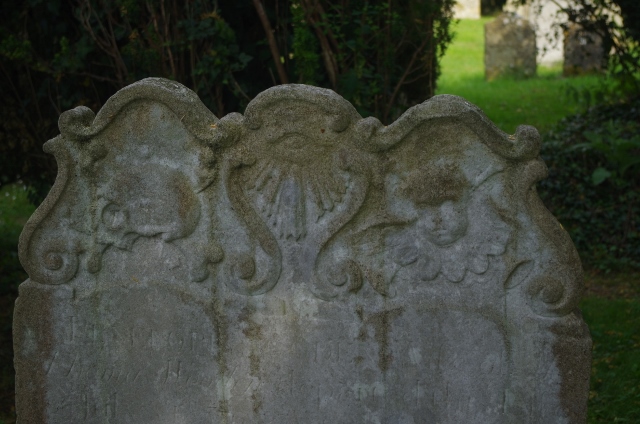
This is the All Seeing Eye, also known as The Eye of Providence, and is usually depicted as a single realistic eye within a triangle or within a burst of light. I’ve always associated it with Freemasons as it appears on their documents. But neither of these headstones had any other symbols linked with Freemasons such as the square and compass. So what was the story?
The one in the churchyard of St Martin of Tours in Eynsford was bordered by what looked like two snakes with a skull and crossbones and a winged spirit on either side, familiar memento mori symbols. Sadly the epitaph is now illegible.
The second one is in the churchyard of All Saints in Frindsbury and this intriguing version is on the grave of the Caryer family. The Kent Archaeological Society thought that it might represent the Woman of Samuria as featured in John 4.4-26 but I’m not sure about that. (see Symbol of the month – the womand from Samaria or a Greek goddess? 27 January 2021) The epitaph reads: ‘Sacred To the memory of Hannah wife of John Caryer Died 9th Sept 1809 aged 30 years Also Robert her son Died 28th June 1801 aged 8 years Also the above John Caryer Died 11th March 1814 aged (4)2 years.’
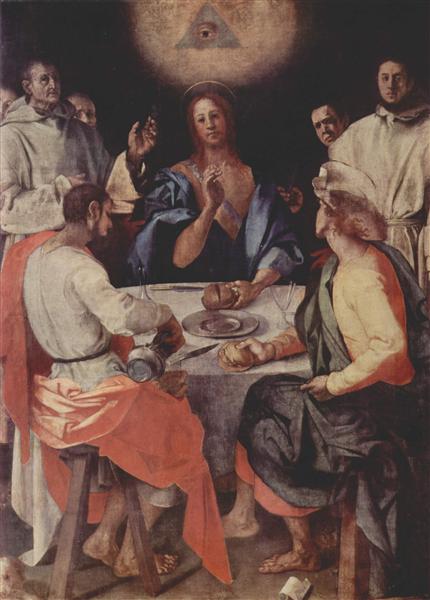
The earliest known representation of The Eye is in a painting called ‘The Supper at Emmaus’ by the Italian painter Jacopo Pontormo in 1525. This was painted during the Renaissance and it depicts the second part of the Second Appearance story in Luke 24: verses 13.35:
‘And they drew nigh unto the village, whither they went: and he made as though he would have gone further. But they constrained him, saying, Abide with us: for it is toward evening, and the day is far spent. And he went in to tarry with them. And it came to pass, as he sat at meat with them, he took bread, and blessed it, and brake, and gave to them. And their eyes were opened, and they knew him; and he vanished out of their sight. And they drew nigh unto the village, whither they went: and he made as though he would have gone further. But they constrained him, saying, Abide with us: for it is toward evening, and the day is far spent. And he went in to tarry with them. And it came to pass, as he sat at meat with them, he took bread, and blessed it, and brake, and gave to them. And their eyes were opened, and they knew him; and he vanished out of their sight.’
As you can see the Eye is above Christ’s head which shows that God is watching the event and so can be seen as a Christian symbol. On the Ancient Origins website it’s claimed that
‘the elements surrounding the eye also have a Christian meaning. For example, the triangle surrounding the eye also have a Christian meaning in that it’s a clear reference to the Holy Trinity – the Father, the Son and the Holy Spirit. The burst of light is meant to symbolise divinity, holiness and God himself’
Within the Bible there are many references to The Eye in the context of God keeping watch and observing in Proverbs and Ecclesiasticus and also from Psalms 33: verse 18:
‘The LORD is in his holy temple, the LORD’s throne is in heaven: his eyes behold, his eyelids try, the children of men. Behold, the eye of the LORD is upon them that fear him, upon them that hope in his mercy . . . . The eyes of the LORD are upon the righteous, and his ears are open unto their cry.’
But older religions and faiths such as Hinduism and the Ancient Egyptians also had an important eye symbol.
In Egypt it was known as the Eye of Horus. Even today it’s still used as an emblem of protection and good health. The Eye was also known as a wadjet (the whole one), wedjat or udjat. Sailors would often paint the Eye of Horus on the prows of their ships to ensure a safe voyage. I’m sure that I’ve seen this on a boat or two in some of Hollywood’s classic sword and sandal epics! The depiction of the Eye of Horus is said to resemble the markings on a falcon’s eye due to the teardrop marking which is sometimes found below the eye as here. This would make sense as Horus is usually shown as a falcon. There are several myths about Horus and his eye. For instance, in one of them Horus fought with Set who gouged out Horus’s left eye which was later restored by a goddess.
The Eye also appears on the US one dollar bill. But it made its first appearance as a Freemason symbol on the personal seal of Robert Moray (1609-1673) who was a Scottish Freemason. Then during the 18th century it appeared again in two Freemason books, one of which was Thomas Smith Webb’s ‘Freemasonry Monitor’ and, by the 19th century, it had become part of the permanent hieroglyphical emblems of the Freemasons. There are other associations with the Illuminati and, if you’re interested, there is more information online.
But with these two All Seeing Eye symbols I think that they were meant, as they often are, to be a comforting message. The departed, and the bereaved, were all being watched over and supported at a time of sorrow and grief.
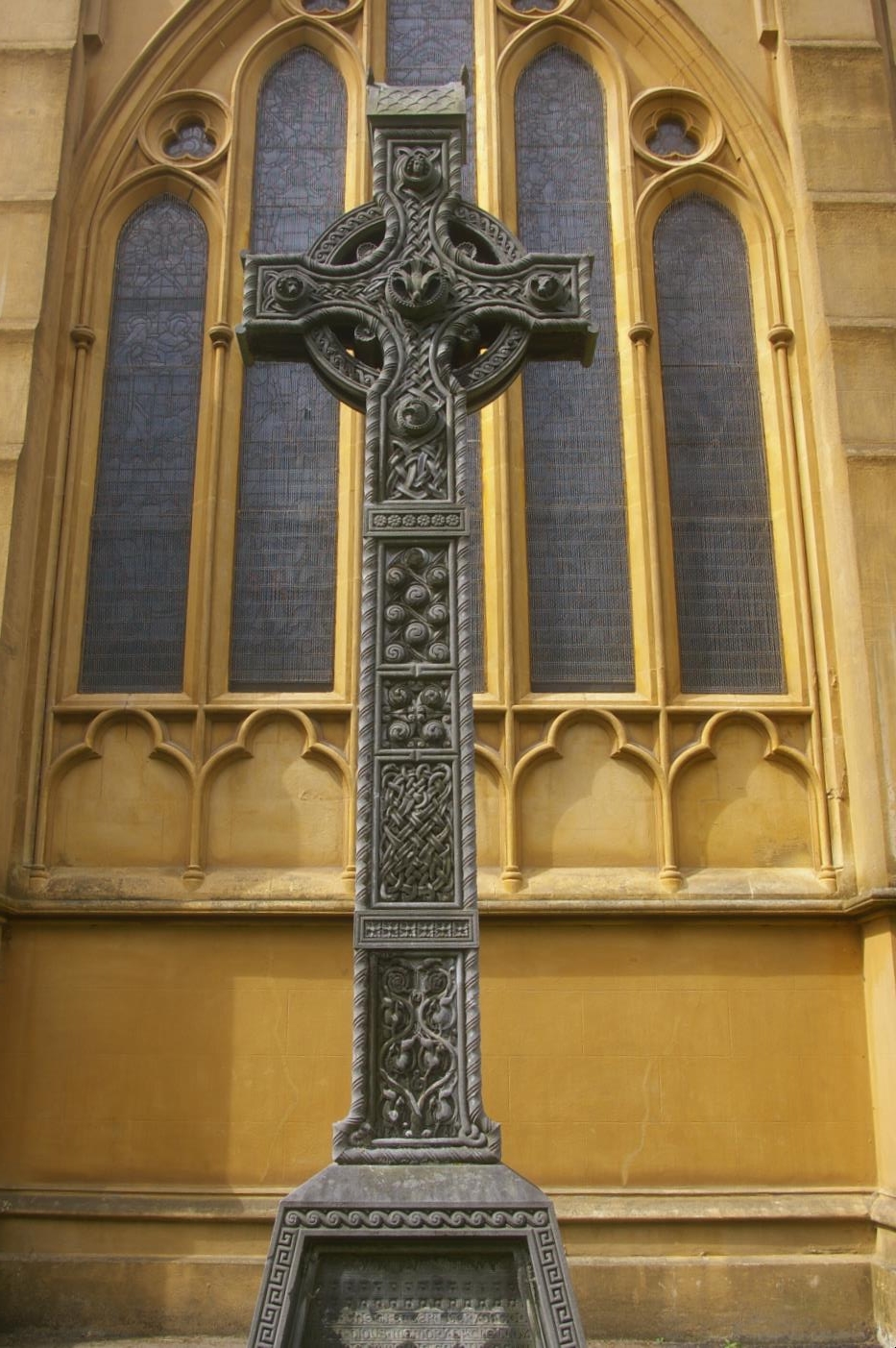
An imposing Celtic Cross in St Margaret’s churchyard, Lee, SE London Copyright Carole Tyrrell
I found this month’s symbol while exploring the churchyard of St Margaret’s church in Lee, South East London. This is a large Victorian church with some lovely stained glass and, more unusually, wall paintings. These are Pre-Raphaelite in style and well worth seeing if you’re in the area. The church is open on the 1st Saturday of every month 10.30am to 4.30pm. There are also windows created from broken pieces of stained glass, like a jigsaw, and which create kaleidoscope patterns on the floor when the sun shines through.
But St Margaret’s is a church in two halves. Across the road is the ruined, older church. It was not constructed well and fell down eventually. What was left was mostly demolished in 1813 and only the ruined west tower remains. This is surrounded by 18th century headstones which include no less than three Astronomers Royal. They are Nathaniel Bliss, John Pond and Edmond Halley (1674-1742) who computed the orbit of Halley’s Comet. They all keep company with, amongst others, a parachutist that fell to earth and a Restoration actress. There is also a poignant grave of a mother and her infant child. An interpretation board by the entrance lets visitor know who is buried where in the churchyard. The churchyard is English Heritage listed and , due to restoration, is open by appointment only. Enquiries via: office@stmargaretslee.org.uk.
But, while exploring the churchyard of the larger St Margaret’s, I discovered this imposing and beautiful monument in memory to a deceased wife. The epitaph is written in sinuous Art Nouveau style writing which was well worn and, as a result, almost indecipherable.
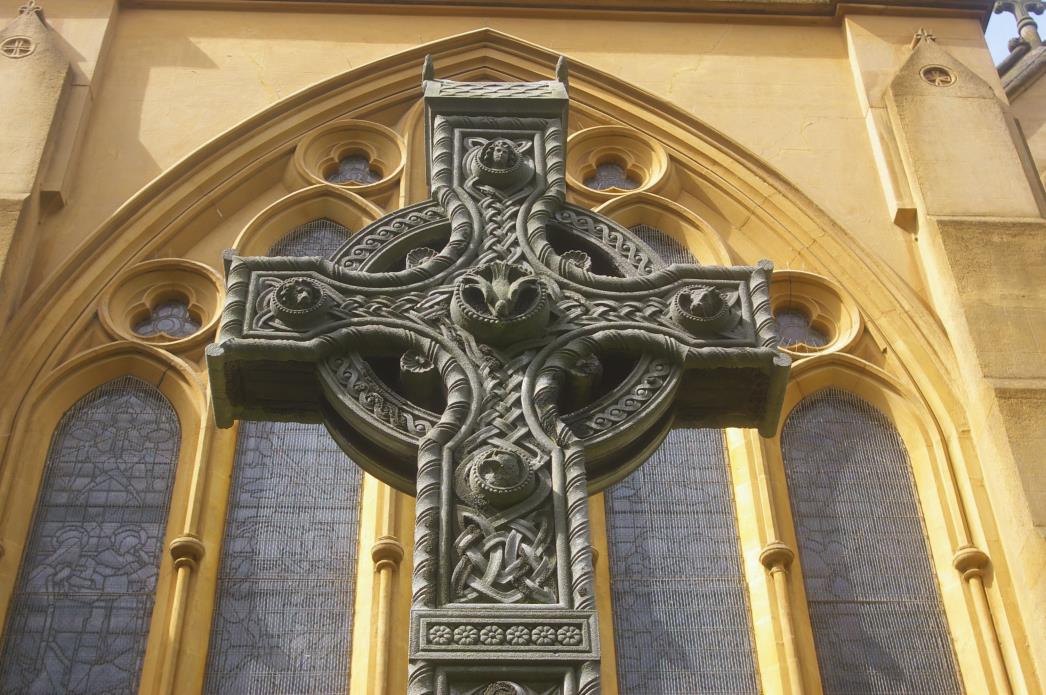
It’s the largest and tallest memorial in the churchyard and is in the form of a Celtic Cross. This was a reminder of the Celtic Revival that was popular from 1880-1910. But it was the symbols that intrigued me. There were four of them in the form of a head at each point of the cross. They were a human or angel, a lion, an ox and an eagle. I felt sure that they had meaning and were not just decoration. After posting my photos on a cemetery related Facebook page, I received a reply (who says that social media isn’t educational?) from a lady who thought that they might represent the four evangelists. This would be:
Human/Angel Matthew
Lion Mark
Ox Luke
Eagle John
A closer view of the memorial showing the four Evangelists symbols in each corner. Copyright Carole Tyrrell
The arrangement of the symbols is known as a tetramorph. It references the four Gospels of the Evangelists and the four living creatures that surround the throne of God. There are several Biblical references to them. For example, in the Book of Revelations chapter 4: verses 6-7:
‘And before the throne there was a sea of glass like unto crystal: and in the midst of the throne, and round about the throne, were four beasts full of eyes before and behind.
And the first beast was like a lion, and the second beast was like a calf, and the third beast had a face as a man and the fourth beast was like a flying eagle.’ King James version
The four living creatures are also mentioned in Ezekiel Chapter One verses 1-14, Ezekiel, Chapter 10, verses 1-22 and Daniel Chapter 7, verses 1-8. In addition, the creatures are featured in other religious texts such as St Irenaeus of Lyons and St Augustine of Hippo.
Wikipedia defines a tetramorph as :
‘ ………a symbolic arrangement of four different elements. Tetramorph is derived from the Greek tetra, meaning four, and morph, which means shape. In Christian art, the tetramorph is the union of the symbols of the Four Evangelists, the four living creatures derived from the Book of Ezekiel into a single figure, or more commonly, a group of four figures. The Evangelists portraits are often accompanied by the tetramorphs or the symbols often used to represent them. Each symbol can be described as a tetramorph in the singular, and a group as ‘the tetramorphs but usually only when all four are together. Tetramorphs were very common in early medieval art especially in illuminated Gospel books, They are still common in religious art up to the present day.
Other examples of the combination of different elements are the Sphinx in Egypt which has the body of a lion and the head of a human.’
There are two more examples below:
Fresco, Meteora c.1550 shared under Wiki Commons.
Ivory plaques on a wooden coffret early 13th century. Musee de Cluny. Shared under Wiki Commons.
The animals associated with the Christian tetramorph originate in the Babylonian symbols of the four fixed signs of the zodiac; the Ox representing Taurus; the lion representing Leo, the eagle representing Scorpio; the man or angel representing Aquarius. In Western astrology the four symbols are associated with the elements of, respectively Earth, Fire, Water and Air. The creatures of the Christian tetramorph were also common in Egyptian, Greek and Assyrian mythology. The early Christians adopted this symbolism and adapted it for the four Evangelists as the tetramorph, which first appears in Christian art in the 5th century
The evangelistic symbols on the cross in St Margarets are beautifully carved and it really stood out in the churchyard due to its size and position. Since seeing this one I have found other tetramorphs. There is one over the entrance to the imposing church of St Augustine’s in Kilburn and another one in Ely Cathedral. Gaudi also featured prominent winged versions of the evangelists on his unfinished masterpiece, The Sagrada Familia in Barcelona.