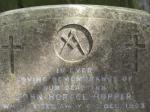
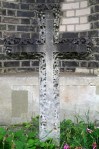
This month’s symbol features a single word, MIZPAH, but it is a term and an emblem of an emotional bond that goes beyond the grave. However, it doesn’t appear to be a common symbol and so far I have only discovered three instances of in in nearby cemeteries.
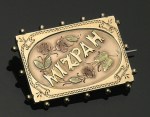
I often used to see Mizpah inscribed on old fashioned jewellery such as brooches during the 1970’s and ‘80’s when browsing in charity shops and jumble sales. At that time I thought that it might have been Hebrew, or a similar language, and might have stood for Mother.
However, during this year’s Open House I visited St Nicholas church in Chislehurst as I’d read somewhere that Napoleon III was buried there. Alas, it was the wrong church and he has long since been re-interred elsewhere. However, on a churchyard tour that afternoon, led by Peter Appleby, I finally learned what it actually signified as he indicated Mizpah on the Campbell monument. He said that it came from an Old Testament phrase ‘I will set around you a mountain which will keep you and protect you.’ I haven’t been able to find this particular Biblical quotation although Psalm 27.5 seems to be the likeliest source.
The word appears in the Old Testament in Genesis 31:49 :
‘And Mizpah, for he said, the Lord watch between you and me, when we are out of another’s sight.’ King James Bible
In other words the one left behind is still protected and watched over even though their loved one has gone. The touching link between two people or an entire family who have been separated by death or another force.
But there is another version, according to Wikipedia, in which it’s claimed that Mizpah stands for ’Lord watch over me’ and relates to the story of Jacob and Laban. Jacob fled with from Laban’s house in the middle of the night with all of his earthly possessions including animals, wives and children and Laban was soon in pursuit. But the two men came to an agreement and built a watchtower or Mizpah. This would be a border between their respective territories and neither would pass the watchtower, which was reputed to be merely a pile of stones, to visit the other to do evil. God would be the only witness to their pact and would protect one from the other. Today a modern village stands on the supposed site called Metullah which means lookout.
However I prefer the more poignant reference to the affectionate ties between the departed and the bereaved and the wish to leave them with the feeling that they were still being supported and protected as exemplified by the one simple word.
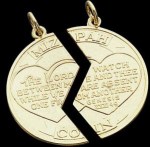
MIZPAH jewellery is still available and is often in the form of a coin shaped pendant, cut in two, with a zig-zag line bearing the words that I quoted in the first paragraph.
Here are two examples that I found online; one is vintage and the other is contemporary.
MIZPAH brooch found on Jewelry Nerd. Used without permission.
Example of MIZPAH medal/coin. Found on Jewelry Nerd. Used without permission
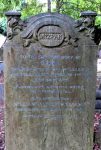
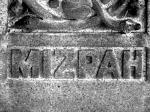
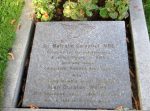
This first example is from Beckenham Cemetery and the Victorian epitaph is an affectionate tribute to a much loved and missed wife, Emma.
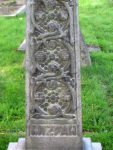
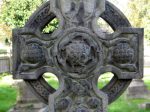
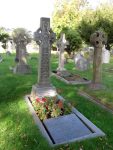
The second is from the Campbell monument in St Nicholas churchyard. The Celtic cross above the grave has strapwork made from entwined snakes, themselves symbols of eternity and mortality. The Campbells had two famous sons; Sir Malcolm Campbell and his son Donald. Note the small motif of a bluebird in one corner above the epitaph. This was the name of the vehicles on which both Sir Malcolm and Donald achieved several world speed records during their lifetimes. Donald was tragically killed in 1967 when another world speed record breaking attempt on Coniston Water went tragically wrong and both he and Bluebird sank the bottom of the lake. It wasn’t until 2001 that his remains were discovered and buried in Coniston cemetery. Nick Wales, his son, maintains the grave and also holds the world record for the fastest lawnmower. He has also tested a new Bluebird over Bewl Water.
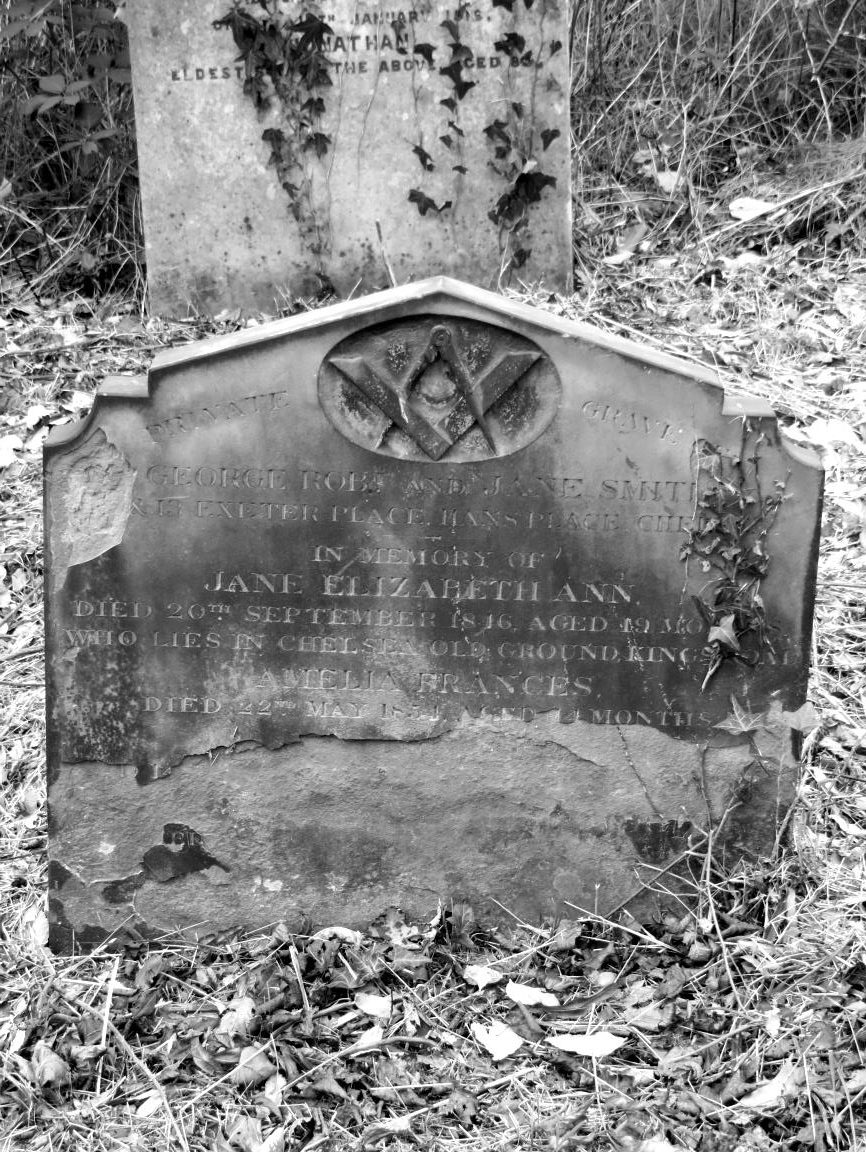
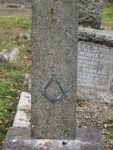
The Square and the Compass is a symbol which is traditionally associated with the Freemasons and appears on their insignia. It’s also an important part of their teachings. The two elements together form a hexagram which often has the capital letter G inside it to denote God. However, the ones that I found didn’t have this so perhaps it is a regional or international variation. But there is a another interpretation of the motif which may be more appropriate to a funerary emblem and let’s not forget that these are also an architect’s tools of the trade
The Freemason association is the most obvious and common. They’re often seen as quite a secretive and shadowy organisation. ‘It’s all leather aprons and funny handshakes.’ seems to be the opinion of many people. But according the Freemasons UK website they define themselves as’
‘the world’s largest and oldest non-religious, non-political, fraternal and charitable organisations…rooted in the traditions of the medieval stonemasons who built our cathedrals and castles.’
They also claim to ‘make good men better’ by encouraging to live their lives according to the Freemasons Five Values of Integrity, Kindness, Honesty, Fairness and Tolerance.’
They use the Square and Compass in Masonic rituals to teach symbolic lessons. Wikipedia says ‘
‘they have been defined as lessons in conduct as in Duncan’s Masonic Monitor of 1866
in which he defines ‘The square to square our actions and the compass to define boundaries and to circumscribe and keep us within the bounds of mankind.’
There is also a further, somewhat florid definition on the Masonic Lodge of education website which may make for further reading. As they point out, the square is often used in everyday language such as in ‘getting a square deal and, possibly a mason’s comment, ‘squaring off.’ It also appears in earlier texts such as Confucius. However, the square and the compass aren’t exclusive to the Freemasons as they are also used by several other fraternal organisations both in the UK and abroad.
But I prefer the definition of the symbols project in which they point out that both the square and the compass are measuring instruments and so represent judgement and discernment. The compass draws circles which are a symbol of eternity and also infinity. However the square can be viewed as being material and representing ‘fairness, balance, firmness’ and also:
‘something that is stable and a firm foundation to build upon’
They are a union of the material and of the spirit represented by the hexagram that they form. So perhaps this is the spirit leaving the earthly plane and going into eternity i.e. from earth into heaven. It’s certainly another way to look at it.
But who knows? The people who chose to use the Square and the Compass on their tombstone may have been Freemasons or maybe not. There was only one that I felt might have been one because of the quotation above the motif on his cross but this turned out to be a quotation from an 18th century hymn. With the others it was impossible to say.
You don’t see this symbol all that often although I discovered one in Brompton Cemetery and a sprinkling of them in Beckenham Cemetery recently. Interestingly, this is also a cemetery with several Salvation Army burials as well. Here is a gallery of the ones I found within Beckenham Cemetery:
With gossamer wings which turn into tiny rainbows under the sun’s rays as they pose on trees and tombstones and incredible acrobatic flying displays dragonflies and damselflies are regular visitors to my local churchyard. And 2017 has been an incredible year for spotting them.
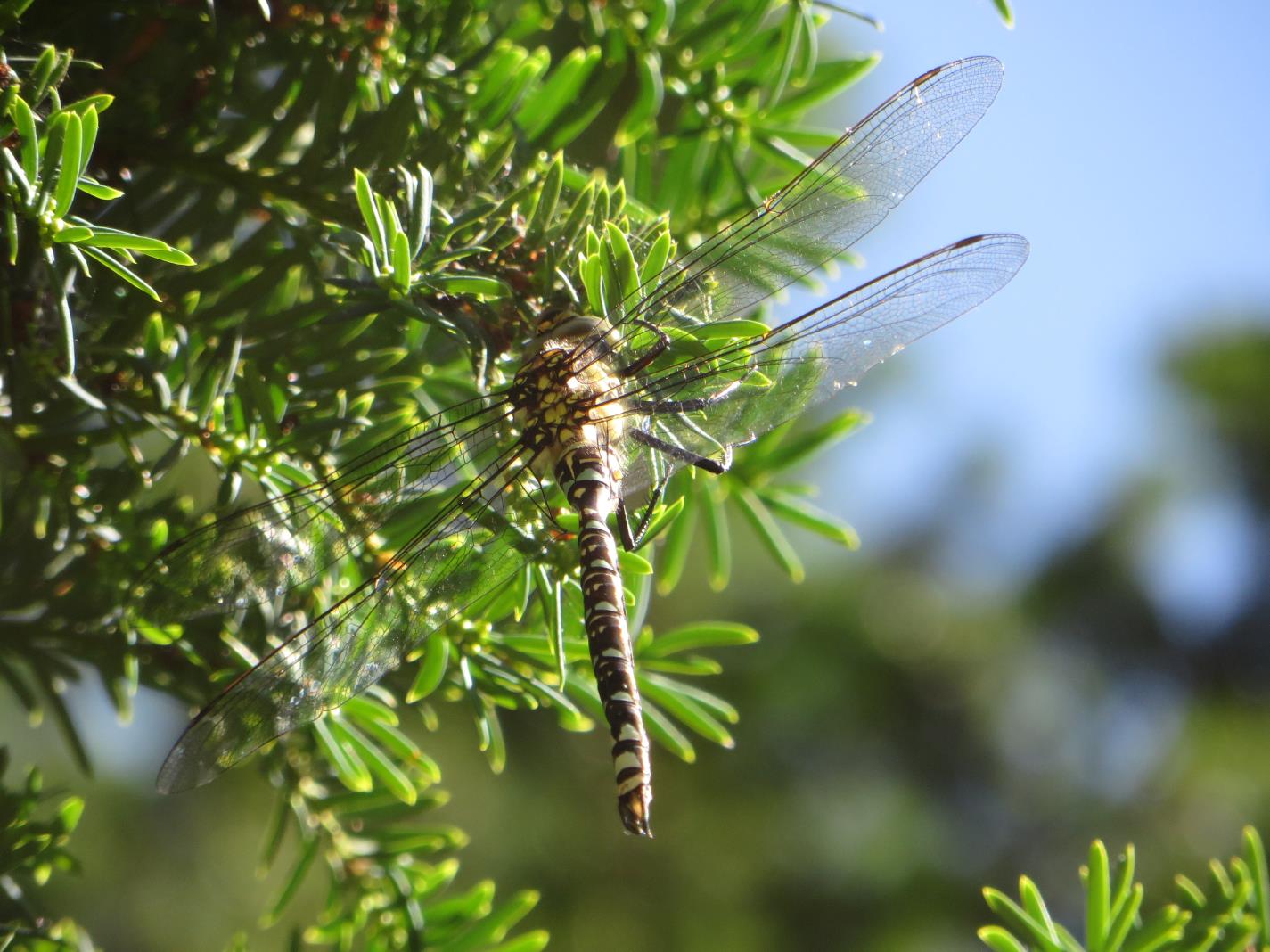
I don’t think that a chucrwarden in St George’s, Beckenham, believed me when, in 2016, she found me trying to capture a Southern Hawker which was conveniently posing on a lofty yew branch.. But this year, I have seen so many in there that it did become a regular part of my day to walk through and look for them.
I would watch in amazement at their aerodynamics and speed as their 4 wings whirled furiously like helicopter blades as they flew at speed. However, they would also fly at a more leisurely pace around and around before, tantalisingly, they would veer off into the foliage of trees to vanish from sight. It would often be the bigger dragonflies such as Southern Hawkers that I would see on the wing but also as the summer moved on, Common Darters began to appear.
Often a dragonfly would obligingly land on a tombstone or lower branch and I noticed that they were particularly attracted to evergreens such as yews. This might account for their attraction to cemeteries and graveyards.
Here’s a selection of my favourite images of dragonflies and damselflies from both cemeteries and churchyards:
This is a Southern Hawker from 2016 and was seen it in St George’s churchyard, Beckenham.
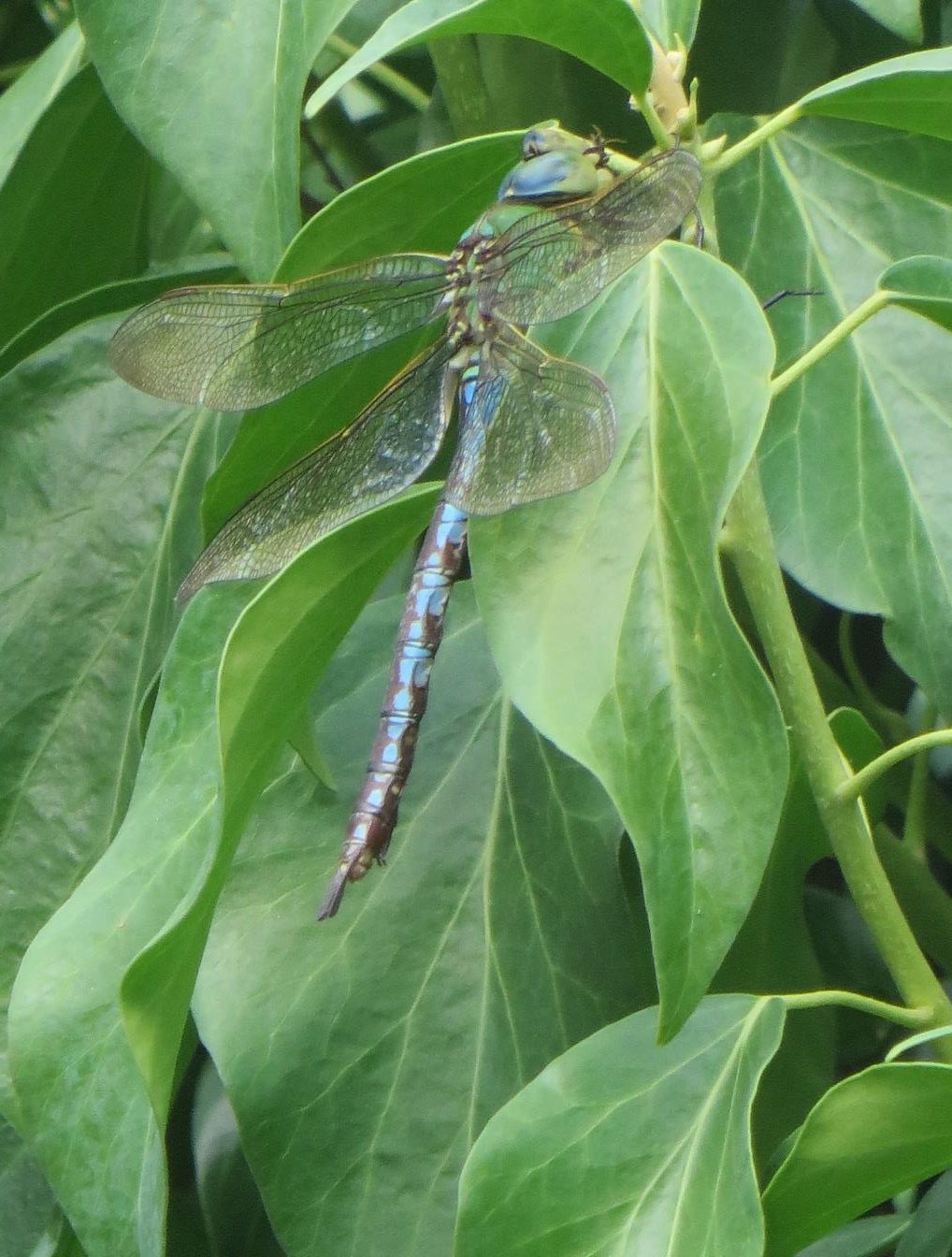
This is a male Emperor from Kensal Green cemetery, London in July 2017. I spotted him/her flying around above The Meadow section which is left uncut around the monuments and tombstones during the summer to encourage wildlife such as butterflies, In some parts it’s very damp underfoot hence the dragonfly I thought. It evaded my attempts to photograph it until, near the entrance as I was leaving, it landed temporarily on an ivy clad monument.
These are two damselflies from Beckenham Cemetery’s Garden of Remembrance pool from July 2017. From July –August it is a magnet for red and azure damselflies. They look almost like tiny, coloured sticks floating on the breeze and I caught these two ovipositing i.e. laying eggs. The upright one is laying the eggs and the other is holding it steady.
Again from St George’s but from 2017, I waited patiently until this beautiful male Southern Hawker landed and helpfully rested on a tombstone. It stayed there for a few minutes until it got fed up and flew off again.
This is a Common Darter and I saw several over the summer this year in the churchyard. For some reason they were particularly attracted to the pink granite monuments – a cool surface on a hot summer’s day?
I enjoy looking out for them and on one occasion last year the angle at which the dragonfly was perched on a yew branch and the way in which the sun shone through its wings made them look as if they were made from burnished copper.
So do look up when you’re next visiting a cemetery or churchyard on a warm summer’s day and you might be surprised. I’m looking forward to what the summer of 2018 might bring already!
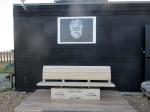
It was the striking monochrome photo that made me stop to look at this memorial on a day trip to Hastings this month. I’d admired the brand new pier and then wandered along the beach to the fishermen’s section commonly known as the Stade.
The photo was of a man whose tough outdoor life showed in his face and had obviously been a Hastings fisherman. He’d earned his livelihood from the sea in both calm and storm tossed waters with his boat as his only protection as it sailed its course, gulls shrieking overhead for any rejected catch. And then returning to the pebbled Stade at sunrise to offload the catch which would be sold at the Fishmarket later that day.
Beard died aged 68 and may have ended his days as ‘the boy on shore’ which meant that he was no longer able to go out on the boats but, instead, helped bring them ashore or sorted out the catch and nets. He looked quite a character in his photo and I felt that it really captured him.
Hastings fishermen have had the right to use the Stade free of charge for over 800 years. In fact, Stade comes from the Saxon for ‘landing place.’ There are usually 25 boats on the beach and it’s the largest beach launched fishing fleet in Britain. There’s always gulls here looking for any titbits and amidst the pebbles are the usual paraphernalia of fishing; nets, ropes and cuttlefish cages. Near the promenade and the Fishermen’s Museum are the unique tall, black tarred Grade II listed sheds used for storage. The boats have to be hauled from the sea after each trip so cannot be longer than 10 metres and care only able to travel a few miles. This makes for an ecologically friendly method of fishing.
But ask any fisherman and he’ll tell that, with quotas and costs, it’s becoming more and more difficult to make a living from the sea. In Hastings, there’s also the clash between an old established working community which occupies a large section of valuable land in the Old Town and property developers. The fishermen strongly opposed the building of the new Jerwood Gallery on part of the Stade. In fact, ‘No Jerwood’ was the message on one fisherman’s shed.
However, I couldn’t find out much about Beard apart from a brief obituary in the Hastings Observer dated 3 June 2016. It merely said that he’d died peacefully at home on 15 May 2016 and donations were to be given to either the RNLI or Cats Protection. Under the online condolences was one from a breakdown recovery service who described him as
‘a very jolly, helpful man who will be missed by the people who knew him…heartfelt condolences and sympathy to all the family.’
So he had a family and was obviously well liked but Beard may have been one of a vanishing breed. The photo that caught my attention made me wonder about Beard and his life. Memorial benches can often feel very anonymous as there’s usually only a small plaque with a few details but Beard’s photo gave you the man as well.
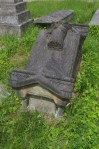
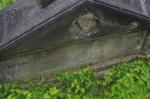
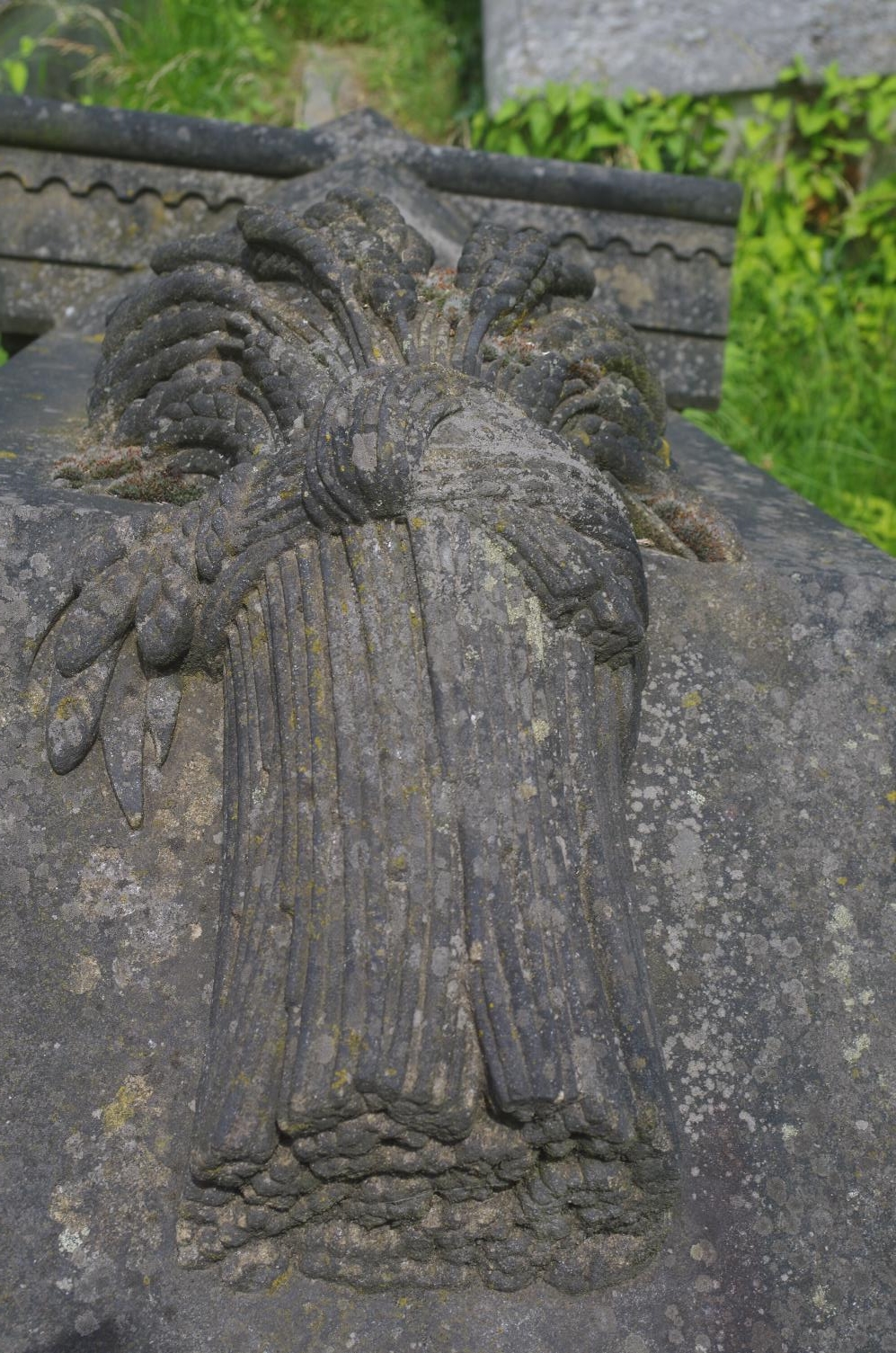
I was on a summer stroll in early July of this year in Kensal Green Cemetery when I noticed this symbol. From where I was standing it resembled a mop head which had dried out and been left on top of a grave. I was planning to carry on stalking obliging butterflies but curiosity got the better of me and I made my way over to the monument. It was then that I realised that the supposed mop head was in fact a beautifully sculpted wheatsheaf.
‘Had the deceased been a master baker?’ was my first thought as it’s a traditional symbol associated with them or perhaps a pub owner as you do see a lot of pubs called The Wheatsheaf. The epitaphs on both side of the tomb were virtually unreadable. However, on one side I could make out ‘Sarah’ and on the other ‘Milnes’. But more of the Milnes later as this family has a strong connection to Kensal Green Cemetery
A sheaf is a tied bunch of grain stalks after they have been harvested by hand with scythes. However with the advent of agricultural mechanisation it is now a bygone image. No-one has ever known the origins of this staple crop and so it has been regarded by many cultures as a gift from God.
The wheatsheaf and resurrection
However, the wheatsheaf symbol has always had strong associations with the theme of resurrection.
This seemingly humble grain has played its part in many funeral cults and mourning rites throughout ancient cultures. For example, the ancient Greeks and Romans regarded it as life springing from death or immortality. Priests are reputed to have sprinkled wheat flour on their victim’s head prior to sacrificing them. Ceres and Demeter, the Greek and Roman goddesses of harvest and agriculture, often carried either a wheatsheaf or a harvester’s sickle. Ancient Egypt was seen as the breadbasket of the ancient Mediterranean due to the volume of crops that it produced and Osiris, god of the underworld, was strongly associated with wheat within the context of a representation of rebirth.
Wheat is also important to the Christian religion with the Eucharist bread which represents the body of Christ and his sacrifice and also in remembrance of the Last Supper. There is the famous biblical quotation from Luke 22:19:
‘and he took bread and gave thanks, and brake it, and gave unto them, saying, This is my body which is given for you: do this in remembrance of me’ King James Bible.
When wheat is harvested the ground is left to lie still during the winter and then re-sown in the spring to begin the cycle of life again. Here it represents renewal and renewal as the cycle of seasons has once more given grain for bread. There is also the association with the harvesting of years in that Death and his scythe prepare to reap at the end of life.
So there has always been an association with the wheatsheaf of resurrection and remembrance. This is where it is at its most powerful as a funerary symbol. However, Douglas Keister has also suggested that a wheatsheaf on a tombstone can indicate someone who
‘lived a long and fruitful life of more than seventy years and one that was harvested by the Reaper when it was time’
The wheatsheaf and the Victorian cult of mourning
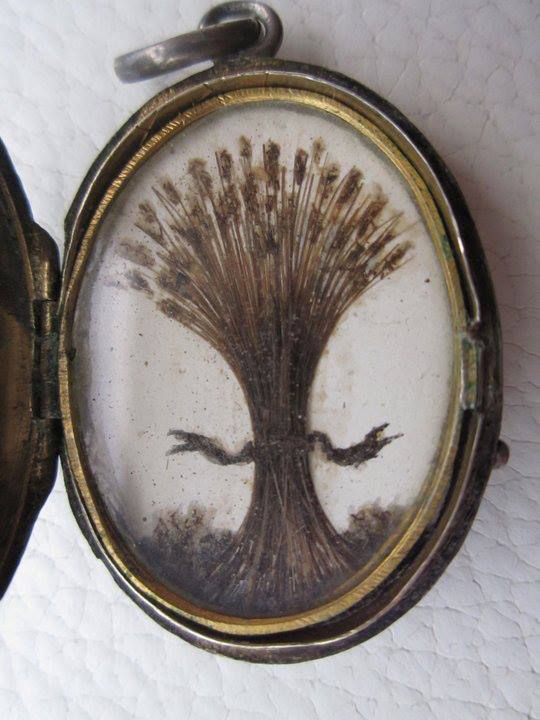
This is a lovely example of a wheatsheaf motif within a piece of Victorian mourning jewellery. I found it on Pinterest and could not find the source of the image.
According to the art of mourning website, the wheatsheaf was also a very popular motif in Victorian mourning jewellery. In fact they have suggested that it could be seen as a memento mori in that it denotes life cut and renewal or resurrection of the soul. Its heyday was during 1820-1860 and it also survived into early 20th century mourning jewellery just as it was going out of fashion. The wheatsheaf was often found in mourning wreaths, brooches, lockets and rings and was an effective emblem when working with hair to create these pieces.
There is also a stained glass window featuring a wheatsheaf at St Michael & All Angels in Eaton Bishop, Herefordshire but this may be a Victorian addition by Kempe after restoration.
This grave contains 2 women who were, respectively, the first and second wives of the Victorian sculptor Thomas Milnes. He is buried with his third and final wife elsewhere within Kensal Green cemetery under a far plainer stone. He certainly lived a long life – his dates are 21 December 1810 – 6 May 1888 but there’s no wheatsheaf on top of him. Milnes completed a number of funerary monuments which can be seen in churches in Gloucestershire, Cumbria and Suffolk and also statues which still stand in Norwich and Woolwich. Milnes exhibited statues and busts at the Royal Academy after entering its schools on 21 April 1841. He also designed another monument in Kensal Green, the horse and child on top of Alfred Cooke, which, although damaged, is still in place.
However he wasn’t destined to became a major British sculptor despite, in 1858, being invited to design and model the four lions for the base of Nelson’s column. It would have been the commission of a lifetime but his designs were deemed ‘unsuitable’ and the commission went to Sir Edwin Landseer’s monumental symbols of Empire instead. However, Milnes lions which are, in my opinion, more lively and playful than Landseer’s can be seen in Saltaire, near Bradford. After that he seems to have sunk in obscurity.
The ‘Sarah’ that is still legible on one side was Milnes’ first wife: Sarah Betsey Harrad. They married in London on 19 May 1836. Sarah died on 1 April 1867 of ‘apoplexy’ which is now known as a stroke or cerebral haemorrhage. Frances Eidsforth became his second wife on 16 July 1867 at St Georges, Bloomsbury and she died on 16 July 1875. She is buried with Sarah.
Milnes married his third and final wife, Jessie Anne Fletcher, on 1 June 1876 but there were no children from any of his marriages
Little seems to be known about either Sarah or Frances and it’s a real shame that their epitaphs, presumably on either side of the monument are now illegible. However I would assume that the wheatsheaf placed on top of them is a symbol or resurrection and a hope that they would all meet again in eternity.
The wheatsheaf is remarkably well carved and has outlasted the epitaphs. It has been presumed that it is by Milnes himself but no definite proof has been found to be able to attribute it to him with certainty.
There is another smaller wheatsheaf in Kensal Green which is on the Samuel Horsley memorial.
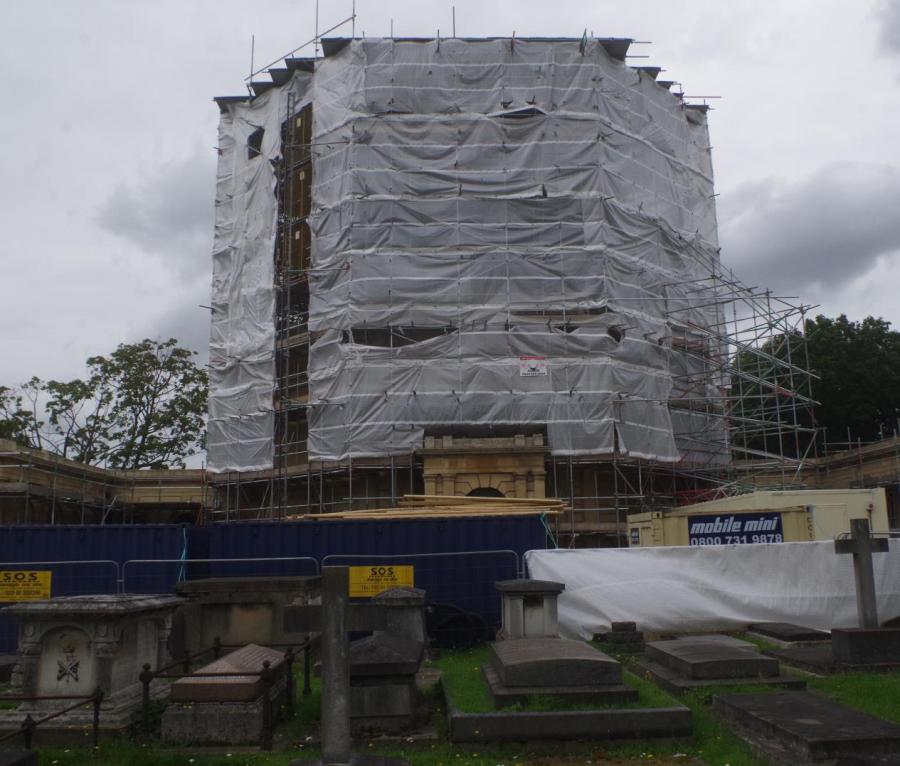
As part of its major restoration project , Brompton Cemetery held a short series of free walks around the cemetery last month to discuss future plans. I joined one which was led by Nigel Thorne, Project Manager and Halima Khanom, Partnership and Community Engagement Officer for the Royal Parks..
The weather had been dull and overcast all day but, as we gathered at the South entrance project office, blue sky suddenly burst through the clouds and it became a lovely golden summer evening bathing the chapel and monuments in a soft glow. A relief really as we were out in the open throughout. Nigel was very enthusiastic and knowledgeable and began by revealing that Brompton had received an impressive grant of £6.2 of which £4.2 had come from the Heritage Lottery Fund (your £1 lottery ticket does something useful after all even if it doesn’t make you a millionaire) and the rest had come from Parks for People.
He added that he saw cemeteries as another form of public space which I’d not previously considered and an aspect that maybe isn’t emphasised enough. Brompton is already well used as a cut through with joggers much in evidence and people on the edge of the group huddled in so as not to be entangled with cyclists.
South entrance.
This was to be updated. Apparently it hadn’t existed when Brompton had opened and had been just been land owned by British Gas. The ex -assistant cemetery manager’s accommodation and the Friends base was now the Project Office.
Almost opposite was a bijou sized building which had been, of all things, a police box dating from when the Royal Parks had had their own police force. It was now hiding behind a temporary fence.
Monument restoration
Nigel stopped by the Robert Coombes monument. This is dedicated to a champion sculler and the upturned boat on top of it with his waterman’s coat draped across it had once had a set of oars attached. These were now long gone and so, sadly, were the heads of the four statues, one at each corner. Cemetery vandals always seem to go for the heads of statues.
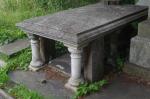
Nigel revealed that this monument was to be restored at a cost of around £40k. However, although the HLF grant included £140k for monument restoration, a substantial legacy would instead pay for Mr Coombes. We noticed that there was a tabletop grave very near to Coombes which was being propped up by blocks of wood.
Nigel almost shuddered as he related stories of the horrors of 1970’s restoration. ‘They would have been better off leaving it alone!’ he said with feeling. There is a gap between the inner and outer dome which is accessible but a tight squeeze apparently. A good opportunity I thought , to explore and record areas not normally accessible. It’s envisaged that the Chapel will be open more often once restoration is complete and visitors to a recent art exhibition were very pleased to have an additional opportunity to go inside.
There would be a disabled visitors’ ramp at the chapel entrance to increase access.
Nigel pointed up at the crumbling Bath Stone visible along the top of the East wing’s roof. ‘Very soft.’ he explained.
Two huge basements had been found under each of the East and West wings. The latter was originally the cemetery supervisor’s office. But there was a surprised in the West wing as there were no stairs making it inaccessible.
Another secret had been discovered when investigating the floor. It had always been assumed that it had been made from poured concrete but this was revealed to actually be lino. When that was taken up there was a lovely flagstone floor in a radial pattern – something to see when the chapel is reopened.
Nigel indicated where Brompton’s original owners had run out of money and the lonely cupola above a colonnade marked the spot.
The Western catacombs:
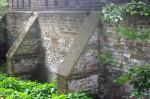
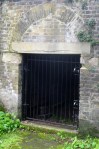
These were never used as catacombs but they form part of the boundary walls facing onto the rail and tube line. A gated and blocked entrance at either end still remains with a far grander one in the centre. Originally it had a promenade over the top on which visitors could walk and admire the fields and canal on the other side but these are obviously long gone. Parts of the promenade still remain but I wouldn’t fancy walking on it now. Some of the wall is now supported by buttresses and one end of the catacombs is now in the new Horticultural team’s area.
When opened the catacombs were found to full of spoil which took a year to dig out. This had to be done as it was pushing out the wall that faced onto the railway line.
Nigel told us that all of Brompton’s current paths are made of tarmac. This leads to a uniformity of paths that can be confusing for a visually impaired visitor. As a result, one blind woman had no idea where she was in Brompton. It was now hoped to have a hierarchy of paths to counteract this.
Cemetery maintenance:
We paused by a rampant area of long grass and wildflowers (or weeds depending on your point of view). Nigel commented that the area needed a tidy up and that grave owners in the area had been given Brompton’s policy and their obligations at the time of burial – no vertical tombstones or planting.
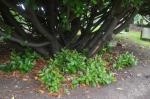
A perennial problem was the planting of small trees and shrubs on graves which are now huge. According to Nigel they reduce light and space as well as damaging and obscuring memorials and monuments. He indicated a somewhat spindly rose bush which looked very untended.
A huge laurel plant had had its lower branches lopped but regrowth had already started. There was a monument just underneath it which we could hardly see. I found others examples such as the Mary King grave by the chapel.
There’s a debate between those who like cemetery to look messy to encourage wildlife and those who don’t. I personally like wild areas to encourage this as Brompton is known for its large crow population and I’ve disturbed the odd sunbathing fox. The large bramble stands, in Nigel’s opinion, were of benefit only to the foxes as hiding places.
Garden of Remembrance:
The tall hedges surrounding it are to be reduced in size as they encourage anti-social behaviour. Visitors can buy a 1m memorial tablet under which up to 4 urns can be buried.
Work on the visitors centre and café is well on schedule – I’ve been pleasantly surprised by the speed at which they are being built. Nigel added that the café was intended to be a social enterprise and not another outpost of one of the chains. It would be staffed by local people and use local produce (blackberry jam anyone?). The visitors centre opposite had all sorts of exciting plans such as allowing visitors access to Brompton’s records of the 200k people buried within it.
A fascinating walk – our thanks to Nigel and Halima – which covered not only Brompton’s ambitious restoration plans but also some of the problems of cemetery maintenance and restoration.
Shadows move on the coffins and walls. Above you the glass orbs set into the high ceiling admit a little light into the depths but you prefer the intimate illumination of the flame. It reflects on the brass fittings and the patterns of the nails on the coffin on the shelf beside you. Your loved one now rests eternally in Brompton catacombs as you sit by the head of the coffin in its space or lochulus. Family news, world events: you talk to them as if they were alive with your voice the only sound in the silence. Then you open the book that you have brought with you at the bookmarked page, and then read the next chapter of what was their favourite novel. It’s almost like having your own private mausoleum.
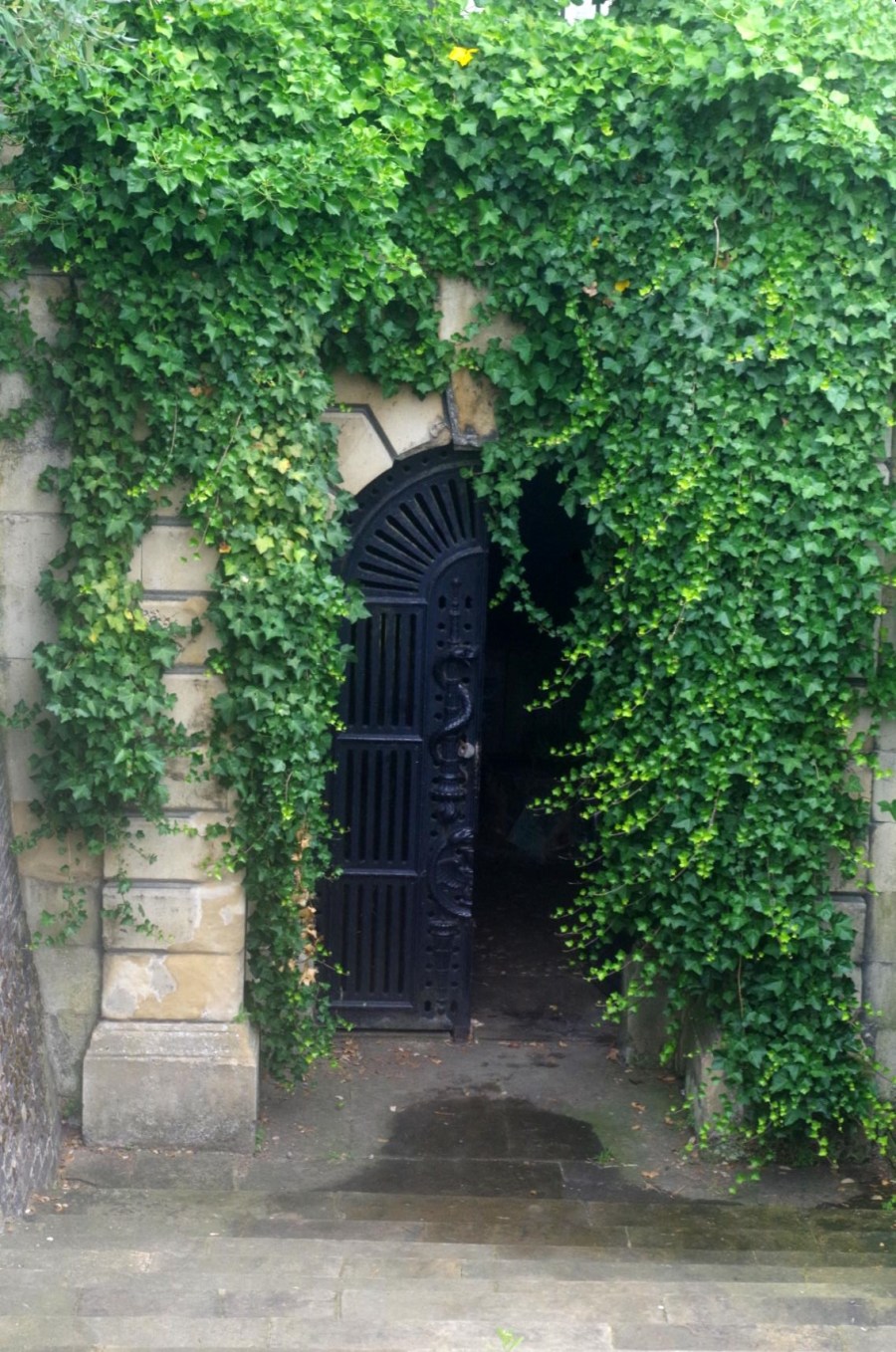
Finally, almost reluctantly, you close the book, after having marked next week’s chapter and pick up the candleholder. As you walk towards the cast iron entrance gates, your footsteps echo behind you and the candle finally goes out as you open them. The sun outside temporarily blinds you as you pull the gate closed and then lock it with your own key. The symbols of eternity and mortality on them remind you of the other world behind. Then you ascend the flight of steps and return into Brompton Cemetery and the noisy world again. You have been ‘communing with the dead’ as our guide, Nick, explained.
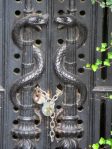
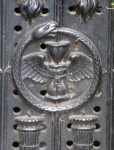
Brompton Cemetery isn’t holding an Open Day in 2017 due to the ongoing restoration project but, instead, on 15 July they held catacomb tours. These are not usually open and I haven’t visited these for some time so eagerly took up the opportunity. It was a drizzly day so it was good to be under cover. The catacombs have the most magnificent cast iron doors featuring snakes, downturned torches, an ouroboros and a winged hourglass – all symbols of mortality and eternity. You know that you are entering the realm of the dead once you step inside.
I have visited several catacombs located in large London cemeteries and what has always remained with me is the special and unique atmosphere that each one has: Kensal Green, Highgate, Brompton and the Valhalla that is West Norwood. One of Nunhead’s catacombs has now become the Anglican chapel crypt and is only open on certain days.
Catacombs never became popular in England and most of the coffin spaces available were destined to only have dust as an occupant. These are known as loculi or loculus in the singular. Even Highgate was unable to sell all theirs in the Egyptian Avenue and I would have thought that they would have been snapped up. However, there is reputed to be a cemetery in Cheshunt which is doing a roaring trade in selling them as they have an Italian and Greek community who view catacombs differently.
There is another set of catacombs under Brompton’s western colonnades with an identical set of doors on the other side of the circle but these have remained unused. The other Western catacombs on the boundary side were never used and when reopened were crammed floor to ceiling with spoil which took a year to remove.
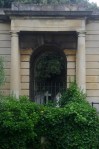
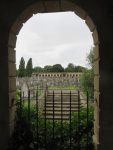
We were visiting the Eastern colonnade crypt and a flight of steps led to the iron doors. As Nick said imagine six pallbearers carrying a coffin on their shoulders down them on a wet day. The coffin would have been triple lined: wood, lead, wood so a heavy load indeed. Brompton, unlike other catacombs, such as West Norwood or Kensal Green, didn’t have a chapel above the catacombs with a handy hydraulic catafalque to transport the coffin down into the darkness.
Nick indicated an interment in the first chamber behind the doors. This was sealed in with a plaque and epitaph dedicated to Captain Alexander Louis Ricardo of the Grenadier Guards. For me, it was a reminder of the still unsolved Victorian Charles Bravo murder. Captain Ricardo was Florence Bravo’s first husband who died young from alcoholism in Cologne. I noticed ferns growing from a family vault beneath him and wondered about damp as a perennial problem.
Lit candles had been placed on the coffin shelves to light our way which added to the ambience. Victorians were fascinated with the idea of an afterlife and seances and mediums were big business. Sir William Crookes of the notorious Katie King case is also buried in Brompton. Nick added the Victorians were a heady mix of hardheadiness and sentimentality.
The glass inserts that allowed some light into the catacomb have long gone and been bricked up. Brompton’s original owners, The Westminster and West London Cemetery Company initially offered 4000 loculi for sale but of these only 700 were sold. So if you have a hankering for going underground they still have at least 3300 spaces available. Nick informed us that the last request for a catacomb space was in 1926.
English catacombs were based on the ones in Rome. Cremation was illegal until well into the 19th century so it was either under or over ground burial until then. Catacombs at Brompton were also called upon as a temporary mortuary when necessary. A visitor noticed that one coffin was just under the roof above four other coffins stacked on shelves and asked how the cemetery workers got it up there. Nick indicated the pulley blocks that they could have used to lift it up and manoeuvre it into place. Quite a feat.
Nick indicated the plumber’s diaper mark on the exposed side of one coffin which indicated that he had sealed it properly and there would be no leakages. He also pointed out the wreaths, somewhat desiccated by now, that mourners often left by the coffins, and there was a small elegant urn containing ashes placed on a shelf next to one.
Our visit lasted 30 minutes and we filed out towards the light of the outside world again leaving Brompton’s catacomb’s incumbents to eternally sleep on.
The attractive colonnades of Brompton are above the catacombs and have plaques on their walls. These were to enable friends or other relatives without keys to pay their respects to the deceased at the plaque. These are reputed to be affixed directly above the departed’s place within the chamber.
A word of cautionfor anyone considering visiting a catacomb for the first time: if you feel uncomfortable about seeing coffins, and a lot of people do, then don’t visit or think carefully about it first.
Please note: Photography is not permitted in the Brompton catacombs.
Summer is when you can really appreciate the wild corners and places within cemeteries. Often spaces between tombstones and monuments will be left unmown or unscythed which allows grasses to grow tall. The rapidly expanding bramble stands are good hiding places for foxes to hide in or use to travel between. Already ripe, plump blackberries are dessert for hungry birds and jam makers.
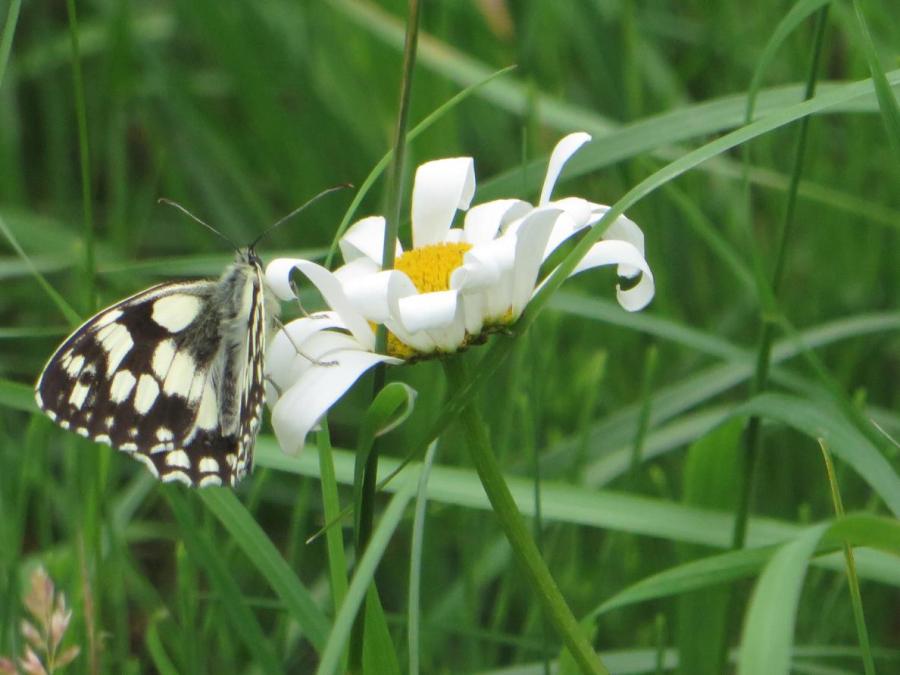
Wildflowers begin to stud the grass and undergrowth with bright dots of colour as they bud and begin to flower under the summer sun’s rays. These create dazzling combinations of colour as they grow together. At Kensal Green one area near the closed catacomb terrace is designated as a meadow. I stood inside it in early July of this year, almost waist high in grass and flowers, surrounded by flitting butterflies and day flying moths, leaping grasshoppers and even a large blue Emperor dragonfly. The latter was a complete surprise. There was even a pair of courting Small White butterflies as well. I just felt so happy to be there with the sun on my face and nature getting on with itself regardless of me.
Ragwort, a bright yellow plant which is rampant at the moment, divides opinion in some quarters. It has been described as a weed and a wildflower. Butterflies love it but it’s poisonous to cattle and horses. I counted 8 Gatekeepers on one Ragwort flower head munching away quite contentedly. The cemeteries that I explored teamed with wildlife and sometimes unusual or uncommon specimens.
I am a Citizen Scientist (not the most catchiest of titles I must admit and it sounds somewhat po-faced)which means that I go about recording wildlife and what I see on my urban ramblings for various websites including irecord and the LondonButterflyProject. Cemeteries are highly recommended by the latter organisation as great places in which to find butterflies and now, I go to a cemetery or graveyard first, in order to do my count.
So here’s a gallery of what you might find on a sunny afternoon wander through a marble orchard.
NB: Be careful and take care if walking through or exploring areas of long grass and wildflowers as monuments can be camouflaged by them. So wear appropriate footwear – not flips-flops – and watch out for kerbstones and the edges of graves so that you don’t trip over them. Also, due to subsidence monuments can also be at odd angles so again take care.
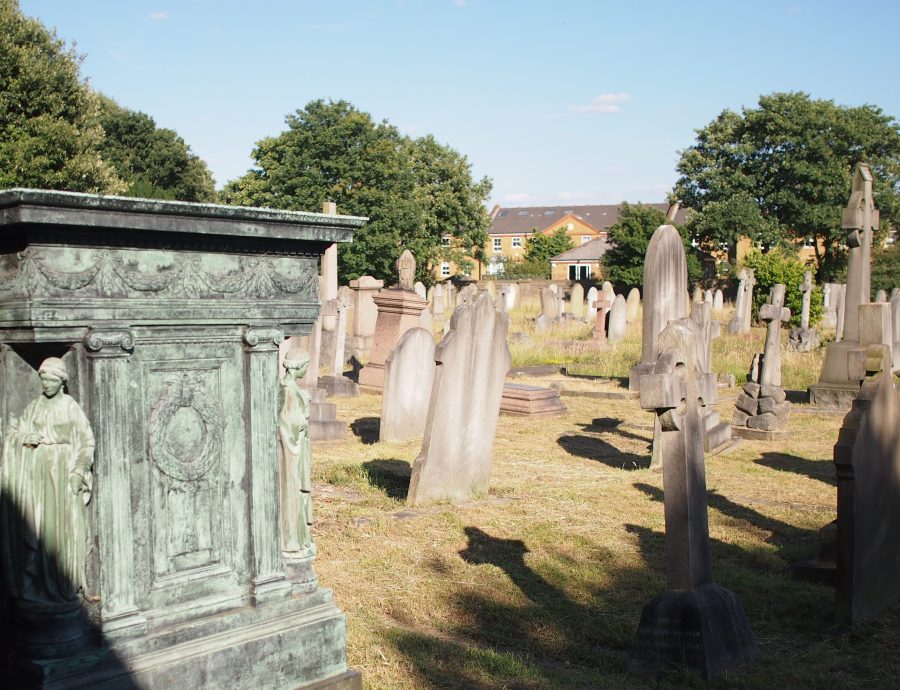
Chiswick Old Burial Ground is a large extension to the old churchyard at St Nicholas, Chiswick, close to the River Thames in west London. The Georgian graves clustered closest to the church (including the grand tomb of the artist William Hogarth) give way to Victorian and more modest headstones, filling a site that’s just under 7 acres in size. Unlike some of London’s larger Victorian cemeteries, most of the memorials here are fairly modest in scale and ornamentation, made from stone or occasionally marble. But one incongrous memorial catches the eye, despite being tucked away near the cemetery’s northern boundary wall: a striking copper tomb turned green by the passing of the years, which marks the burial place of two artists.
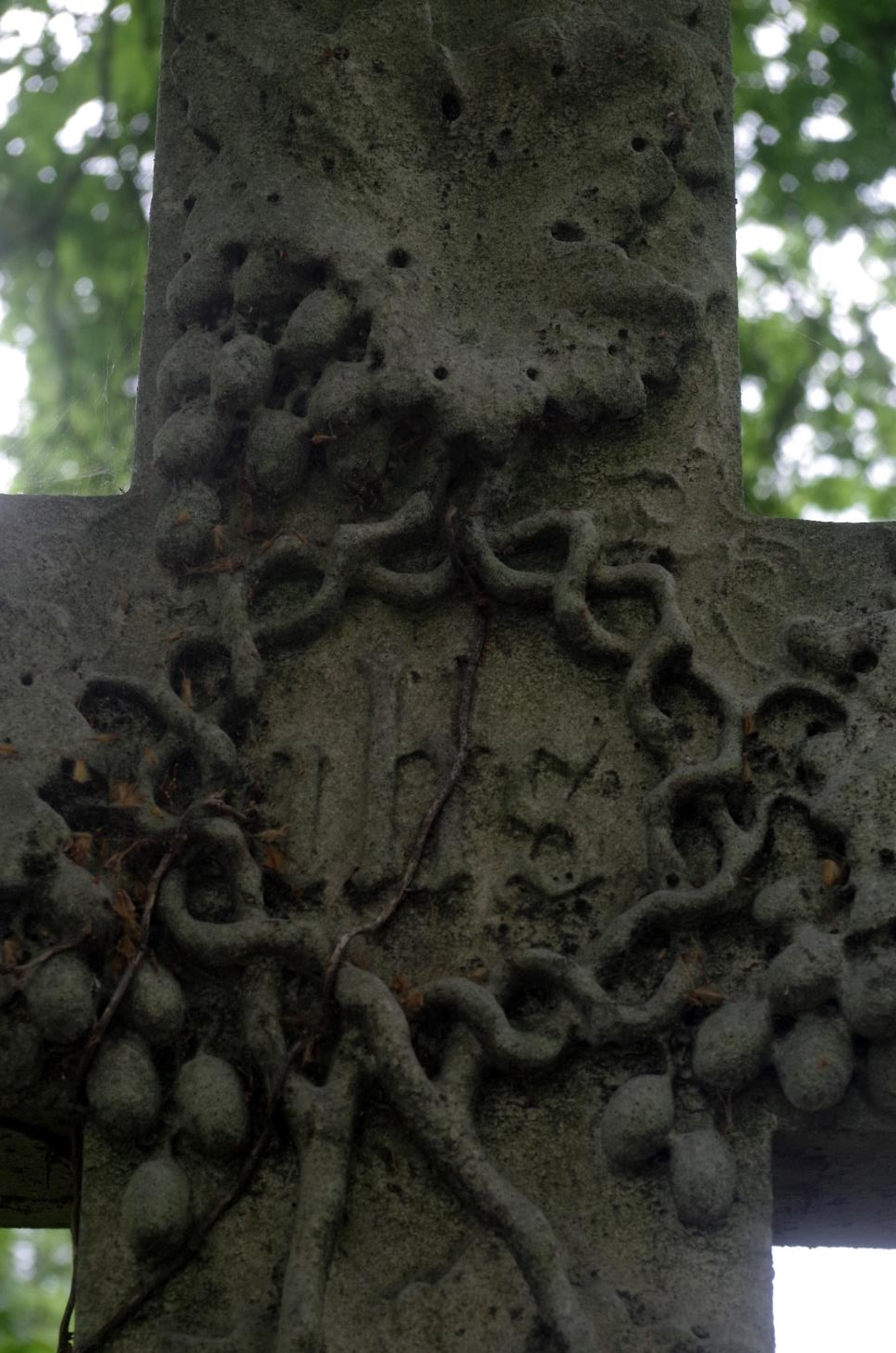
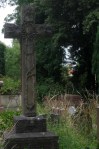
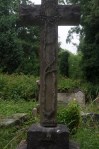
This is another less well known symbol but, in my opinion, a very attractive one. I found two examples of a grapevine climbing up a cross during a recent visit to Kensal Green cemetery together with another that only featured grapes as decoration and a fourth which had trailing vine leaves on a Celtic cross. The first two in Kensal Green really make good use of the cross on which they are carved to its fullest advantage with the vines sinuously climbing up the stem and then the leaves almost hanging from the crosspiece. In fact the form of a grapevine almost resembles a cross with the long stems stretching up and then branching out horizontally with the grapes hanging from them. I also found a cross in Brompton Cemetery which had a design of grapes and vine leaves as a border around its edges.
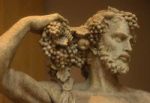
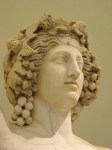
For the source of this symbol we have to go back to the ancient Greeks and the god Dionysus. He was also known to the ancient Romans as Bacchus and both of them are always represented in paintings and sculptures as holding grapes. The latter were often depicted on Greek wine cups in tribute to Dionysus. Both of them were seen as the god of the vine and were associated with wine-making, celebration and ecstasy. Dionysus was also associated with rebirth in that, after his dismemberment by the Titans, he came back to life in an echo of the winter pruning of grapevines so they may bear fruit again during the next year. He was unique in that he could bring a dead person back from the underworld.
As you may imagine, the early Christians adopted the less bacchanalian side of Dionysus and Bacchus. There are many similarities between Dionysus and Jesus in that both were supposed to have been born from a mortal woman but fathered by a god, to have returned from the dead and to have transformed water into wine. The early Christians took the latter and transformed it into a miracle. They also used the powerful symbol of the grapevine with Christ calling himself ‘the vine.’ In John 15:5 there is the famous quotation:
‘I am the vine and you are the branches. If a man is in me and I in him, he will bear much fruit.’
In fact a vine and its branches are traditionally seen as depicting Christ and his followers, the Church and its faithful. He also uses the analogy of the Kingdom of Heaven as being similar to that of a manager hiring workers for his vineyard. The grapevine was also adopted by the ancient Roman Christian converts and appears on their graves and in their mosaics.
Grapes are an abundant crop and are one of the earliest cultivated crops known to us. It bears fruit for the harvest and so is associated with celebration and good times. The artofmourning website has suggested that there is also an element of birth/rebirth with the representation of the grapes and also a connection with victory.
‘The ripe harvest shows the promise of the fruits rewards being reaped and turned into the production of sustenance for the future.’
An interesting theory within the context of a funerary symbol as it hints at resurrection. There is also the theme of sacrifice. Wine, which comes from the grape, has always traditionally been seen as representing the blood of Christ and this is particularly symbolic during the service of Holy Communion within the Catholic church. Also, during the Last Supper, Christ gave wine to his disciples and told them to drink it in remembrance of him.
But what does this age-old symbol mean within a Victorian London cemetery? As I see it, it can be a representation of the deceased becoming part of an eternal vineyard i.e. the Kingdom of Heaven or that their earthly lives were full of abundance and achievement. But it can also be a motif of resurrection in that the grapes are crushed underfoot to be reborn as wine and this would be highly appropriate for use within a cemetery. In fact I’m surprised that it doesn’t appear more often as it is very eye-catching amongst more restrained classical symbols especially when combined with a cross.
These two fine examples come from Kensal Green cemetery and demonstrate how well a grapevine translates onto a cross. Note the three letters in the centre of the Cross which are IHS combined together. This is a Greek abbreviation for Jesus Christ, Man and Saviour which is ‘Iesus Honinum Salvator’ which translates as ‘Jesus the Saviour of Man’.
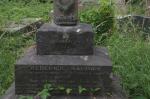
The first is to Frederick Salmon and the other to George Gordon Moir. I haven’t been able to find out anything on Moir but research is ongoing. However, he obviously liked Salmon’s cross and embellishment as his is identical.
But Frederick Salmon (1796 – 1859) was a renowned and pioneering surgeon and he has a fascinating story to tell.
Salmon was a restless Victorian medical man out to make his mark and improve the lives of his fellow citizens. In many ways he was a maverick destined to rebel against and work outside the medical establishment of the time. As you can see from his epitaph he founded St Mark’s Hospital which is still in existence, based in Harrow and is part of the St Bart’s and the London NHS Trust.
He was born in Bath in 1796 and, at 15, was apprenticed to a surgeon-apothecary. Somewhere along the line he met William White, one of the earliest surgeons to write on rectal disease. Salmon always credited White with the direction in which his own career went which was in the field of proctology.
However, the medical establishment frustrated Salmon. Training depended on money and influence as posts had to be bought and so were often earmarked for friends and relations of surgeons and physicians. In 1817 he paid £8.15s.0d to become a house surgeon at St Barts and then rose to a surgeon’s post. He also wrote a book on intestinal disease in 1828 which ran to four editions. But Salmon became part of a medical scandal when, in 1833 aged 37, he resigned with other staff members from the General Dispensary in protest. They were angry at the plans of the hospital governors to revert to a system in which posts were up for sale to those who could afford to pay. The Lancet declared in the same year that the practice was ‘one of money, of favour and of family interest.’ Salmon was now a free man and obviously one of considerable charisma and talent. He founded St Mark’s in 1835 with the City of London providing much of the finance. It was in one room with seven beds and 2 other staff members at 11 Aldersgate Street in the City. A plaque still marks its location. It had the less than catchy name of St Mark’s Infirmary for the Relief of the Poor afflicted with Fistula and other diseases of the Rectum. But it soon acquired a nickname: The Fistula Infirmary. Despite several moves and expansions of premises St Mark’s remained in the City until 1995 when it moved to its present location.
From the beginning St Mark’s filled a desperate need for London’s poor to be able to access treatment. Salmon was not only able to attract significant funding but also wealthy patrons and supporters. Sir William Copeland, Lord Mayor of London, was a grateful patient who became St Mark’s first President and Charles Dickens presented several autographed copies of his latest book, The Pickwick Papers, and 10 guineas in gratitude. This was after having undergone a rectal operation without anaesthetics. Salmon was reputed to have performed 3500 operations without a single fatality which was an incredible achievement at a time when antiseptics were unknown and anaesthetics were only just coming into use.
Salmon retired, due to ill health, in 1859 and died at Ombersley near Droitwich on 3 January 1868 aged 72. St Mark’s was his lasting legacy and there is a ward named after him. Today the hospital is one of only 14 worldwide hospitals to be recognised as a centre of excellence by the Worldwide Organisation of Digestive Endoscopy.
Salmon was a vine that bore fruit as did John Edward Taylor (1830-1905)
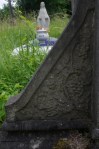
Mr Taylor’s magnificent Art Nouveau style monument is tucked away on a lower path in Kensal Green Cemetery. It dwarves the far more recent surrounding graves and headstones. Such unashamedly Art Nouveau memorials are rare within cemeteries. There’s one in Streatham cemetery, a lovely gem in West Norwood, another in Hendon and there are undoubtedly others scattered across London.
Here the grapes are carved on the left hand side sidepiece flanking the main memorial. These reflect the Art Nouveau love of natural forms and structures. The movement used the curving, organic lines taken from plants and flowers. But, by the time Mr Taylor’s widow Martha died in 1912, Art Nouveau was about to be replaced by the angular lines of Art Deco.
Taylor was another restless Victorian man who was involved in many areas. He was the second son of John Edward Taylor senior who founded the Manchester Guardian in 1821 backed by a group of local liberals known as The Little Circle. They had successfully lobbied for parliamentary reform in the era of rotten boroughs and as a result of their efforts Parliament passed the Reform Act of 1832. Taylor senior witnessed the Peterloo massacre in 1819 but been unimpressed by its leaders. The Manchester Guardian is still in business but now renamed the Guardian and Taylor edited it until his death at the early age of 52.
After the death of his older brother, Russell, in 1848 Edward became co-owner and then sole owner of his father’s paper in 1856. He also edited it from 1861-1872. Newspaper ink was in his blood and he also became owner and then co-owner of the Manchester Evening News until his death. He was also a philanthropist and believed in education which led him to become a trustee of Manchester College from 1854 until his death. He founded the Manchester Aid Society in 1863, advocated temperance and free trade and was also involved in the British and Foreign Bible Society. On top of this he was also a director of the Buenos Aires Great Southern Railway Company.
Taylor remained a lifelong liberal and in 1895 he refused a baronetcy offered to him by Lord Rosebery. But he was also known as a great art collector and a generous one. He often lent out some of his collection to local exhibitions in Manchester or at Burlington House. After his death, Christie’s held a sale of his collection over 12 days and achieved record prices for the time. Taylor lived in London after his marriage in 1861 to Martha Elizabeth, the sorrowing wife, recorded on the monument. The newspapers passed to other members of the extended family.
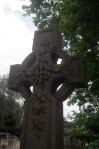
This is less ornate and, instead, features vine leaves cascading on a Celtic cross with again the very ornate combined letters of IHS in the centre of the cross, or the nimbus, with a dedication below to Matilda Morris who died on 10 December 1881. Again I haven’t been able to find out anything about her but research is ongoing.
This is an example from Brompton Cemetery and here the grapevine and leaves form an intricate pattern around the cross. I may not be able to read the epitaph on the flat slab beneath until the winter die-off.