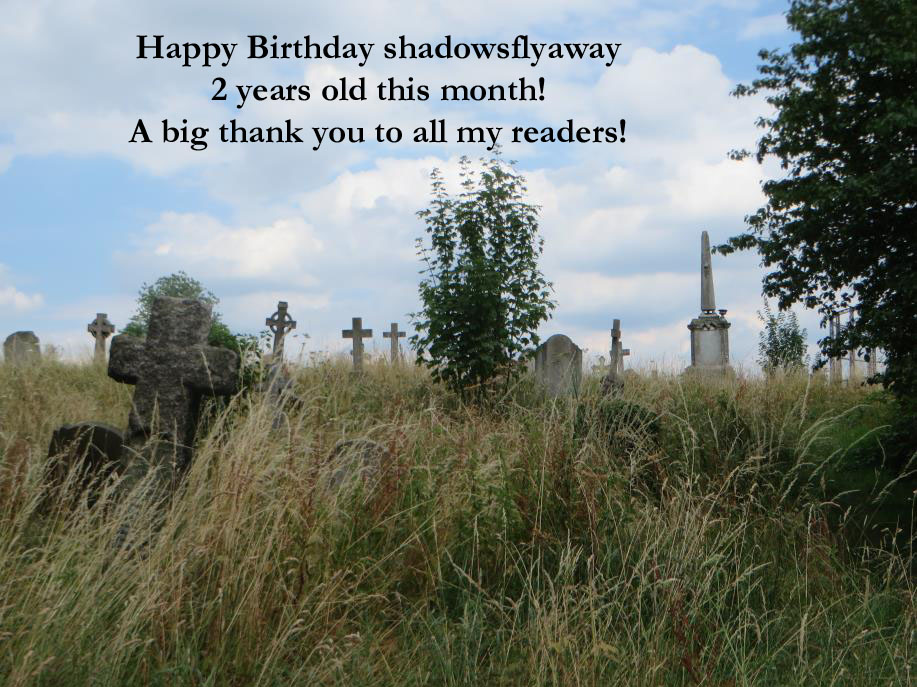
Yes shadowsflyaway is two years old this month! I’ll just blow out the candles on the birthday cake…
When I started shadowsflyaway in July 2015 I had no idea if anyone would read it although I invited a few like-minded people to view it. But sometimes putting something out into cyberspace with no idea of who, or if anyone, is going to look at it can be very liberating.
But some of my readers and followers have been with me from the start so thank you for staying with me and the blog.
And also welcome to my new followers and readers – it’s great to have you on board!
I really enjoy writing and researching shadowsflyaway as well as taking the photos to accompany the posts. I never know where the research might take me from a simple symbol to an unsolved Victorian murder. I know that Symbol of the Month is very popular and there’s many more out there for me to write about and discover. As a tour guide leading a recent Symbols tour within Brompton Cemetery it was a privilege to share my passion with other enthusiastic people face to face.
Shadowsflyaway started out to support my proposed book on symbols which is still an ongoing project. But the blog has taken on a life of its own and has also encompassed other aspects of cemeteries such as wildlife etc.
So raise your glasses,mugs or cups and let’s drink a toast to you for your support and to the next year of shadowsflyaway……now let me take you by the hand and we’ll explore that shadowy, overgrown part of the local cemetery as I’m sure there’s an interesting symbol under all that undergrowth……trust me I know these things.
Once Spring has sprung it brings with it the start of the Cemetery Open Day season. What better way to spend your time on a sunny day than out in a cemetery?
In London, with the Magnificent 7, it kicks off with Nunhead’s cross between a village fete and a knees-up followed by Brompton, Kensal Green and Tower Hamlets.
However, the Open Days are not, as you might be thinking, an opportunity for cemetery volunteers to measure you up for an eternal des res . But, instead, they’re a good opportunity to wander round and explore. Now you have an excuse to visit that cemetery that you’ve always been meaning to go and have a look round but were worried that you weren’t quite Goth enough.. , There will be undoubtedly be a nice cuppa on offer, the opportunity to go on a tour or just admire the scenery. Each cemetery has its own unique atmosphere and little gems to discover .
Sadly neither Brompton or Kensal Green are holding Open Days in 2017 (boo!) but it’s not only the Magnificent 7 that have them. In 2013 I attended the Friends of Streatham Cemetery’s Open day. Unfortunately for them it rained all day. But there was a newly reopened derelict chapel to explore, interesting angels to see and some excellent refreshments. In the 1990’s Brookwood Cemetery near Woking held an Open Day at which Highgate sold chocolate covered marzipan coffins shaped biscuits on their stall – well worth the trip alone.
So why not support your local cemetery and go and have a look round when you see the Open Day posters on display. . You never know, you might find a long lost relative in the undergrowth or a lovely piece of cake in the refreshments section.
This is a slightly revised article I wrote for the Friends of Kensal Green’s magazine, Th e Telemon, on my fond memories of previous Kensal Green Open Days.
‘Only 50p.’ said the earnest young Goth at the entrance gate as he offered me a small red plastic coffin. Inside was a pastel coloured candy skeleton in pieces. How could I resist such a bargain?
This souvenir was offered at one of the first Kensal Green Open Days that I attended in the mid 1990’s. I was a little overawed by the cemetery at first as I walked along the main avenue, past the Casement Turks, the four angels and the Princess Sophia’s bathtub – sorry I mean sarcophagus. Kensal Green felt like a huge film set as the avenue swept up to the dramatic Anglican chapel and colonnades. In the courtyard behind the chapel was a flock of glamorous Goths roosting like exotic birds of paradise. In contrast, there were waiters bustling about serving strawberries. I felt that they set the tone but, alas, although the Goths are still visible, the waiters are not.
However, each Open Day has had its own highlights and special memories; a man in period costume enthusiastically riding a penny farthing bicycle around the chapel, Goths peering out from colonnade columns or posing over in the terraces and atmospheric tours of the catacombs, now sadly closed for restoration. The ebony clad throng may have decreased over the years and Medusa, as Aspasia Broome’s heavenward gazing figure was known, has lost her crown of dead tree branches but the Open Day is a permanent fixture in the London cemetery calendar.
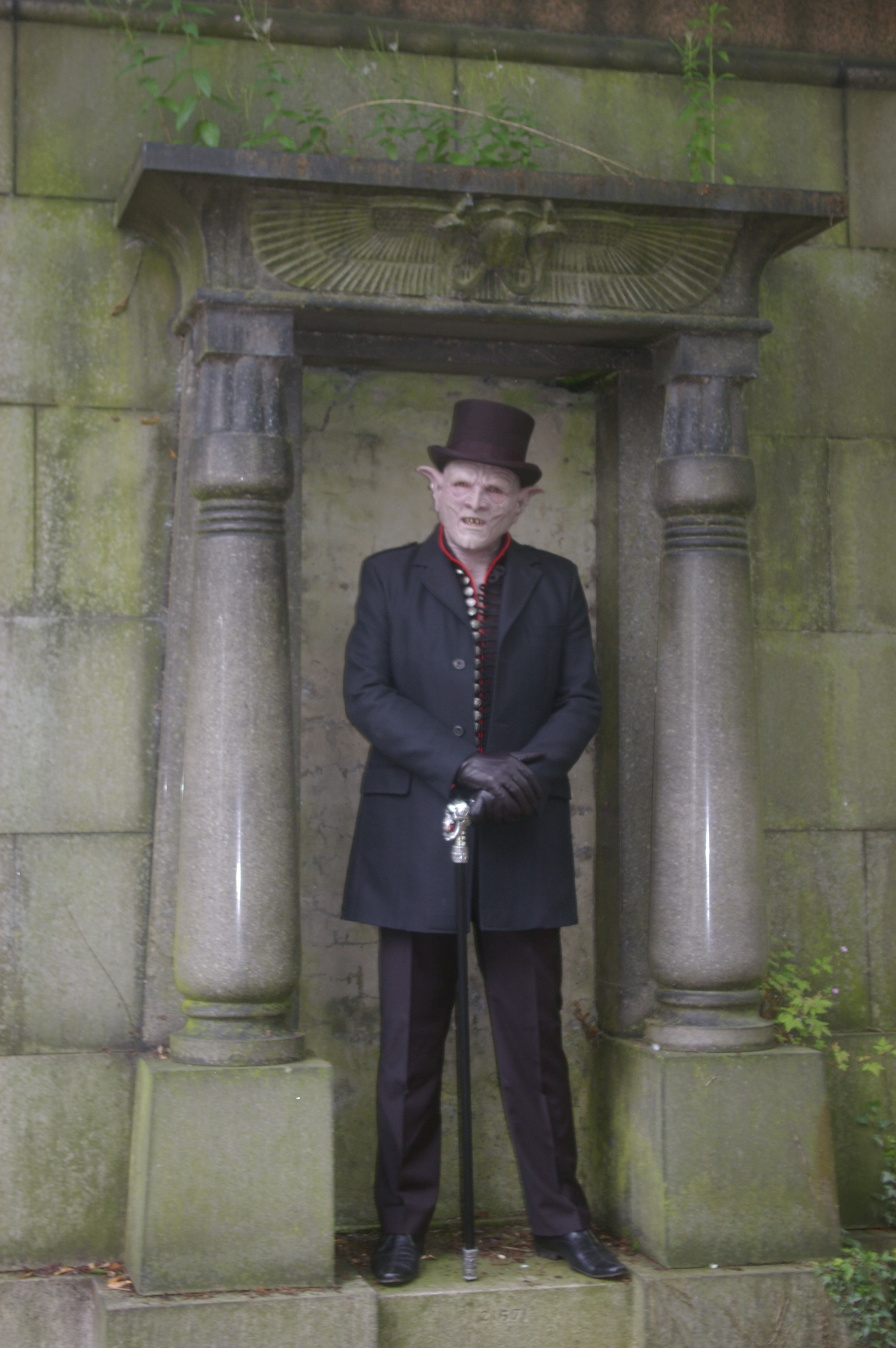
One of the most memorable was in 2013 when I encountered this exotic creature in the doorway of an Egyptian influenced mausoleum as I made my way up the main avenue. I assumed that he was wearing a mask but I never saw him take it off so who knows….There was also a wonderful display of vintage cars that year which drove around the cemetery in a stately parade. An old-fashioned pick-up truck announced itself as ‘The Final Cruise’ and carried a black coffin in the back. Several appeared to date from the ‘60’s and came from the USA. Others had been decorated with skulls and signs. It was an impressive sight to see so many in one place.
In fact, the cemetery has been used for filming. My younger sister used to live in the Harrow Road opposite the cemetery and often saw film crews inside in the early morning mists. So it was a real treat when, in 2014, Peter Fuller led the Theatre of Blood tour. I couldn’t miss this one as it’s one of my favourite films. A much loved 1970’s camp horror and film classic with its tongue firmly in its cheek, it told the story of the Shakespearean actor Edward Lionheart who apparently commits suicide after receiving bad reviews. If every actor di that we wouldn’t have many left. The much missed Vincent Price played Edward with his customary joie de vivre, sinister air and obvious enjoyment.
But he’s isn’t really dead and exacts an inventive and gruesome revenge on his critics with his devoted daughter, Edwina, played by Diana Rigg. The deaths all have a Shakespearean theme and several key scenes were actually filmed in the cemetery. Peter led us round some of them. We were a motley crew of Goths, film fans and Theatre of Blood devotees as we sat on the chapel steps and read the Shakespearean quotes used in the film. We looked down along the main avenue where one of the critics had been dragged by a horse, the colonnades where Carol Browne and Ian Hendry, two of the film’s stars, had chatted and the Sievier monument where Diana Rigg had mourned her father. Peter related several anecdotes about the film and revealed that it was on this film that Coral and Vincent’s love affair began which eventually led to the breakup of his marriage. They married after his divorce and then entered their ‘kaftan period’. This sounded too horrible for words and I had to go and have a restorative cup of tea.
On one Open Day I was leaving after a lovely day exploring and discovering the shrouded angel on the Gardner memorial only to find that the Ladbroke Grove entrance was locked and closed. I immediately turned around and headed for the West entrance which I hoped was still open. As I hurtled along, a middle aged Goth couple were also heading in the same direction. The male Goth said enthusiastically to his partner ‘If we’re locked in do you fancy sleeping in a mausoleum?’ She replied emphatically, ‘No.’ and quickened her pace. I felt a little disappointed as they had plenty of choice and a mausoleum motel did sound appealing.
Sadly there isn’t an Open Day in 2017 but I still have my little plastic coffin as a memento. Whenever I look at it I remember young girls in Victorian costume, the gleam of a chrome skull on a radiator grille and the best 50p I’ve ever spent.
My local allotments are very popular and there’s always half a dozen people working away and getting their hands dirty. They’re watched closely by birds looking for worms in the dug over soil before swooping down for their meal. In summer the allotments burst forth with vegetables: lines of runner beans, rows of cabbages , lettuces and flowers and the occasional fox can be seen strolling through at dusk.
But, if you walk up the slope towards the chain link fence that divides the allotments from the park, you’ll come to a large stone plinth at the top. It nestles amongst the trees that have grown up around it. On one end there is a sculpted swag containing roses for remembrance so it once had a farh more illustrious past. I first saw the plinth from the other side of the fence while on the Kelsey park Woodland Trail looking for fungi to photograph. I wondered what it was. It was far too grand to be an allotment user’s display or flower pot stand. Maybe a small statue had been on top and had since disappeared as the empty pedestal was now in no man’s land. The plinth has also puzzled and intrigued the casual passer-by, dog walker and jogger as they go past. The local legend was that it marked the burial site of a horse which belonged to ‘one of the Burrell girls.’
But it wasn’t until I started researching this article that I managed to source a contemporary engraving of the plinth dating from the 1790’s which was entitled ‘Patch’s tomb’ that I had any evidence for the story. At last I had a name for the incumbent. It looks very grand in the picture with an elegant urn on top which is being admired by a fashionably dressed gentleman with an equally well dressed couple nearby. The perspective looks a little strange as the tomb looks larger than the onlookers. This was a serious monument both in cost and the determination to remember Patch. The location, on a small slope, was no idle choice and can be seen from the lakeside path 150 yards away below if you know where to look. Trees and vegetation have grown up on the small hill obscuring the tomb so it’s much easier to see during the winter die-off.
The Burrells were a prominent, land-owning family in Beckenham during the 16th -19th centuries and some of their descendants are still in the area. They have left a fine collection of monuments in the local church, St George’s.
The Burrells were also connected with Kelsey Park in Beckenham in that the site once formed part of Peter Burrell III’s 600 acre estate and it was a Burrell who built the first manor house there. Confusingly, there were four Peter Burrells and, after exploring their various family lineage, I decided that one of Peter Burrell III’s four daughters was probably the most likely owner of Patch. He also had a son who, strangely enough, became Peter Burrell IV but more of him later. The third Peter Burrell (27/08/1724 – 06/11/1775) was a politician and barrister and in 1748 he married Elizabeth Lewis, daughter of John Lewis of Hackney. There seem to be no pictures of him in existence and, instead, photos of Paul Burrell, Princess Diana’s ex-butler popped up!
Peter Burrell III was called to the bar in 1749, became MP for Launceston in Cornwall 1759-1768 and then MP for Totnes in Devon from 1774 – 1752. In 1769 Burrell was then appointed the Surveyor General of the Land Revenues of the Crown. So he was an ambitious man with considerable connections and wealth. He was also involved with other prominent local land-owning families in Beckenham such as the Cators after whom Cator Park is named. Burrell’s estate in Beckenham is now buried under roads and desirable detached houses with large gardens. But there is a local road called Burrell Row after the family. Peter Burrell I purchased the first Kelsey Park House and estate in 1690. It was extended several times as can be seen in the 1790 watercolour and then became incorporated into the far grander, rambling Victorian Scottish baronial style mansion which replaced it. The original house was a square, modest house which had several later additions.
The first Kelsey Park Manor House in the Georgian style. A square shape so easy to incorporate into the grander mansion that replaced it. This watercolour dates from 1790 and is the believed to be the earliest known picture of the Manor House which had been extended over the centuries. Friends of Kelsey Park newsletter Summer 2008
The four daughters were:
Elizabeth Amelia (1749-1837) – married a gentleman from Cambridgeshire. Richard Henry Alexander Bennett
Isabella Susanna (1750 – 1812) – married Algernon Percy, Ist Earl of Beverley, ancestor to the Dukes of Northumberland
Frances Juliana (1752 – 1820) – In 1779 she married Hugh Percy, 2nd Duke of Northumberland
Elizabeth Anne (1757 – 1837) – She married twice – firstly to Douglas Hamilton, 8th Duke of Hamilton and then secondly, to Henry Cecil, 1st Marquess of Exeter.
Marriages at that time were rarely for love but mainly for the joining of great houses, the exchange of land and also heirs. Frances had eleven children and Isabella had seven who all went onto more illustrious marriages and careers.
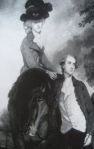
Elizabeth Anne Burrell (1757 – 1837) the youngest daughter of Peter Burrell II – I assume the man with her is her second husband Henry Cecil, 1st Marquess of Exeter.
I couldn’t find any further details on this image. https://www.wikitree.com/photo/jpg/Burrell-883
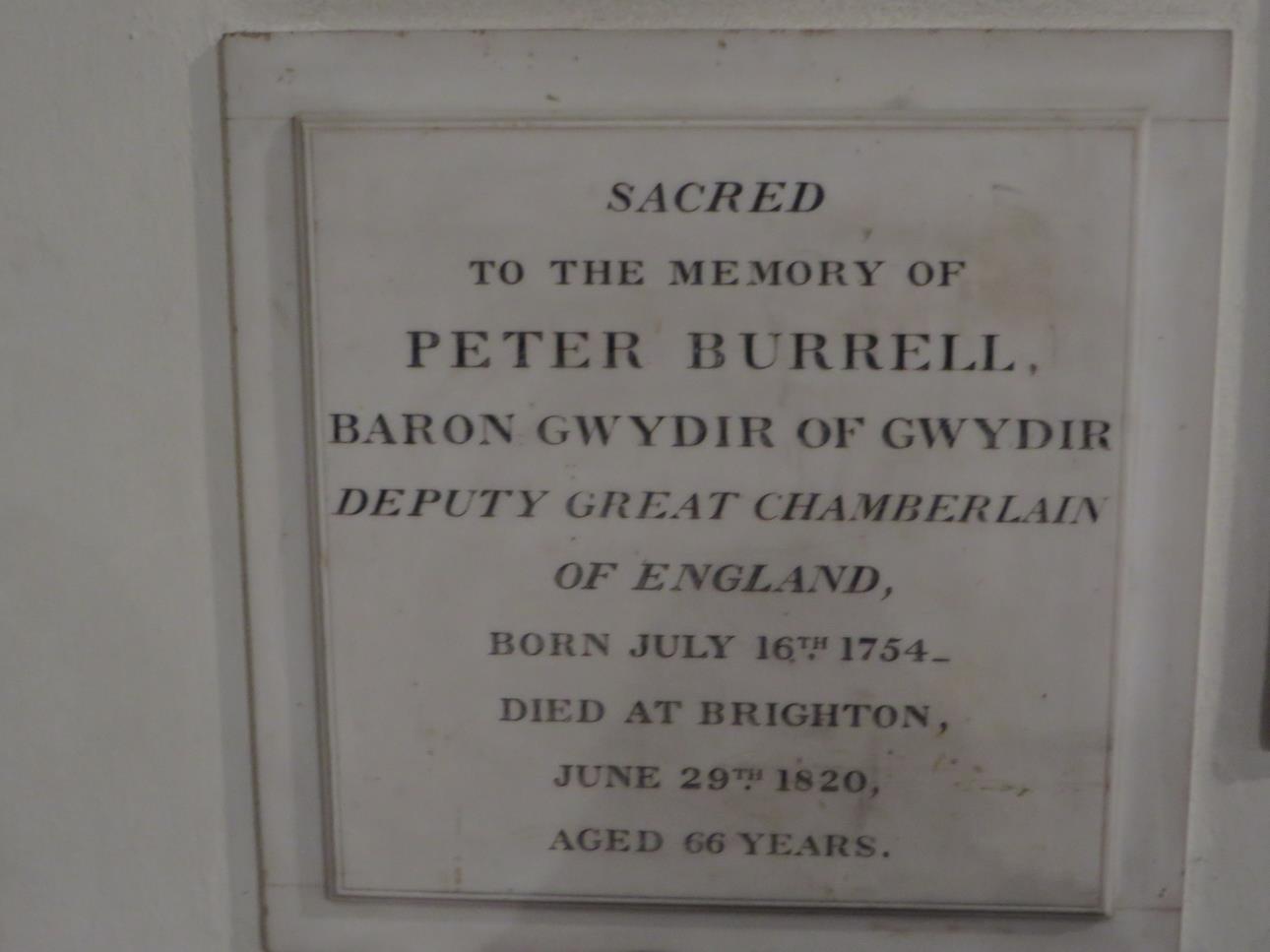
The Burrell girls seem to have been the ‘It’ girls of their day with their brilliant marriages into the aristocracy. Peter Burrell IV, the son, achieved even more dizzying heights as he became the Lord Chamberlain of England and the 1st Baron Gwydir of Gwydir Castle.
But it’s the eldest one, Elizabeth Amelia, who may have been Patch’s owner. Peter Burrell III built a house for her on his Kelsey estate where she lived with her husband, Richard Bennett. He was the MP for Newport from 1770-1774 but didn’t seem to have the same illustrious career as his father-in-law and the notes on his political career are brief. Elizabeth would have seen Patch’s last resting place from the house every day of her life as a reminder. I haven’t been able to find a picture of Elizabeth as it would have been interesting to see what she looked like. There’s no clue on the contemporary engraving as to the architect of the tomb and I wondered if Burrell paid for it or did Elizabeth?
So was Patch a young girl’s pet or a teenager’s source of freedom? We’ll never know and I was unable to source any pictures of Patch. It may seem strange to us to lavish such attention and money on a horse’s memorial. But in those days a horse almost certainly gave its owner a certain amount of freedom and independence. An earlier form of horsepower and being a good horsewoman at the time was a major attribute.
I like to think that, maybe when Kelsey Park’s closed and the lights have all gone out in the surrounding houses and apartment blocks, a spectral galloping can be heard. A passing badger or fox may prick up their ears at the sound as a young girl shouts ‘Hi, ho Patch and awaaay!’
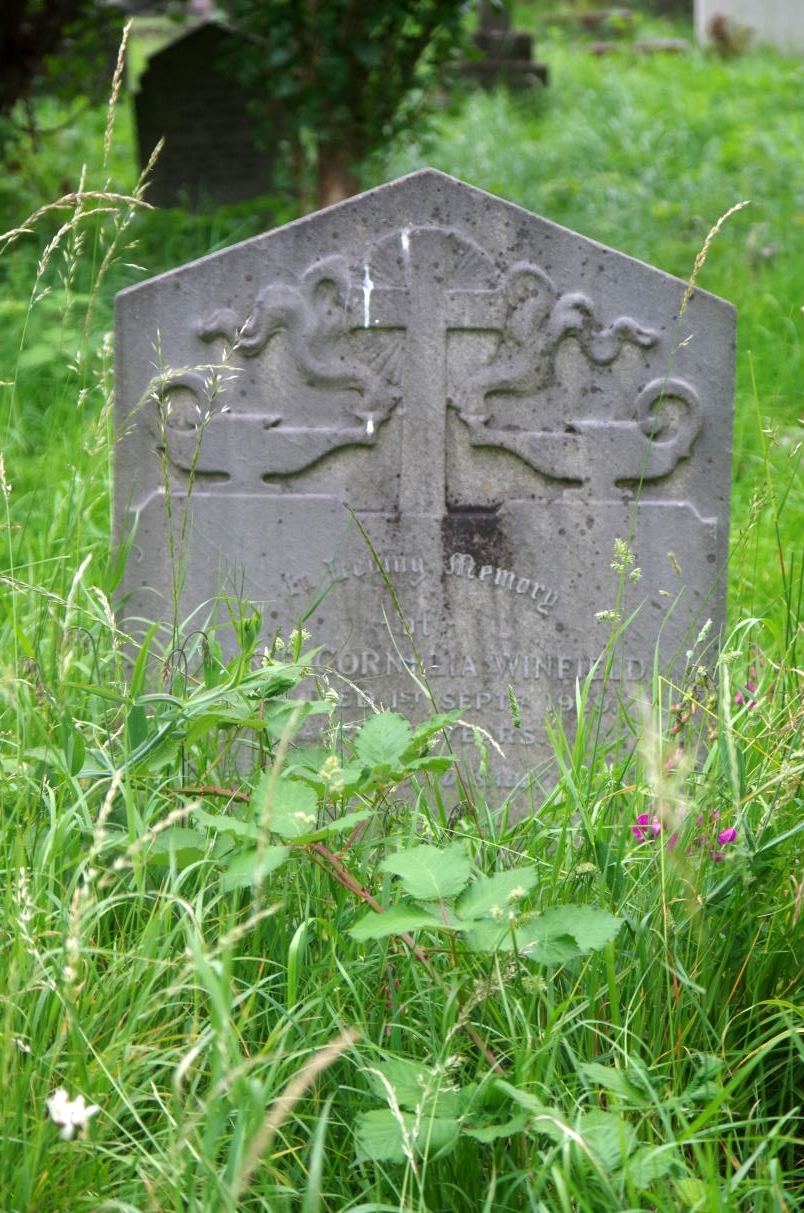
I was looking for butterflies, the Marbled White to be exact, on a side path in Brompton Cemetery when I found this memorial. Should I rub one of the Aladdin style lamps and see if a genie appeared to grant me three wishes? I was intrigued as to why they were on the stone and so began my research for this month’s symbol – The Lamp.
The grave is that of Marie Cordelia Winfield who died young at the age of 19. There is another family member commemorated on the headstone who is called James Alfred Winfield. But it’s very lowdown on the stone and the encroaching summer vegetation obscured it making it difficult to read.
Lamps are an unusual symbol to see in a cemetery but Light as a motif in itself has been used in many forms. Often it’s represented by the eternal flame or a downturned/ upturned torch but lamps are rare. Obviously now I’ve said that, I’ll see lamps in every cemetery on every tombstone but so far it’s just been this one.
The Winfield lamps appear to be oil lamps and these have been used as illumination for thousands of years. In Arabian folklore a genie’s lamp contained a magical spirit known as a djinn or genie. This mythical being could help or hinder those who were brave enough to rub the lamp as in the story of Aladdin.
An example of an Aladdin Lamp.
In this story the lamp was seen as a gateway to another world of mystery and other gods. The symbol of the lamp was later adopted by Christianity as many pagan motifs were and it came to symbolise Jesus as the ‘light of the world’. There is a famous passage in the New Testament in Matthew 25:1-13 of the parable of the 10 virgins:
‘Then shall the kingdom of heaven be likened unto ten virgins, which took their lamps, and went forth to meet the bridegroom.
And five of them were wise, and five were foolish.
They that were foolish took their lamps, and took no oil with them:
But the wise took oil in their vessels with their lamps.
While the bridegroom tarried, they all slumbered and slept.
And at midnight there was a cry made, Behold, the bridegroom cometh; go ye out to meet him.
Then all those virgins arose, and trimmed their lamps.
And the foolish said unto the wise, Give us of your oil; for our lamps are gone out.
But the wise answered, saying, Not so; lest there be not enough for us and you: but go ye rather to them that sell, and buy for yourselves.
And while they went to buy, the bridegroom came; and they that were ready went in with him to the marriage: and the door was shut.
Afterward came also the other virgins, saying, Lord, Lord, open to us.
But he answered and said, Verily I say unto you, I know you not.
Watch therefore, for ye know neither the day nor the hour wherein the Son of man cometh.
King James version
There are several other references to lamps in Matthew 6:22-23, Revelation 22:5 and also John 5:35 in which John the Baptist is described as
‘he was a burning and shining lamp, and you were willing to rejoice for a while in his light.’
And let’s not forget God appearing to Moses in the burning bush. There is also a famous quotation from Psalms 119:105:
‘Thy word is a lamp unto my feet, and a light unto my path.’
The lamp as a representation of God and faith appears in other religions including the Jewish Feast of Dedication or Festival of Lights and also Diwali which is the Hindu Festival of Lights. Judaism sees lamps as a way of lighting the way for the righteous and the wise. This is represented by the seven branched ritual Jewish oil lamp which is known as a menorah. Lamps are also an integral part of the Orthodox and other Eastern Catholic churches as they are used on the Holy Table or altar and also to illuminate icons. In Chinese religions an oil lamp is always lit at traditional Chinese shrines before either an image of a deity or a plaque in classical Chinese characters with the name of the deity. Lamps also feature in the Koran. There is also a strong element of self-sacrifice associated with the lamp as it consumes itself in order to bring light to the world.
There is long tradition of lamps representing purity and virginity as well as love. So it’s highly appropriate for the Winfield tombstone which is dedicated to a young girl. When I looked more closely at the Winfield memorial I noticed that both of the lamps were pointing towards the cross in the centre with what I presumed were the rays of the sun coming from behind it almost like a halo. The lamps are obviously lit as fumes are coming from their spouts and, to me, they seemed to be illuminating the way through eternal darkness towards the light of a new life. I thought that it would have been comforting to those left behind to mourn the loss of a daughter who had been taken too soon. As the epitaph says:
‘Greatly loved and sadly missed.’
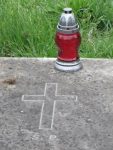
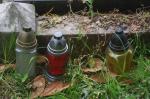
However, as I explored further in Brompton I noticed actual lamps placed on top of graves or alongside them. These were mainly on the graves of Polish people.
In Poland, there is a long tradition of lighting lamps and candles on their All Saints’ Day which is held on November 1st each year. This is the day before the Christian festival of All Souls Day which is traditionally held on November 2nd. I visited Brompton Cemetery on November 1st 2015 and witnessed the local Polish community’s celebration of All Saints with lit tea candles and lamps on top of Polish and non-Polish graves alike. The lights were again being used as a way to help the souls of the departed on their way and so the tradition continues.
On a recent visit to Brompton Cemetery to research animals on memorials my companion and I decided to explore a side path to find examples. On a corner where it met another side path we suddenly saw a very large gathering of crows perched on various tombstones, graves and memorials. There were so many that passers-by were stopping to look and take photos. My photo doesn’t do the scene justice as I couldn’t fit all the crows that were actually there in the picture.
Brompton’s crows have always been known for their photogenic and obliging qualities by posing on a nearby tombstone in suitably Gothic fashion but I’ve never seen that many gathered together in one place.
A group of crows is known as ‘a murder of crows’ and it only takes 2 crows to make one of these.
The phrase however, appears to date from the late Middle Ages and comes from the Book of Saint Albans or The Book of Hawking, Hunting and Blasing of Arms, which was published in 1486. This is a compendium of items for gentlemen of the time and had an appendix which consisted of a large list of collective nouns for animals. These were known as ‘company terms’ or the’ terms of hunting’. These include familiar ones such as ‘a gaggle of geese’ amongst other colourful and poetic names such as ‘a skulk of foxes’ or ‘an ostentation of peacocks’. There were also collective nouns for various professions such as ‘a melody of harpers’ etc. The ones that have survived to this day derive from this book include ‘a subtlety of sergeants’ and also ‘a murder of crows’. A crow gathering has often been the subject of folk tales and superstition and amongst these is the claim that crows will gather and decide the fate of another crow.
There are also other traditions, which considering that this was happening within a large London cemetery, are worth quoting ,
‘Many view the appearance of crows as an omen of death because ravens and crows are scavengers and are generally associated with dead bodies, battlefields, and cemeteries, and they’re thought to circle in large numbers above sites where animals or people are expected to soon die.’
Romain Bouchard, Etymology nerd
However, there are birdwatchers who insist that a group of crows should be known as a flock of crows and not a ‘murder’ so the jury’s out on that term.
A Facebook friend identified some of the crows as juveniles by the white patches on their breasts who may have just left the nest and are with their parents. The adults will defend their youngsters very aggressively. Crows are very social, live in tight knit families and they mate for life. They can roost in huge numbers of up to 1000+ as protection from other predators. Crows are also highly intelligent and have a repertoire of at least 250 different calls. A distress call will bring other crows to their aid as crows will defend other unrelated crows. A crow’s black plumage have led to them being associated with death and they are members of the Corvidae family which includes magpies and ravens. They are predators and scavengers and will eat virtually anything including roadkill, snakes, mice, eggs and nestlings of other birds amongst other delicacies. I often see crows inspecting the contents of large waste bins at supermarkets or communal litter bins and have seen them take young ducklings in a flash.
A couple of minutes after I took this photo the entire gathering took flight and scattered and I felt very privileged to have seen it at all.
Cemeteries are often great places to find wildlife. If you’re lucky you might see a bright little robin or blue tit flitting amongst the memorials as well as foxes, cats and the odd dog out for a walk with his owner. The beginning of summer also heralds the arrival of insects such as butterflies and grasshoppers.
But app designer, Simon Edwards and I, were exploring Brompton Cemetery to find animals of the stone or granite variety either carved or perched onto tombstones. Simon, a GP by trade, had the same enthusiasm as me and we began near the chapel.
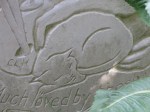
The weather couldn’t have been better and my way down to meet Simon I saw a Great Spotted Woodpecker land on a memorial and then take off again before I could get my camera out. I had a few suggestions as to where we might find some interesting examples and Simon already had some on his phone and so we began. We also included insects and birds. However once you start looking for carved wildlife it suddenly catches your eye whereas you might not have noticed it before. The afternoon became a treasure hunt as we found cats, a polar bear, a butterfly and a carving of an Egyptian deity amongst others. If you want to find out how many we found you will have to try the app at:https://ticl.me/West-Brompton/headlines/13317/view
However the most popular animal motif was undoubtedly the dove. They were everywhere – both in 2D and 3D versions whether portrayed flying downwards or perched on a cross until eventually we decided that we were both ‘doved-out’. Undoubtedly the best ones were the one on Susannah Smellie’s memorial near the chapel and the one on the headstone dedicated to a 6 month old baby near Hannah Courtoy’s imposing mausoleum.
The app is intended to give you a pleasant way of spending an afternoon exploring the cemetery and finding the graves on which they are and perhaps wondering more about the people who chose them. Don’t forget to let Simon or me know if you find any that we’ve missed!
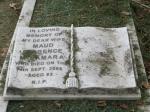
Sometimes a wander through a cemetery can make you feel as if you’re in a heavenly library due to the number of open books reverently laid on top of graves. They’re usually made from stone or granite, inscribed with the name and dates of the deceased and often a decorative book marker complete with carved tassel keeping the pages open. On first appearance the open book can seem a very simple and obvious symbol and it’s used in place of a more formal headstone. But, as with other symbols, it can have alternative meanings.
The 3 dimensional version that is carved to simulate a real book is a 20th century innovation. Prior to this it was rendered in a 2 dimensional, flat form and can be found on 18th and 19th century tombstones as part of an overall design or epitaph. This example is from the Gibbs memorial in Brompton cemetery in which the downwardly pointing finger indicates the large open book.
The open book can almost resemble a visitors book with the deceased’s details inscribed on it as if they were signing in or checking out for eternity and sometimes one page is left blank for perhaps the partner who will follow. On a recent stroll through Beckenham I came across several variations:
For example, there was one with both pages blank which could indicate that the inscription has worn off or that they were ready to be written for eternity. The latter echoes the well-known phrase ‘he or she can be read like an open book’ and the empty pages can indicate that this is how they want to be judged on the Day of Judgement. The echoes the quotation from the Book of Revelation 20:11-15:
And I saw the dead, small and great, stand before God; and the books were opened: and another book was opened, which is the book of life: and the dead were judged out of those things which were written in the books, according to their works. King James Bible
This is also why the open book is also known as the Book of Life as it contains everything that the deceased has done throughout their life and for which they will now be accountable. Christ is often depicted carrying a book. J C Cooper also sees it as the Book of Life and adds that it can also represent
‘….learning and the spirit of wisdom, revelation and …wisdom.’
It can also indicate a chapter of life has ended or closed.
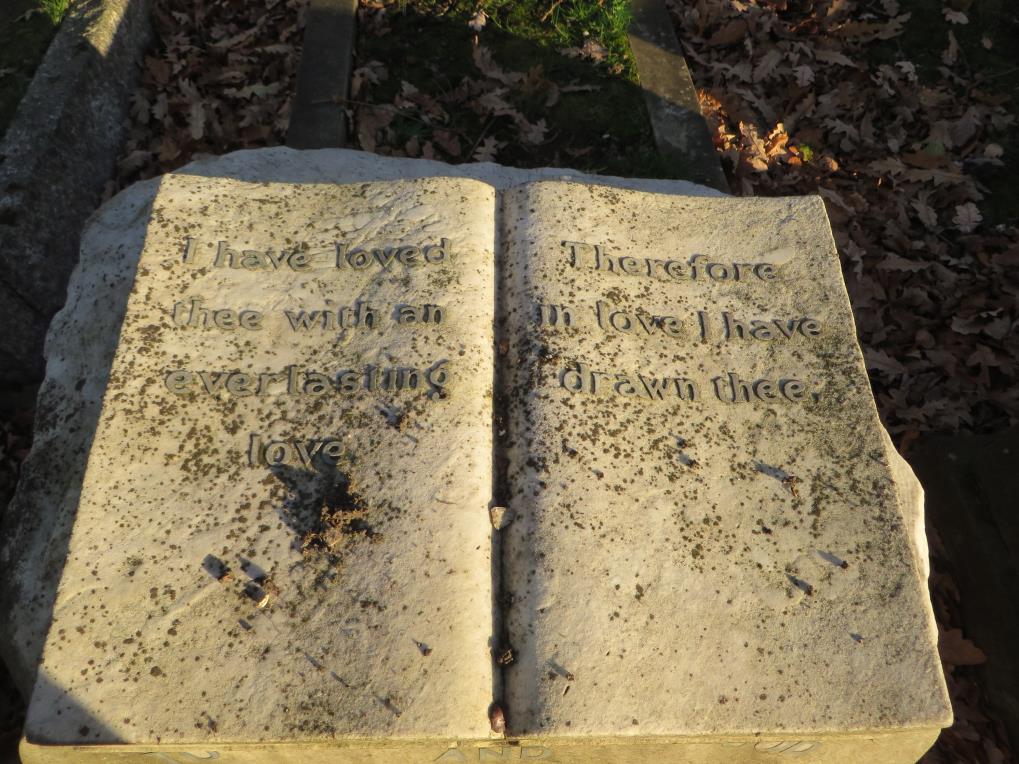
In this example, a favourite verse has been inscribed on the pages. It is a quotation from Jeremiah 31:3
The LORD hath appeared of old unto me, saying, Yea, I have loved thee with an everlasting love: therefore with lovingkindness have I drawn thee. King James Bible
This makes the symbol almost resemble a Bible. Other suggestions are that it can indicate the grave of a writer, publisher or even more obviously a clergyman.
It can also indicate a chapter of life has ended or closed and a variant is the closed book. I found this one in West Norwood cemetery and it clearly indicates a life that has ended with the final chapter now written.
So the open book has made me think about how my book of life would look on my last resting place. I’m determined to make sure that it’s a good read for any passing visitor.
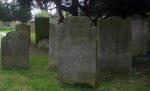
It’s often on a winter’s night, just as dusk begins to fall and the lamp lights in St Georges churchyard come up, that the fine selection of 18th century tombstones are at their best. Carved skulls leer at you, an hourglass emphasises time passing and the gravedigger’s tools stand ready for the next interment. And perhaps there is still a phantom schoolteacher using his sculpted globe to teach geography to his spectral students.
There has been a church on this site since the 14th century and in one place in the graveyard the number of burials over the centuries has made the ground rise up on both sides. But, as well as 18th century examples of funerary symbolism, there are also some wonderful 19th century ones as well. Inside the church there’s also a good selection of impressive wall monuments dedicated to prominent local families dating back to the 1600’s. They are buried in the vaults beneath the church. St George’s also has the country’s oldest lych gate in that the current one incorporates elements from a far older one. The churchyard is a pretty one for a short walk through to the bustling High Street especially when the spring flowers begin to appear, carpeting the grass between the stones with bluebells and flitting butterflies.
However for this month’s Symbols post I will concentrate on the 18th century memorials within the churchyard. These tombstones are topped with classic memento mori symbols. This is Latin for ‘remember me.’ They are the visual accompaniment to the immortal epitaph from Dundee’s Howff graveyeard:
‘Remember Man as you pass by
As you are now so once was I
As I am now so must you be
Remember man that you must die.’
Graveyard symbolism, according to Douglas Keister, began when the well to do could no longer be buried with in their local church due to lack of space. Instead, they took up their eternal residence in the newly consecrated burial grounds outside and surrounding the church walls. These were often known as’God’s Acres’ and gave the wealthy the opportunity to erect a lasting memorial or tombstone in their memory.
St George’s churchyard became the last resting place of prominent local familes, some of whose descendants still live in the area. The oldest tombstone dates from 1668 and the 18th century ones are nearest to the church walls which in effect meant that they were ‘‘Nearer my God to Thee.’
I’ve always enjoyed walking through the churchyard as it can feel like walking through a gallery of funerary symbols. There’s something very exuberant about these 18th Century motifs of mortality even though some have eroded and only one epitaph is still fully readable. However, the skull and crossbones, the Death’s Heads and others have, in several cases, lasted better than the epitaph below them.
The skull and crossbones are an effective, if macabre, reminder of what is left of a body after it decomposes and there are several good examples in St Georges.
This one is near the church entrance and features a skull and crossbones with what appear to be protruding palm fronds. It also seesm to be resting on something whch may be a shield. All that can now be read on the epitaph is…who dep….’
Nearby is another skull and crossbones with a winged hourglass above it. This is a reminder that ‘Time flies’ or ‘Tempus Fugit’ and that the onlooker will soon be bones and dust and it’s important to make the most of their time on earth. On the left hand side is a pick and shovel. These are a sexton’s tools which made me wonder if this was a sexton’s grave but the epitaph is now illegible. The sexton’s role not only encompassed maintaining and looking after the church but also the churchyard. In larger graveyards the sexton would have been more of a manager but in smaller ones he would have had sole responsibility for preparing the ground, digging and closing the grave, mowing the lawn and also maintaining the lawn and paths.
Skulls also feature prominently on two other tombstones on the other side of the church very near the wall. One seems to have a very sharp pair of horns and a definite smirk. On each side of it there appear to be small trumpets but it’s too weathered to see if anyone’s blowing them. Maybe he’s keenly anticipating the Last Day of Judgement.
Nearby is a large tombstone with what seem to be two somersaulting skulls on them although one is more eroded than the other. Below them is a small worn hourglass. I believe that these two examples of skulls may be unique to St Georges as I’ve haven’t yet seen them anywhere else.
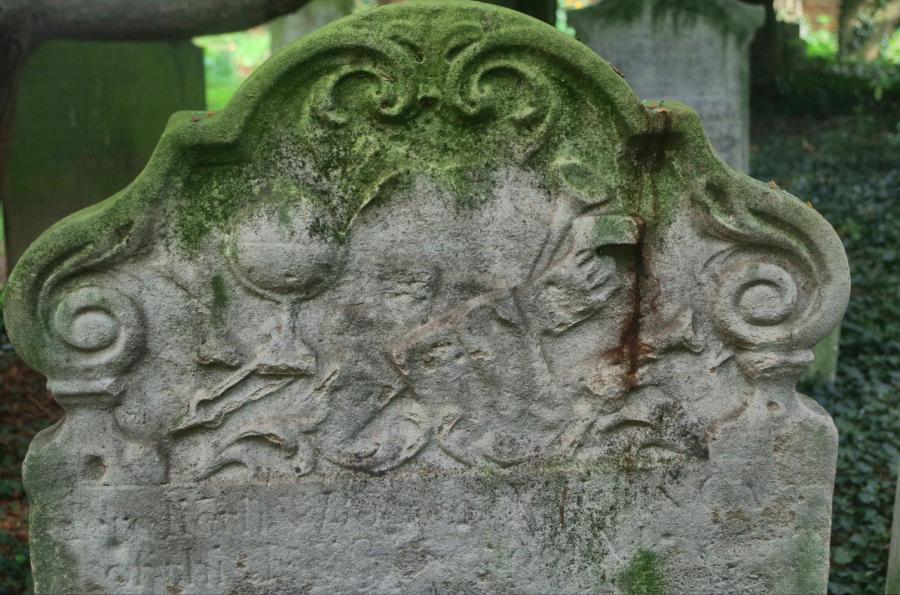
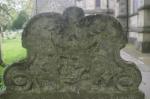
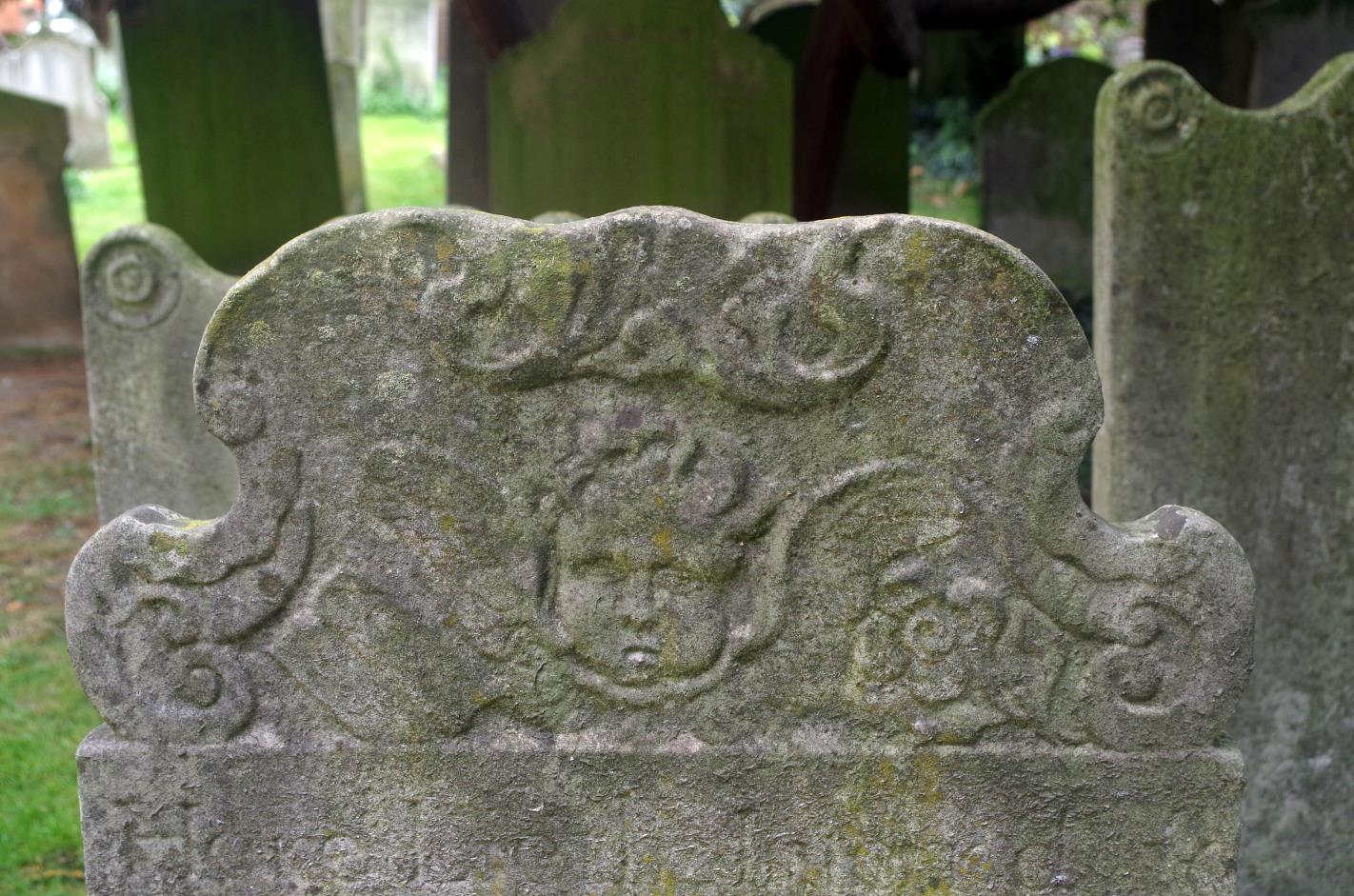
Douglas Keister has suggested that the skull and crossbones slowly began to be replaced by the much less stark and macabre ‘Death’s Head.’ This is a human face with wings on either side of it. I’ve always known it as the ‘winged cherub’ and there are also several good examples within the churchyard.
I am also a huge fan of calligraphy having studied it for two years at evening classes and it has undergone a revival on late 20th and early 21st century tombstones. However 18th century calligraphy has a style all of its own and is instantly recognisable. The only legible 18th century epitaph in St Georges is the one dedicated to a John Saxby. It reads:
‘ ‘Here lyeth the body of John Saxby of the Parish who Departed this life…year of May 1731 aged 41 years. ‘
A fine example of a Death’s Head is on top with an open book beside it which may be the Bible or the Book of Life and there’s a stylised flower on the other side. The open book may be a depiction of the incumbent offering their life to God for judgement as an ‘open book’. People are sometimes described as an ‘open book’ as they have their feelings and thoughts open to the world with no attempt to hide them.
On another memorial two small faces, presumably from the angelic host, peer out from either side of the clouds surrounding a crown. It’s a representation of the reward that awaits the faithful in heaven. This verse from the Bible refers to it:
James 1:12 New International Version (NIV)
Blessed is the one who perseveres under trial because, having stood the test, that person will receive the crown of life that the Lord has promised to those who love him. https://www.biblegateway.com/passage/?search=James%201:12
A plump faced death’s head is surrounded by another open book and what I think maybe a small skull in the far corner of the stone.
But one of the most unique and impressive tombstones in St George’s, or perhaps anywhere, is that of John Kay. He was an 18th century schoolmaster and his life and talents are recorded by the tools of his trade that have been carved on his stone. There’s a globe on a stand, a trumpet, what appears to be a cornet, an artists palette, a pair of compasses and other items which are now too indistinct to read. He was obviously very erudite and much appreciated by his students. Sadly his fulsome epitaph is now virtually unreadable. He lies near Mr Saxby under a spreading yew tree.
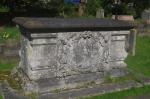
On the other side of the graveyard is a large chest tomb. There is a dedication and an armorial on its top and I feel that some patient research in St George’s burial registers may reveal the incumbent’s identity. There are blank cartouches on each side with death’s heads on top and two skulls beneath each one. At one end are palm fronds which are a Roman symbol of victory which were then adapted by the Christians as a martyr’s triumph of death. The palm as a symbol originated in the ancient Near East and Mediterranean region and is a powerful motif of victory, triumph, peace and eternal life. It’s traditionally associated with Easter and Palm Sunday and Christs’ resurrection and victory over death. On the other end of the tomb are what appear to be olive flowers. The olive’s association with wisdom and peace originally came from Greek mythology when the goddess, Athena, presented an olive tree to the city that was to become Athens. Successive Greek ambassadors then continued the tradtion by offering an olive branch of peace to indicate their goiod intentions. The olive tree is also associated with longevity, fertility, maturity, fruitfulness and prosperity. In the Bible, Noah sent the dove out after the Flood to see if the floodwaters had receded and when it returned with an olive leaf in its beak Noah knew that the Flood had ended. Even today the phrase ‘ offering an olive branch’ means the someone wants to make peace. But in this context the olive branch may mwean that the soul has departed with the peace of God. So one memorial incorporates powerful motifs of mortality and resurrection.
St George’s has also used old tombstones to pave two of the pathways within the churchyard of which some are still readable. It always feels as if I’m walking over someone’s grave although they are buried elsewhere in the graveyard. However, although the 19th and 20th century memorials are rather more restrained and far more legible I prefer the more ‘in your face’ 18th century symbols. But in the case of the horned skull I can only frustratingly only guess at its meaning and the person who lies beneath…..
Now that the spring equinox has arrived and winter seems to be coming to an end this is a good time to be visiting cemeteries. The vegetation will have died back and you can often find little gems which would normally be covered by undergrowth.
But cemeteries also attract many spring flowers as I discovered when I went to photograph Dr James Barry’s tombstone in Kensal Green cemetery recently. It was a March day and was initially overcast. But eventually the sun decided to make an appearance despite the slight nip in the air.
As I walked up the main avenue to the Anglican Chapel I noticed that in some areas the large swathes of flowers almost flowed like a colourful carpet between the graves and memorials. The backdrop of grey granite, pensive angels, crosses, Turkish men and many others emphasised their bright colours. Yellows, pinks, blues, whites and purples: they were all reminders that life goes on. Some graves were an absolute riot of nodding flower heads as the breeze made them move.
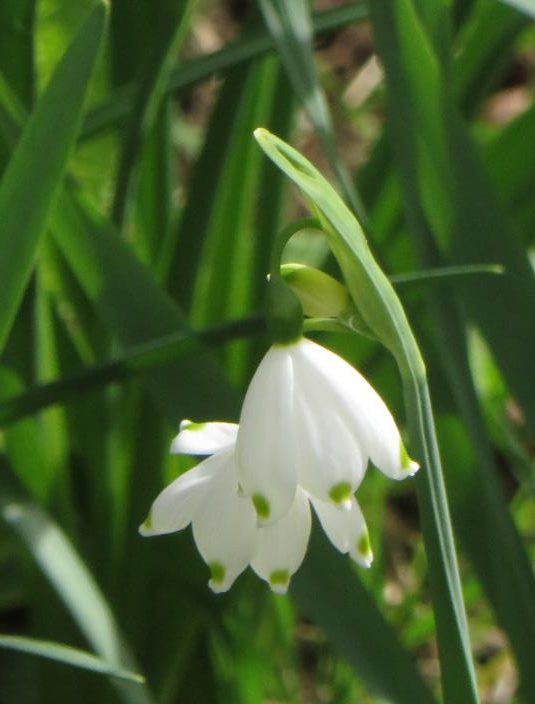
Snowdrops are often seen in churchyards. They are traditionally associated with Candlemas Day on February 2 and are often known as ‘the passing of sorrow.’ They are also called corpse flowers as the unopened bloom has been said to resemble a lifeless body in a shroud.
If you’re in London and near Brompton Cemetery around 2.30pm on Saturday 8 April 2017 then you are cordially invited onto the Symbols and Symbolism tour.
If you’ve ever wondered what the symbols often found in Victorian cemeteries actually mean and the fascinating background to them then this is the tour for you!
Some of the symbols which will be discussed on the tour have featured on this blog but there will be others as well.
The details are below – cost will be £5 per head – so let’s hope for decent weather on the 8th!
The Brompton Butterfly surrounded by an ivy wreath. copyright Carole Tyrrell