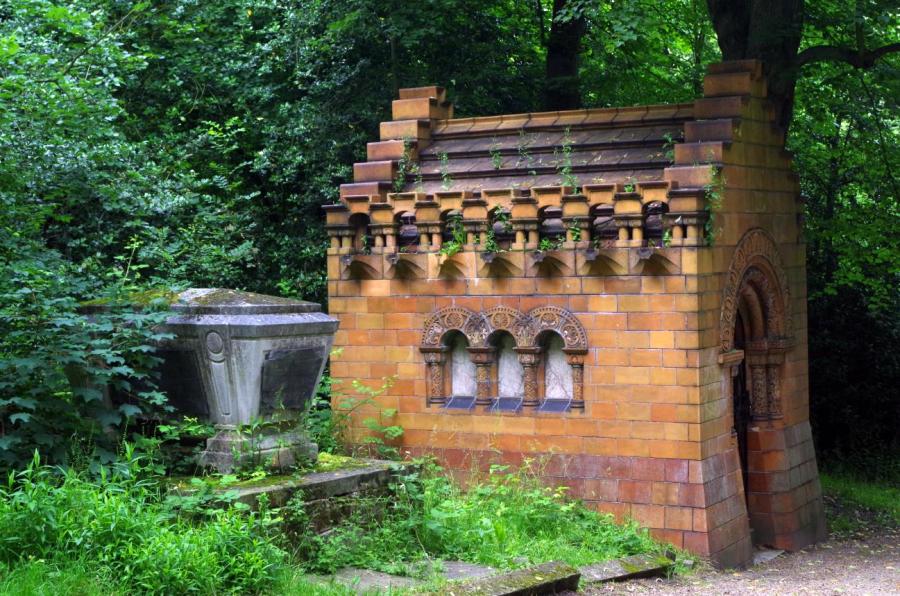
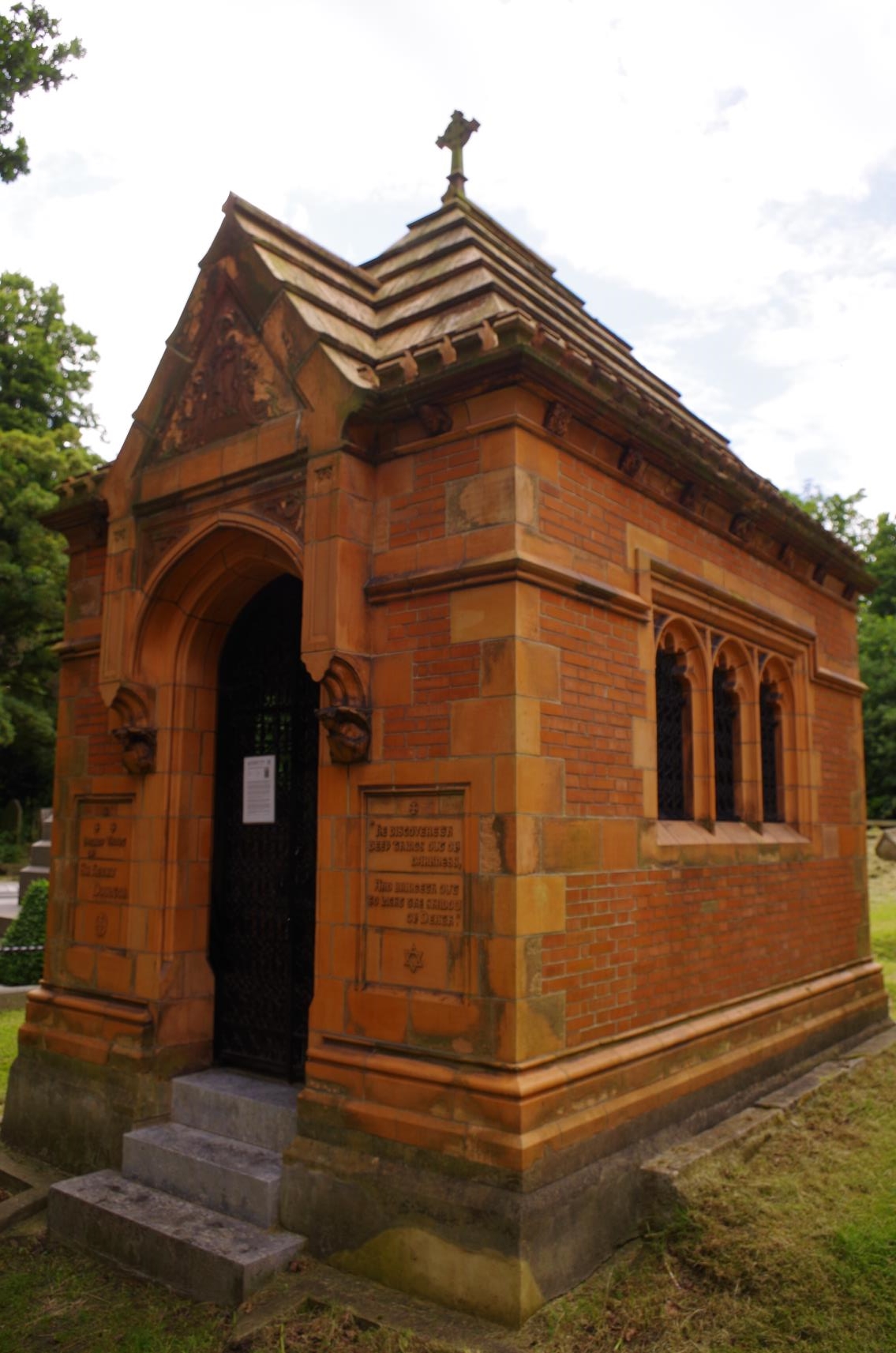
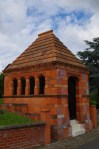
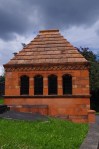
View of the Stearns mausoleum – note stepped roof and water spouts. copyright Carole Tyrrell
This is the last of the trio and, in contrast to the ones in West Norwood, wasn’t designed by Harold Peto. He had left Peto and Geoge by then and it has been suggested that the building was actually designed by an anonymous assistant who worked from previously rejected designs. It’s very different from the other two, both in style and decoration. It was built in 1901 to house the coffin of Mrs Laura Stearns. She died in 1900 and came from Twickenham. William Chillingworth, her father, is buried next to her in his own vault.
View of mausoleum with Mrs Stearns father, William Chillingworth’s sepulchre visible to the left.
copyright Carole Tyrrell
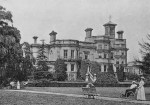
Radnor House Twickenham – owned by Mrs Laura Stearns and her father. Demolished in 1940 after being hit by a bomb.
He was a wine merchant and they owned Radnor House in Twickenham. It was known as Pope’s House as it was built on the site of Alexander Pope’s original house. It no longer exists as it was demolished in 1940 after being hit by a bomb. There seems to be no mention of a Mr Stearns. In the 1930’s Mrs Stearns’ coffin was removed from the mausoleum by her relatives and interred behind it.
The interior was never finished which is why it is so plain. However, 20 years later, an anonymous builder glazed it with bland tiles. There are two simple, unadorned stone coffin shelves set into each of the side walls. A trefoil shaped window on the back wall lets light in as the side windows are blocked up.
Trefoil window at the back of the mausoleum – the grille is a modern addition.
copyright Carole Tyrrell
Side windows of the mausoleum with relief and stylised Romanesque detailing.
copyright Carole Tyrrell
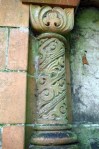
One of the side window columns with patterning.
copyright Carole Tyrrell
The mausoleum is decorated in the Romanesque style. This is an architectural style of medieval Europe which possibly dates from the 10th century and was characterised by the use of semi-circular arches. It was used extensively throughout Europe and in Britain is referred to as Norman Architecture. The word ‘Romanesque’ originally means descended from Roman and most surviving examples are on churches.
One of the 4 columns on either side of the entrance featuring stylised flowers and leaves.
copyright Carole Tyrrell
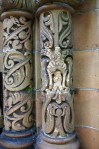
This is the other two columns which feature stylised birds, flowers and fruits in a quasi medieval style.
copyright Carole Tyrrell
The front view with stylised flowers and leaves and classic Romanesque semi circular arches.
copyright Carole Tyrrell
It is also characterised by its use of columns and, on the Stearns vault, we can see that the two small ones on either side of the entrance are carved with birds etc in a medieval style. The carvings are very tactile and I can never walk past within wanting to touch them. The side window columns are also patterned but not as beautifully as the entrance ones. Romanesque was also a highly decorative style as can be seen from the arched bands of stylised leaves over the entrance.
Close-up of Romanesque semi arch over entrance with stylised leaves. copyright Carole Tyrrell
The 19th century saw a Revival of Romanesque although it was decried by some writers as ‘barbaric ornament.’ The Natural History Museum in London is highly decorated in Romanesque Revival style and is well worth seeing.
It’s the only surviving mausoleum within Nunhead Cemetery and, although a tree tried to grow through it while the cemetery was abandoned, it’s still in good condition. When I first visited Nunhead in 1989, it was rumoured that the only person who now rested within the mausoleum was a passing tramp. It now has a wrought iron gate to protect it.
References:
Nunhead Cemetery, An Illustrated Guide by The Friends of Nunhead Cemetery . 1988, FONC Publications, London
The terracotta trio are all so different and unique and all three are Grade Ii listed and although, in comparison to other mausoleums such as Highgate’s Beer vault and Hannah Portnoy’s vast Egyptian Revival sepulchre in Brompton, they are relatively modest. However, I feel that they deserve their own special place in 19th century English funerary architecture..
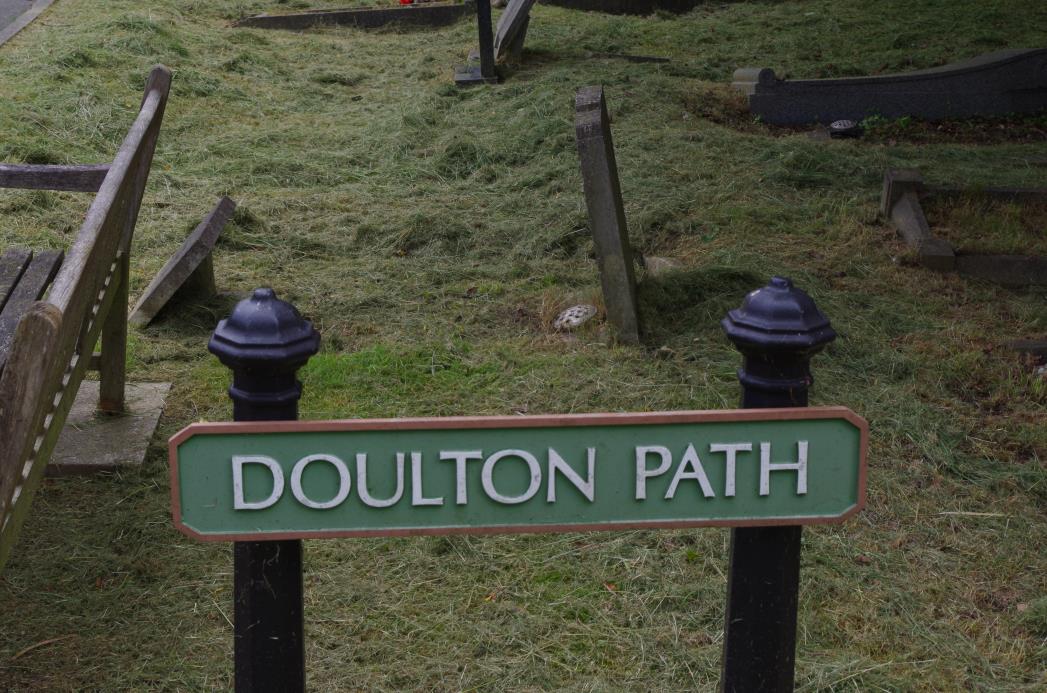
Path sign in West Norwood named after the Doulton mausoleum. copyright Carole Tyrrell
Doulton – note cross on roof and relief lettering on front. copyright Carole Tyrrell
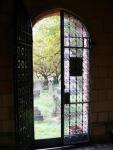
It’s easy to find the Doulton mausoleum in West Norwood Cemetery – just look for the Doulton Path sign and you’ll soon come to its lovely wrought iron doorway.
This is the second of the Doulton mausolea and, although similar in shape to the Tate Mausoleum, the external and interior decoration and style are very different.
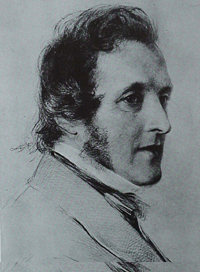
Sir Henry Doulton (1820 – 1897) commissioned this mausoleum after the death of his wife, Sarah, in 1888 and it was built in 1889. He entered the family firm of Doultons in 1835, enlarged its range of wares and took it over completely on his father’s death. In fact it was Sir Henry who invented the weather resistant type of terracotta used on all three vaults and he was knighted in 1887.
Sir Henry asked Harold Peto to design a similar building to the Tate mausoleum on a nearby plot and they are within walking distance of each other. Sir Henry’s son, Henry Lewis Doulton, followed him into the business and is also interred in the mausoleum. There is a memorial tablet to both Sarah and Sir Henry on the interior back wall of the building.
The sepulchre’s exterior is covered in relief ornamentation. This includes small busts of angels on either side of the entrance door, the Lamb of God on the back of the roof and Gothic revival medieval style heads along the roof border below it. Sir Henry ordered green glass for the windows on either side which are protected by wrought iron grilles and as, no expense was spared, the rear window is glazed with rippled Venetian glass.
Doulton – one of a pair of angels busts on either side of the entrance door.
copyright Carole Tyrrell
Doulton – damaged relief of angels over entrance.
copyright Carole Tyrrell
Doulton – damaged relief panel on back roof but Lamb of God is still visible.
copyright Carole Tyrrell
Doulton – back view with Venetian glass window and the relief of the Lamb of God on roof.
copyright Carole Tyrrell
Doulton – relief lettering on front which is a Biblical quote from the Book of Job 12.22.
copyright Carole Tyrrell
Doulton – close-up view of green glass windows on side of mausoleum. They resemble church windows.
copyright Carole Tyrrell
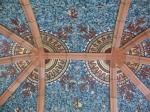
The external decoration has been credited to Mark Marshall who was Doulton’s chief artist but I have also seen George Tinsworth also mentioned which even I’ve heard of as he was one of Doulton’s most renowned artists. I am indebted to Jeane Trend-Hill for the lovely photos of the stunning marble interior and mosaic ceiling. The mausoleum is not open to the public.
A Doulton descendant still comes and mows the grass around the mausoleum every Sunday and so it always looks at its best.
Doulton – side view showing green glass side windows and grilles.
copyright Carole Tyrrell
Doulton – front view – note relief s of angels blowing trumpets on either side of the entrance.
copyright Carole Tyrrell
Both of the West Norwood mausolea were restored in 2002 and so are in very good condition. The architect, Harold Peto, is said to have also been responsible for the extensive use of terracotta in buildings along Pont Street in Mayfair.
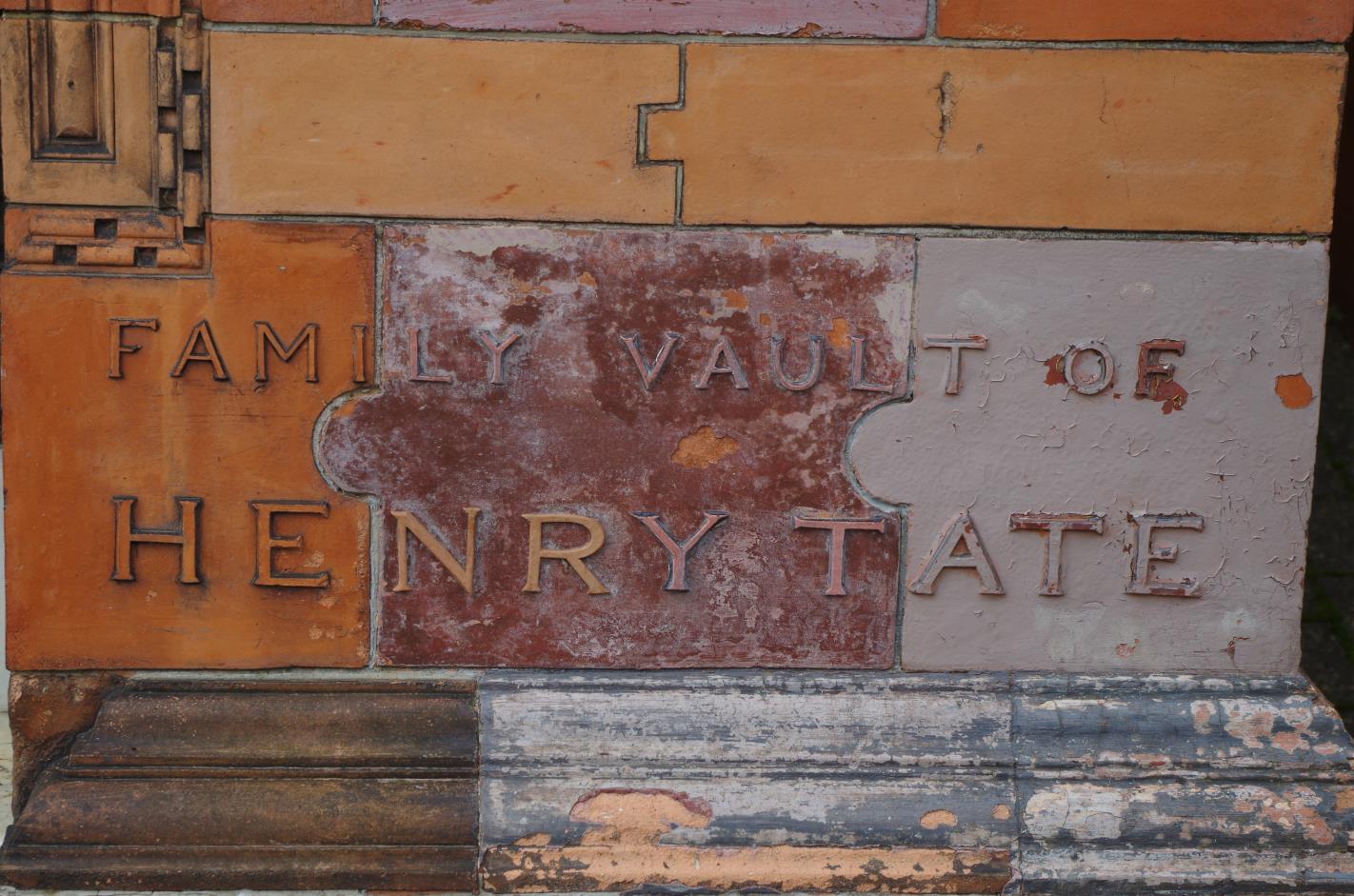
View of the Tate Mausoleum – note the patterning of the contrasting colours.
copyright Carole Tyrrell
Doulton – note cross on roof and relief lettering on front.
copyright Carole Tyrrell
View of mausoleum with Mrs Stearns father, William Chillingworth’s sepulchre visible to the left.
copyright Carole Tyrrell
My first encounter with the Doulton mausolea was seeing the charming Stearns mausoleum in Nunhead Cemetery. I fell in love with its dainty proportions and beautiful Romanesque decoration. When I first saw it in 1989, its coffin shelves were empty, the entrance was open and it was rumoured to be the preferred hotel of choice for any passing vagrants.
But first, a brief history of mausoleums. The word comes from the Mausoleum of Halicarnassus which was near the modern day city of Bodrum in Turkey. It was the 140ft high, highly decorated, last resting place of King Mausolea who was the Persian Satrap or Governor of Caria. It was created by his wife, Queen Artemesia Ii of Caria after he died in 353 BC and it was one of the Seven Wonders of the World.
Mausoleums were very popular with the Romans and were usually created for deceased leaders and other important people. The via Appia Antica near Rome contains the ruins of many private mausolea but the coming of Christianity made them fall out of favour.
A mausoleum is literally a house of the dead and usually contains a burial chamber either above ground or with a burial vault below the structure. This can contain the body or bodies. However, some mausolea contain coffin shelves above ground as with the Kilmorey Mausoleum near Richmond where the coffins are still in situ. One of the most famous mausoleums is the Taj Mahal in India.
The three Doulton mausolea are all made of red brick with terracotta facing. It’s a surprisingly durable material and is a very warm colour. Indeed it almost seem to glow when the sun shines on it. As the name implies, they were all built by the famous firm of Doulton & Co – now Royal Doulton – who had a factory at Vauxhall. They made many ceramic items including stoneware and salt glaze sewer pipes and are still in existence today. The firm and especially Sir Henry Doulton pioneered the use for terracotta and provided unlimited amounts of it to the mausolea builders.
Mortal Remains; The History and Present State of The Victorian and Edwardian Cemetery, Chris Brooks, 1989, Wheaton Publishers
Here lies Mr Cube copyright Carole Tyrrell
Part 1 – The Tate Mausoleum – West Norwood
This is the first of the three and was commissioned t in 1884. It was designed by Harold Peto of the firm of Peto and George and Doulton craftsmen worked on it. It’s in the Perpendicular style which was the last breath of English Gothic from late 14th – mid 16th century and is characterised by its use of vertical lines. The patterning on the terracotta surface resembles that of a jigsaw especially with the contrasting bands of red and buff colours.
There is some lovely ornamentation including 2 angels in relief blowing trumpets in the upper corners of the door frame – one on either side.
Tate Mausoleum – note the reliefs of angels blowing trumpets on either side of the door frame. copyright Carole Tyrrell
It also has the famous quote from the Song of Solomon on one side of the door:
‘Until the day dawns and the shadows flee away’
Tate Mausoleum – note the famous quote from the Song of Solomon in relief. copyright Carole Tyrrell
This is where I first saw it and it was the inspiration for the name of this blog.
The interior, which I haven’t yet seen, is reputed to have a vaulted ceiling with the design of an angel at Sir Henry’s request.
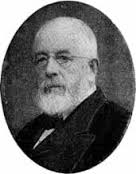
Sir Henry Tate (1819 – 1899) was originally from Lancashire and worked in the Liverpool sugar trade. He soon amassed a huge fortune and invented the sugar cube.
In fact he was known as ‘Mr Cube.’ Sir Henry was an avid art collector and, in 1897, donated his entire art collection the nation. He gave it to what was then known as The National Gallery of British Art before becoming The Tate Gallery and now finally as Tate Britain. It was built on the former site of Millbank Prison. Two of Tate Britain’s most popular paintings; Millais’ ‘Ophelia’ and Waterhouse’s ‘The Lady of Shalott’ came from Sir Henry’s collection.
He refused a knighthood on several occasions and only finally accepted it after being informed that the Royal Family would be offended if he refused again.
In 2012, as part of an art trail in West Norwood Cemetery in 2012, a Belfast based artist, Brendon Jamiston recreated a mini version of Mr Cube’s last resting place from 5,117 sugar cubes in homage to Sir Henry and his invention. It was displayed next to the real thing and I feel that Sir Henry would have approved.
The Gordon monument butterfly motif in all its glory. Kensal Green Cemetery. copyright Carole Tyrrell
Cemeteries and graveyards can be happy hunting grounds for butterflies. But not just the bright, dancing summer jewels, borne on the breeze, but also the much rarer kind which perches in them for eternity.
So far I’ve only discovered two of this particular species which were both in London. One was in Brompton and the other was in Kensal Green. But I have also seen others online in American cemeteries.
But I’m surprised that the butterfly symbol isn’t more widely used as it is a deep and powerful motif of resurrection and reincarnation. It has fluttered through many cultures which include Ancient Egypt, Greece and Mexico.
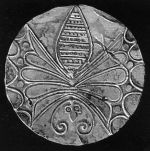
Gold disc found at Myceanae near Greece – possibly dating from 1350 BC
In classical myth, Psyche, which translates as ‘soul’, is represented in the form of a butterfly or as a young woman with butterfly wings. She’s also linked with Eros the Greek God of love. It is also a potent representation of rebirth and in this aspect, the Celts revered it. Some of the Ancient Mexican tribes such as the Aztec and Mayans used carvings of butterflies to decorate their buildings as certain butterfly species were considered to be reincarnations of the souls of dead warriors. The Hopi and Navaho tribes of Native American Indians performed the Butterfly Dance and viewed them as symbols of change and transformation.
The butterfly is an archetypal image of resurrection in Christianity and this meaning is derived from the 3 stages of a butterfly’s life. These are: 1st stage = the caterpillar, 2nd stage = the chrysalis and 3rd and final stage = the butterfly. So the sequence is life, death and resurrection. The emergence of the butterfly from the chrysalis is likened to the soul discarding the flesh. It has been depicted on Ancient Christian tombs and, in Christian art, Christ has been shown holding a butterfly. It is supposed to appear chiefly on childrens memorials but the two that I’ve seen were on adult memorials.
Butterflies also feature in Victorian mourning jewellery and there is a fascinating article on this with some lovely examples at:
In the 20th century, butterflies appeared in the flowing, organic lines of Art Nouveau and often featured in jewellery and silverware.
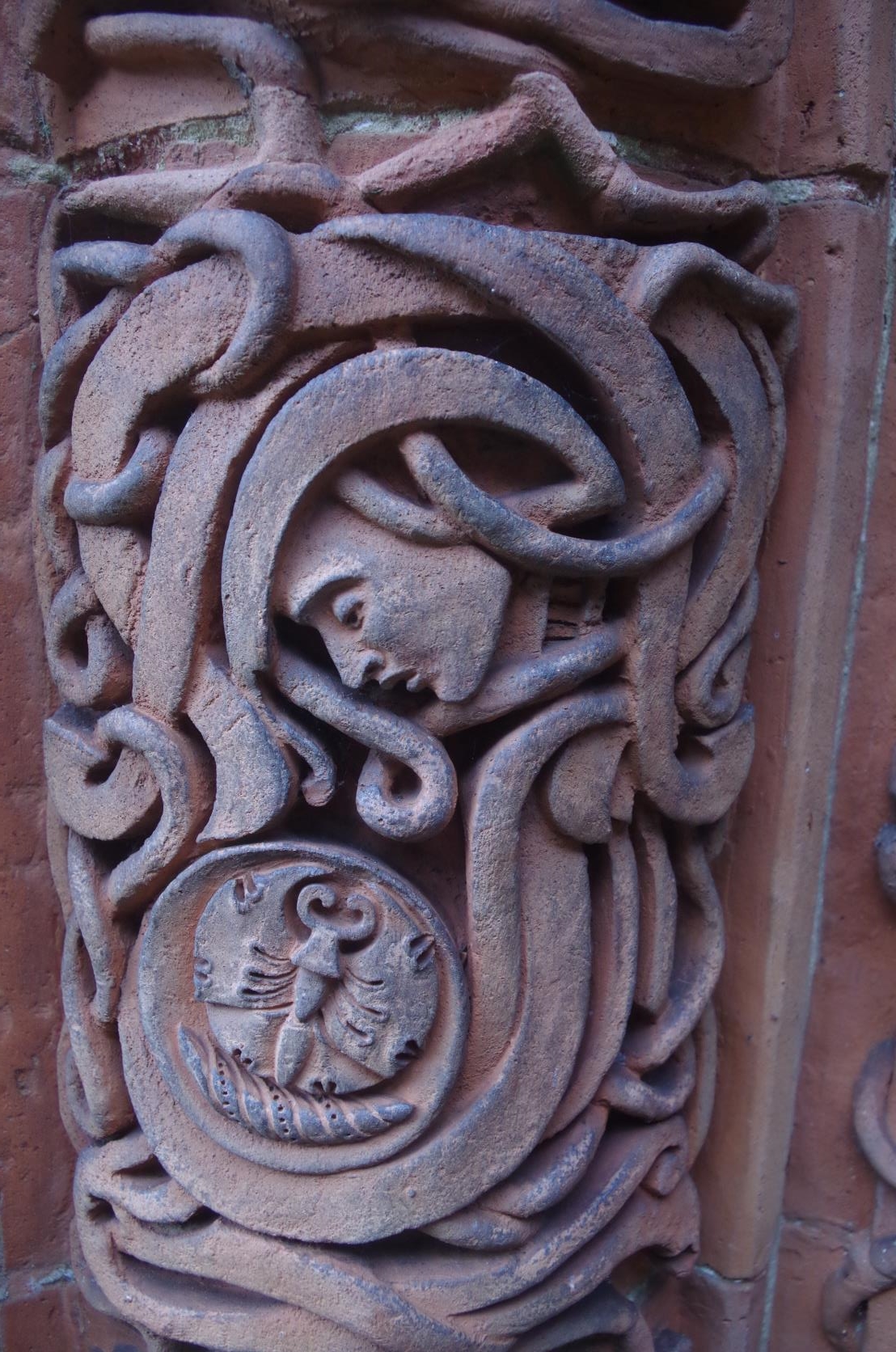
Face and butterfly on exterior of chapel.
copyright Carole Tyrrell
This example is from the Watts Chapel in Surrey and shows the flowing lines and stylised butterfly. They also appear in vanitas paintings, the name given to a particular category of symbolic works of art and especially those associated with the still life paintings of the 16th and 17th centuries in Flanders and the Netherlands. In these the viewer was asked to look at various symbols within the painting such as skulls, rotting fruit etc and ponder on the worthlessness of all earthly goods and pursuits as well as admiring the artist’s skill in depicting these. Butterflies in this context can be seen as fleeting pleasure as they have a short life of just two weeks.
Vanitas Still Life – Maria van Oosterwijck (1630-16930
Maria van Oosterwijck [Public domain], via Wikimedia Commons
The Nature as a Symbol of Vanitas Abraham Mignon created between 1665-1679.
Abraham Mignon [Public domain], via Wikimedia Commons
Butterfly traditions
There are many superstitions and beliefs associated with butterflies. They are often regarded as omens, good and bad, or as an advance messenger indicating that a visitor or loved one is about to arrive. In Japan, they are traditionally associated with geishas due to their associations with beauty and delicate femininity.
Butterfly & Chinese wisteria by Xu Xi Early Sing Dynasty c970. By Xü Xi (Scanned from an old Chinese book) [Public domain], via Wikimedia Commons
The Chinese see them as good luck and a symbol of immortality. Sailors thought that if they saw one before going on ship it meant that they would die at sea . In Devon it was traditional to kill the first butterfly that you saw or have a year of bad luck as a result. In Europe the butterfly was seen as the spirit of the dead and, in the Gnostic tradition, the angel of death is often shown crushing a butterfly underfoot. In some areas in England, it’s thought that butterflies contain the souls of children who have come back to life. A butterfly’s colours can also be significant. A black one can indicate death and a white one signifies the souls or the departed. It’s also a spiritual symbol of growth in that sometimes the past has to be discarded in order to move forward as the butterfly sheds its chrysalis to emerges complete. So it can indicate a turning point or transition in life. There are also shamanistic associations with the butterfly’s shapeshifting and it has also been claimed as a spiritual animal or totem.
Another view of the Brompton Butterfly surrounded by an ivy wreath.
copyright Carole Tyrrell
An example of a stylised butterfly on a tombstone in Brompton Cemetery in London. Unfortunately the epitaph is now unreadable. copyright Carole Tyrrell
Brompton Cemetery, tomb unknown
This example with its wings outstretched is from Brompton Cemetery in London. Alas, the epitaph appears to have vanished over time and the surrounding vegetation was so luxuriant that I will have to return in the winter to investigate further. Note the wreath of ivy that surrounds it. Ivy is an evergreen and is a token of eternal life and memories. The wreath’s ribbons are also nicely carved.
The Gordon monument, Kensal Green
The second one is perched on the tomb of John Gordon Esquire, a Scotsman from Aberdeenshire who died young at only 37. As the epitaph states ‘it was erected to his memory as the last token of sincere love and affection by his affectionate widow’. Gordon came from an extended family of Scottish landowners who had estates in Scotland and plantations in Tobago amongst other interests. The monument is Grade II listed and is made of Portland stone with a York stone base and canopy supported by the pillars. There was an urn on the pedestal between the four tapering stone pillars but this was stolen in 1997.
John Gordon’s epitaph – he was only 38 when he died and it was erected by his affectionate widow as ‘last token of sincere love and esteem.’ Kensal Green Cemetery
copyright Carole Tyrrell
The Gordon Monument in Kensal Green Cemetery. There are traces of something once being in place – perhaps an urn – on the platform between the pillars.
copyright Carole Tyrrell
The butterfly also has an ouroboros encircling it so, not only a symbol or resurrection, but also of eternity with the tail devouring snake. It is a little hard to see but it is there.
The butterfly symbol of the roof of the Gordon monument Kensal Green Cemetery. copyright Carole Tyrrell
The pharaonic heads at each corner are Egyptian elements within an ostensibly classically inspired monument. Acroteria, or acroterion as is its singular definition, are an architectural ornament. The ones on this monument are known as acroteria angularia. The ‘angularia’ means at the corners.
Detail of the rood of the monument – note the Pharaonic head, one at each corner, and another glimpse of the butterfly. Kensal Green Cemetry
copyright Carole Tyrrell
Close- up of one of the four Pharaonic heads on the Gordon monument. Kensal Green Cemetery
copyright Carole Tyrrell
The entire monument is based on an illustration of the monument of the Murainville family in Pugin’s Views of Paris of 1822 and also on Moliere’s memorial which are both at Pere Lachaise in Paris.
The Gordon memorial incorporates elements of the Egyptian style and symbolism that influenced 19th century funerary monuments after the first Egyptian explorations. Kensal Green contains many significant examples and there are others to be found in Brompton, Highgate and Abney Park. The Victorians regarded the Egyptians highly as it was also a cult of the dead.
So when you next see a butterfly fluttering on the breeze or even perched on a memorial for eternity remember its importance within the tradition of symbols, religions and cultures. Who knows it might be one of your ancestors…..
A memorial from West Norwood Cemetery. copyright Carole Tyrrell
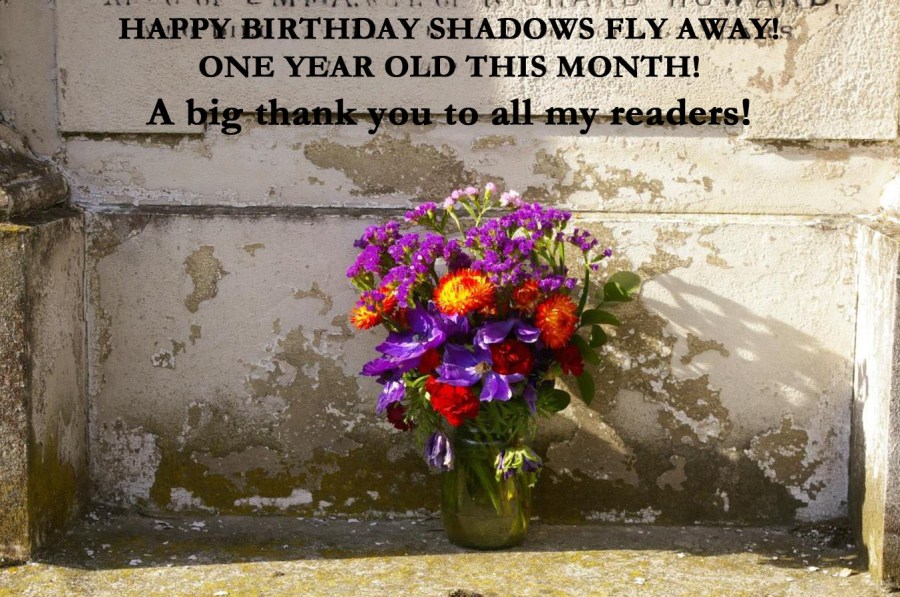
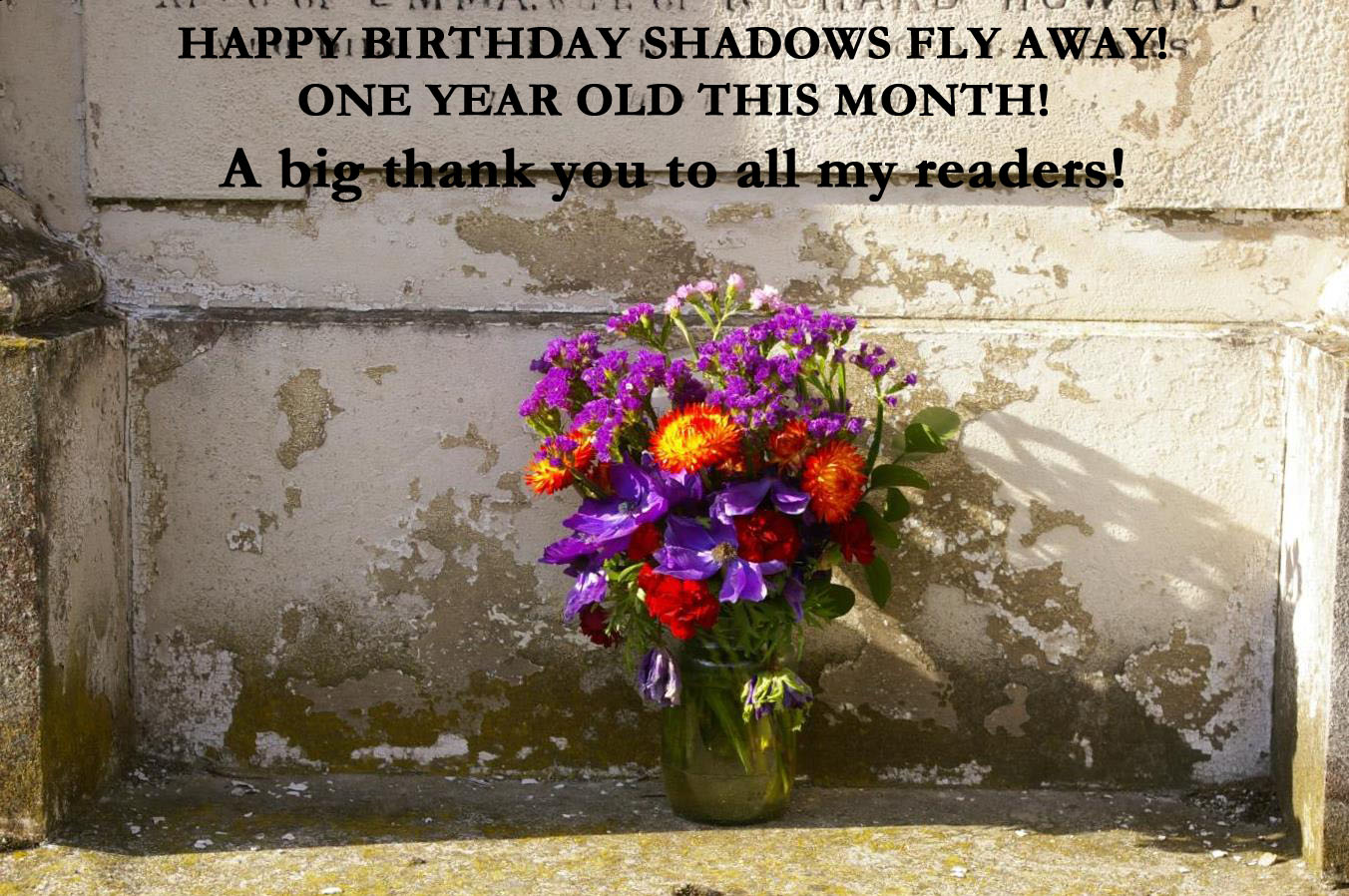
Yes shadowsflyaway is one year old this month!
I’ve really enjoyed researching, writing and posting my entries – it’s been wonderful to have an opportunity to immerse myself in history again and to meet other interesting cemetery enthusiasts via cyberspace. Please keep sending your comments.
So let’s raise a glass, cup or mug and celebrate and revel in being taphophiles. After all everyone has to have a hobby….without cemeteries where would all those eager Pokemon Go enthusiasts go?
This photo was taken in West Norwood Cemetery near the Columbarium – every time I visit there is is always a glass jar or vase containing fresh flowers placed on the shelf. I thought it looked appropriate.
The Unknown Mourner West Norwood June 2016
copyright Carole Tyrrell.
Before and after cleaning
I recently visited West Norwood Cemetery to see their celebrated catacombs. They are well worth seeing if you have the chance but please note that you must be a member of the Friends of West Norwood Cemetery to be able to visit them. This is for Health and Safety and insurance reasons. While I was waiting for the rest of the participants to arrive I looked around for the recumbent statue of the Unknown Mourner.
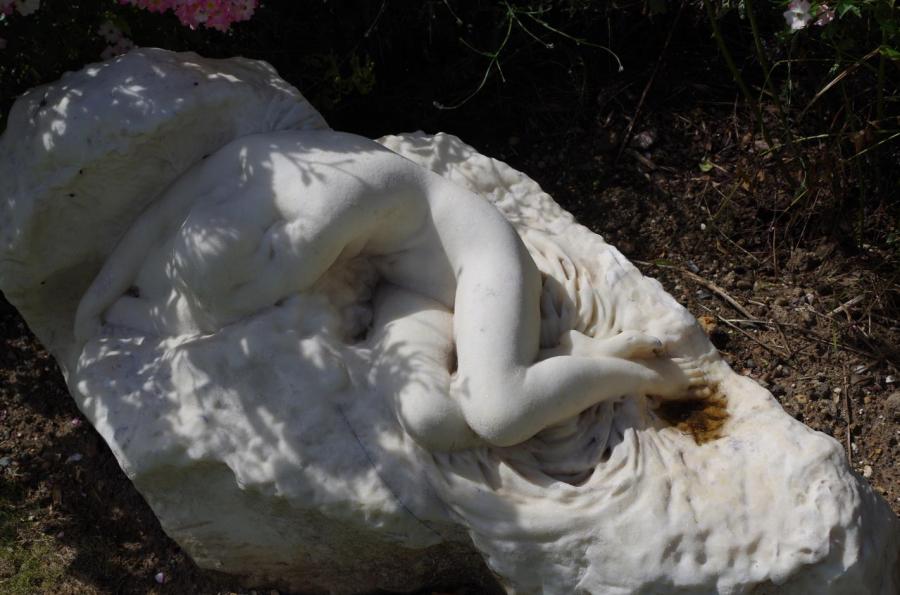
This is a large statue of a naked, prostate mourning woman which was, when I first saw her, was under some bushes on the forecourt in front of the main entrance gates. Then she moved inside the gates and I next saw her lying on some waste ground during renovations. No-one knows, or is probably ever likely to know, to which grave she belongs. The Unknown Mourner is undoubtedly a victim of Lambeth Council’s notorious clearances of West Norwood during the 1960’s. They just bulldozed anything , including listed memorials and monuments, without any recordkeeping until they were stopped by an ecclesiastical court.
But this time the Mourner was a gleaming pristine white which has revealed details of the sculpture that I’d never noticed before. I had always assumed that she was meant to be the uniform dull grey as that was the colour of the stone but what a difference a good clean has made. However, it’s unfortunate that discoloured water has gathered by her feet which make it look as if she’s stepped in something nasty. But it’s such a pleasure to see her looking so good and basking in the sunshine in the middle of rose bushes. Wherever her owner is within the cemetery I’m sure they would be pleased.
A pelican in her piety. Detail of monument, The Drake Chapel, St Mary’s Amersham.
copyright Carole Tyrrell
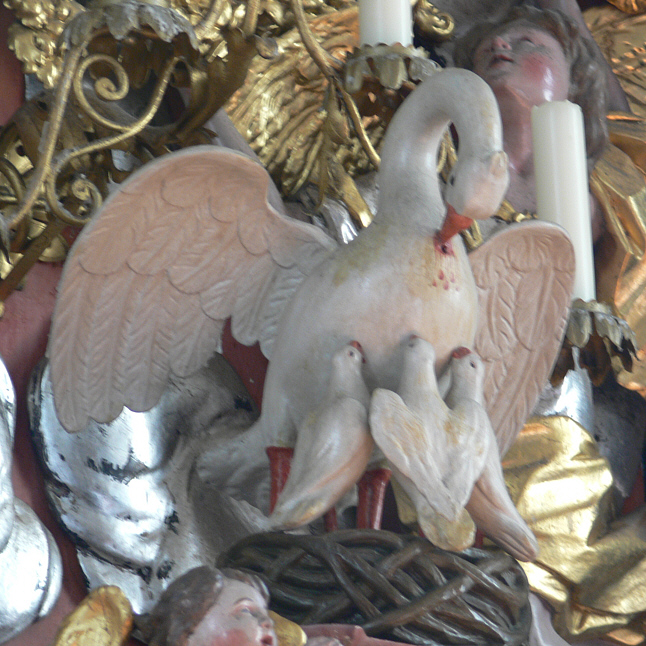
This is a more unusual symbol to find in cemeteries and dates from pre-Christian times. There are two versions of the legend. In one, the pelican pierces her own breast to feed her children with her own blood and in the second she feeds her dying children with her own blood to bring them back to life but as a result she dies herself. In both of them the pelican is a potent motif of self-sacrifice and charity. It’s also seen as a powerful representation of Christ’s Passion in that he gave his life for us and rose again. The symbol is known as a pelican in her piety.
However, the legend of the pelican is found in Physiologies, an anonymous Christian work from Alexandria which dates from the 2nd century. It contained legends of animals and their allegorical interpretations which is where the attribution of the pelican’s sacrifice to the Passion of Christ come from. It states that
‘ the pelican is very fond of its brood, but when the young ones begin to grow they rebel against the male bird (the father) and provoke his anger, so that he kills them, the mother returns to the nest in three day, sits on the dead birds, pours her blood over them, revives them, and they feed on the blood.
The pelican in its piety was very popular during the Middle Ages and can be found on altar fronts, fonts and misericords in churches. Also, when tabernacles were occasionally suspended over the altar, they were shaped like pelicans as was one in Durham Cathedral.
Later, in St Thomas Aquinas’s hymn ‘Adoro te devote.’ or Humbly we adore thee’, in the penultimate verse he describes Christ as:
‘the loving divine pelican able to provide nourishment for his breast’
In Nicholas Hilliard’s famous 1573 portrait of Elizabeth I which is known colloquially as the Pelican portrait she wears a prominent piece of jewellery which features a pelican feeding her young with her blood which symbolised her role as Mother of the Nation.
Detail of The Pelican Portrait showing pelican piercing her own brhttp://www.npg.org.uk/research/programmes/making-art-in-tudor-britain/the-phoenix-and-the-pelican-two-portraits-of-elizabeth-i-c.1575.phpeast to feed young.
The pelican also appears in Shakespeare’s Hamlet in Act IV in which Laertes says:
‘To his good friend thus wide,
I’ll open my arms.
And, like the kind life-rendering pelican
Repast them with my blood.’
The renowned bird appears in key Renaissance literature. For example, Dante in The Divine Comedy refers to Christ as ‘our Pelican’. John Lyly in Euphues of 1606 also wrote:
‘Pelicane who striketh blood out of its own owne bodye to do others good.’
John Skelton wrote in 1529 in his Armorie of Birds:
‘They sayd the Pellycan’
When my Byrds be slayne
With my bloude I them nevyve. Scripture doth record the same dyd as our Lord
And rose from deth to lyve.’
However, the belief that the pelican nourishes her children with her own blood is a myth. It may have arisen from the fact that pelicans have a large pouch attached under their bill. When the parent is about to feed its chicks, it macerates small fish in this pouch and then whilst pressing the bag against its breast, it transfers the food to the babies.
However, its use in Victorian cemeteries may indicate a resurrection motif in that the pelican gives er life to her children so that they are resurrected. It is quite a rare one to find although it does appear within churches especially on wall memorials, altars and fonts.
This is a sculpture from a church in Germany. copyright Andreas Praefcke
This is a magnificent impressive pelican sculpture from a church in Germany.
There is an impressive monument in a Cuban cemetery which has a large marble pelican and children carving on it and there is also one on a memorial in Arnos Vale Cemetery near Bristol. This is an especially poignant one as is it is to a young doctor, Joseph Williams, who insisted on treating the local workhouse inmates for cholera, during the 1849 Bristol epidemic. Sadly, and perhaps inevitably, he succumbed to it himself and subsequently died. Here the pelican and her young are a true representation of self-sacrifice.
This is one is in my local church, St Georges in Beckenham and appears on a monument to Dame Ann Frances Hoare who died in 1800 at 64.
A pelican feeding her brood wit her own blood. Detail of monument in St George’s Church, Beckenham.
copyright Carole Tyrrell
The pelican in its piety. The Hoare memorial, St Georges, Beckenham.
copyright Carole Tyrrell
The Hoare memorial, St Georges church, Beckenham.
copyright Carole Tyrrell
And this one is from the Drake Room in St Mary’s Church Amersham.
A pelican in her piety. Detail of monument, The Drake Chapel, St Mary’s Amersham.
copyright Carole Tyrrell
Monument to Rev Frank in the Drake Chapel, St Mary’s Amersham with pelican at the right hand side.
copyright Carole Tyrrell
Here is a more recent use of the Pelican in her piety on a World War II blood donor appeal.
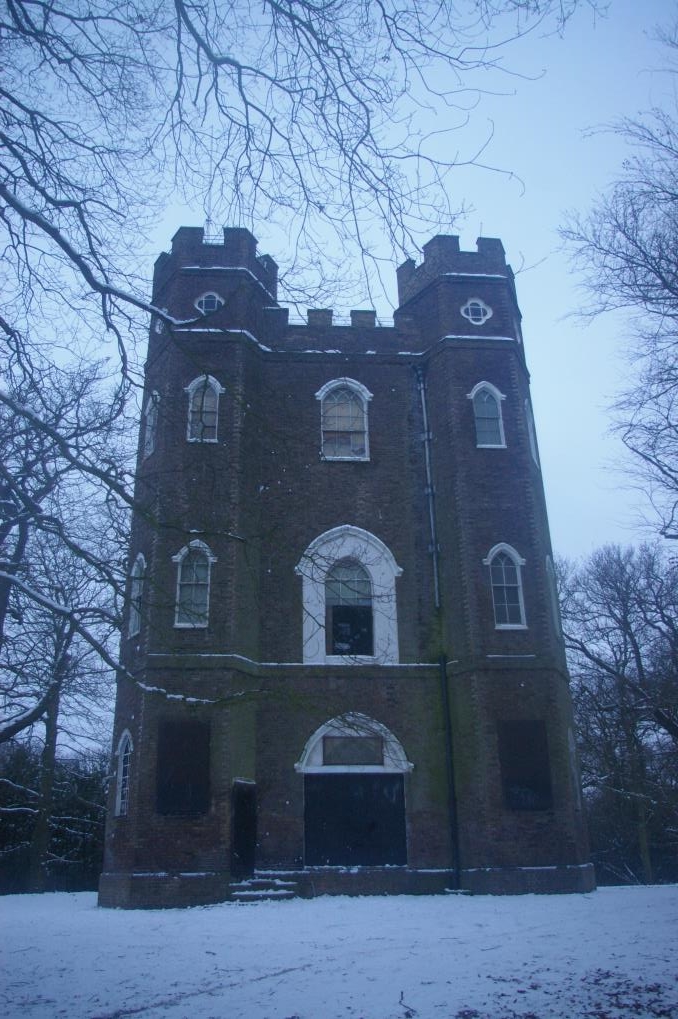
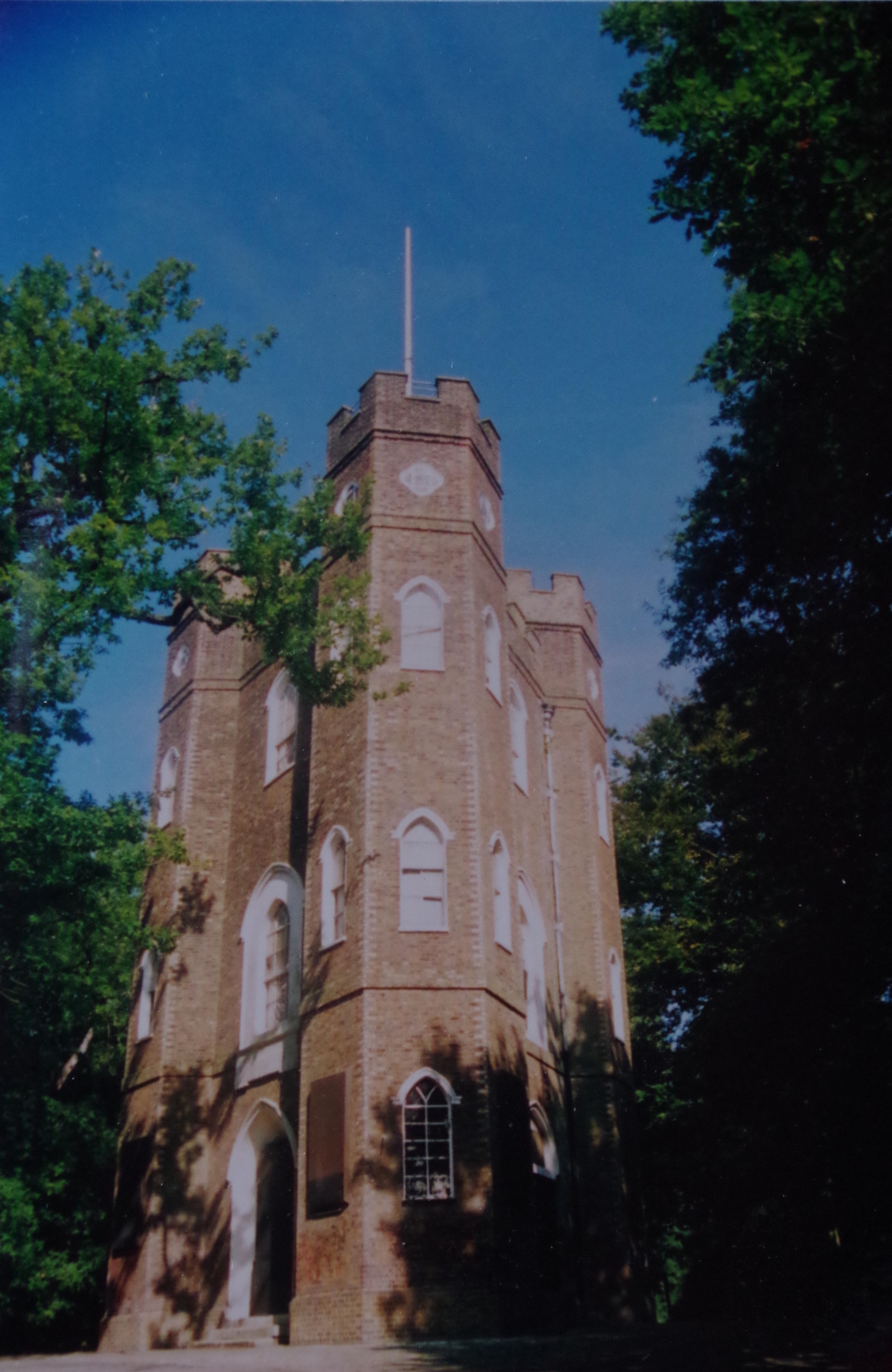
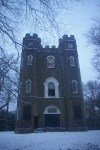
View of Castle when derelict and boarded up in 2008 copyright Carole Tyrrell
Severndroog Castle hides teasingly behind its cover of ancient trees but it can be seen from miles around if you know where to look. It perches on its hilltop, looking down and over the suburbs and landmarks below as it has done since 1784. But it’s not a proper castle. Instead Severndroog is one of the largest memorials to a single person ever created and is a much loved local landmark.
But, after walking up Shooters Hill, following the sign post and following the paths bordered by verdant hedges and a field you may start wondering where the Castle is. And then as you round the path’s curve the Castle begins to slowly, almost reluctantly, come into view. The only sound is birdsong or perhaps a dog walker calling to their dogs and you’re in the midst of one of the oldest woodlands in London.
The castle comes into view as you come around the path’s curve.
copyright Carole Tyrrell
View in June 2016 – virtually impossible not to get the railings in the picture.
copyright Carole Tyrrell
The Castle nestles within Oxleas Wood which is reputed to be 8,000 years old and you’re aware that the outside world has retreated completely. In 2004, ‘Alice Through the Looking Glass’, was performed nearby in the woods on a lovely summer’s evening. Tweedledum and Tweedledee, Humpty Dumpty, the White Knight, even Jabberwocky, appeared and disappeared before our very eyes as they led us through the dark forest.
Severndroog almost belongs in Alice. It’s dainty, a fairy tale creation of a castle. A triangular building with hexagonal turrets at each corner, it was designed by the architect, Richard Jupp who was known for creating light houses. It stands 63 feet or 19 metres high and has been compared to Horace Walpole’s magnificent Strawberry Hill as they shared similar decorative features. These include circular windows and decorative ceilings. The battlements and turrets are why Severndroog is called a castle, although it was never designed to be a fortification. Instead it was originally a summerhouse and a memorial. It was known as Lady James’s Folly after the woman who had it built in 1784.
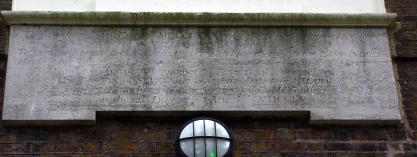
She was the widow of Sir William James of the East India Company who defeated pirates and captured the brigand castle of Suvarndurg, hence Severndroog, an island fortress of the Maratha Empire on India’s West Coast between Mumbai and Goa in 1755. . A plaque over the entrance to the Castle commemorates this although it’s not that easy to read now. He died of a stroke on his daughter’s wedding day in 1783 presumably after receiving the bill..
Plaque commemorating Sr William James victory in India. copyright Carole Tyrrell
Lady James filled the first floor of the Castle with mementos of him and would sit amongst his swords, armour and clothes to remember him. If you look up at the doorway of one of the oddly proportioned rooms you may see some very decorative original Georgian artwork. Now the room is used for weddings but was empty when I last visited and you could still see the dumb waiter from the Castle’s days as a tea room set into its floor. Locals could still recall enjoying a cuppa and then spending a penny to climb the spiral staircase to the roof.
Sir William James 1784 painted by Joshua Reynolds.
from Wikipedia
Lady Anne James with her daugther
copyright englandevents.co.uk
Lady James bought the highest land in Eltham and reputedly had the Castle constructed within sight of her own house. It stands at least 40ft further above sea level than the cross on top of St Paul’s Cathedral. From Severndroog’s roof you can, on a clear day, see 20 miles in all directions and across 7 counties over the treetops in 360°. As a result of this advantageous vantage point, Severndroog was used as a radar station and air raid lookout during the Second World. A barrage balloon floated above the Castle during the war and, due to the leafy covering of trees, it might still be there. However, there have been pirates aboard Severndroog but manning illegal radio stations from a turret.
Lady James died in 1798 and the Castle passed through various owners. But there’s always been plans for it. In 1847 there was a proposal to build a 10,000 catacomb cemetery in terraces on the site and in 1922 the London County Council bought it and opened the first tea room. Eventually in 1986, it became the property of Greenwich Council who boarded it up and left it. Vandalised and abandoned, in 2002, the council suggested that it be leased to a property developer to be converted to dull offices. No doubt the shopping centre was next. A preservation trust was formed, the Castle appeared on BBC’s Restoration and slowly the Castle came back to life.
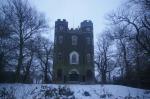
Severndroog Castle Winter 2010. Another view as you approach it along the drive.
copyright Carole Tyrrell
Severndroog Castle in Winter 2010. Still boarded up and derelict but still beautiful.
copyright Carole Tyrrell
I first visited the Castle when it was still boarded up. It completely enchanted me as soon as I saw it. I only knew that it was a folly but nothing of its history and how it came to be built. I remember thinking that it would have been perfect for Rapunzel with its tall walls and turrets. I revisited it during the heavy snows of 2010 when its dark walls stood out starkly against the bare trees and branches and the surrounding white. On both visits it seemed like a secret castle, my own personal one. The spectacular view over the rose garden below its slopes is breathtaking as the suburban sprawl stretches into the distance.
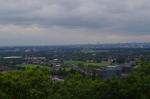
View over rose garden below the Castle as suburbia stretches on into the distance. copyright Carole Tyrrell
In June 2016 I revisited the Castle after its restoration and renovations. It had re-opened on 20 July 2014 with a new ground floor tea room and the rooms had been spruced up. I re-climbed the 86 steps of the spiral staircase to the roof to admire the view once again. The Millennium Wheel on the horizon, the 02 on my right hand side with the Thames snaking past it and the view just stretched on and on. Below us was the tree canopy as parakeets swooped and screeched amongst the branches.
View over Blackheath from the roof top.
copyright Carole Tyrrell
View over a turret and the tree tops below.
copyright Carole Tyrrell
Severndroog is one of my favourite places in London and I would love to live there. Imagine climbing the spiral staircase every day to lob missiles at any marauding property developers or letting down my newly acquired hair extensions to allow friends to climb up to the roof to admire the view. As I climbed down the staircase again I thought how pleased Lady James would be that the Castle is still there, still being used and admired and preserving her husband’s memory and her vision.
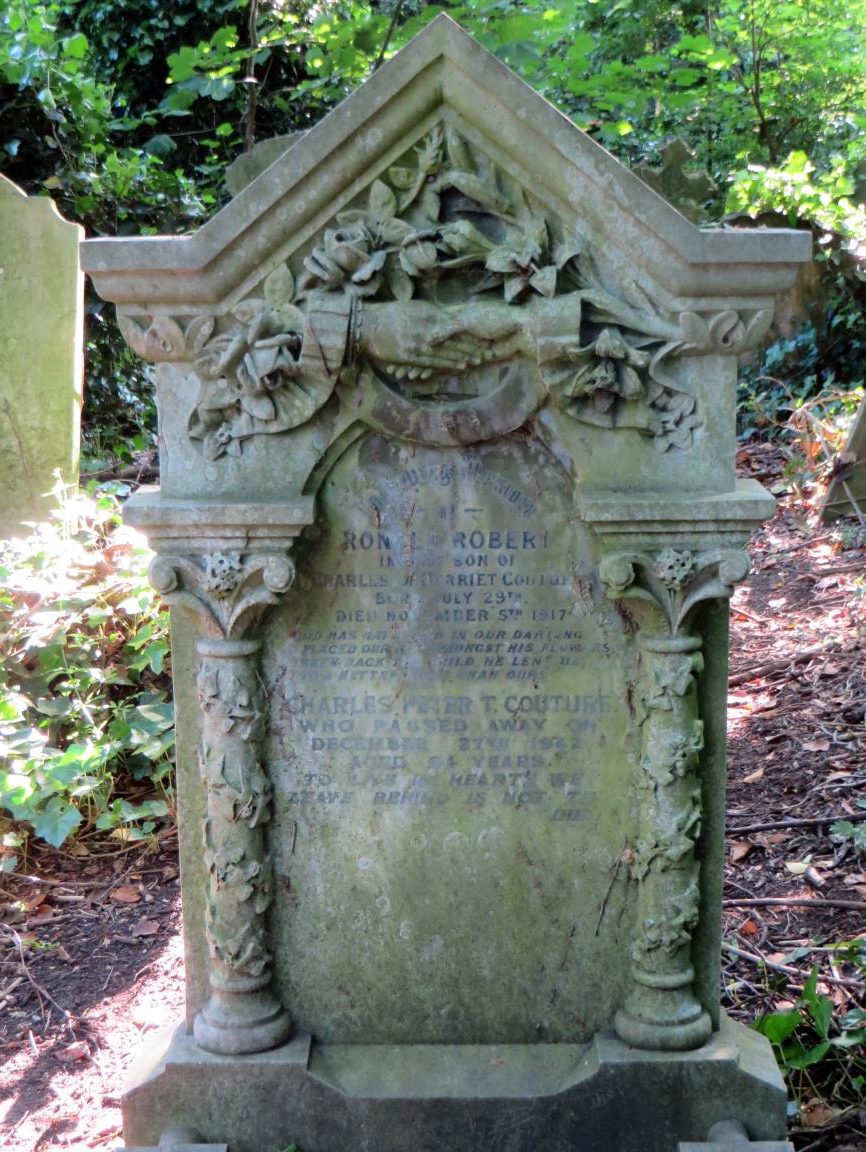
The Couture memorial in Nunhead Cemetery – very ornate and to a son who died in infancy. copyright Carole Tyrrell
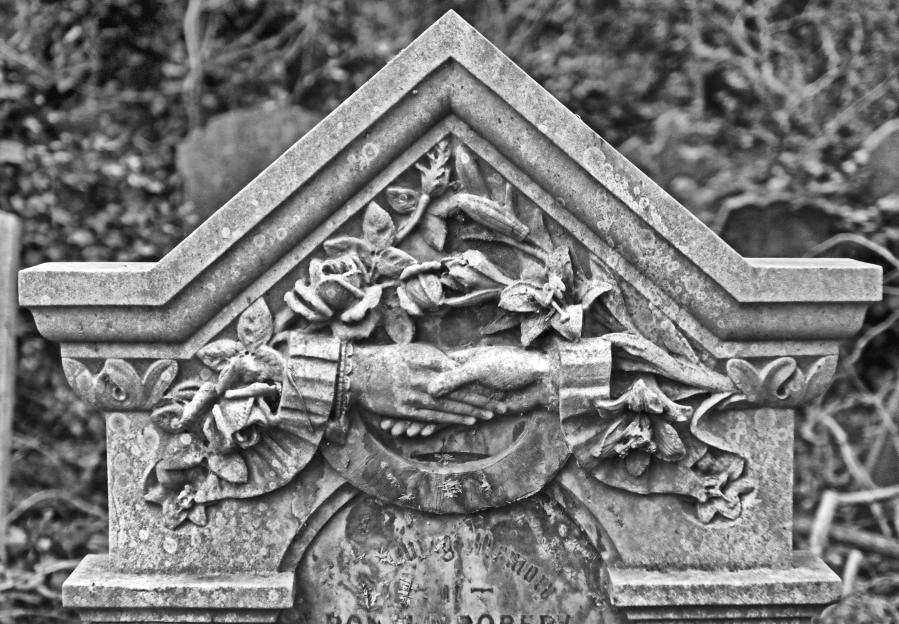
This is one of the most common symbols in a Victorian cemetery and visitors on my tour often ask about it. Initially the handshakes may all look the same but, if you look carefully, there are differences. Although a handshake is a traditional way of saying goodbye or farewell, as with other funerary motifs, it can have several meanings.
For example, it can signify the parting of a wife from her husband or vice versa and this is demonstrated by the fact that on several examples that I’ve seen there are two carefully delineated cuffs. One will have a more attractive, perhaps a frilly one, with the other having a plainer one to indicate the husband. This emphasises a marital connection or at the very least a close bond. It has also been suggested that the deceased person is holding the other’s hand to guide them to heaven.
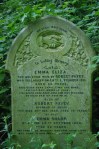
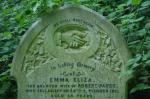
The full tombstone to Emma Eliza Pavey with ivy for evergreen surrounding the handshake. Nunhead Cemetery. copyright Carole Tyrrell
Emma Pavey’s tombstone in Nunhead Cemetery. Note the inscription above the handshake saying ‘We shall meet again’. A comforting thought to those left behind.
copyright Carole Tyrrell
This epitaph is to Eliza Pavey and the differentiation of the cuffs can be seen quite clearly on the handshake. Also his right hand clasps her open right hand with his fingers overlapping. On this tombstone it confirms marriage or a close bond between individuals, unity and affection even after death. There is also a saying above it which reads ‘We shall meet again’. Eliza left behind a sorrowing husband who clearly wanted the comfort of knowing that they would meet again in the after-life. Note the ivy leaves surrounding the handshake which indicate evergreen or everlasting. She died at 54, which is quite a young age at which to die, and her husband, Robert, outlasted her by another 20 years.
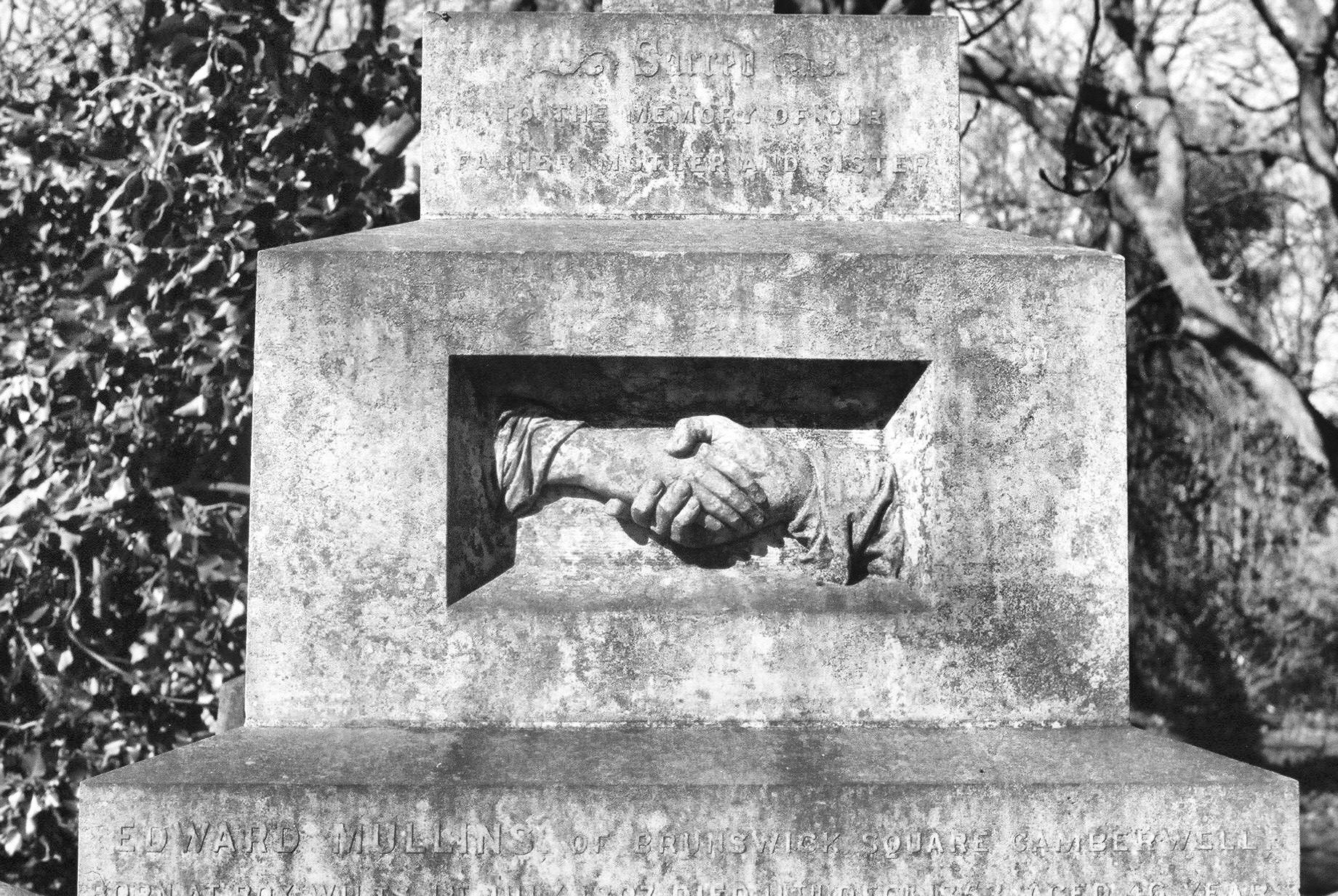
This is on the monument to Edwin Roscoe Mullins a 19th century sculptor. copyright Carole Tyrrell
A particularly striking and beautifully carved example is on the Edward Roscoe Mullins vault. There are several examples within Nunhead Cemetery but these are the best in my opinion. Mullins was a Victorian sculptor and began his career working with classical themes and then moved onto municipal sculpture such as on Croydon Town Hall amongst others. This has been extremely well sculpted, in my opinion, with the two hands and cuffs being sharply defined.
The handshake can also be a representation of hope as there is a suggestion of meeting again in the afterlife.
The full memorial – note the ivy for evergreen or everlasting on the lower pillars. A lovely monument to a much loved child who died in infancy copyright Carole Tyrrell
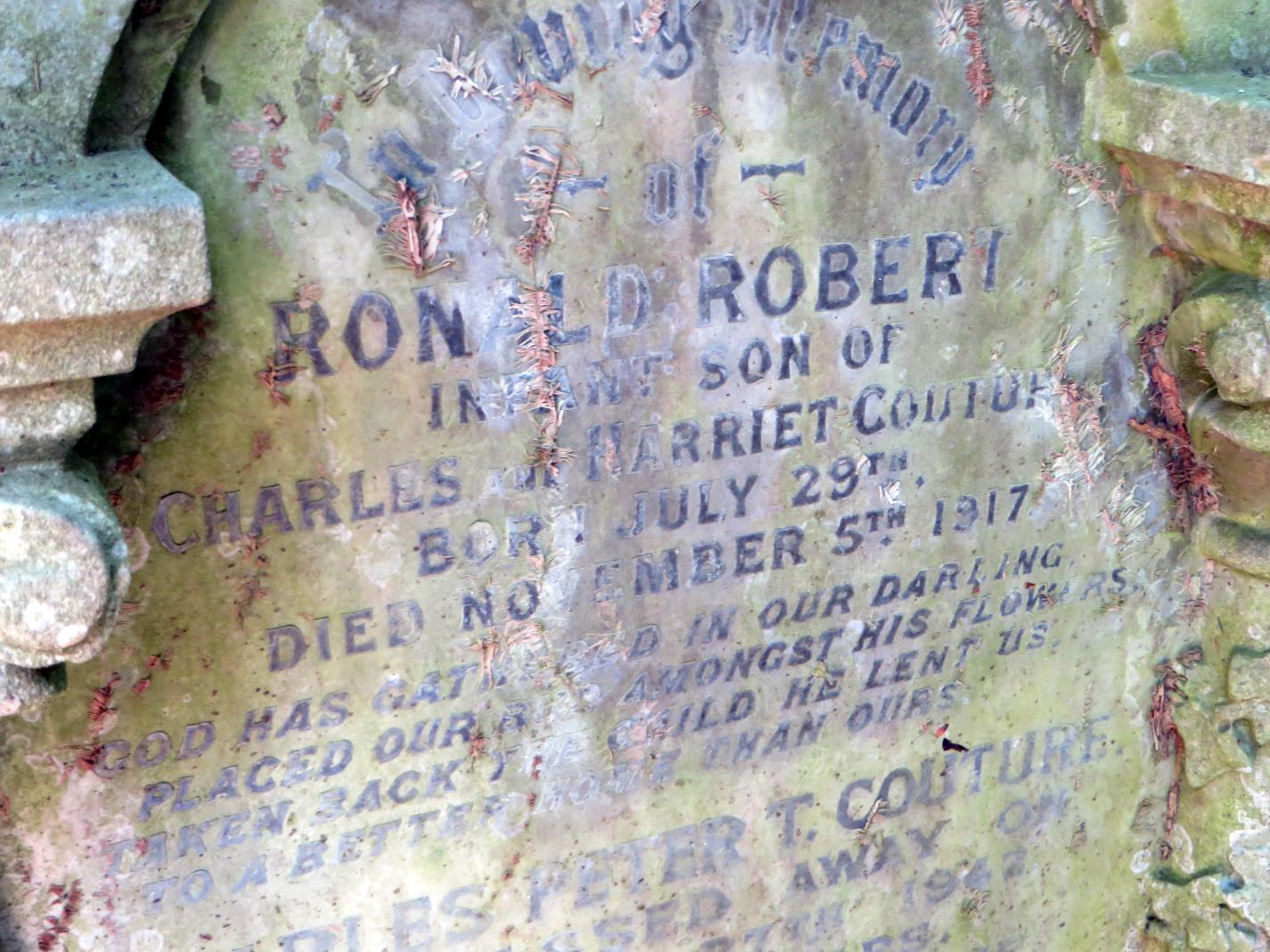
This is the poignant memorial to Ronald Robert Couture who died in his infancy at just over 3 months old. The handshake is garlanded with flowers; roses which represented love, beauty and hope and also daffodils which meant regard in floriography, the language of flowers. There is a rosebud in the garland which often appears on childrens memorials. It represents a life unfulfilled, a rose that never opened and bloomed. There is also ivy entwined around the two pillars. This beautiful and elegant monument to an obviously much wanted and much missed child would indicate that here the handshake is a hopeful sign.
The handshake may also be a reminder of ‘see you soon’ from the deceased to their sorrowing close relatives which may not be as comforting as it sounds with the Victorians high mortality rate.
Ultimately, the handshake is a symbol of comfort and reassurance from the departed to those left behind and in the case of Ronald Couture, that his brief life was not forgotten.
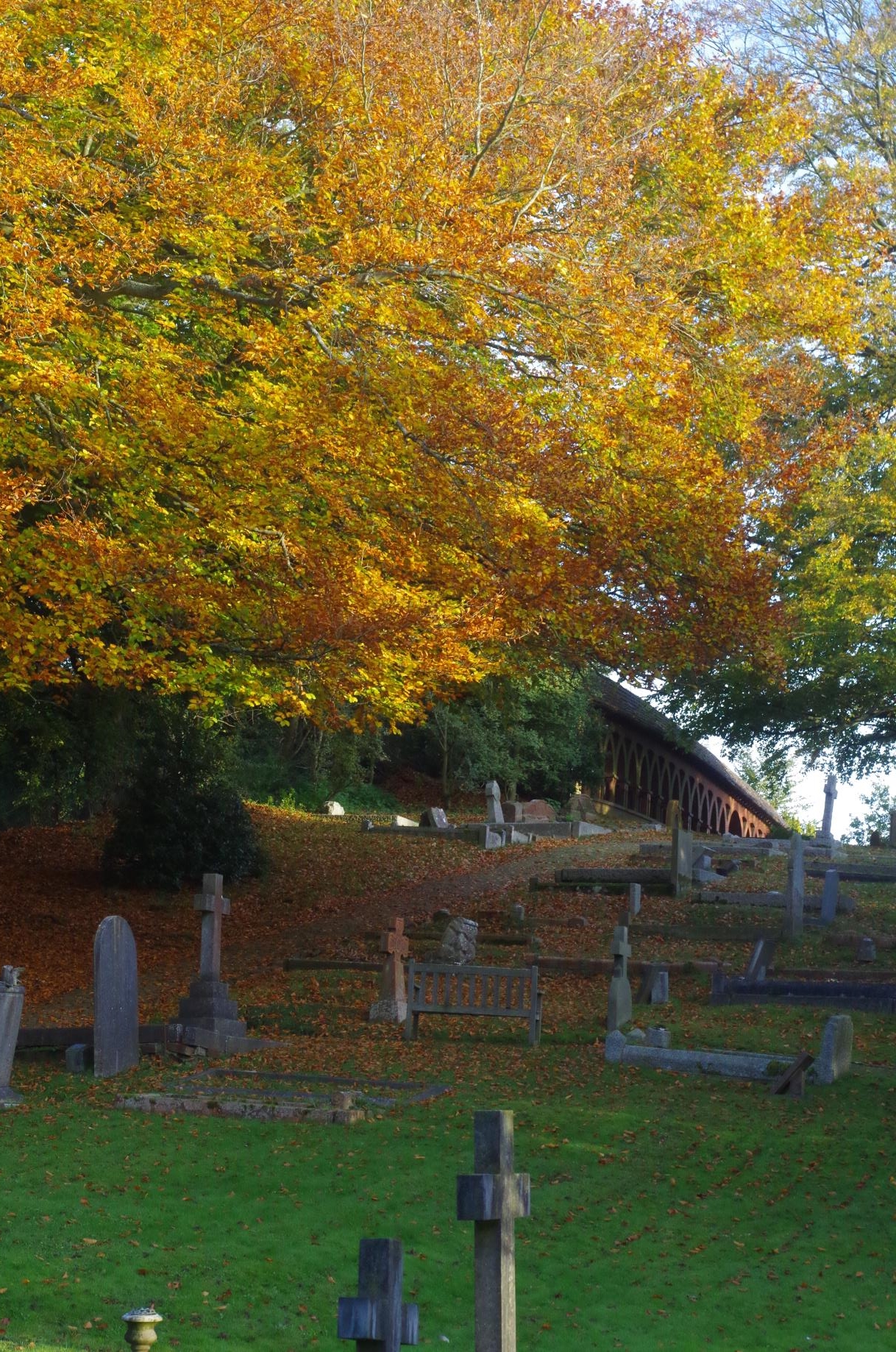
Autumn view over the churchyard showing the cloisters from the road oustide. copyright Carole Tyrrell
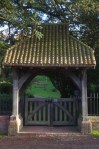
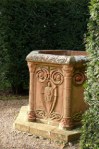
The golden autumn sunshine of the last afternoon had created long shadows and bathed the leaves on the trees in gold. It was one of those autumn days on which you’re glad to be outdoors to make the most of the last golden days before the dark season sets in. Once you’ve gorged yourself on the beautiful Watts Chapel, make sure that you have left yourself enough time to explore the churchyard. This is a tranquil place which was created by Mary Watts and Compton Parish Council and has gorgeous views over the surrounding countryside from the cloister at the top of the hill. From the road outside we could see the cloister and several of the terracotta memorials, two of which are Grade II listed. The Wattses erected the picturesque oak lych gate at the entrance in 1897. Mary Watts’ terracotta wellhead, encircled by a yew hedge, is along the left hand path. This was designed in 1906 and also Grade II listed. There are inscriptions on its top sides; ‘ the lord god planted a garden eastward in eden and a river went out of eden to water the garden.’
The Wattses also gave this to the churchyard in 1897. Made from oak with a brick floor.
copyright Carole Tyrrell
View of Compton wellhead and encircling yew hedge.
copyright flickrhivemend
One of the figures on one side of the Art Nouveau well head in Compton churchyard.
copyright Carole Tyrrell
Mary Watts and the Parish Council laid out the cemetery which is also known as the Watts cemetery, in 1895-8. It’s Grade II listed and was created as the old Compton churchyard was completely full. At an 1894 meeting of the Parish Council it was proposed to buy land from the nearby Loseley estate and the Council agreed to raise a sum of £1300 from the poor rate of the parish for the purpose of ‘providing and laying out a Burial ground and building the necessary Chapel or Chapels thereon.’ Mary Watts wrote to the Council a year later, offering to build a cemetery chapel, with her husband’s financial help and inspiration. Evergreens were planted which included cedars and yews and Mary planted the Irish yews. The graveyard and chapel were consecrated by the Bishop of Winchester on 1 July 1898. It was extended in 1950 and a garden of remembrance was added in 1959. The Parish Council still own and manage the cemetery.
The graveyard feels like a much older cemetery and a real part of the community. It was created from local materials and local people with Mary Watts as part of the Compton Potters Guild. As with the Watts Chapel it’s in the Arts and Crafts style that was popular at the time. Mary was fully involved with the churchyard as, from September 1896, she sat on the Parish Council sub-committee that was responsible for the graveyard together with the rector of St Nicholas, H H Gillett, the Loseley landowner William More-Molyneux and Mr Andrews, estate steward at Limnerslease, the Wattses nearby home. It was landscaped in the Romantic style with winding paths and the choice of trees was designed to inspire feelings of mourning and contemplation.
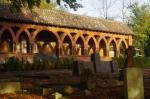
Another view of the cloisters, Compton churchyard. copyright Carole Tyrrell
The cloister was added in 1907. It keeps to a similar Italianate theme as the Chapel. Again, it’s also Grade II listed and has been compared to the loggia in Postmens Park. This was G F Watts, Mary’s husband, memorial to self-sacrifice near St Paul’s in the City of London. There is a memorial to G F Watts on the cloister wall with a small recumbent statue of ‘Signor’ as Mary called him flanked by two seated cherubs. Mary’s memorial tablet is also there.
Another view of the cloisters, Compton churchyard.
copyright Carole Tyrrell
Signor at rest on his memorial in the Compton churchyard cloisters.
copyright Carole Tyrrell
Cherub on G F Watts memorial in Compton churchyard cloisters.
copyright Carole Tyrrell
The memorial tablet To Mary Seton Watts, Compton churchyard.
copyright Carole Tyrrell
We didn’t have enough time to find the two Grade II listed memorials; one to Margery Gillett, the Rector’s wife and the other to a novelist, Julian Russell Sturgis(1848 – 1904). We also didn’t find the Huxley family grave either as the author of 1932’s Brave New World, Aldous Huxley’s, ashes are interred with his parents. We did find some m
Moss has etched out the epitaph in an organic way and the sweet little mouse on the terracotta book makes this a lovely memorial. copyright Carole Tyrrell
The recumbent Celtic Cross from a 1904 memorial is being reclaimed and enhanced by moss.
copyright Carole Tyrrell
A lovely Art Norveau memorial. There is a very similar on in Golders Green Crematorium’s cloisters. copyright Carole Tyrrell
The churchyard is still open for burials and we did find one recent terracotta memorial dating from 2012.
A modern terracotta memorial in Compton churchyard copyright Carole Tyrrell
The Chapel and churchyard are the result of one woman’s vision and determination to create a lasting memorial to her husband and to give something lasting to the community. I was full of admiration for Mary Seton Watts as she has left a lasting tribute to Signor and to herself. A significant artist in her right, she was obviously extremely capable, talented and a born organiser. Thanks to her and to Signor, there is a unique place in the Surrey hills for which she will always be remembered.
Watts Chapel; An Arts & Crafts Memorial, Veronica Gould & Joanna Howse, Books for Dillons, published 2 October 1993 (NB: This may be out of print but the Gallery may still have a few copies)



















![Butterfly & Chinese wisteria by Xu Xi Early Sing Dynasty c970. By Xü Xi (Scanned from an old Chinese book) [Public domain], via Wikimedia Commons](https://shadowsflyaway.blog/wp-content/uploads/2016/07/butterfly-chinesewiki.jpg)























 shadows fly away
