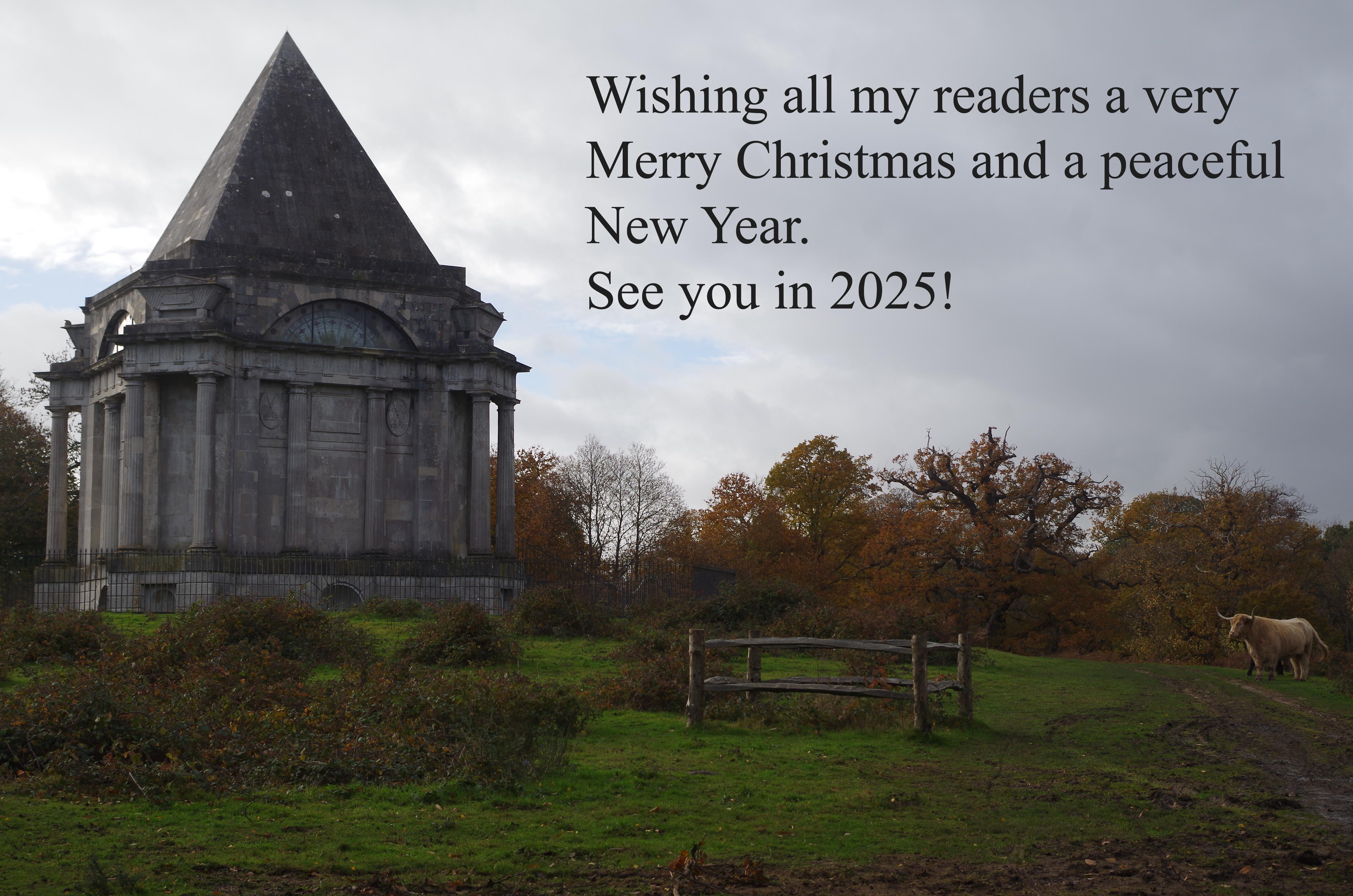
As the festive season gets underway, it’s time for the shadowsflyaway Christmas card! It’s a small thank you to all of my readers and those that have liked a post or sent me a message. Next year will be the tenth anniversary of shadowsflyaway which I think is a real achievement. So there is no Symbol of the Month. It will resume in January 2025.
The picture is of the Darnley Mausoleum in Cobham Woods in Kent. It’s one of my favourite places to visit even when its closed. In 2005, it was featured on ‘Restoration, a BBC TV programme about buildings that needed rescuing and the Mausoleum was one of them. It was in a sorry state, vandalised, burnt out, and surrounded by impenetrable woodland. I watched the TV programme, thinking ‘Why bother? It will just be vandalised again.’ But it was restored and landscaped and it is now a beautiful and elegant focal point.
And of course replete with symbols as I said in a previous post.
It’s often on a winter’s night, just as dusk begins to fall and the lamp lights in St Georges churchyard come up, that the fine selection of 18th century tombstones are at their best. Carved skulls leer at you, an hourglass emphasises time passing and the gravedigger’s tools stand ready for the next interment. And perhaps there is still a phantom schoolteacher using his sculpted globe to teach geography to his spectral students.
There has been a church on this site since the 14th century and, in one place in the graveyard the number of burials over the centuries has made the ground rise up on both sides. But, as well as 18th century examples of funerary symbolism, there are also some wonderful 19th century ones as well. Inside the church there’s also a good selection of impressive wall monuments dedicated to prominent local families dating back to the 1600’s. They are buried in the vaults beneath the church. St George’s also has the country’s oldest lych gate in that the current one incorporates elements from a far older one. The churchyard is a pretty one for a short walk through to the bustling High Street especially when the spring flowers begin to appear, carpeting the grass between the stones with bluebells and flitting butterflies.
However for this month’s Symbols post I will concentrate on the 18th century memorials within the churchyard. These tombstones are topped with classic memento mori symbols. This is Latin for ‘remember (that you have) to die.’ They are the visual accompaniment to the immortal epitaph from Dundee’s Howff graveyard:
‘Remember Man as you pass by
As you are now so once was I
As I am now so must you be
Remember man that you must die.’
Graveyard symbolism, according to Douglas Keister, began when the well to do could no longer be buried with in their local church due to lack of space. Instead, they took up their eternal residence in the newly consecrated burial grounds outside and surrounding the church walls. These were often known as ’God’s Acres’ and gave the wealthy the opportunity to erect a lasting memorial or tombstone in their memory.
St George’s churchyard became the last resting place of prominent local families, some of whose descendants still live in the area. The oldest tombstone dates from 1668 and the 18th century ones are nearest to the church walls which in effect meant that they were ‘Nearer my God to Thee.’
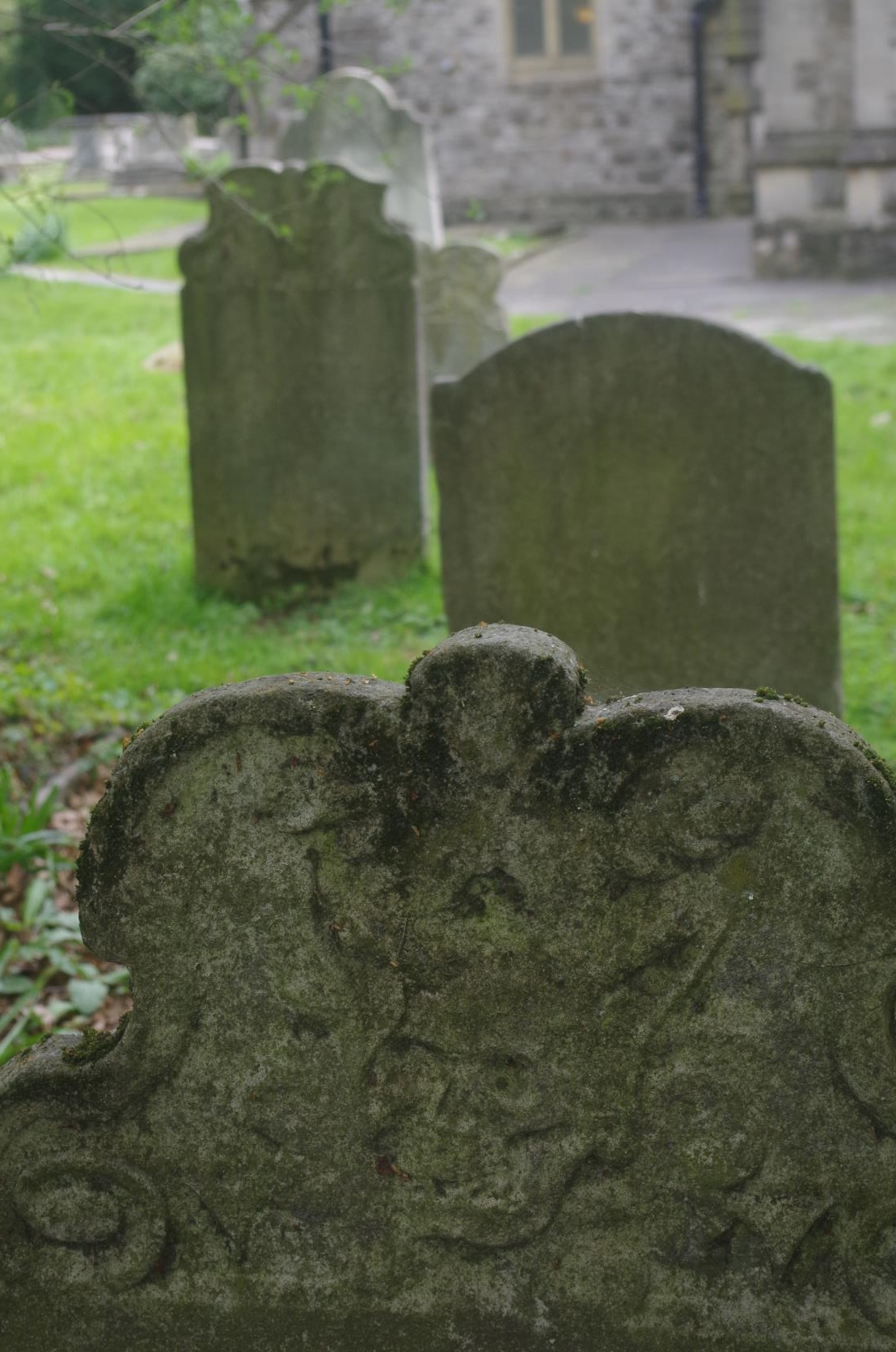
I’ve always enjoyed walking through the churchyard as it can feel like walking through a gallery of funerary symbols. There’s something very exuberant about these 18th Century motifs of mortality even though some have eroded and only one epitaph is still fully readable. However, the skull and crossbones, the Death’s Heads and others have, in several cases, lasted better than the epitaph below them.
The skull and crossbones are an effective, if macabre, reminder of what is left of a body after it decomposes and there are several good examples in St Georges.
This one is near the church entrance and features a skull and crossbones with what appear to be protruding palm fronds. It also seesm to be resting on something whch may be a shield. All that can now be read on the epitaph is…who dep….’
Nearby is another skull and crossbones with a winged hourglass above it. This is a reminder that ‘Time flies’ or ‘Tempus Fugit’ and that the onlooker will soon be bones and dust. So it’s important to make the most of their time on earth. On the left hand side is a pick and shovel. These are a sexton’s tools which made me wonder if this was a sexton’s grave but the epitaph is now illegible. The sexton’s role not only encompassed maintaining and looking after the church but also the churchyard. In larger graveyards the sexton would have been more of a manager but in smaller ones he would have had sole responsibility for preparing the ground, digging and closing the grave, mowing the lawn and also maintaining the lawn and paths.
Skulls also feature prominently on two other tombstones on the other side of the church very near the wall. One seems to have a very sharp pair of horns and a definite smirk. On each side of it there appear to be small trumpets but it’s too weathered to see if anyone’s blowing them. Maybe he’s keenly anticipating the Last Day of Judgement.
Nearby is a large tombstone with what seem to be two somersaulting skulls on them although one is more eroded than the other. Below them is a small worn hourglass. I believe that these two examples of skulls may be unique to St Georges as I’ve haven’t yet seen them anywhere else.
Douglas Keister has suggested that the skull and crossbones slowly began to be replaced by the much less stark and macabre ‘Death’s Head.’ This is a human face with wings on either side of it. I’ve always known it as the ‘winged cherub’ and there are also several good examples within the churchyard. These are symbols of resurrection intended to give those left behind some hope.
I am also a huge fan of calligraphy having studied it for two years at evening classes and it has undergone a revival on late 20th and early 21st century tombstones. However 18th century calligraphy has a style all of its own and is instantly recognisable. The only legible 18th century epitaph in St Georges is the one dedicated to a John Saxby. It reads:
‘Here lyeth the body of John Saxby of the Parish who Departed this life…year of May 1731 aged 41 years.’
A fine example of a Death’s Head is on top with an open book beside it which may be the Bible or the Book of Life and there’s a stylised flower on the other side. The open book may be a depiction of the incumbent offering their life to God for judgement as an ‘open book’. People are sometimes described as an ‘open book’ as they have their feelings and thoughts open to the world with no attempt to hide them.
On another memorial two small faces, presumably from the angelic host, peer out from either side of the clouds surrounding a crown. It’s a representation of the reward that awaits the faithful in heaven. This verse from the Bible refers to it:
James 1:12 New International Version (NIV)
‘Blessed is the one who perseveres under trial because, having stood the test, that person will receive the crown of life that the Lord has promised to those who love him. ‘
A plump faced death’s head is surrounded by another open book and what I think maybe a small skull in the far corner of the stone.
But one of the most unique and impressive tombstones in St George’s, or perhaps anywhere, is that of John Kay. He was an 18th century schoolmaster and his life and talents are recorded by the tools of his trade that have been carved on his stone. There’s a globe on a stand, a trumpet, what appears to be a cornet, an artists palette, a pair of compasses and other items which are now too indistinct to read. He was obviously very erudite and much appreciated by his students. Sadly his fulsome epitaph is now virtually unreadable. He lies near Mr Saxby under a spreading yew tree.
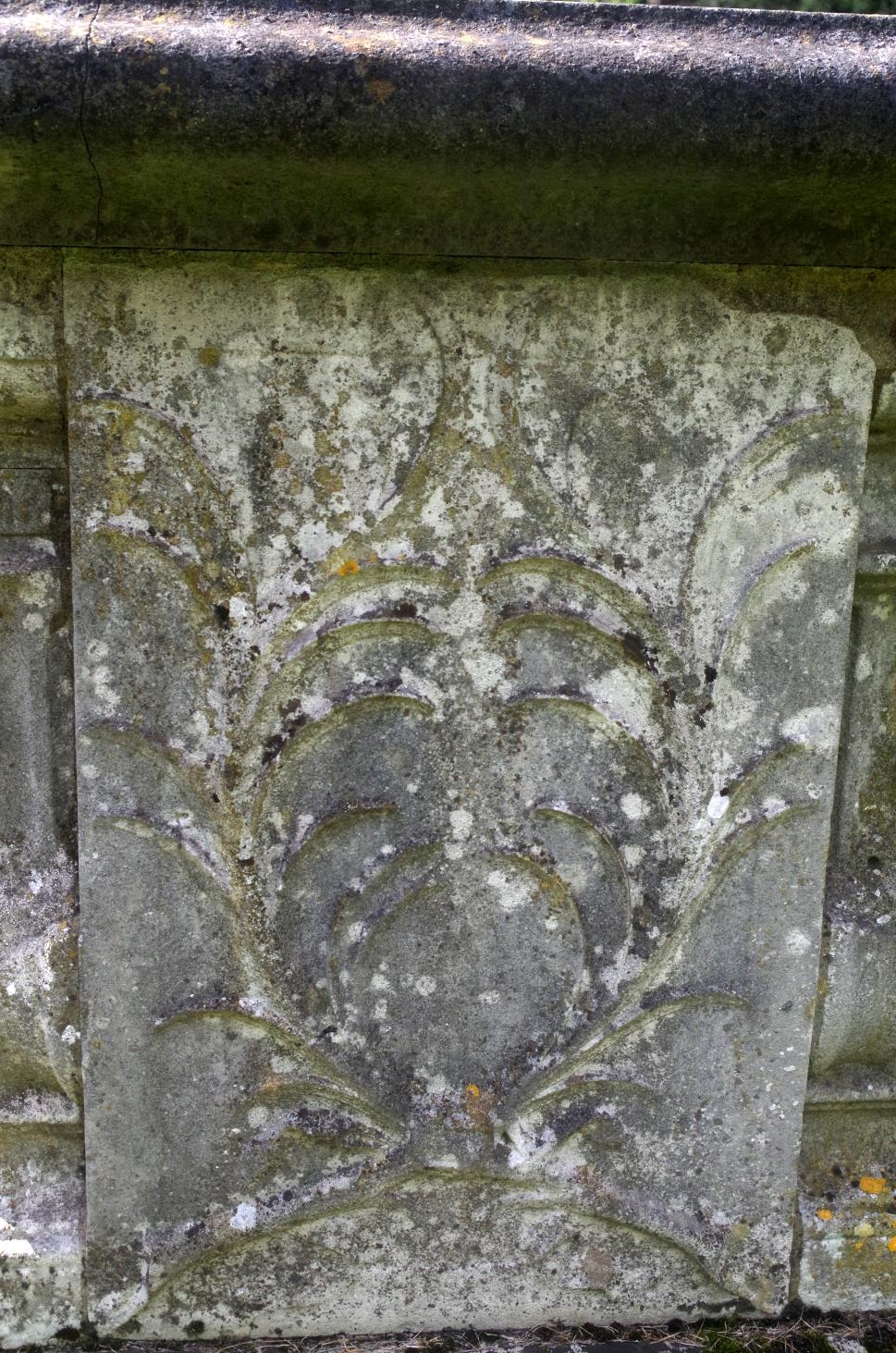
On the other side of the graveyard is a large chest tomb. There is a dedication and an armorial on its top and I feel that some patient research in St George’s burial registers may reveal the incumbent’s identity. There are blank cartouches on each side with death’s heads on top and two skulls beneath each one. At one end are palm fronds which are a Roman symbol of victory which were then adapted by the Christians as a martyr’s triumph of death. The palm as a symbol originated in the ancient Near East and Mediterranean region and is a powerful motif of victory, triumph, peace and eternal life. It’s traditionally associated with Easter and Palm Sunday and Christs’ resurrection and victory over death. On the other end of the tomb are what appear to be olive flowers. The olive’s association with wisdom and peace originally came from Greek mythology when the goddess, Athena, presented an olive tree to the city that was to become Athens. Successive Greek ambassadors then continued the tradtion by offering an olive branch of peace to indicate their goiod intentions. The olive tree is also associated with longevity, fertility, maturity, fruitfulness and prosperity. In the Bible, Noah sent the dove out after the Flood to see if the floodwaters had receded and when it returned with an olive leaf in its beak Noah knew that the Flood had ended. Even today the phrase ‘ offering an olive branch’ means the someone wants to make peace. But in this context the olive branch may mwean that the soul has departed with the peace of God. So one memorial incorporates powerful motifs of mortality and resurrection.
St George’s has also used old tombstones to pave two of the pathways within the churchyard of which some are still readable. It always feels as if I’m walking over someone’s grave although they are buried elsewhere in the graveyard. However, although the 19th and 20th century memorials are rather more restrained and far more legible I prefer the more ‘in your face’ 18th century symbols. But in the case of the horned skull I can only frustratingly only guess at its meaning and the person who lies beneath…..
There are over 53 war graves and I found the plot containing most of them although there are others buried throughout the cemetery. The plot contains 18 German airmen, (one unidentified), and 50 British casualties. The others are Commonwealth service personnel of which 2 remain unidentified and I saw some of them as I explored.
The Hebrew section is near the crematorium and I found other notable permanent residents although a chill was beginning to make its presence felt as the afternoon wore on. Samual Courtauld and his wife’s headstone seemed quite modest considering his achievements. He was the great art collector who founded the Courtauld Institute of Art in 1932 which continues to this day and, after a series of gifts during the 1930’s, bequeathed his entire collection to the Institute on his death. He also created a £50k acquisition fund for the Tate and National Gallery in London which enabled them to acquire works that helped create national collections of Impressionist and Post-Impressionist art.
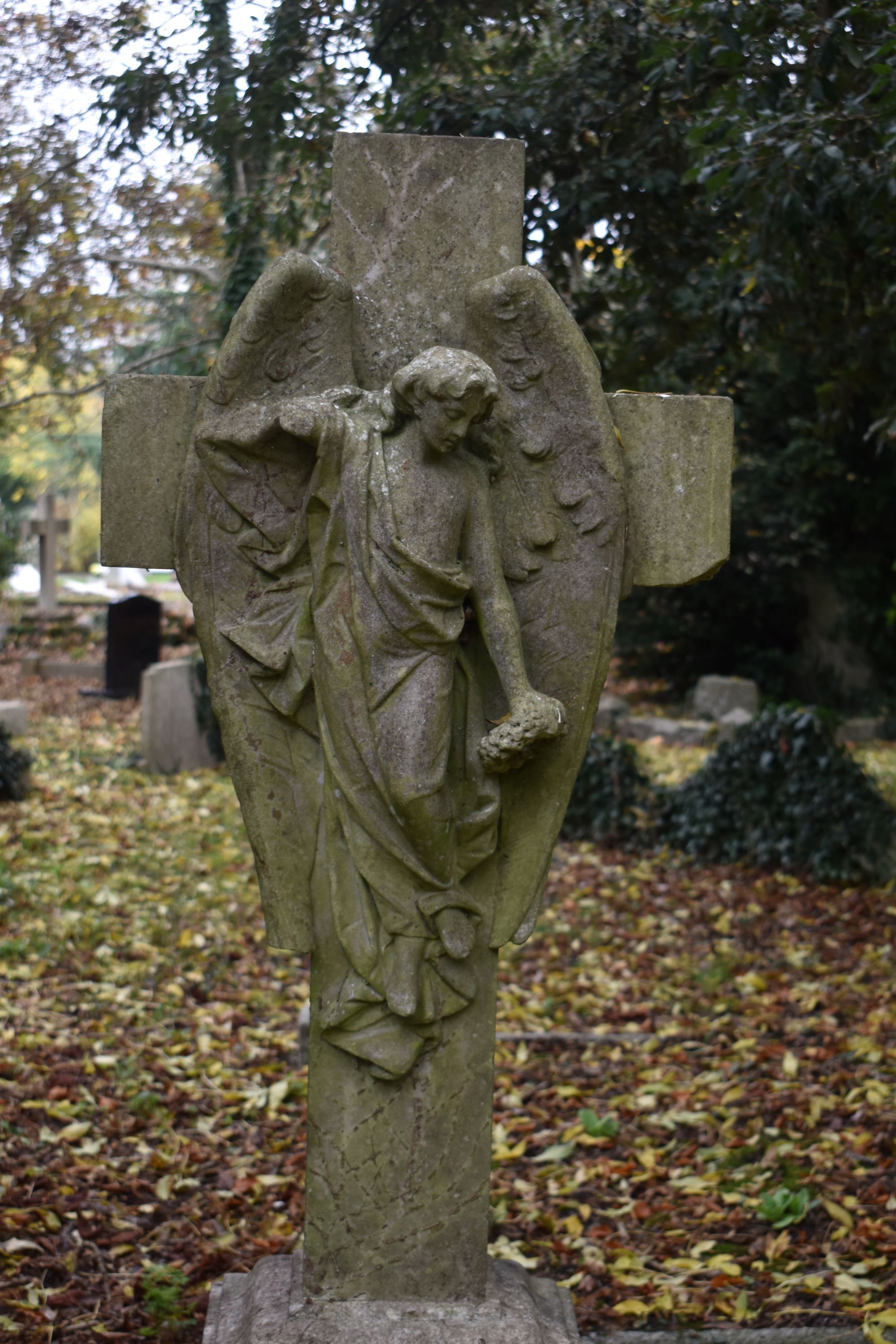
Another surprise was finding a definitely male angel draped in what could be described as a toga (it looked chilly) keeping watch over the grave of Arthur and Ethel Weston. It’s unusual as most angels in cemeteries and churchyards appear to be pretty, pensive young women.
There was a 2D representation of ‘Simply To Thy Cross I Cling’ on the Holness headstone. I found a metal Lourdes medal that had been placed on a stone cross.
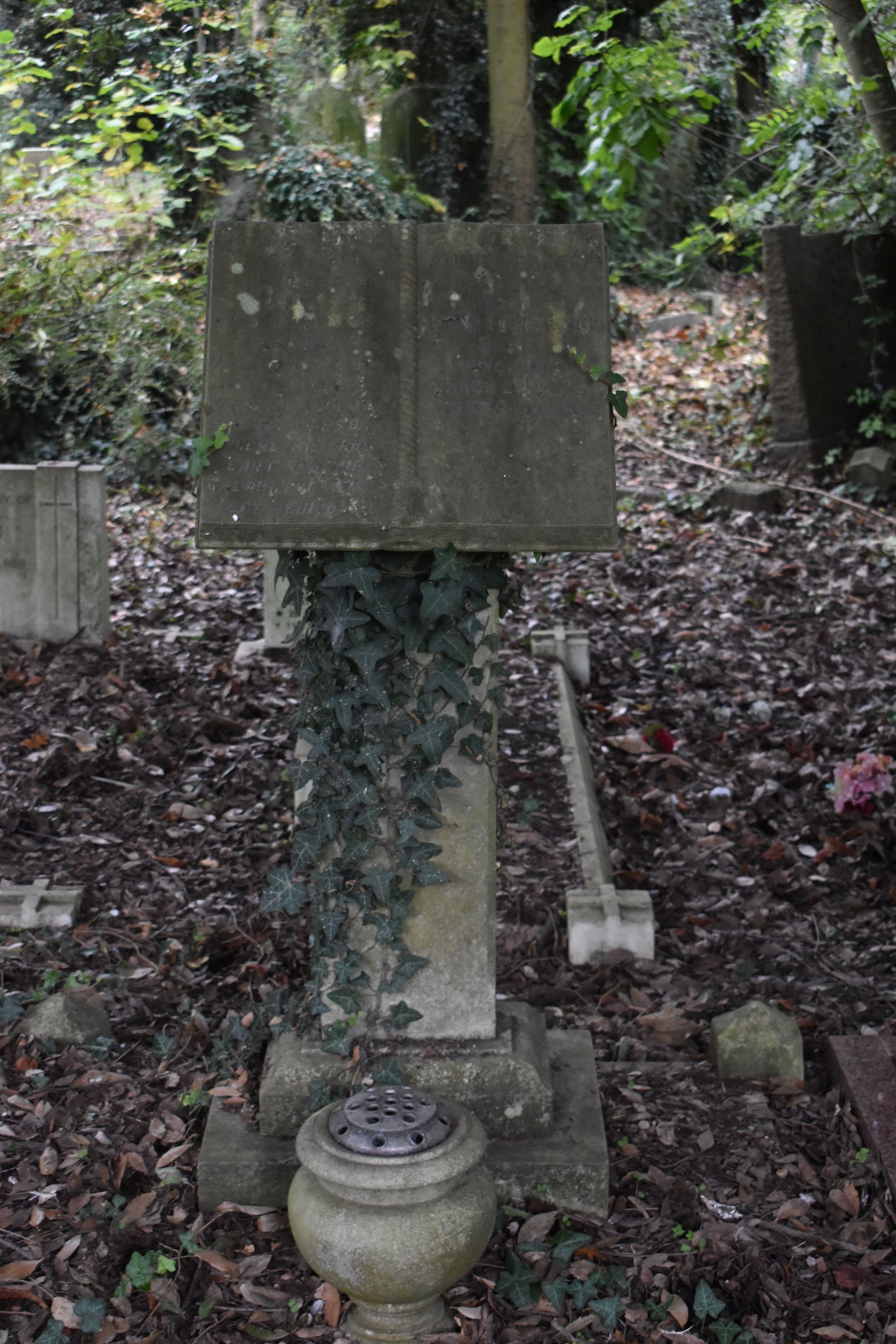
There was also a variant on the open book which was last month’s Symbol of the Month. Here it has been placed on a lectern style stand which made me think of the deceased standing up and telling all those around him of his or her good deeds or perhaps giving them a sermon.
On the elegant Devereux headstone dedicated to Thomas and his wife, Maria, I didn’t need to look at the epitaph to know that this was dedicated to a Royal Navy man. The two pillars have chains wrapped around them ending in two entwined anchors. There is also a Crown above them and the familiar shaking hands at the top.
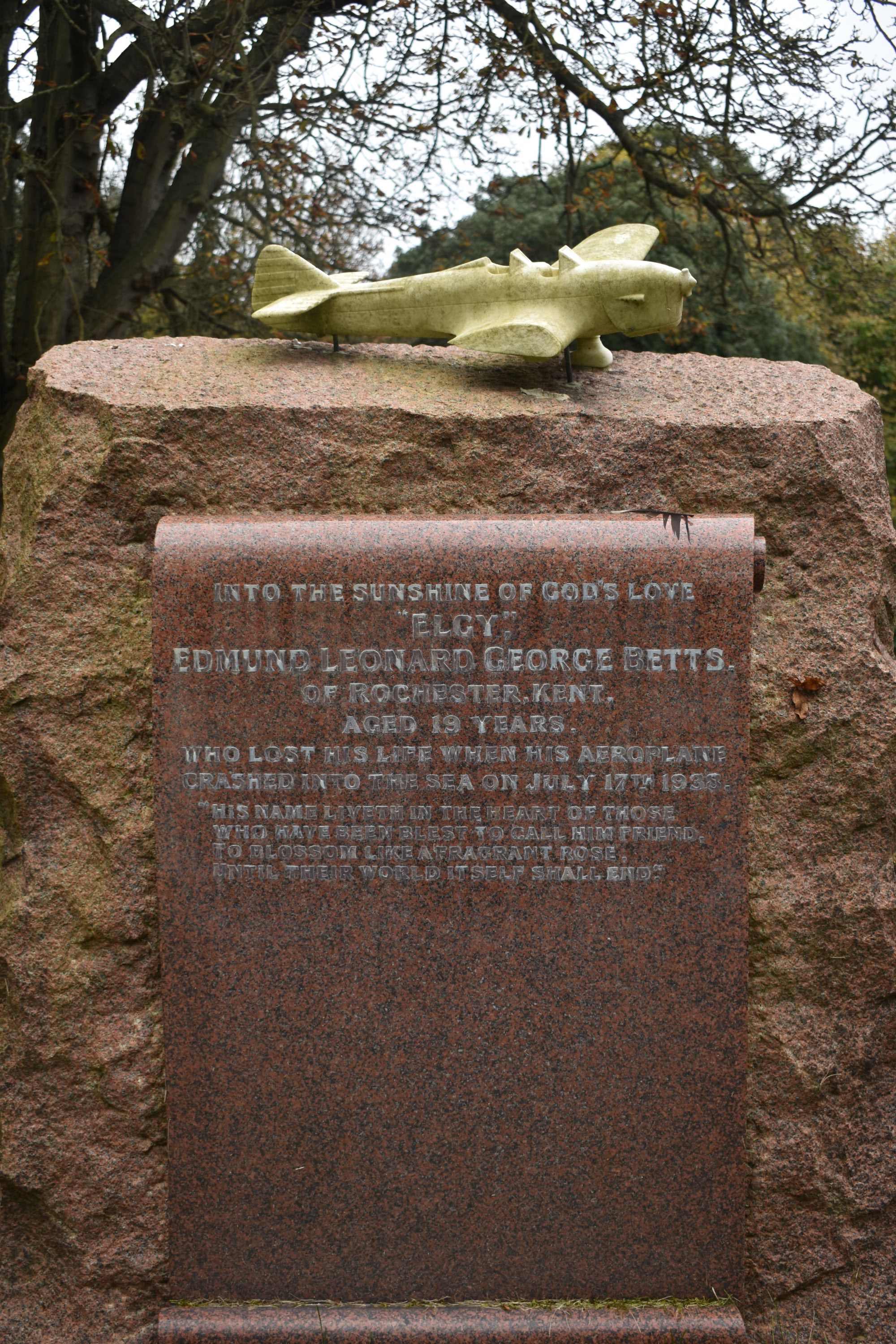
I then came across my other surprise of the day when I found another Grade II listed monument. I was surprised that the small model airplane on top of it hadn’t been stolen although I saw very little vandalism in the cemetery. The monument is dedicated to Edward Leonard George ‘Elgy’ Betts who died aged 19 on 17 July 1938. I am indebted to Findagrave for the information about him:
‘….crashed into the sea with a 2 seater light aircraft after taking off from Ramsgate airport. He was flying a Miles Hawk Trainer airplane belonging to Thanet Aero Club and it crashed into the sea off Cliftonville, Margate, Kent. He and his passenger, 16 year old Marjorie Wall, were killed….. She is also buried in Margate Cemetery with her parents. The sculpture of the plane is and accurate representation of the plane in which he died, including the registration letters G-AEFU.’
Ramsgate airport is long gone and has been replaced by an industrial. For a Sunday afternoon the cemetery was quite busy with visitors, mostly in cars, and a few like myself on foot. But I was aware that I didn’t have enough time on this visit to explore the entire cemetery so will do it in sections on future visits. I am already anticipating this although there is already plenty to write about!
It was a dark, gloomy grey Sunday when I decided to explore the cemetery and walked up the impressive avenue of yew trees studded with bright red berries to the two cemetery chapels. But, by the entrance, I discovered a smaller building hidden behind bushes in the Gothic style of the chapels. I thought that it might have been a mortuary chapel but, on looking at the map, it may have been a more prosaic toilet block now locked up. The cemetery is officially known as St John’s cemetery and also houses a crematorium and associated gardens of rest.
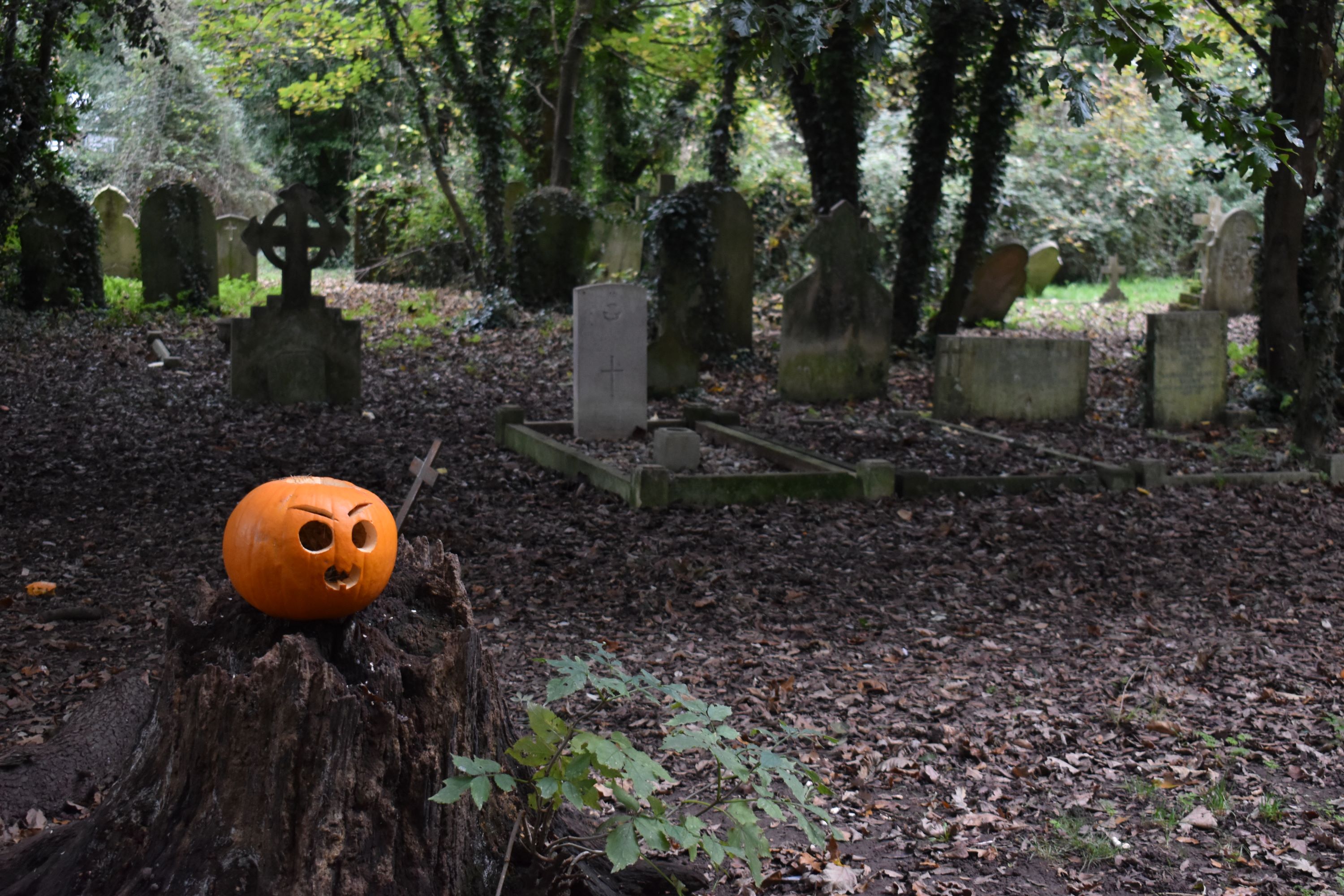
After the excitement of Halloween, people appeared to have donated their pumpkins to the local wildlife and I disturbed a squirrel scampering over one. However, although people may consider them to be a tasty treat. Forestry England doesn’t agree and suggests on their website that they be reused to make pumpkin soup or be added to compost.
Nothing prepared me for the size of the cemetery and, so far, I have been unable to discover its exact dimensions. I soon realised knew another visit or two would be necessary to explore it fully. The bright Autumn colours of the leaves were dulled by the greyness of the skies as I merrily kicked up leaves and looked for fungi. But all I could find were a couple of what I thought were parasol mushrooms lurking in the fallen leaves.
The cemetery was opened in 1856 and a sign marks the place of the first burial which was a woman, Harriet Ross, on 1 November of that year. Most of the first section along the main avenue dates from the 19th century. As I neared the chapels, there was a large monument in a gap between the yew trees, set back from the path featuring an angel praying before a cross with, I assumed, a portrait of the deceased looking approvingly on. This was on the LeMair monument.
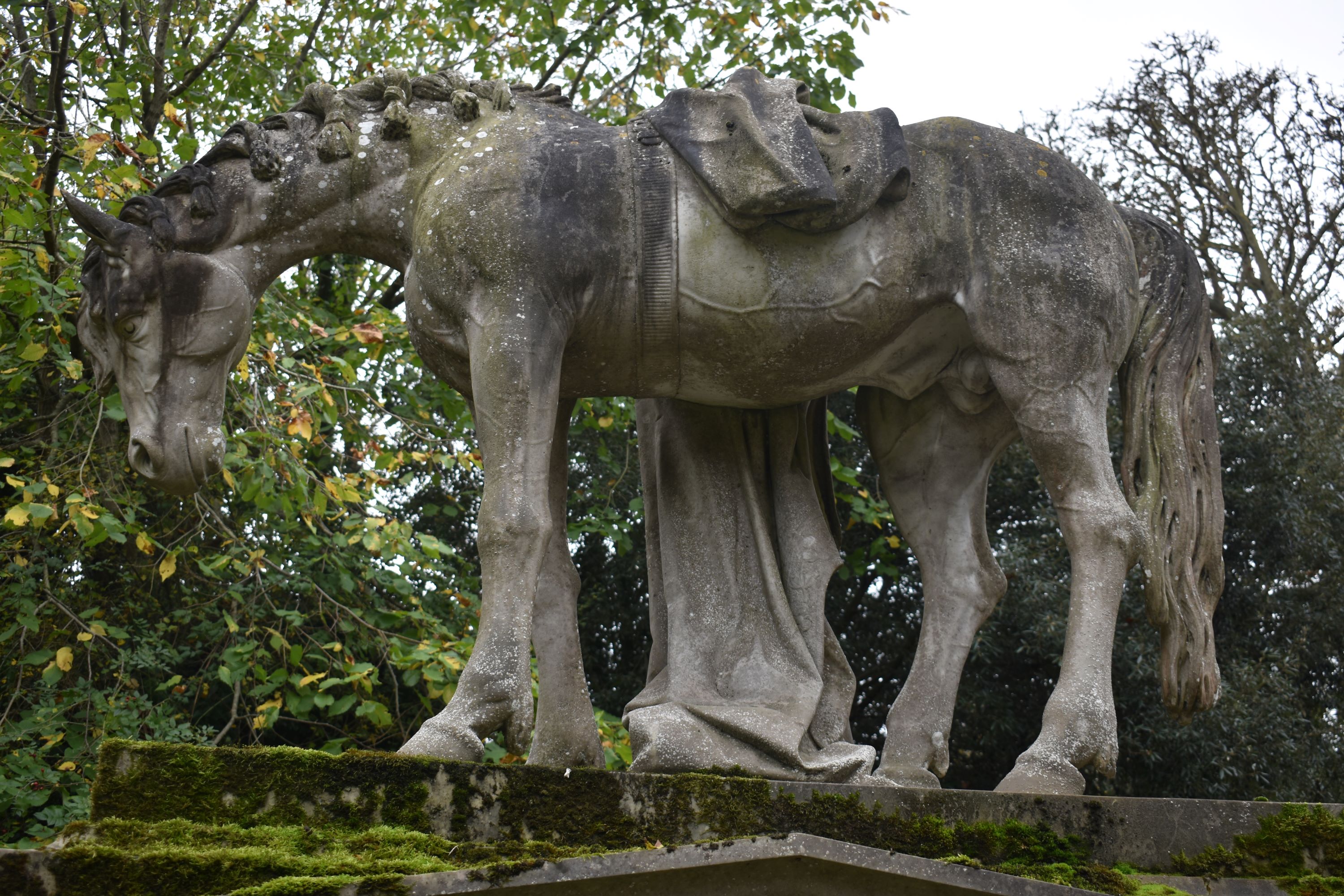
A sign announced ‘Sanger Path’, I wandered along it and came to my first surprise of the day. 4 angels forming a square, one at each corner, on the Reeve memorial. They are well sculpted with detail on the back as well. But then my eye was drawn, well I could hardly miss it, by the lifesize statue of a horse atop the Sanger monument. Beautifully sculpted, it is dedicated to a circus proprietor, John Sanger (1816-1899). He has a tenuous connection to one of my favourite Beatles songs. There is an upturned horseshoe above John Sanger’s epitaph for luck and his shows featured equestrian acts involving horses and ponies and a pantomime every Christmas. He originally went into partnership with his brother, George, but eventually they went their separate ways. George was brutally murdered in 1911 by an ex employee who then committed suicide. A photo album of George’s circus, its performers and animals came up for auction in 2017 and showed that a Victorian circus certainly was value for money! The Sanger circus appeared by royal command at Windsor Castle by Queen Victoria and they also took part in the annual extravaganzas at Crystal Palace.
One of George Sanger’s great granddaughters ashes are also interred in the family plot. This was Victoria Sanger Freeman (1895-1991) and she went under the sobriquet of ‘Queen of the Elephants’ with 4 of them under her charge. She was the last member of the Singer dynasty of circus performers. Beside John Sanger’s horse is another Sanger, Mary Rebecca, who married into the family. She is sandwiched between John and the Reeve ladies. She married William Sanger but I’m not sure at the moment where he stood within the Sanger hierarchy.
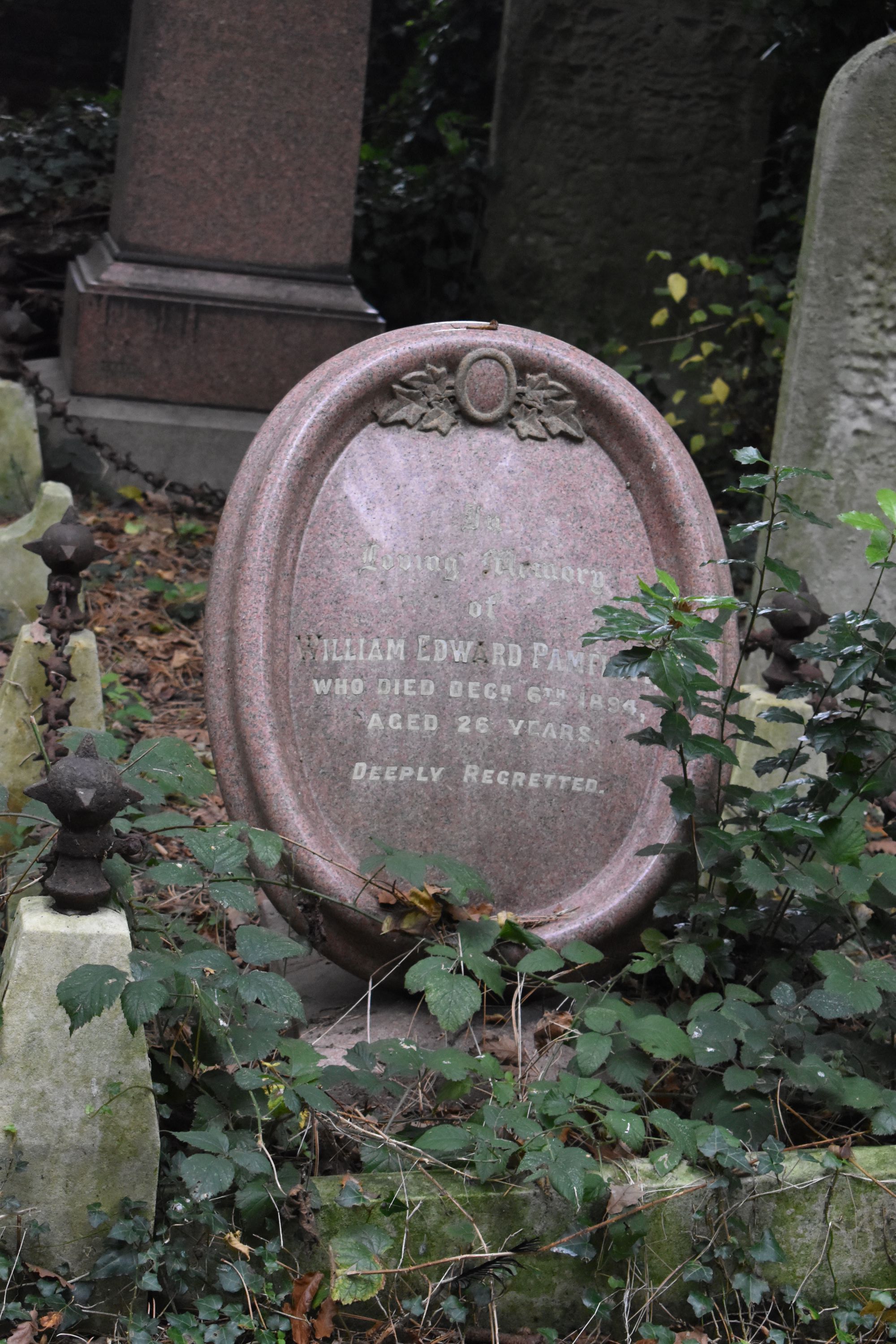
There was an interesting variation regarding epitaphs within the cemetery. On several graves, they were carved within an oval frame that was reminiscent of a portrait. I thought they looked very elegant.
There was only one way to discover why another path was named ‘Surfboat Path’ and halfway down I came upon the Grade II listed memorial to the Surfboat Disaster. It commemorated the tragedy that killed 9 Margate boatman on 2 December 1887 and was restored by the Royal National Lifeboat Institute, 120 years later in 2017. The town’s surfboat, ‘Friend to All Nations’, went out on that night in appalling weather to assist the sailing vessel, ‘Persian Empire’. Sadly, the surfboat capsized on the Nayland Rock in Margate with only 4 survivors. A surfboat is according to Wikipedia: ‘A surfboat (or surf boat) is an oar-driven boat designed to enter the ocean from the beach in heavy surf or severe waves. It is often used in lifesaving or rescue missions where the most expedient access to victims is directly from the beach’
The 2017 memorial service was not only to acknowledge the tragic event but also as a reminder that the crews and elements still face the same challenges as emphasised in the sad loss of the crew of the Penless lifeboat in 1981. To say that it is impressive is an understatement as it is surrounded by more modest memorials. It’s in the shape of a huge rock with a lifesize mourning woman, her hands to her head, face turned away, in Victorian dress and carrying a laurel wreath, an evergreen that symbolises eternity. There is an epitaph to the disaster beside her and above, on the top of the rock, are a collection of nautical symbols: chains, anchors, ropes and a life belt with the surfboat’s name on it. I was stunned although I would have expected a few nautical graves due to Margate being on the coast.
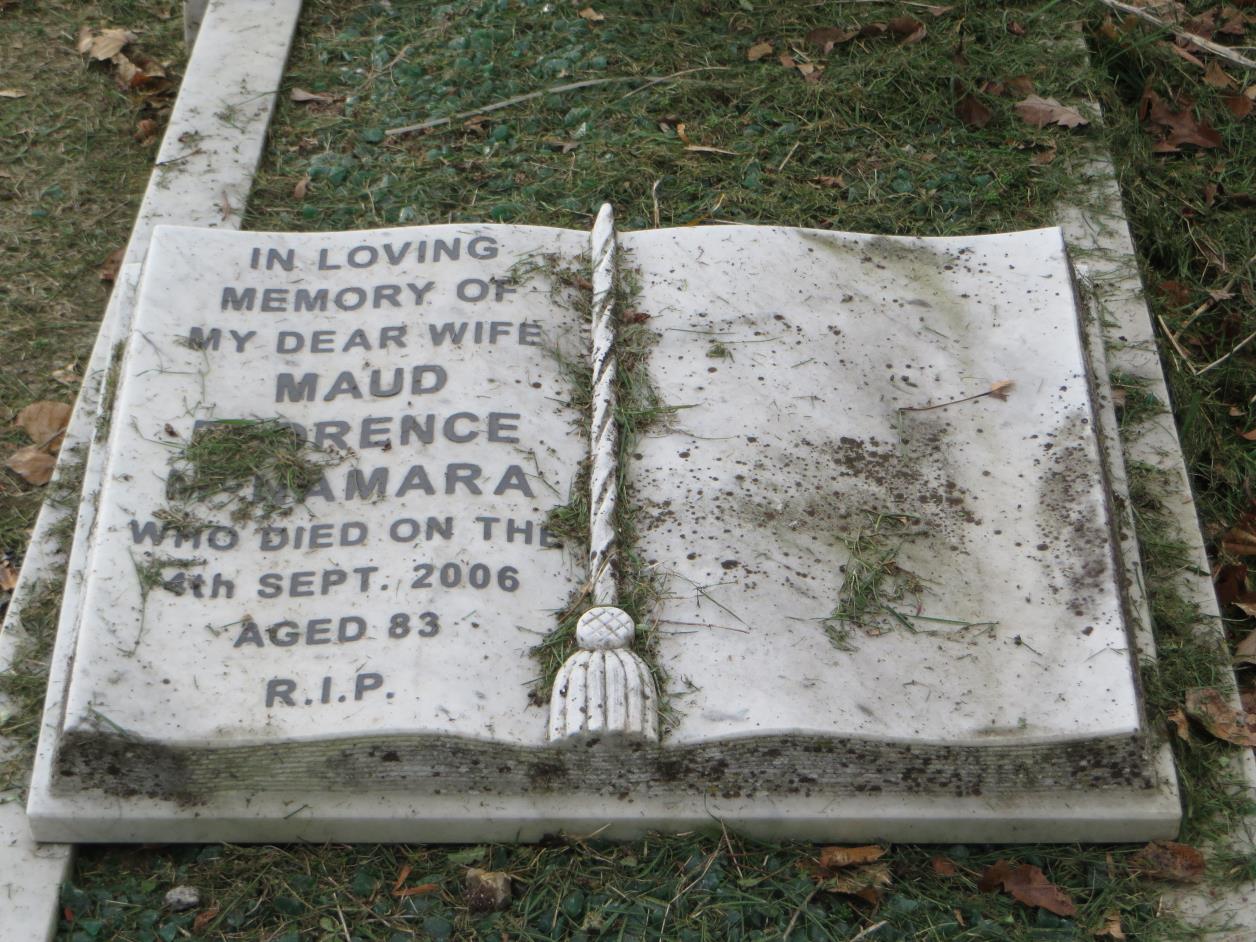
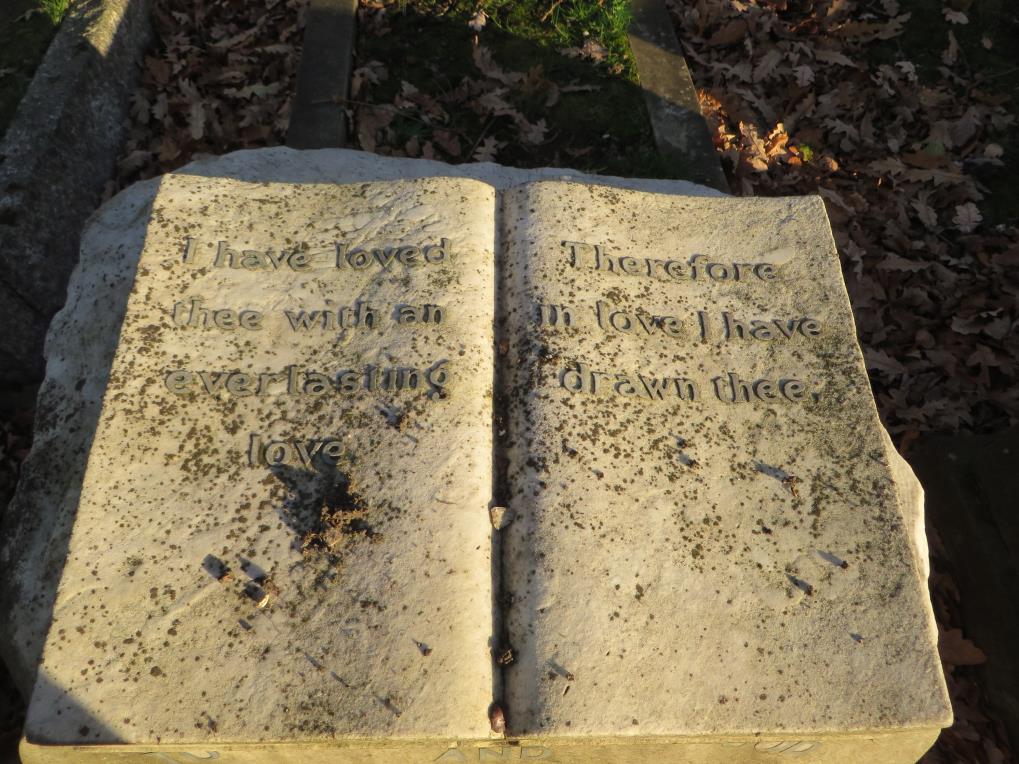
Sometimes a wander through a cemetery can make you feel as if you’re in a heavenly library due to the number of open books reverently laid on top of graves. They’re usually made from stone or granite, inscribed with the name and dates of the deceased and often a decorative carved book marker complete with tassel keeping the pages open. In this example, a downwardly pointing finger indicates the large open book.
On first appearance the open book can seem a very simple and obvious symbol and it’s used in place of a more formal headstone. But, as with other symbols, it can have alternative meanings.
The 3 dimensional version that is carved to simulate a real book is a 19th century innovation. Prior to this it was rendered in a 2 dimensional, flat form and can be found on 18th century tombstones as part of an overall design or epitaph.
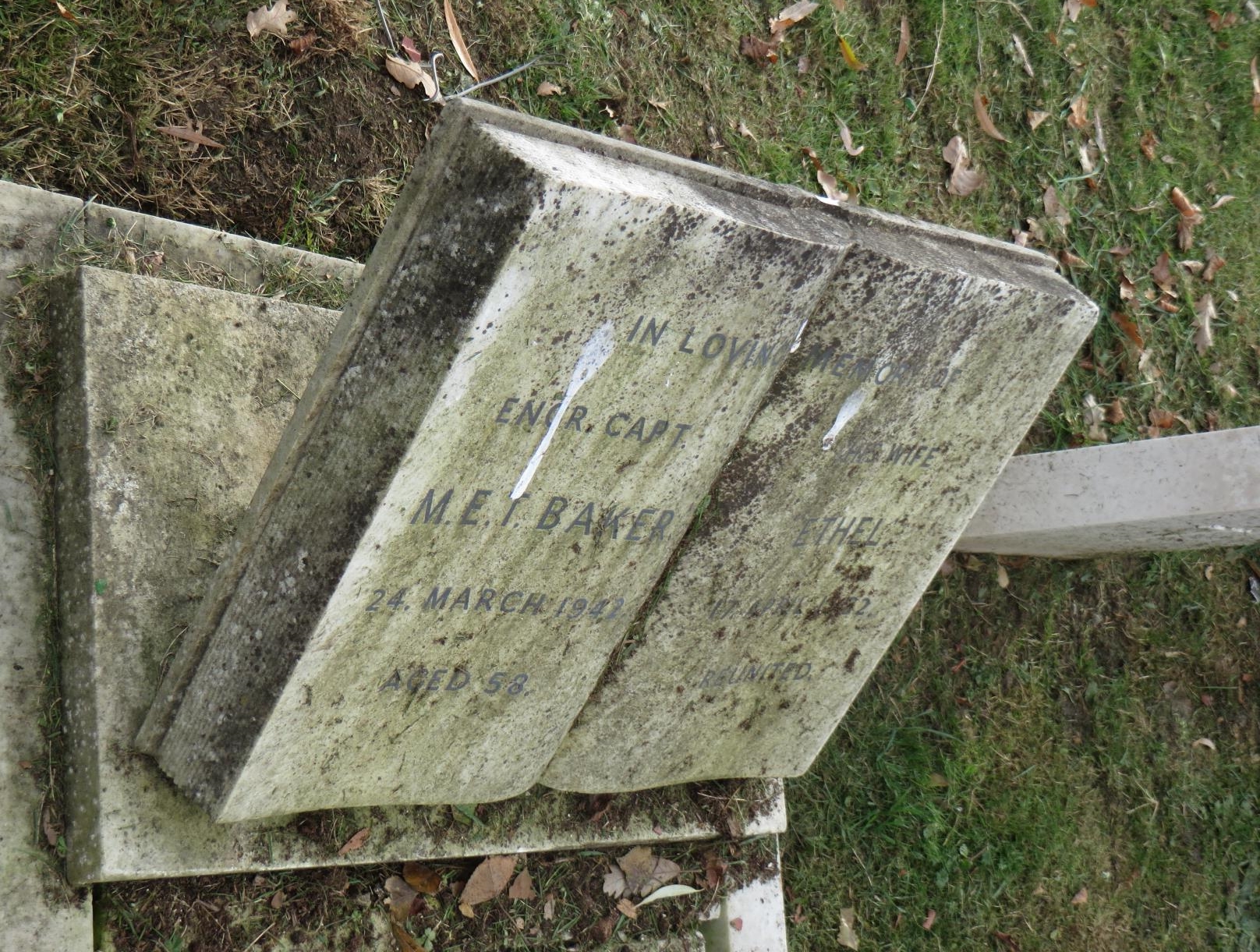
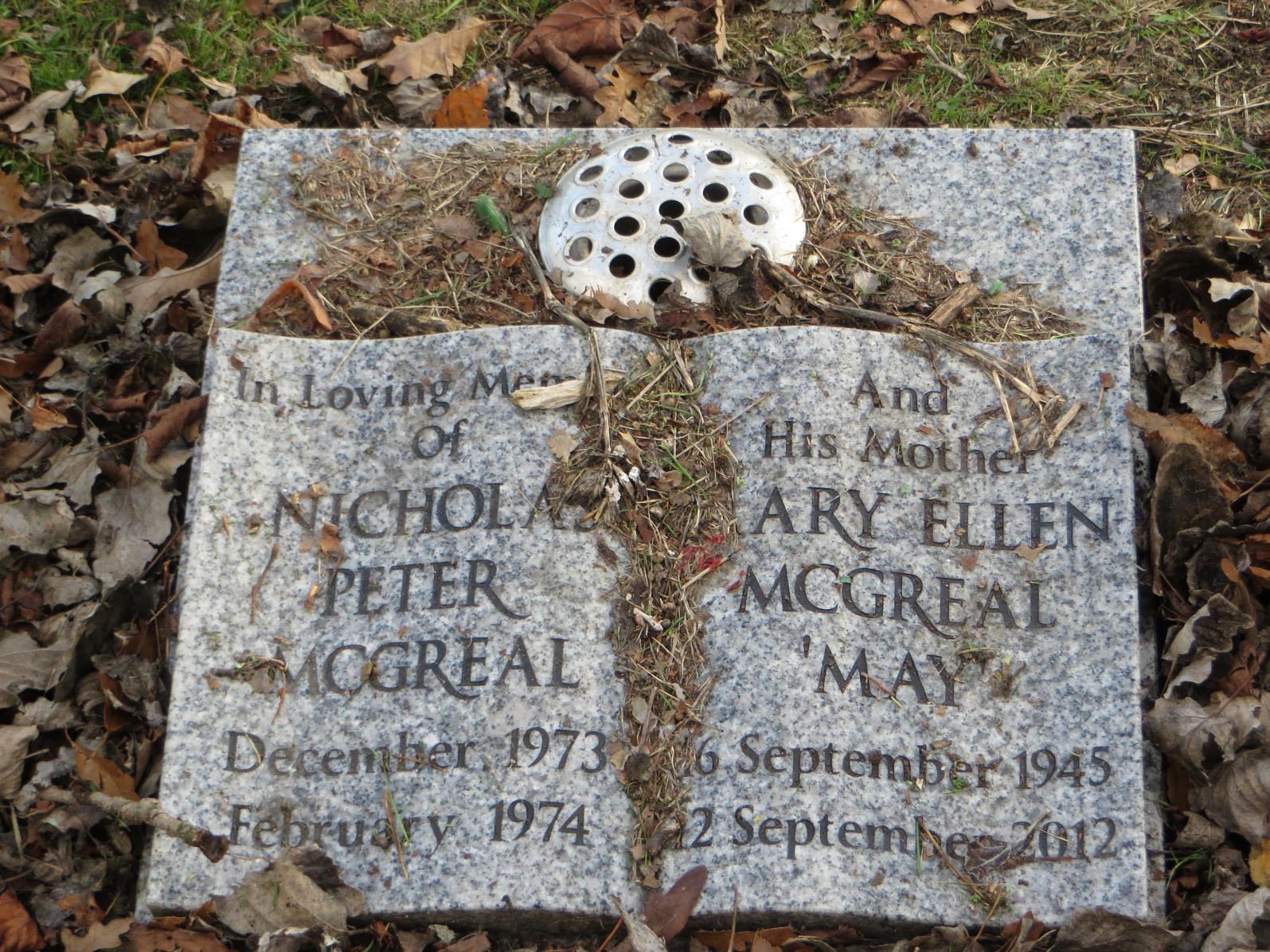
The open book can almost resemble a visitors book with the deceased’s details inscribed on it as if they were signing in or checking out for eternity and sometimes one page is left blank for perhaps the partner who will follow. On a recent stroll through Beckenham cemetery I came across several variations:
For example, there was one with both pages blank which could indicate that the inscription has worn off or that they were ready to be written for eternity. The latter echoes the well-known phrase ‘he or she can be read like an open book’ and the empty pages can indicate that this is how they want to be judged on the Day of Judgement. This references the quotation from the Book of Revelation 20:11-15:
‘And I saw the dead, small and great, stand before God; and the books were opened: and another book was opened, which is the book of life: and the dead were judged out of those things which were written in the books, according to their works.’ King James Bible
This is also why the open book is also known as the Book of Life as it contains everything that the deceased has done throughout their life and for which they will now be accountable. Christ is often depicted carrying a book. J C Cooper also sees it as the Book of Life and adds that it can also represent
‘….learning and the spirit of wisdom, revelation and …wisdom.’
‘The LORD hath appeared of old unto me, saying, Yea, I have loved thee with an everlasting love: therefore with loving kindness have I drawn thee.’ Jeremiah 31.3 King James Bible
This makes the symbol almost resemble a Bible. Other suggestions are that it can indicate the grave of a writer, publisher or even more obviously a clergyman.
It can also suggest that a chapter of life has ended or closed and a variant is the closed book. I found this one in West Norwood cemetery and it clearly indicates a life that has ended with the final chapter now written.
So the open book has made me think about how my book of life would look on my last resting place. I’m determined to make sure that it’s a good read for any passing visitor.
Hannah’s headstone prior to restoration. Copright Greenshed. Shared under Wiki Commons
This story came from the BBC News website.
This is the 300 year old headstone of 33 year old Hannah Twynnoy who was mauled to death in Malmesbury, Wiltshire. She was fatally attacked by the tiger, believed to be part of a travelling menagerie, which was being housed in a pub yard. It escaped and attacked her.
The inscription had become so illegible that. prompted by a local campaign, masonry restorers were brought in to clean it. The epitaph reads:
In bloom of Life She’s snatchd from hence, She had not room To make defence; For Tyger fierce Took Life away. And here she lies In a bed of Clay,
Until the Resurrection Day.
Follow the link for more information and photos as this is a unique cause of death in England.
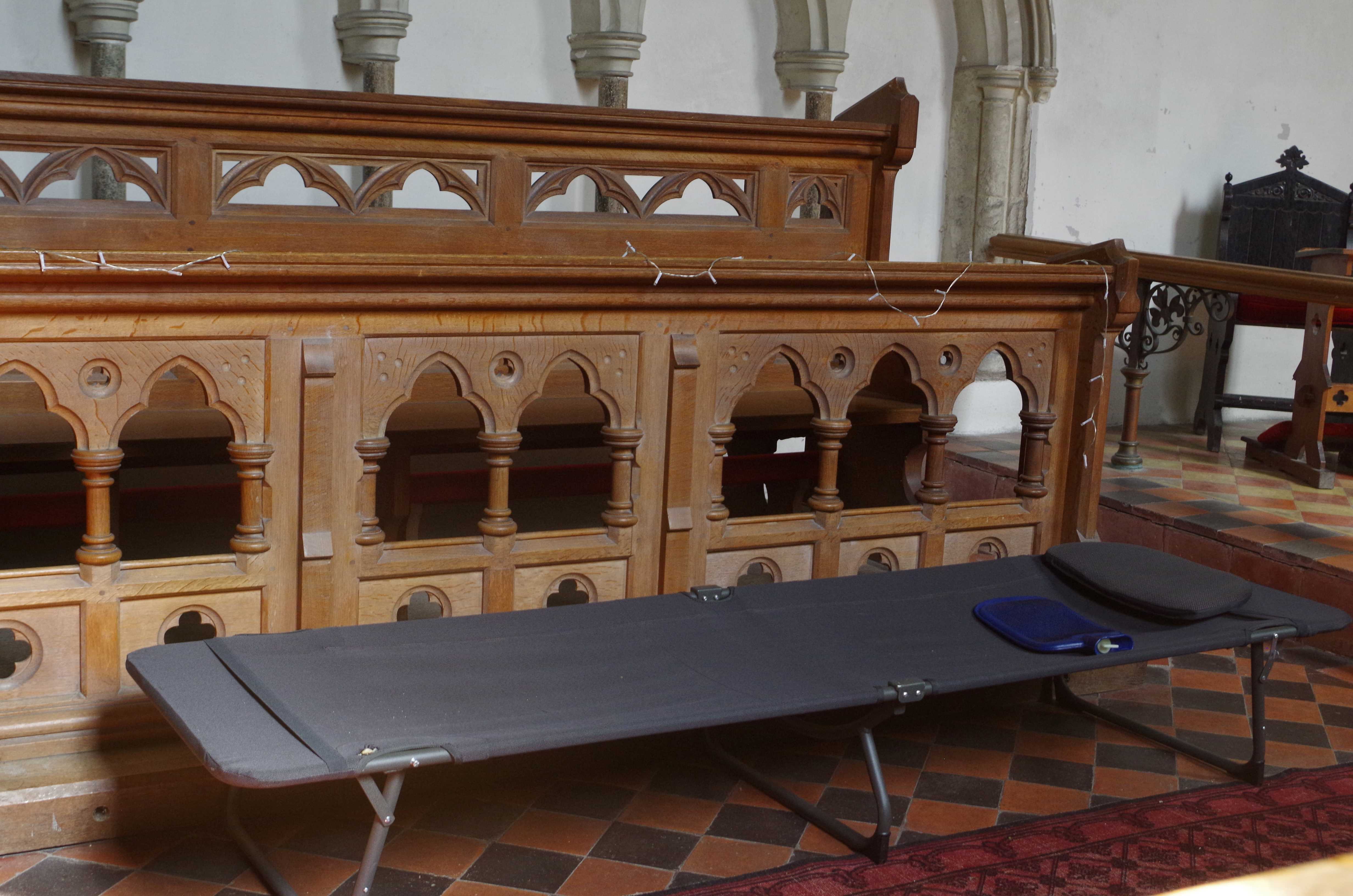
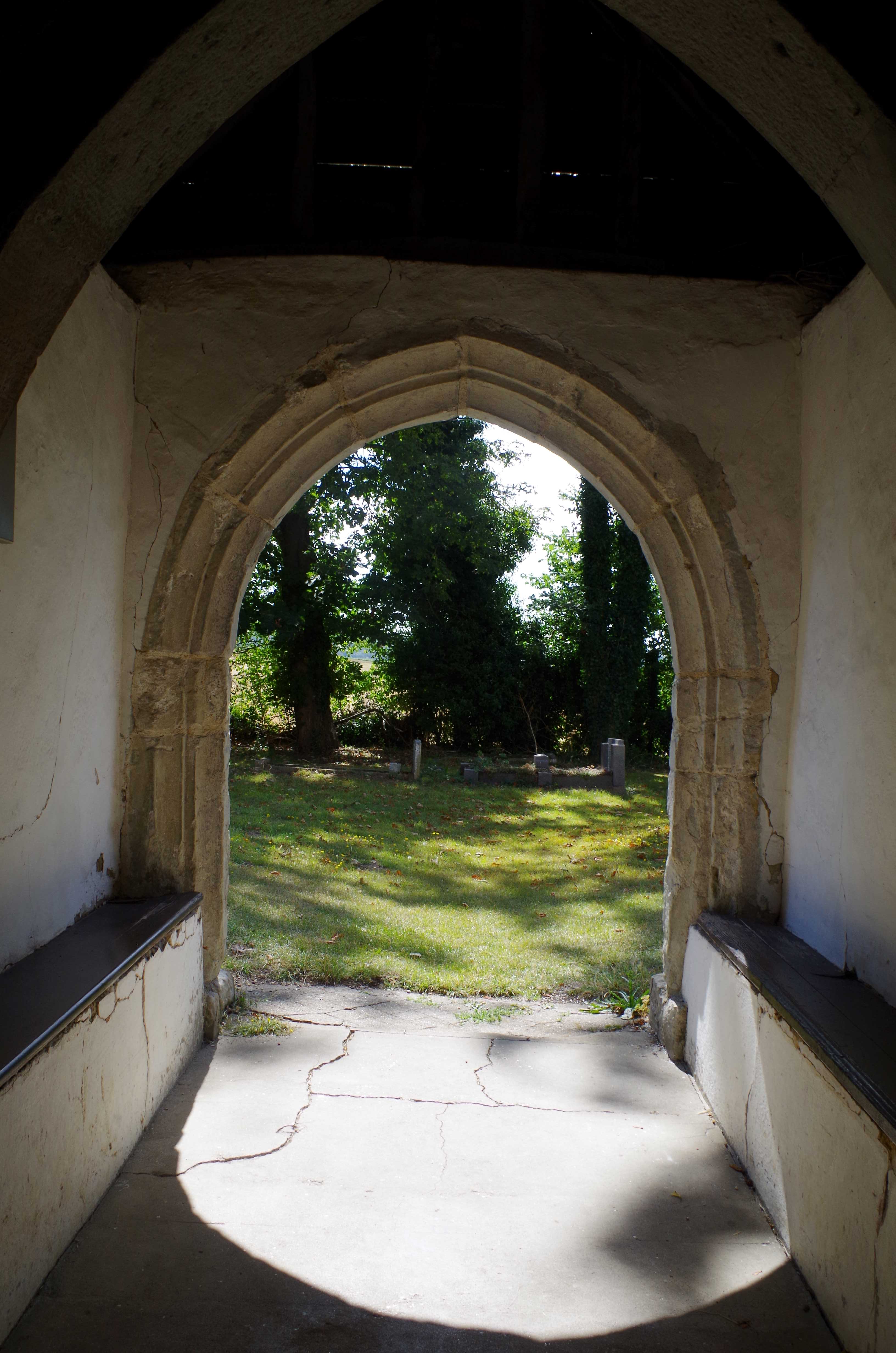
Maybe I just disturbed the nocturnal guests at St James’s and they felt compelled to hide but all appeared to be silent as I stepped inside the church. But they were given away by 2 vacant camp beds in front of the altar and the small refreshment area by the pulpit. I thought that the hot water bottle on one of the camp beds was a nice touch as I stood there for a moment and wondered what it must have been like staying overnight in an empty church in such an isolated place. There are houses around the church but not that many. ‘Champing’, is a euphemism for overnight ‘camping’ in churches looked after by The Churches Conservation Trust. Don’t worry they’re not pitching tents! The church provided the campbed and the usual amenities. It’s really caught on in recent years and I have been tempted to try it myself.
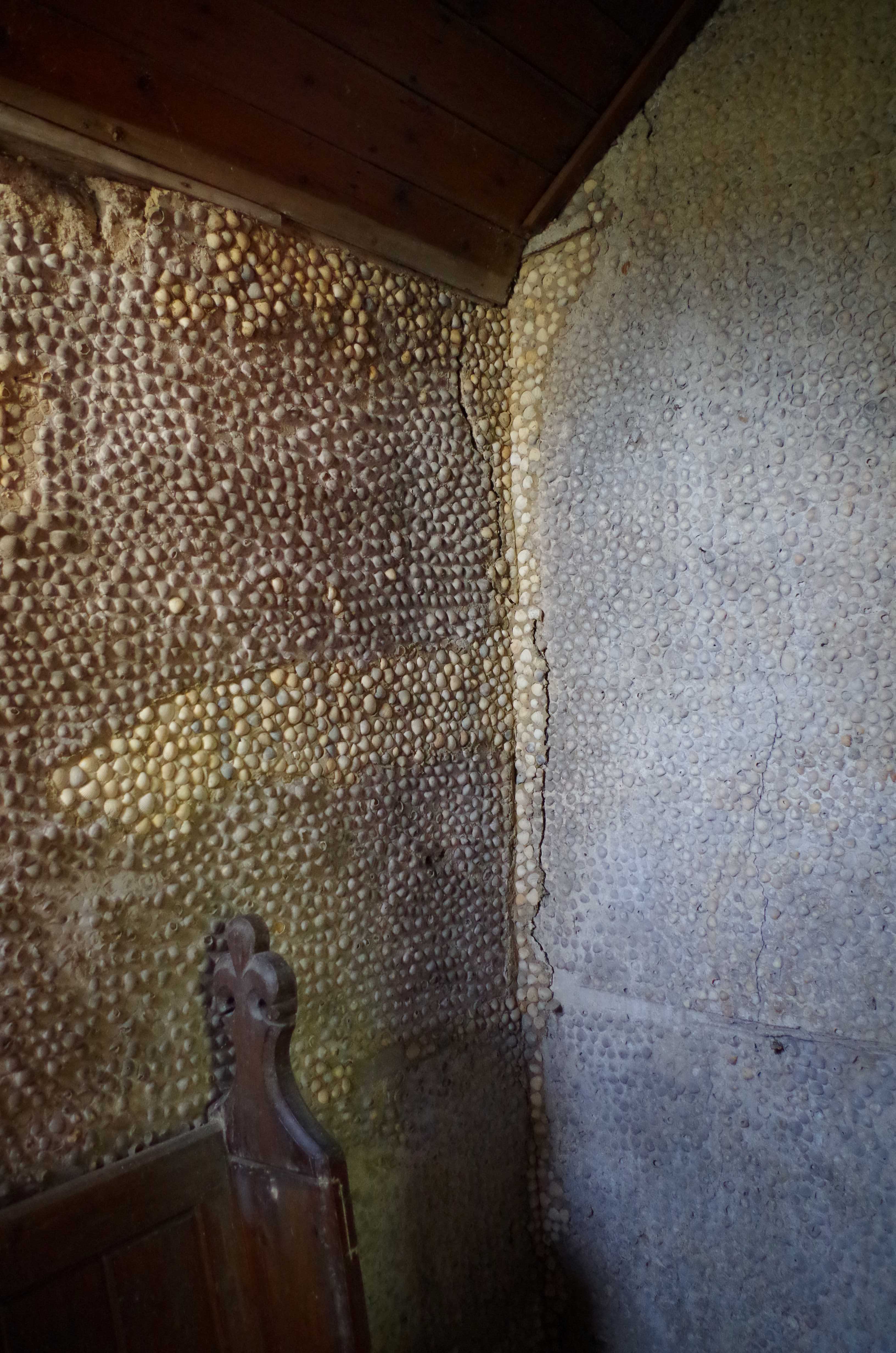
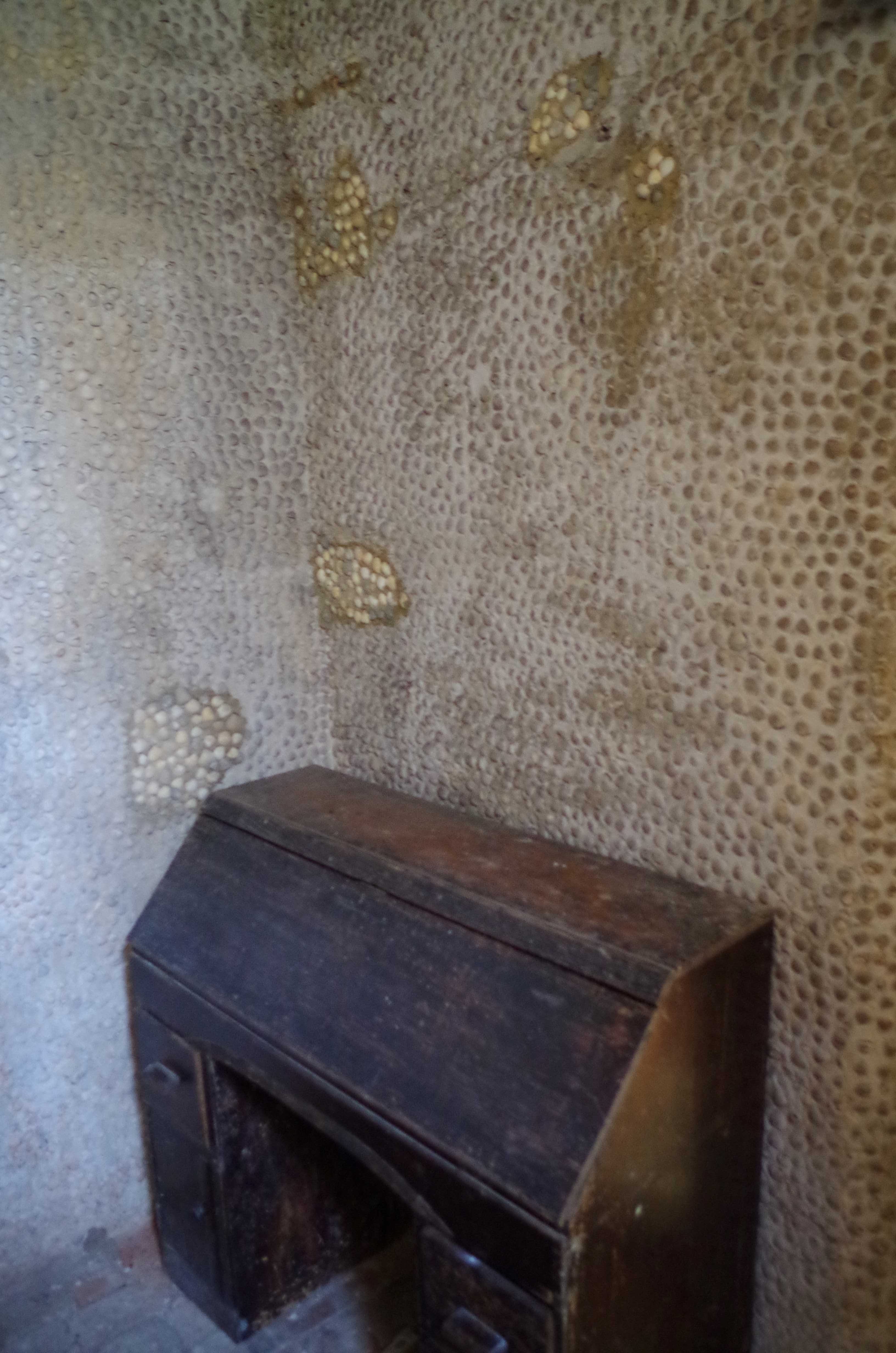
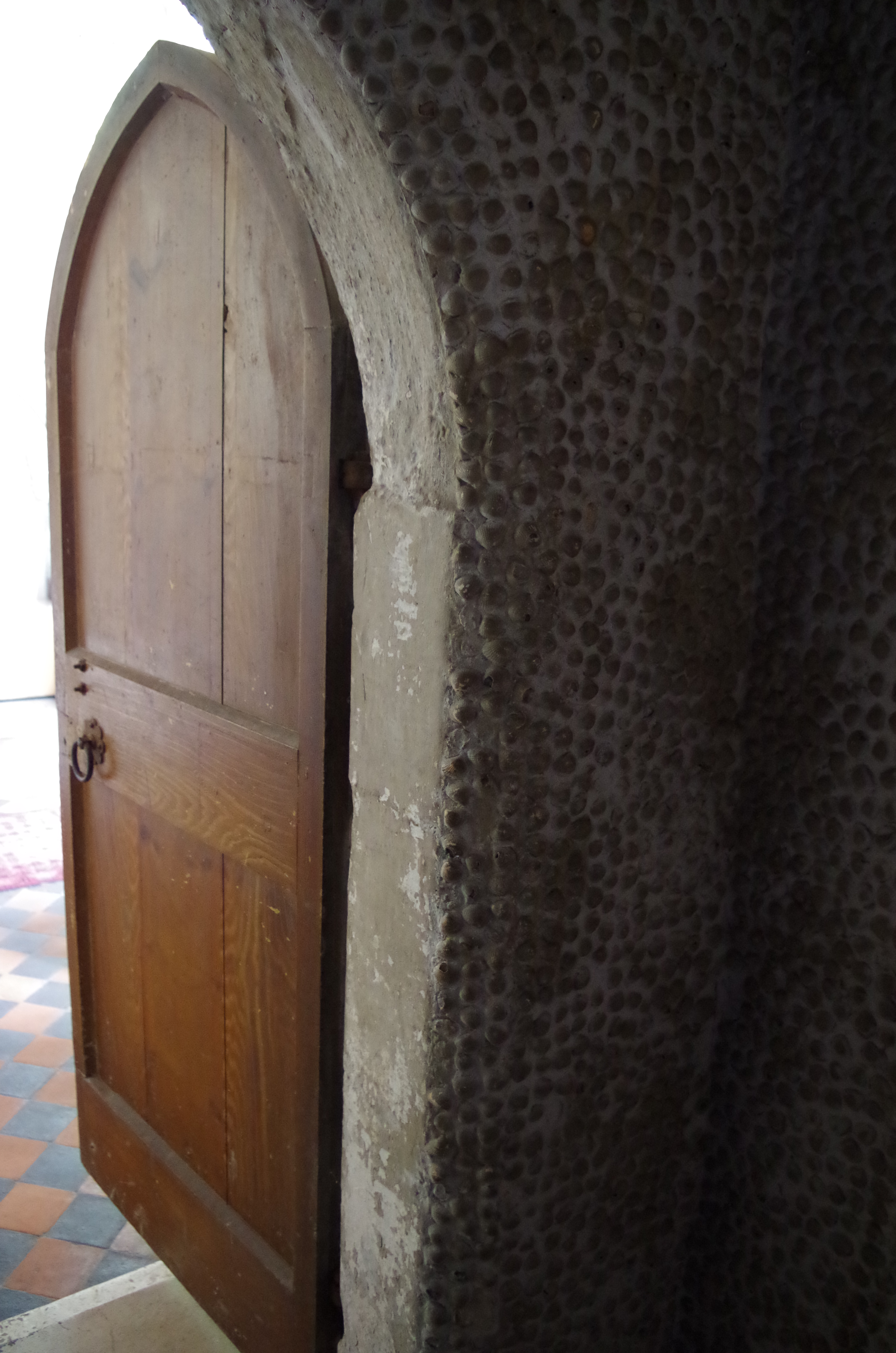
But I was at St James’s to see the cockleshell room which I’d missed on earlier visits. There wasn’t a sign advertising it but a quick look at the church map of the interior and I headed for the church organ. This time I found it! The door’s latch seemed to echo in the tranquillity as I pulled it open. The vestry is ‘compact and bijou’ as an estate agent would undoubtedly say – it is tiny and there was only a small open cobwebbed window, high up in the wall for ventilation. The room felt very warm and contained only a chair, possibly a recycled pew, and a bureau.
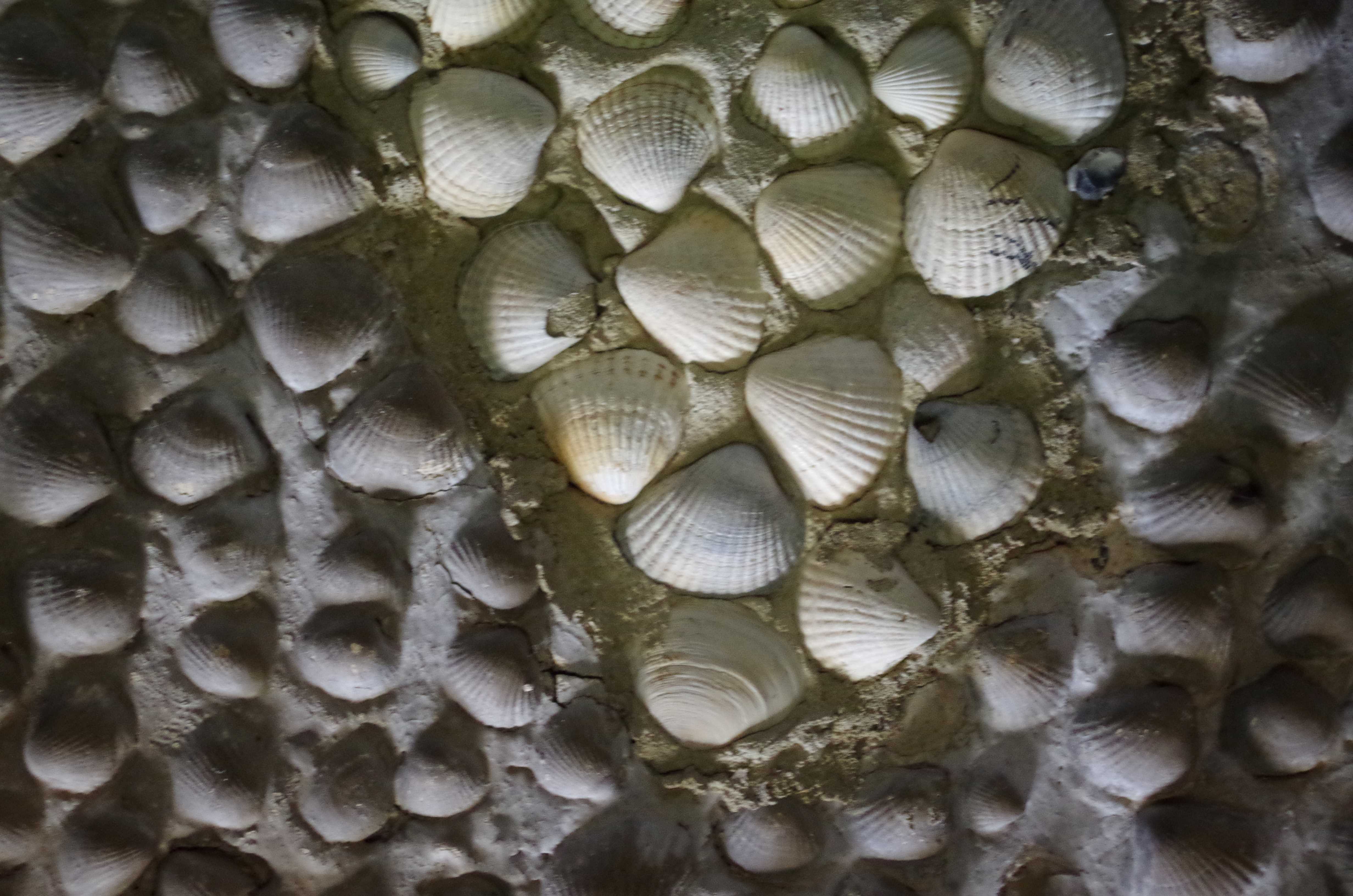
But it’s the thousands of cockleshells that made me catch my breath. They are floor to ceiling, arranged in patterns with newer ones being cemented in. I have to say that it did feel a little claustrophobic. The vestry dates back to the 19th century and is considered to be either a reminder or perhaps homage to the shell being the symbol of the saint, St James. Shells would be worn in pilgrims’ hats as they went on the trail to his shrine in Santiago de Compostela. Above the door, and supposed to be, are initials and a date which may be 1833 or 1838. The initials are I.M. and I.C. CWARDENS which could stand for John Murton and John Comport churchwardens. I was looking in the wrong place so didn’t spot it but perhaps on another visit…. you do need a few minutes just to take it all in and try not to touch them although it is a very tactile surface.
According to the Churches Conservation Trust, it’s considered to be
‘unique in an English church’.
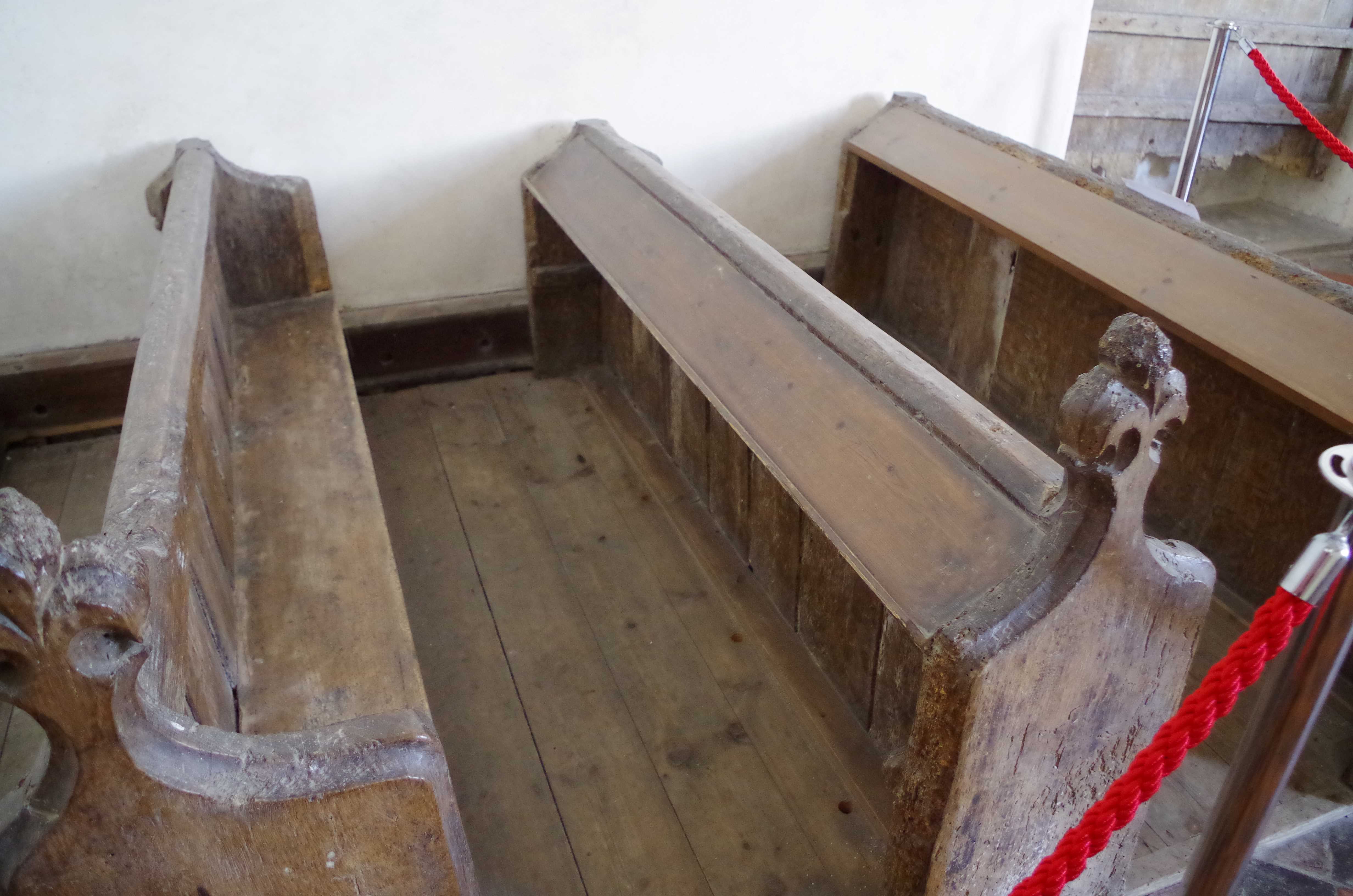
As I explored the nave after leaving the little room I saw the medieval benches that date back to the 14th century. They’ve evaded the iconoclasts of the 1600s and Victorian restoration but are now too fragile to be touched, much less sat on, and are now roped off.
The name Murton appeared again on an elegant and poignant wall memorial to a sailor, John William, eldest son of John Murton of nearby Cooling Castle. He died young, aged 28, after falling overboard from the Monarch off Rio de Janeiro during a voyage to Calcutta. The inscription on the marble tablet quotes from the ship’s captain’s log:
‘And so perished one of the finest and best hearted seamen who ever trod a ship’s deck. I have lost a trustworthy officer and valued friend. Peace be to his remains.’
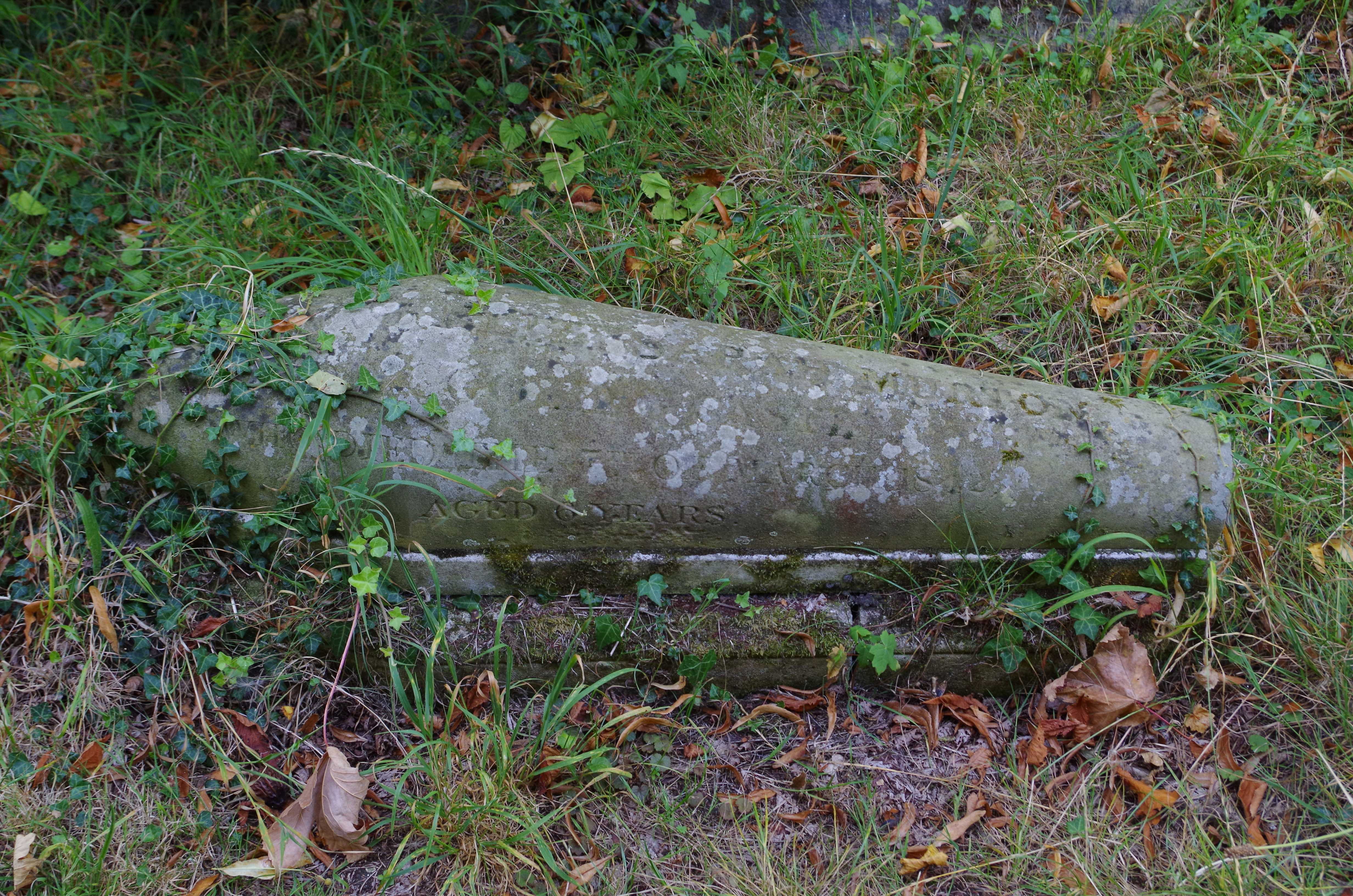
After that I went outside to see ‘Pip’s Graves’ and the table tomb on which Charles Dickens is reputed to have eaten his lunch. Across the marsh I could see docked ships and butterflies flitted about on the buddleia at one end of the churchyard. I found a clergyman’s grave denoted by a chalice and more childrens graves. One was dedicated to a six year old. I also pursued a Common Darter dragonfly until it posed obligingly and checked to see if the little grinning demon still kept watch over the outside loo. He did. I looked up as I left the churchyard and saw, glinting on the weathervane above the tower the representation of another cockleshell.
The 18th historian, Edward Hasted, described Cooling as
‘an unfrequented place, the roads of which are deep and miry, and it is as unhealthy as it is unpleasant.’
It certainly is unfrequented as I was alone as I walked along Cooling Road to and from the church with only passing cars for company. The remains of the 14th century Cooling Castle, which is in private hands, are still impressive. Dark blue sloe berries were still on several bushes and windfalls clustered beneath apple trees in a nearby orchard. I retraced my steps back to Cliffe for a wander round St Helen’s churchyard and then a very welcome cuppa in their café.
But how I envied the ‘champers’ enjoying a good night’s kip(I hope) in that little corner of Kent.
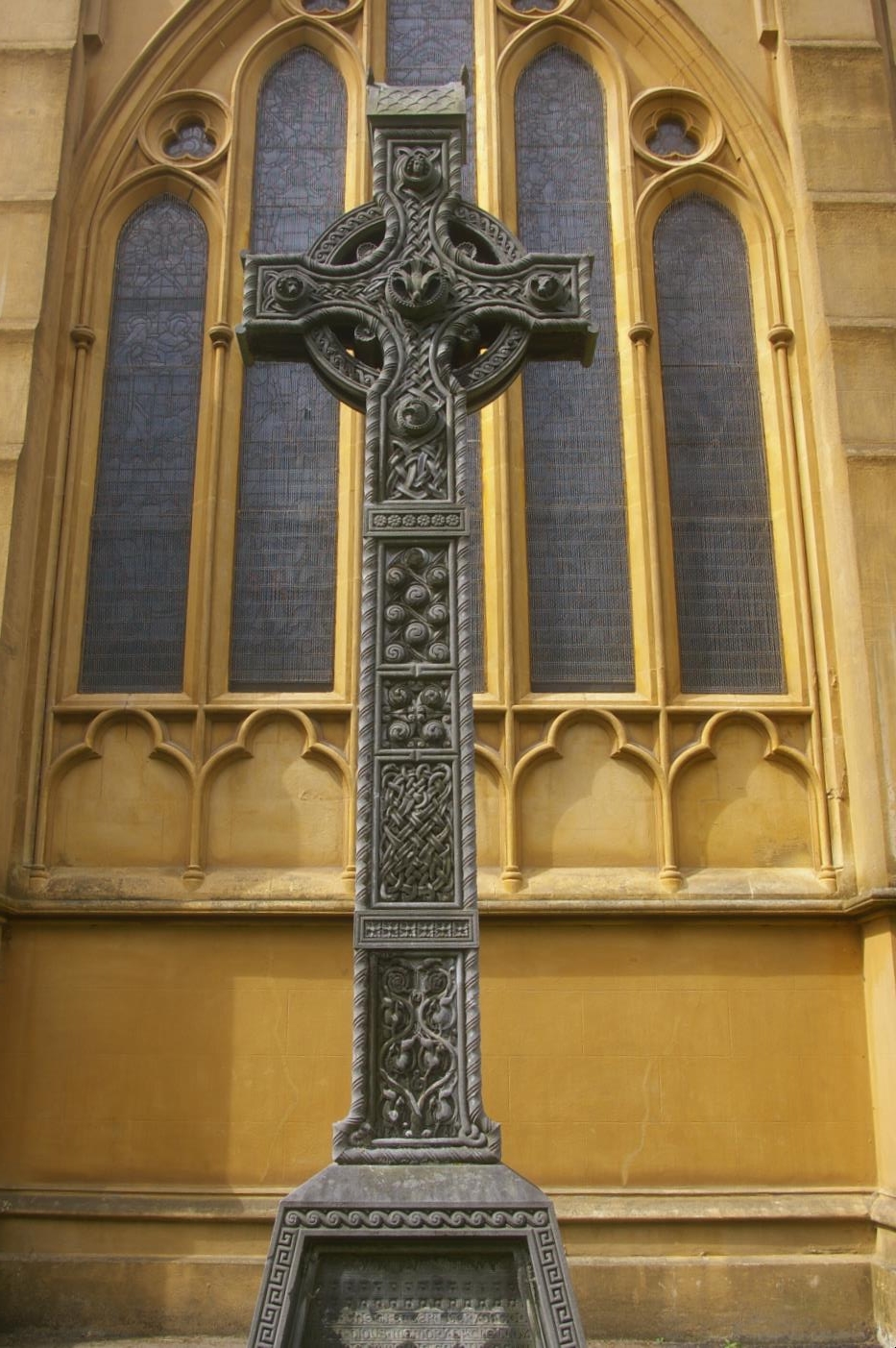
An imposing Celtic Cross in St Margaret’s churchyard, Lee, SE London Copyright Carole Tyrrell
I found this month’s symbol while exploring the churchyard of St Margaret’s church in Lee, South East London. This is a large Victorian church with some lovely stained glass and, more unusually, wall paintings. These are Pre-Raphaelite in style and well worth seeing if you’re in the area. The church is open on the 1st Saturday of every month 10.30am to 4.30pm. There are also windows created from broken pieces of stained glass, like a jigsaw, and which create kaleidoscope patterns on the floor when the sun shines through.
But St Margaret’s is a church in two halves. Across the road is the ruined, older church. It was not constructed well and fell down eventually. What was left was mostly demolished in 1813 and only the ruined west tower remains. This is surrounded by 18th century headstones which include no less than three Astronomers Royal. They are Nathaniel Bliss, John Pond and Edmond Halley (1674-1742) who computed the orbit of Halley’s Comet. They all keep company with, amongst others, a parachutist that fell to earth and a Restoration actress. There is also a poignant grave of a mother and her infant child. An interpretation board by the entrance lets visitor know who is buried where in the churchyard. The churchyard is English Heritage listed and , due to restoration, is open by appointment only. Enquiries via: office@stmargaretslee.org.uk.
But, while exploring the churchyard of the larger St Margaret’s, I discovered this imposing and beautiful monument in memory to a deceased wife. The epitaph is written in sinuous Art Nouveau style writing which was well worn and, as a result, almost indecipherable.
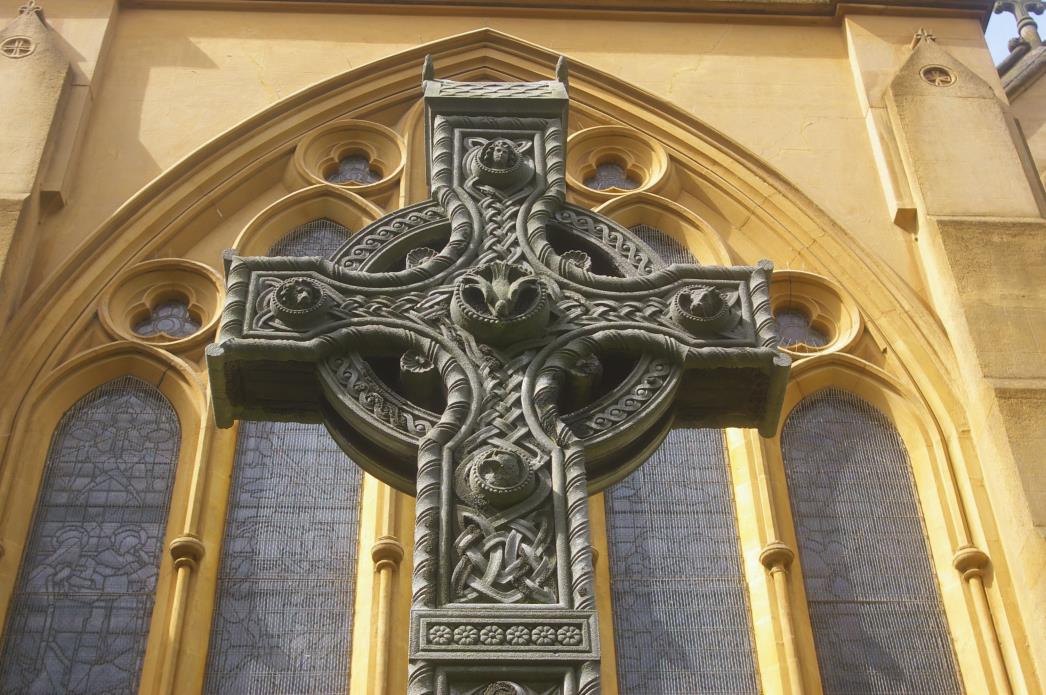
It’s the largest and tallest memorial in the churchyard and is in the form of a Celtic Cross. This was a reminder of the Celtic Revival that was popular from 1880-1910. But it was the symbols that intrigued me. There were four of them in the form of a head at each point of the cross. They were a human or angel, a lion, an ox and an eagle. I felt sure that they had meaning and were not just decoration. After posting my photos on a cemetery related Facebook page, I received a reply (who says that social media isn’t educational?) from a lady who thought that they might represent the four evangelists. This would be:
Human/Angel Matthew
Lion Mark
Ox Luke
Eagle John
A closer view of the memorial showing the four Evangelists symbols in each corner. Copyright Carole Tyrrell
The arrangement of the symbols is known as a tetramorph. It references the four Gospels of the Evangelists and the four living creatures that surround the throne of God. There are several Biblical references to them. For example, in the Book of Revelations chapter 4: verses 6-7:
‘And before the throne there was a sea of glass like unto crystal: and in the midst of the throne, and round about the throne, were four beasts full of eyes before and behind.
And the first beast was like a lion, and the second beast was like a calf, and the third beast had a face as a man and the fourth beast was like a flying eagle.’ King James version
The four living creatures are also mentioned in Ezekiel Chapter One verses 1-14, Ezekiel, Chapter 10, verses 1-22 and Daniel Chapter 7, verses 1-8. In addition, the creatures are featured in other religious texts such as St Irenaeus of Lyons and St Augustine of Hippo.
Wikipedia defines a tetramorph as :
‘ ………a symbolic arrangement of four different elements. Tetramorph is derived from the Greek tetra, meaning four, and morph, which means shape. In Christian art, the tetramorph is the union of the symbols of the Four Evangelists, the four living creatures derived from the Book of Ezekiel into a single figure, or more commonly, a group of four figures. The Evangelists portraits are often accompanied by the tetramorphs or the symbols often used to represent them. Each symbol can be described as a tetramorph in the singular, and a group as ‘the tetramorphs but usually only when all four are together. Tetramorphs were very common in early medieval art especially in illuminated Gospel books, They are still common in religious art up to the present day.
Other examples of the combination of different elements are the Sphinx in Egypt which has the body of a lion and the head of a human.’
There are two more examples below:
Fresco, Meteora c.1550 shared under Wiki Commons.
Ivory plaques on a wooden coffret early 13th century. Musee de Cluny. Shared under Wiki Commons.
The animals associated with the Christian tetramorph originate in the Babylonian symbols of the four fixed signs of the zodiac; the Ox representing Taurus; the lion representing Leo, the eagle representing Scorpio; the man or angel representing Aquarius. In Western astrology the four symbols are associated with the elements of, respectively Earth, Fire, Water and Air. The creatures of the Christian tetramorph were also common in Egyptian, Greek and Assyrian mythology. The early Christians adopted this symbolism and adapted it for the four Evangelists as the tetramorph, which first appears in Christian art in the 5th century
The evangelistic symbols on the cross in St Margarets are beautifully carved and it really stood out in the churchyard due to its size and position. Since seeing this one I have found other tetramorphs. There is one over the entrance to the imposing church of St Augustine’s in Kilburn and another one in Ely Cathedral. Gaudi also featured prominent winged versions of the evangelists on his unfinished masterpiece, The Sagrada Familia in Barcelona.
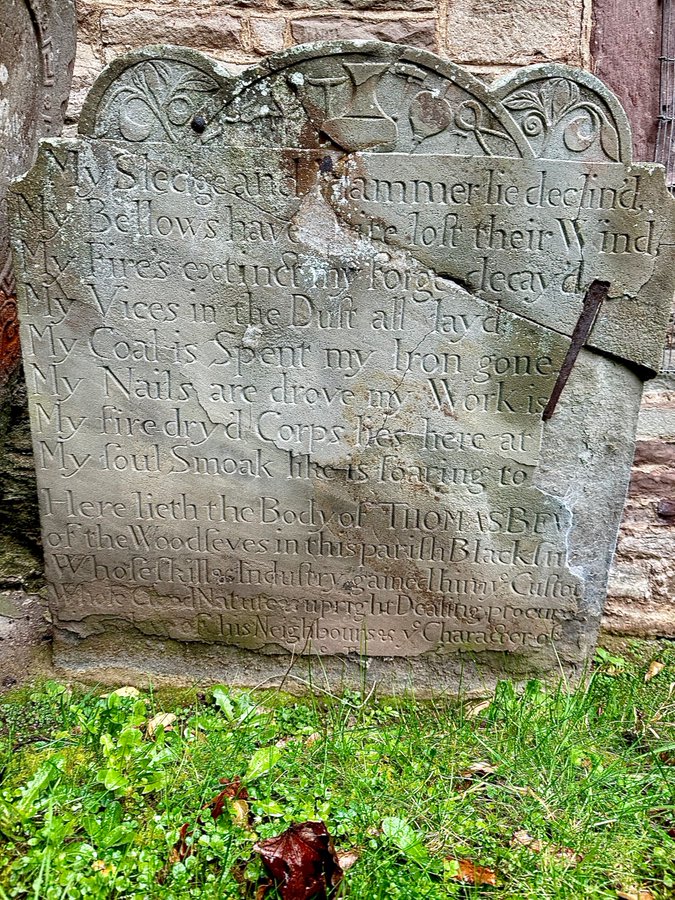
This is a fine and expressive epitaph to a blacksmith, Thomas Bevan, who died in 1774 in Eardisley, Herefordshire. Under the carvings of blacksmith tools at the top of the headstone is this epitaph:
‘My sledge and hammer lies declined.
My bellows have quite lost its wind;
My forge’s extinct, my fires decayed
My vices in the dust all laid.
My coal is spent, my iron is gone,
My nails are drove, my work is one.
My fire-dryd corps lies here at rest
My foul (soul) smoak like is soaring to be blest.’
I found this on stonemason Andrew Ziminski’s Twitter or X (whatever it’s called now) and is used with his permission. He has an interesting account and he has published 2 books on his work and his travels around country churches. ‘Stonemason: A History of Building Britain’ and a forthcoming on in October 2024, ‘Churchgoing; A Stonemason’s Guide to the Churches of the British Isles.’ Always interesting posts – this is his address. https://twitter.com/natchjourneyman
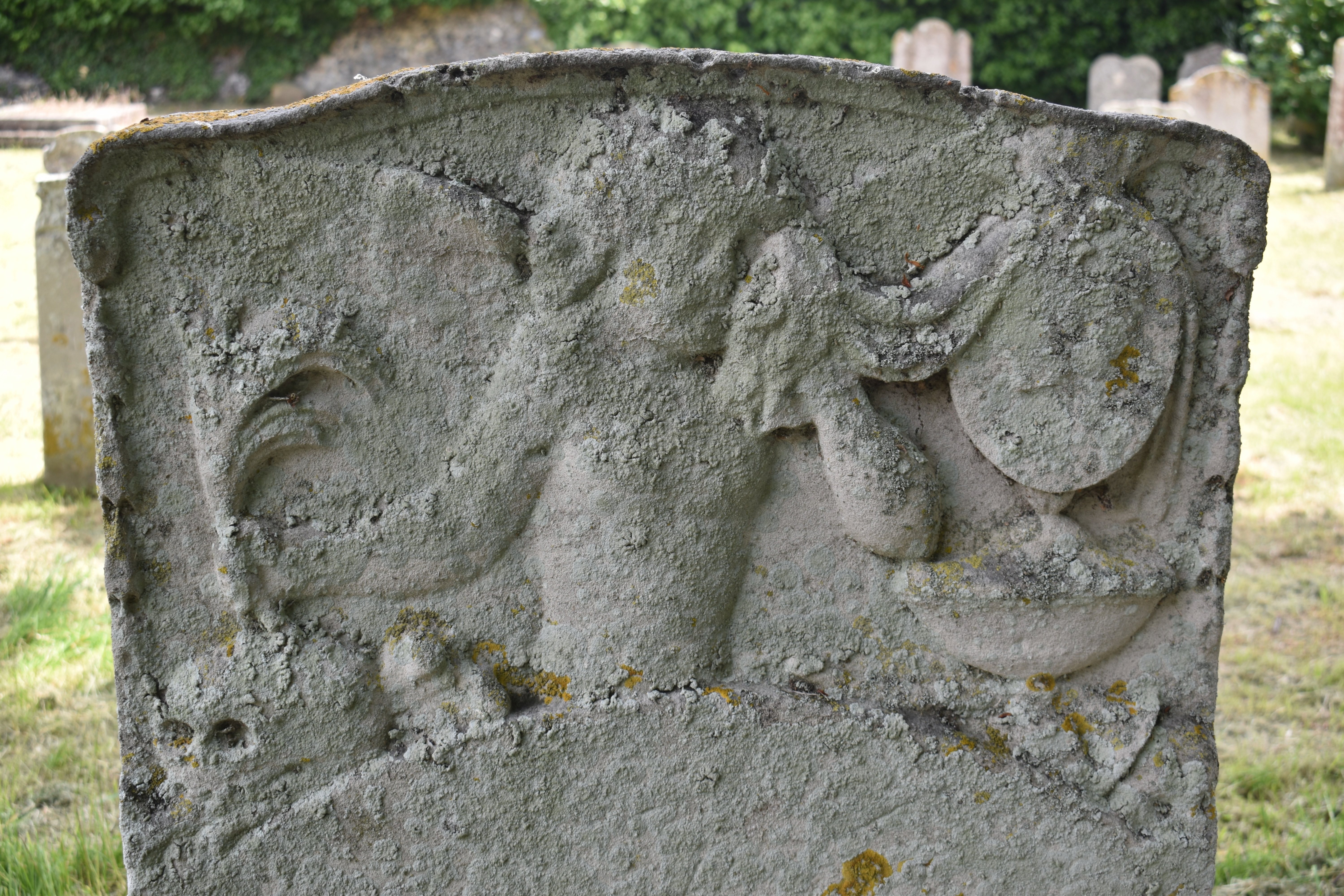
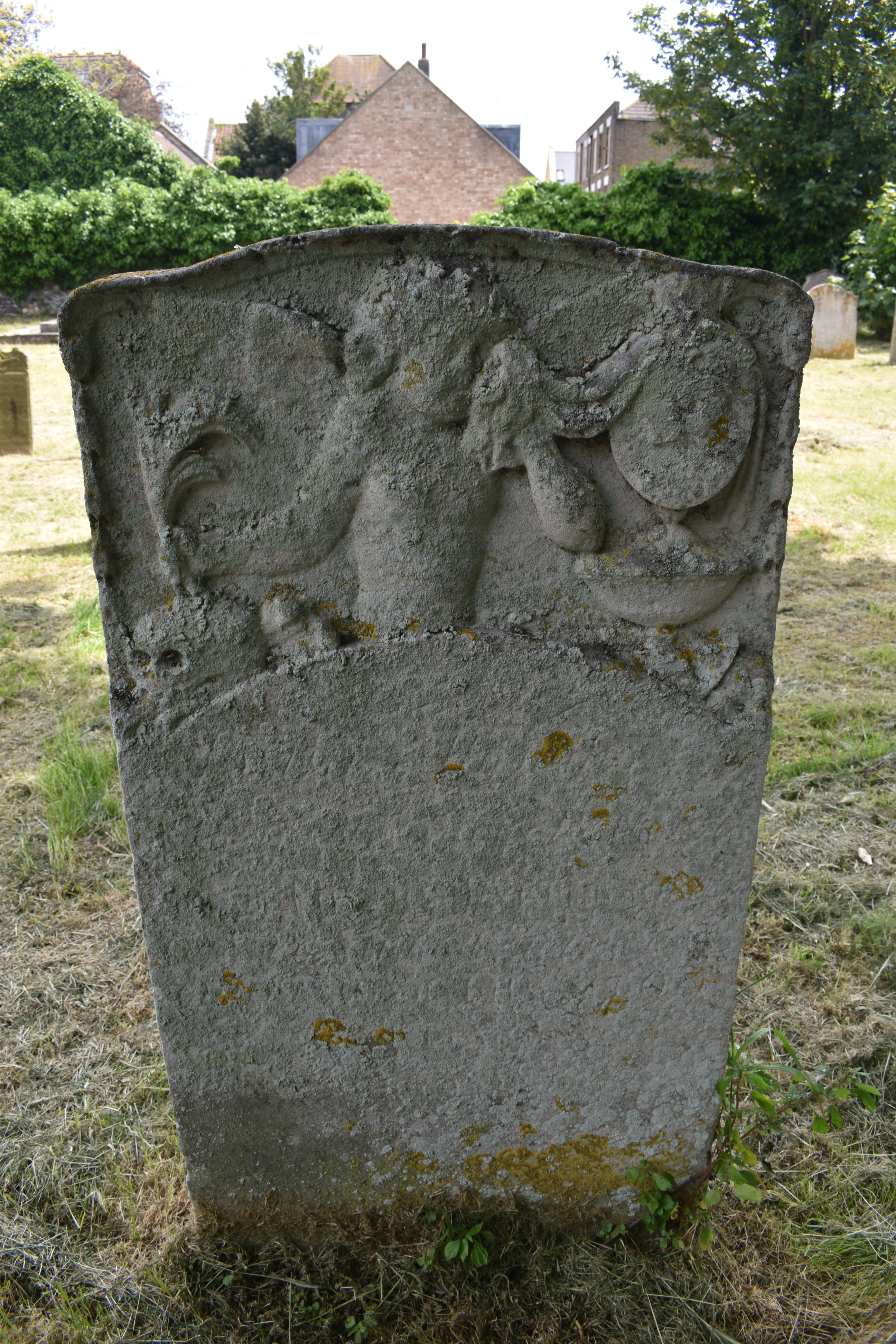
I was visiting Margate on the Kent coast and, after a paddle in the glittering sea, followed a sign that pointed the way to the 14th century church of St John the Evangelist. It was an interesting churchyard with some fascinating headstones including this one. It depicts a weeping cherub, but, despite weathering by the elements, the figure can still be seen clearly but sadly the epitaph is illegible.
It’s carved in 3D relief and shows a male cherub with its wings behind him, dabbing his eyes with a piece of cloth draped over an oval tablet. I think I can just about see a head carved on it which is presumably the deceased. This surmounts an urn in the classical style which appears to be on a plinth.
On the other side the figure holds what appears to be a either a bunch of flowers or palm leaves which are on top of a human skull with its lower jaw missing. There may be bones protruding from underneath the skull but it’s a little difficult to be sure.
It must have been very impressive when first carved and it’s testament to the stonemason’s skills that so much of it has survived. Despite there being no readable epitaph, I would estimate that this dates back to the 18th century. The church itself was closed on my visit so I couldn’t enquire further.
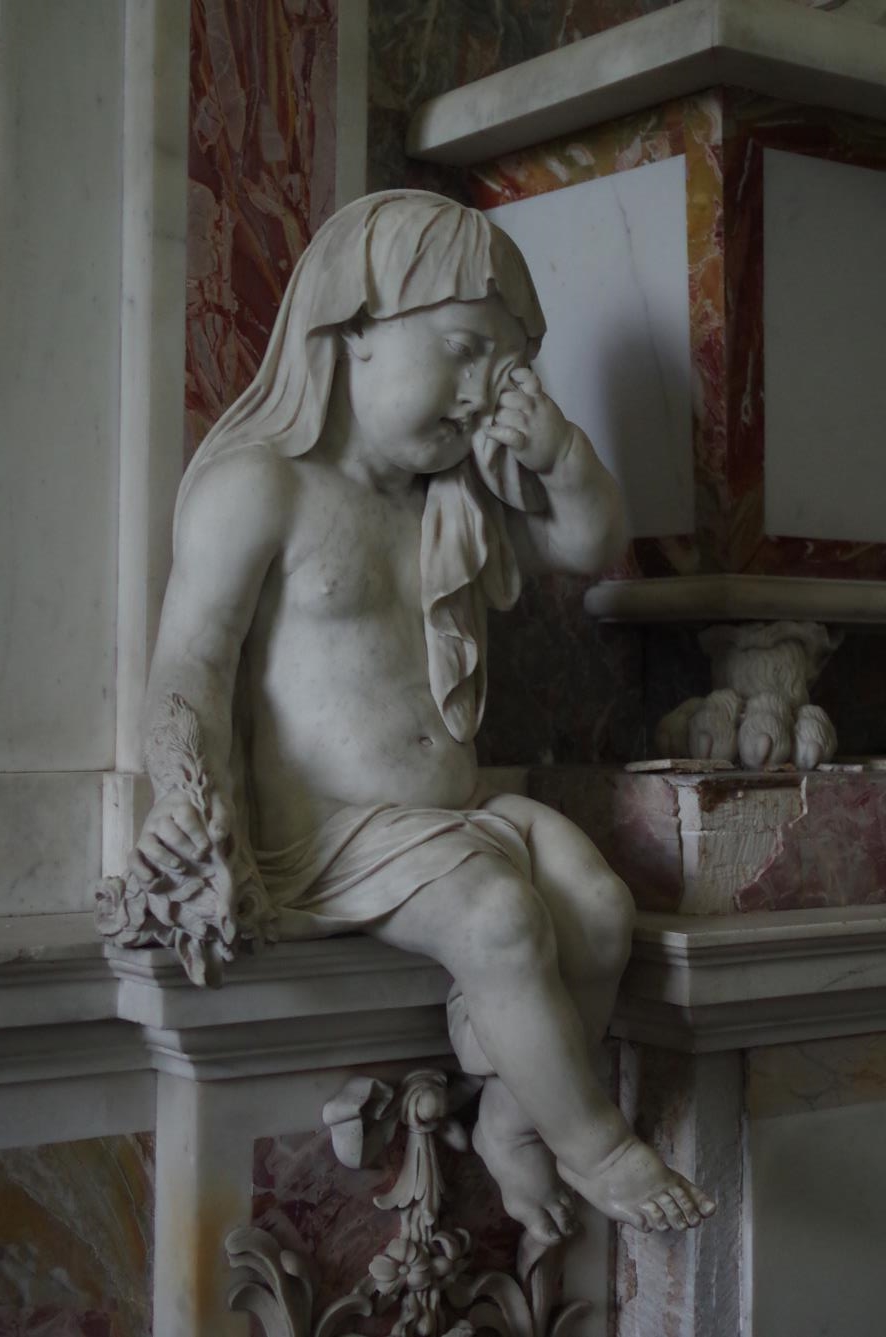
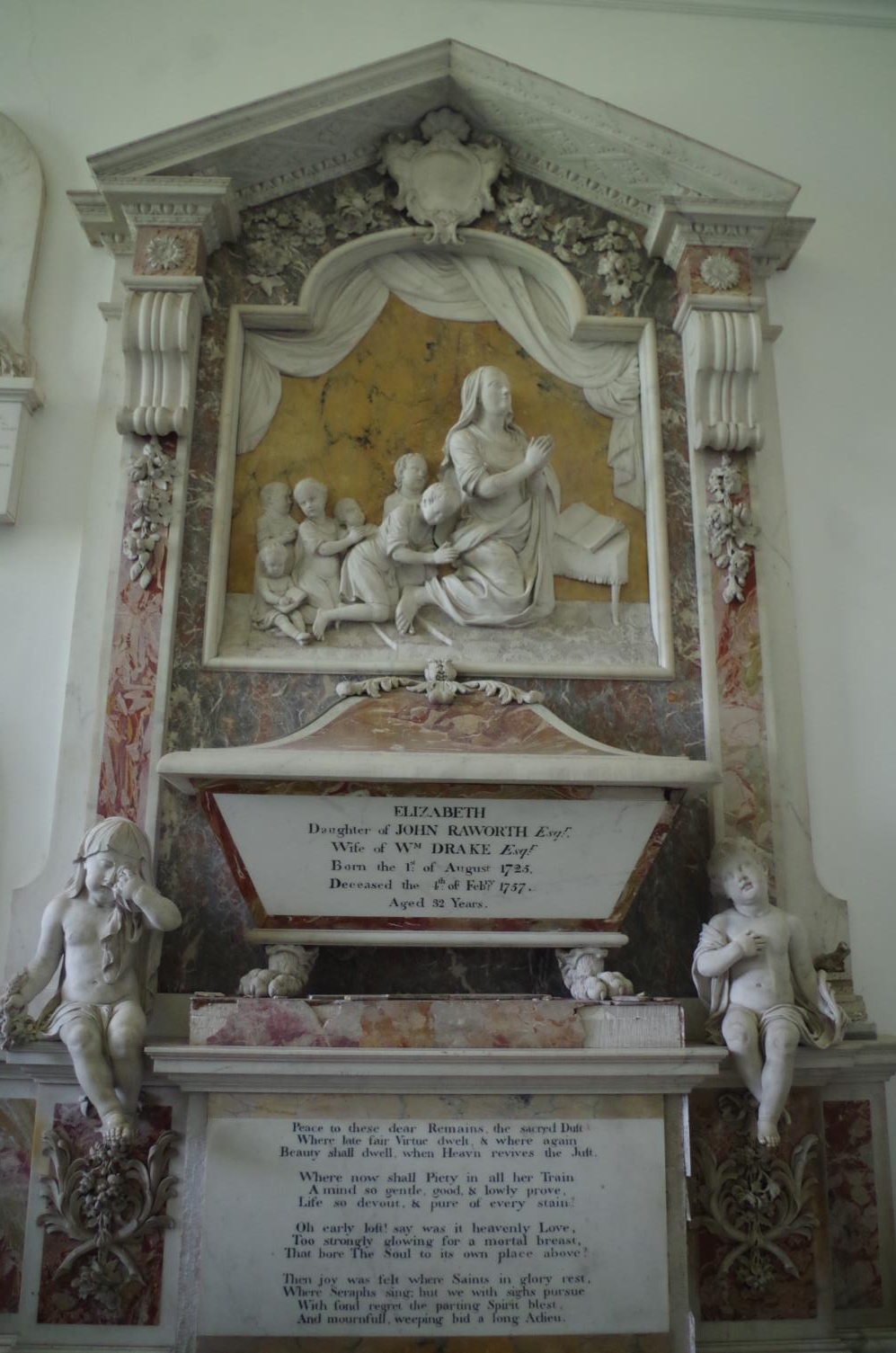
This is an unusual symbol to find in a churchyard as weeping cherubs are generally found inside a church and not outside. For example,this is a fine example from St Mary and All Saints in Amersham and is on the monument to Elizabeth Drake who dies young in 1757 aged only 32. She appears in a carved panel praying with her six surviving children and two deceased children. The weeping cherub sits alongside a sarcophagus on a shelf and is using a piece of cloth draped over his head to dry his tears.
The other one is in All Saints Herstmonceux and he stands on a freestanding short pillar sorrowing with an agonised expression over an urn, again in the classical style, which is partly draped with a piece of cloth and one hand is on a garland of roses. Beside the urn there seems to be a flaming torch on its side. Please follow link to view the photos:
Others can be found in St Stephen’s Norwich, St John the Evangelist in Burford and All Saints Church, Spetchley on the tomb of Robert Berkeley (1650-1694). There is also a pair on a painting on glass dedicated to Lord Nelson and is described as a monumental design to perpetuate his memory.
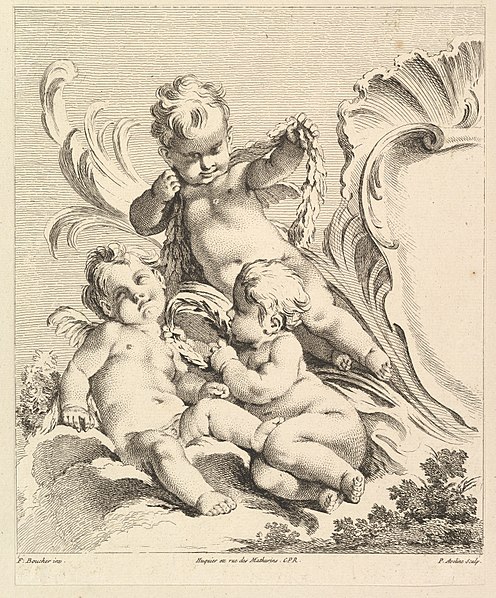
Cherubs are usually seen as plump, male small boys, usually naked, with small wings protruding from their shoulders as below:
Three Putti next to a cartouche Pierre Alexandre Aveline after Francois Boucher 1727-60 shared under Wiki Commons
But they had begun to appear in churchyards when the very stark skull and crossbones fell out of fashion. There was a sense that a more inspiring and sensitive image would be more appropriate for those left behind and so the winged messengers appeared (see my post Symbol of the Month – The winged soul 27/09/20).
These were the heads of what appeared to be children with wings around them that emphasised a rebirth of the soul in heaven which was a kinder view of death. Cherubs are supposedly found on childrens graves and a walk through any churchyard or cemetery would confirm this. But cherubs can be confused with putti which is the Italian word for cherub but they are very different. Cherubs are powerful figures in the hierarchy of angels whereas putti are childlike and playful.
Cherubs
The word ‘cherub’ is derived from the Hebrew word ‘Kěrub’ which means ‘to draw near’ or ‘to bless’. However it has also been associated with the Assyrian word, ‘karibu’ which means one that intercedes’. Cherubs can be viewed:
‘as divine messengers drawing near to humans to deliver blessings or divine messages. They also symbolise the spiritual closeness between the divine realm and the human world.’ Spiritualityshepherd.com
In the Bible cherubs are seen as powerful figures that guard sacred spaces such as the Ark of the Covenant in the Old Testament. There are several references to them in the Bible particularly in the Book of Genesis 3:24:
‘So he drove out the man: and he placed at the east of the garden of Eden Cherubims, and a flaming sword which turned every way, to keep the way of the tree of life.’ King James Version.
In the Book of Ezekiel 10:14, they are described as angelic beings with four faces; a human, a lion, an eagle and a human. These derives from ancient Mesopotamian and Assyrian art which depicted winged creatures with multiple faces which often guarded temples or palaces. These influenced early Christian artist who used them in their images of cherubim. The multiple faces represent different aspects of creation or divine attributes such as wisdom, strength, courage and swiftness and the wings are a reminder of their celestial nature and ability to move quickly between heaven and earth.
Putti
Wikipedia defines putti as:
‘a putto or putti is a figure in a work of art depicted as a chubby male child usually naked and very often winged….came to represent a sort of baby angel in religious art, often called cherubs or cherubim.’
In fact the Italian word ‘putto’ derives from the Latin word ‘putus’ meaning boy or child. Today in Italy, ‘putto’ means ‘toddler winged angel’ and there are similar words or meanings in other languages. Putti were believed to influence human lives in the ancient classical world and in the 2nd century they could be found dancing and playing amongst other activities on child sarcophagi. Their role as messengers were emphasised by them being seen as between the realms of the human and divine by being Roman spirit guardians or the Greek daimon. During the Renaissance they were revived due to the painter Donatello. Putti also became associated with the Greek and Roman goddesses of love, Aphrodite and Venus by becoming Eros and Cupid.
Now putti are largely decorative and feature extensively on Victorian and Edwardian buildings – just look up and you’re bound to see one at least. Please visit Bob Sheel’s invaluable page on these for examples – just follow the link: http://www.speel.me.uk/gp/cherubs.htm
Weeping cherubs
They could be interpreted as weeping angels which immediately brought to mind one of Dr Who’s most brilliant and intimidating villains – the Weeping Angels -don’t blink! There are several prominent weeping angel statues in cemeteries such as Friendship Cemetery, Columbus, Mississippi, USA where a life size female angel is prostrate across the monument:
and the Haserot bronze figure in Lakeview cemetery, Cleveland, Ohio, USA where the rain has discoloured it and made it look resemble tears running down its face.
But why are there weeping cherubs? I haven’t found a definitive explanation but the edenbengals website has a theory:
‘They openly express the sorrow that the ones left behind feel, and in their role of divine messengers take it heavenwards to God.’
It’s a very poignant symbol in that a small child is seen openly weeping. I hope to find others in my explorations of churchyards and cemeteries as I’m sure that the Margate one can’t be the only one. If I know these places as well as I do – there is at least another one waiting to be found – hopefully by me!































 shadows fly away