The Art Nouveau trio with a poignant story – All Saints, Snodland, Kent

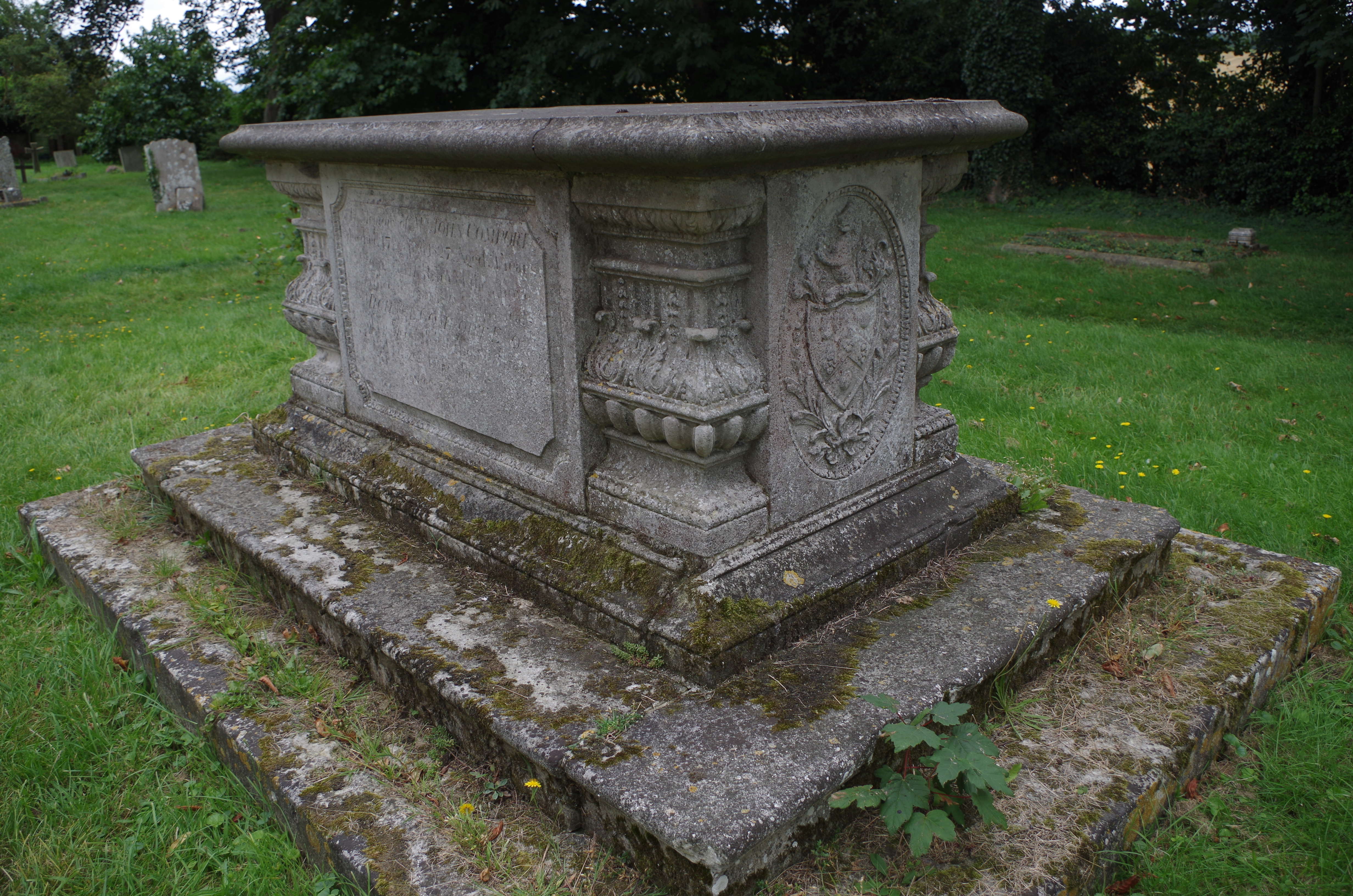
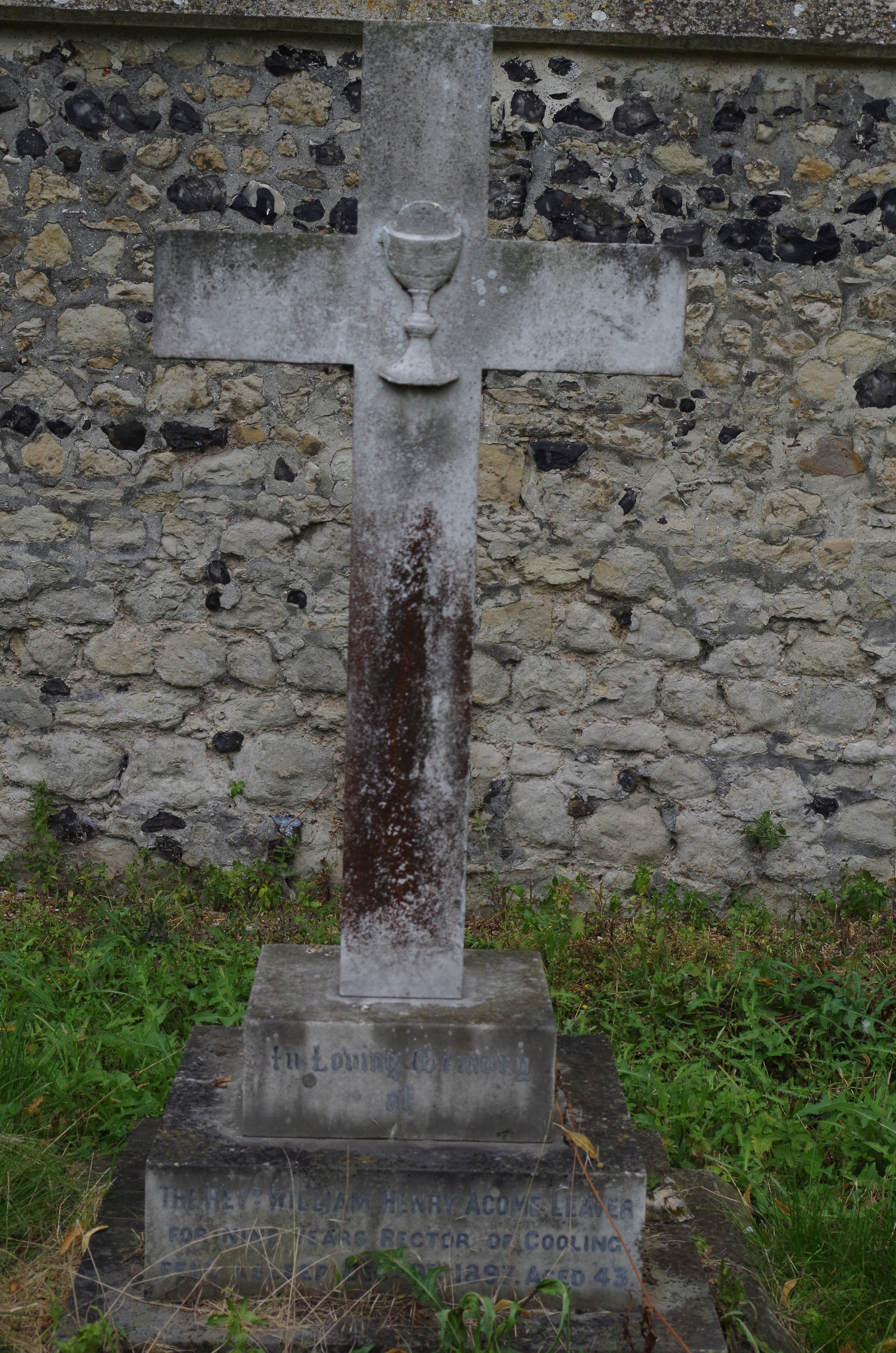
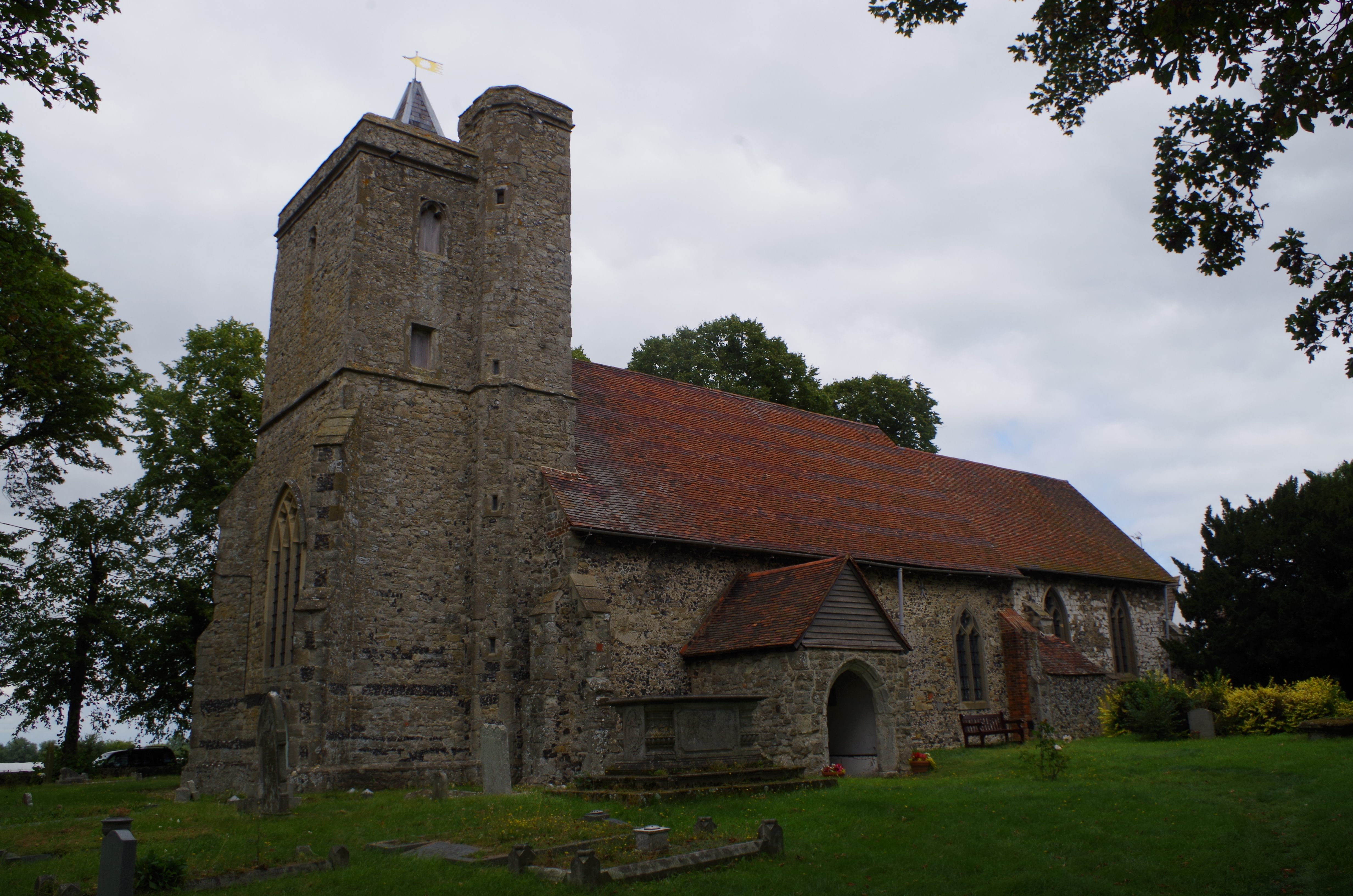
I came across this elegant little family group during the summer in a country churchyard. Although a couple are damaged, they are all still in reasonably good condition. The panels set into the stone crosses are made from metal with a floral painted decoration which I feel may be anticipating the Art Nouveau movement. It flourished from 1861 – 1914 and the dates of death would fit it with this.

Dedicated to a child. ©Carole Tyrrell

On this one, dedicated to Charles William Elliott, the floral decoration is intact despite the epitaph being damaged and you can see the flowing, sinuous lines of the stems and petals which is typical of Art Nouveau. However, the inscription is in a Gothic style.

©Carole Tyrrell

The epitaph above is very poignant as it’s dedicated to 4 children, 2 of whom died as babies and 2 others, presumably twins , who died at just under a year old. The epitaph is again in Gothic style with more restrained floral decoration and the addition of a cross.

©Carole Tyrrell

This may be dedicated to the mother of the children who lived until she was in her 60’s and she seems to have been buried with another child who died at just under a year old.

The trio are one of the few memorials within the churchyard which still appear to be in their original place as most have been moved to an outer wall. They emphasise the high infant mortality rate during the 19th century which is why people often had big families. Not all the children were expected to survive. It must have been heartbreaking. I have only seen one other memorial in this style and it was in Highgate East cemetery.

So, an elegant and intriguing little trio of memorials that tell a sad story of a local family.

©Carole Tyrrell Text and photographs

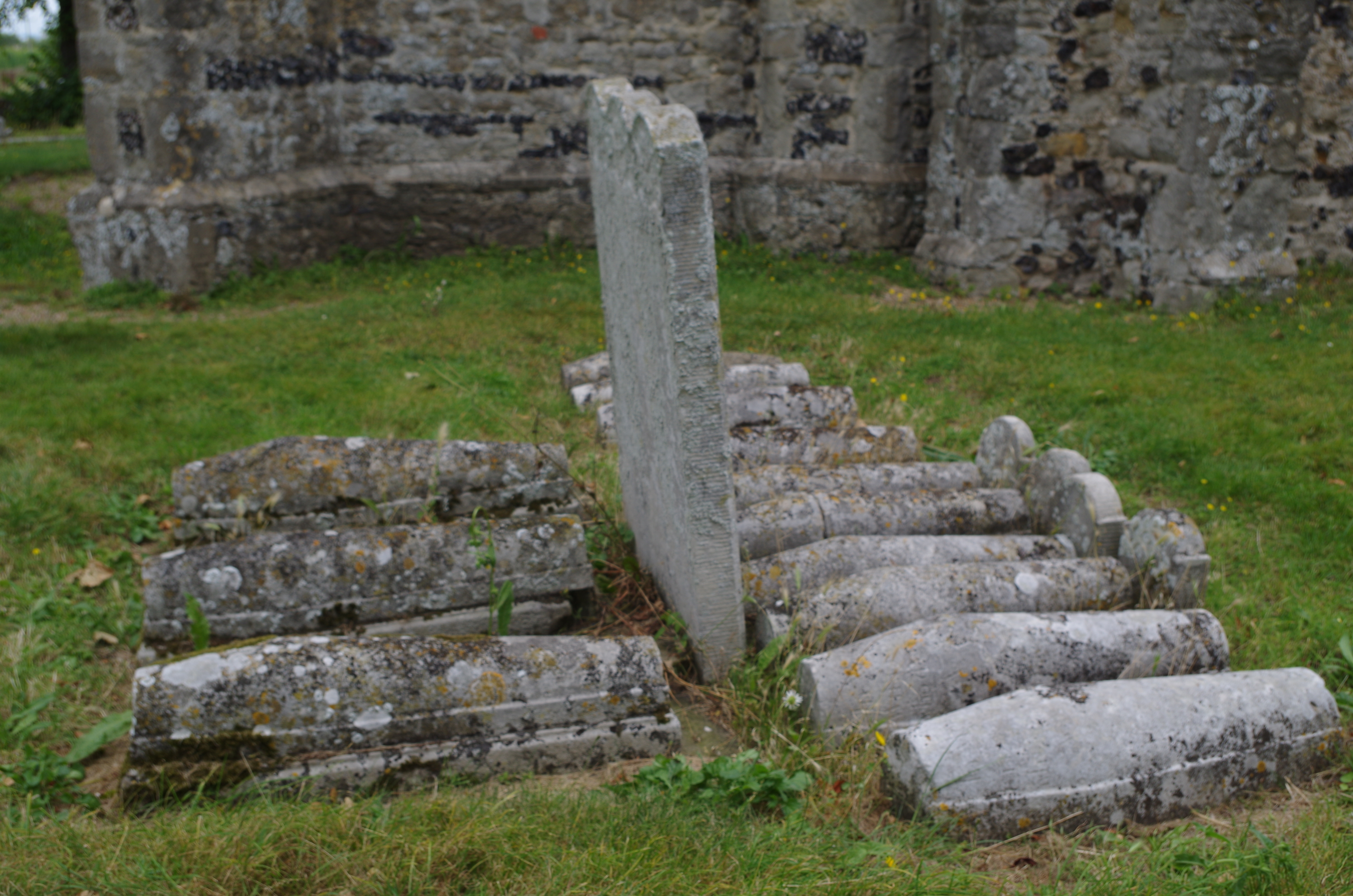
Stairway to heaven? A new use for old headstones.

I’ve often seen headstones used as paving for paths in cemeteries and churchyards and sometimes feel a little uncomfortable when I see them used in this way.. This is because it feels as if ‘I’m walking over someone’s grave’ as the old saying goes. It seems to happen when the churchyard or cemetery has become a park with the headstones removed from their original location and often placed against a wall.

However in my local churchyard, St Margaret’s in Rochester, they have gone one step further and created a small set of steps that lead up to a grassed area. This is where the graves belonging to the people to whom the headstones belonged may still lie. The slope may also have been created by the bodies being buried on top of each other over the centuries which does happen in old burial places.

So I call it the Stairway to Heaven – a little irrelevant perhaps but I felt it’s appropriate!

Side view of steps ©Carole Tyrrell
Looking up the steps from the ground. ©Carole Tyrrell
Looking down from the top of the steps. ©Carole Tyrrell

©  Text and photos Carole Tyrrell

Symbol of the Month – ‘Here I am, given to the worms’ – the Hamsterley memento mori

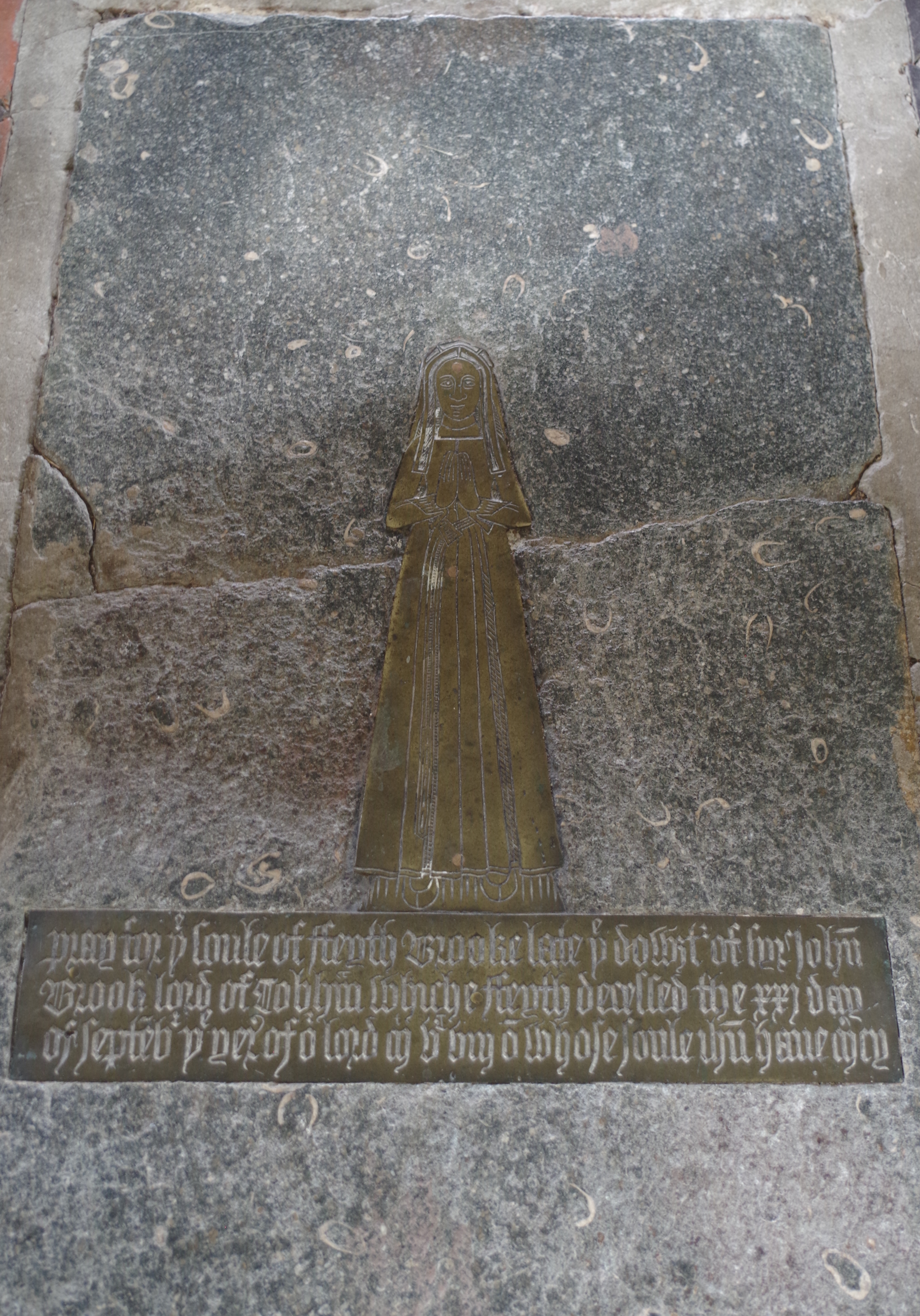
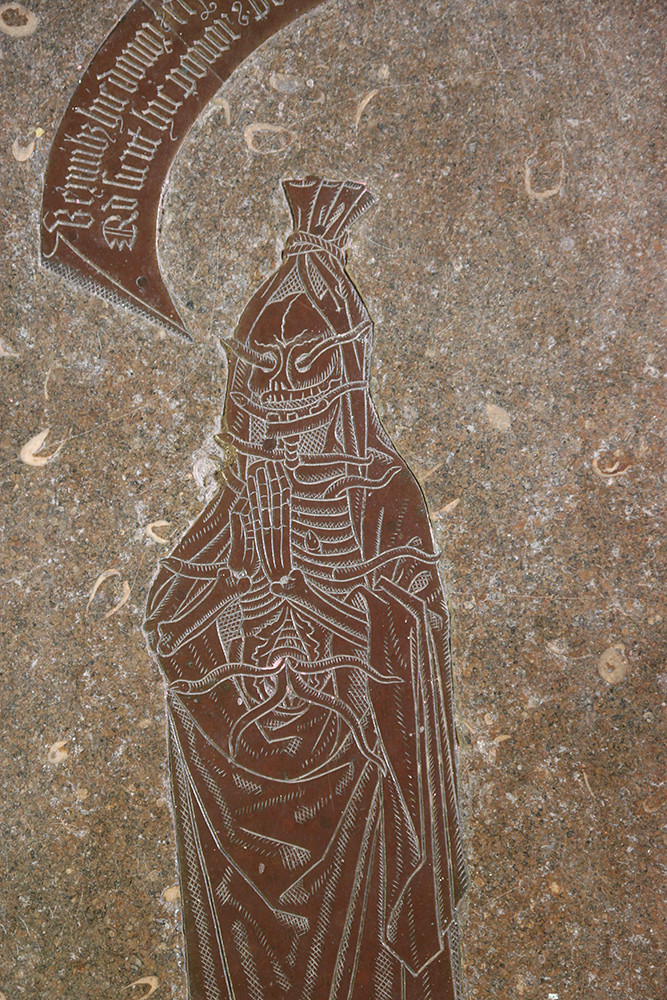
This wonderful example of a medieval mori is dedicated to Master Ralph Hamsterley and doesn’t shrink back from depicting what awaits the viewer after death. It’s a symbol of death that’s designed to make the viewer think, not only of the man that placed it there, but also of their own mortality. However, it’s the only one that has survived from the original four that Hamsterley had placed in Oxford at least 10 years before his death in 1518.

I’ve made it a Symbol of the Month because it’s one of the most arresting and realistic symbols of death that I’ve ever seen.

The article comes from the https://medievalart.co.uk website which is well worth a look if you’re interested in medieval art and like poking around in churches as I do.

//embedr.flickr.com/assets/client-code.js

In the centre of the chancel at Oddington in Otmoor, in eastern Oxfordshire, is a large purbeck marble slab into which is set one of the most unusual monumental brasses from late medieval England.  The brass consists of an effigy, a corpse in a tied shroud, with it’s hands in the attitude of prayer.  The corpse is skeletal and well through the process of putrefaction and issuing out of the body cavity, from between the ribs, leg bones and from the sockets of the eyes, are wriggling maggots or worms.  Such memento mori were not unusual in late medieval England, both shroud brasses and transi tombs were common from the middle of the fifteenth century and survive in some quantity, but this example is particularly grisly and intense.

//

embedr.flick

Oddington, Oxfordshire

r.com/as

sets/client-code.js

Below the effigy is an inscription that identifies the persons commemorated, it asks for prayers for Master Ralph Hamsterley, a fellow of Merton College Oxford and Rector of Oddington.  Issuing from the mouth of the Hamsterley’s cadaverous effigy, is a scroll, a Tudor speech bubble, with the following Latin rhyme:

Vermibus hic donor et sic ostendere conor
quod sicut hic ponor: ponitor omnis honor.

This can be translated as:

Here I am, given to the worms, and thus I try to show
That as I am laid aside here so is all honour laid aside.

Here laid before us is in brass is Hamsterley ‘given to the worms’.  The brass must have been erected within Hamsterley’s lifetime.  He died in 1518, but he actually ceased to be Rector of Oddington in 1508 and it is likely that the brass was erected before that time.  As we will see, Hamsterley wasn’t actually buried here.  Space has been left for the inclusion of Hamsterley’s date of death in the inscription, but this still remains blank, because he was buried elsewhere and ceased to have a connection with the place, nobody bothered to come and add his date of death. 

So here ten years before his death, Hamsterley was clearly contemplating his own mortality and if this brass is anything to go by, seemingly thinking on the sheer futility of human vanity and honour.  If you think that indicates that Hamsterley was a humble man, think again, people are always much more complex than that, aren’t they?  In life Master Ralph Hamsterley was a man of great ambition.  Although he held a number of parochial livings, he was primarily career scholar in Oxford.  At the time the Oddington monument was being laid down, with all it’s self-deprecating imagery, Hamsterley was in the process of contemplating the latest move in his progression up the Tudor academic career ladder. 

//embedr.flickr.com/assets/client-code.js

Born in the 1450s, he was a native of Durham, but by the late 1470s was a fellow of Merton college Oxford. He was a proctor on 1481 and served as principal of St Alban’s hall,  next door to Merton and since incorporated into it.   He spent the next twenty years in Oxford as a fellow at Merton and in both 1507 and 1508, he came very close to being elected Warden of Merton, but was defeated and the post went to others.  Not to be downhearted, he then started looking elsewhere in Oxford for a similar position.  In May of 1509 he decided to give a gift, of some sort, to University College.  Although we don’t know precisely what the gift was, it was generous enough for the Master and fellows of University College to consider Hamsterley as a benefactor of the college and add his name to the obit roll of the college, so that his gift would be remembered for perpetuity.  This gift, presumably financial, seems to have been part of calculated campaign to secure the Mastership at University College.  It worked, very soon the Master of the college died and in September 1509, Hamsterley was duly elected as Master.  His election was not without controversy, the college statutes stated that only fellows of the college could be elected Master and as fellow of another college, he was an outsider, and some of the fellowship resented his presence.  His election was contested and he had to seek recourse to Archbishop Warham to be confirmed in the role and thereon in had trouble controlling the fellows.  Nevertheless the ambitious Hamsterley remained as Master of University College, until his death in 1518.

After laying the brass at Oddington, Hamsterley began what can only be described as a campaign of a memorialisation across Oxford.  The brass at Oddington was to be the first of a series of four brasses that Hamsterley would lay down in his own memory in his lifetime. The other brasses at Durham, University and Merton colleges are all now lost, but Anthony Wood the Oxford antiquarian, saw the University and Merton brasses in the 1650s and transcribed their inscriptions.

At University College, Hamsterley had a brass laid down right smack the middle of the college chapel.  Wood tells us that ‘on a small marble stone, was the effigies of a man in a gown’, below was an inscription invoking prayers for Hamsterley’s soul and stating that he was fellow of Merton and Master of University college.  He wasn’t going to have his great benefaction of May 1509 forgotten and unusually the inscription on the brass records the obit, stating that his obit should be kept on the second feria after the feast of the Holy Trinity – forever!

The brass he laid at Merton college, his alma mater, was also rather unusual.  It was in the south transept of Merton and was not just a memorial to Hamsterley but also commemorated a friend, colleague and rival.  Wood tells that that on the same stone, there were two brass effigies of men side by side and below them a double inscription.  The first portion of the inscription invoked prayers for the repose of the soul of Thomas Harper, who was Warden of Merton between 1507-1508, the man Hamsterley had lost out to in the 1507 election.  The second portion of the inscription asks for prayers for Hamsterley himself, who is referred to here as Master of University college, as well as a fellow of Merton, indicating that the brass was erected after September 1509, well over a year after Harper’s death.  Were Harper and Hamsterley friends, or was erecting this double monument to a former Warden and rival, an attempt by Hamsterley to ingratiate himself with the Merton fellowship and further his career?  Although Harper was buried in his living in Bristol and not here, when Hamsterley died he appears to have been buried underneath this brass at Merton.  He was determined he would not be forgotten in his old college and he endowed a chantry priest ‘Hamsterley’s chaplain’, to sing masses for his soul at the altar of St Catherine in the chapel at Merton.  It was probably before that altar that the brass was placed.

These three brasses laid down by one man, reveal an awful lot about his personality, his piety and his ambition.  Ralph Hamsterley was a man of clear contradictions, well aware of his own mortality and prepared to invest in his memorialisation well before his own demise; he was clearly a man of significant ability too, an ambitious man who was determined to make his mark and to be remembered in Oxford. 

Sources
Details of the brasses in Merton and University Colleges are found in: J. Gutch (ed.), The History and Antiquities of the Colleges and Halls in the University of Oxford: by Anthony Wood (Oxford, 1886), pp. 26-27 & 62. 

Sources on the life of Hamsterley and his career:
G. C. Brodrick, Memorials of Merton College (Oxford, 1885), pp. 162 and 240.
J. M. Fletcher and C. A. Upton, ‘Destruction, Repair and Removal: An Oxford College Chapel during the Reformation’ in Oxoniensia 48 (1983), p. 122
R. Darwall-Smith, Early Records of University College, Oxford (Oxford, 2015), p. xvi

Wildlife in Cemeteries No 9 – Wild Places

A Wild place at London’s Brompton Cemetery, June 2021 ©Carole Tyrrell

Cemeteries and churchyards aren’t just for the dead.  As their permanent residents eternally slumber, life still goes on above them and it can be a rich and varied diversity.

Over the last two or there years, when I’ve been out exploring and in churchyards in particular, I have noticed areas within them that are allowed to grow freely without being troubled by a passing mower or scythe.

However, after the start of the first lockdown in 2020, every green space looked like a wild place as in the East cemetery at Frindsbury in Kent when grass cutting appeared to have halted in mid cut! 

The untrimmed East Cemetery, Frindsbury, Kent, March 2020 resulting in a magnificent carpet of primroses. ©Carole Tyrrell

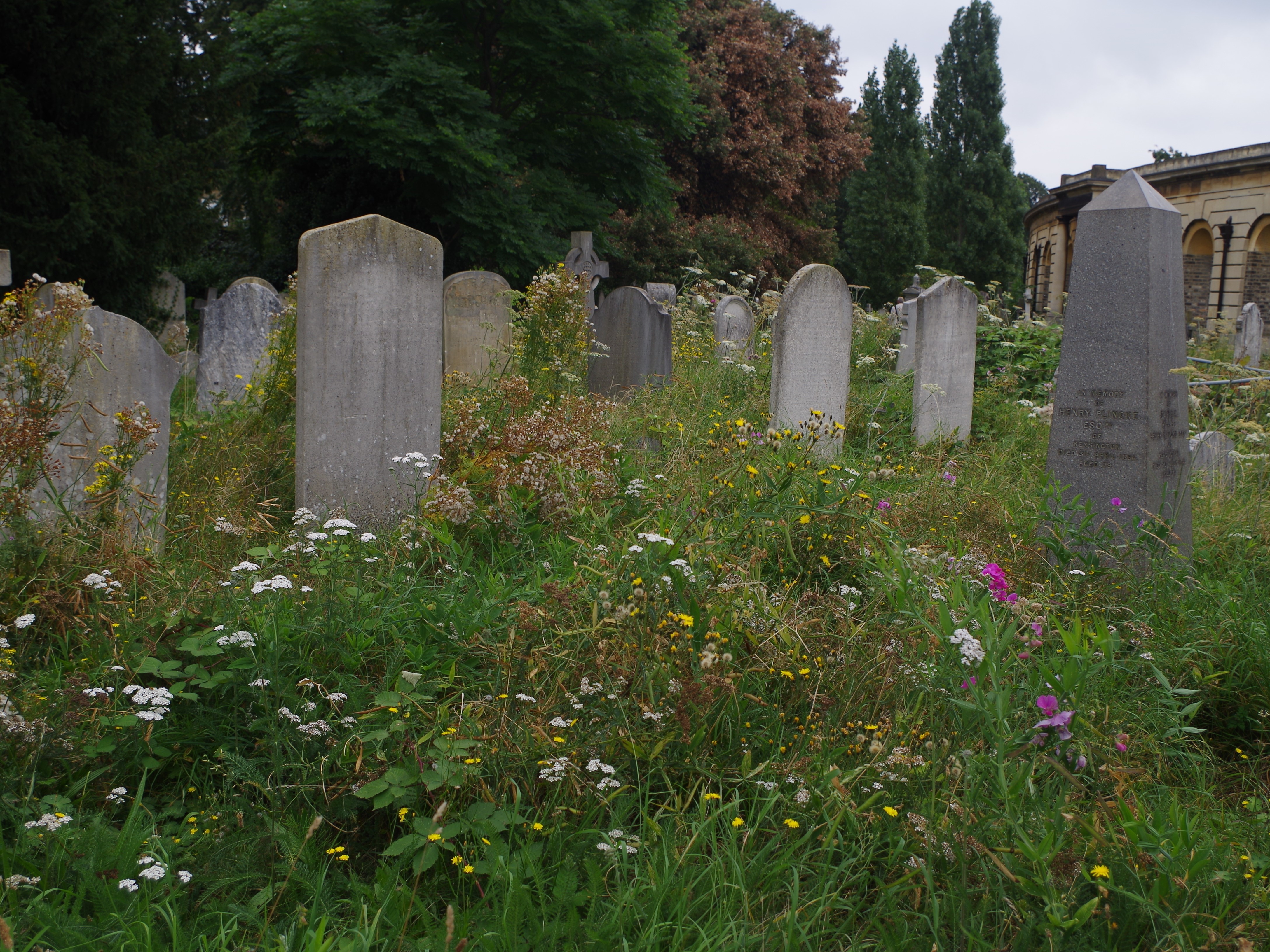
These ‘wild places’ attract butterflies, bees, moths and wildflowers amongst others.  In central London. and in the Magnificent Seven’s Brompton and Kensal Green cemeteries in particular, there are large swathes of the untrimmed and unkempt (according to some visitors).  These are teeming with caterpillars, grasshoppers and dragonflies to name a few.  To be in Kensal Green’s meadow area on a warm, sunny July day is a memorable experience. 

The bright pink of a Wild Pea, Brompton Cemetery, June 2021. ©Carole Tyrrell
Ladies Bedstraw, Brompton Cemetery, June 2021. ©Carole Tyrrell
A sea of Ox Eye Daisies, Brompton Cemetery, June 2021 ©Carole Tyrrell
Brompton Cemetery, September 2021 ©Carole Tyrrell
Grasses, Brompton Cemetery, June 2021. ©Carole Tyrrell

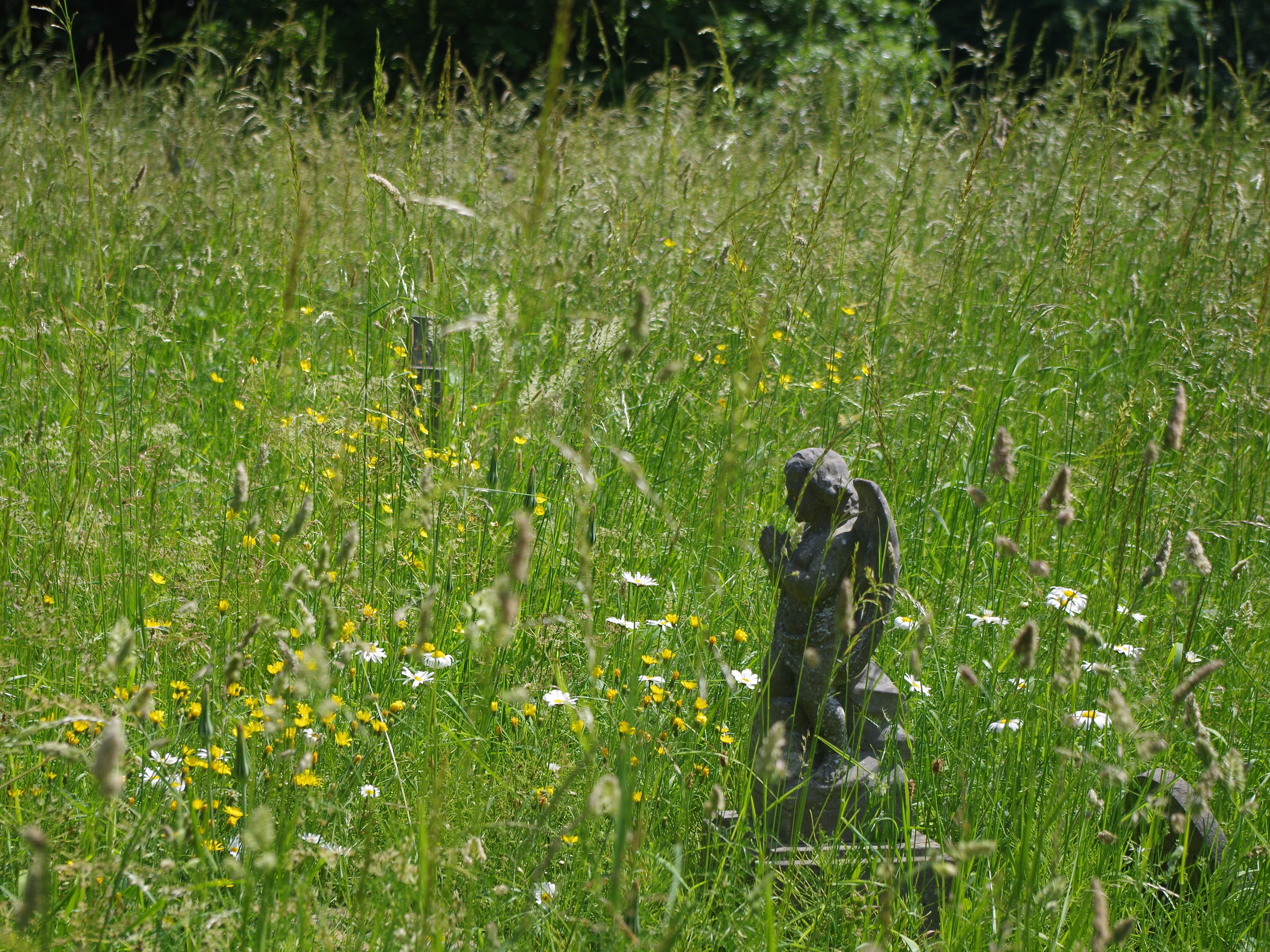
In June 2020, All Saints in Snodland, Kent had a fabulous area of ox eye daisies and a pair of mating damselflies in an untrimmed area.  In Brompton, the bright splashes of colour of wild peas, ragwort, Ladies Bedstraw amongst others are a contrast to the much more sombre memorials and monuments.  In July 2021, one area was a mass of Ox eye daisies.  But do take care.  An area of long grass and wildflowers can often hide the edges of graves and memorials so make sure tread carefully.  

A view of the church and its wild place from a corner filled with Ox Eye Daisies. June 2020 ©Carole Tyrrell
All Saints, Snodland’s wild patch! June 2020 ©Carole Tyrrell
All Saints Snodland, two Azure Damselflies prepare to mate in a wild place. June 2020 ©Carole Tyrrell

My local church, St Margaret’s in Rochester, planted a wildflower meadow this year. It was cordoned off from the rest of the churchyard which is mainly grass with the tombstones ranged along the wall that faces the River Medway.   In the Spring it was full of yellow buttercups and the blue of speedwell.  In the summer it was the turn of yarrow and poppies and the Beautiful Burial Grounds Project made a visit to record what was there.  This is a project that runs until December 2022 and I have submitted wildlife records to them.   When you think of it, cemeteries and churchyards are ideal places for wildlife as they are quiet places where they are unlikely to be disturbed and so can flourish.

St Margaret’s wildflower meadow, June 2021 as it begins. ©Carole Tyrrell
St Margaret’s, Rochester’s wildflower meadow becomes official. ©Carole Tyrrell
Fleabane, St Margaret’s, Rochester wildflower meadow July 2021 ©Carole Tyrrell
Some of the magnificent buttercup displays this year. St Margaret’s, Rochester wildflower meadow June 2021 ©Carole Tyrrell
Red Verbena on the churchyard wall, St Margaret’s, Rochester, June 2021 ©Carole Tyrrell
Herb Robert, St Margaret’s, Rochester wildflower meadow, June 2021 ©Carole Tyrrell

However, there are those who see the wild places as untidy and perhaps not really in keeping with a place of the dead.  But I always explain to them that cemeteries are also about life; not just everlasting life but also about real life and helping biodiversity.  They may go away thinking ‘ that’s all very well but it does look very untidy and perhaps the dust needs to come off their lawnmower’ but they may equally go away thinking ‘What a good idea, perhaps I could try it at home.’

I have tried it at home and the variety of insects that I attract into my back garden is proof of how a wild place can help wildlife thrive despite what the neighbours may think about the ‘untidiness’….

© Text and photos Carole Tyrrell

Further reading:https://www.caringforgodsacre.org.uk/about-us/projects/our-beautiful-burial-grounds-project/

Symbol of the Month – the Mass Dial

Mass Dial set into wall of St James’s Church, Cooling, Kent. ©Carole Tyrrell

Despite the somewhat dispiriting summer, I was determined to escape from the house and see at least one or two local churches.  My little part of Kent is known as Charles Dickens country (I’m not sure that he knows about this) and there are several buildings and churches associated with him. 

One of these is St James’s church at Cooling.  Although closed for services, it is still kept open by local people on most days. The Churches Conservation Trust take care of it and it’s in an isolated spot which borders onto marshes.  It’s also a fair walk from the nearest town, Cliffe.  I didn’t see any signs of much of a village there although there is a 14th century ruined castle nearby. St James’s is the end of a terrace of houses appropriately named Dickens Walk. 

l’ll talk more about St James in a later post as it inspired one of Dickens most atmospheric scenes in ‘Great Expectations’ with the childrens graves in the churchyard.  But while I was there, I found a symbol set within a wall that I had heard of but had never actually seen an example – this is the Mass Dial.  I have to admit that, if it hadn’t been pointed out on a display board within the church, I might have missed it as it’s set into an outer wall of the church.  Not many have survived and Victorian restoration may meant that they are found in odd places.

Mass dials are rare survivors and were a way of telling time before the invention of mechanised clocks and timepieces in the 14th century. 

It was the Anglo-Saxons who established the dials.  There had been confusion with all the different calendar systems such as the Lunar and Julian, and with a largely illiterate population, a visual way of telling the time was necessary.

According to the Building Conservation website:

the Anglo Saxons divided night and day into 8 artificial divisions known in Old English as Tid or Tides.  The 4 daylight divisions were called:

Morgen – 6am – 9am

Undern – 9am to noon

Middaeg – Noon to 3pm

Geletendoeg – 3pm to 6pm. 

Morning, noon and evening are still in use as the last remnants of this division still in use today as are moontide, yuletide and shrovetide.’

But, throughout the Middle Ages, the Catholic church emphasised the reciting of prayers and fixed times during the day as pre-Reformation Britain was still a Catholic country.  These were known as the Divine Offices and were:

Matins – pre-dawn

Prime (6am)

Terce (9am)

Sext (12pm)

None (3pm)

Vespers (sunset

Nocturnes (after sunset) 

However, these were not set as the sun might not shine for a few days and, if a mistake was made, then the parish priest might end up celebrating certain feasts on different days from a neighbouring parish. 

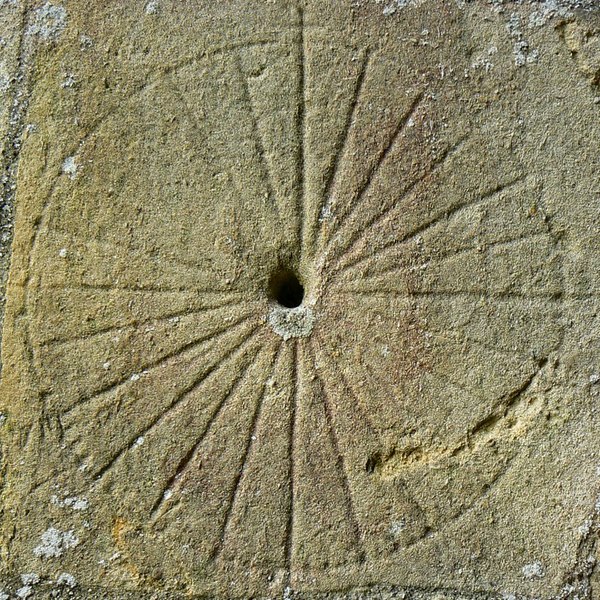
Mass Dial, St John’s church, Devizes, Wiltshire – note that it still has the marker in it showing how it worked.© Brian Robert Marshall under Geograph Creative Commons Licence.

They were a form of medieval sun dial and originally the hole in the centre of the dial would have contained a horizontal wooden or metal rod that cast a shadow.  This was known as a ‘gnomon’ which is pronounced as No Mon.  These may well have been the local community’s only way of telling the time although medieval life revolved around getting up at sunrise and going to bed at sunset.

According to the British Sundial Society,

‘mass dials can be found on the south side of many churches.  They are usually small and often located on the walls, buttresses, windows and doorways of a church.  However, they can also appear in more unlikely places such as inside churches and on north walls where the sun rarely shines. But they have also been found in porches suggesting that the porch was built sometime after the dial was made.’

The Society goes onto suggest that this may be

 ‘due to the stone blocks having been re-used in the rebuilding of the church.’ 

The location of the Cooling one may indicate that it’s been moved.

Again, according to Building Conservation:

‘if a mass dial is found anywhere other than a church and other than the south elevation of a church, this usually means that it has been moved from its original location often as part of a Victorian restoration.  In such cases, the dials were sometimes rebuilt into the fabric upside down, making them unreadable.’

The positioning of mass dials is important and can vary.  They may be on the smooth cornerstone or quoin of a tower, nave or chancel, above a porch or on a door or window jamb.  Often they are set at eye level and in one church it is cut into a window ledge.

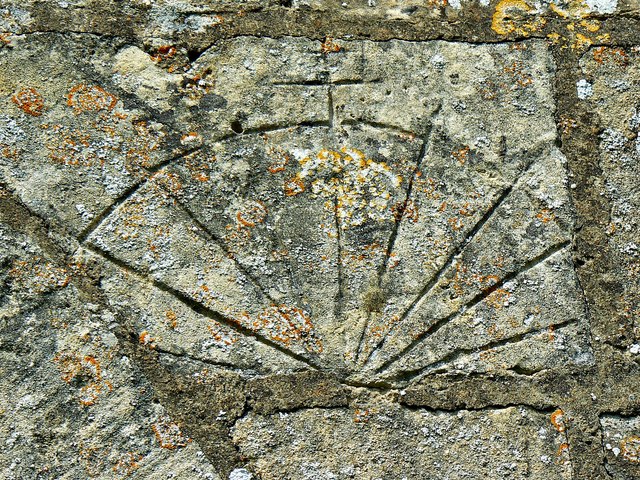
Mass dial, All Saints.Oaksey, Wiltshire. © Brian Robert Marshall. Shared under Wiki Creative Commons
Mass Dial, St Michael 7 All Angels., Heydon, Lincs. ©Richard Croft. Shared under Wiki Creative Commons

Mass dials also vary in their design as:

‘Some have either a few or many radiating lines, {others} have ‘hour’ lines within the circles or semi circles and others are constructed with a ring of ‘pock’ marks drilled into the stone.’  British Sundial Society

There are also variants in the way that the hour lines are numbered as they may have Roman numerals or even Arabic ones.  They’re also known as scratch dials as

‘many are quite crudely scratched into the stone.’ British Sundial Society

A full circle version, All Saints, Yatesbury. ©Brian Robert Marshall Shared under Wiki Creative Commons

The 14th century brought mechanical clocks that created a regulated 24 hour time period.  As a result, medieval life changed as it was no longer so reliant on daylight.  However, mass dials were still in use but now they were a complete circle with lines radiating from the central gnomon to simulate the 24 hour clock.  But by the 16th century they had fallen out of use.  Sundials and mechanical locks had overtaken them and it was no longer the Roman Catholic church that dominated after the Reformation.

Mass dials are of great archaeological and historic importance.  However, many of them are now indecipherable due to erosion and vandalism and people may not even realise what they are or their significance.

© Text and photos Carole Tyrrell unless indicated otherwise

References and further reading

https://www.buildingconservation.com/articles/mass-dials/mass-dials.htm

http://massdials.org.uk/links.htm

Photos

Symbol of the Month- The Scallop Shell

Carved scallop shell on monument in Brompton Cemetery. Note Celtic cross type support for it.
©Carole TyrrellThis month’s symbol is the scallop shell and is traditionally associated with pilgrims. Since ancient times they have made the not inconsiderable journey to visit St James of Compostella’s shrine in Spain and proudly collected their scallop shell badge as evidence of their trip. But this humble mollusc has several other meanings especially in a funerary context.

However, despite it being a common shell and also an invaluable food source, I have only found it gracing 3 monuments so far.  There are several flat 2D versions on a tomb in Nunhead Cemetery and two examples within Brompton Cemetery; one is a more decorative touch and the other is this lovely 3D beauty.  So well carved and tactile – I just wanted to reach out and touch it.  But I’m keeping a look out for any other shells adorning memorials.

Shells have been with us since time immemorial and who hasn’t picked one up from a beach to take home as a souvenir?

A scallop on sand.
Shared under Wiki Creative Commons

The scallop is inextricably linked with the Christian religion and its use in funerary rites pre-dates the Egyptians.  In pre Christian times, the Celts in particular, used it as an emblem of the setting sun and note that in the above example it is placed in the centre of the supporting Celtic Cross.  The nimbus of the Cross is considered to be a sun symbol.  In Christianity baptismal fonts were often shell shaped and a shell was used to scoop water up and then pour it over the person being baptised’s head. This emphasises the shell’s association with water as it’s thrown up by the sea onto the shore.  But there is another link in that it’s seen as representing the final journey from the world of the living to that of the dead by the crossing of a body of water such as the River Styx and so is also a motif of rebirth.  This is how the early Christian church used it.

Another funerary use for the shell was being placed, often with stones and coins, on tombstones or at gravesites.  The artofmourning website says:

It has been suggested that this refers to the ancient tradition of burying the dead under a cairn of rocks as protection from scavenging animals or as a reminder of the deceased.’

But there’s also a more meditative side to the scallop as its grooves can also be seen as representing many paths leading to one point such as searching for God or a path in life.  So this ancient motif can be seen as representing a journey through life itself or indeed to St James’ shrine.

It’s also associated with fertility and, in particular, the goddess of love, Venus.  In Botticelli’s celebrated painting, ‘The Birth of Venus’, the goddess is portrayed as standing on a large scallop shell.

Sandro Botticelli The Birth of Venus shared under Wiki Creative Commons

Incidentally, it also features in Palladian architecture which flourished 1715 – 1760 which was built on the heritage from Greece and Rome.  Here the shell was used in a concave form and usually within a niche.  In this example, also from Brompton, the shell is less obvious and more of a decorative feature.

Stylised shell decoration on memorial in Brompton Cemetery.
©Carole Tyrrell

The link with St James is that scallop shells are very common in Galacia where the shrine is located.  But there are also 3 very famous myths and legends that reinforce the link.  According to the hillwalktours website:

St James, together with his brother John, one of Christs’  disciples. After Jesus’s death, James went to Iberia, which is now Galacia in the north of Spain with the intention of converting the pagans there to Christianity.  However, in roughly 44AD, after returning to Jerusalem, James was beheaded by order of King Herod.  This made him the first disciple to be martyred. James’s body was then carried by ship to Galacia where the three myths arose.

In the first, the ship carrying St James’ body was lost and destroyed in a severe storm. After an unspecified length of time, his body washed ashore completely covered in scallop shells.  In the second myth, a knight fell from a clifftop as St James’ ship passed beneath. The saint’s influence was felt as the knight emerged from the sea unharmed and covered in scallop shells.  The third and final one features a wedding in which the horse carrying the bride bolted into the ocean as St James’ ship passes by. But the bride and horse were saved as they emerged from the water covered in scallop shells.  Hence the link between St James and the shell.

Pilgrims were big business in medieval times and the scallop was a badge of honour for pilgrims to display that they had made the journey.  They often had their shells buried with them or carved on their tombs.

And so the humble scallop shell reveals itself as an important symbol with several significant meanings.   A fertility symbol, evidence of a seeker exploring many oaths towards their goal or a passenger on Charon’s boat towards eternity?  Myself, I would incline to the final river journey but I also like the idea of exploring many paths in life.   We will probably never know the actual significance of the shell to the deceased but it was important enough to be placed on their memorial to be enjoyed by any passer-by.

©Text and photos Carole Tyrrell unless otherwise stated. ©Carole Tyrrell

References and further reading:

www.thecemeteryclub.com/symbols.html

https://www.gravestonestudies.org/knowledge-center/symbolism

www.waysidearteastanglia.me.uk/symbols.html

https://www.hillwalktours.com/…/camino-scallop-shell-symbolism

https://symbolsproject.eu

https://compostela.co/symbols/the-scallop-shell-was-the-emblem…

https://en.wikipedia.org/wiki/The_Birth_of_Venus

Victorian Mourning Clothes

This came from the Billion Graves blog and covers the complex issue of mourning etiquette in the Victorian era. The fact that black mourning clothes were dipped in arsenic may have contributed to the mortality rate in itself. This article has such wonderful photos and also covers men’s mourning wear and rules and the use of human hair in mourning jewellery amongst other items. This may seem a little creepy to us thes days but then it was considered a lovely memento of the one that had passed.

 Cathy Wallace1 month ago  

Victorian mourning clothes may have been hanging in your ancestor’s closet during the 1800s – a black dress with a high neck, black leather button-up shoes, a black top hat, and more. And when death brought those black clothes out of storage, your ancestors may have worn them for years at a time.

England’s Queen Victoria, who was crowned June 20, 1837, set the standard for Victorian mourning clothes. She was the second-longest reigning monarch in British history and she is also known for deep grief at the passing of her husband, Prince Albert.

Queen Victoria with Empress Frederick BillionGraves, ancestors, family history, Victorian era, Victorian mourning clothes, funeral. mourning, cemetery, grave, GPS, cemetery documentation, gravestone photos

The couple had been married for 21 years and had 9 children together when Albert suddenly passed away. He died of typhoid fever in 1861 at the age of 42. Victoria was so devastated that she entered into a deep state of mourning and wore black for the rest of her life.

Victoria’s behavior was so influential that it impacted entire nations, causing a shift in funeral customs and mourning clothes.

BillionGraves, ancestors, family history, Victorian era, Victorian mourning clothes, funeral. mourning, cemetery, grave, GPS, cemetery documentation, gravestone photos, ostrich feather hat, mourning clothes for women

Mourning dress consisted of entire outfits intended to inform onlookers of the person’s state of grief. The fabrics and colors changed over time to mark how long it had been since the death of the loved one.

Since mortality rates were high during the Victorian era, mourning dress was often be worn for most of their lives.

Victorian Mourning Clothes Were a Must

Following Albert’s death, Queen Victoria dressed in full mourning clothes for three years. And she continued to wear black in some form until the day she died – a full forty years!

Mourning clothes were considered an outward expression of one’s inner grief. It was considered disrespectful to break with traditional standards. Going out without your black silk weeping veil or carrying a handkerchief with too narrow of a black border could signify that you did not love your departed family member deeply enough.

Mourning ensemble, silk/wool, silk, American BillionGraves, ancestors, family history, Victorian era, Victorian mourning clothes, funeral. mourning, cemetery, grave, GPS, cemetery documentation, gravestone photos

Earlier societal groups used clothing as a symbol of mourning, but Victorian mourning clothes rituals were especially strict. If someone was in doubt as to what was appropriate, they could consult the Cassell’s Household Guide.

Prior to the Victorian era, mourning clothes were not put on until the day of the funeral. But during the Victorian era, it was customary to put on mourning clothes as soon as possible after someone died.

mourning clothes ad

When family members died there wasn’t time to go shopping for mourning clothes. They had to put on right away! So mourning clothes were purchased in advance in case death came to their household.

Who Wore Mourning Clothes?

In our day, it is still fairly common to see nearly everyone at a funeral wearing black or dark colors. But in the Victorian era, mourning clothes were reserved for close family members of the deceased.

In fact, it was considered rude for anyone outside of the family to wear mourning clothes to a funeral.

There was a purpose to this social norm. An entire community would know to rally around a grieving family when they saw them wearing mourning garb.

Victorian Mourning Clothes for the Ladies

A Victorian woman was expected to remain in deep mourning for a year and a day during which she wore only simple black clothing.

Mourning dress, silk, glass, French

This was followed by six to nine months of “second mourning” which lasted six to nine months and allowed for some use of trim and small jewelry.

Next came three to six months of “half-mourning” which allowed for more elaborate fabrics and jewelry. Colors like gray and lavender were permitted as long as there was minimal ornamentation.

Dress, Mrs. F. M. Carroll (American), silk, mother-of-pearl, American

During the entire mourning time, a woman was expected to refrain from attending any social events, especially weddings.

The Victorian Lady’s Mourning Dress

Deep mourning required dressing entirely in black. A woman’s ensemble was called “widow’s weeds”.

Mourning ensemble, silk, American

The body was to be completely covered with a lusterless fabric that would not reflect light, such as crepe. The process used to remove the sheen from crepe fabric caused it to have a strange odor which some found offensive. But wear it, they must!

Mourning ensemble, silk, American

Women who couldn’t afford special black mourning clothes dyed their everyday clothing black.

During the later stages of mourning, dresses could be grey or shades of violet with black decorative designs and trim.

The Victorian Lady’s Mourning Veil

It was considered inappropriate to show emotion in public so veils were a way to allow a grieving family member to keep their tears to themselves.

Widows in deep mourning wore a black silk weeping veil or “widow’s cap” covering their faces for 3 months after their husband’s death.

Passion for the Past: 19th Century Mourning Practices BillionGraves, home, house, family history, genealogy, victorian home, Victorian era, funeral, preparing Victorian homes, cemetery, grave, gravesite, cemetery, BillionGraves

Veils were sometimes a woman’s full height and were secured in place with a hat. Crepe veils were incredibly heavy. They were difficult to breathe through and difficult to see through.

Mourning ensemble, silk, American

It was considered vain to wear dresses that were smooth or shiny during the mourning period so the fabric was treated with chemicals to make it matte and crinkly. Many of the substances used were toxic. One of the most common was arsenic. (Yes, deadly arsenic!!)

By the 1880s, medical journals were reporting on the ill health effects of heavy crepe veils.

The New York Medical Journal noted “the irritation to the respiratory tract caused by minute particles of poisonous crepe”.

The North-Western Lancet called the mourning veil “a veritable instrument of torture” in hot weather. It left stains on women’s faces, caused acne, headaches, and filled their lungs with toxic particles.

Fashion magazines published advice like this for women who were doomed to wear the black veil:

“It is a thousand pities that fashion dictates the crepe veil, but so it is.  It is the very banner of woe, and no one has the courage to go without it.  We can only suggest to mourners wearing it that they should pin a small veil of black tulle over the eyes and nose, and throw back the heavy crepe as often as possible, for health’s sake.” (From Polite Life and Etiquette or What is Right and The Social Arts, written by Georgene Corry Benham, 1891)

The Victorian Lady’s Mourning Bonnet

As a woman moved into “second mourning”, black crepe bonnets replaced veils.

BillionGraves, ancestors, family history, Victorian era, Victorian mourning clothes, funeral. mourning, cemetery, grave, GPS, cemetery documentation, gravestone photos, bonnet, mourning bonnet

After three months, a widow’s veil was moved to the back of their bonnet.

They continued to wear the veils for approximately one year and the rest of their mourning attire for a total of two years.

The Victorian Lady’s Ostrich Feather Hat

As the “half-mourning” period was entered women could wear fancier hats.

BillionGraves, ancestors, family history, Victorian era, Victorian mourning clothes, funeral. mourning, cemetery, grave, GPS, cemetery documentation, gravestone photos, feather hat, fur

Ostrich feathers and jewelry could be added to their black hats.

The Victorian Lady’s Mourning Parasol

Fashion accessories such as parasols were black during deep mourning. They did not have any lace or other decorations.

Mourning ensemble, silk, American parasol, black parasol, GPS, BillionGraves, ancestors, family history, Victorian era, Victorian mourning clothes, funeral. mourning, cemetery, grave, GPS, cemetery documentation, gravestone photos

Parasols for later mourning periods could be gray or lavender with black trim.

The Victorian Lady’s Black Button Trim

The use of jewelry was forbidden during deep-mourning but dulled black jet buttons were fine.

Mourning dress, silk, glass, French

So buttons gradually made their way onto collars and became a new form of trim!

The Victorian Lady’s Mourning Handkerchief

Even handkerchiefs showed the world the stage of mourning a woman was in.

BillionGraves, ancestors, family history, Victorian era, Victorian mourning clothes, funeral. mourning, cemetery, grave, GPS, cemetery documentation, gravestone photos

Wide black borders represented the deep-mourning stage.

BillionGraves, ancestors, family history, Victorian era, Victorian mourning clothes, funeral. mourning, cemetery, grave, GPS, cemetery documentation, gravestone photos, handkerchief

Later mourning stages called for narrower borders.

The Victorian Lady’s Mourning Gloves

During the Victorian era ladies were strongly encouraged to wear gloves not only outdoors, but indoors as well. Gloves were an indicator of a person’s social and economic status.

BillionGraves, ancestors, family history, Victorian era, Victorian mourning clothes, funeral. mourning, cemetery, grave, GPS, cemetery documentation, gravestone photos, black leather gloves

Long black kid-skin gloves were worn during the deep mourning phase.

There were no mass-produced gloves. After a measuring and fitting session, each pair was custom-made so they would fit perfectly.

It was scandalous at any time for a woman to be seen outside of her home without gloves on and this was especially true for a widow.

The Victorian Lady’s Mourning Fan

feathers, fan, BillionGraves, ancestors, family history, Victorian era, Victorian mourning clothes, funeral. mourning, cemetery, grave, GPS, cemetery documentation, gravestone photos, ostrich feathers

During the Victorian era, black ostrich feathers showed up on women’s fans.

The Victorian Lady’s Mourning Cape

Some capes were for warmth but many were just for added adornment as the mourning period came to a close.

Mourning cape, Abraham & Straus, silk, American

This cape, with its purple ribbon and lace, was an example of a half-mourning evening garment.

ostrich feather cape, BillionGraves, ancestors, family history, Victorian era, Victorian mourning clothes, funeral. mourning, cemetery, grave, GPS, cemetery documentation, gravestone photos

This elegant black ostrich feather cape was also a half-mourning accessory.

Victorian Lady’s Human Hair Jewelry

Keeping a lock of someone’s hair was considered a sentimental thing to do during the 1800s. It was commonly done when someone moved away or when they died.

BillionGraves, ancestors, family history, Victorian era, Victorian mourning clothes, funeral. mourning, cemetery, grave, GPS, cemetery documentation, gravestone photos

The lock of hair was often placed in a locket.

BillionGraves, ancestors, family history, Victorian era, Victorian mourning clothes, funeral. mourning, cemetery, grave, GPS, cemetery documentation, gravestone photos, human hair

It could even be woven into a bracelet or a necklace.

hair, BillionGraves, ancestors, family history, Victorian era, Victorian mourning clothes, funeral. mourning, cemetery, grave, GPS, cemetery documentation, gravestone photos

Or intricately placed in a golden brooch.

To us, human hair jewelry seems rather odd. But to our Victorian ancestors, it was a sweet, tender way to remember those they loved.

Queen Victoria’s Human Hair Headdress

This human hair thing really took off with Queen Victoria.

QueenVictoriaInMourningGown.jpg

She carried this custom to the extreme by wearing an entire mourning headdress made of blond hair.

File:Queen Victoria white mourning head-dress.JPG hairpiece, royalty, mourning traditions

Just lovely, isn’t it?! Ummmm . . .

Victorian Mourning Clothes for the Gentlemen

For men, funeral fashion was much easier – they simply wore dark suits with black gloves, hatbands, and cravats.

The period of mourning for men was also different. A husband was expected to mourn a wife for just three months. During that time, they could still undertake business and attend social events.

The Victorian Gentleman’s Mourning Suit

BillionGraves, ancestors, family history, Victorian era, Victorian mourning clothes, funeral. mourning, cemetery, grave, GPS, cemetery documentation, gravestone photos

Victorian men who were in mourning wore plain black suits.

The Victorian Gentleman’s Mourning Hat

Victorian mourning clothes for men included a silk black top hat. The width of the hat-band depended on how close the person who wore it was to the person who died.

top hat, man, silk, Victorian

If the top hat was worn by the husband of the deceased then the band was expected to be about seven inches wide.

Hats worn by fathers for sons, or sons for fathers, were about five inches wide.

For other degrees of relationships, the width of the hat-band varied from two and a half inches to four inches.

The Victorian Gentleman’s Mourning Cravat

The cravat was the forerunner of today’s necktie. It was a short, wide strip of fabric worn around the neck and tucked inside a shirt or overcoat.

BillionGraves, ancestors, family history, Victorian era, Victorian mourning clothes, funeral. mourning, cemetery, grave, GPS, cemetery documentation, gravestone photos, victorian man

Most of the time Victorian cravats were white but during the mourning period, they were black.

Victorian man, vintage photo

A tiny pin sometimes held the cravat in place.

The Victorian Gentleman’s Mourning Gloves

Men’s mourning gloves were black leather and had long cuffs.

BillionGraves, ancestors, family history, Victorian era, Victorian mourning clothes, funeral. mourning, cemetery, grave, GPS, cemetery documentation, gravestone photos, gloves

It was customary to present a pair of mourning gloves as a gift to the person who officiated at the funeral whether that was the local religious leader or the undertaker.

Why did the Victorians Wear Mourning Clothes?

Mourning clothes let our Victorian ancestors tell the world that they were grieving without them having to say a word about it to anyone.

It was so unacceptable to speak of the loss of a loved one that they let their clothes do the talking.

BillionGraves, ancestors, family history, Victorian era, Victorian mourning clothes, funeral. mourning, cemetery, grave, GPS, cemetery documentation, gravestone photos, ad, mourning toilettes

The following sketch from a women’s magazine published in 1831 shows why Victorian mourning clothes were so important to people of that era.

“The mourning habit is a sacred shield against that intrusive curiosity . . . which would otherwise urge inquiries about why the countenance was sad . . .”

For example . . . “The brother of Miss B. had been dead only ‘three little weeks’– but there are duties which make it indispensable she should go abroad. If mourning apparel were prohibited, she may go forth in the same dress she would have worn had her dear brother been the companion of her walk.

“She meets a friend just arrived in the city, and who consequently knows not her loss. His salutation is cordial but it is repelled by a sad and chilling expression of countenance in Miss B.

“She is shocked at his levity and he is stung by her coldness or indifference. Their feelings are mutually wounded . . .

“Reverse the picture. Let the mournful apparel of Miss B. show that she has a reason for her sadness. The friends meet. The tale of sorrow is told and compassion is felt.” (from the Ladies’ Magazine and Literary Gazette, 1831, p. 115)

Will this Never End?

Some women could end up wearing mourning clothes for decades if they lost several close family members in succession. This was often the case during the American Civil War.

But ending the mourning period too soon was considered disgraceful.

In the 1939 film Gone with the Wind, widow Scarlett O’Hare drew criticism by dancing with Rhett Butler at a ball while still wearing her mourning clothes.

Packing Away the Victorian Mourning Clothes

At the end of the mourning period, deep black dresses and suits were packed away. Family members gradually transitioned from dark colors to lighter ones.

Black ostrich feathered hats and top hats went into storage trunks. Black parasols and leather gloves were laid away on closet shelves.

ball gown, happy woman, dance

Social events again became a part of our ancestor’s lives. Black cravats were traded for white. Ball gowns replaced mourning dresses. Smiles swept away sadness.

And after the First World War with its mass carnage no one had time for these rules. (ed)

Symbol of the Month – the grapevine.

This is a previous symbol of the month from 2017 and it is a very popular one as I see grapevines in a lot of cemeteries.

A closer view of the Salmon cross ©Carole Tyrrell

This is another less well known symbol but, in my opinion, a very attractive one. I found two examples of a grapevine climbing up a cross during a recent visit to Kensal Green cemetery together with another that only featured grapes as decoration and a fourth which had trailing vine leaves on a Celtic cross.  The first two in Kensal Green really make good use of the cross on which they are carved to its fullest advantage with the vines sinuously climbing up the stem and then the leaves almost hanging from the crosspiece. In fact the form of a grapevine almost resembles a cross with the long stems stretching up and then branching out horizontally with the grapes hanging from them. I also found a cross in Brompton Cemetery which had a design of grapes and vine leaves as a border around its edges.

For the source of this symbol we have to go back to the ancient Greeks and the god Dionysus.  He was also known to the ancient Romans as Bacchus and both of them are always represented in paintings and sculptures as holding grapes.  The latter were often depicted on Greek wine cups in tribute to Dionysus. Both of them were seen as the god of the vine and were associated with wine-making, celebration and ecstasy. Dionysus was also associated with rebirth in that, after his dismemberment by the Titans, he came back to life in an echo of the winter pruning of grapevines so they may bear fruit again during the next year. He was unique in that he could bring a dead person back from the underworld.

As you may imagine, the early Christians adopted the less bacchanalian side of Dionysus and Bacchus.  There are many similarities between Dionysus and Jesus in that both were supposed to have been born from a mortal woman but fathered by a god, to have returned from the dead and to have transformed water into wine. The early Christians took the latter and transformed it into a miracle.  They also used the powerful symbol of the grapevine with Christ calling himself ‘the vine.’   In John 15:5 there is the famous quotation:

‘I am the vine and you are the branches.  If a man is in me and I in him, he will bear much fruit.’

In fact a vine and its branches are traditionally seen as depicting Christ and his followers, the Church and its faithful. He also uses the analogy of the Kingdom of Heaven as being similar to that of a manager hiring workers for his vineyard. The grapevine was also adopted by the ancient Roman Christian converts and appears on their graves and in their mosaics.

Grapes are an abundant crop and are one of the earliest cultivated crops known to us.  It bears fruit for the harvest and so is associated with celebration and good times.  The artofmourning website has suggested that there is also an element of birth/rebirth with the representation of the grapes and also a connection with victory.

‘The ripe harvest shows the promise of the fruits rewards being reaped and turned into the production of sustenance for the future.’

An interesting theory within the context of a funerary symbol as it hints at resurrection. There is also the theme of sacrifice. Wine, which comes from the grape, has always traditionally been seen as representing the blood of Christ and this is particularly symbolic during the service of Holy Communion within the Catholic church.  Also, during the Last Supper, Christ gave wine to his disciples and told them to drink it in remembrance of him.

But what does this age-old symbol mean within a Victorian London cemetery? As I see it, it can be a representation of the deceased becoming part of an eternal vineyard i.e. the Kingdom of Heaven or that their earthly lives were full of abundance and achievement.  But it can also be a motif of resurrection in that the grapes are crushed underfoot to be reborn as wine and this would be highly appropriate for use within a cemetery. In fact I’m surprised that it doesn’t appear more often as it is very eye-catching amongst more restrained classical symbols especially when combined with a cross.

These two fine examples come from Kensal Green cemetery and demonstrate how well a grapevine translates onto a cross. Note the three letters in the centre of the Cross which are IHS combined together. This is a Greek abbreviation for Jesus Christ, Man and Saviour which is ‘Iesus Honinum Salvator’ which translates as ‘Jesus the Saviour of Man’.

Note the IHS motif in the centre of the Moir cross in gothic lettering.
©Carole Tyrrell

The first is to Frederick Salmon and the other to George Gordon Moir. I haven’t been able to find out anything on Moir but research is ongoing. However, he obviously liked Salmon’s cross and embellishment as his is identical.

But Frederick Salmon (1796 – 1859) was a renowned and pioneering surgeon and he has a fascinating story to tell.

Salmon was a restless Victorian medical man out to make his mark and improve the lives of his fellow citizens. In many ways he was a maverick destined to rebel against and work outside the medical establishment of the time. As you can see from his epitaph he founded St Mark’s Hospital which is still in existence, based in Harrow and is part of the St Bart’s and the London NHS Trust.

Frederick Salmon founder of St Mark’s Hospital
©http://www.stmarksacademicinstitute.org.uk/about/history/

He was born in Bath in 1796 and, at 15, was apprenticed to a surgeon-apothecary. Somewhere along the line he met William White, one of the earliest surgeons to write on rectal disease. Salmon always credited White with the direction in which his own career went which was in the field of proctology.

However, the medical establishment frustrated Salmon. Training depended on money and influence as posts had to be bought and so were often earmarked for friends and relations of surgeons and physicians. In 1817 he paid £8.15s.0d to become a house surgeon at St Barts and then rose to a surgeon’s post. He also wrote a book on intestinal disease in 1828 which ran to four editions. But Salmon became part of a medical scandal when, in 1833 aged 37, he resigned with other staff members from the General Dispensary in protest. They were angry at the plans of the hospital governors to revert to a system in which posts were up for sale to those who could afford to pay. The Lancet declared in the same year that the practice was ‘one of money, of favour and of family interest.’ Salmon was now a free man and obviously one of considerable charisma and talent.  He founded St Mark’s in 1835 with the City of London providing much of the finance. It was in one room with seven beds and 2 other staff members at 11 Aldersgate Street in the City. A plaque still marks its location. It had the less than catchy name of St Mark’s Infirmary for the Relief of the Poor afflicted with Fistula and other diseases of the Rectum. But it soon acquired a nickname: The Fistula Infirmary.  Despite several moves and expansions of premises St Mark’s remained in the City until 1995 when it moved to its present location.

From the beginning St Mark’s filled a desperate need for London’s poor to be able to access treatment. Salmon was not only able to attract significant funding but also wealthy patrons and supporters. Sir William Copeland, Lord Mayor of London, was a grateful patient who became St Mark’s first President and Charles Dickens presented several autographed copies of his latest book, The Pickwick Papers, and 10 guineas in gratitude.  This was after having undergone a rectal operation without anaesthetics. Salmon was reputed to have performed 3500 operations without a single fatality which was an incredible achievement at a time when antiseptics were unknown and anaesthetics were only just coming into use.

Salmon retired, due to ill health, in 1859 and died at Ombersley near Droitwich on 3 January 1868 aged 72. St Mark’s was his lasting legacy and there is a ward named after him.  Today the hospital is one of only 14 worldwide hospitals to be recognised as a centre of excellence by the Worldwide Organisation of Digestive Endoscopy.

Salmon was a  vine that bore fruit as did John Edward Taylor (1830-1905)

Mr Taylor’s magnificent Art Nouveau style monument is tucked away on a lower path in Kensal Green Cemetery. It dwarves  the far more recent surrounding graves and headstones. Such unashamedly Art Nouveau memorials are rare within cemeteries.  There’s one in Streatham cemetery, a lovely gem in West Norwood, another in Hendon and there are undoubtedly others scattered across London.

Here the grapes are carved on the left hand side sidepiece flanking the main memorial. These reflect the Art Nouveau love of natural forms and structures. The movement used the curving, organic lines taken from plants and flowers. But, by the time Mr Taylor’s widow Martha died in 1912, Art Nouveau was about to be replaced by the angular lines of Art Deco.

Taylor was another restless Victorian man who was involved in many areas. He was the second son of John Edward Taylor senior who founded the Manchester Guardian in 1821 backed by a group of local liberals known as The Little Circle. They had successfully lobbied for parliamentary reform in the era of rotten boroughs and as a result of their efforts Parliament passed the Reform Act of 1832. Taylor senior witnessed the Peterloo massacre in 1819 but been unimpressed by its leaders. The Manchester Guardian is still in business but now renamed the Guardian and Taylor edited it until his death at the early age of 52.

After the death of his older brother, Russell, in 1848 Edward became co-owner and then sole owner of his father’s paper in 1856. He also edited it from 1861-1872.  Newspaper ink was in his blood and he also became owner and then co-owner of the Manchester Evening News until his death. He was also a philanthropist and believed in education which led him to become a trustee of Manchester College from 1854 until his death.  He founded the Manchester Aid Society in 1863, advocated temperance and free trade and was also involved in the British and Foreign Bible Society. On top of this he was also a director of the Buenos Aires Great Southern Railway Company.

Taylor remained a lifelong liberal and in 1895 he refused a baronetcy offered to him by Lord Rosebery. But he was also known as a great art collector and a generous one.  He often lent out some of his collection to local exhibitions in Manchester or at Burlington House.  After his death, Christie’s held a sale of his collection over 12 days and achieved record prices for the time. Taylor lived in London after his marriage in 1861 to Martha Elizabeth, the sorrowing wife, recorded on the monument.  The newspapers passed to other members of the extended family.

This is less ornate and, instead, features vine leaves cascading on a Celtic cross with again the very ornate combined letters of IHS in the centre of the cross, or the nimbus, with a dedication below to Matilda Morris who died on 10 December 1881.  Again I haven’t been able to find out anything about her but research is ongoing.

This is an example from Brompton Cemetery and here the grapevine and leaves form an intricate pattern around the cross. I may not be able to read the epitaph on the flat slab beneath until the winter die-off.

Of course the use of the grape and vine might just indicate that they liked a drink or two……but that’s something that we will never know…

©Text and photos unless otherwise stated Carole Tyrrell

References:

http://agraveinterest.blogspot.co.uk/2011/04/religious-symbols-in-cemetery.html

https://stoneletters.com/blog/gravestone-symbols

http://www.planetgast.net/symbols/plants/plants.html

http://www.vam.ac.uk/content/articles/c/christian-symbolism-the-natural-world/

http://artofmourning.com/2010/12/26/symbolism-sunday-the-grape/

site on mourning jewellery – well worth a look.

https://en.wikipedia.org/wiki/John_Edward_Taylor(senior)

https://en.wikipedia.org/wiki/St._Mark%27s_Hospital

https://www.ncbi.nlm.nih.gov/pmc/articles/PMC1034506/?page=1

http://www.stmarksacademicinstitute.org.uk/about/history/

http://www.crystalinks.com/bacchus.html

Symbol of the Month – the square and compass

This example is from Brompton Cemetery and is dedicated to a woman. ©Carole Tyrrell

The Square and the Compass is a symbol which is traditionally associated with the Freemasons and appears on their insignia. It’s also an important part of their teachings.  The two elements together form a hexagram which often has the capital letter G inside it to denote God.  However, the ones that I found didn’t have this so perhaps it is a regional or international variation.  But there is a another interpretation of the motif which may be more appropriate to a funerary emblem and let’s not forget that these are also an architect’s tools of the trade

The Freemason association is the most obvious and common.  They’re often seen as quite a secretive and shadowy organisation. ‘It’s all leather aprons and funny handshakes.’ seems to be the opinion of many people.  But according the Freemasons UK website they define themselves as’

‘the world’s largest and oldest non-religious, non-political, fraternal and charitable organisations…rooted in the traditions of the medieval stonemasons who built our cathedrals and castles.’

They also claim to ‘make good men better’ by encouraging to live their lives according to the Freemasons Five Values of Integrity, Kindness, Honesty, Fairness and Tolerance.’

They use the Square and Compass in Masonic rituals to teach symbolic lessons.  Wikipedia says ‘

‘they have been defined as lessons in conduct  as in Duncan’s Masonic Monitor of 1866

 in which he defines ‘The square to square our actions and the compass to define boundaries and to circumscribe and keep us within the bounds of mankind.’

There is also a further, somewhat florid definition on the Masonic Lodge of education website which may make for further reading. As they point out, the square is often used in everyday language such as in ‘getting a square deal and, possibly a mason’s comment, ‘squaring off.’ It also appears in earlier texts such as Confucius. However, the square and the compass aren’t exclusive to the Freemasons as they are also used by several other fraternal organisations both in the UK and abroad.

But I prefer the definition of the symbols project in which they point out that both the square and the compass are measuring instruments and so represent judgement and discernment. The compass draws circles which are a symbol of eternity and also infinity. However the square can be viewed as being material and representing ‘fairness, balance, firmness’ and also:

something that is stable and a firm foundation to build upon’

They are a union of the material and of the spirit represented by the hexagram that they form.  So perhaps this is the spirit leaving the earthly plane and going into eternity i.e. from earth into heaven. It’s certainly another way to look at it.

But who knows? The people who chose to use the Square and the Compass on their tombstone may have been Freemasons or maybe not.  There was only one that I felt might have been one because of the quotation above the motif on his cross but this turned out to be a quotation from an 18th century hymn. With the others it was impossible to say.

You don’t see this symbol all that often although I discovered one in Brompton Cemetery and a sprinkling of them in Beckenham Cemetery recently. Interestingly, this is also a cemetery with several Salvation Army burials as well. Here is a gallery of the ones I found within Beckenham Cemetery:

This is from Beckenham Cemetery and is dedicated to a holder of the Victoria Cross which was for ‘conspicuous bravery at the Somme.’ ©Carole Tyrrell
The Kidd tombstone Beckenham Cemetery. ©Carole Tyrrell
Closeup of Square and Compass on the Hopper headstone, Beckenham Cemetery. ©Carole Tyrrell
This one is at the base of a cross on the Cecil Essex monument, Beckenham Cemetery ©Carole Tyrrell

I enjoyed researching this symbol as, although it seemed to be have an obvious association, it was also fascinating to find out other suggestions.

©Text and photos unless otherwise stated Carole Tyrell

Further reading and references:

http://www.graveaddiction.com/symbol.html

http://www.bbc.co.uk/london/content/articles/2005/05/10/victorian_memorial_symbols_feature.shtml

https://en.wikipedia.org/wiki/Square_and_Compasses

https://symbolsproject.eu/explore/human/hobby-/-leisure-/-affiliation-/-membership/compass-and-carpenters-square.aspx

http://www.masonic-lodge-of-education.com/square-and-compasses.html

http://www.richardcassaro.com/square-compasses-unveiled

Long-winded but worth a look

The Quest to Honor Disabled Patients Buried in Anonymous Graves

This is a post from Atlas Obscura which discusses the burial places of large institutions in the US which were left behind when they closed. Patients records may have been lost and when they are buried anonymously how do their families know where they are? When I visited Netherne Hospital cemetery and also St Lawrence’s burial ground, there were very few markers but in recent years relatives have been reclaiming their loved ones. I thought this was an interesting post in light of disability rights campaigns. It also reminds us that these people are not fogotten.

Historically, institutions often interred their dead with simple markers. In Massachusetts, researchers are learning about the patients’ lives and the facilities’ fraught legacies.

BY ASIA LONDON PALOMBAJULY 1, 2021The Quest to Honor Disabled Patients Buried in Anonymous GravesThis marker in the MetFern Cemetery denotes the burial of Robert Comeau (1943-1959).This marker in the MetFern Cemetery denotes the burial of Robert Comeau (1943-1959). ASIA LONDON PALOMBAIn This StoryDESTINATION GUIDEWaltham

IT’S QUIET. The afternoon sky is draped in a blanket of clouds and a breeze weaves its way through the trees. Down a winding dirt path in the woods of WalthamMassachusetts, is a clearing peppered with hundreds of small, gray slabs of concrete. They sink into the earth as if pulled down by invisible hands.

These uneven stumbling stones serve as crass grave markers for the hundreds of people who died in two nearby institutions for people with disabilities. The cemetery is shared by the Metropolitan State Hospital, a former psychiatric hospital, and the Walter E. Fernald Developmental Center, the oldest state-run institution of its kind in the United States.

Between 1947 and 1979, these institutions buried 296 of their patients in simple, anonymous graves on a plot of former marshland now called the MetFern Cemetery, a portmanteau of the two institutions’ names. The grave markers are sunken and toppled, and have only two things etched onto their concrete slabs: “C” or “P,” for Catholic and Protestant (though records indicate that a Muslim man and two Jewish patients may have been buried there as well), and a number that denotes the order in which the patient was interred.

One of the buildings on the Walter E. Fernald Developmental Center campus, pictured in February 2020.
One of the buildings on the Walter E. Fernald Developmental Center campus, pictured in February 2020. ASIA LONDON PALOMBA

For the past seven years, Alex Green, a local disability historian, has worked to identify and research the lives of those buried at MetFern. By combing through birth and death certificates, he has come to know their names and stories. Today, most of Green’s advocacy focuses on working alongside the state to make the cemetery more dignified.RELATEDWhen Chinese Americans Were Blamed for 19th-Century Epidemics, They Built Their Own HospitalThe Chinese Hospital in San Francisco is still one-of-a-kind.Read more

The burial ground is a powerful symbol for the people who grappled with the institutions’ legacies. “It kind of provides a safe, central place where everyone agrees to come back together around it,” says Green, an adjunct lecturer in public policy at Harvard University. “People are sharing stories more for the first time.”


THE WALTER E. FERNALD DEVELOPMENTAL Center, also referred to as the Fernald School, was originally called the Massachusetts School for Idiotic and Feeble-Minded Youth. Founded in South Boston in 1848 by Samuel Gridley Howe, it opened as a small experimental school to teach children and teens with intellectual disabilities life skills so they could live independently. Due to the popular perception that children with disabilities couldn’t learn, it proved to be the most progressive and radical institution of its era, says Green.

By 1888, the institution had moved to a sprawling, 196-acre campus in Waltham under the direction of superintendent Walter E. Fernald, where it quickly became the model for other institutions in the state and country. By the late 19th century, Fernald had become a custodial facility where those with disabilities might be locked away for life.

The national peak of institutionalization for those with intellectual and developmental disabilities in the U.S. was in 1967, when nearly 200,000 people were incarcerated in more than 350 large, state-run institutions. An additional 30,000 people were living in state psychiatric facilities, according to the National Council on Disability, an advisory agency on disability policy.

Protestant grave markers in the MetFern Cemetery, photographed in June 2021.
Protestant grave markers in the MetFern Cemetery, photographed in June 2021. ASIA LONDON PALOMBA

The Metropolitan State Hospital, also known as MetState, opened in 1930 and was the state’s last large-scale institution. Between 1924 and 1947, patients were buried in Waltham’s Mt. Feake Cemetery or were sent back to their original towns—though some are unaccounted for, and Green suspects there were additional burials around the institutions’ grounds. By 1947, both the Fernald School and MetState had fallen apart, and would eventually shutter (MetState in 1992, and Fernald in 2014). The onset of major crises such as the Great Depression and both World Wars caused the institutions to become severely underfunded and short-staffed. As conditions declined, an increasing number of patients suffered premature deaths, leading the institutions to open a shared cemetery, says Green.

Patients were buried in institutional cemeteries for a number of reasons. Some had no living family or couldn’t afford a proper burial. Institutions usually did a haphazard job of contacting family members about deaths, and in many cases families didn’t make an effort to collect their relative’s body. The unnamed gravestones were likely a measure taken to protect a family’s reputation in an era of overwhelming social stigma surrounding disabilities.

This was the case at similar institutions all over the state and country, and in the past few years, grassroots movements have been gaining traction from Utah to Minnesota to Georgia, aiming to bring recognition and justice to those buried under unnamed graves. These movements emphasize marking and preserving the final resting grounds of institutional patients.

“To ask for this history is not enough.”

Adam Rosenblatt, a professor at Duke University, has been studying this phenomenon for a book he’s writing—titled Cemetery Citizens and slated for publication in 2022—on people who care for places of the marginalized dead. One of his chapters focuses specifically on MetFern.

“The movement to try to commemorate mental hospital cemeteries is something that’s been around since the 1990s and seems to be slowly but gradually spreading,” he says. “There is a desire to contextualize and commemorate….even by just filling in the gaps on sites like findagrave.com with pictures of each grave.” Rosenblatt says there’s now “a lot of energy” around unearthing information and restoring dignity to deceased people who have long been overlooked.


SOME OF GREEN’S ACTIVISM INVOLVES working alongside students—especially 11th graders he once taught part-time at Gann Academy, an independent Jewish high school tucked between Fernald and MetFern. In 2017, Green, Yoni Kadden, and Kevin Levin—two history teachers at Gann—created a disability history curriculum focused on MetFern, Fernald, and MetState. Over the years, students have parceled through census data to research the individual lives of those buried at MetFern. In 2020, the students created a memorial book and an official website, coded by a 2020 Gann graduate, to house the names and biographies of each person buried in the cemetery. The website led to some relatives finally learning where their loved ones are buried after decades of speculation. In this way, these institutional cemeteries are “two-way streets to the past and into the present,” Green says. “They help [us] process the trauma and grief around them.”

When students learned about the burial ground’s legacy they “were horrified. They wanted to know more,” says Kadden. “A lot of them tied this to our responsibility to talk about other injustices.” Kadden will be leading another disability history class at Gann in the fall of 2021.

Alex Green and students.
Alex Green and students. COURTESY ALEX GREEN

The work surrounding MetFern echoes elements of the deinstitutionalization movement that gained steam in the early 1970s. The movement was spearheaded by a large number of parent advocacy groups who witnessed the squalid living conditions in these facilities and demanded court-mandated safeguards for those living in institutions. This work coincided with a rise in self advocacy, where people with disabilities agitated for their own rights, and was compounded by support from institutional staff members who witnessed the human rights abuses in these facilities up close. This advocacy reverberates into the present as activists continue to fight for this dark and overlooked part of American history.

“There is an enormous growing coalition of disability rights people who see this is a galvanizing example of why denying us the access to our history is in of itself a form of cruelty,” says Green, who has a history of mental illness which has closely tied him to his work and helped inform the way he processes what he learns. “I see another history where I’m just another person in that graveyard. There is a personal level.”


MASSACHUSETTS’S DEPARTMENT OF CONSERVATION AND Recreation (DCR) manages MetFern, and its groundskeepers trim the grass regularly and erected the cemetery’s first two signs in the early 2000s. These explain what the markings on the gravestones mean, and list the years the cemetery was operational. A makeshift shrine has been erected at MetFern’s center where family members and passersby leave statues, coins, and notes to the deceased.

In the summer of 2019, George Darcy, a Waltham City Councilor, applied for a $80,000 city preservation grant to restore MetFern. Over the coming year, the goal is to transfer those funds to the DCR through a matching grant program; if approved, the DCR will use the $160,000 to restore the cemetery with community input. Darcy’s grant aims to regrade the land, reset the headstones, and place signage at the cemetery’s entrances. Based on designs by Gann students, the signs will offer a brief history on the institutions, list patients’ names, and provide instructions on how to identify each person.

The DCR plans on keeping the gravestones as they are instead of installing new ones with names, as was done at other institutional cemeteries across the state. Being able to see these unmarked stones is fundamental to understanding how these institutions fit into the larger fabric of American society, explains Green.

The Metropolitan State Hospital's administration building, pictured here in October 2019, is the facility's last building standing. The rest were torn down in the 1990s to make way for luxury condos.
The Metropolitan State Hospital’s administration building, pictured here in October 2019, is the facility’s last building standing. The rest were torn down in the 1990s to make way for luxury condos. ASIA LONDON PALOMBA

In February 2021, a bill was introduced into the Massachusetts State House to study the history of institutions for people with disabilities in the state. Co-authored by Green alongside Representative Sean Garballey and Senator Michael Barrett, the bill proposes a disabled-persons-led commission tasked with locating records and graves and issuing a formal report. Green hopes this bill will help reconcile the different approaches taken at various cemeteries across the state to find the best way forward for MetFern.

While MetFern is just one of many institutional cemeteries across the country, it is emblematic of an era and an attitude that continue to exert influence. For Green and other activists, these defunct institutions and their cemeteries are not merely relics of a bygone era, but reminders that the past is never truly far behind us.

“To ask for this history is not enough, ” says Green. “To fight for this history as our history, as disabled people, is to fight for respect for [our] fundamental rights.”

©Asia London Palambo/Atlas Obscura