Spring may seem a distant memory now that we are in the middle of a summer heatwave but this may bring back memories of sunny but more bearable days at Easter….
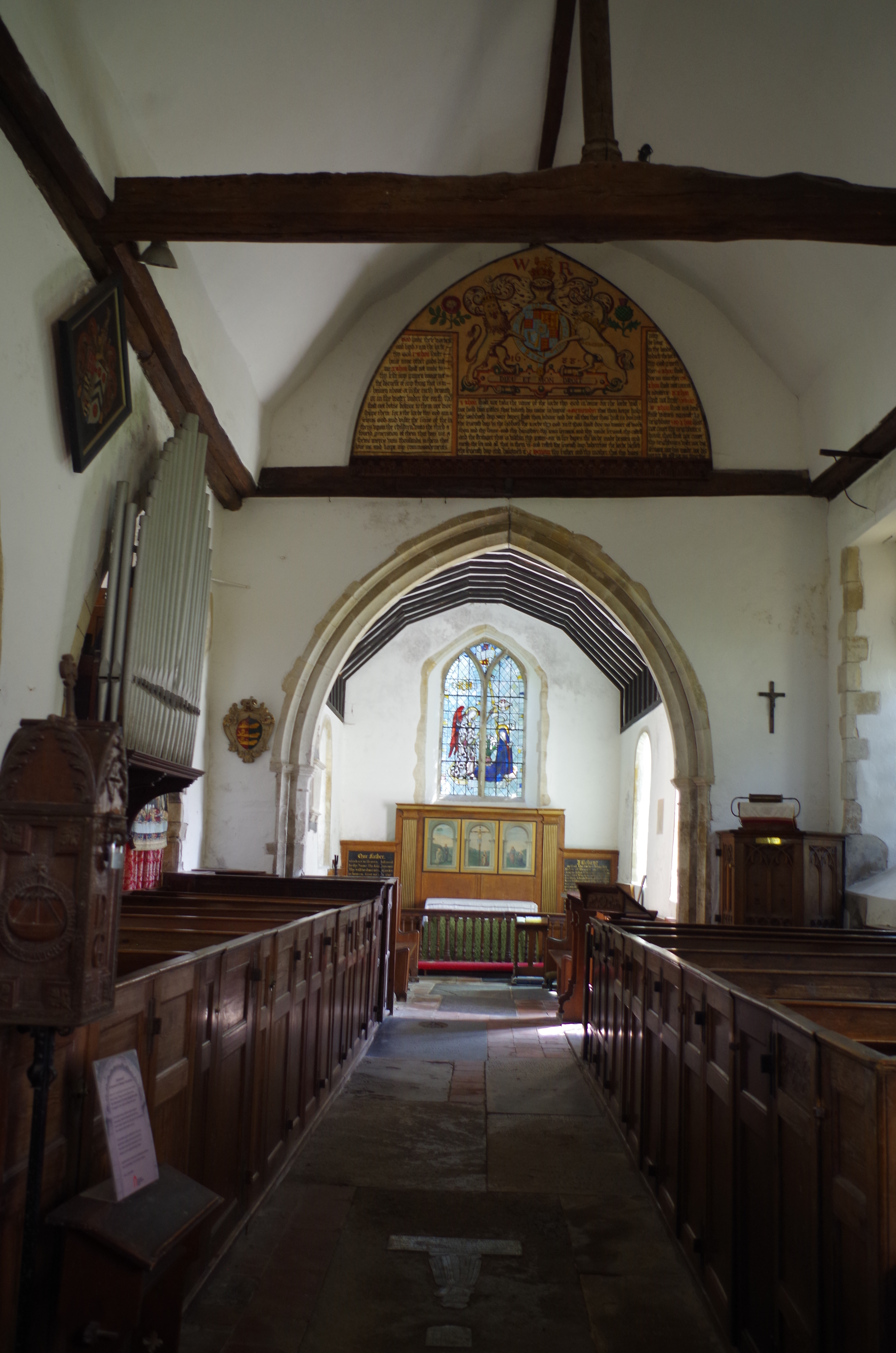
When I stepped into St Mary the Virgin’s church, I knew immediately that I was in a very special place. It held the history of a community within it: help for the poorer parishioners over the centuries and the still to be seen traces of the medieval church. But so much had been left untouched, it was almost like walking into a time capsule.
From the mysterious tomb, rumoured to be that of a local saint, to the remnants of the Great Rood and evidence of the charity, still in use today, instituted by two brothers who lie in the churchyard, I could see how much the little church had meant, and continues to mean to the little village (well, hamlet really) of Fordwich
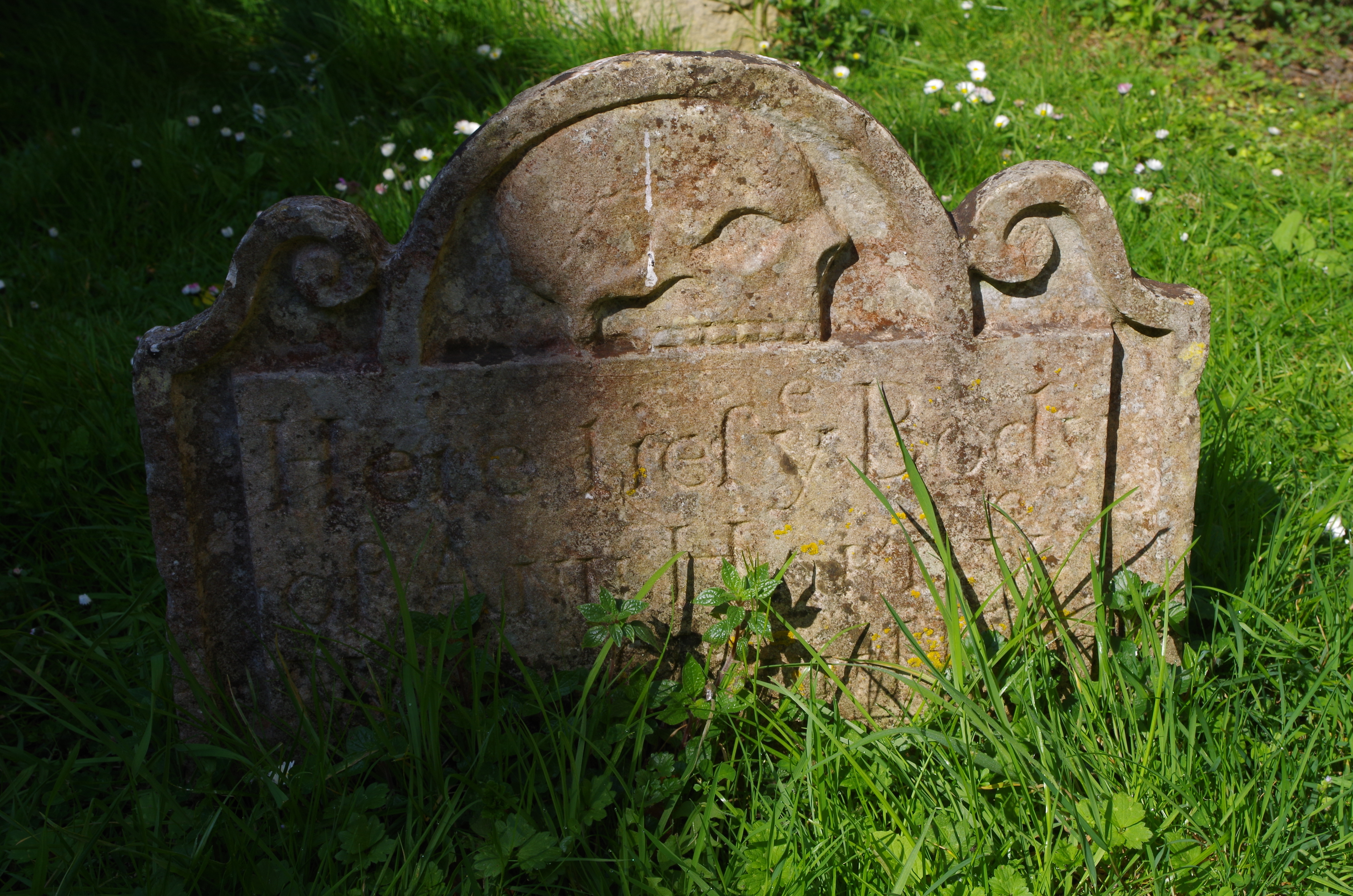
Although now closed for services and managed by the Churches Conservation Trusts (CCT), it nestles in its churchyard with the River Stour running alongside the churchyard behind it. It was photos of the headstones in the churchyard on Facebook that had attracted me here and Easter had seemed a good time to visit. Despite the bus driver saying that she had never heard of Fordwich Road despite it being on the timetable, I spotted the sign announcing ‘Historic Church’ and, once in the village, I was directed to St Mary’s by a friendly couple and their smiling, fluffball of a dog. Church crawling, or steeple chasing 2022, had begun! And I had already noted another possible church to explore from the bus as we trundled through Sturry, just outside Canterbury.
Although, as Fordwich proudly boasts on its town sign, it is England’s smallest town with only 300 residents it has been connected with Canterbury for centuries.
According to the guidebook:
‘Fordwich once served as the port for Canterbury and was part of the Cinque Port of Sandwich. It still takes part in the annual ceremony of paying its Ship money. In the 15th century, there are payments for the shipment of over 400 tons of stone from Sandwich to Fordwich to build the south west tower of Canterbury Cathedral.’
It may seem strange to describe an inland hamlet as a port but in Roman times, Thanet was an island and the sea came up to Canterbury and could be navigated as far as Fordwich. However, it became silted up and by the 17th century was no longer a port. In fact in 1830, it ceased being a port altogether with the coming of the railway.
Spreading, tall yew trees provided welcome shade, both along the path to the church door and in the churchyard. An 1855 restoration was responsible for the shingled, splay footed tower but there were original features to be seen inside.
Box pews were still in place and these, prior to a collection plate or box going round, were once the source of a small regular income to the church. They could be rented by individuals and families for their sole use. A singers pew was still in place and the supports for the silver gilt Mayor’s mace were still there. The mace now resides in a far safer place but returns to St Mary’s on Mayor’s Sunday.
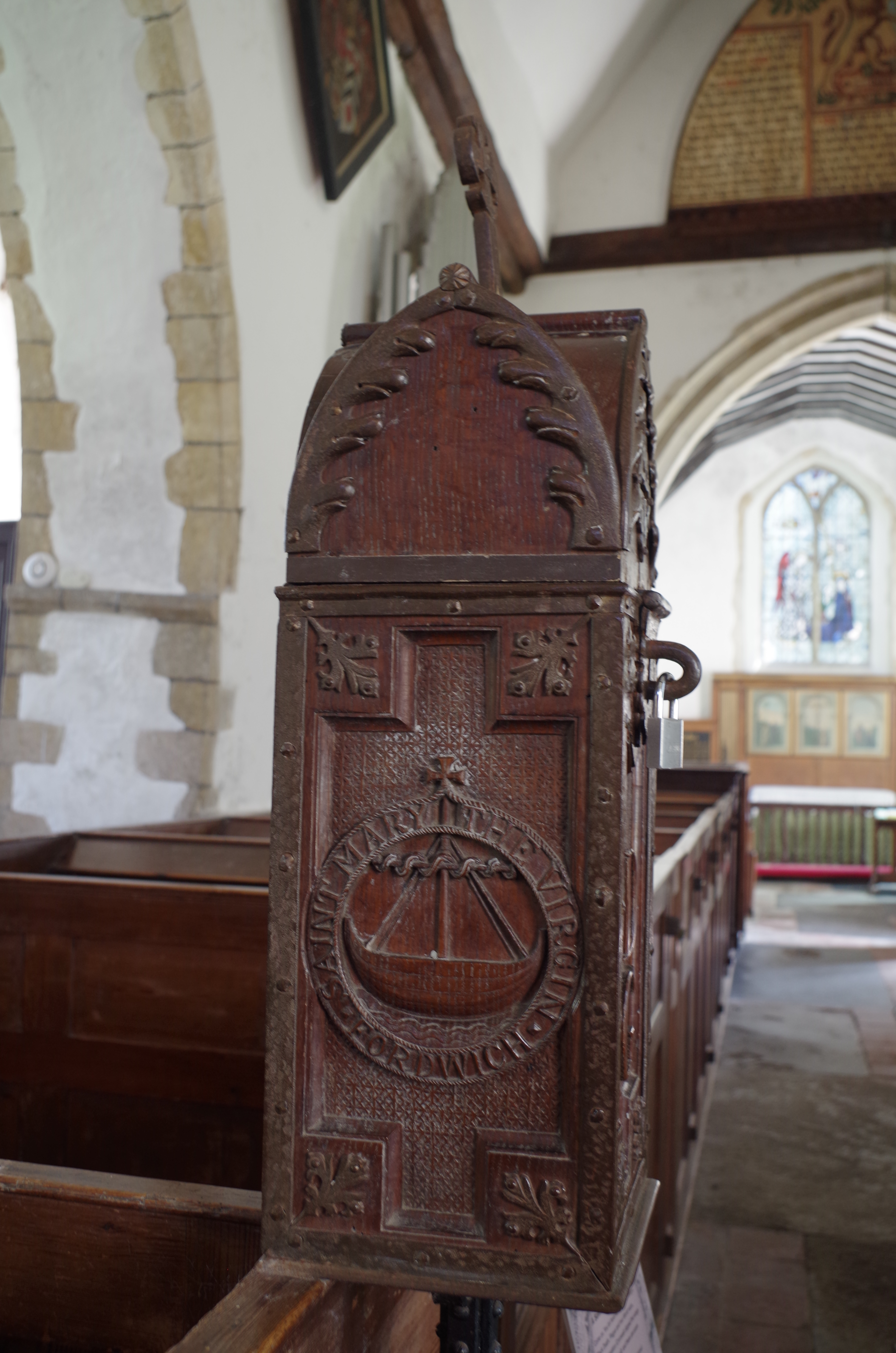
The church interior is plain and peaceful and in the plaster of the main arch, the 10 Commandments are inscribed together with the coat of arms of King William II. But this colourful addition from 1688 hides what is left of the medieval Rood. The 14th century chancel arch was filled in with plaster but before this it would have been the focal point of the church. A Rood contained 3 figures: Christ crucified with his Mother and St John at the foot of the Cross. The 17th century iconoclasts and their determination to remove all idolatry from churches made their mark even here. Another reminder of St Mary’s links to Canterbury is the prominent and large alms box. This was carved from an oak beam taken from Canterbury’s Guildhall to commemorate the 1953 Coronation.
But I felt that I might not be alone in St Mary’s as a sign announced that Champers were in residence in the side chapel. I paused but could hear no snoring. It was good to see that Champing had returned to the church calendar and was happening at a church I might be able to get to. Champing is an amalgam of ‘camping’ and ‘church’ and people pay to stay a night or more in a CCT church and I have been very tempted…
I began to tiptoe towards the legendary Fordwich stone which is alongside a side wall. This stone has been traditionally known as St Augustine’s tomb. The guidebook informed me
‘is believed to have been in the form of a dummy tomb.’
It’s a large block of oolitic limestone, roughly 5.5. feet long and has moved several times. In 1760, it went into the churchyard, according to the guidebook, and then onto Canterbury Cathedral before coming home to St Mary’s in 1877. It is thought that relics of a saint may been placed beneath it. The lovely carving on the stone dates from 1100 and
‘consists of interlaced Norman arches beneath scaly decorations’.
The font has a locking device on its lid to prevent baptismal water being ‘misappropriated.’ I wondered what the guidebook meant by that….
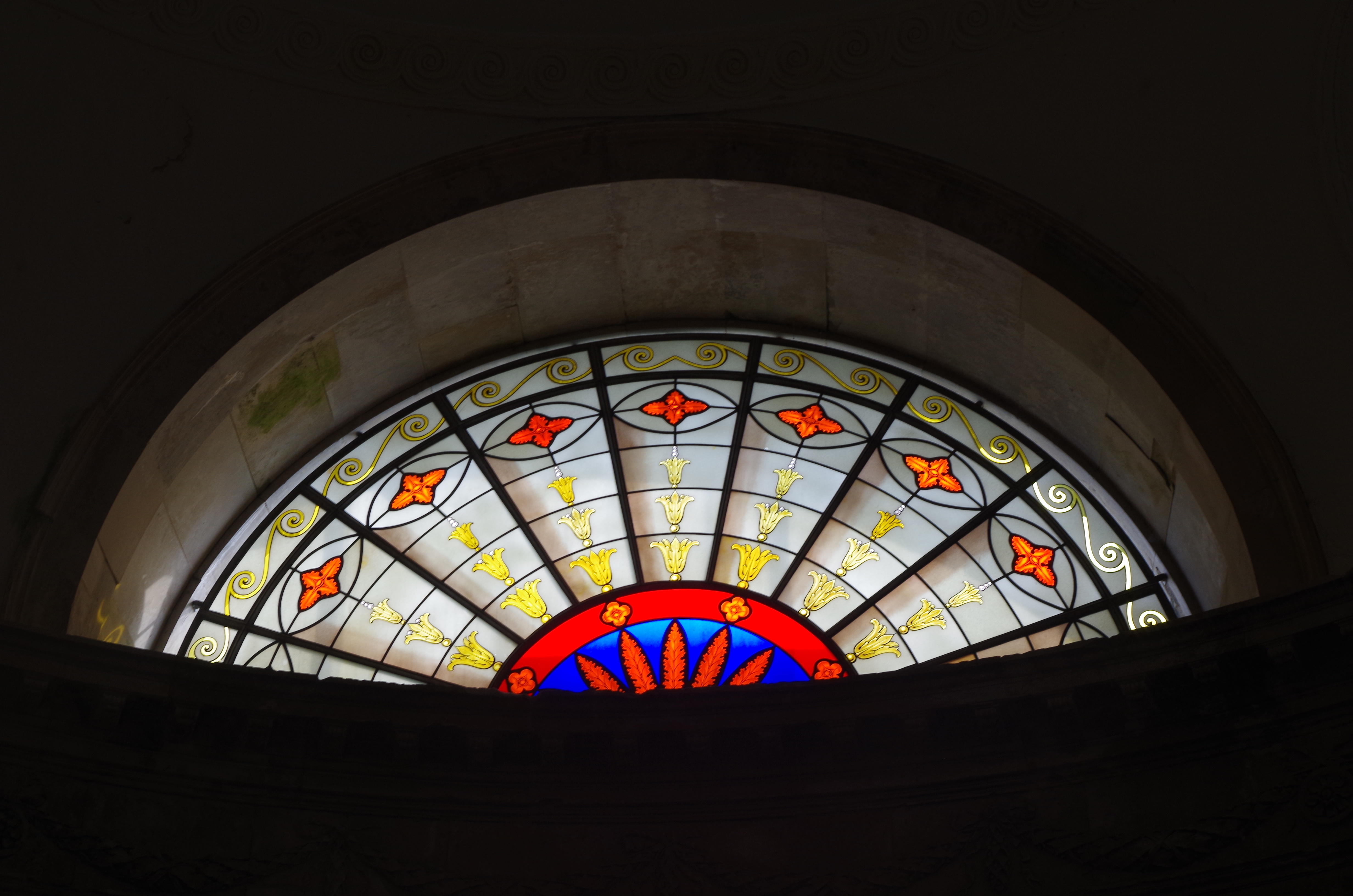
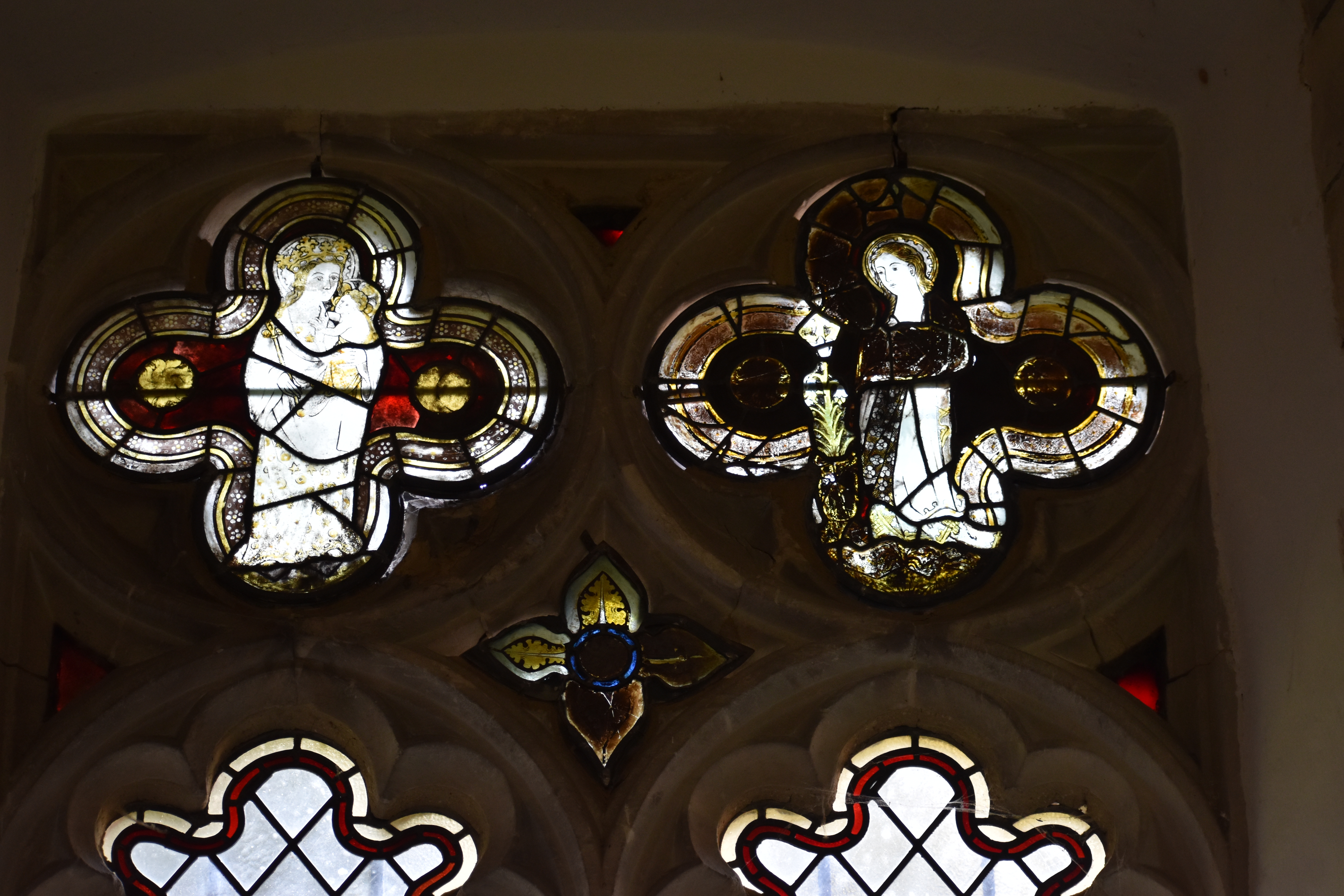
In addition St Mary’s has some gorgeous and rare stained glass, both medieval and 20th century. I’ve only seen fragments of medieval glass in other churches so to see complete, quatre foil windows of it was a real treat.
And in the main aisle was a brass – I can remember when brass rubbing was all the rage in the 1970’s – dedicated to the very fashionably dressed, by 17th century standards, Alpha Hawkins, who died aged 21 in 1605.
I left St Mary’s feeling curious about what it would be like to spend the night there…but the churchyard was calling and on such a lovely Spring day, I could no longer resist…..
Part 2 St Mary’s churchyard – the place of skulls and Spring flowers.
‘A Life on the Ocean Wave?’ You could be forgiven for thinking this whenever you see an anchor on a headstone or monument and perhaps assume that it’s a mariner’s grave. But if it appears on a Commonwealth War Grave like this one in Brompton’s Cemetery then it will undoubtedly be on the grave of a naval man or woman.
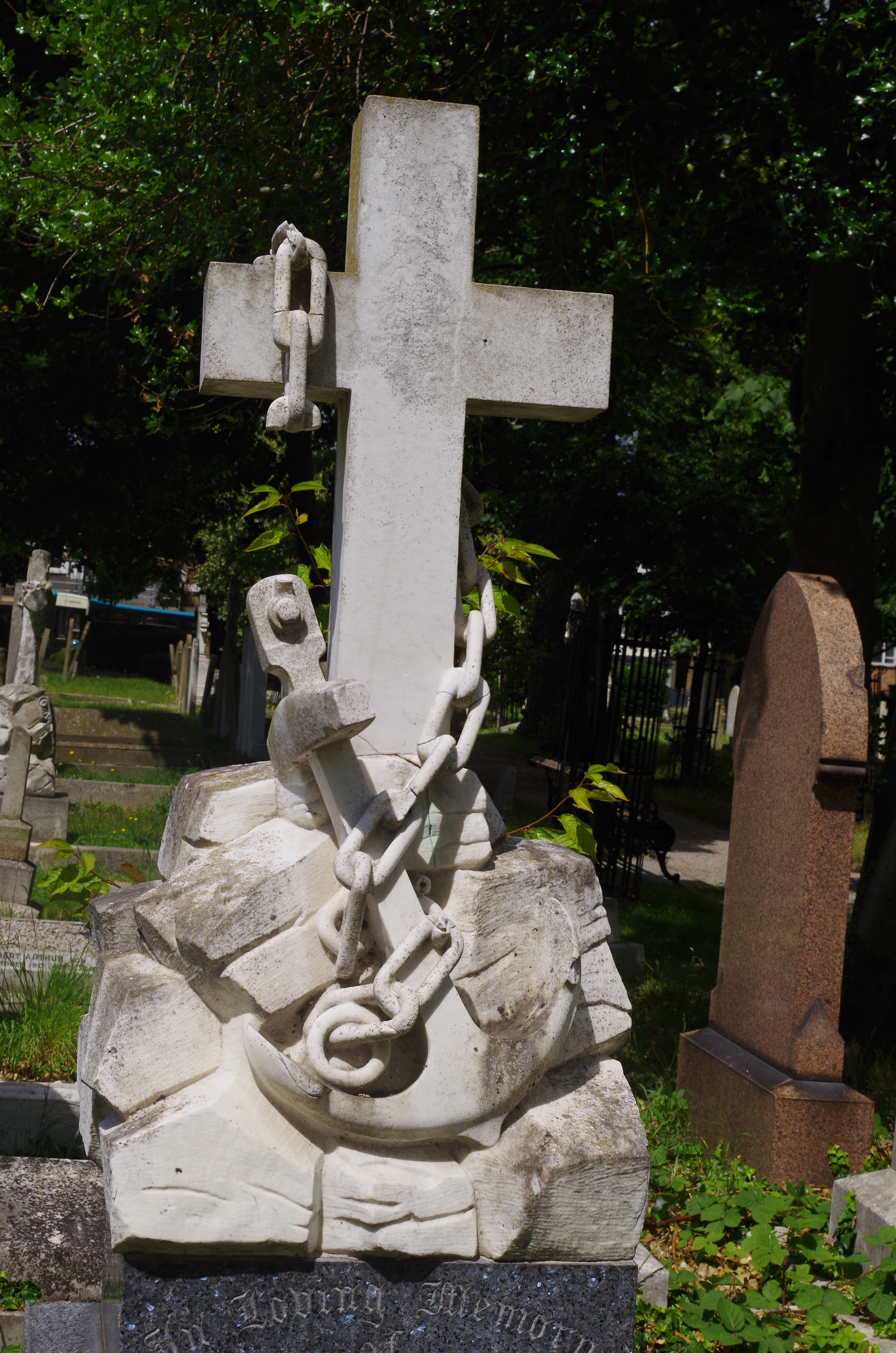
But when it appears elsewhere then the anchor can have several other meanings. It was a popular motif in the 19th century and appears in many cemeteries. This example comes from the churchyard of St John the Evangelist in Southend on Sea.
The definition of an anchor is that it is a heavy object made from metal and connected to a rope or chain which is then connected to a ship. It holds the ship in place by digging into the seabed under the ship. There is a metal shank with a ring at one end for the rope or chain and, at the other end, there are two flukes with barbs to dig into the seabed and it’s these that give the anchor its distinctive shape.
Found on Pinterest with no photographer’s name attached.
But, despite its popularity with the Victorians, the anchor symbol Is much, much older. It was used by the ancient Christians in Rome prior to them adopting the fish symbol. The anchor resembles a cross and so was a covert way of identifying other Christians. It was seen as a metaphor for faith and steadfastness in that it grounds a ship and keeps it fixed in a secure place despite storms and bad weather and faith does the same thing by keeping the faithful grounded and secure during the difficult times in life.
Found online with no artist credited.
The anchor appears in the New Testament of the Bible in Acts 27:13,17, 29-30 and 40. In Hebrews 6:18:19 it says:
‘That by two immutable things, in which it was impossible for God to lie, we might have a strong consolation, who have fled for refuge to lay hold upon the hope set before us;
Which hope we have as an anchor of the soul, both sure and steadfast, and which entereth into that within the veil’. King James Bible.
This is where hope and anchors become entwined and there are many pubs in the UK named ‘The Hope and Anchor.’ But more of Hope later.
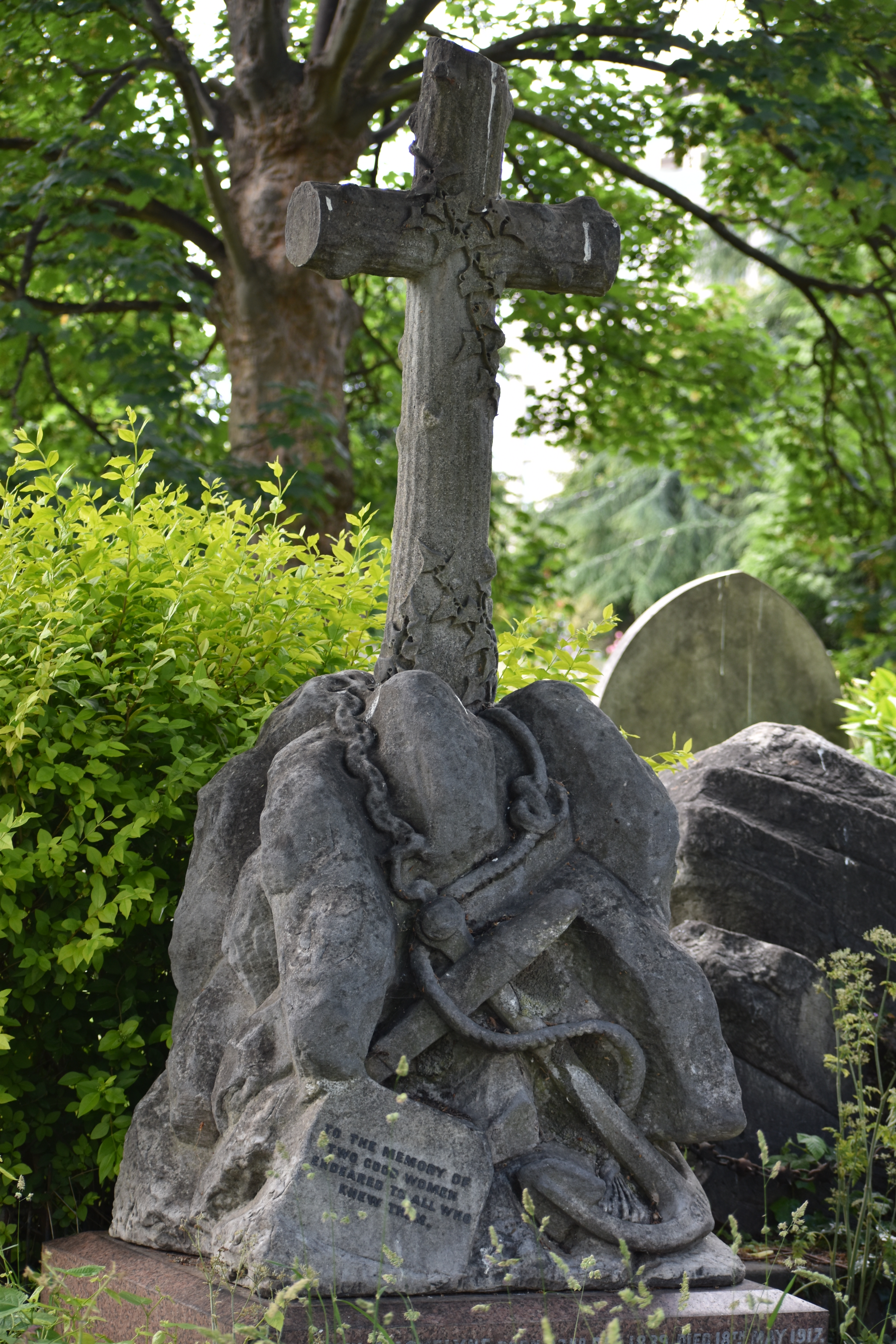
In these examples, you can see that the anchor is very firmly chained to the cross and so to God. The deceased believed in eternal life. On the one below dedicated to the Maskelyne family, there is a well carved anchor with a rope attaching it to a cross. This has been carved to resemble wood, perhaps Christ’s cross, and with ivy winding around it as a symbol of eternity.
However, I think that the wide spread use of the anchor during the 19th century was due to an immensely popular hymn of the time which is still sung today and is one of the most well known in the English language. It was written by a Sunday school teacher, Priscilla Jane Owen (1829-1907).
Will your anchor hold in the storms of life (We have an anchor)
Will your anchor hold in the storms of life,
When the clouds unfold their wings of strife?
When the strong tides lift, and the cables strain,
Will your anchor or firm remain?
We have an anchor that keeps the soul
Steadfast and sure while the billows roll,
Fastened to the Rock which cannot move,
Grounded firm and deep in the Saviour’s love.
It is safely moored, ‘twill the storm withstand,
For ‘tis well secured by the Saviour’s hand;
And the cables passed from His heart to mine,
Can defy the blast, through strength divine.
It will firmly hold in the straits of fear,
When the breakers have told the reef is near;
Though the tempest rave and the wild winds blow
Not an angry wave shall our bark o’erflow.
It will surely hold in the floods of death,
When the waters cold chill our latest breath;
On the rising tide it can never fail,
While our hopes abide within the veil.
Note the reference to the Rock which appears in these two monuments.
On some of the monuments that I’ve seen, the chain to the anchor is broken and it’s difficult to know if this is deliberate to indicate that the deceased’s earthly life is over or just general wear and tear.
There have been other suggestions about the anchor motif in that it might have been a tribute to St Nicholas who was the patron saint of fishermen or to St Clement of Rome who was rumoured to have become a martyr by being tied to an anchor and drowned. But there is no firm evidence of St Clement’s watery death.
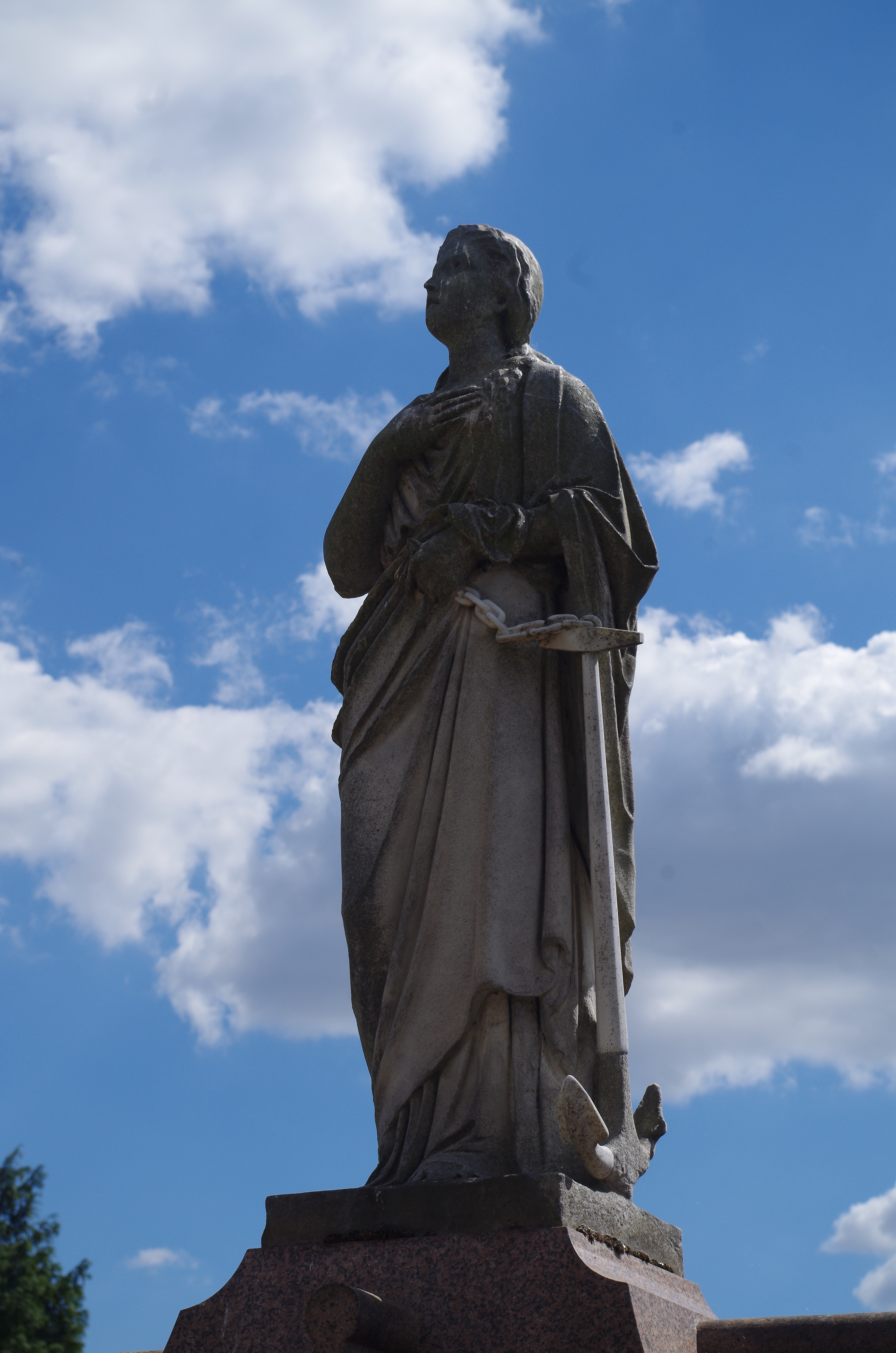
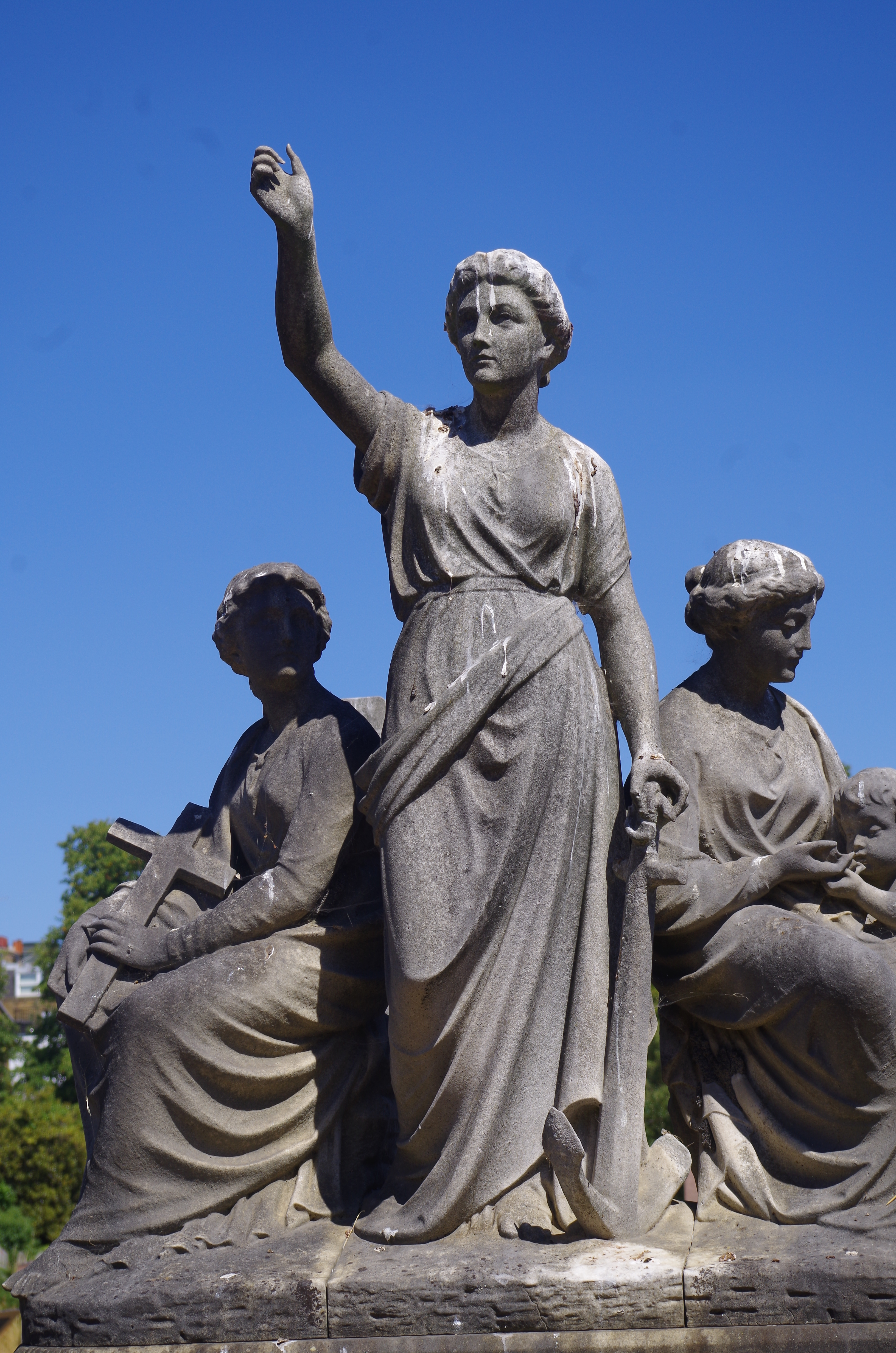
Now let’s return to Hope. She appears in cemeteries as the statue of a woman dressed in vaguely classical robes and holding an anchor in one hand. This one is on a monument to Louisa Mutton in Brompton Cemetery. Hope is one of the Seven Virtues of the Christian religion, and she is with Faith and Charity. Note that her right arm is raised with the index finger pointing to Heaven and symbolising the pathway to Heaven. The other example is from the Blondin monument in Kensal Green cemetery in which Hope does not have a raised arm but, instead, is looking heavenwards. So, Hope was the deceased’s way of telling those left behind that they were entering into eternal life. According to Wikipedia, the earliest Hope statue was in Dublin in the 18th century. But there has also been a suggestion that Hope was influenced by the Statue of Liberty.
So, the Hope and Anchor have become entwined as examples of faith, steadfastness and a hope for an eternal life – a comforting message perhaps for both the deceased and those left behind.
So far, during my explorations of churchyards and cemeteries, I have not yet found the name or initials of the stonemasons that created some of these beautiful carvings and symbols. In All Saints, Maidstone, however, there are two headstones dedicated to two stonemasons but they date from the 19th century.
However, the image above came from the Twitter account of Andrew Ziminski who is a stonemason by profession and he said:
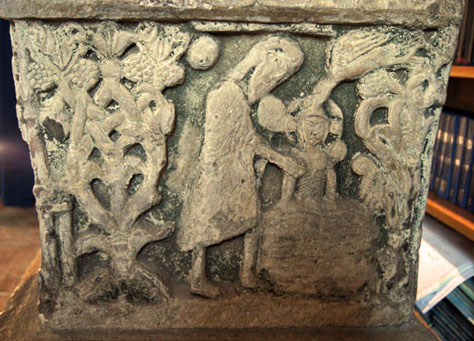
‘The font at Bridekirk, Cumbria with its Anglo/Norse runes read something like “Rikarth he made me and brought me to this splendour”. So not only do we know the name of the mason/carver but also what he looked like from his ‘selfie’ where he is busy with mallet & (huge) chisel. (Andrew Ziminski @natchjourneyman.)
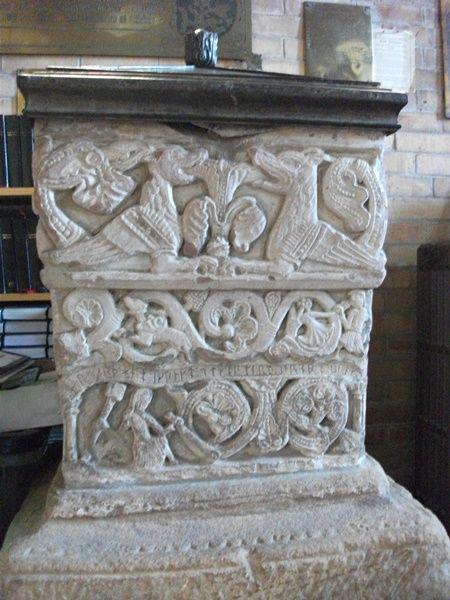
The church in question is St Bridget’s in Bridekirk and this is what its website has to say about it:
‘An unusual feature is the font, possibly from the earlier church.(this may have been the one built in 1130). It is 12th century and is described as ‘perhaps the most finished and perfect remains of Northern culture in the Kingdom.’ It was carved by Richard of Durham and shows how old Nordic influences continued after the Nordic conquest. One side depicts Richard at work with his hammer and chisel carving a flower and leaf. It has an inscription which read, ‘Richard he me wrought and to this beauty me brought.’ The decoration is runic. It depicts the baptism of Christ, Adam and Eve as well as strange beasts.’
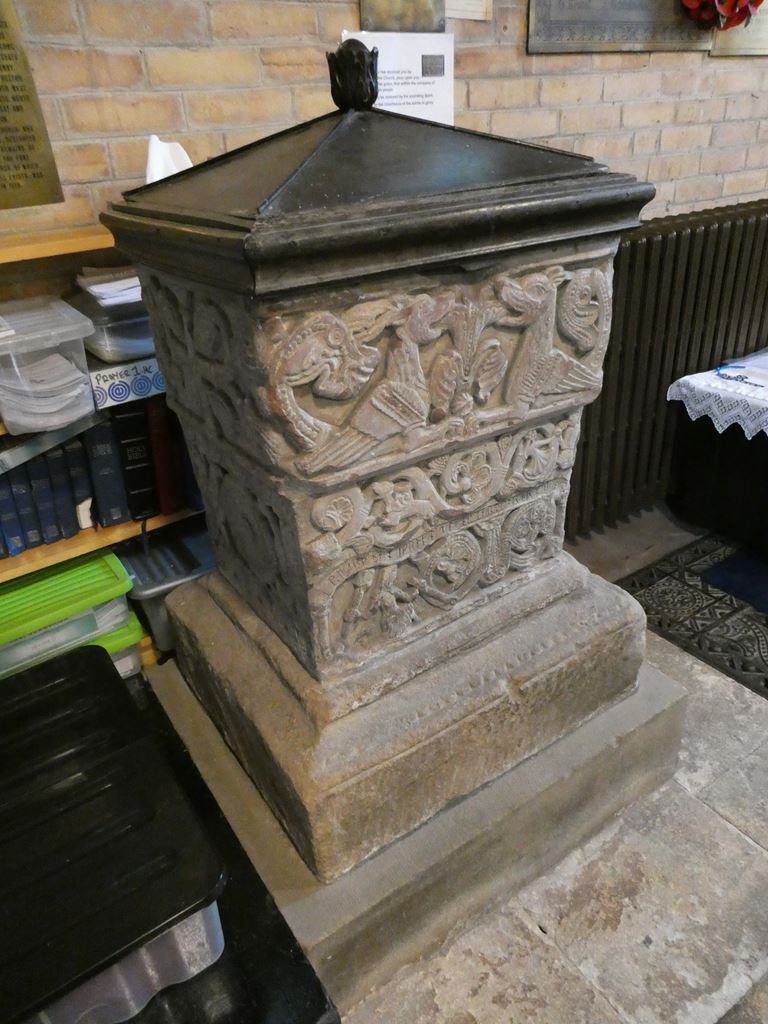
It is a beautiful piece of carving and still looks reasonably crisp after all these centuries. These two photos of the font in situ give an idea of its size. The font has 4 sides: east, west, north and south. It’s the East side that has the Runic script which is a Germanic script form. Runic script tends towards vertical symbols which enabled masons to carve into the grain of wood or stone. Note the size of the mallet and chisel that Richard holds.
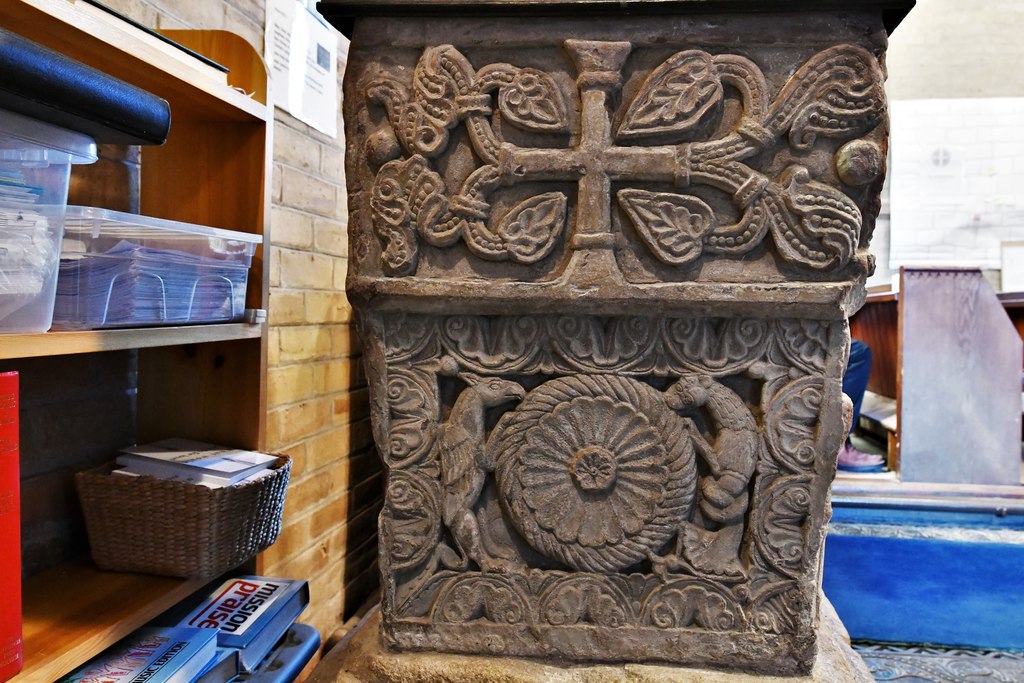
South face top panel: This is a Greek cross with acanthus leaf decoration. Again, the church guidebook suggests that ‘it may be derived from the Easter rite in which a plain cross was taken into the church to be replaced by one with jewels and leaves to represent ‘Christ arisen.’
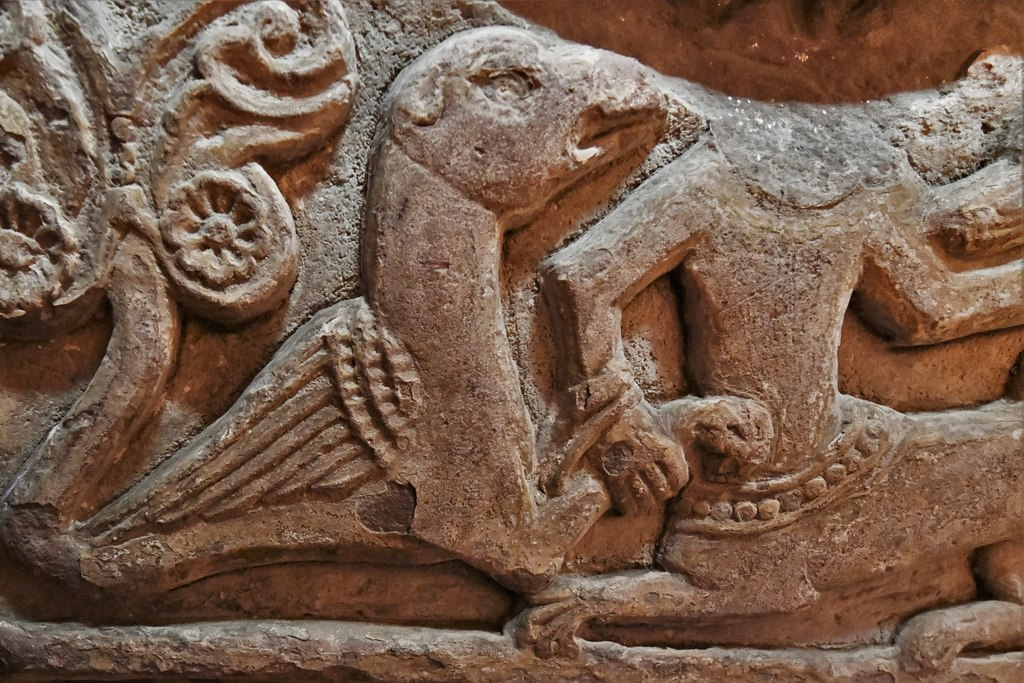
South face: lower panel: This features 2 types of griffin flanking a large floral roundel
West face lower panel: according to the guidebook, ‘this shows Adam and Eve being expelled from Eden by an angry God wielding a sword. Eve is at the foot of the tree but there is no serpent.’
And here is the font in all its glory with its lid although it’s obviously not the original.
This is an amazing survivor although Bridekirk is a little out of the way and maybe the 16th century iconoclasts didn’t get up that far. A beautiful font and I will be looking at them more closely in future to see if I can identify another self-promoting medieval stone mason.
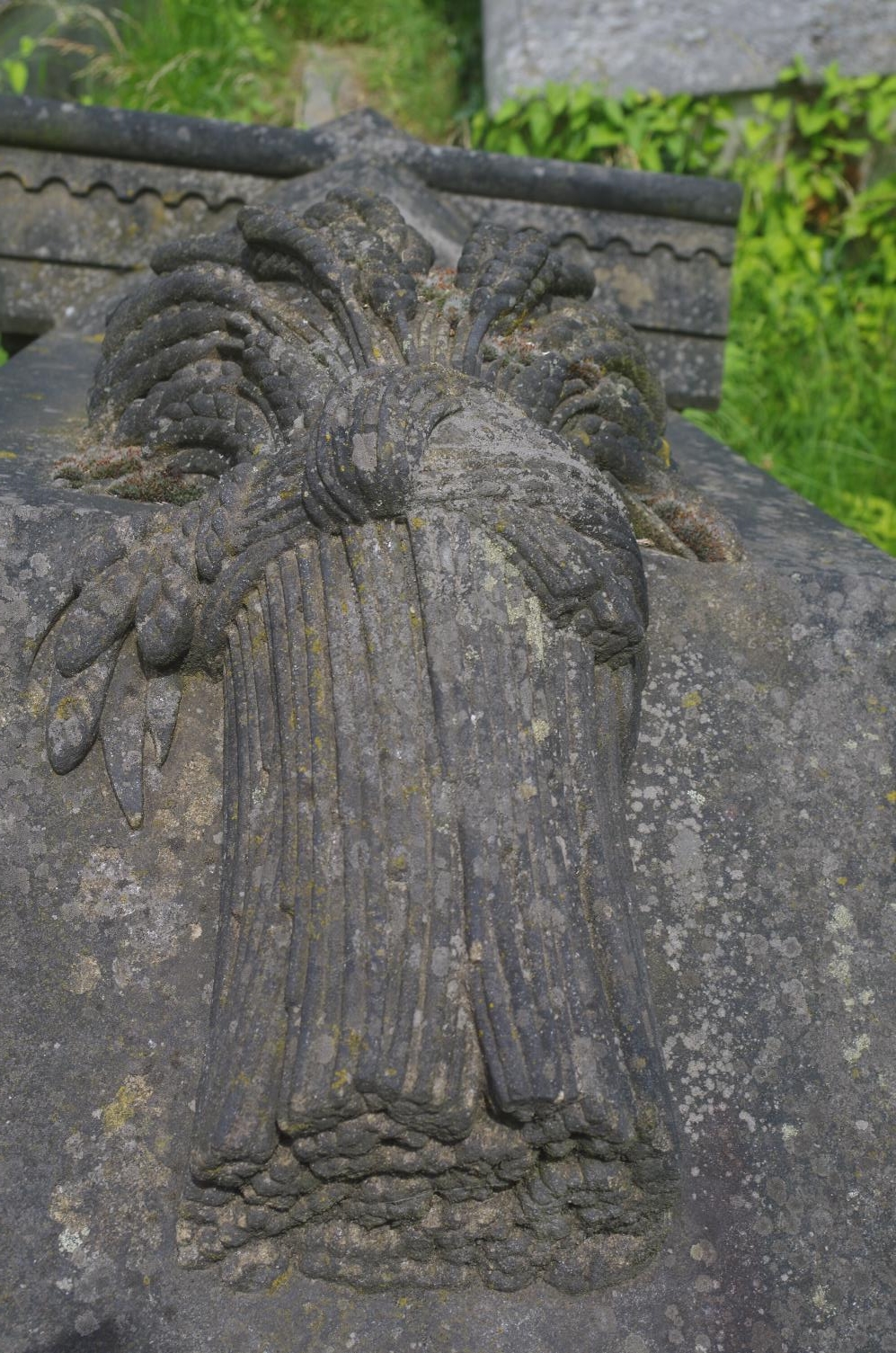
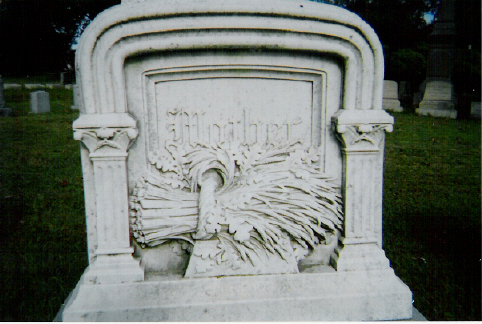
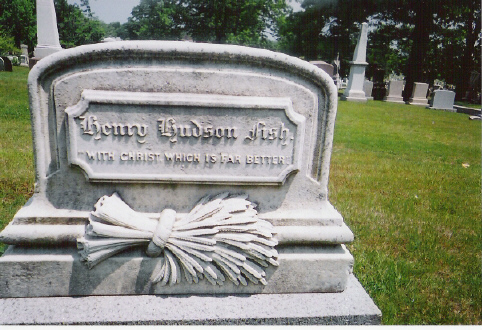
I was on a summer stroll on an early July day in 2017 in Kensal Green Cemetery when I noticed this symbol. From where I was standing it resembled a mop head which had dried out and been left on top of a grave. I was planning to carry on stalking obliging butterflies but curiosity got the better of me and I made my way over to the monument. It was then that I realised that the supposed mop head was in fact a beautifully sculpted wheatsheaf.
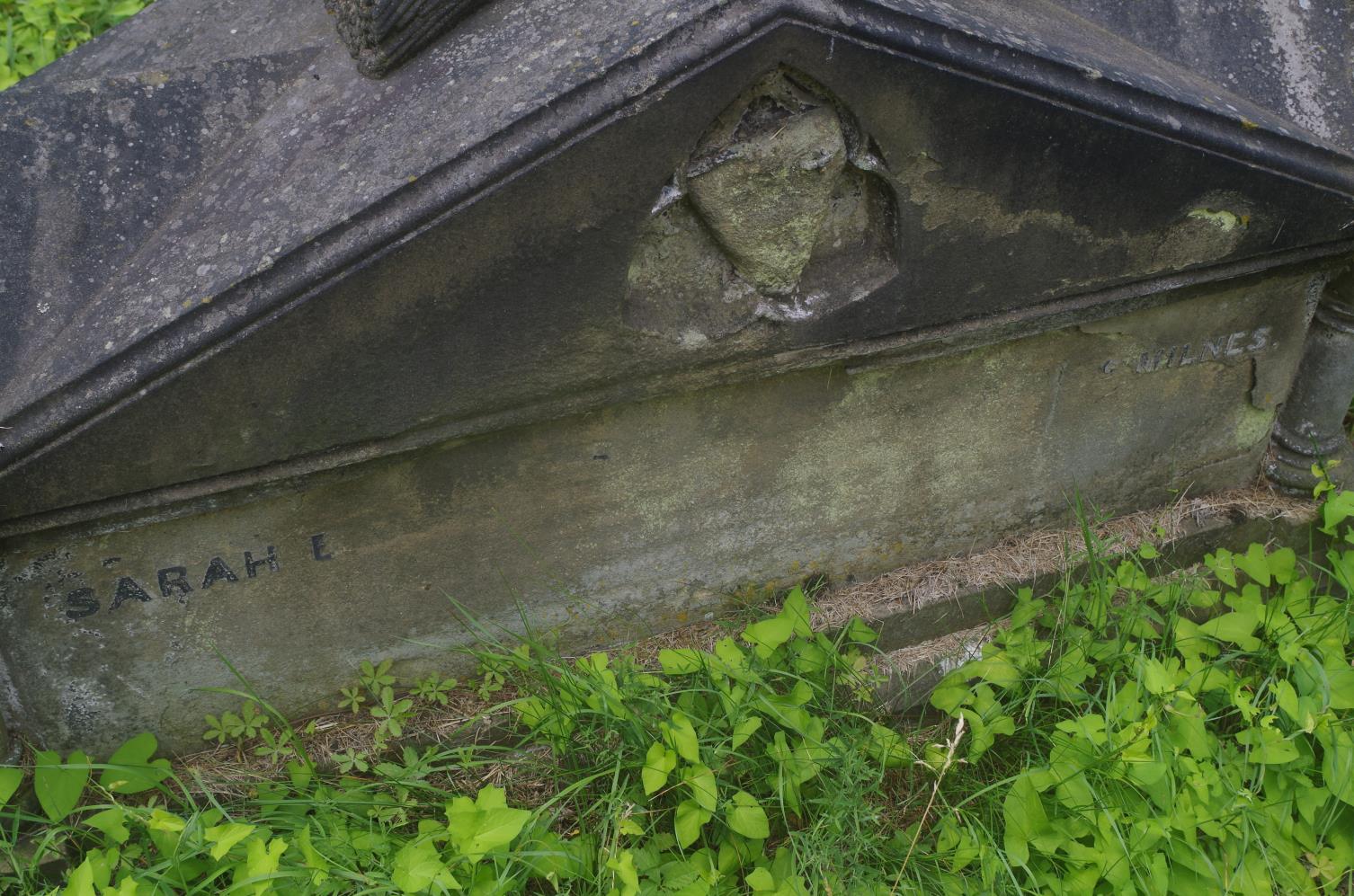
‘Had the deceased been a master baker?’ was my first thought as it’s a traditional symbol associated with them or perhaps a pub owner as you do see a lot of pubs called The Wheatsheaf. The epitaphs on both side of the tomb were virtually unreadable. However, on one side I could make out ‘Sarah’ and on the other ‘Milnes’. But more of the Milnes later as this family has a strong connection to Kensal Green Cemetery
A sheaf is a tied bunch of grain stalks after they have been harvested by hand with scythes. However with the advent of agricultural mechanisation it is now a bygone image. No-one has ever known the origins of this staple crop and so it has been regarded by many cultures as a gift from God.
The wheatsheaf and resurrection
However, the wheatsheaf symbol has always had strong associations with the theme of resurrection.
This seemingly humble grain has played its part in many funeral cults and mourning rites throughout ancient cultures. For example, the ancient Greeks and Romans regarded it as life springing from death or immortality. Priests are reputed to have sprinkled wheat flour on their victim’s head prior to sacrificing them. Ceres and Demeter, the Greek and Roman goddesses of harvest and agriculture, often carried either a wheatsheaf or a harvester’s sickle. Ancient Egypt was seen as the breadbasket of the ancient Mediterranean due to the volume of crops that it produced and Osiris, god of the underworld, was strongly associated with wheat within the context of a representation of rebirth.
Wheat is also important to the Christian religion with the Eucharist bread which represents the body of Christ and his sacrifice and also in remembrance of the Last Supper. There is the famous biblical quotation from Luke 22:19:
‘and he took bread and gave thanks, and brake it, and gave unto them, saying, This is my body which is given for you: do this in remembrance of me’ King James Bible.
When wheat is harvested the ground is left to lie still during the winter and then re-sown in the spring to begin the cycle of life again. Here it represents renewal and renewal as the cycle of seasons has once more given grain for bread. There is also the association with the harvesting of years in that Death and his scythe prepare to reap at the end of life.
So there has always been an association with the wheatsheaf of resurrection and remembrance. This is where it is at its most powerful as a funerary symbol. However, Douglas Keister has also suggested that a wheatsheaf on a tombstone can indicate someone who
‘lived a long and fruitful life of more than seventy years and one that was harvested by the Reaper when it was time’
The wheatsheaf and the Victorian cult of mourning
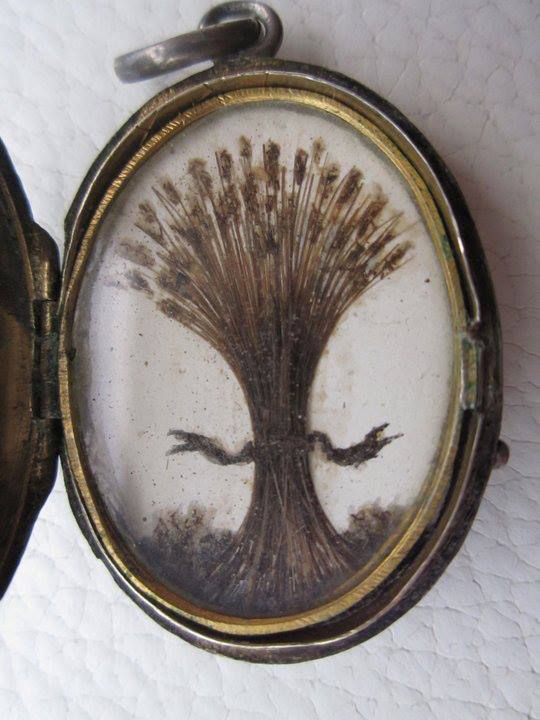
This is a lovely example of a wheatsheaf motif within a piece of Victorian mourning jewellery. I found it on Pinterest and could not find the source of the image.
According to the art of mourning website, the wheatsheaf was also a very popular motif in Victorian mourning jewellery. In fact they have suggested that it could be seen as a memento mori in that it denotes life cut and renewal or resurrection of the soul. Its heyday was during 1820-1860 and it also survived into early 20th century mourning jewellery just as it was going out of fashion. The wheatsheaf was often found in mourning wreaths, brooches, lockets and rings and was an effective emblem when working with hair to create these pieces.
There is also a stained glass window featuring a wheatsheaf at St Michael & All Angels in Eaton Bishop, Herefordshire but this may be a Victorian addition by Kempe after restoration.
This grave contains 2 women who were, respectively, the first and second wives of the Victorian sculptor Thomas Milnes. He is buried with his third and final wife elsewhere within Kensal Green cemetery under a far plainer stone. He certainly lived a long life – his dates are 21 December 1810 – 6 May 1888 but there’s no wheatsheaf on top of him. Milnes completed a number of funerary monuments which can be seen in churches in Gloucestershire, Cumbria and Suffolk and also statues which still stand in Norwich and Woolwich. Milnes exhibited statues and busts at the Royal Academy after entering its schools on 21 April 1841. He also designed another monument in Kensal Green, the horse and child on top of Alfred Cooke, which, although damaged, is still in place.
However he wasn’t destined to became a major British sculptor despite, in 1858, being invited to design and model the four lions for the base of Nelson’s column. It would have been the commission of a lifetime but his designs were deemed ‘unsuitable’ and the commission went to Sir Edwin Landseer’s monumental symbols of Empire instead. However, Milnes lions which are, in my opinion, more lively and playful than Landseer’s can be seen in Saltaire, near Bradford. After that he seems to have sunk in obscurity.
The ‘Sarah’ that is still legible on one side was Milnes’ first wife: Sarah Betsey Harrad. They married in London on 19 May 1836. Sarah died on 1 April 1867 of ‘apoplexy’ which is now known as a stroke or cerebral haemorrhage. Frances Eidsforth became his second wife on 16 July 1867 at St Georges, Bloomsbury and she died on 16 July 1875. She is buried with Sarah.
Milnes married his third and final wife, Jessie Anne Fletcher, on 1 June 1876 but there were no children from any of his marriages
Little seems to be known about either Sarah or Frances and it’s a real shame that their epitaphs, presumably on either side of the monument are now illegible. However I would assume that the wheatsheaf placed on top of them is a symbol or resurrection and a hope that they would all meet again in eternity.
The wheatsheaf is remarkably well carved and has outlasted the epitaphs. It has been presumed that it is by Milnes himself but no definite proof has been found to be able to attribute it to him with certainty.
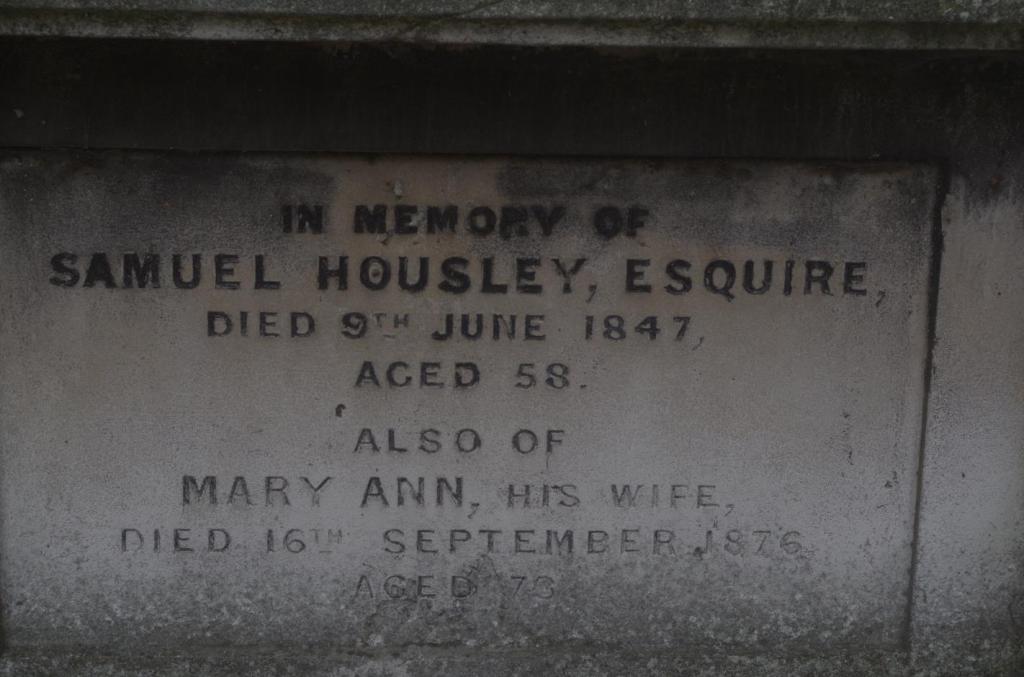
There is another smaller wheatsheaf in Kensal Green which is on the Samuel Horsley memorial.
Although I didn’t see many symbols in St Mary’s churchyard in Higham that I hadn’t previously seen before, my attention was drawn to this one.
It appears to be another version of the carving, although in far better condition, that I called Hebe after the Greek Goddess and first saw in the churchyard of All Saints, Frindsbury. Higham is only, just under 3 miles, away from Frindsbury so a journeyman stonemason could probably walk or ride there in a day.
The one in Higham is on a in a unusual roundel on a headstone dedicated to Catherine Jamson who died on 26 August 1806 at 52. It’s beautifully carved and still crisp but with its head missing. There is an almost ghostly impression of where it once was if you look closely. It seems to be a clean break but is it vandalism, as they always like to go for the heads on statues or carvings, or just wear and tear over the years? We may never know. In 2012, according to the Kent Archaeological Society, the epitaph read:
“While in this World I did Remain, My Latter Days were Grief and Pain, At Length the Lord did think it Best, To Take me to a place of Rest”
Thomas Jamson is also buried with her and he died on 3 November 1828 aged 82 years. He was a house carpenter and left a substantial will to his second wife.
The Caryer headstone in 2011 , All Saints Frindsbury
Photo Kent Archaeological Society
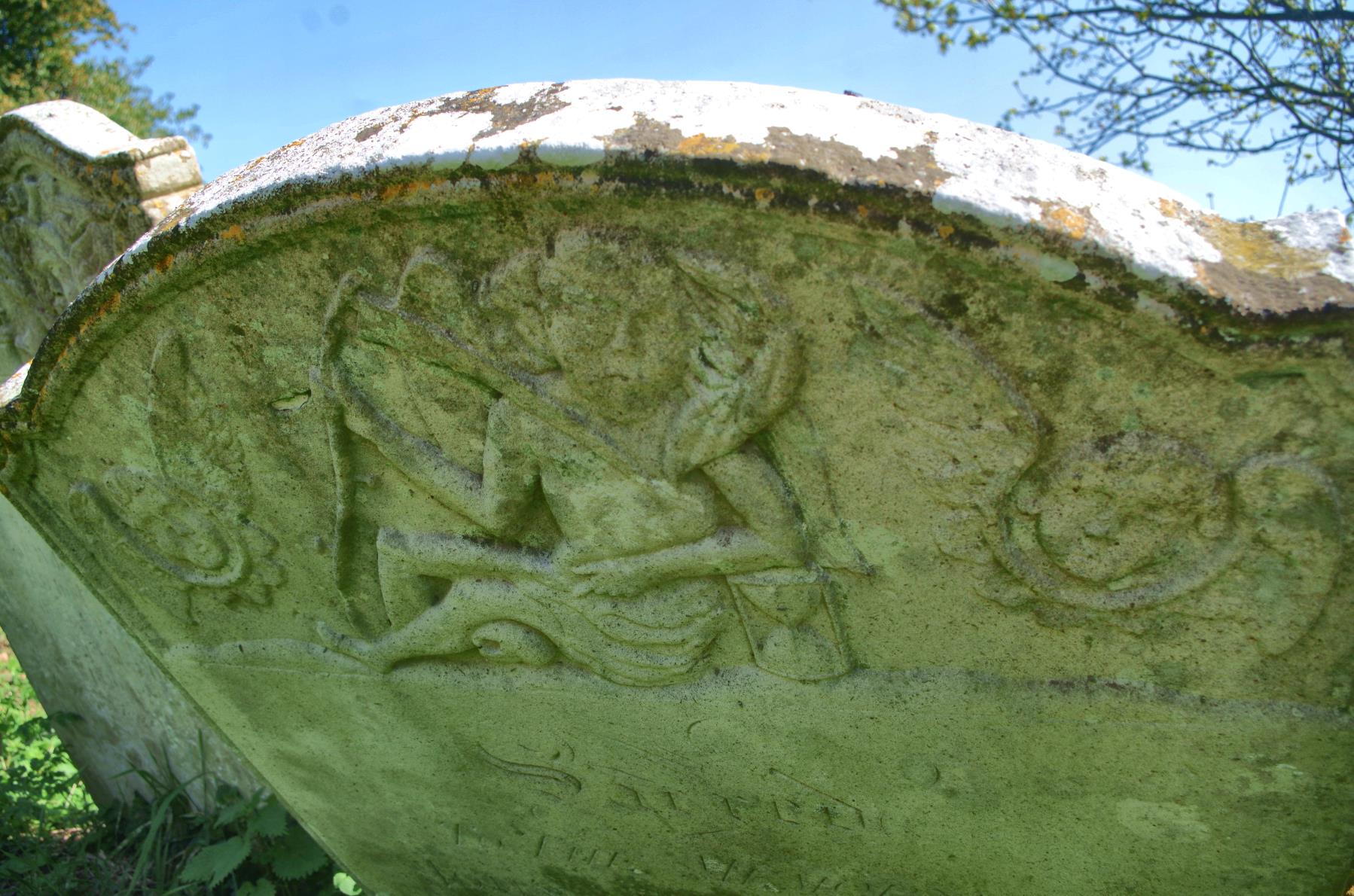
In All Saints churchyard, Frindsbury, the headstone is a sad one as it is dedicated to Hannah Caryer, wife of John who died young aged 30 years in 1809. John, her husband died later and also young aged 41 and their young son who predeceased his mother by 8 years. The Frindsbury Hebe still has its head although there has been some wear and tear over the years. So could it be the same stonemason as they were itinerant craftsmen who travelled from parish to parish. Sometimes you can see their work in several churchyards but of course it could be two separate stonemasons using the same symbol, perhaps from a pattern book of the time. However, it’s interesting to note that both ladies died 3 years apart – a fashionable emblem at the time?
However, part of the pleasure of researching symbols in country churchyards is in attempting to identify an individual stonemason’s work. I have not yet been lucky enough to find any signatures or identifying marks on carvings. But maybe I’m not looking in the right places. But this seems to be almost a coincidence that this symbol appears on the headstones of two women in the same area. Especially as it’s a pagan image, if it is Hebe the Greek goddess, in a Christian burial place.
Although I have found several occupations on headstones such as carpenter, caulker, baker and gunner, the only stonemasons grave I have found so far in All Saints churchyard in Maidstone. There are two of them and they date from the 19th century. But I am sure that I will find one that dates from an earlier period if wear and tear hasn’t got there first.
Yes, it’s been seven years since shadowsflyaway began – during which I have visited so many churchyards and cemeteries looking for symbols and interesting stories and, often, I may spot a symbol from a bus or a train and feel compelled to immediately get off and go back to see what it is. It has been fascinating to be able to see how symbols have evolved over the centuries and the way that people want to use them to define themselves after death. Even if it is just the passing visitor stopping to look and then asking themselves ‘Why on earth did they choose that?’
So here’s to another year of shadowsflyaway and unearthing more hidden gems in country churchyards and city cemeteries. Let’s raise our virtual glasses of champagne, or whatever else you choose, and drink a toast to us all. And with symbol finding, I still have a death weekend in Edinburgh to plan……
St Mary’s church in Higham is another one that is associated with Charles Dickens. I am beginning to think that if he even so much as sniffed in the direction of a building or local place, then it is forever part of ‘Dickens country’.
The church was his parish church when, in 1859, he moved into Gad’s Hill Place on the Gravesend-Rochester road. Katey, his daughter, was married there, and in the same year, he began Great Expectations. The abandoned gun emplacement where the convict, Magwitch, hides has been suggested as being that of Shornewood Fort.
I set off to visit St Mary’s church which, like St James in Cooling, is also in a remote place in a rural area roughly 2 miles outside Higham (which is pronounced Hi-am and means ‘high village’). It was never anything but sparsely populated and in the 1860’s most of the population moved inland, away from the marshes, towards Upper Higham. There isn’t much to Higham I have to say. The pubs have gone, the shops have gone, all now converted into accommodation. The houses and streets soon gave way to a straggle of terraced houses, an orchard and then open fields. Above me the sky was azure blue with only chem trails from planes crossing it.
It was a long road with little traffic and I enjoyed being out in the open air again with the sun shining down on me. The church came into sight at last and it was as pretty a country church as I could have wished for. Grade 1 listed St Mary’s has striped walls of flints and Kentish ragstone which were roughly set in horizontal bands and it nestled within its churchyard. (I revisited it over the Platinum Jubilee weekend and the wooden spire has been repaired)
The church is now under the care of the Churches Conservation Trust as it is closed. There was a very small street or ‘street-ette’ along one side of the churchyard which had 2 houses with thatched roofs, one of which was the clerk’s house.
I paused for a moment to drink it all in. The lychgate, dedicated in 1918, had scenic views from both side; on one side was the church and on the other was fields. Inside the church, originally Norman, much of the 14th century features still remained despite an enthusiastic remodelling in 1863. The 16th century iconoclasts don’t seem to have troubled this corner of Kent as the Cooling church had also retained most of its ancient artifacts
Sadly, there is no longer any medieval glass at St Mary’s and, instead, it all dates from the 19th century. But the 14th century chancel screen, the beautifully carved wooden entrance door, the font and the pulpit still remain. The church door is a superb example of medieval carving in that it resembles a four light window and contains flower designs, animals and a small Green Man (on my second visit I found him!).
St Mary’s also has 2 naves and 2 chancels. One of the chancels contains a tomb niche with a wide cinque foil arch decorated with corbel heads which was originally contained the tomb of Abbess Joan de Hadloe who died in 1328. Every time I think I’ve seen the earliest memorial, monument or tomb, I promptly come across an earlier one! At last, I hear you say, a naughty nun? Not yet. There was also a memorial to Ann Cordewell who died in 1642. It has an epitaph verse on its wall. Nearby is a plaque dedicated to Ann’s barrister grandson, Samuel Levinge, who died in 1748. To be in St Mary’s was to be in the middle of a community’s history as another memorial recorded a woman who had died in 1615.
As I admired the rare surviving Tortoise stoves, a 19th century form of heating and their proud statement ‘Slow but sure combustion’, two middle aged ladies bustled in presumably from the side road and began regaling me with tales of the medieval ‘naughty nuns’ who offered travellers more than bed and breakfast…..or perhaps they thought I might attempt to run off with the font in my bag..
Prior to the Dissolution, there was a medieval priory at Higham near the church and the village is reputedly built on it. It was a substantial place which had a fishery and other buildings and the nuns would ferry people across the river. Travellers could also stay at the priory and perhaps received more than bed and breakfast…..
There was a mother church at Saint Sulpice La Florentine which still exists and is in Brittany. It was a Benedictine order and the prior existed from 1151-1521. But according to the records, by 1504, only 5 nuns were still living there. The arrival of a new priest, Edward Steroper, may be what created the image of the ‘naughty nuns’ as he is reputed to have made 2 of them pregnant. Apparently, according to the guidebook the ‘notorious’ conduct of the Higham nuns was common knowledge in the district’ Oo-er! Looking at this now, almost lonely, spot it’s hard to believe that it was once a thriving community, with the nuns clearly making their own entertainment. The priory had an early dissolution and the buildings and land were transferred to St John’s Cambridge. The tomb recess to Abbess Joan de Hadloe is all that remains of the priory and the nuns.
The churchyard that nestles around the church appeared to mostly 19th century memorials with a sprinkling of now unreadable 18th century ones.
The two friendly ladies suggested that I visit the side road where there were some ancient houses. It was very pretty and it emerged out into an empty farm. 2 large blue Emperor dragonflies flitted above the small pond as the marshes stretched on into the distance. A notice revealed that 6 houses were to be built here in the not too distant future and the locals didn’t seem happy about it. The views over the Kent marshes are towards Stanhope-le-Hope, the oil refineries and Shell Haven and Langdon Hills in Essex.
I walked back to the station along the empty road and, as I sat waiting for the train, a bat flew above me. I wondered how many other churches there were in Kent that were, even vaguely, associated with Charles Dickens and if I had the stamina to visit them all.
The two masks of comedy and tragedy, or Sock and Buskin as they are also known for reasons I’ll explain later, are not often found in cemeteries. And as you might expect, when they are there’s a theatrical association.
But what is the history behind this two faced symbol and how did these icons from Ancient Greece come into Victorian cemeteries?
It began with the custom of actors wearing masks, an essential part of the performance, in early Greek theatre. It was a vital part of Greek culture and civic pride. However, Comedy and Tragedy were viewed as completely separate genres and no plays ever combined them.
Tragedy
This genre began in Athens around 532 BC with Thespis, the earliest recorded tragic actor. He was known as ‘Father of Tragedy’ and it has been suggested that his name inspired the English term, thespian, for a performer.
Muse of Tragedy:
Melpomene is the Muse and is often depicted holding the Mask of Tragedy. She often also holds a knife or club and also wears the ‘cothurni ‘or buskin boots that elevated her above other actors. She was a daughter of Zeus and Mnemosyne as was Thalia, the Muse of Comedy, and there were also 7 other daughters who were all Muses.
And so both Comedy and Tragedy became two sides of the theatre world.
Tragic Comic masks Hadrian’s Wall mosiac 2nd Century AD. Domain USA . Located in Capitoline Museum, Rome, Italy. Licenced under wikipedia Creative Commons 2.0
Masks:
They were seen as one of the iconic conventions of classical Greek theatre and date back to the time of Aeschylus (525-456 BC) commonly considered to be the father of Greek tragedy. The Ancient Greek term for mask is ‘prosopon’ or face. There are paintings on vases, such as the 5th century BC Pronomos vase, depicting actors preparing for performance with masks. However none have survived due to the organic materials from which they were created such as stiffened linen, leather or cork with wigs of human and animal hair. After the performance they were dedicated at the altar of Dionysus.
It was mainly the chorus that used masks on stage of which there could be up to 12-15 members. Masks created a sense of unity when representing a single character or voice. They always created a sense of mystery and were also a method of disguise. The actor would use the mask to totally immerse himself in his role and become someone else. It also allowed him to appear and reappear in several different roles instead of only being seen as one character. The exaggerated features of the mask also enabled audience members who were sitting at a distance to see characters emotions.
I have found four monuments featuring Tragedy and Comedy each in differing styles, in London Victorian cemeteries: Fred Kitchen in West Norwood Cemetery with a link to Charlie Chaplin. There are two in Brompton Cemetery: Gilbert Laye and Augustus Henry Glossop Harris’s elegant monuments and the exuberant Andrew Ducrow tomb in Kensal Green.
The graceful Kitchen memorial was recently restored by the Music Hall Guild of Great Britain & America in March 2016 with the Heritage Lottery Fund’s support. It almost dazzles under a summer sky. Both Fred and his father, Richard (1830-1910) rest here and note the broken column on which the Sock and Buskin are placed. This denotes that the head of the family as a broken column indicated that the support, or head of the family, rests here.
Fred came from a theatrical family in that his father, Richard, was the Ballet Master and Dancer at the Theatre Royal Drury Lane. Fred worked mainly in the music halls which were considered a low form of entertainment but many famous comedians learned their craft in them. He was discovered by the legendary impresario, Fred Karno, while playing in a production at Glasgow’s Princess Theatre. It was the stuff of showbiz legend, or cliche depending on your point of view, as Fred was standing in for the chief comedian and so, as a result, a 50 year career theatrical career began. From 1897-1910 Fred was a member of Fred Karno’s Army along with such legends as Laurel and Hardy and Charlie Chaplin. Kitchen had a unique style which featured a splayed walk as he had flat feet and scruffy costume. Chaplin later admitted that this had influenced or he had simply ‘borrowed’ it for his iconic tramp character. In 1913 Fred appeared in a Royal Command Performance for King George V and continued to work until 1945 aged 73. But the music hall circuit was beginning to vanish but his son, Fred Kitchen Jr, continued the family tradition in film and theatre.
This is a striking memorial with ‘Comedy & Tragedy’ of either side of a stylised young woman who is holding what appears to be a lyre. There isn’t much known about Gilbert Laye, the incumbent, and I could only find one credit for him online. This was as the director of ‘My Lady Molly’ at Daly’s Theatre on New York’s Broadway. It was a musical comedy and opened on 5 January 1904 and closed on 16 January 1904. He was also briefly the manager of the Palace Pier in Brighton. Both he and his wife, Evelyn Stuart were known as struggling minor actors/ However, she was known as a respected provincial Principal Boy. However, it was their daughter, Evelyn Laye (1900-1995) who became a huge star on stage in musical comedy roles. She made her stage debut in 1915 and acted until well into her nineties. Evelyn worked with Noel Coward and made her first appearance on Broadway in 1929 in his Bitter Sweet. However, her parents disapproved of her first marriage to actor Sonnie Hale in 1926 which ultimately ended in divorce when he left her for actress Jessie Matthews. Evelyn attracted public sympathy over this with the divorce judge branding Matthews ‘an odious creature.’
Augustus Harris By Henri Brauer (1858-1936) – Joseph Uzanne, Figures contemporaines tirées de l’Album Mariani, Librairie Henri Floury, Paris, vol II, 1896, Bibliothèque nationale de France, Public Domain, https://commons.wikimedia.org/w/index.php?curid=3181870
This is a very sophisticated monument with a barefoot mourning woman in robes and her hair tied back resting one outstretched arm on the cenotaph. In vintage photos, the other is raised towards a bust of Harris which tops the plinth. However, the bust is no longer in place and neither is the hand that seemed to stroke it. There are three people commemorated on the monument: Augustus himself, his wife Florence Edgcumbe and their daughter, Florence Nellie Cellier. None of them appear to be buried in Brompton as Augustus died at Folkestone and Florence’s ashes were scattered elsewhere. Florence remarried after Augustus’s death so she may actually be buried with her second husband.
Augustus was a British actor and impresario who came from another theatrical family. Born in Paris his father was a dramatist, Augustus Glossop Harris, and his mother was Maria Ann Bone, a theatrical costumier. The Brompton Augustus Henry was known as ‘the Father of British pantomime’. He co-wrote and produced scripts for large scale pantos that were performed at the Theatre Royal Drury Lane every Christmas. They attracted a popular cast including the legendary Dan Leno. Augustus was also involved in local politics and, in 1890, represented the Strand division in the London County Council. In 1891 he was appointed a sheriff and was also knighted. He married Florence Edgcumbe Rendle in 1881 and after his death she remarried and died in 1914.
Florence Nellie Harris Cellier was their daughter. She married Frank Cellier in 1910 and divorced him in 1925. He was an actor who both appeared and directed in numerous plays and acted in Hitchcock’s ‘The 39 Steps’ in 1948.
‘Comedy and Tragedy’ lie beneath a laurel wreath and violin on top of a carved cloth at the base of the cenotaph.
On one of the most desirable and prominent plots in Kensal Green Cemetery lies Andrew Ducrow. To call his blue painted tomb flamboyant is an understatement although the 19th century magazine ‘The Builder’ described it as a piece of ‘ponderous coxcombry‘ . It was supposedly created for his first wife but as the epitaph states
‘Within this tomb erected by genius for the reception of its own remains are deposited those of Andrew Ducrow’
It’s a feast of symbols ranging from 4 Egyptian style 4 sphinxes and columns on the mausoleum and a Greek style roof. A relief over the door depicts Pegasus, the winged horse and a weeping woman in Grecian dress with ‘Comedy and Tragedy’ beside her on clouds.
A pair of gloves and hat lie almost just discarded waiting for their owner to don them again on part of a broken column. There’s also beehives, shells, flowers and downturned torches. Two angels flank the now bricked up entrance which are the closest to any Christian symbol on the monument.
However, Pegasus and an urn decorated with horses heads and garlands are not just mere emblems but direct references to Ducrow’s profession which was as a renowned circus performer. He was known as the ‘Father of British Circus Equestrianism’. Modern day horse acts owe a huge debt to him as he created many horse feats and acts that are still in use today. For example, his most famous act ‘Courier of St Petersburg’ is still performed to this day at equestrian events. In this a rider straddles 2 cantering horses while other horses bearing the flags of the countries through which a courier would pass on his way to Russia passed between his legs.
Ducrow owned a circus called Astley’s Amphitheatre and had learned his skills from his Belgian father who had emigrated to England in 1793. However, Ducrow also had another act that attracted and thrilled audiences. This was the ‘plastique’ or physique performances in which he and his sons would wear ‘fleshings’ or flesh coloured body stockings and pose on white stallions as they carried them around the amphitheatre several times. It must have been quite a sight to see under the lights and it’s a shame that no-one has yet attempted to revive it. There was a black performer in the company called Pablo Fanque who is mentioned in the Beatle Sgt Pepper Lonely Hearts Club Band track, ‘Being for the Benefit of Mr Kite’ which is one of my favourites.
As you can imagine Ducrow and his company were incredibly popular but bad luck dogged him. The Amphitheatre burned down 3 times and after the last one in 1841 he had a nervous breakdown. He died soon after in 1842 and the Amphitheatre and circus were taken over by others who had worked with him.
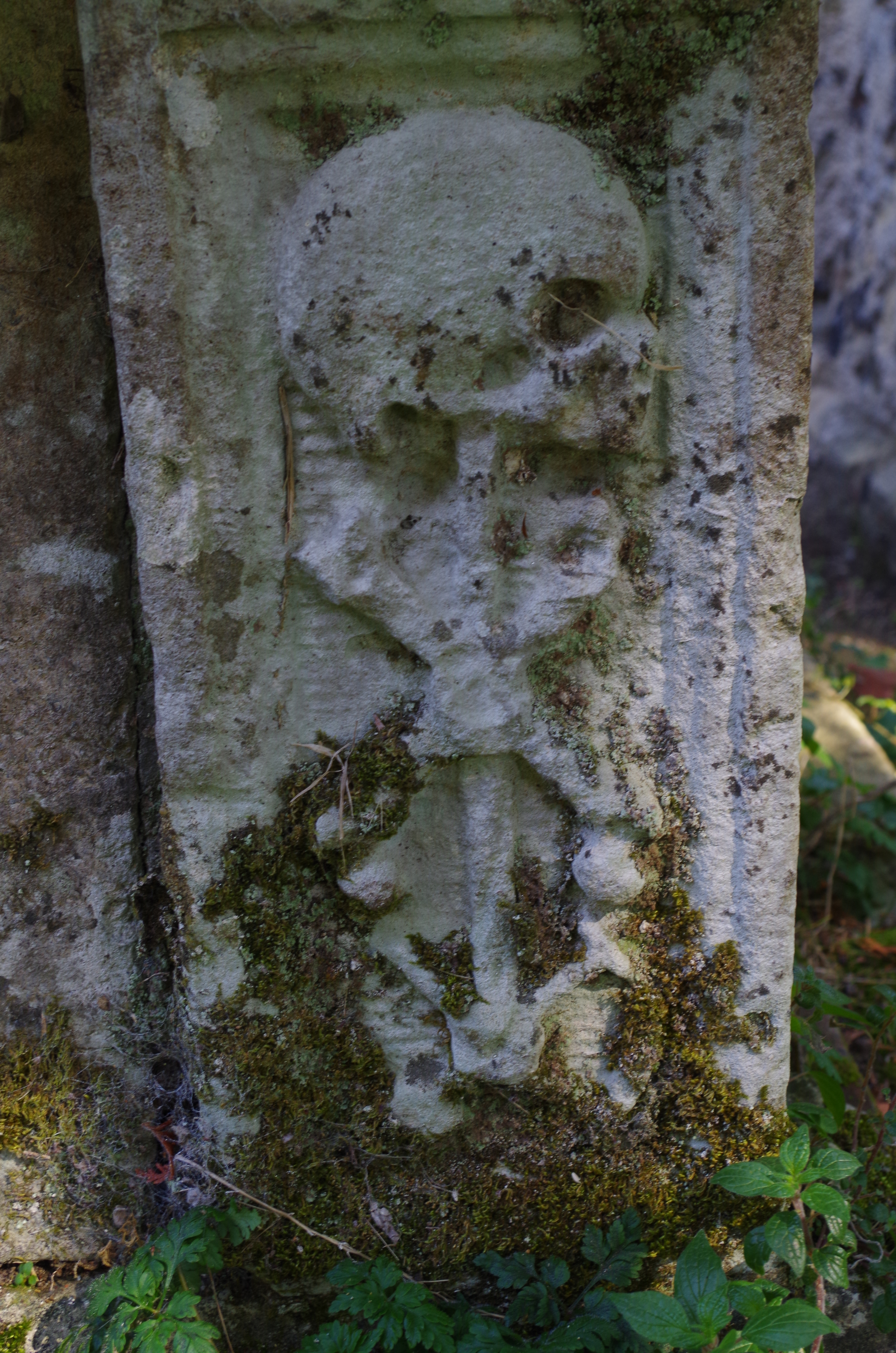
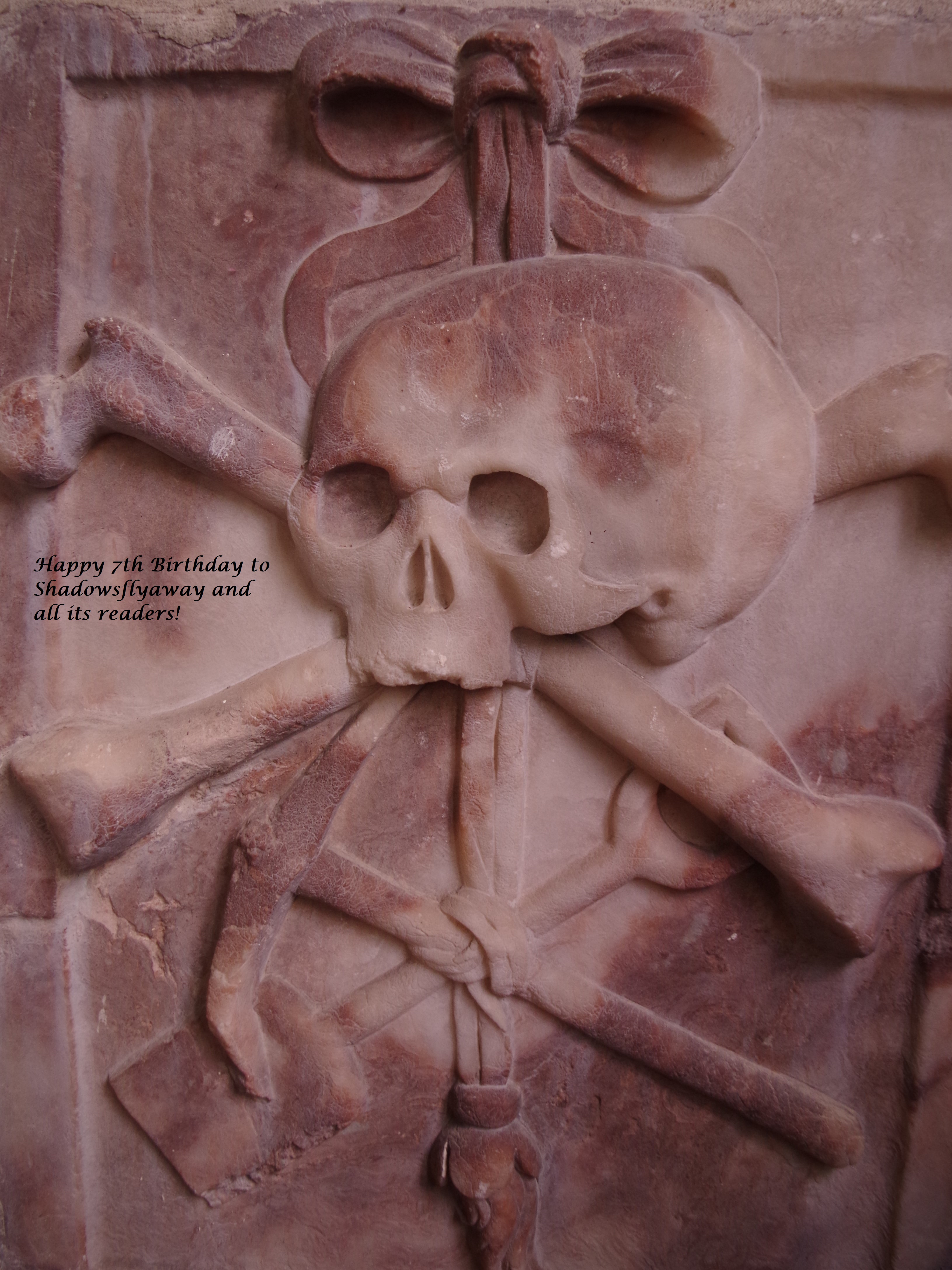
The skull and crossbones symbol is a ‘memento mori’ which is Latin for ‘Remember that you have to die’ or ‘Remember that you are mortal.’ It’s a reminder of the temporary, transient nature of human life. We are all born to die and should try to make the most of life. The skull and long bones crossed together are the survivors after death along with the other bones as they are the body parts that survive after the flesh has gone. It originated in ‘The Danse Macabre’, a medieval European allegory, in which the universality of death invites everyone, from all walks of life, to dance along to the grave. They are often accompanied by a pope, emperor, king, child, or
The Danse Macabre Nobleman and Physician from the Lübeck Totentanz courtesy UT Southwestern
labourer as key symbols and people. It was intended to remind people of the fragility of their lives and that earthy glories were i n vain. Skeletons lead them to their death. The images of the Danse Macabre were not only reminders of the ultimate fate for us all but they were often humourous as well. But its most powerful theme is of death’s indiscriminate nature. In the Danse, Death wears many faces, as he brandishes his scythe, sounds the death toll bell or plays a violin – he is a friend as well as the inevitable. The skull and crossbones was also a reminder that, on the Day of Judgement, the bones and skull would attach themselves together and the deceased would be able to walk again. This symbol has appeared in other, more ancient cultures such as the Mayans. This example comes from Mexico.
The skull and crossbones was also appropriated in the 18th century by sea pirates and rechristened as The Jolly Roger. This emphasises the skull’s eternal wide open grin. There are also military connections and also counter culture with Hells Angels etc claiming it for their own. According to blogger, Amy Johnson Crow, there is also a Christian connection as she claims that the crossed long bones resemble the Christian cross. The skull and crossbones is one of the most potent and universal symbols that has come down through the centuries. It will always remind us that the skull looking back at us reveals our own ultimate fate. Sources: Wikipedia ‘Death’ Richard Harris, Wellcome Collection An Illustrated encyclopedia of traditional symbols, J C Cooper, Thames & Hudson, 1978 UT Southwestern Digital Services website
This is taken from an email that I received from Historic England about various heritage updates. It included an item on a particularly lovely lych gate which they have recently listed and I thought I would share it with you due to its history and associations.
A picturesque Victorian lych gate at St Giles’ Church in the village of Stoke Poges, Buckinghamshire has been listed at Grade II by the Department for Digital, Culture, Media and Sport (DCMS) on the advice of Historic England, after an application was submitted by local man Harvey Whittam.
Harvey Whittam, Chairman of The Stoke Poges Society, had long admired the lych gate and recently applied to Historic England for it to be considered for listing. He said: “I first saw the lych gate in 1981 in the opening scene of the James Bond film ‘For Your Eyes Only’, when I thought it was beautiful and in a delightful country setting.
“Last year, I started volunteering with others to help to compile a list of historic sites in Stoke Poges for the Parish Council – it was then I realised again, but this time in real life, that it’s a fine structure. I am delighted the lych gate has received national recognition. There’s no doubt having it listed adds cultural, social and environmental value to the area.”
The wooden gateway and its flanking knapped flint wall stand prominently in the churchyard of St Giles, a setting associated with the poet Thomas Gray’s ‘Elegy Written in a Country Churchyard’ published in 1751.
The elegy is said to be one of the best-known poems in the English language. Until relatively recently, it was routinely learnt by school children. It’s widely acknowledged to refer to Stoke Poges, where Gray was staying when he wrote the poem in 1750.
Gray is buried in the churchyard and his tomb is listed at Grade II. A nearby monument to Gray designed by James Wyatt and carved with verses of the elegy is Grade II* listed and is a National Trust site. St Giles’ Church itself is Grade I listed. The newly listed lych gate and boundary wall form an ornate entranceway to, and are part of, this group of significant historic structures.
I’m pleased that new, thorough research has enhanced our understanding of this beautifully carved lychgate, which now takes its place on the National Heritage List. 99% of people in England live within a mile of a listed place – we invite you to explore the List and share your knowledge and pictures so we can record information, and even unlock the secrets of some places.
The lych gate also has special architectural interest in its own right. It is a well-preserved exemplar of its type by a leading architect of the period, with fine carved details. It was designed by the architect John Oldrid Scott and built in 1887 as part of an extension of the churchyard. Oldrid Scott was the eldest son of the architect Sir George Gilbert Scott, from whom he inherited the family practice in 1878. Oldrid Scott established himself as a leading figure in the development of the Gothic Revival in England in the last decades of the 19th century.
The low-set wall and ‘most beautiful lych-gate’ were paid for by a donation by Mr Gilliat of Duffield House, Stoke Poges, as noted in a letter to The Times from the then Rector of St Giles, Reverend Vernon Blake, published 22 November 1887.
The Stoke Poges lych gate has stylistic similarities with another designed by Oldrid Scott in 1880 that stands in the Churchyard of St Andrew and St Mary in Fletching, East Sussex – the lych gate is listed at Grade II.
View of St Giles’ church from the inner lych gate, 1906 – public domain/out of copyright.
What is a lych gate?
Lych gates are the ornamental gateways which lead to churchyards. They symbolise the threshold between the secular and sacred zones of a parish and once served a practical function of storing a coffin before burial. Their name derives from the Anglo-Saxon or German word for corpse: lich, or leiche.
Medieval lych gates were used as a meeting point and shelter for mourners. The group would convene beneath it and would be met by the priest prior to entering the consecrated churchyard for the funeral service. Lych gates continued to be built throughout the 19th and 20th centuries, and later examples, particularly after the First World War, were often erected as memorial structures.