A doomed royal marriage and a mausoleum in Ramsgate – Part 2

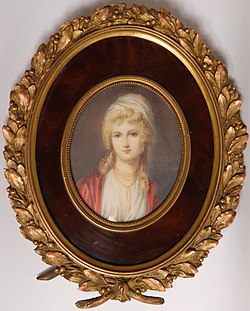
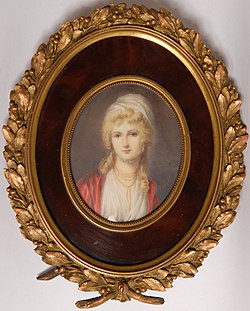
Lady Augusta Murray by Richard Cosway shared under Wiki Creative Commons

Part 2 the aftermath and the move to Ramsgate

By now Augusta was deeply in debt and in 1806 she finally gave up the title of the Duchess of Sussex. On 15 October 1806 George III authorised her to take the name of D’Ameland, one of the titles of the House of Orange with which Lord Dunmore’s family was connected. On 31 October 1806, the Treasury agreed to pay off her debts of £29,457 but with three conditions. She was to abandon the chancery case and not use the Duke’s coat of arms or livery. The Duke, Augustus, settled all of her debts that had been incurred prior to 25 March 1802 and from that date she was entitled to a £4000 pension p.a. deemed to be £1,000 p.a. at the time of the settlement. Thereafter she would receive an income of £4000 p.a. of which her existing pension of £1,200 would form a part.   £700 was awarded for the maintenance of the children.  Neither George III or Queen Charlotte ever saw their grandchildren from the marriage.

Augusta had been in debt for 13 years but by 1807 she was finally financially solvent and would be generously supported for the rest of her life. But at what a cost. Excluded from society, doubts cast on Emma’s parentage and the ruination of her family. But I do admire her as she didn’t fade away in shame but fought for herself and her children as much as she was able to. 

After considering other seaside resorts, Augusta moved to Ramsgate and bought a house there which she developed into an estate. She named it Mount Albion and it totalled 16 acres. At 45 she had another child, a son, Henry Hamilton, whom she never acknowledged. He was born in 1805 and died in 1824. She died on 4 March 1830 and was interred with her parents in the vaults at St Laurence in Thanet. Mount Albion was sold off for development and Holy Trinity Church now stands on what was her shrubbery. She is commemorated by street and road names named after her: Augusta Road, Augusta Steps and Augusta Place.

Augustus D’Este as a young man by Simon Jacques Rochard. Shared under Wiki Creative Commons

Augusta’s son, Augustus, joined the army and the 9th Light Dragoons. He took part in the Battle of New Orleans but was an unpopular officer. Although he never married he was reputed to have had several romantic liaisons. Eventually his father broke off any contact with him. Augustus was constantly frustrated by his unsuccessful attempts to achieve his rightful status and so decided to create the mausoleum in Augusta’s memory. By 1822 his health was failing and he had contracted multiple sclerosis. In fact his diaries, begun in that year, are the earliest recorded experiences of someone living with the disease and its effects. But he was determined to give his mother the status in death that she had been denied in life. The mausoleum was built in the shape of a Greek cross and cost £212.  George White who had worked on the repairs to the York Minster Chapter House carved the stones.  When it was completed the coffins of Augusta and her parents were moved from the vaults in the church and placed inside it. D’Este died on 18 December 1848 a month before his 55th birthday.

Augusta Emma Wilde, Baroness Truro (1801-1866) by Henri-Francois Riesener shared under Wiki Creative Commons

Augusta Emma married Sir Thomas Wilde who later became Lord Truro making her a Lady. They married on 13 August 1845 when she was 44. It was a low key ceremony as she would have also been subject to the Royal Marriages Act due to her being a descendant of George III, acknowledged or not. Lord Truro died in 1855 and she died in 1866. Truro Road in Ramsgate is named after her.

Lady Dunmore, Augusta’s mother, died on 11 November 1818. She never disowned her and supported her financially. Prince Augustus regarded her as a second mother:

‘although she had been excluded from royal circles and shared Augusta’s disgrace and isolation.’

Queen Charlotte died in 1818 and, two years later, George III died on  29 January 1820. Times were changing and the new King and Queen, William IV and Queen Adelaide, conferred a knighthood and  pension on Augusta’s son and a title to Emma which she refused. But she was a bridesmaid at the wedding to the King’s youngest daughter’s wedding. Queen Victoria gave them both pensions.

The Duke of Sussex, Prince Augustus, remarried privately after Augusta’s death to Lady Cecilia Buggin, the daughter of the Earl of Arran and his countess.  He wrote to Duke of Hamilton:

‘When one looks back to events thirty seven years ago one cannot do it without a sigh. My intentions were and always have been honest and for the best. I could not fight more than I did against established Laws and a Power greater than my own. Peace to her soul do I say from the bottom of my heart.’

He was a favourite uncle to Queen Victoria and  died on 21 April 1843 from a bacterial infection, erysipelas , and his son was not mentioned in his will. However, Emma who he described as ‘his delight’ inherited £10,000 and a house in Mayfair. In an obituary his children were acknowledged and the Royal Marriages Act was railed against. It would not be repealed until 26 March 2015. Augustus, the Duke of Sussex, was buried in Kensal Green Cemetery in London after refusing a State Funeral.

The grave of Prince Augustus, The Duke of Sussex, in Kensal Green Cemetery, London. February 2025.

It’s a sad tale as Augusta, due to her aristocratic background, would have made a suitable consort for Prince Augustus. But circumstance created by The Royal Marriages Act and possibly George III’s mental health problems conspired against them. They never met again after 1800.

View of mausoleum October 2025.© Carole Tyrrell

Grafitti on the illegible panels. © Carole Tyrrell

Damaged stones on mausoleum. © Carole Tyrrell

The mausoleum is crumbling now and looking the worse for wear as it nestles behind tall yew trees.  But who would have thought that a decaying mausoleum at the back of an overgrown churchyard would have such a dramatic and fascinating story to tell?

Text and photos © Carole Tyrrell unless otherwise stated.

References and further reading

St. Laurence Churchyard booklet and information boards

Augusta Emma Wilde, Baroness Truro – Wikipedia the daughter

St Lawrence, Laurence, Ramsgate, Thanet – Churchyard M.I.’s by Charles Cotton 1895 the inscriptions on the Mausoleum

Prince Augustus Frederick, Duke of Sussex – Wikipedia

Lady Augusta Murray – Wikipedia

https://en.wikipedia.org/wiki/Augustus_d%27Este

Forbidden Wife: The Life and Trials of Lady August Murray, Julia Abel Smith, The History Press, 2020.

A doomed Royal marriage and a mausoleum in Ramsgate – St Laurence in Thanet.

View of the D’Este Mausoleum showing bricked up entrance. ©Carole Tyrrell

Part 1 – The love story and a terrible home coming

The churchyard of St Lawrence in Ramsgate contains 1400 graves and was consecrated in 1275. It is now closed to burials but as I explored in early October I found a huge mausoleum right at the very back, peeping out from behind yew trees. It is a little worse for wear to say the least but the mausoleum has royal connections.

It is the D’Este mausoleum according to an information board and the guidebook.  Its inscriptions are now illegible, the outer decoration has been smashed, its roof tiles stolen and the entrance has been bricked up but it has such a story to tell.

It contains 6 people hence its size. They are:

The Duchess of Sussex, wife of Prince Augustus Frederick.

The Duchess’s parents, the Earl and Countess of Dunmore

Two unacknowledged grandchildren of King George III, Augustus and Augusta. She is interred with her husband, Sir Thomas Wilde, The Lord High Chancellor.

Illustrious permanent residents indeed.  I was immediately intrigued and found an archive photo which showed that it had once had an imposing position within the churchyard. Please follow this link:

MMT – Gazetteer Mausoleum Details

It is now considered to be at risk.

The D’Este Mausoleum showing where the inscriptions would have been originally on all sides of the mausoleum. ©Carole Tyrrell

This is the original wording on the inscriptions from 1895:

324. D’Este Mausoleum. South side: Sacred to the beloved memory of The Right Honorable Thomas WILDE, 1st Baron TRURO, who began his professional life as an attorney, by great talent, perseverance, and integrity, unaided by patronage, became Lord Chief Justice of the Court of Common Pleas, and afterwards Lord High Chancellor of England. Born 7th day of July 1782, died 11th November 1855. He had by his first marriage with Mary WILEMAR three sons, the eldest of whom died in infancy, and one daughter. By his second wife Augusta Emma D’ESTE he left no issue. In this tomb are also enclosed the remains of The Right Honourable Augusta Emma, Baroness Truro, widow of Thomas, 1st Baron Truro. And only daughter of Augustus Frederick, Duke of SUSSEX, who died on the 21st day of May 1866. “May God mercifully receive her soul”.

On the west side of ditto: Erected by Augustus Frederick D’ESTE, to receive the mortal remains of his venerated and loved mother, the Lady Augusta MURRAY, 2nd daughter of John, Earl of DUNMORE. Married at Rome on the 4th day of April, A.D. 1793, to His Royal Highness, Prince Augustus Frederick, afterwards Duke of SUSSEX, 6th son of His Majesty KING GEORGE THE THIRD, a subsequent marriage was solemnized at St George’s Church, Hanover Square, London. Both marriages were held invalid in England, as contrary to an Act of Parliament entitled “The Royal Marriage Act”. Here also repose the remains of Augustus Frederick D’Este, the only son of Lady Augusta, and His Royal Highness the Duke of Sussex. Born 13th January 1794, died 18th December 1848.

North side of ditto: On this side are deposited the remains of John, 4th Earl of DUNMORE, died March 1809, and of his Countess, the Lady Charlotte STEWART, daughter of Alexander, 6th Earl of CALLAWAY, died November 1818.’   Kent Archaeological Society

Lady Augusta Murray – portrait miniature by Richard Cosway. Image shared under Wiki Commons

It’s the inscription to Augusta, Duchess of Sussex that begins the story. This is the 18th century Royal marriage which fell foul of a punitive Act of Parliament, The Royal Marriages Act. A wife was denied and repudiated becoming a social outcast, her family ruined and her children nameless. Until eventually she ended up living in Ramsgate where several road and street names still commemorate her.  This the sad story of Lady Augusta Murray’s doomed marriage to Prince Augustus Frederick, the sixth son of George III.

I am indebted to Julia Abel Smith’s biography of Lady Augusta, ‘Forbidden Wife – the Life and Trials of Lady Augusta Murray’ which was published by The History Press in 2020.

She was the daughter of John Murray, the 4th Earl of Dunmore and his wife Lady Charlotte Stewart. Augusta was 32 when she met Prince Augustus, the sixth son of George III in Rome in 1793 . He was 20 and  largely estranged from his father. She was widely travelled and very accomplished which was unusual for a woman of her time. Her father had been the Governor of  New York,  and later Virginia, as the first stirrings of independence happened. In fact, she and her mother were in Gibraltar when news came of the French Revolution and the beheading of Marie Antoinette.  Augusta and Augustus then remarried in London.

Prince Augustus Frederick, portrait by Guy Head. Shared under Wiki Commons.

Augustus had not yet told his father of the marriages as he wanted to do it when he became of age. But neither he nor Augusta had any idea of how strictly the Royal Marriages Act of 1771 could be applied, and particularly to them, once George III and Queen Charlotte found out.

The Act declared that any descendants of George III would be prevented from marrying without his previous consent as well as his heirs and successors. Any marriage contracted without the King’s consent would be null and void.  The result of this would be ruin and rejection for both parties and any children would be illegitimate.  Anyone connected with the marriage would also be liable for prosecution.  However, it was different if the royal petitioner was aged over 25 and hadn’t received the King’s consent as they could give notice to the Privy Council and, if within a year the Houses of Parliament had no objection they would be free to marry.

The inquiry on the legitimacy of both of the marriages which was held on 27 January 1794, was scathing. The marriages were deemed ‘pretended’ and ‘absolutely null and void’ and Augusta was ‘falsely calling herself the wife of the said Royal Highness Prince Augustus Frederick.’  If that wasn’t enough she was also liable for the legal expenses. But Augusta always regarded her marriages as completely legal.

As a result of the inquiry she was awarded a pension of £1,000 p.a. but she, their children and her family became pariahs in the eyes of polite society.  But her parents never stopped supporting her.

Prince Augustus and Augusta continued to see each other and a daughter, called Augusta Emma, was born on 9 August 1801. She was always known as Emma. She and her brother were given the surname of Hanover and it was later changed to D’Este. But life was hard for Augusta with no income and no longer being part of society. She ended up in considerable debt.

However, after eight years of trying to have Augusta recognised as his wife, the final separation came on 7th December 1801 when Augustus finally conceded defeat. He wrote:

‘We are to meet no more. My whole wish now is to make her comfortable.’.

He then became the Duke of Sussex in England, Earl of Inverness in Scotland and Baron Arklow in Ireland. He also moved to Portugal and had a mistress.

Part 2 – The aftermath and the move to Ramsgate

Text and photos ©Carole Tyrrell unless otherwise stated.

References and further reading:

St. Laurence Churchyard

Augusta Emma Wilde, Baroness Truro – Wikipedia the daughter

St Lawrence, Laurence, Ramsgate, Thanet – Churchyard M.I.’s by Charles Cotton 1895 the sicriptions on the Mausoleum

Prince Augustus Frederick, Duke of Sussex – Wikipedia

Lady Augusta Murray – Wikipedia

Forbidden Wife: The Life and Trials of Lady Augusta Murray, Julia Abel Smith, The History Press, 2020.
One of the most unusual names to find in a churchyard – St Werbergh, Hoo, Kent

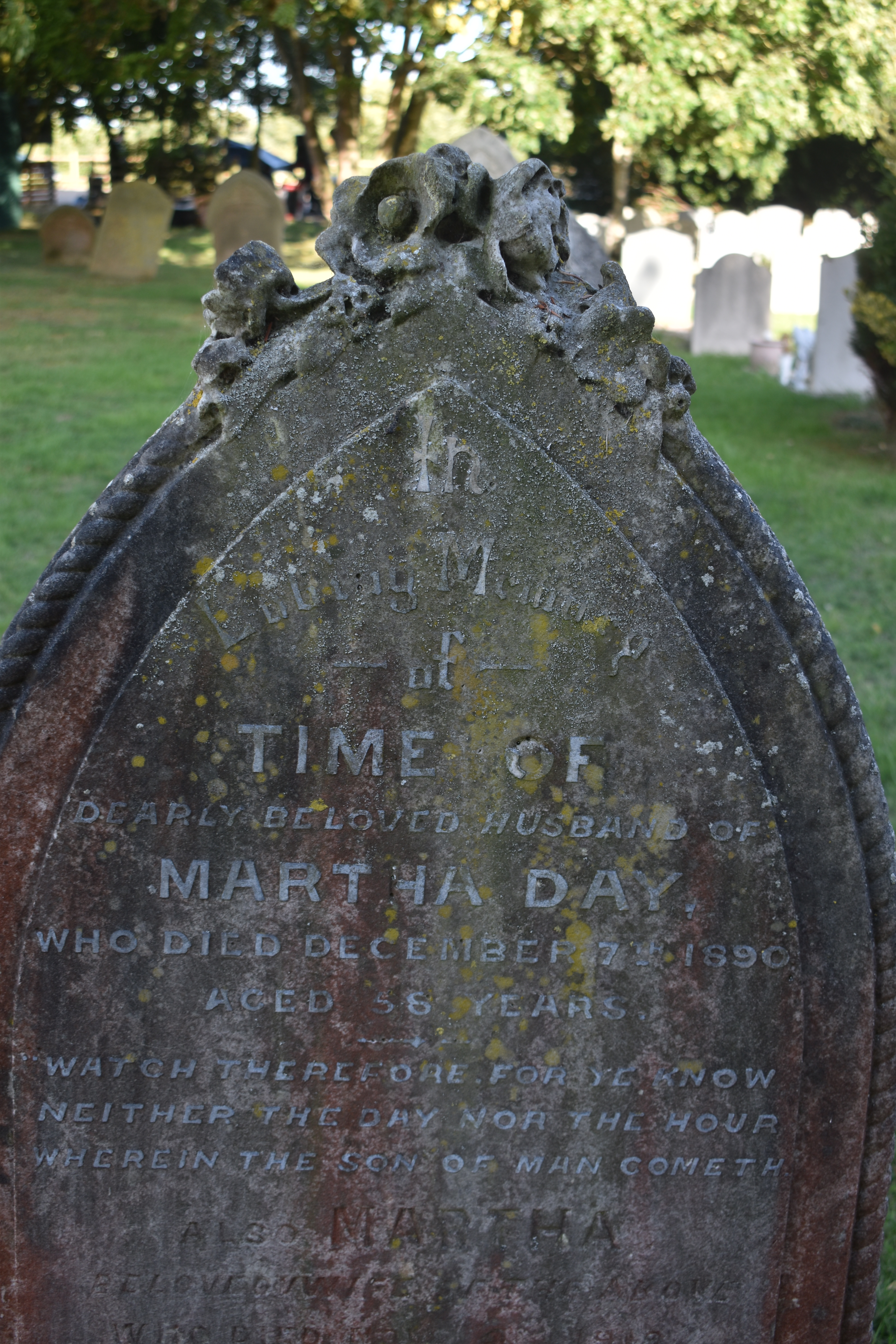
Headstone dedicated to Time of Day, Hoo St Werberga.© Carole Tyrrell

I tried to find this grave last year in the churchyard of Hoo St Werbergh but ran out of time. However, on a return visit this year I finally found it.

It’s dedicated to a man called ‘Time Of Day’ ( I kid you not). (1833-1890) with ‘Day’ being his surname. I did wonder if his siblings were called after days of the week with their surname providing the end as in ‘Sun – Day, Mon-Day etc.

He was a licenced victualler or publican who owned a pub in a nearby hamlet, Fenn Street, Hoo, called The Bell Inn from 1881.  He died on 11 December 1890 and the headstone was erected by his wife, Martha, who was the executrix of his will. The value of his estate was £962.10s.3d which was a substantial sum at that time. There was no mention of any children.

The Fenn Bell Inn Sign © David Anstiss Geograph. Shared under Creative Commons

The Fenn Bell Inn as it looked roughly 16 years ago. © Chris Whippet – Geograph Shared under Creative Commons.

The Fenn Bell Inn may have been named after one of several bells erected on nearby marshes. In poor weather they would ring to enable travellers to find a safe way to cross but The ‘Bell’ is a common name for pubs throughout Britain.  The Fen Bell Inn has been in existence since the 17th century although it has been remodelled and restored since then. However, some of the original fabric still exists. Since 2014, it has housed the Fenn Bell Conservation project for rescued animals and a miniature railway. Recently, there has been controversy over the pub landlord’s plan to sell off land for housing but he has defended it saying that he needed to do it to keep his business going.

‘Time of Day’ is a very unusual name as you might agree but he was a man of some substance and is likely to remembered for many years to come.

© Text and photos Carole Tyrrell unless otherwise stated.

References and further reading

TQ 77 NE 1105 – Fenn Bell Inn or Fenn Bell Public House or Bell Inn, Fenn Street, St Mary Hoo Parish – Historic Environment Record

The Fenn Bell, Pub Sign, Fenn Street,… © David Anstiss cc-by-sa/2.0 :: Geograph Britain and Ireland

Notes from Kent’s Hoo Peninsula: Medway Archives and Local Studies Centre – expanded photo library now online!    (scroll down for vintage photo of The Bell although it doesn’t state when it was taken)

The Fenn Bell Inn, Fenn Street © Chris Whippet cc-by-sa/2.0 :: Geograph Britain and Ireland (photo taken 2009)

Sign for the Fenn Bell Inn © JThomas :: Geograph Britain and Ireland – pub sign taken 2022

Fenn Bell zoo owner in St Mary Hoo says he’s suffered ‘personal attacks’ over plans for 44 homes next door

BELL INN  Pub of St Mary Hoo

Symbol of the Month – The Mass Dial

In light of the mass dial found at St Mary’s In the Marsh, I thought it might be timely to repeat the 2021 Symbol of the Month about them. Easily missed as they are not always where you expect to find them, they are survivors from a time where there were no time keepers such as clocks. People rose with the sun and went to bed at sunset which is why they were so important to villages and their inhabitants.

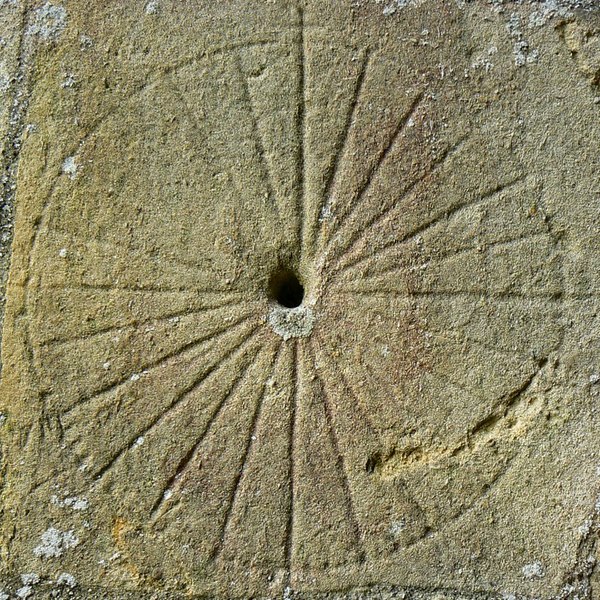
Mass Dial set into a wall at St James’s, Cooling, Kent. © Carole Tyrrell

Despite the somewhat dispiriting summer, I was determined to escape from the house and see at least one or two local churches.  My little part of Kent is known as Charles Dickens country (I’m not sure that he knows about this) and there are several buildings and churches associated with him. 

One of these is St James’s church at Cooling.  Although closed for services, it is still kept open by local people on most days. The Churches Conservation Trust take care of it and it’s in an isolated spot which borders onto marshes.  It’s also a fair walk from the nearest town, Cliffe.  I didn’t see any signs of much of a village there although there is a 14th century ruined castle nearby. St James’s is the end of a terrace of houses appropriately named Dickens Walk. 

l’ll talk more about St James in a later post as it inspired one of Dickens most atmospheric scenes in ‘Great Expectations’ with the childrens graves in the churchyard.  But while I was there, I found a symbol set within a wall that I had heard of but had never previously seen an example – this was the Mass Dial.  I have to admit that if it hadn’t been pointed out on a display board within the church that I might have missed it as it’s set into an outer wall of the church.  Not many have survived and Victorian restoration may have meant that they are found in odd places.

Mass dials are rare survivors and were a way of telling time before the invention of mechanised clocks and timepieces in the 14th century. 

It was the Anglo-Saxons who established the dials.  There had been confusion with all the different calendar systems such as the Lunar and Julian, and with a largely illiterate population, a visual way of telling the time was necessary.

It was the Anglo-Saxons who established the dials.  There had been confusion with all the different calendar systems such as the Lunar and Julian, and with a largely illiterate population, a visual way of telling the time was necessary.

According to the Building Conservation website:

the Anglo Saxons divided night and day into 8 artificial divisions known in Old English as Tid or Tides.  The 4 daylight divisions were called:

Morgen – 6am – 9am

Undern – 9am to noon

Middaeg – Noon to 3pm

Geletendoeg – 3pm to 6pm. 

Morning, noon and evening are still in use as the last remnants of this division still in use today as are moontide, yuletide and shrovetide.’

But, throughout the Middle Ages, the Catholic church emphasised the reciting of prayers and fixed times during the day as pre-Reformation Britain was still a Catholic country.  These were known as the Divine Offices and were:

Matins – pre-dawn

Prime (6am)

Terce (9am)

Sext (12pm)

None (3pm)

Vespers (sunset

Nocturnes (after sunset) 

However, these were not set as the sun might not shine for a few days and if a mistake was made then the parish priest might end up celebrating certain feasts on different days from a neighbouring parish. 

Mass Dial, St John’s church, Devizes, Wiltshire – note that it still has the marker in it showing how it worked.© Brian Robert Marshall under Geograph Creative Commons Licence.

They were a form of medieval sun dial and originally the hole in the centre of the dial would have contained a horizontal wooden or metal rod that cast a shadow.  This was known as a ‘gnomon’ which is pronounced as No Mon.  These may well have been the local community’s only way of telling the time although medieval life revolved around getting up at sunrise and going to bed at sunset.

According to the British Sundial Society,

‘mass dials can be found on the south side of many churches.  They are usually small and often located on the walls, buttresses, windows and doorways of a church.  However, they can also appear in more unlikely places such as inside churches and on north walls where the sun rarely shines. But they have also been found in porches suggesting that the porch was built sometime after the dial was made.’

The Society goes onto suggest that this may be

 ‘due to the stone blocks having been re-used in the rebuilding of the church.’ 

The location of the Cooling one may indicate that it’s been moved.

Again, according to Building Conservation:

‘if a mass dial is found anywhere other than a church and other than the south elevation of a church, this usually means that it has been moved from its original location often as part of a Victorian restoration.  In such cases, the dials were sometimes rebuilt into the fabric upside down, making them unreadable.’

The positioning of mass dials is important and can vary.  They may be on the smooth cornerstone or quoin of a tower, nave or chancel, above a porch or on a door or window jamb.  Often they are set at eye level and in one church it is cut into a window ledge.

Mass dial, All Saints.Oaksey, Wiltshire. © Brian Robert Marshall. Shared under Wiki Creative Commons

Mass Dial, St Michael & All Angels., Heydon, Lincs. ©Richard Croft. Shared under Wiki Creative Commons

Mass dials also vary in their design as:

‘Some have either a few or many radiating lines, {others} have ‘hour’ lines within the circles or semi circles and others are constructed with a ring of ‘pock’ marks drilled into the stone.’  

British Sundial Society

There are also variants in the way that the hour lines are numbered as they may have Roman numerals or even Arabic ones.  They’re also known as scratch dials as

‘many are quite crudely scratched into the stone.’ British Sundial Society

A full circle version, All Saints, Yatesbury. ©Brian Robert Marshall Shared under Wiki Creative Commons

The 14th century brought mechanical clocks that created a regulated 24 hour time period.  As a result, medieval life changed as it was no longer so reliant on daylight.  However, mass dials were still in use but now they were a complete circle with lines radiating from the central gnomon to simulate the 24 hour clock.  But by the 16th century they had fallen out of use.  Sundials and mechanical locks had overtaken them and it was no longer the Roman Catholic church that dominated after the Reformation.

Mass dials are of great archaeological and historic importance.  However, many of them are now indecipherable due to erosion and vandalism and people may not even realise what they are or their significance.

© Carole Tyrrell Text and photos unless otherwise stated.

References and further reading

https://sundialsoc.org.uk/dials_menu/mass-dials/

https://www.buildingconservation.com/articles/mass-dials/mass-dials.htm

http://massdials.org.uk/links.htm

Happy New Year with a couple of mysteries!

Sorrowing woman on headstone, All Saint, Birchington-on-sea, Kent. © Carole Tyrrell

Happy New Year to all my readers and what an auspicious year it is for shadowsflyaway!

It’s 10 years since I began this blog on July 10th 2015 to be exact and some of my readers have been with me since the very beginning. Even now I am still discovering new symbols to write about, little mysteries that I find in churchyards and cemeteries that intrigue and inspire me.

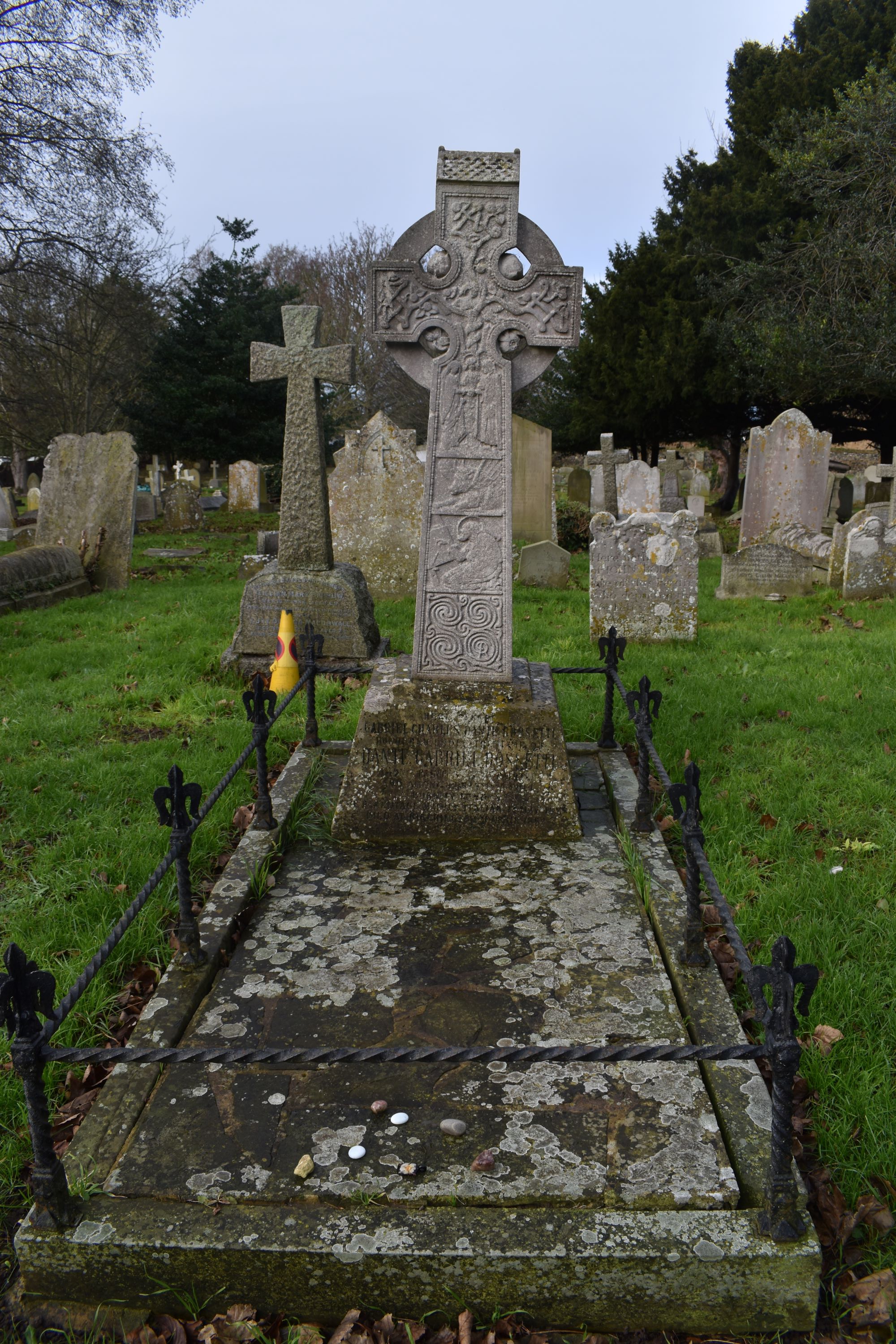
Here are a couple that I found on a Christmas Eve walk in All Saints churchyard, Birchington on Sea. This is where the 19th century Pre-Raphaelite artist, Dante Gabriel Rossetti is buried with a Celtic Cross over his grave. It was a dull grey day, enlivened only by the bright efforts of the town’s yarn bombers.

Dante Gabriel Rossetti’s grave, All Saints Birchington-on-Sea which is in the form of a Celtic Cross. © Carole Tyrrell

An example of one of Rossetti’s most beautiful paintings, ‘Lady Lilith’.

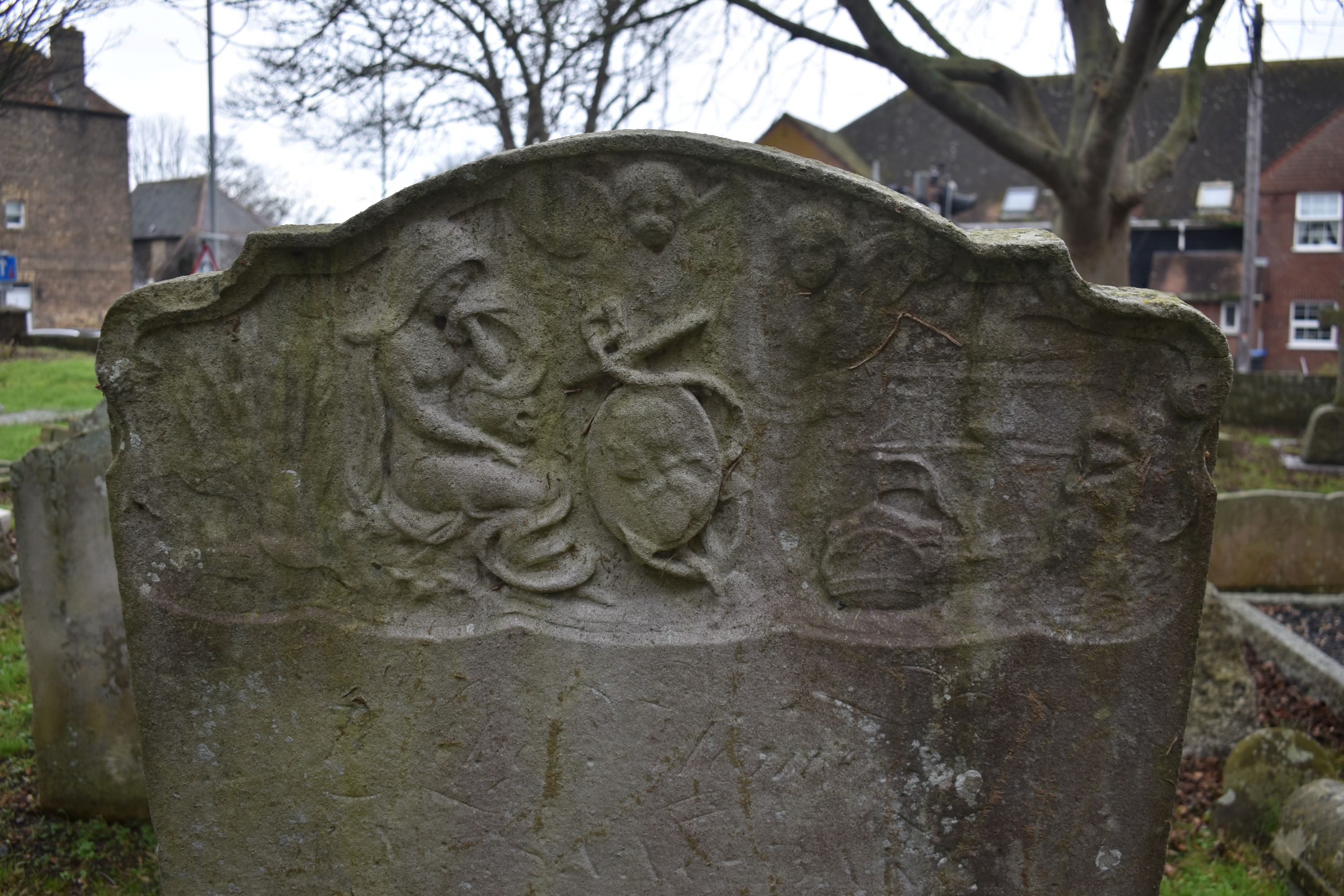
But these two stood out. The first one was located by the original church door and appeared to be a variant on the mourning woman symbol as a woman, wearing a billowing gown or cloak, weeps over a man’s portrait. He faces her in profile and is dressed in 18th century fashion with a small ponytail and is within an oval frame. She sits with a skull on her lap. The portrait is supported by a large anchor whose rope ripple around and behind it. Above it there are two floating angel heads or winged messengers. The carvings on either side of the tableau were indistinct under the overcast sky. But a sunny day can often bring out details of carvings and epitaphs so I will return. The anchor would indicate a naval man and I have to say that that, on first look, the folds of cloth around the lower half of the woman resembled a mermaid’s tail to me. But that may just be me being more fanciful… It’s an impressive headstone with the central figures still crisp. I would hazard a guess that this is from the 18th century.

A closer view of the sorrowing woman headstone. © Carole Tyrrell

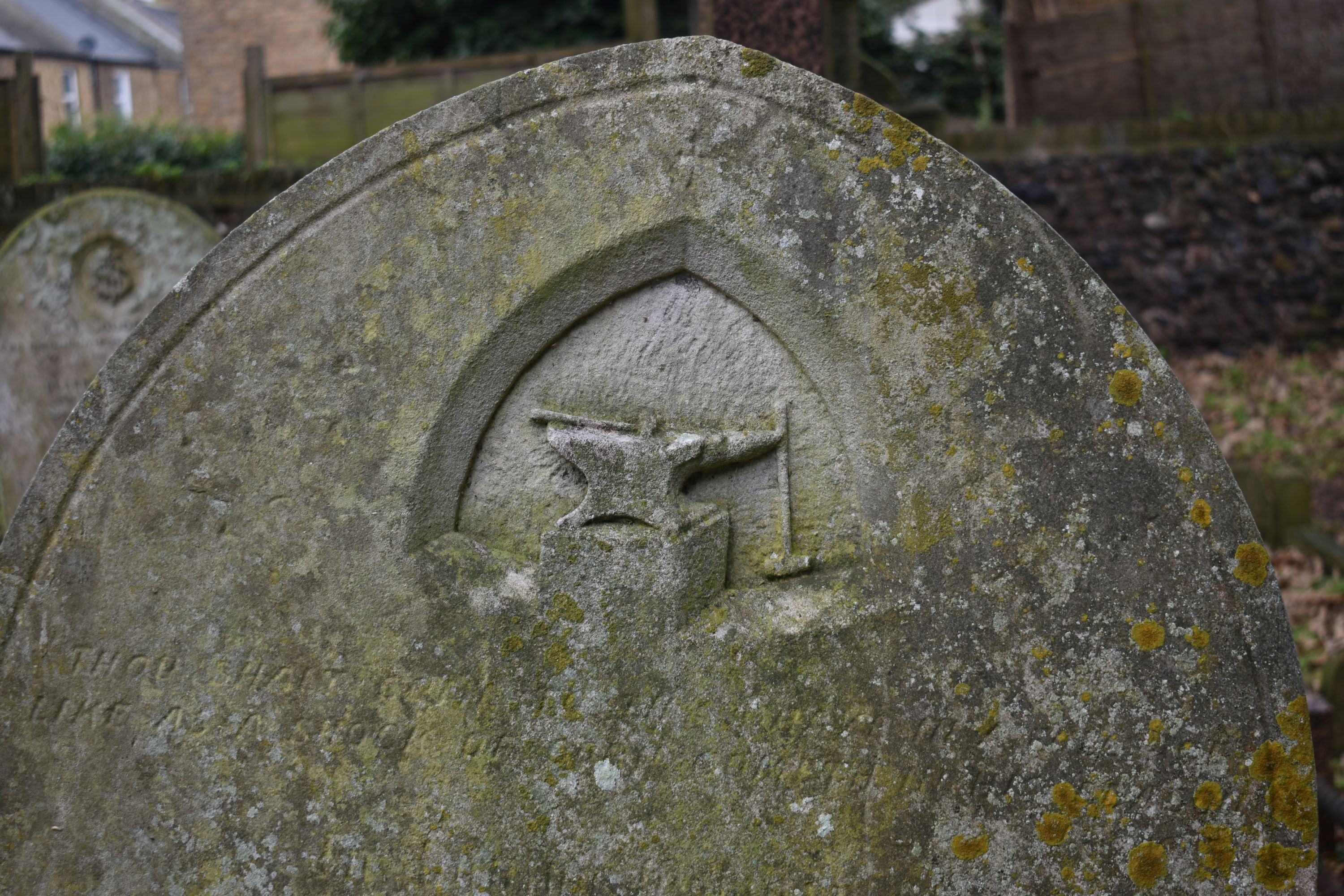
The other one is on a 19th century headstone and features an anvil and tools. On first glance I thought it might belong to the village blacksmith. But it’s dedicated to a woman, Elizabeth Adams. Underneath the motif is what appears to be a quotation which I thought might have come from the Bible. But, so far, I haven’t found anything that resembles it but a burst of bright sunshine could illuminate it further on a future visit.

A closer view of the anvil and tools with quotation partly visible beneath. © Carole Tyrrell

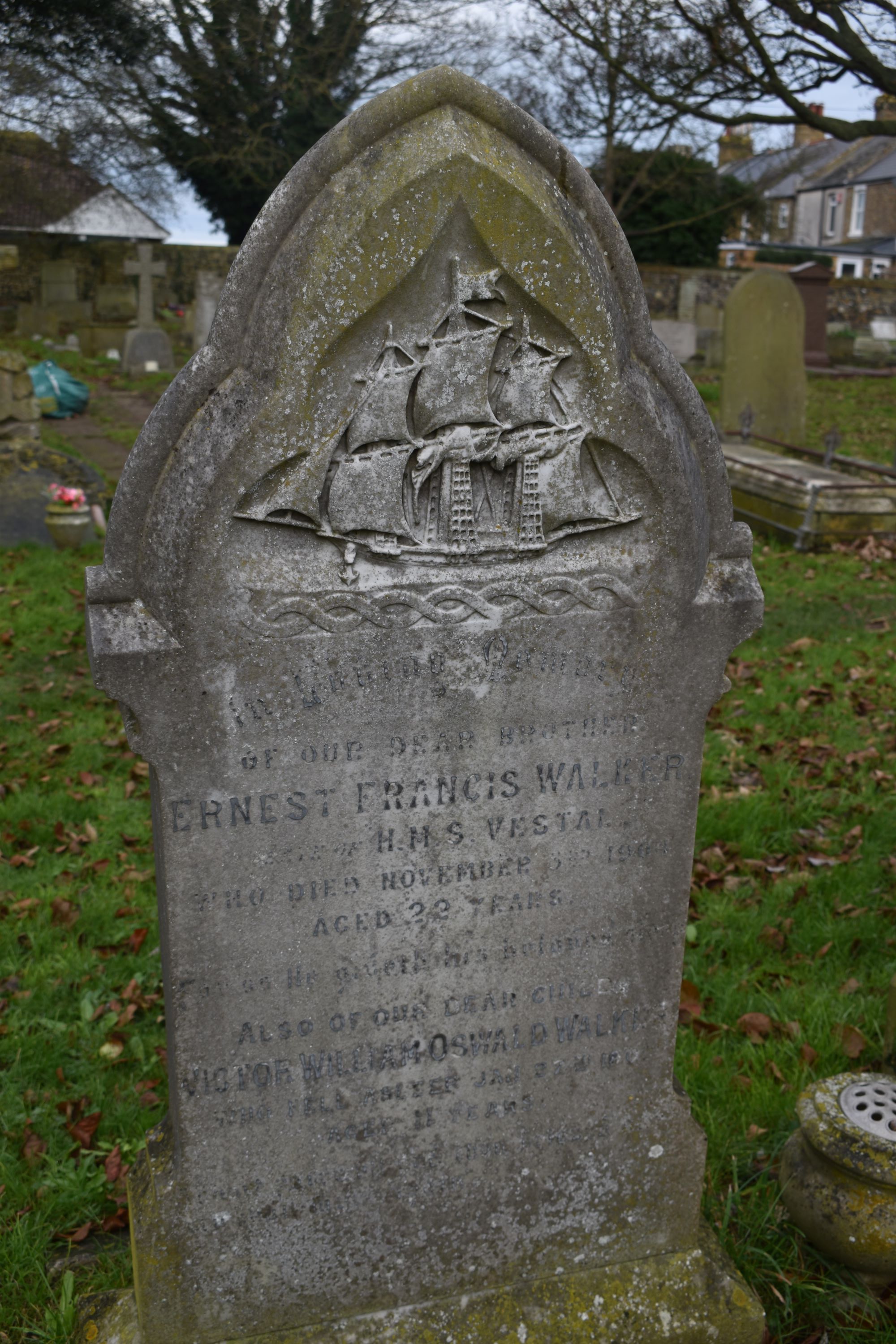
A ship is permanently sailing on Ernest Francis Walker’s headstone with a border of entwined ropes beneath it. The epitaph states that he was a crew member on HMS Vestal and so I presume the carving of a ship is a representation of it. Ernest died young at 22 and there are several ships that bear this name. The one that I think is most likely is a 26 gun sixth rate frigate of the Royal Navy. She was launched in 1833 and sailed in the West Indies and the Caribbean. In 1852 she ran aground near the Needles on the Isle of Wight and was taken to Portsmouth for inspection and repair prior to being decommissioned in 1860 and then broken up in 1862.

I am already looking forward to what else I will discover in 2025 including the spooky angel in a Broadstairs churchyard but I am determined to wait for a really foggy day for that one!

© Text and photos Carole Tyrrell


References and further reading:
https://en.wikipedia.org/wiki/HMS_Vestal_(1833)

Symbol(s) of the Month – the exuberant 18th century symbols of St George’s churchyard

One of the skulls at base of blank cartouche on one side of large chest tomb, St George’s. ©Carole Tyrrell

It’s often on a winter’s night, just as dusk begins to fall and the lamp lights in St Georges churchyard come up, that  the fine selection of 18th century tombstones are at their best. Carved skulls leer at you, an hourglass emphasises time passing and the gravedigger’s tools stand ready for the next interment.  And perhaps there is still a phantom schoolteacher using his sculpted globe to teach geography to his spectral students.

There has been a church on this site since the 14th century and, in one place in the graveyard  the number of burials over the centuries has made the ground rise up on both sides.  But, as well as 18th century examples of funerary symbolism, there are also some wonderful 19th century ones as well.  Inside the church there’s also a good selection of impressive wall monuments dedicated to prominent local families dating back to the 1600’s.  They are  buried in the vaults beneath the church.  St George’s also has the country’s oldest lych gate in that the current one incorporates elements from  a far older one. The churchyard is a pretty one for a short walk through to the bustling High Street  especially when the spring flowers begin to appear, carpeting the grass between the stones with bluebells and flitting butterflies.

View of tombstones with horned skull in foreground. ©Carole Tyrrell

However for this month’s Symbols post I will concentrate on the 18th century memorials within the churchyard. These  tombstones  are topped with classic memento mori symbols.  This is Latin for ‘remember (that you have) to die.’  They are the visual accompaniment to the immortal epitaph from Dundee’s Howff graveyard:

Remember Man as you pass by

As you are now so once was I

As I am now so must you be

Remember man that you must die.’

Graveyard symbolism, according to Douglas Keister, began when the well to do  could no longer be buried with in their local church due to lack of space. Instead, they took up their eternal residence in the newly consecrated burial grounds outside and surrounding the church walls. These were often known as ’God’s Acres’ and gave the wealthy the opportunity to erect a lasting memorial or tombstone in their memory.

St George’s churchyard became the last resting place of prominent local families, some of whose descendants still live in the area. The oldest tombstone dates from 1668 and the 18th century ones  are nearest to the church walls which in effect meant that they were  ‘Nearer my God to Thee.’

I’ve always enjoyed walking through the churchyard as it can feel like walking through a gallery of funerary symbols.  There’s something very exuberant about these 18th Century motifs of mortality even though some have eroded and only one epitaph is still fully readable.  However, the skull and crossbones, the Death’s Heads and others have, in several cases, lasted better than the epitaph below them.

The skull and crossbones are an effective, if macabre, reminder of what is left of a body after it decomposes and there are several good examples in St Georges.

This one is near the church entrance and features a skull and crossbones with what appear to be protruding palm fronds.  It also seesm to be resting on something whch may be a shield.  All that can now be read on the epitaph is…who dep….’

© Carole Tyrrell

The skull and crossbones, a winged hourglass and a set of sexton’s tool on the left hand side.
©Carole Tyrrell

Nearby is another skull and crossbones with a winged hourglass above it.  This is a reminder that ‘Time flies’ or ‘Tempus Fugit’ and that the onlooker will soon be bones and dust. So it’s important to make the most of their time on earth. On the left hand side is a pick and shovel.  These are a sexton’s tools which made me wonder if this was a sexton’s grave but the epitaph is now illegible.  The sexton’s role not only encompassed maintaining and looking after the church but also the churchyard.  In larger graveyards the sexton would have been more of a manager but in smaller ones he would have had sole responsibility for preparing the ground, digging and closing the grave, mowing the lawn and also maintaining the lawn and paths.

Skulls also feature prominently on two other tombstones on the other side of the church very near the wall. One seems to have a very sharp pair of horns and a  definite smirk.  On each side of it there appear to be small trumpets but it’s too weathered to see if anyone’s blowing them.  Maybe he’s keenly anticipating the Last Day of Judgement.

© Carole Tyrrell

The horned skull tombstone showing trumpet detail. ©Carole Tyrrell

Nearby is a large tombstone with what seem to be two somersaulting skulls on them although one is more eroded than the other.  Below them is a small worn hourglass.  I believe that these two examples of skulls may be unique to St Georges as I’ve haven’t yet seen them anywhere else.

Somersaulting skulls and hourglass. ©Carole Tyrrell

Douglas Keister has suggested that the skull and crossbones slowly began to be replaced by the much less stark and macabre  ‘Death’s Head.’  This is a human face with wings on either side of it.  I’ve always known it as the ‘winged cherub’ and there are also several good examples within the churchyard. These are symbols of resurrection intended to give those left behind some hope.

© Carole Tyrrell A closer view of the Saxby Angel with what appears to be a faded open book on one side and a stylised flower on the other side.

I am also a huge fan of calligraphy having studied it for two years at evening classes and it has undergone a revival on late 20th and early 21st century tombstones.  However 18th century calligraphy has a style all of its own and is instantly recognisable.  The only legible 18th century epitaph in St Georges is the one dedicated to a John Saxby.  It reads:

Here lyeth the body of John Saxby of the Parish who Departed this life…year of May 1731 aged 41 years.’

A fine example of a Death’s Head is on top with an open book beside it which may be the Bible or the Book of Life and there’s a stylised flower on the other side.  The open book may be a depiction of the incumbent offering their life to God for judgement as an ‘open book’. People are sometimes described as an ‘open book’ as they have their feelings and thoughts open to the world with no attempt to hide them.

A crown on clouds with two small angelic faces on each side of it. ©Carole Tyrrell

On another memorial two small faces, presumably from the angelic host, peer out from either side of the clouds surrounding a crown.  It’s a representation of the reward that awaits the faithful in heaven.  This verse from the Bible refers to it:

James 1:12 New International Version (NIV)

Blessed is the one who perseveres under trial because, having stood the test, that person will receive the crown of life that the Lord has promised to those who love him.

A plump faced death’s head is surrounded by another open book and what I think maybe a small skull in the far corner of the stone.
 

A plump faced Death’s Head or winged cherub with an open book on one side and what I think is a small skull on the other. ©Carole Tyrrell

But one of the most unique and impressive tombstones in St George’s, or perhaps anywhere, is that of John Kay.  He was an 18th century schoolmaster and his life and talents are recorded by the tools of his trade that have been carved on his stone. There’s a globe on a stand, a trumpet, what appears to be a cornet, an artists palette, a pair of compasses and other items which are now too indistinct to read.  He was obviously very erudite and much appreciated by his students.  Sadly his fulsome epitaph is now virtually unreadable. He lies near Mr Saxby under a spreading yew tree.

© Carole Tyrrell

On the other side of the graveyard is a large chest tomb.  There is a dedication and an armorial on its top and I feel that some patient research in St George’s burial registers may reveal the incumbent’s identity.  There are blank cartouches on each side with death’s heads on top and two skulls beneath each one.  At one end are palm fronds which are a Roman symbol of victory which were then adapted by the Christians as a martyr’s triumph of death.  The palm as a symbol originated in the ancient Near East and Mediterranean region  and is a powerful motif of victory, triumph, peace and eternal life.  It’s traditionally associated with Easter and Palm Sunday and Christs’ resurrection and victory over death. On the other end of the tomb are what appear to be olive flowers.  The olive’s association with wisdom and peace originally came from Greek mythology when the goddess, Athena, presented an olive tree to the city that was to become Athens.  Successive Greek ambassadors then continued the tradtion by offering an olive branch of peace to indicate their goiod intentions. The olive tree is also associated with longevity, fertility, maturity, fruitfulness and prosperity.  In the Bible, Noah sent the dove out after the Flood to see if the floodwaters had receded and when it returned with an olive leaf in its beak Noah knew that the Flood had ended.  Even today the phrase ‘ offering an olive branch’ means the someone wants to make peace. But in this context the olive branch may mwean that the soul has departed with the peace of God. So one memorial incorporates powerful  motifs of mortality and resurrection.

View of chest tomb, St George’s churchyard. ©Carole Tyrrell
Palm fronds at one end of chest tomb, St George’s churchyard ©Carole Tyrrell
Blank cartouche on one side of chest tomb. Note Death’s Heads and skulls. ©Carole Tyrrell

St George’s has also used old tombstones to pave two of the pathways within the churchyard of which some are still readable.  It always feels as if I’m walking over someone’s grave although they are buried elsewhere in the graveyard.  However, although the 19th and 20th century memorials are rather more restrained and far more legible I prefer the more ‘in your face’  18th century symbols.  But in the case of the horned skull I can only frustratingly only guess at its meaning and the person who lies beneath…..

©Text and photos Carole Tyrrell otherwise stated.

References

Stories in Stone; A Field Guide to Cemetery Symbolism and Iconography, Douglas Keister, Gibbs M Smith, 2008

St George’s Churchyard, St George’s Parish Church, Beckenham, Revised June 2005

St George’s Parish Church, Beckenham, information leaflet,, October 2003

http://www.thecemeteryclub.com/symbols.html

http://www.catholictradition.org/Saints/signs4.htm

http://www.planetgast.net/symbols/plants/plants.html

https://stoneletters.com/blog/gravestone-symbols

http://www.graveaddiction.com/symbol.html

A Margate Meander Part 2- a visit to St John’s Cemetery, Margate

Samuel Courtauld and his wife. ©Carole Tyrrell

There are over 53 war graves and I found the plot containing most of them although there are others buried throughout the cemetery. The plot contains 18 German airmen, (one unidentified), and 50 British casualties. The others are Commonwealth service personnel of which 2 remain unidentified and I saw some of them as I explored.

Hebrew section of the cemetery. ©Carole Tyrrell


The Hebrew section is near the crematorium and I found other notable permanent residents although a chill was beginning to make its presence felt as the afternoon wore on. Samual Courtauld and his wife’s headstone seemed quite modest considering his achievements. He was the great art collector who founded the Courtauld Institute of Art in 1932 which continues to this day and, after a series of gifts during the 1930’s, bequeathed his entire collection to the Institute on his death. He also created a £50k acquisition fund for the Tate and National Gallery in London which enabled them to acquire works that helped create national collections of Impressionist and Post-Impressionist art.

Male angel keeping watch on the Weston grave. ©Carole Tyrrell

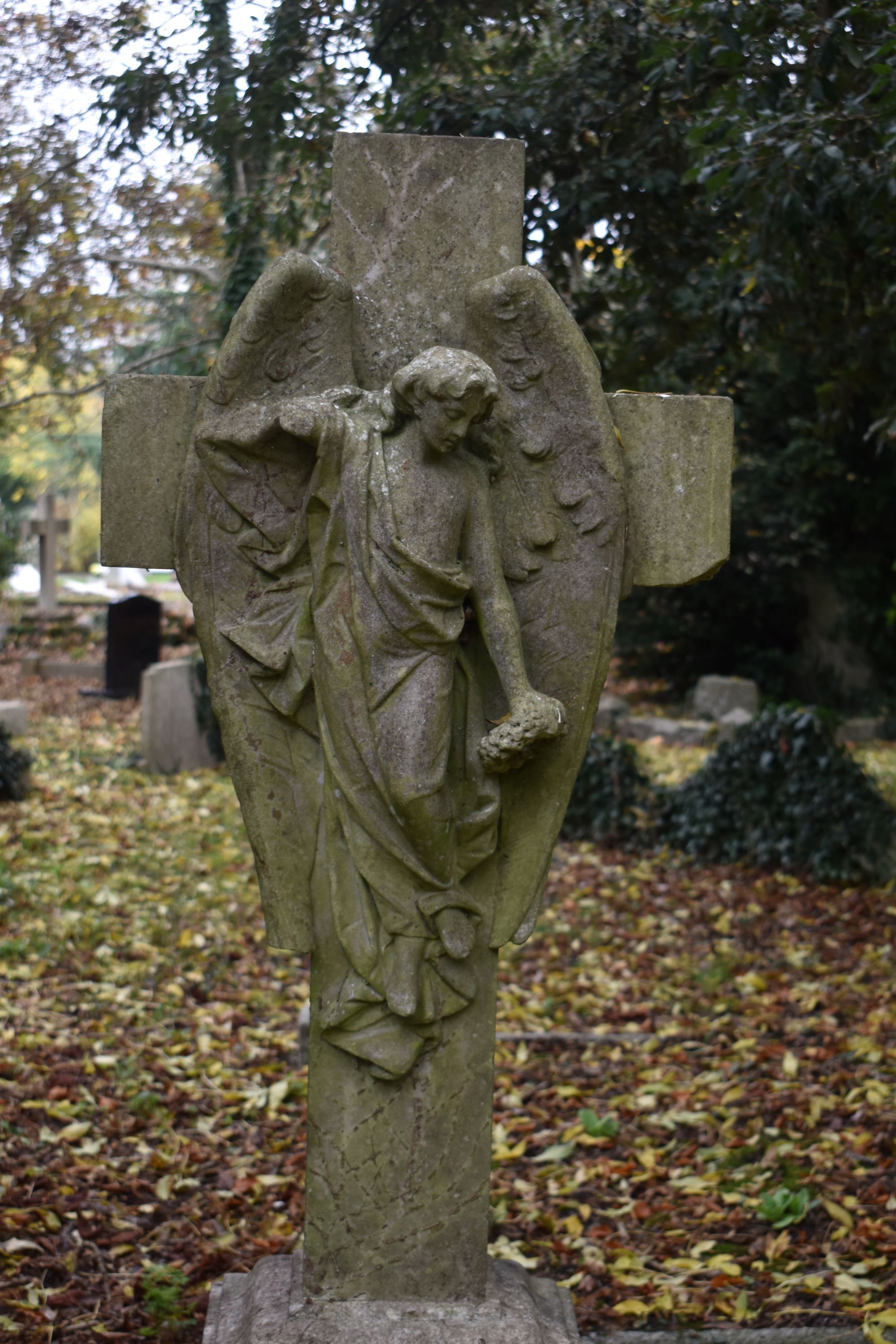
Another surprise was finding a definitely male angel draped in what could be described as a toga (it looked chilly) keeping watch over the grave of Arthur and Ethel Weston. It’s unusual as most angels in cemeteries and churchyards appear to be pretty, pensive young women.

A 2D representation of ‘Simply to Thy Cross I cling.’ ©Carole Tyrrell

There was a 2D representation of ‘Simply To Thy Cross I Cling’ on the Holness headstone. I found a metal Lourdes medal that had been placed on a stone cross.

Lourdes medal placed over a grave. ©Carole Tyrrell

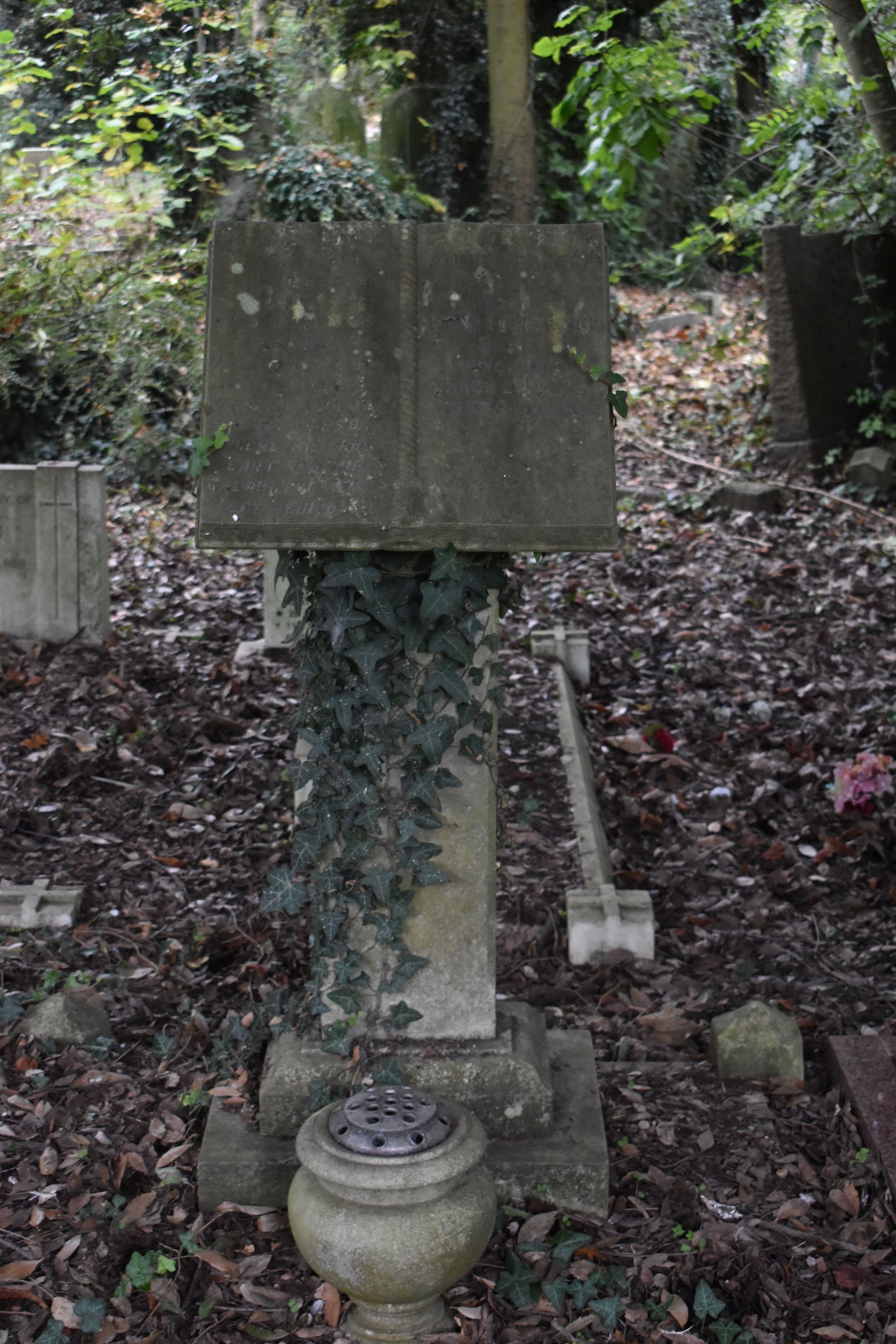
There was also a variant on the open book which was last month’s Symbol of the Month. Here it has been placed on a lectern style stand which made me think of the deceased standing up and telling all those around him of his or her good deeds or perhaps giving them a sermon.

The Open Book. ©Carole Tyrrell

On the elegant Devereux headstone dedicated to Thomas and his wife, Maria, I didn’t need to look at the epitaph to know that this was dedicated to a Royal Navy man. The two pillars have chains wrapped around them ending in two entwined anchors. There is also a Crown above them and the familiar shaking hands at the top.

The Deveraux headstone with naval symbols. ©Carole Tyrrell
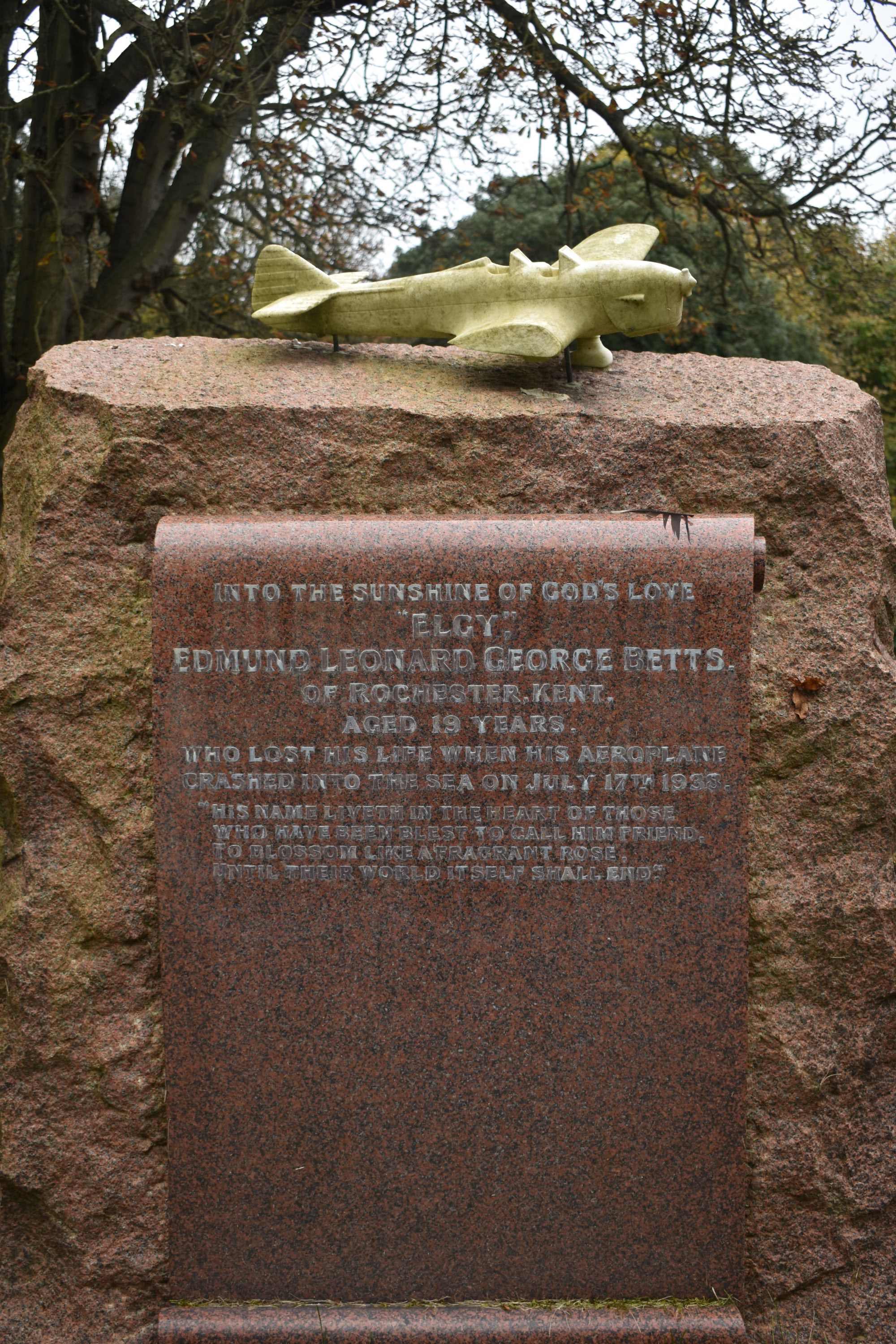
The model airplane on the Betts monument. ©Carole Tyrrell

I then came across my other surprise of the day when I found another Grade II listed monument. I was surprised that the small model airplane on top of it hadn’t been stolen although I saw very little vandalism in the cemetery. The monument is dedicated to Edward Leonard George ‘Elgy’ Betts who died aged 19 on 17 July 1938. I am indebted to Findagrave for the information about him:


….crashed into the sea with a 2 seater light aircraft after taking off from Ramsgate airport. He was flying a Miles Hawk Trainer airplane belonging to Thanet Aero Club and it crashed into the sea off Cliftonville, Margate, Kent. He and his passenger, 16 year old Marjorie Wall, were killed….. She is also buried in Margate Cemetery with her parents. The sculpture of the plane is and accurate representation of the plane in which he died, including the registration letters G-AEFU.’

Full view of the Betts monument. ©Carole Tyrrell

Ramsgate airport is long gone and has been replaced by an industrial. For a Sunday afternoon the cemetery was quite busy with visitors, mostly in cars, and a few like myself on foot. But I was aware that I didn’t have enough time on this visit to explore the entire cemetery so will do it in sections on future visits. I am already anticipating this although there is already plenty to write about!

©Text and photos Carole Tyrrell unless otherwise stated
References and further reading:

https://en.wikipedia.org/wiki/Victoria_Sanger_Freeman

https://en.wikipedia.org/wiki/Surfboat
https://courtauld.ac.uk/about-us/our-history/

https://en.wikipedia.org/wiki/Samuel_Courtauld_(art_collector)
https://en.wikipedia.org/wiki/John_Sanger
https://www.britannica.com/biography/John-Sanger
https://theisleofthanetnews.com/2017/12/15/a-service-has-marked-the-restoration-of-margates-surf-boat-memorial-and-the-loss-of-9-lives-in-the-tragedy/
https://margatelocalhistory.co.uk/Pictures/Pictures-Storms.html
https://daily.jstor.org/vintage-circus-photos-sanger-circus-collection/
https://www.findagrave.com/memorial/46295073/edmund_leonard_george-betts
https://historicengland.org.uk/listing/the-list/list-entry/1396419

https://victorianweb.org/history/education/ulondon/courtauld.html


Champers and cockleshells – a return visit to St James, Cooling August 2024

The Cockleshell vestry, St James Cooling, Kent. © Carole Tyrrell

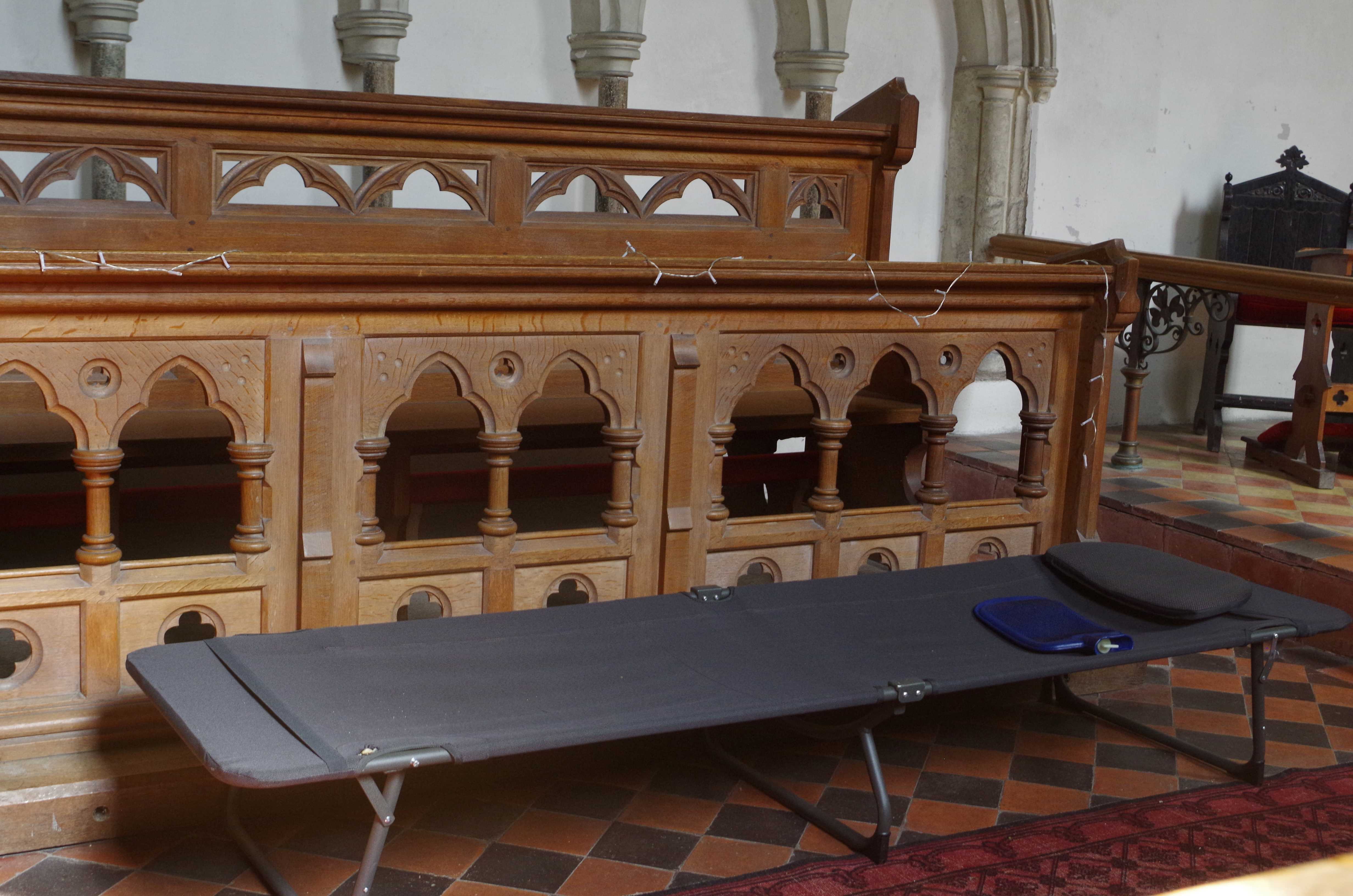
Maybe I just disturbed the nocturnal guests at St James’s and they felt compelled to hide but all appeared to be silent as I stepped inside the church.  But they were given away by 2 vacant camp beds in front of the altar and the small refreshment area by the pulpit. I thought that the hot water bottle on one of the camp beds was a nice touch as I stood there for a moment and wondered what it must have been like staying overnight in an empty church in such an isolated place. There are houses around the church but not that many. ‘Champing’, is a euphemism for overnight ‘camping’ in churches looked after by The Churches Conservation Trust. Don’t worry they’re not pitching tents! The church provided the campbed and the usual amenities. It’s really caught on in recent years and I have been tempted to try it myself.

A recently vacated Champers campbed. © Carole Tyrrell

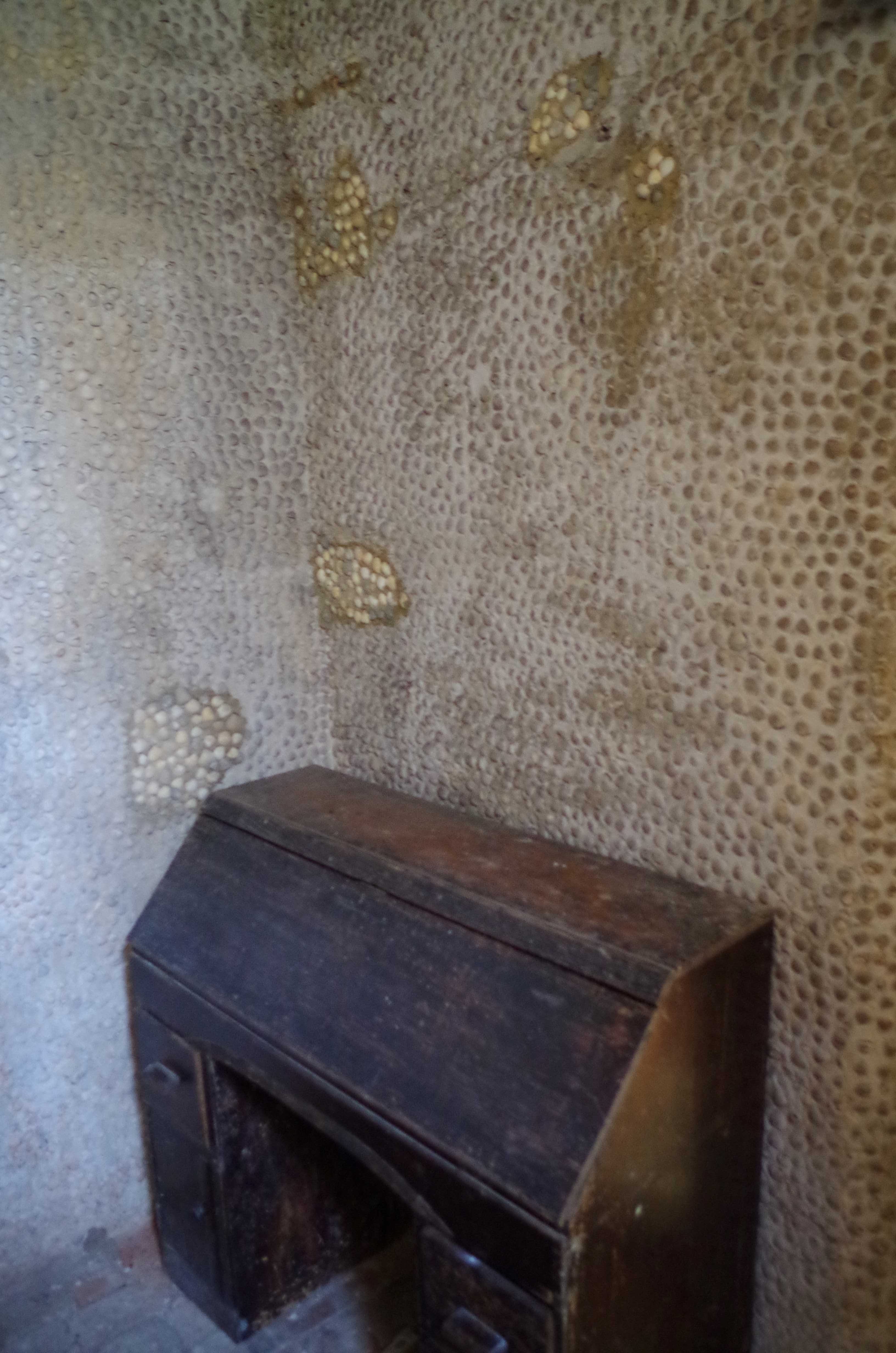
But I was at St James’s to see the cockleshell room which I’d missed on earlier visits. There wasn’t a sign advertising it but a quick look at the church map of the interior and I headed for the church organ. This time I found it! The door’s latch seemed to echo in the tranquillity as I pulled it open. The vestry is ‘compact and bijou’ as an estate agent would undoubtedly say – it is tiny and there was only a small open cobwebbed window, high up in the wall for ventilation. The room felt very warm and contained only a chair, possibly a recycled pew, and a bureau.

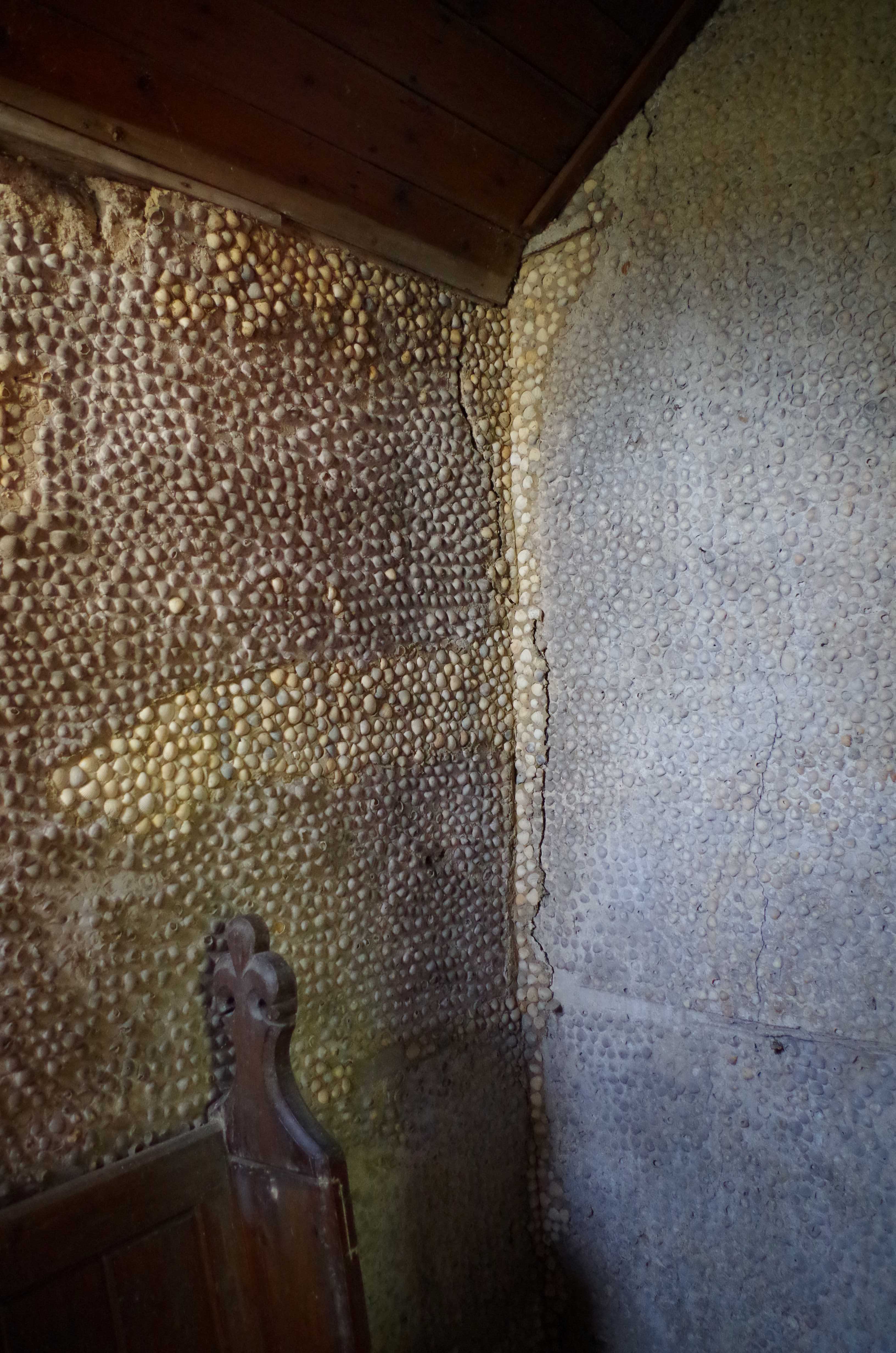
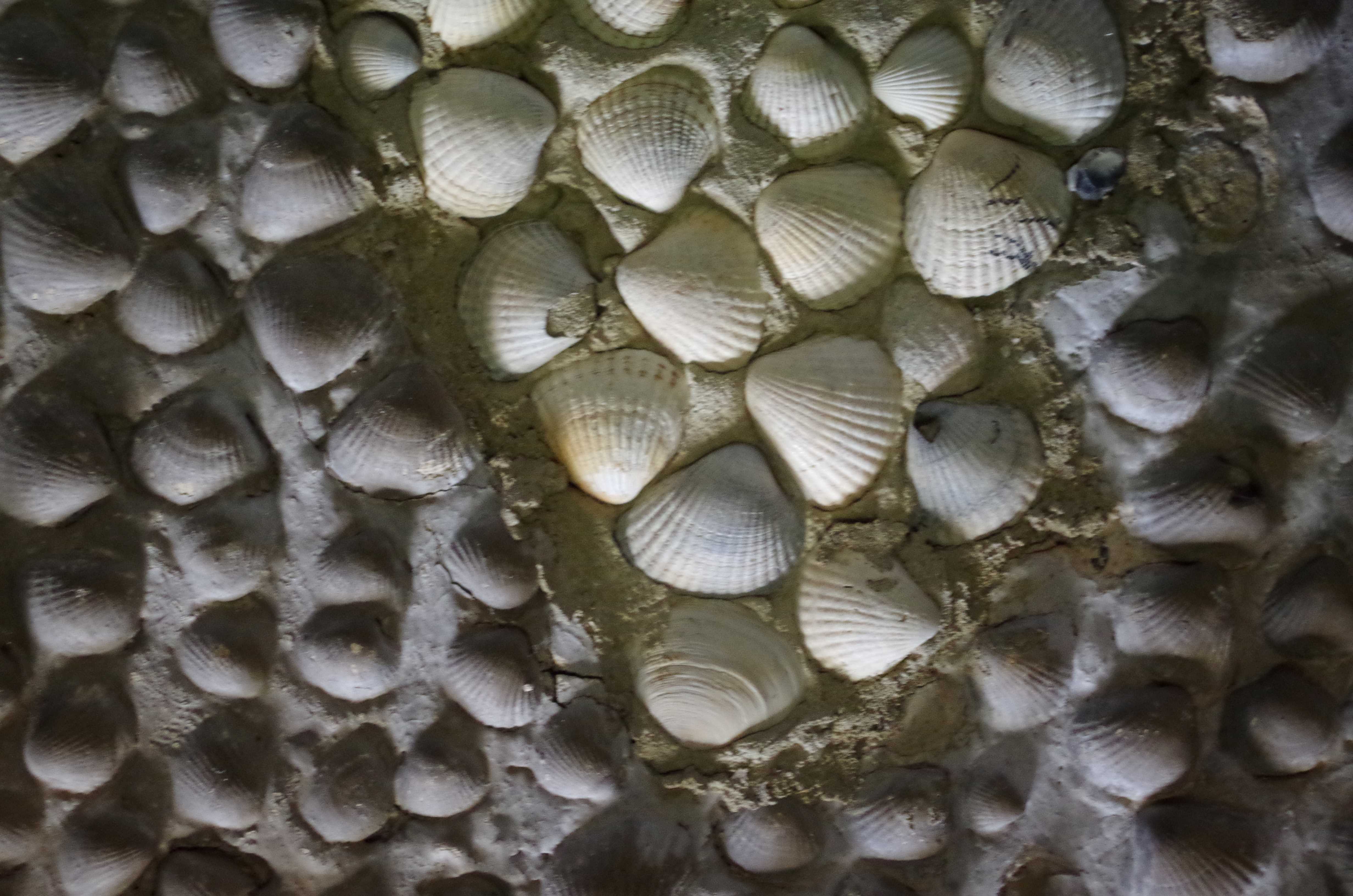
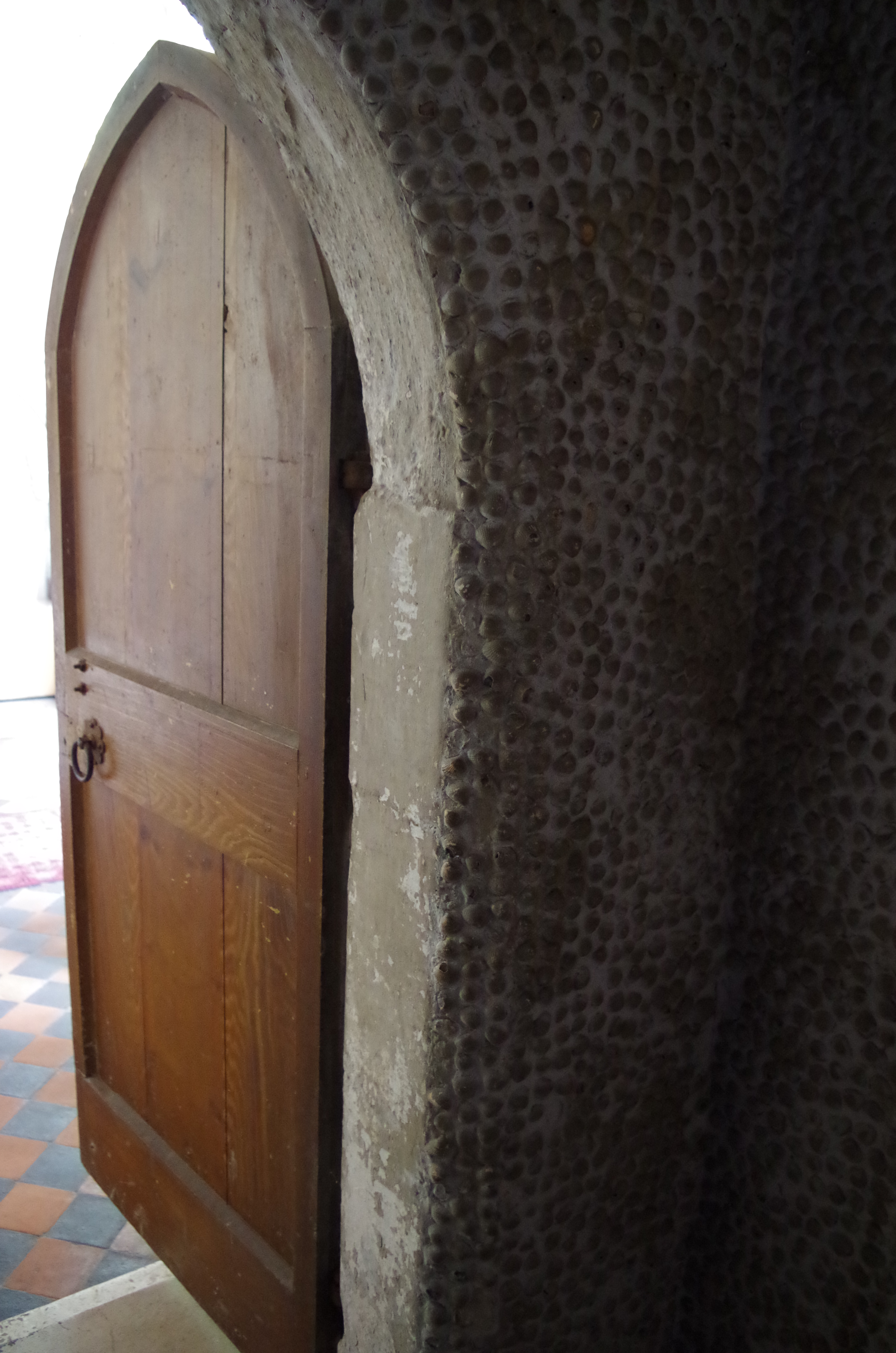
But it’s the thousands of cockleshells that made me catch my breath. They are floor to ceiling, arranged in patterns with newer ones being cemented in. I have to say that it did feel a little claustrophobic.  The vestry dates back to the 19th century and is considered to be either a reminder or perhaps homage to the shell being the symbol of the saint, St James. Shells would be worn in pilgrims’ hats as they went on the trail to his shrine in Santiago de Compostela. Above the door, and supposed to be, are initials and a date which may be 1833 or 1838.  The initials are I.M.  and I.C. CWARDENS which could stand for John Murton and John Comport churchwardens. I was looking in the wrong place so didn’t spot it but perhaps on another visit…. you do need a few minutes just to take it all in and try not to touch them although it is a very tactile surface.

View of the vestry. © Carole Tyrrell

Close up view of cockleshells on wall showing newer ones cemented in. © Carole Tyrrell

You can almost imagine what this room must have looked like at one time with newer shells. © Carole Tyrrell

View of bureau and walls. © Carole Tyrrell

View of church from vestry. © Carole Tyrrell

According to the Churches Conservation Trust, it’s considered to be

‘unique in an English church’.

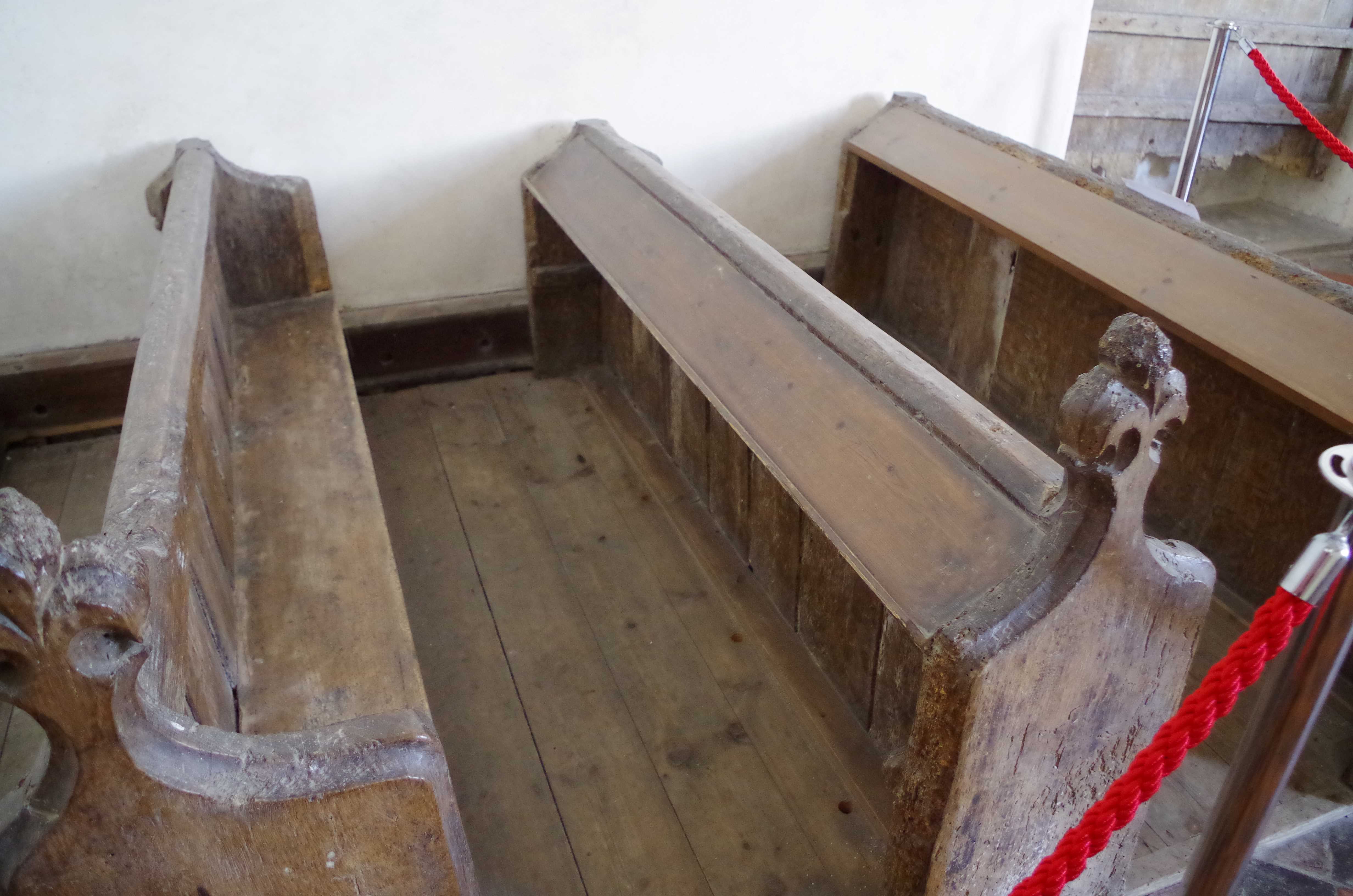
As I explored the nave after leaving the little room I saw the medieval benches that date back to the 14th century. They’ve evaded the iconoclasts of the 1600s and Victorian restoration but are now too fragile to be touched, much less sat on, and are now roped off.

The medieval pews – not considered comfortable by the Victorians. © Carole Tyrrell

The Murton memorial. © Carole Tyrrell

The name Murton appeared again on an elegant and poignant wall memorial to a sailor, John William, eldest son of John Murton of nearby Cooling Castle.  He died young, aged 28, after falling overboard from the Monarch off Rio de Janeiro during a voyage to Calcutta. The inscription on the marble tablet quotes from the ship’s captain’s log:

‘And so perished one of the finest and best hearted seamen who ever trod a ship’s deck. I have lost a trustworthy officer and valued friend. Peace be to his remains.’  

View of churchyard from inside church. © Carole Tyrrell

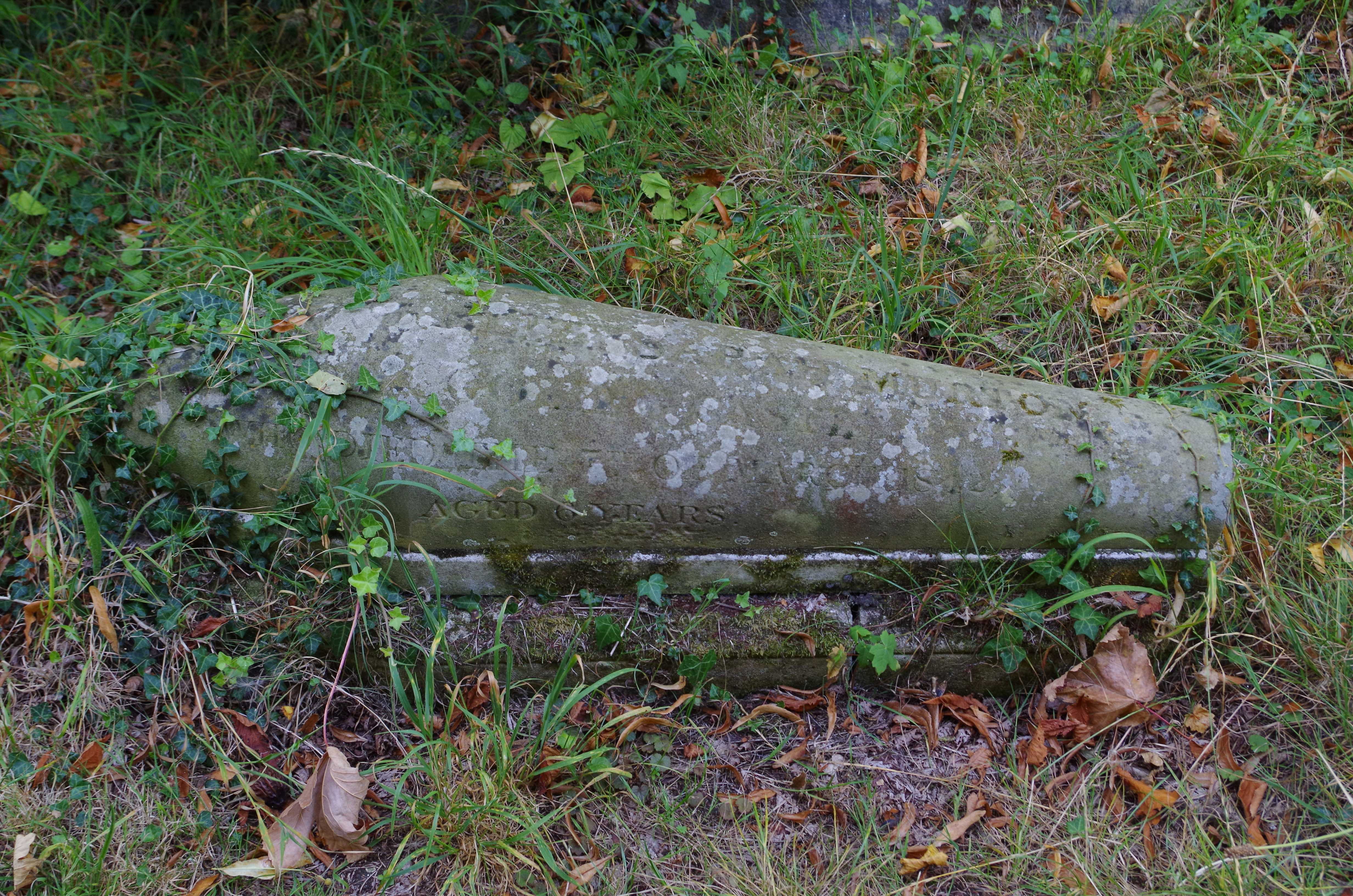
After that I went outside to see ‘Pip’s Graves’ and the table tomb on which Charles Dickens is reputed to have eaten his lunch. Across the marsh I could see docked ships and butterflies flitted about on the buddleia at one end of the churchyard.  I found a clergyman’s grave denoted by a chalice and more childrens graves. One was dedicated to a six year old. I also pursued a Common Darter dragonfly until it posed obligingly and checked to see if the little grinning demon still kept watch over the outside loo.  He did. I looked up as I left the churchyard and saw, glinting on the weathervane above the tower the representation of another cockleshell.

Docked ships over the marshes from the churchyard. © Carole Tyrrell

Common Darter. © Carole Tyrrell

The chalice symbol indicates the grave of a priest or clergyman. © Carole Tyrrell

A small grave dedicated to a 6 year old in another part of the churchyard. © Carole Tyrrell

Shell symbol on the weathervane. © Carole Tyrrell

View of St James from outside the churchyard. © Carole Tyrrell

The 18th historian, Edward Hasted, described Cooling as

‘an unfrequented place, the roads of which are deep and miry, and it is as unhealthy as it is unpleasant.’ 

It certainly is unfrequented as I was alone as I walked along Cooling Road to and from the church with only passing cars for company. The remains of the 14th century Cooling Castle, which is in private hands, are still impressive. Dark blue sloe berries were still on several bushes and windfalls clustered beneath apple trees in a nearby orchard.  I retraced my steps back to Cliffe for a wander round St Helen’s churchyard and then a very welcome cuppa in their café. 

But how I envied the ‘champers’ enjoying a good night’s kip(I hope) in that little corner of Kent.

© Text and photos Carole Tyrrell unless otherwise stated.

References and further reading

St James’ Church, Cooling, Kent | The Churches Conservation Trust (visitchurches.org.uk)

James the Great – Wikipedia

St. James | Biography, Apostle, the Greater, Death, Feast Day, & Facts | Britannica