They are the sentinels of the silent cities, standing tall and spreading out their branches to shade the last resting places of the permanent residents. Yew trees can often be older than the churches which they nestle beside in the churchyard and may predate Christianity as many churches were built on pagan sites of worship. In fact there are reputed to be at least 500 yew trees of this vintage! And incredibly, there are 10 yew trees in Britain that are believed to predate the 10th century.
These venerable trees have many associations and traditions. I will try and concentrate on a few but they are usually associated with churchyards and burial grounds. The most common one is that they are nourished by the decaying bodies beneath them and, as they can grow up to 20 metres high, this could seem plausible. Another tradition states that yews were planted on plague victims graves to protect and purify them – if this were true than some churchyards would resemble a forest!
Another common tradition is that they were planted to prevent ‘commoners’ from grazing their cattle on church ground. This was because yews are very poisonous to livestock. The needles are deadly, and Shakespeare used this in Macbeth when the three witches conjure up a deadly brew that contains, amongst other unpleasant ingredients:
‘Gall of goat, and slips of yew Silver’d in the moon’s eclipse,’
However, the Celts saw the yew as a symbol of immortality, death and resurrection. The yew’s drooping branches are able to root and form new trunks where they touch the ground. The one at St James in Cooling was living inside its dead ancestor which demonstrates its ability to renew itself.
In fact, they are one of the most long lived trees in Western Europe but are not considered ancient until at least 900 years old. The oldest tree in Scotland, and possibly Europe, is the magnificent Fortingall yew in Glen Lyon. It has been suggested that it is over 2000 years old and maybe even 9000 years old. It has numerous legends attached to it and in 1769 was reputed to have a girth of over 56ft. In 1854, funeral processions were reputed to be able to pass through the arch formed by its split trunk. The yew in St Cynog’s churchyard in Wales is a mere stripling at a reputed 5000 years old. One of the world’s oldest surviving wooden artifacts is a yew spear head which is estimated to be around 450,000 years old. They are evergreens with red berries which although are edible, the seed in the berry is extremely dangerous.
One of my favourite churchyards is that of St Marys in Painswick, Gloucestershire. It has 99 clipped yew trees but according to Roy’s blog post, attempts to grow a 100th tree have always failed. They are a dramatic sight to see!
I must admit that I would feel disappointed if I visited a churchyard and didn’t see a tall, majestic yew or two keeping watch over the dead as potent symbols of resurrection and immortality.
This summer I was out walking with a friend along the sea wall to Minnis Bay when we saw this little roadside shrine. It was on a popular route which is used by walkers and cyclists alike. On one side is the pebbly beach and on the other are marshes that stretch down to the railway line. It was touching to see that people, friends or perhaps fellow passers-by, had left little tributes of a bunch of flowers and stones.
The placing of stones on graves is something that I’ve always associated with the Jewish faith (see blog post ‘Silently slumbering for remembrance Part 1 dated 14 April 2016). If you have ever visited a Jewish cemetery then you will have noticed stones placed on top of graves and headstones and there may be a basket of stones available for this purpose. But over the last few years I have noticed them being placed on the graves of people who aren’t Jewish and I was intrigued by their possible meaning.
In the Jewish faith, it is believed that the placing of stones ‘keeps the soul down.’ This comes from the Talmud
‘which is the central text of rabbinical Judaism and is the primary source of Jewish religious law and theology’ Wikipedia
In the Talmud, it is stated that:
‘souls continue to dwell for a while in the graves in which they are placed. The grave was called a beit olam or a permanent home and was thought to retain some aspects of the departed soul. By placing stones, it becomes a way of the living helping the dead to ‘stay put’.
This may have brought comfort to those visiting the grave in that they may feel that their loved ones are still near.The Hebrew word for pebble is ‘tz’ror’ which can also mean ‘bond’. The placing of stones was also a mark of respect and a way of showing that someone had visited.
Stones were used because of their durability. The Ancient Greeks believed that using stones to mark graves would ward off evil spirits and they also symbolised the soul’s eternal nature as they didn’t change over time. They associated them with the god, Hermes. However, stones and their associations with burials have been known to many ancient cultures especially Ireland, Scandinavia North Africa, the Middle East and Asia amongst others where they used them to mark sacred territories where communities would gather to honour their dead. Also the Neolithic and Bronze periods in Europe in particular. Stones were used to create cairns. These are usually placed on top of graves as markers and to protect the dead from predators. In the Bronze Age they may have believed that the stones would stop the dead from rising as in the Jewish faith. Some of these still stand. The word ‘cairn’ comes from the Irish ‘carn’ with the plural being ‘cairn’ . In Scottish Gaelic ‘càrn’ translates to ‘heap of stones.’
They were also seen as a method of defence in that it would ward off predators from the burial site.
However, more recently, there has been controversy regarding the building of cairns on certain sites. This is due to the environmental damage that they can cause. Both the Hawaiian Volcano Observatory and the US National Park Service have complained about visitors prying off pieces from important geological features to make them as well as interfering with existing cairns and the destruction of important trail markers. In the Peak District one man has made his mission to kick down the dozens of stacks that he finds. BBC News reported that:
‘Many have been created by taking stones from an old wall which may have damaged the habitats of the small creatures that live inside the wall and may have long term effects according to the National Trust who will also disassemble any stacks.
The stacks are seen as :
…. not to mark any burial sites or act as markers but just create unnecessary stacks for aesthetic purposes forgetting their original purpose as wayfinding tools and symbols rather than decorations.’
The stones that have been left behind on the little seawall shrine, have presumably, come from the beach below and are a poignant symbol of remembrance signifying that the departed has been visited. The stones emphasise the enduring nature of memory and ite sbaility to enable the departed to live on. He is not forgotten by those who knew him and he died at one of his favourite places. RIP.
Happy New Year to all my readers and what an auspicious year it is for shadowsflyaway!
It’s 10 years since I began this blog on July 10th 2015 to be exact and some of my readers have been with me since the very beginning. Even now I am still discovering new symbols to write about, little mysteries that I find in churchyards and cemeteries that intrigue and inspire me.
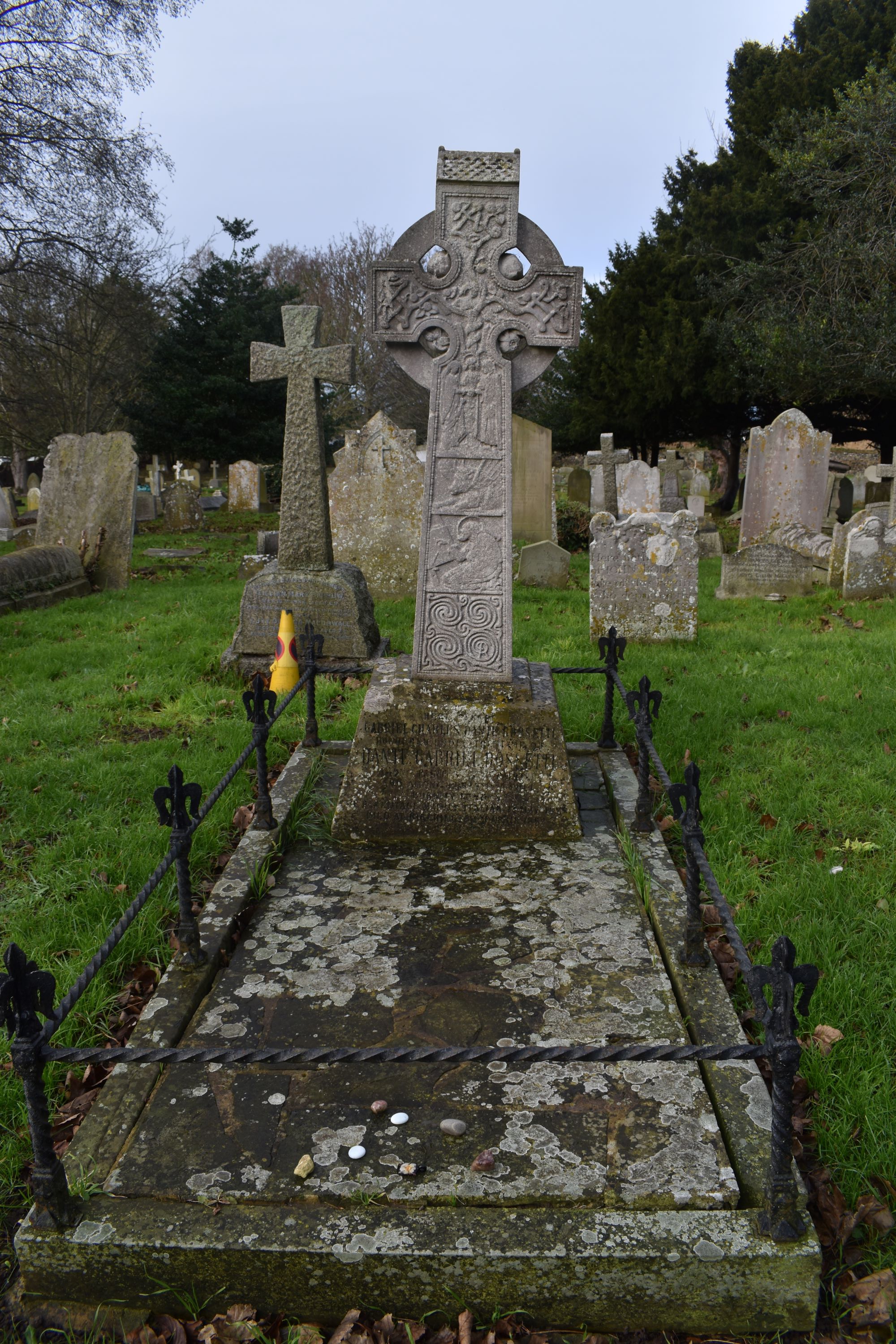
Here are a couple that I found on a Christmas Eve walk in All Saints churchyard, Birchington on Sea. This is where the 19th century Pre-Raphaelite artist, Dante Gabriel Rossetti is buried with a Celtic Cross over his grave. It was a dull grey day, enlivened only by the bright efforts of the town’s yarn bombers.
An example of one of Rossetti’s most beautiful paintings, ‘Lady Lilith’.
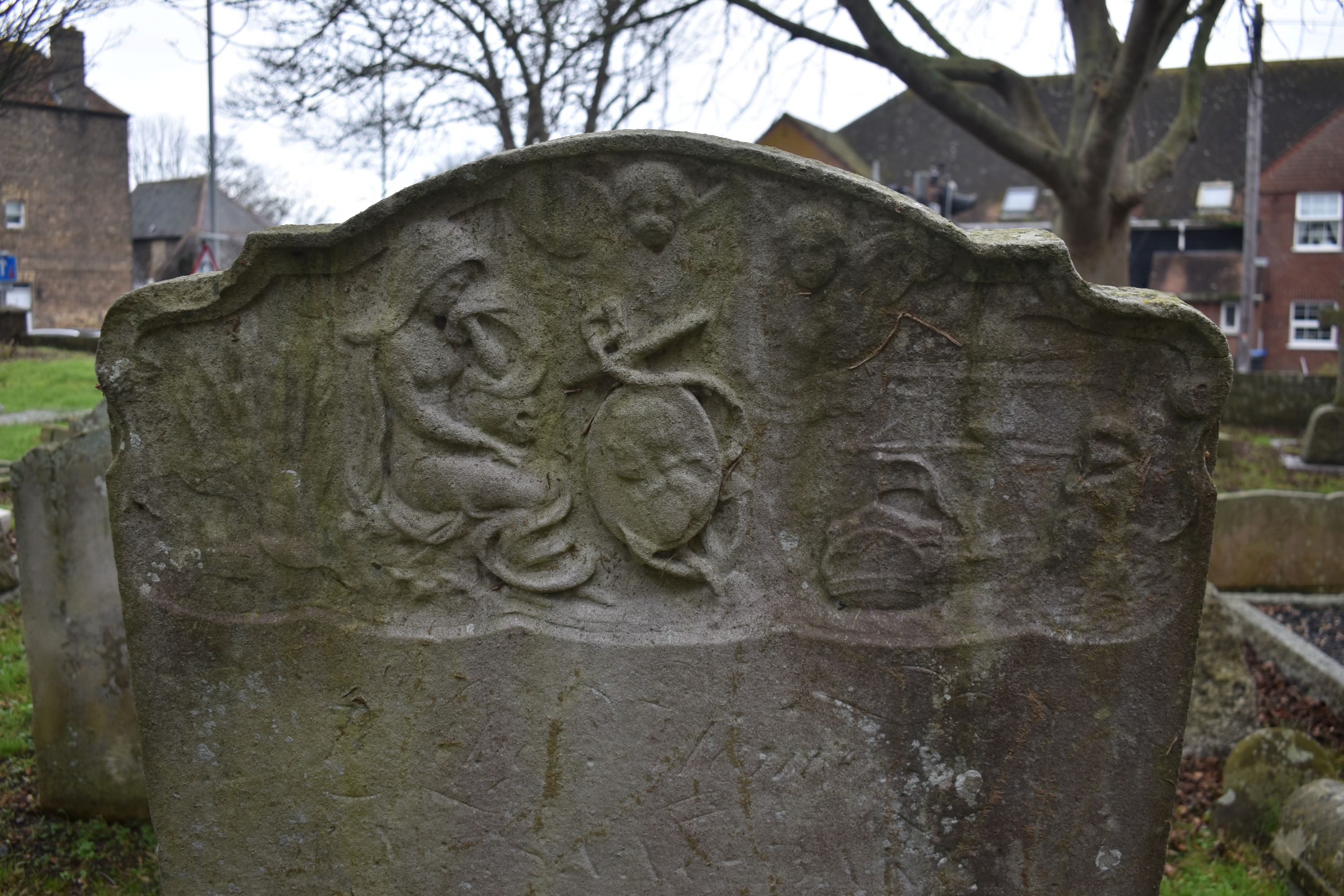
But these two stood out. The first one was located by the original church door and appeared to be a variant on the mourning woman symbol as a woman, wearing a billowing gown or cloak, weeps over a man’s portrait. He faces her in profile and is dressed in 18th century fashion with a small ponytail and is within an oval frame. She sits with a skull on her lap. The portrait is supported by a large anchor whose rope ripple around and behind it. Above it there are two floating angel heads or winged messengers. The carvings on either side of the tableau were indistinct under the overcast sky. But a sunny day can often bring out details of carvings and epitaphs so I will return. The anchor would indicate a naval man and I have to say that that, on first look, the folds of cloth around the lower half of the woman resembled a mermaid’s tail to me. But that may just be me being more fanciful… It’s an impressive headstone with the central figures still crisp. I would hazard a guess that this is from the 18th century.
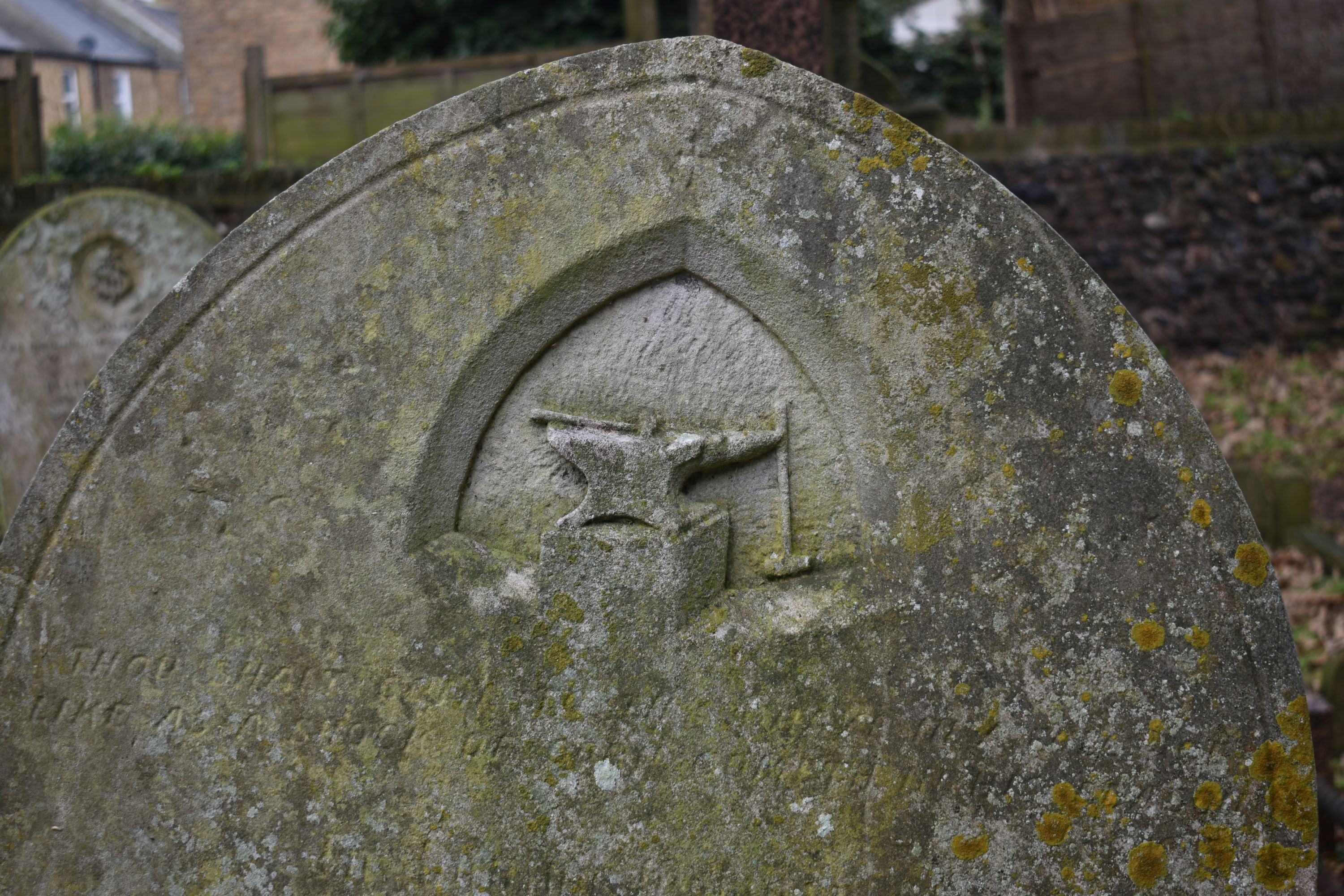
The other one is on a 19th century headstone and features an anvil and tools. On first glance I thought it might belong to the village blacksmith. But it’s dedicated to a woman, Elizabeth Adams. Underneath the motif is what appears to be a quotation which I thought might have come from the Bible. But, so far, I haven’t found anything that resembles it but a burst of bright sunshine could illuminate it further on a future visit.
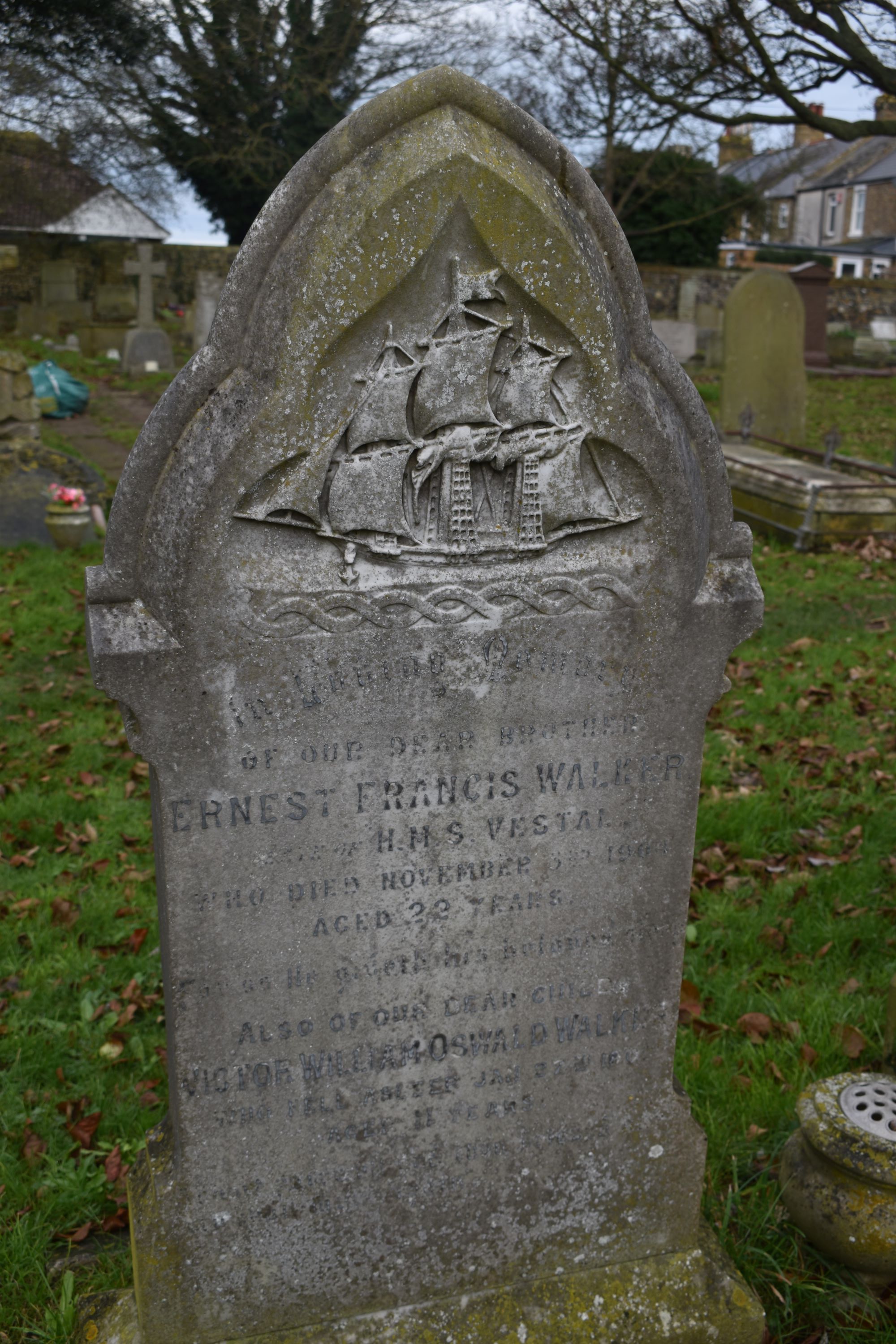
A ship is permanently sailing on Ernest Francis Walker’s headstone with a border of entwined ropes beneath it. The epitaph states that he was a crew member on HMS Vestal and so I presume the carving of a ship is a representation of it. Ernest died young at 22 and there are several ships that bear this name. The one that I think is most likely is a 26 gun sixth rate frigate of the Royal Navy. She was launched in 1833 and sailed in the West Indies and the Caribbean. In 1852 she ran aground near the Needles on the Isle of Wight and was taken to Portsmouth for inspection and repair prior to being decommissioned in 1860 and then broken up in 1862.
I am already looking forward to what else I will discover in 2025 including the spooky angel in a Broadstairs churchyard but I am determined to wait for a really foggy day for that one!
It’s often on a winter’s night, just as dusk begins to fall and the lamp lights in St Georges churchyard come up, that the fine selection of 18th century tombstones are at their best. Carved skulls leer at you, an hourglass emphasises time passing and the gravedigger’s tools stand ready for the next interment. And perhaps there is still a phantom schoolteacher using his sculpted globe to teach geography to his spectral students.
There has been a church on this site since the 14th century and, in one place in the graveyard the number of burials over the centuries has made the ground rise up on both sides. But, as well as 18th century examples of funerary symbolism, there are also some wonderful 19th century ones as well. Inside the church there’s also a good selection of impressive wall monuments dedicated to prominent local families dating back to the 1600’s. They are buried in the vaults beneath the church. St George’s also has the country’s oldest lych gate in that the current one incorporates elements from a far older one. The churchyard is a pretty one for a short walk through to the bustling High Street especially when the spring flowers begin to appear, carpeting the grass between the stones with bluebells and flitting butterflies.
However for this month’s Symbols post I will concentrate on the 18th century memorials within the churchyard. These tombstones are topped with classic memento mori symbols. This is Latin for ‘remember (that you have) to die.’ They are the visual accompaniment to the immortal epitaph from Dundee’s Howff graveyard:
‘Remember Man as you pass by
As you are now so once was I
As I am now so must you be
Remember man that you must die.’
Graveyard symbolism, according to Douglas Keister, began when the well to do could no longer be buried with in their local church due to lack of space. Instead, they took up their eternal residence in the newly consecrated burial grounds outside and surrounding the church walls. These were often known as ’God’s Acres’ and gave the wealthy the opportunity to erect a lasting memorial or tombstone in their memory.
St George’s churchyard became the last resting place of prominent local families, some of whose descendants still live in the area. The oldest tombstone dates from 1668 and the 18th century ones are nearest to the church walls which in effect meant that they were ‘Nearer my God to Thee.’
I’ve always enjoyed walking through the churchyard as it can feel like walking through a gallery of funerary symbols. There’s something very exuberant about these 18th Century motifs of mortality even though some have eroded and only one epitaph is still fully readable. However, the skull and crossbones, the Death’s Heads and others have, in several cases, lasted better than the epitaph below them.
The skull and crossbones are an effective, if macabre, reminder of what is left of a body after it decomposes and there are several good examples in St Georges.
This one is near the church entrance and features a skull and crossbones with what appear to be protruding palm fronds. It also seesm to be resting on something whch may be a shield. All that can now be read on the epitaph is…who dep….’
Nearby is another skull and crossbones with a winged hourglass above it. This is a reminder that ‘Time flies’ or ‘Tempus Fugit’ and that the onlooker will soon be bones and dust. So it’s important to make the most of their time on earth. On the left hand side is a pick and shovel. These are a sexton’s tools which made me wonder if this was a sexton’s grave but the epitaph is now illegible. The sexton’s role not only encompassed maintaining and looking after the church but also the churchyard. In larger graveyards the sexton would have been more of a manager but in smaller ones he would have had sole responsibility for preparing the ground, digging and closing the grave, mowing the lawn and also maintaining the lawn and paths.
Skulls also feature prominently on two other tombstones on the other side of the church very near the wall. One seems to have a very sharp pair of horns and a definite smirk. On each side of it there appear to be small trumpets but it’s too weathered to see if anyone’s blowing them. Maybe he’s keenly anticipating the Last Day of Judgement.
Nearby is a large tombstone with what seem to be two somersaulting skulls on them although one is more eroded than the other. Below them is a small worn hourglass. I believe that these two examples of skulls may be unique to St Georges as I’ve haven’t yet seen them anywhere else.
Douglas Keister has suggested that the skull and crossbones slowly began to be replaced by the much less stark and macabre ‘Death’s Head.’ This is a human face with wings on either side of it. I’ve always known it as the ‘winged cherub’ and there are also several good examples within the churchyard. These are symbols of resurrection intended to give those left behind some hope.
I am also a huge fan of calligraphy having studied it for two years at evening classes and it has undergone a revival on late 20th and early 21st century tombstones. However 18th century calligraphy has a style all of its own and is instantly recognisable. The only legible 18th century epitaph in St Georges is the one dedicated to a John Saxby. It reads:
‘Here lyeth the body of John Saxby of the Parish who Departed this life…year of May 1731 aged 41 years.’
A fine example of a Death’s Head is on top with an open book beside it which may be the Bible or the Book of Life and there’s a stylised flower on the other side. The open book may be a depiction of the incumbent offering their life to God for judgement as an ‘open book’. People are sometimes described as an ‘open book’ as they have their feelings and thoughts open to the world with no attempt to hide them.
On another memorial two small faces, presumably from the angelic host, peer out from either side of the clouds surrounding a crown. It’s a representation of the reward that awaits the faithful in heaven. This verse from the Bible refers to it:
James 1:12 New International Version (NIV)
‘Blessed is the one who perseveres under trial because, having stood the test, that person will receive the crown of life that the Lord has promised to those who love him. ‘
A plump faced death’s head is surrounded by another open book and what I think maybe a small skull in the far corner of the stone.
But one of the most unique and impressive tombstones in St George’s, or perhaps anywhere, is that of John Kay. He was an 18th century schoolmaster and his life and talents are recorded by the tools of his trade that have been carved on his stone. There’s a globe on a stand, a trumpet, what appears to be a cornet, an artists palette, a pair of compasses and other items which are now too indistinct to read. He was obviously very erudite and much appreciated by his students. Sadly his fulsome epitaph is now virtually unreadable. He lies near Mr Saxby under a spreading yew tree.
On the other side of the graveyard is a large chest tomb. There is a dedication and an armorial on its top and I feel that some patient research in St George’s burial registers may reveal the incumbent’s identity. There are blank cartouches on each side with death’s heads on top and two skulls beneath each one. At one end are palm fronds which are a Roman symbol of victory which were then adapted by the Christians as a martyr’s triumph of death. The palm as a symbol originated in the ancient Near East and Mediterranean region and is a powerful motif of victory, triumph, peace and eternal life. It’s traditionally associated with Easter and Palm Sunday and Christs’ resurrection and victory over death. On the other end of the tomb are what appear to be olive flowers. The olive’s association with wisdom and peace originally came from Greek mythology when the goddess, Athena, presented an olive tree to the city that was to become Athens. Successive Greek ambassadors then continued the tradtion by offering an olive branch of peace to indicate their goiod intentions. The olive tree is also associated with longevity, fertility, maturity, fruitfulness and prosperity. In the Bible, Noah sent the dove out after the Flood to see if the floodwaters had receded and when it returned with an olive leaf in its beak Noah knew that the Flood had ended. Even today the phrase ‘ offering an olive branch’ means the someone wants to make peace. But in this context the olive branch may mwean that the soul has departed with the peace of God. So one memorial incorporates powerful motifs of mortality and resurrection.
St George’s has also used old tombstones to pave two of the pathways within the churchyard of which some are still readable. It always feels as if I’m walking over someone’s grave although they are buried elsewhere in the graveyard. However, although the 19th and 20th century memorials are rather more restrained and far more legible I prefer the more ‘in your face’ 18th century symbols. But in the case of the horned skull I can only frustratingly only guess at its meaning and the person who lies beneath…..
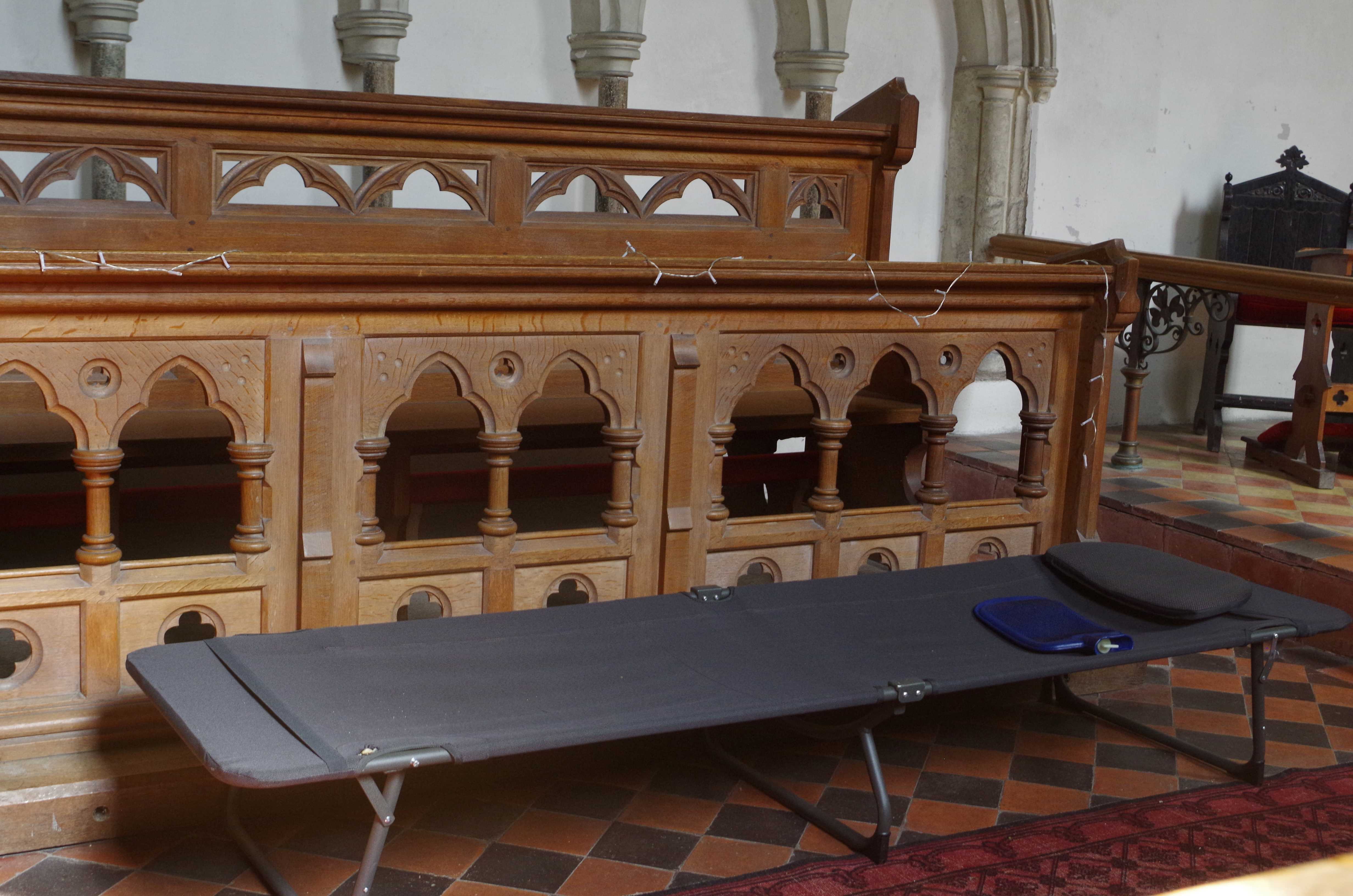
Maybe I just disturbed the nocturnal guests at St James’s and they felt compelled to hide but all appeared to be silent as I stepped inside the church. But they were given away by 2 vacant camp beds in front of the altar and the small refreshment area by the pulpit. I thought that the hot water bottle on one of the camp beds was a nice touch as I stood there for a moment and wondered what it must have been like staying overnight in an empty church in such an isolated place. There are houses around the church but not that many. ‘Champing’, is a euphemism for overnight ‘camping’ in churches looked after by The Churches Conservation Trust. Don’t worry they’re not pitching tents! The church provided the campbed and the usual amenities. It’s really caught on in recent years and I have been tempted to try it myself.
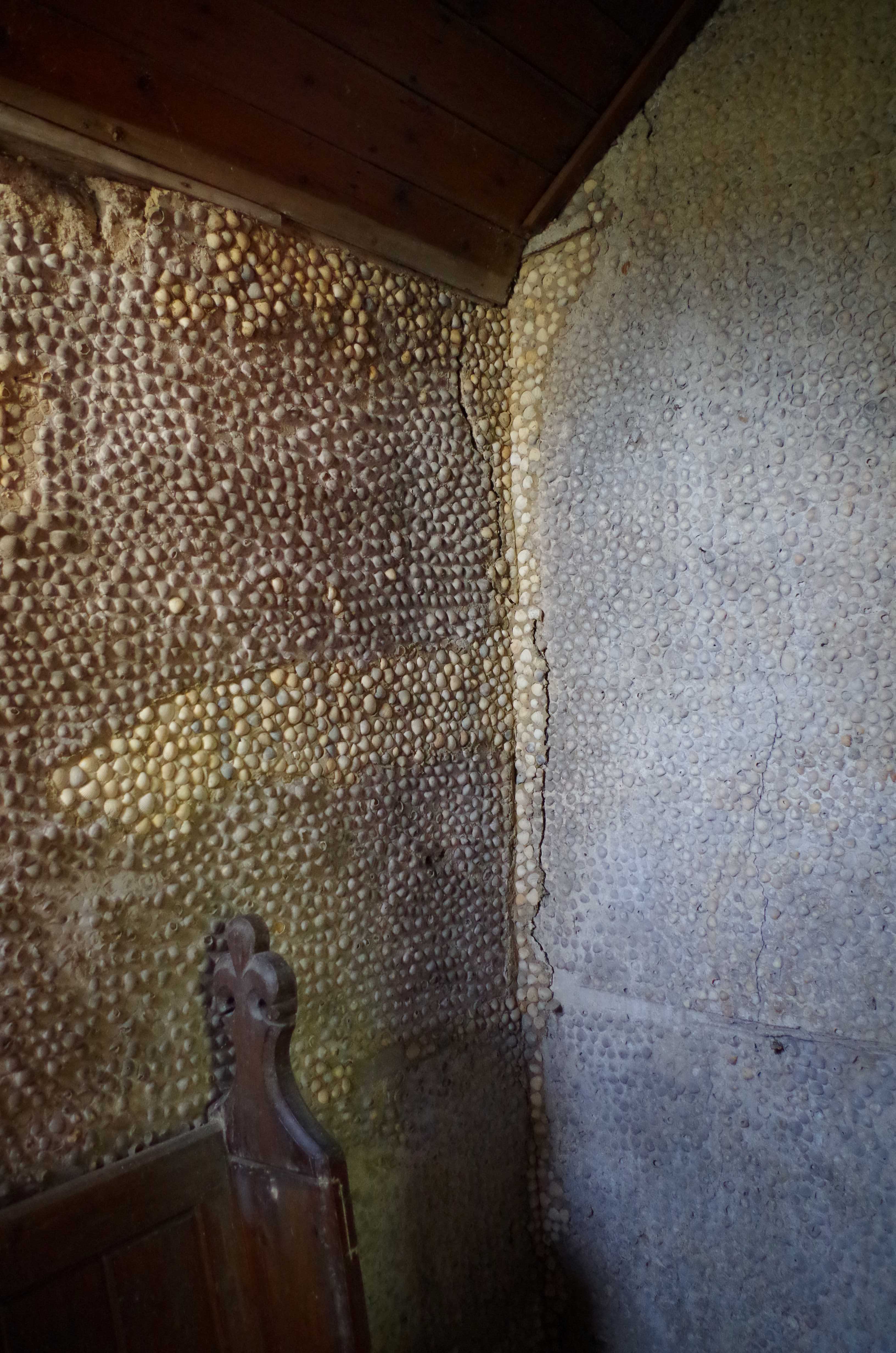
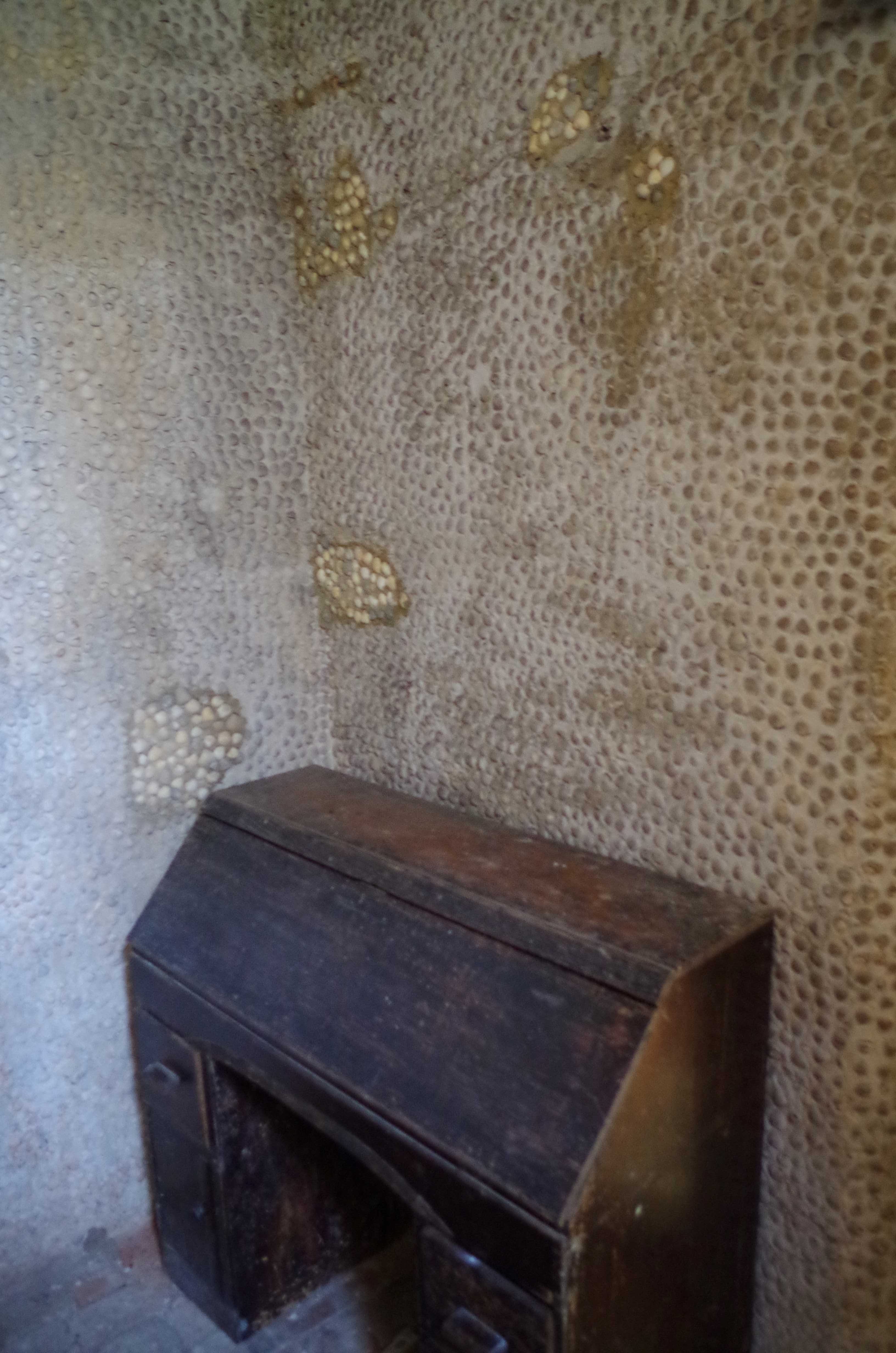
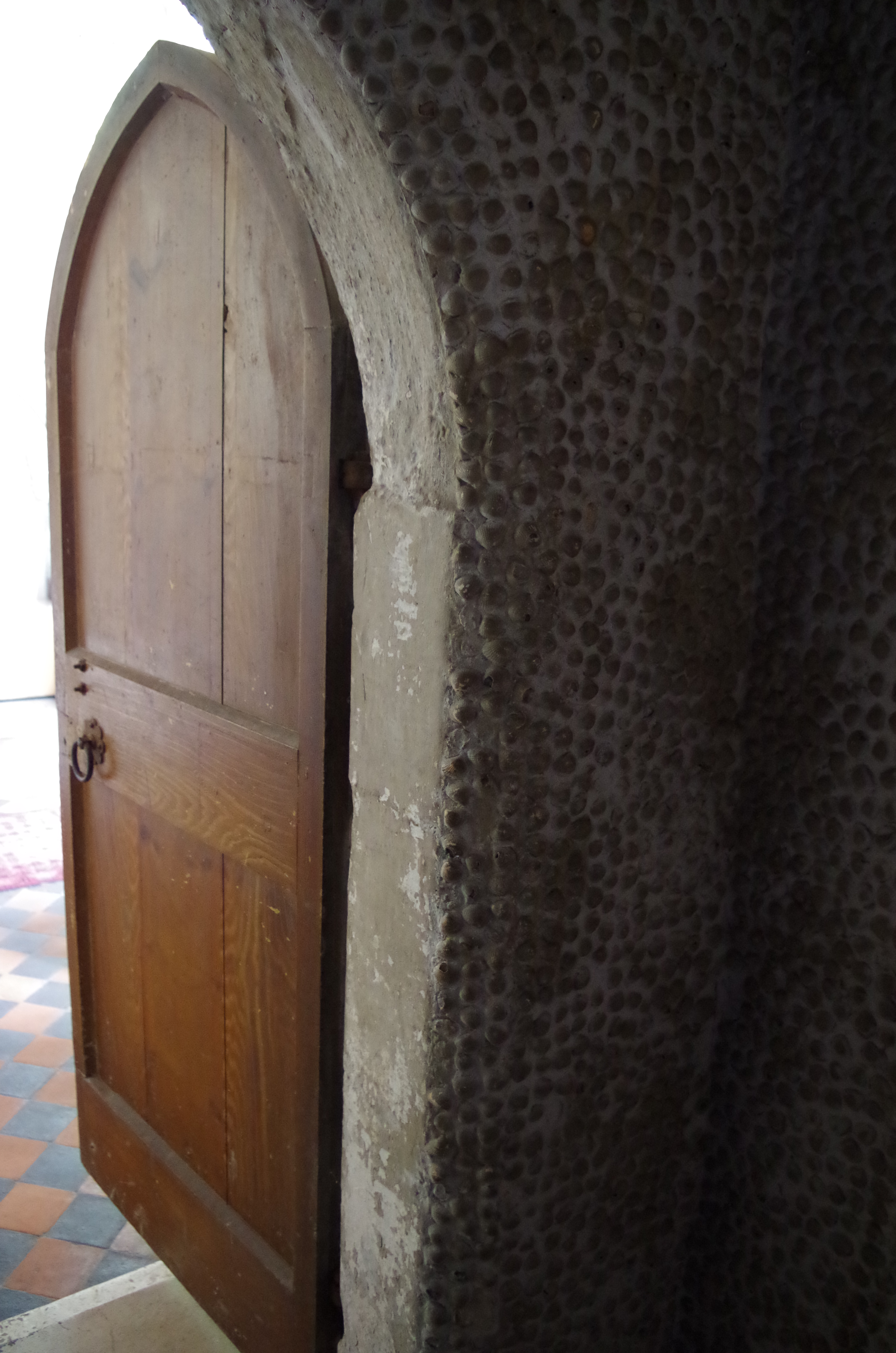
But I was at St James’s to see the cockleshell room which I’d missed on earlier visits. There wasn’t a sign advertising it but a quick look at the church map of the interior and I headed for the church organ. This time I found it! The door’s latch seemed to echo in the tranquillity as I pulled it open. The vestry is ‘compact and bijou’ as an estate agent would undoubtedly say – it is tiny and there was only a small open cobwebbed window, high up in the wall for ventilation. The room felt very warm and contained only a chair, possibly a recycled pew, and a bureau.
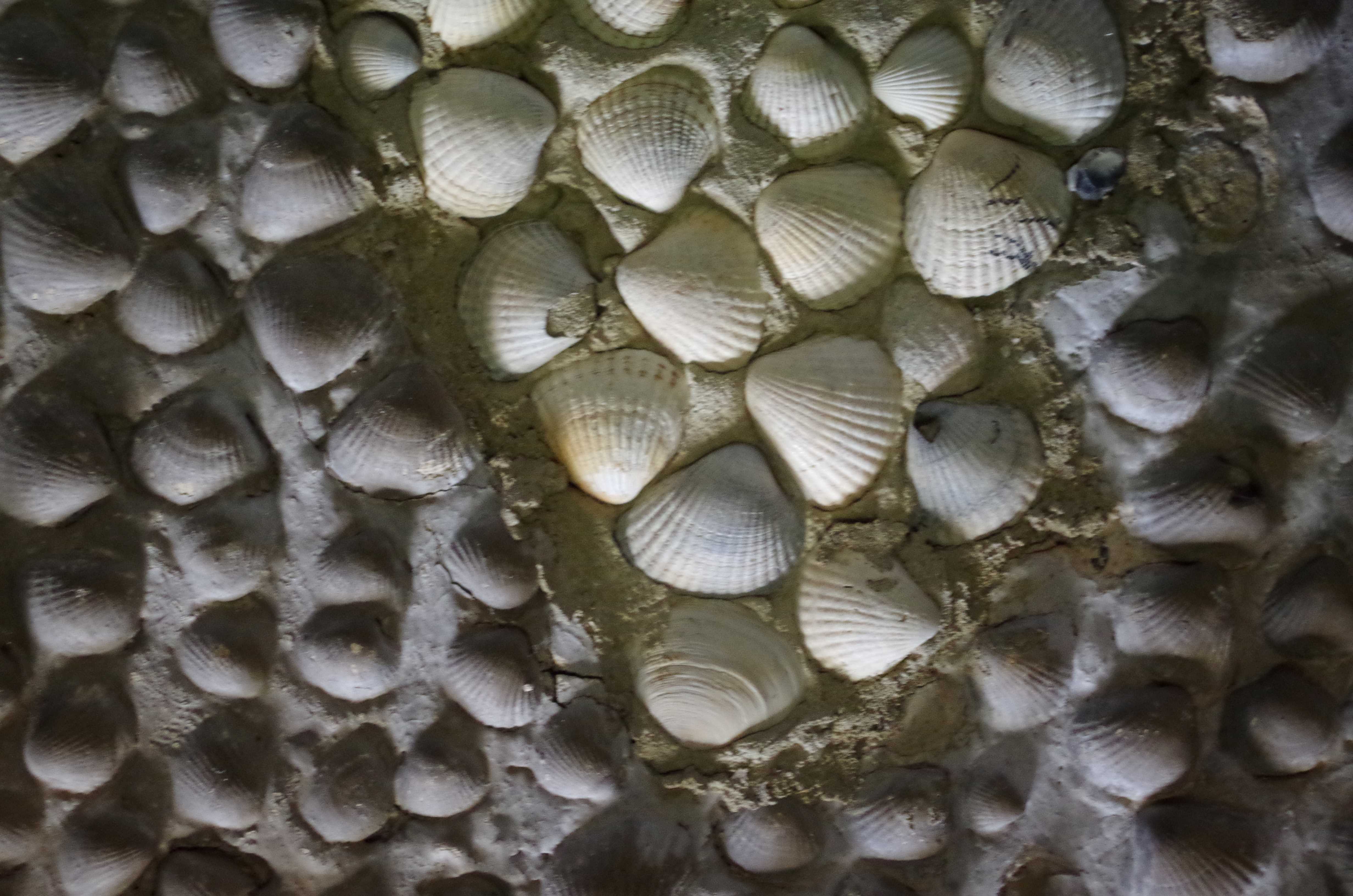
But it’s the thousands of cockleshells that made me catch my breath. They are floor to ceiling, arranged in patterns with newer ones being cemented in. I have to say that it did feel a little claustrophobic. The vestry dates back to the 19th century and is considered to be either a reminder or perhaps homage to the shell being the symbol of the saint, St James. Shells would be worn in pilgrims’ hats as they went on the trail to his shrine in Santiago de Compostela. Above the door, and supposed to be, are initials and a date which may be 1833 or 1838. The initials are I.M. and I.C. CWARDENS which could stand for John Murton and John Comport churchwardens. I was looking in the wrong place so didn’t spot it but perhaps on another visit…. you do need a few minutes just to take it all in and try not to touch them although it is a very tactile surface.
According to the Churches Conservation Trust, it’s considered to be
‘unique in an English church’.
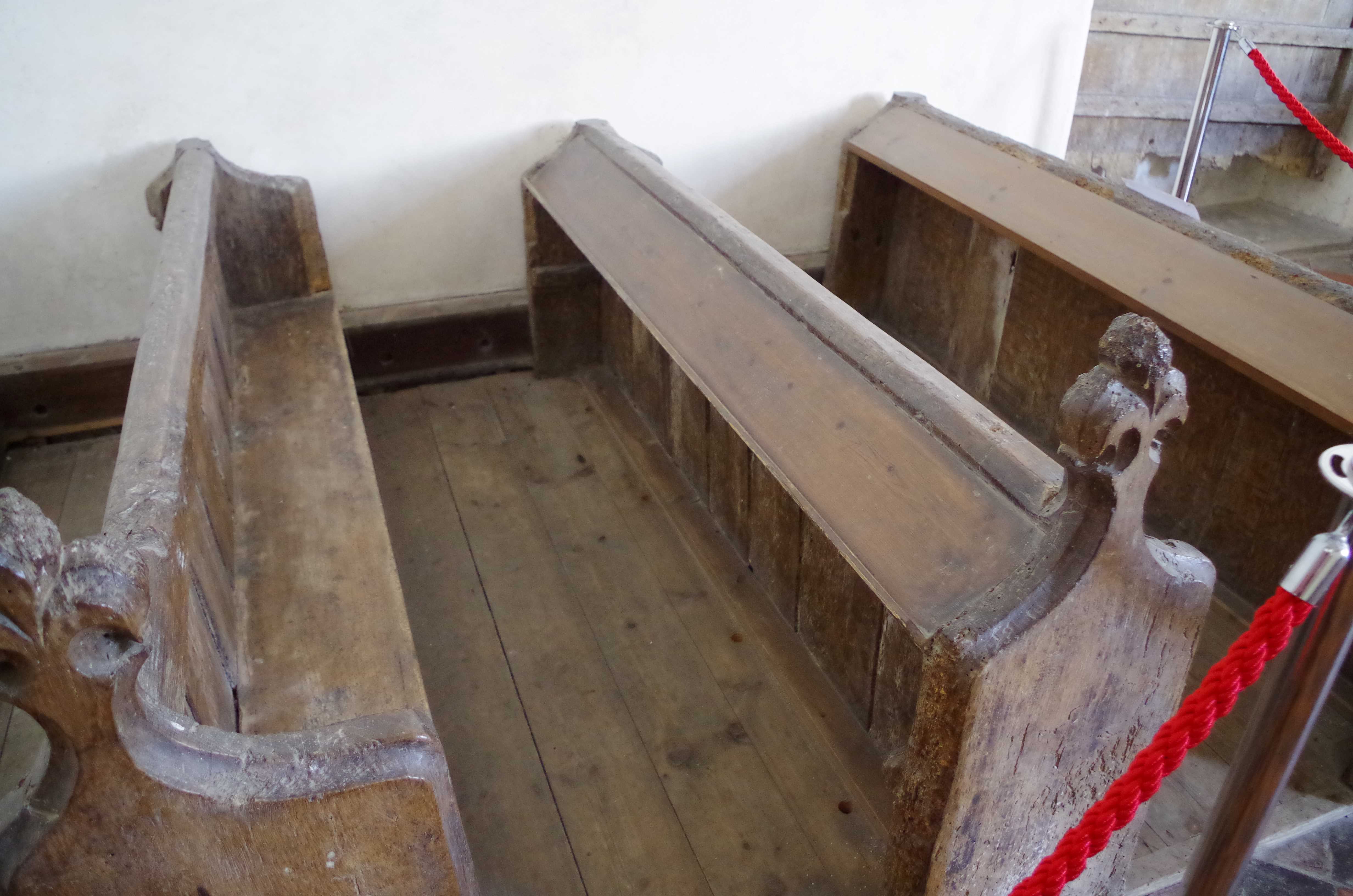
As I explored the nave after leaving the little room I saw the medieval benches that date back to the 14th century. They’ve evaded the iconoclasts of the 1600s and Victorian restoration but are now too fragile to be touched, much less sat on, and are now roped off.
The name Murton appeared again on an elegant and poignant wall memorial to a sailor, John William, eldest son of John Murton of nearby Cooling Castle. He died young, aged 28, after falling overboard from the Monarch off Rio de Janeiro during a voyage to Calcutta. The inscription on the marble tablet quotes from the ship’s captain’s log:
‘And so perished one of the finest and best hearted seamen who ever trod a ship’s deck. I have lost a trustworthy officer and valued friend. Peace be to his remains.’
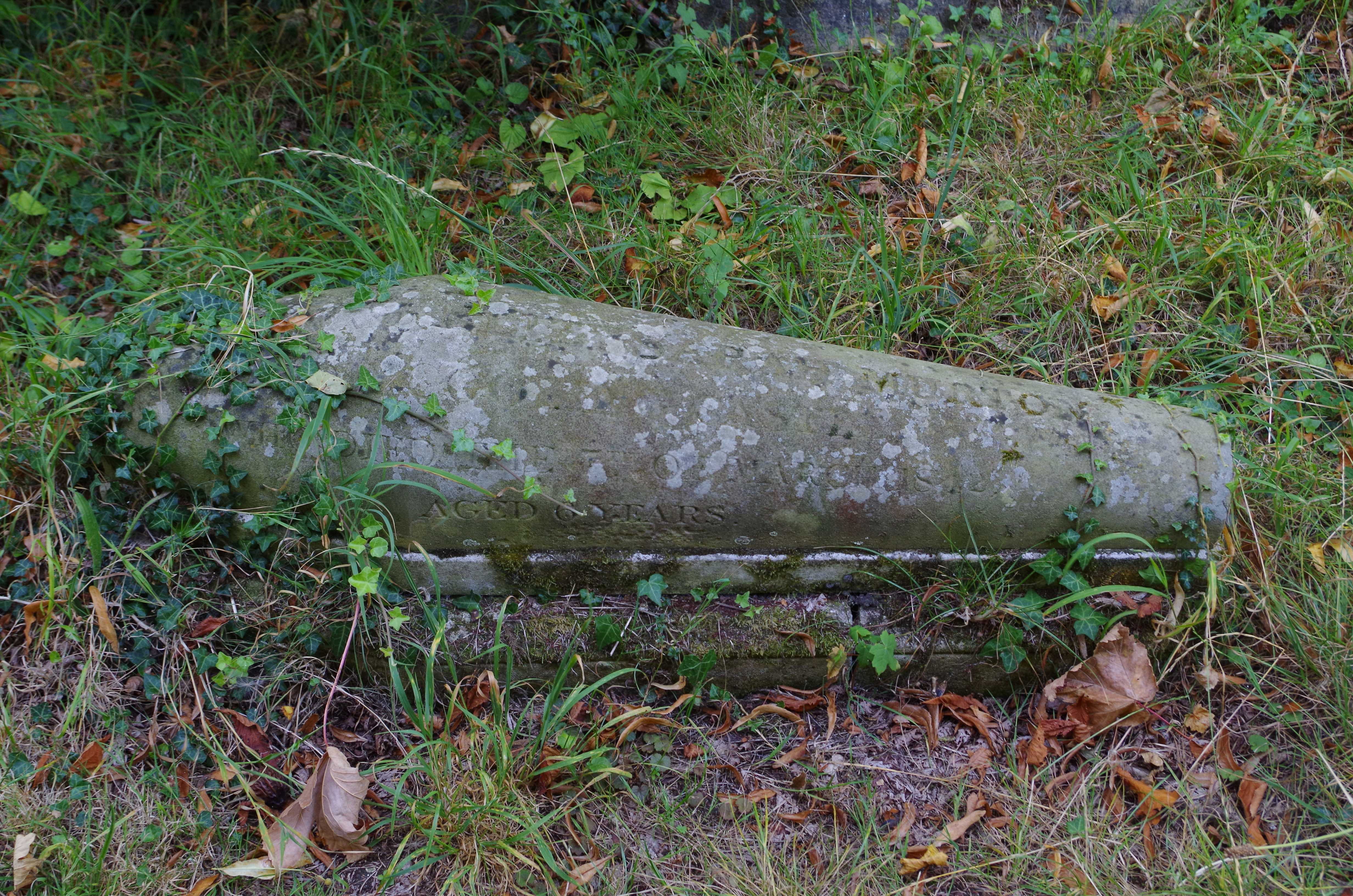
After that I went outside to see ‘Pip’s Graves’ and the table tomb on which Charles Dickens is reputed to have eaten his lunch. Across the marsh I could see docked ships and butterflies flitted about on the buddleia at one end of the churchyard. I found a clergyman’s grave denoted by a chalice and more childrens graves. One was dedicated to a six year old. I also pursued a Common Darter dragonfly until it posed obligingly and checked to see if the little grinning demon still kept watch over the outside loo. He did. I looked up as I left the churchyard and saw, glinting on the weathervane above the tower the representation of another cockleshell.
The 18th historian, Edward Hasted, described Cooling as
‘an unfrequented place, the roads of which are deep and miry, and it is as unhealthy as it is unpleasant.’
It certainly is unfrequented as I was alone as I walked along Cooling Road to and from the church with only passing cars for company. The remains of the 14th century Cooling Castle, which is in private hands, are still impressive. Dark blue sloe berries were still on several bushes and windfalls clustered beneath apple trees in a nearby orchard. I retraced my steps back to Cliffe for a wander round St Helen’s churchyard and then a very welcome cuppa in their café.
But how I envied the ‘champers’ enjoying a good night’s kip(I hope) in that little corner of Kent.
It was the drawings made by Wenceslaus Hollar for Samuel Pepys (see above) that were used as guidance for the recarving of the reliefs in 1773 and 1853. These allow the viewer to see what the tomb originally looked like and to compare them with the changes that successive sculptors have made. For example, G P White in 1853 seemed to have his own interpretation of the hydra.
But, as you might imagine with pollution and the London atmosphere, the tomb being outside and at the mercy of the elements, the carvings have deteriorated and changed over the centuries. As the gardentrust.blog says:
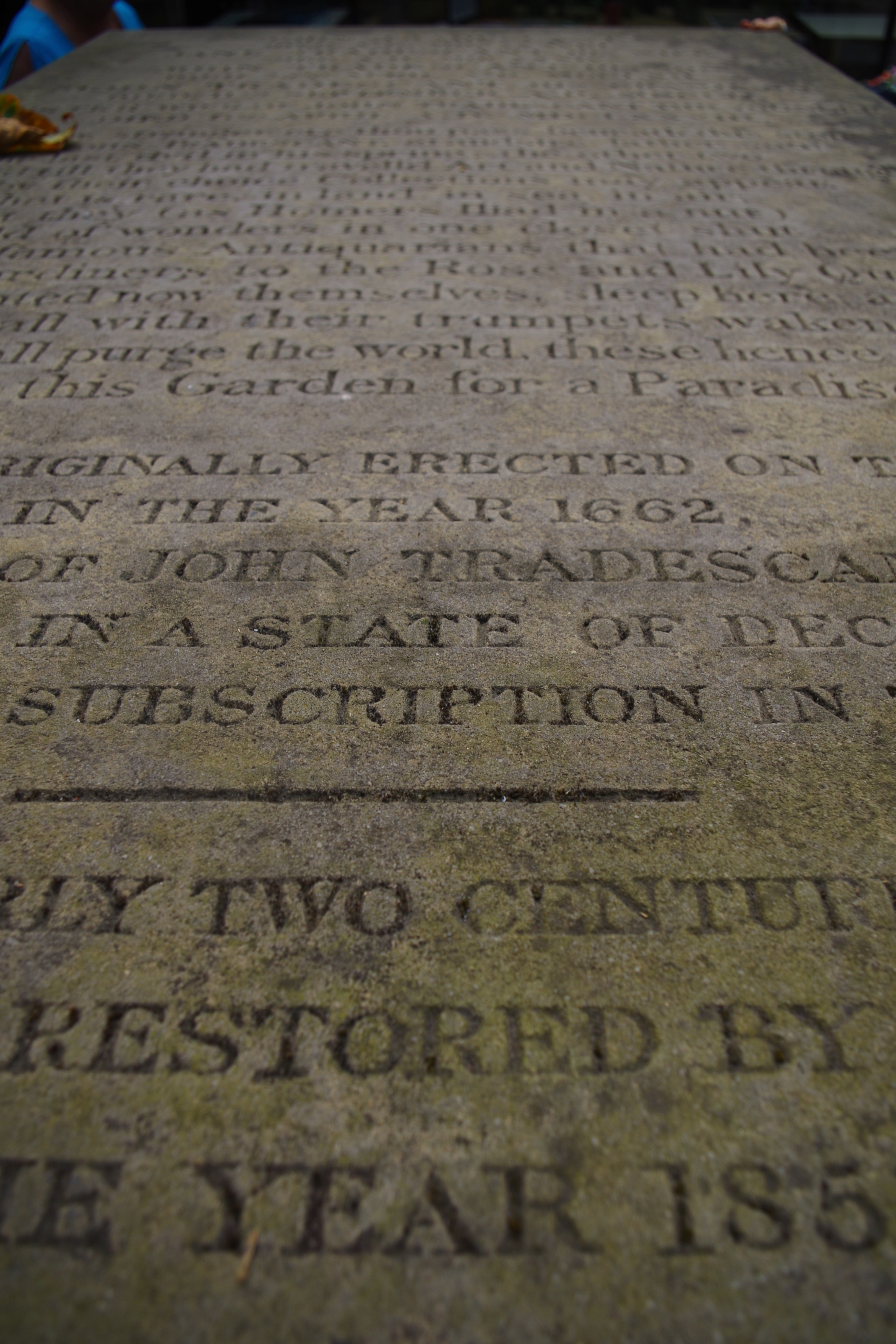
‘The casual viewer is not seeing the original carvings. As it was outside in what would have originally been the churchyard, the elements soon did their work. The tomb was so badly damaged by 1773 that a public subscription was raised for its restoration. Lambeth Archives still have the ledger that recorded the donations.
But in 1853, 70 years later, the public funded a further restoration. It was the sculptor G P White who undertook this restoration.’
The 1853 restoration cost £110. The Victorians were enthusiastic restorers, perhaps too enthusiastic in some ways.
At one end of the tomb is a coat of arms which comprises of three fleur de lys on a diagonal bar and with a lion holding up its paw. A helmet with a closed visor is meant to be a sign of gentility and is topped with the crest of another fleur de lys and 2 wings. However, the Tradescants had no official grant from the College of Arms and may just have adopted it as a ‘rising’ family. It was a standard item on a monument and is the most conventional symbol.
At the other end, the west end, is a fearsome looking hydra which is a mythical ancient Greek creature associated with the 10 Labours of Hercules. It lived in the murky waters of Lake Lerna which was reputed to be the entrance to the underworld. Each time one of the hydra’s heads were cut off , two more would grow in its place so it was a deadly enemy. The hydra in the Pepys drawings is almost friendly and certainly non threatening whereas the 1853 version, carved in high relief, is much more dramatic with its bat like wings, female breasts., seven bird like heads and a long forked reptilian tail.
There were other changes as well and the gardenstrust.blog commented on the skull in the lower part of the panel.
‘It lacks the lower jaw and is presumably the same one that appears in the younger John’s portrait where it is covered with skull moss, much sought after as a powerful medicine.’
This portrait appears in Part 1. The significance of the skull may be a reminder of vanitas paintings which flourished during the 16th and 17th centuries and came from the Netherlands. They often featured a skull and invited the viewer to ponder on the fleeting quality of life.
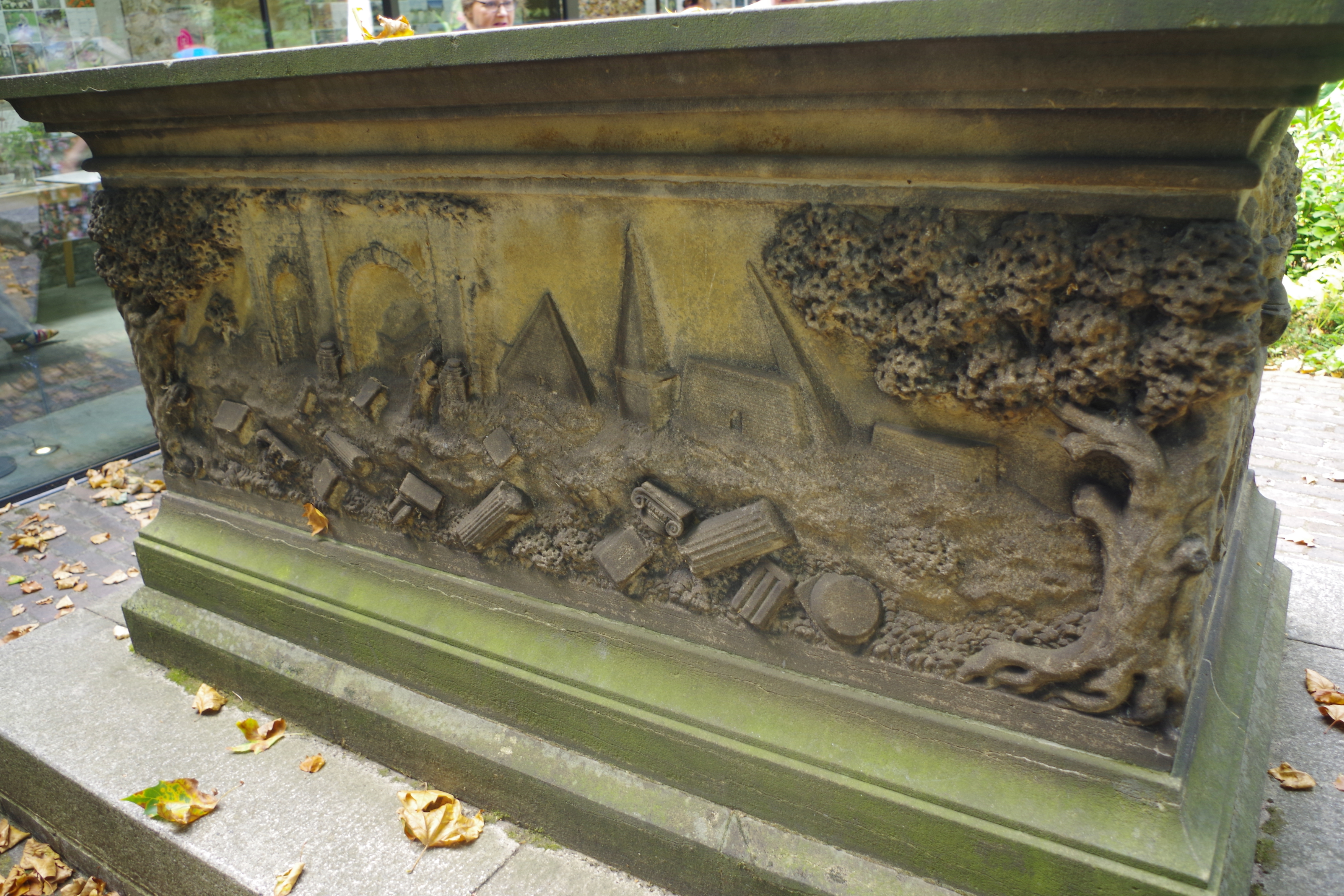
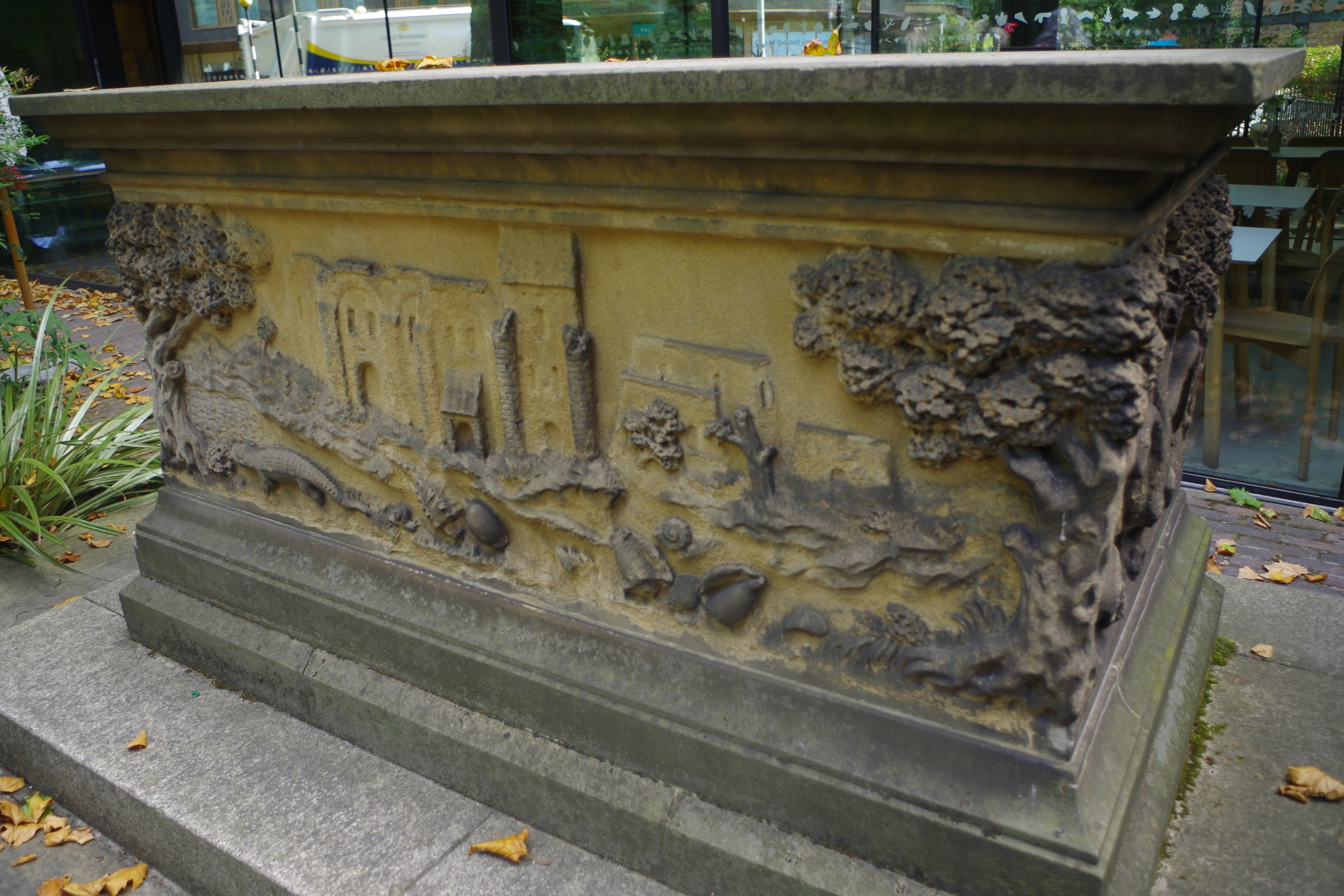
‘ruined buildings in the background and architectural detritus in the foreground together with a crocodile and shells and fossils. The corners are formed by gnarled and stunted trees with heavy foliage.’Cabinet.ox.ac.uk
The depiction of the ruins have been debated as the restorations may have changed their appearance. They have been described as Egyptian or Greek with obelisks and a pyramid amongst others. There are also fragments of Corinthian capitals. The shells may refer to specimens that were in the Tradescant collection and the large reptile in the lower part of the north panel could refer to the ‘Crocodile from Aegypt’ that was listed in the exhibits of the ‘Ark.’ It was also seen as a symbol of the early modern culture of collecting as seen in the oldest depiction of a ‘cabinet of curiosities’, the museum of Ferrente Imperato.
In order to link all the sides of the tomb together, the mason carved a set of large trees in deep relief. They hold up the ledger with its epitaph:
‘Know, stranger, ere thou pass, beneath this stone Lie John Tradescant, grandsire, father, son The last dy’d in his spring, the other two, Liv’d till they had travelled Art and Nature through, As by their choice Collections may appear, Of what is rare in land, in sea, in air, Whilst they (as Homer’s Iliad in a nut) A world of wonders in one closet shut, These famous Antiquarians that had been Both Gardeners to the Rose and Lily Queen,* Transplanted now themselves, sleep here & when Angels shall with their trumpets waken men, And fire shall purge the world, these three shall rise And change this Garden then for Paradise.’
It has been suggested that the line ‘A world of wonders in one closet shut’ may refer to the Ark.
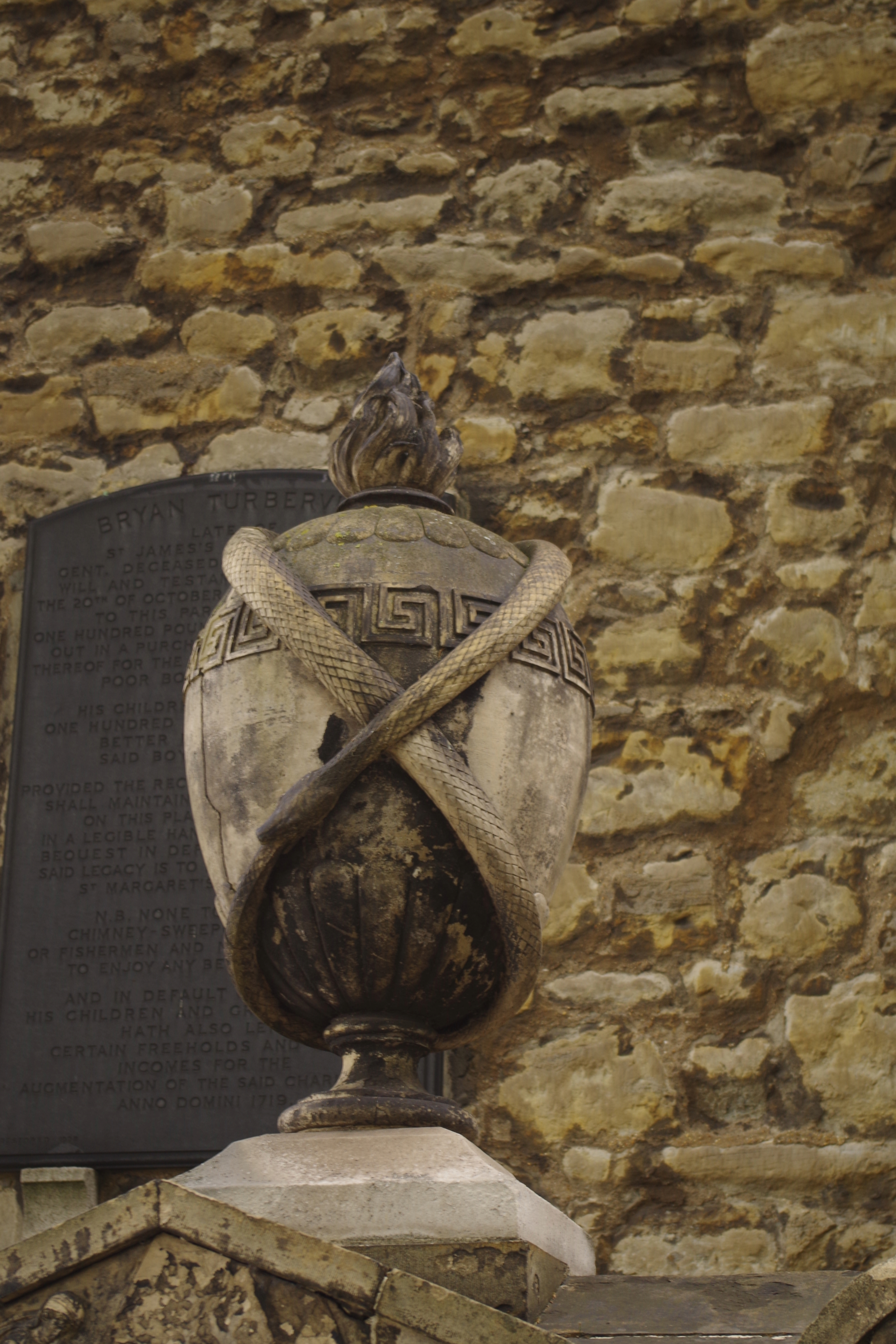
Despite the changes to the carvings, the Tradescant tomb is a magnificent survivor with five members of the family being commemorated. The enigmatic carvings, the epitaph and one woman’s determination have all added to the legendary Tradescant reputation. It’s a real sight to see and there are other interesting memorials in the ex-churchyard as well. For example, there is one dedicated to Admiral Bligh of Mutiny on the Bounty fame and there is a wonderful ouroboros on another, the Sealy family monument.
So what can you do with a ruined, vandalised building in the middle of a wood?
Hope that it falls down and solves the problem?
Forget about it, let nature take its course and make it into a romantic ruin?
Wait for someone else to finish the job and try and blow it up again?
Luckily for the Mausoleum, there were local people who cared about it and knew what a jewel they had in their midst. They were determined to save it. So in 2001, Gravesham Council took the bold step of buying it and Cobham wood from HM Government and, with funding from Union Railways, the Cobham Ashenbank Management Scheme or CAMS for short was formed. This included several stakeholders such as the National Trust and English Heritage and with a £6million grant from the Heritage Lottery Fund they carried out the restoration. They were lucky that Wyatt’s original drawings still existed as well as James Wraight RIBA’s 1946 full drawing with measurements which were invaluable resources. In 2010 the project won at the Kent Design Awards and the National Trust took over in 2013. It must have been a real challenge to turn a ruin back into the glorious building that it is again. It opened to the public in April 2014.
It’s a remarkable building which has survived because local people appreciated its beauty and importance.
Mausolus, the journal of the Mausolea and Monuments Society commented:
‘That it’s a reminder of thwarted sepulchral ambition and episcopal control’
and it is an apt description in many ways. For a funerary symbol enthusiast like myself it was a fascinating structure to walk around it and see the various motifs of death. I was so glad that I made the effort to visit at last.
If you want to visit the Mausoleum then be prepared for a walk. You can come up through the Ransford Nature Reserve which is a lovely stroll, especially if the poppy field is in bloom. Continue walking up through it to the top of the hill and then follow the Darnley trail through the woods. I did manage to get lost on my return journey but kept following the rule of going down all the time. The alternative is to walk through Cobham village and onto Lodge Lane at the bottom and follow the directions on the map on the noticeboard.
However, I saw the Mausoleum on sunny days but on a darker, greyer day it could feel far more eerie and melancholic. A cold wind blowing around it would remind the casual passer-by that eternal rest can be a very, very long time. Perhaps that’s the effect that the Darnleys wanted to achieve.
But then who’s to say that maybe the ghosts of long dead Darnleys don’t drift up from the churchyard of St Mary Magdalene and take up their allotted space within the Mausoleum’s crypt? There’s enough room for 32 of them after all…….
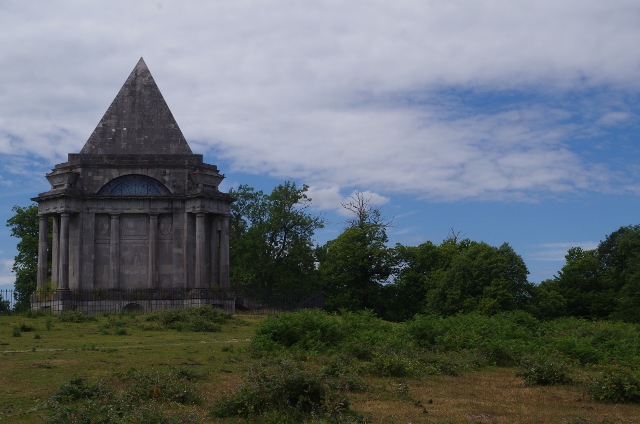
Cobham Wood can feel like a haunted place. This is where the 19th century artist, Richard Dadd, murdered his father in a spot still known as Dadd’s Hole and so began his journey to a lifetime in Broadmoor. But before Mr Dadd gave into his murderous impulses, there was another place associated with death that sits alone in the woodland. Once intended as a grand and capacious building to house the dead of the Earls of Darnley, it was never used and, for a long time during the 1980’s and 1990’s, it was surrounded by piles of burnt out cars and motorbike scramblers. The hilltop location was ideal for these nocturnal sports.
But on 5 November 1980 someone went too far and lit a pile of tyres and petrol cans in an attempt to blow the mausoleum up. It brought down the chapel floor and the Mausoleum was open to the elements. But it survived.
However, it was a sorry sight in 2003 when it featured on BBC TV’s ‘Restoration’ programme as an appeal was launched for funds to restore it. However, the Mausoleum’s future looked bleak and even I thought that, due to its location, any restoration would be destroyed again. You can see how it looked at the time: https://www.bbc.co.uk/programmes/p01mvbfj
But in June 2020 I made the pilgrimage through the poppy field of Ranscombe Nature Reserve and up through the woods to the Mausoleum. As I emerged from under the tree canopy I was amazed by the Mausoleum’s size. It is big, very big and was designed to hold 32 coffins in a lower crypt. It’s an extraordinary building and was originally sat at the highest point of the Darnley estate. It became an important feature of the landscape, almost an eyecatcher folly.
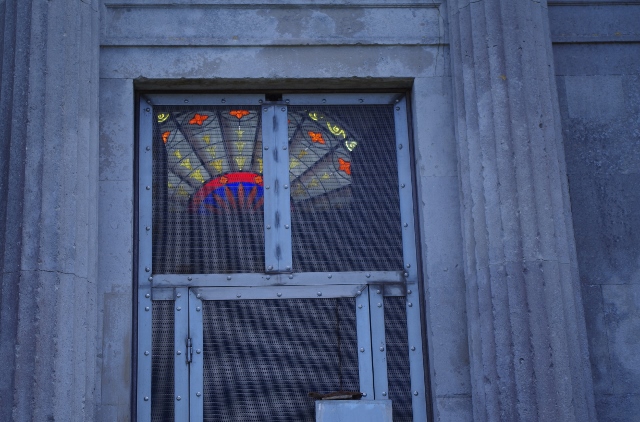
It’s Grade 1 listed and a rather unlovely door keeps it secure from unwelcome visitors. Just above it I could see one of the 4 lunettes or half-moon windows as the sun shone through the amber stained glass. This was a tantalising taste of what lay inside as the light shining through them is intended to create an ethereal light inside. But, alas, the building is closed to visitors at present due to COVID-19. The building is made of brick and faced with Portland stone. It can be seen as
‘a very grand classical temple that emphasised the Age of Enlightenment’s preoccupation with aclassical way of death’ according to the National Trust’s website.
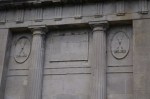
It drips with symbols of death and remembrance. The square, circle and pyramid are classical motifs of eternity, the downturned torches indicate a life extinguished and there are 4 little sarcophagi on each corner. These were stone coffins designed to hold the dead and the word comes from the Greek for ‘flesh eater’. I was in my element as you can imagine.
But who built it and chose its location? It was the 4th Earl of Darnley who commissioned the fashionable and exacting architect, James Wyatt (1746-1813) to design the Mausoleum according to detailed instructions in the 3rd Earl’s will. The Earls of Darnley had always been buried in Westminster Abbey but after the 3rd Earl’s death in 1731 the Abbey was full. So the Mausoleum was to be the solution and would hold the coffins of the Earls and their family members. The 3rd Earl:
‘left detailed instructions in his will in which he clearly stated that he wanted a square stone building with a ‘prominent pyramid’ surrounded by a dry moat. He left £5000 or £10,000 if the first amount wasn’t sufficient.’ National Trust
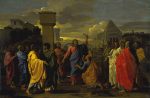
The source of the pyramid might have come from the Earl’s Grand Tour when he may have seen the tomb of Caius Cestius in the Protestant Cemetery in Rome. There is also a building with a pyramid roof in the background of a 1647 painting by Nicholas Poussin, ‘The Sacraments of Ordination’. He was a highly regarded painter in the 18th century and there were several paintings by him included in the sale of Cobham Hall.
As the journal of the Mausolea and Monuments Society says:
‘Pyramids were rare in in English Georgian architecture and made their first appearance at Castle Howard;….Wyatt and Darnley trying to recreate the solemn grandeur of the ancients…’ Masusolus
The Pyramid of Caiius Cestius, Rome.
Shared under Wiki Creative Commons.
Note the pyramid roof on the structure in te background. Seven Sacraments -Ordination II (1647) Nicolas Poussin
Shared under Wiki Creative Commons
Another source of inspiration may have been the famous tomb of King Mausolus at Halicarnassus in Asia Minor. He died in 353BC and such was the fame of his tomb that his name became synonymous with all subsequent stately tombs. As a result they became known as mausoleums.
The Darnleys lived at nearby Cobham Hall so the Mausoleum it would have been handy to have your loved ones nearby for eternity. Of course you may have been looking at it and wondering when you might be joining them. In 1786, at its completion, the Mausoleum cost, in total, £9000 which in today’s money is £1million. It is a lavish building with a marvellous interior from photos I have seen.
Wyatt’s designs were exhibited at the Royal Academy in 1783 and a modified design completed in 1786. However, it was George Dance the Younger (1741-1825) who supervised the work as Wyatt was renowned for having a bad reputation in erecting his own work. After completion, Humphry Repton (1752-1818), considered to be the last great landscape designer of the 18th century spent the next 30 years designing the landscapes around Cobham Hall for the 4th Earl.
But the Mausoleum was never consecrated and so couldn’t be used for its intended purpose. According to Mausolus, the journal of the Mausolea and Monuments Society,
‘the Bishop of Rochester was disapproving of buildings in secular sites and refused to consecrate a building that so brazenly evoked pagan arcadia.’
Repton himself suggested that it be converted to a viewing platform so that it could be put to some use and the views would have been amazing but it didn’t happen.
But instead of being laid out in the Mausoleum as intended the Earls of Darnley have been interred in the vaults and churchyard of St Mary Magdalene in Cobham village. There is a fine display of their memorials at the rear of the church and in the churchyard.
The Darnleys income came from a 25,000 acre estate in County Meath, Ireland. However their fortunes declined and in 1957 they sold Cobham Hall. After the arson attack there were many suggestions and schemes for the Mausoleum’s future. A developer bought it, intending to convert it into a residence but went bankrupt. He was presumably hoping to find a buyer who liked seclusion and could find a use for 32 coffin spaces in a crypt. The building passed into the hands of the official Receiver and HM Government became its new owner. The 4th Earl’s creation’s future looked bleak, its interior blackened from the arson attack and covered in graffiti and surrounded by a rusty junkyard.
The cawing of rooks in the bare trees kept me company as I walked towards St Mildred’s in Nurfield, just outside Meopham. It was a dark, wet, overcast day and St Mildred’s huddled surrounded by fields at the end of Church Lane. In fact, it’s known as ‘The Little Church in the Field’.
Kent has many of these picturesque churches and I hoped to discover more symbols or interesting headstones in the churchyard. Coronavirus was snapping at my heels and I knew that all churches would soon be closed.
On the horizon of one field outside the churchyard I could see the bright yellow traces of a future rapeseed crop but the other field, alongside it, was still ploughed earth. The bare trees tried to stretch up to the sky on the other side of it. I’ve always loved these in winter as you can really see the shape of the tree and the delicate pattern of branches and twigs.
St Mildred’s was closed but the church door was protected, or hidden, by four tall yew tree sentinels. A pot of purple pansies beside it were a splash of colour on such a grey day.
Despite the damp weather there were large patches of Spring flowers; Violets, both purple and white covered parts of the churchyard, together with smaller groups of Lesser Celandine which is one of the seven signs of Spring. Daffodils shuddered in the wind and a group of them huddled together for warmth by headstones. But I was determined and found the symbol of a closed book on one grave to a man who had died young. The oldest headstone was now unreadable and was decorated with tiny pom-pom shapes of a lichen. An imposing Celtic Cross was dedicated to a priest. The bright yellow flowers of lesser celandine had closed themselves up and who could blame them? Primroses kept their heads down but in one corner of the churchyard there were indications of living residents. These were of the four legged kind who had dug deep holes and left pungent evidence…..
Nurstead was described 700 years ago as ‘a poor little parish with a church.’ St Mildred’s was originally a Saxon church and made of wood. The current flint structure dates from the 14th century and the guide leaflet says ’that together with the 14th century hall of nearby Nurstead Court it is the only surviving part of the Manor as it existed in 1349.’
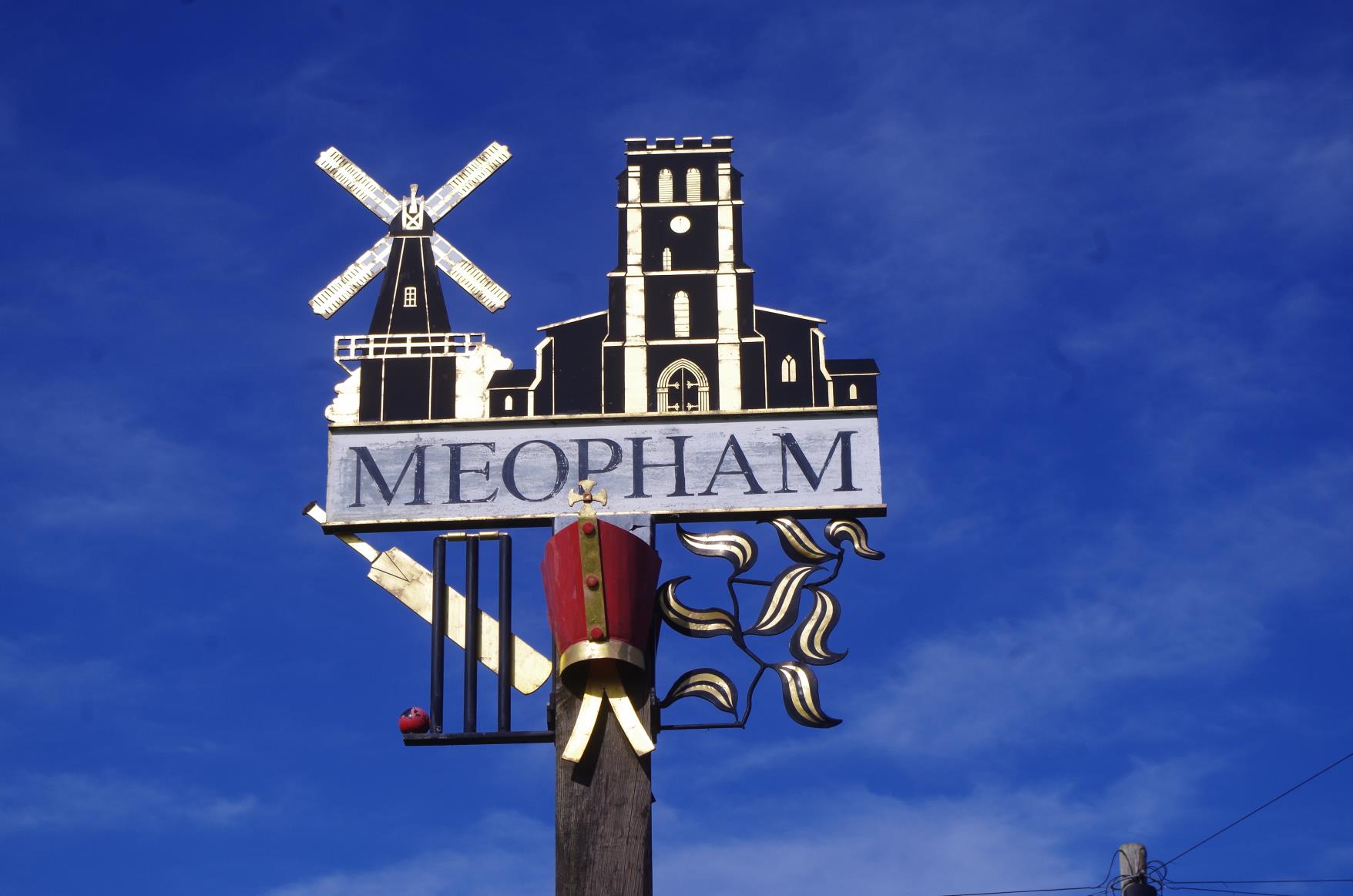
Meopham is pronounced Meppham and it’s more of a hamlet than a village. But it does possess another, larger church at the other end of it. This is dedicated to St John the Evangelist and appears on the village green town sign. St John’s was open and I gratefully sheltered inside glad of the respite from the weather.
The church on the sign – St John the Evangelist
Inside it was peaceful and St Johns had some interesting features. There was a very decorative wooden pulpit attributed to Grinling Gibbons and dated 1632 and the colourful and beautiful tiles decorating the chancel. They were uncredited in the guidebook. There was also a window containing fragments of medieval glass which have been dated to 1346. Curling hazel branches had been placed on windowsills and I wondered if it was in honour of Branch Sunday. Outside in the churchyard I explored and my shoes soon became soaking wet. A bonfire had been lit in an adjoining garden and the combination of that and the gloomy weather made it feel more like November. The Millais painting, ‘Autumn Leaves’, with its melancholy atmosphere sprang to mind. A patch of primroses cuddled up to each other in a drift of fallen leaves and the Lesser Celandine flowers had closed themselves in response to the rain. A lone dog violet stood in defiantly in the middle of them. It was time to go home.
But when I returned two days on the Saturday it was under sunny blue skies. St Mildred’s was now open and despite the wind that made the daffodils blow this way and that I noticed that the Spring flowers seemed to have colour again. The crisp white blossom of blackthorn foamed in one corner as did the Wild Cherry blossom on the other side of the churchyard. Late snowdrops nodded in the wind as I entered the church. The interior was very plain and simple with large ledger stones providing the nave flooring. The bare fields now looked as if they were impatiently waiting for the forthcoming crop to burst forth. I had hoped to see a March hare but no such luck. The headstones were bathed in the golden glow of the sun and the bright flowers of Lesser Celandine lifted their heads upwards and basked.
These were dedicated to past residents, the Edmeades, of nearby Nurstead Court, and dated back to the 17th century. They are actually buried in the vaults beneath the stones. A squint could be seen in the West Tower and the slow, regular ticking of the church clock was the only sound. St Mildred and her stag featured in the window above the altar and an ancient piscina was decorated with wheat ears and grapes. A reference to a farming community? The wind howled round the little church as it had done for centuries, as if trying one last time to blow it down, but it still stood.
In contrast St Johns was closed but the bright sunshine revealed several headstones that I had missed. I’m not quite sure what this figure represents but he does seem to be pointing to the small skull in the corner.
The sticky buds on a venerable Horse Chestnut tree at the entrance reminded me that despite the horrible weather we’ve had over the last couple of months Mother Nature was just getting on with it as she studded and carpeted churchyards with the bright colours of Spring flowers and blossom.
Sadly, my poking about in churchyards has had to be put on hold this Spring due to the virus. However I did manage to visit two Kent churches just before the lockdown and I will blog about this on a future post. One churchyard was awash with symbols!
I hope that you are keeping well and safe during these strange times. Life has taken on a surreal quality for some of us as others, keyworkers, keep things going and risk their lives. Will things return to normal afterwards or will we not take so much for granted again? Who knows.
There’s no Symbol of the Month this month as it’s shadowsflyaway’s 4th birthday!
Yes, it’s been 4 years since I started this blog and it’s been a joy to share my enthusiasm for symbols and other cemetery related stories with you.
I thought that I might have exhausted the supply of symbols on which to write about but no I always find a new one and undoubtedly there are still more out there waiting for me.
I always look forward to exploring a new cemetery or churchyard as there’s often a new gem for me to discover. Recently I have been poking about in medieval Kent churches and discovered a devil’s doorway, windows with eyes and a fine selection of 17th and 18th century names in a list of churchyard burials. Sadly, I don’t think that Beardsel, Chariot or Sundial are going to rediscovered but you never know…..and also some of the finest memento mori.
But mostly I’ve enjoyed letting the dead speak to me through the symbols they chose to have as their lasting message to the world.
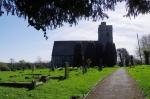
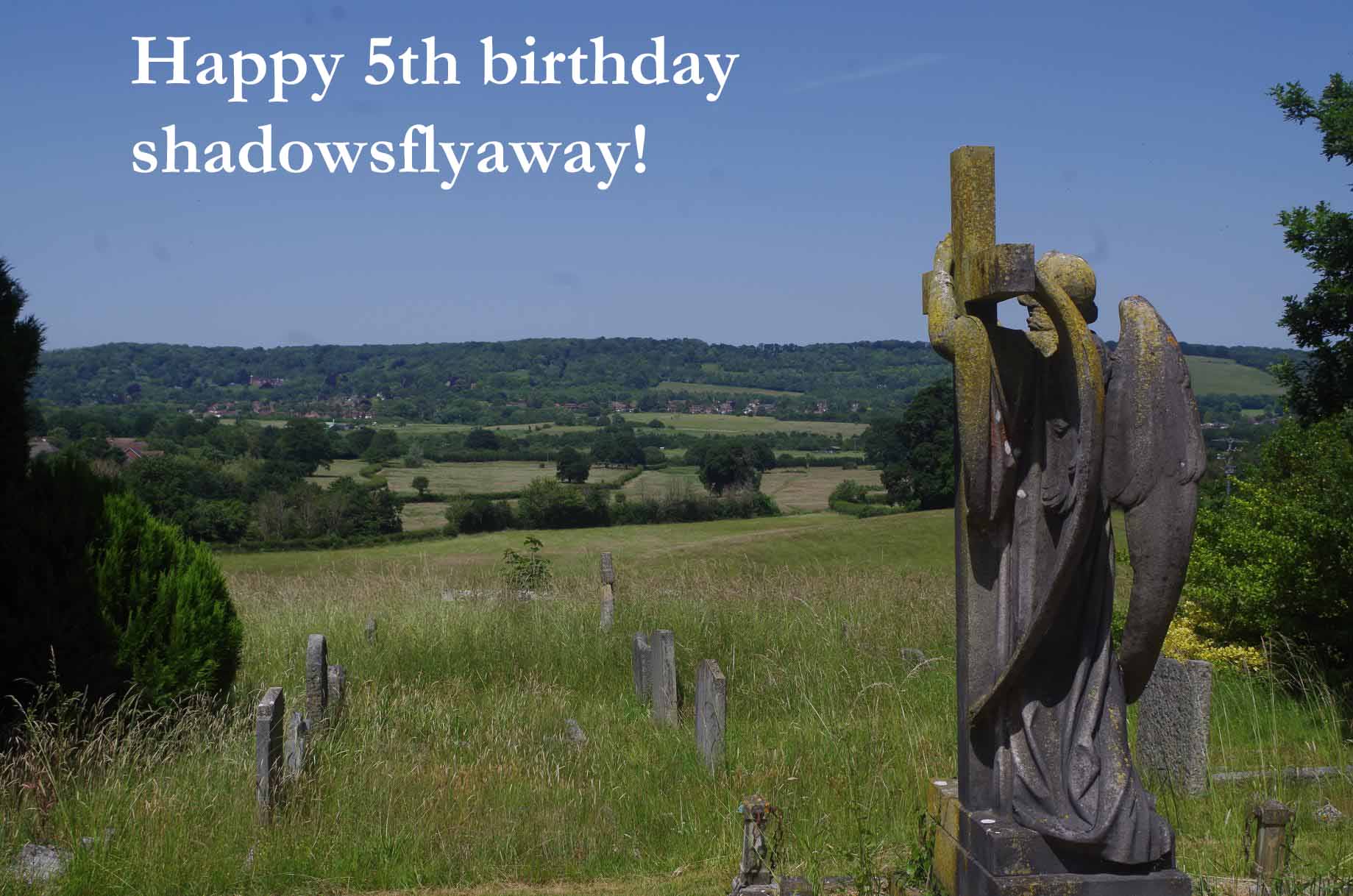
This photo was taken in the churchyard of St Peter & St Paul in Seal, Kent. The view from the back of the churchyard looks out onto the North Downs and it was literally a view to die for (sorry couldn’t resist that one)
So let’s drink a toast, mine’s a lemon and lime flavoured water, and let’s see where we go in shadowsflyaway’s 5th year!





















































 shadows fly away