Symbol(s) of the Month – Ritual Protection Marks

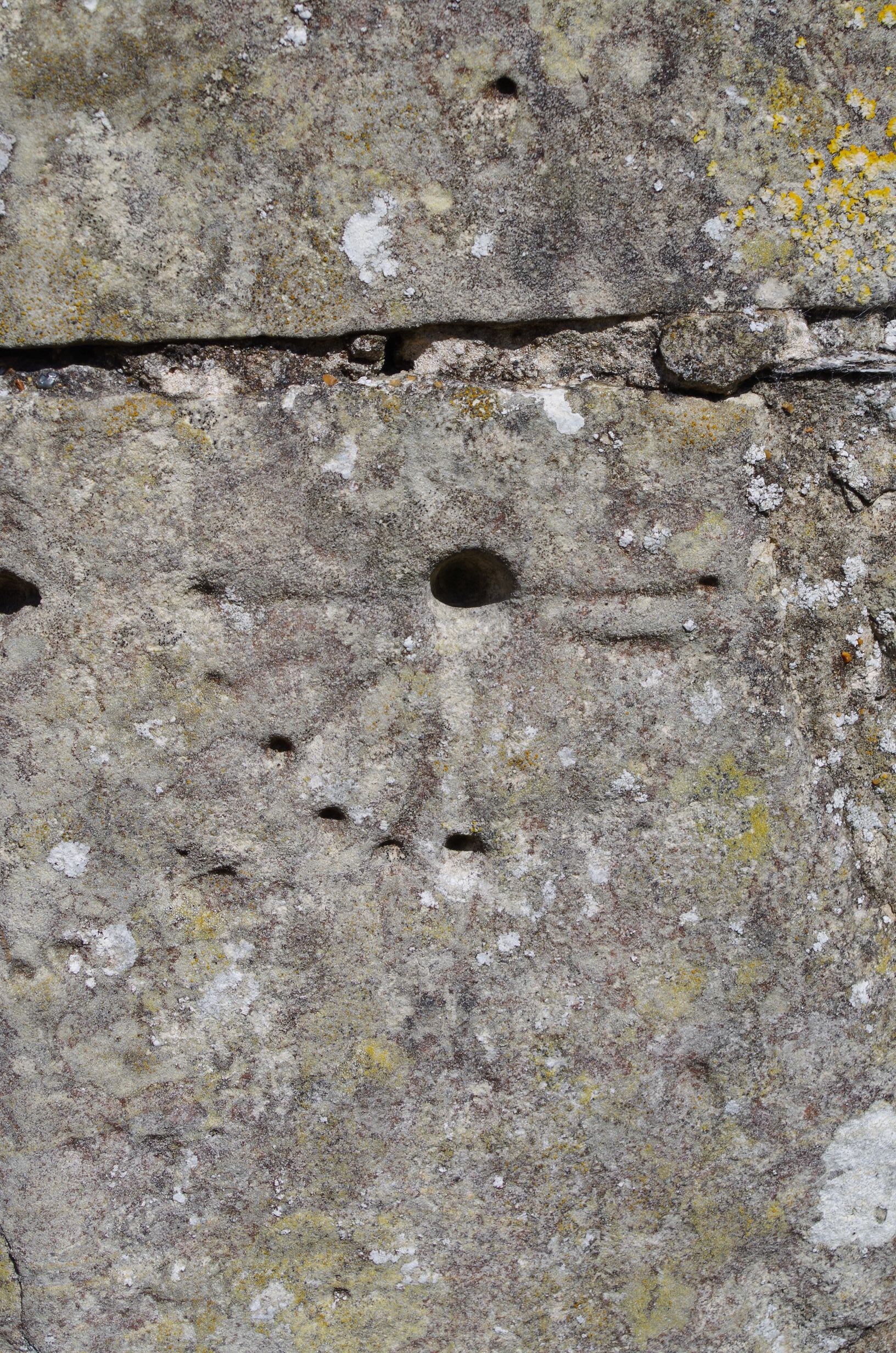
Cross, St Nicholas at Wade, Kent © Carole Tyrrell

Imagine if you will a medieval church.  Inside it would be brightly painted and very colourful in contrast to the whitewashed interiors that we are familiar with today. Faded vestiges of these colours can sometimes be seen on monuments or pillars. The church porch might be used for other activities besides keeping out of inclement weather.  They were used for ceremonies such as marriages or the ‘churching’ of women and churches were often the hub of community life. But they also had a dark side as they were seen, surprisingly,  as places where evil lurked. In fact, it was believed that the Devil and his horde lived within the church on the ‘north’ or sinister side.  

The medieval world was often harsh and the forces of evil were supposedly everywhere. A bad harvest, plague or fires were all attributed to them. Witches were also believed to be real.  Meanwhile the Church taught that the world was full of evil spirits who were always looking for unwary souls to tempt or possess. 

Even churches needed protection despite priests performing blessings and masses and so the local parishioners took action into their own hands and relied on the use of apotropaic symbols.  This is a Greek word that comes from ‘apotrepein’ which means ‘to ward off’ i.e. ‘apo’ = away and ‘trepein’ = ‘to turn.’ It was a secret language which its medieval creators firmly believed could protect them from evil. They were a way of their creators taking back control  over their world. The marks  were often inscribed near vulnerable places such as doorways, windows, fireplaces and even fonts. In other words, wherever an evil presence might try to enter. But they were not confined to churches as they also appeared in other historic and ancient buildings.

Daisy wheel on fragment of a demolished house in Essex, Southend Central museum. © Carole Tyrrell

But by the 18th century, belief in protective marks had declined. However, they were inscribed into buildings and churches up until the 19th century and have been described as ‘folk magic’ or superstition. But in rural areas the tradition continued and was handed down through generations.

I have seen many medieval survivors of the 17th century iconoclasts in Kent churches such as wall paintings at Selling and a Doom painting at Newington but more recently I have been finding the most enigmatic survivors of all, ritual protection marks. You have to know where to look as they are often well hidden.  I did wonder if the priest knew what was going on and turned a blind eye. But we will never know. However, this is a huge subject and I can only scratch the surface. I’m just intrigued by them and their variety.  In this post I am giving you a selection of what I’ve found so far and possible meanings. I have visited 3 churches so far: St Nicholas, Sturry, St Nicholas at Wade and Hoo St Werberga who all have these marks. As you might imagine crosses feature heavily.

Figure on pillar, St Nicholas, Sturry.© Carole Tyrrell

I first found marks in St Nicholas church, Sturry, near Canterbury in 2023. The churchwarden pointed them out as they’d just had someone in to do a survey of them. There were crosses on pillars near the entrance and on the other side of the church. So, I made a return visit this year and this time found a figure which may be the Virgin Mary as it seems to be wearing a skirt and has a halo.

However, there was a Facebook post dated 27 December 2025 on the Ritual Protection Marks and Ritual Practices page in which they say that this particular mark may be a Golgotha mark which represents the site just outside Jerusalem where Jesus was crucified. I can’t put a link to it but if you visits the page it’s easy to find. This is an interesting page and they know what they’re talking about.

There was a little note on a pillar indicating a M or Marian mark but I couldn’t find it and then I was distracted by a cream tea.  I also saw circles which appear to have been appear to have been drawn with a compass as well as dots. The small circles are also referred to as hexafoils and are the most common.

Circle, St Nicholas, Sturry, © Carole Tyrrell

According to their information leaflet on the marks;

‘They can range from simple circles, to six petalled flower designs and highly complex geometric designs which are known as daisywheels.’

They are usually small as at St Nicholas, but they can be up to a metre across. It was originally believed that they were created by the masons who built the churches but there are too many for them to be attributed to one trade. It has been suggested that:

‘they may have been created in order to trap the demons that roamed the world within their complex structure by quite literally pinning them to the walls.’ Information leaflet, St Nicholas, Sturry.

Also at Sturry , there are five ‘dots’ on a pillar which could easily be missed but they have significance:

Dots on pillar, St Nicholas, Sturry. © Carole Tyrrell

‘the dots appear to follow numerical values, being found in generally uneven numbers, and commonly in groups of three, five, seven and nine. Certain uneven numbers had considerable significance in the medieval church, such as the Trinity and the seven sacraments, and numbers were also regarded as powerful within aspects of medieval magic’.  Information leaflet, St Nicholas, Sturry

But this is only one interpretation and, as with most ritual protection marks, there can be several and it’s not possible to say definitively which is the correct one.

I visited St Nicholas at Wade at Easter 2025 and the church was bustling as it was being decked with flowers for the celebrations. They very proudly showed me their ‘daisy wheel’ on a pillar. 

Daisy Wheel, St Nicholas at Wade. © Carole Tyrrell

A daisy wheel is a stylised flower pattern and according to English Heritage ‘

‘they are the most easily recognisable. They have been found in early medieval English buildings from the early medieval period right up to the 19th century. Followers of Wicca see them as sun symbols’

Histories and Castles describe them as:

‘geometric rosettes, often with 6 petals that symbolised eternity and divine protection. The medieval mind believed that evil travelled in straight lines and so could be trapped by circular forms, the looping unbroken line of a hexafoil was thought to confuse evil spirits or trap them in an endless journey.’

I previously visited Hoo St Werberga in September 2024. But this time I was looking specifically for ritual protection marks and found them despite being led astray by another excellent cream tea. This time I found a large ship on a pillar which is possibly a reference to St Werberga’s position on the River Dee and the lantern in its tower to guide shipping. My photo did not come out too well although the body of the ship can be seen. So, I attach a copy of a far better photograph that was displayed on the local history desk with their kind permission.

Ship on pillar, Hoo St Werberga. © Carole Tyrrell

In fact it was one of the local history people who proudly indicated one of the most enigmatic and mysterious marks I’ve seen so far. It was a bullseye on a pillar.  It was partly obscured by the organ and other pieces of church furniture and so I might have missed it.   He told me that they know nothing about it and it’s certainly an unusual item to find in a church. .  However, the circles inside each other may have been another method of trapping demons.

Bullseye, Hoo St Werberga. © Carole Tyrrell

I will undoubtedly find more as I explore other churches in Kent especially as I now know where to look for them. They are the traces of a medieval belief system of protection from the threat of unknown demonic forces from which no one was safe not even the rich and powerful. They were seen as holding protective powers and were a way of empowering their creators.

They are a fascinating glimpse into the world and beliefs of our ancestors.

©Text and photos Carole Tyrrell unless otherwise stated.

References and further reading:

392 WITCH MARKS v2.indd (the Fortean Times article on witches marks from 2019)

Witch marks: Medieval graffiti for protection

Witches, Carpenters & Masons – what’s in a mark?

What Are Witches’ Marks? | Historic England

APOTROPAIC / RITUAL PROTECTION MARKS – GAUDIUM SUB SOLE . SUNDIALS . MEDIEVAL TO MODERN

Witch Marks and Secret Symbols: Discover Medieval Witchcraft Protection in England’s Castles and Churches

Apotropaios – Home (one of the best sites on these marks.)

Magical House Protection – the archaeology of Counter-Witchcraft – Brian Hoggard, Berghahn, 2019

Information leaflet, St Nicholas, Sturry, Kent

A Cheshire cat grin from out of the darkness – St John the Evangelist, Margate

Close up of head, ‘monumental’ brass, St John the Evangelist, Margate. ©Carole Tyrrell

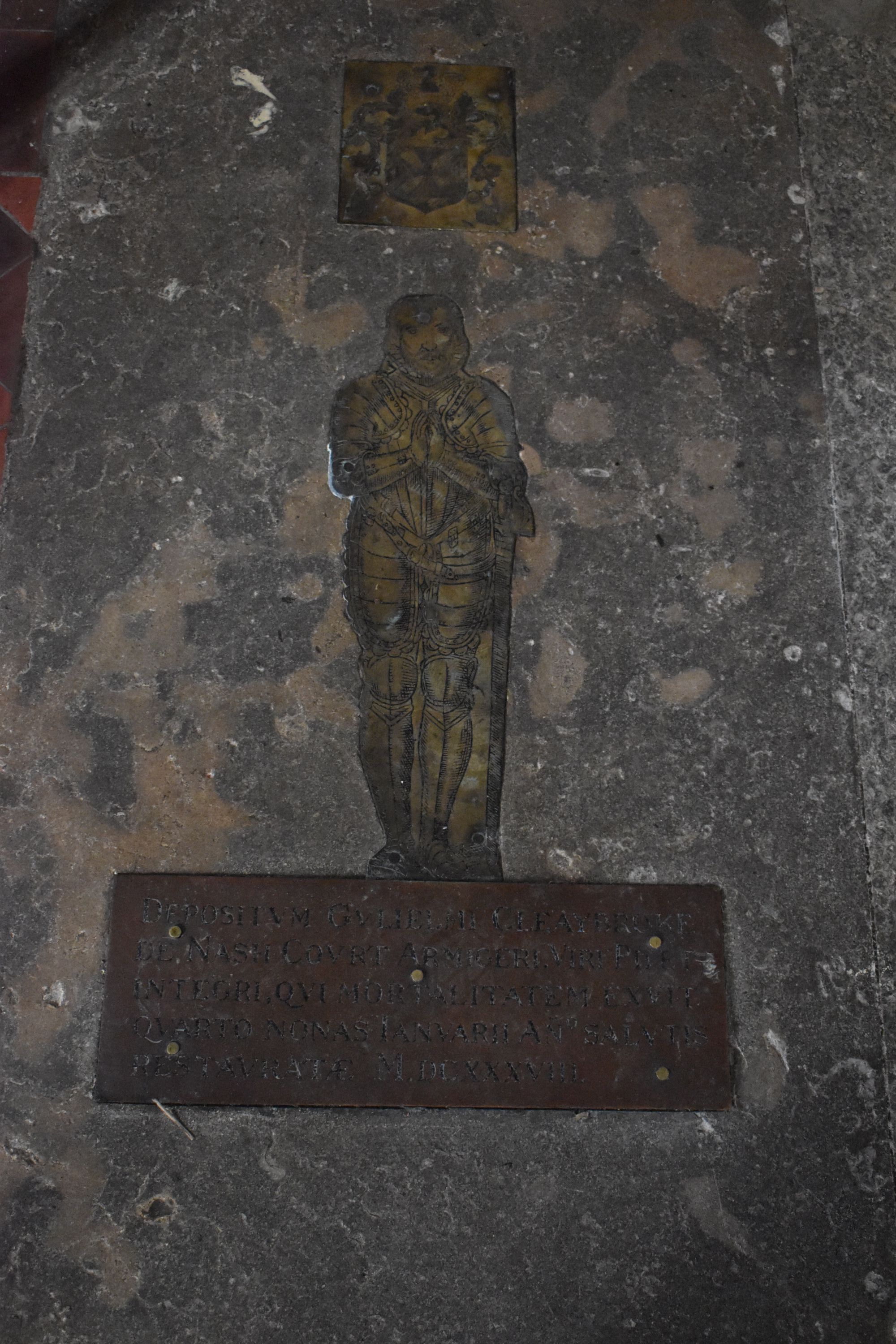
It was dark in the chancel as I explored St John’s and then five small figures set into stones in the floor glinted at me.  Four of them were dressed in the clothes or armour of their time and one depicted a former priest, Sir Thomas Cardiff who was in post from 1460-1415. In fact Kent has the largest number of remaining monumental brasses depicting the human form than any other county. These total 400. But one in particular caught my eye.  How could I resist its smiling, gleeful face?

A knight in full armour, St John’s the Evangelist, Margate. ©Carole Tyrrell

Monumental brass of a priest in his vestments, Sir Thomas St John’s the Evangelist, Margate.©Carole Tyrrell

View of skeleton showing depiction of bones.©Carole Tyrrell

It was a skeleton, standing upright and tall with its arms at its sides facing the viewer, and a label underneath in Latin. This was the language of the church pre-Reformation.

The inscription reads:

‘Orate pro anima Ricardi Notfelde qui obiit penultimo die mensis marcii anno domini millesimo ccccxlvi.’

which translates as:

‘Pray for the soul of Richard Notfelde, who died on the last day of March 1446 AD

 The skeleton’s creator has some knowledge of anatomy as the ribs have been sketched in and there are also leg and arm bones. There is a rubbing of the brass in the Wellcome Collection that dates from 1880 and depicts the bones much more clearly.

Wellcome Collection rubbing of the skeleton. Shared under Wiki Commons Brass rubbing by F.Q. Hawkes Mason, 1880.

But it was its face that caught my attention. That grin! The little eyes and nose! It’s obviously not intended to resemble a proper skull but the effect was impressive. As the brasses are in such a dark place within the church, when I stood over the skeleton to take my photos, my shadow fell on it and the grin would disappear. So it was quite difficult to take a decent picture of any of the brasses.

The skeleton is a memento mori which derives from the Latin, ‘remember you must die.’  It is intended to remind the viewer that the skeleton is all that will remain of them after death. Rich or poor, high or low, all will be the same.  

According to the guide on duty, the brasses and their labels have been moved and it’s not known where they originally were within the church. But they also have a secret.  They’re not actually made of brass. Instead, they were made from a cheap alloy called ‘Latten’.  The guide helpfully reminded me of Chaucer’s Pardoner’s Tale in which he sold fake relics to simple, innocent people to extort money from them.  These included a cross made of ‘Latoum’ a cheap alloy that he pretends is made of gold.

Latten was an alloy that

‘contained varying amounts of copper, tin, zinc and lead which gave the characteristics of both brass and bronze.’   Wikipedia.

These alloys were used for monumental brasses in churches, decorative effects on borders, rivets or other metalwork details as on armour for example. They were also used for livery and pilgrim badges. Canterbury Museums have the largest collection of pilgrims badges in the UK so please follow the link to see a selection.

Pilgrim Badges – Canterbury Museums & Galleries

The skeleton was an unexpected find on a Heritage Open Day and I enjoyed making its acquaintance. A rare survivor in any church although I have seen other brasses made from Latten when visiting other Kent churches.

In this case, all that glitters is not brass!

© Text and photos Carole Tyrrell unless otherwise stated.

References and further reading

Latten – Wikipedia

Latten: The Definition and Meaning

Monumental Brasses in Kent — Kent Archaeological Society

Richard Notfield, St John’s, Margate, Kent, 1446. Brass rubbing by F.R. Hawkes Mason, 1880. | Wellcome Collection

One of the most unusual names to find in a churchyard – St Werbergh, Hoo, Kent

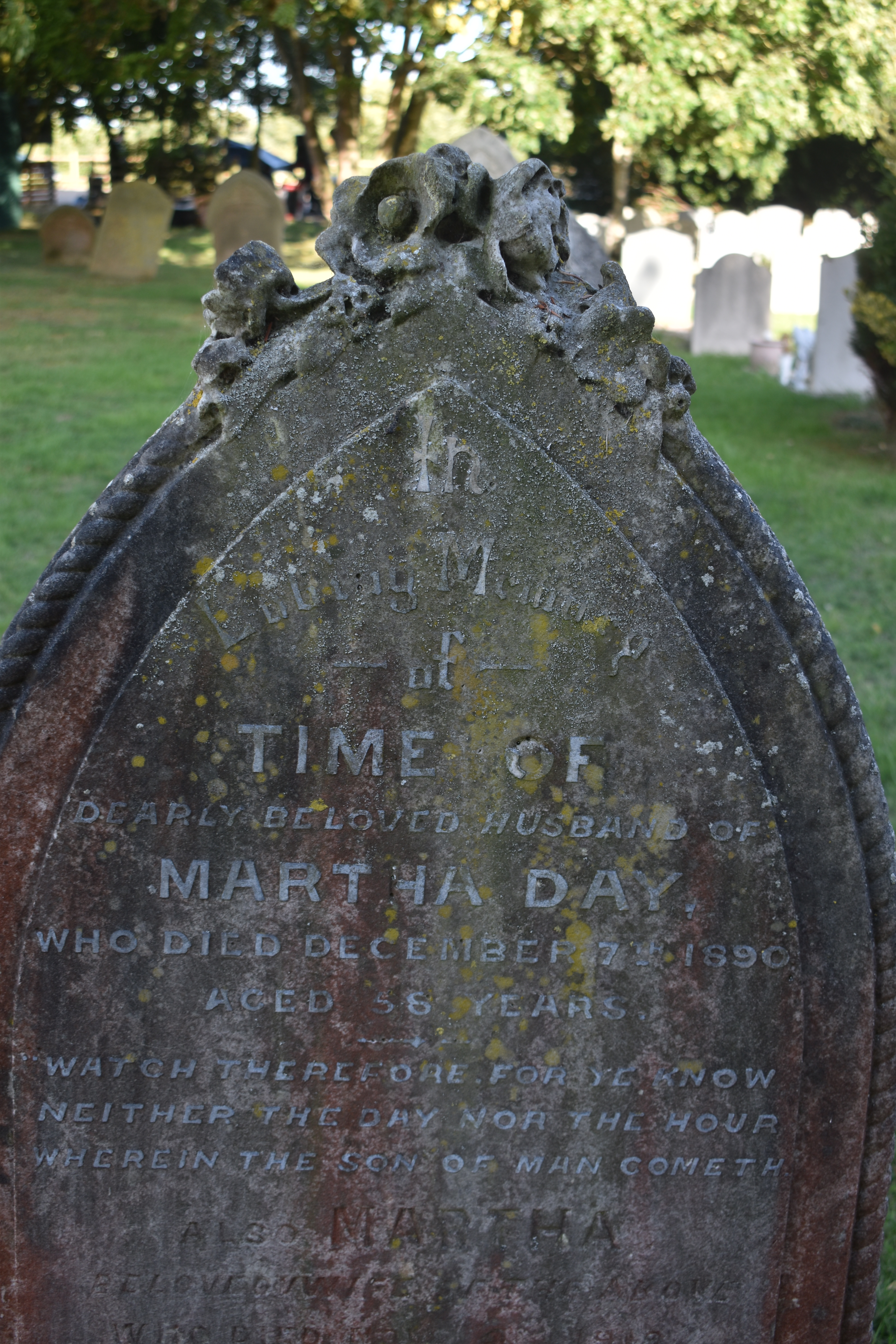
Headstone dedicated to Time of Day, Hoo St Werberga.© Carole Tyrrell

I tried to find this grave last year in the churchyard of Hoo St Werbergh but ran out of time. However, on a return visit this year I finally found it.

It’s dedicated to a man called ‘Time Of Day’ ( I kid you not). (1833-1890) with ‘Day’ being his surname. I did wonder if his siblings were called after days of the week with their surname providing the end as in ‘Sun – Day, Mon-Day etc.

He was a licenced victualler or publican who owned a pub in a nearby hamlet, Fenn Street, Hoo, called The Bell Inn from 1881.  He died on 11 December 1890 and the headstone was erected by his wife, Martha, who was the executrix of his will. The value of his estate was £962.10s.3d which was a substantial sum at that time. There was no mention of any children.

The Fenn Bell Inn Sign © David Anstiss Geograph. Shared under Creative Commons

The Fenn Bell Inn as it looked roughly 16 years ago. © Chris Whippet – Geograph Shared under Creative Commons.

The Fenn Bell Inn may have been named after one of several bells erected on nearby marshes. In poor weather they would ring to enable travellers to find a safe way to cross but The ‘Bell’ is a common name for pubs throughout Britain.  The Fen Bell Inn has been in existence since the 17th century although it has been remodelled and restored since then. However, some of the original fabric still exists. Since 2014, it has housed the Fenn Bell Conservation project for rescued animals and a miniature railway. Recently, there has been controversy over the pub landlord’s plan to sell off land for housing but he has defended it saying that he needed to do it to keep his business going.

‘Time of Day’ is a very unusual name as you might agree but he was a man of some substance and is likely to remembered for many years to come.

© Text and photos Carole Tyrrell unless otherwise stated.

References and further reading

TQ 77 NE 1105 – Fenn Bell Inn or Fenn Bell Public House or Bell Inn, Fenn Street, St Mary Hoo Parish – Historic Environment Record

The Fenn Bell, Pub Sign, Fenn Street,… © David Anstiss cc-by-sa/2.0 :: Geograph Britain and Ireland

Notes from Kent’s Hoo Peninsula: Medway Archives and Local Studies Centre – expanded photo library now online!    (scroll down for vintage photo of The Bell although it doesn’t state when it was taken)

The Fenn Bell Inn, Fenn Street © Chris Whippet cc-by-sa/2.0 :: Geograph Britain and Ireland (photo taken 2009)

Sign for the Fenn Bell Inn © JThomas :: Geograph Britain and Ireland – pub sign taken 2022

Fenn Bell zoo owner in St Mary Hoo says he’s suffered ‘personal attacks’ over plans for 44 homes next door

BELL INN  Pub of St Mary Hoo

Symbol of the Month – Visitation stones.

Roadside shrine on the way to Minnis Bay, Kent © Carole Tyrrell

This summer I was out walking with a friend along the sea wall to Minnis Bay when we saw this little roadside shrine. It was on a popular  route  which is used by walkers and cyclists alike. On one side is the pebbly beach and on the other are marshes that stretch down to the railway line.   It was touching to see that people, friends or perhaps fellow passers-by, had left little tributes of a bunch of flowers and stones.

Stones left on a grave in a North London Jewish cemetery. © Carole Tyrrell

The placing of stones on graves is something that I’ve always associated with the Jewish faith (see blog post ‘Silently slumbering for remembrance Part 1 dated 14 April 2016). If you have ever visited a Jewish cemetery then you will have noticed stones placed on top of graves and headstones and there may be a basket of stones available for this purpose. But over the last few years I have noticed them being placed on the graves of people who aren’t Jewish and I was intrigued by their possible meaning.

In the Jewish faith, it is believed that the placing of stones ‘keeps the soul down.’ This comes from the Talmud

‘which is the central text of rabbinical Judaism and is the primary source of Jewish religious law and theology’   Wikipedia

In the Talmud, it is stated that:

‘souls continue to dwell for a while in the graves in which they are placed. The grave was called a beit olam or a permanent home and was thought to retain some aspects of the departed soul. By placing stones, it becomes a way of the living helping the dead to ‘stay put’.  

This may have brought comfort to those visiting the grave in that they may feel that their loved ones are still near.The Hebrew word for pebble is ‘tz’ror’ which can also mean ‘bond’. The placing of stones was also a mark of respect and a way of showing that someone had visited.

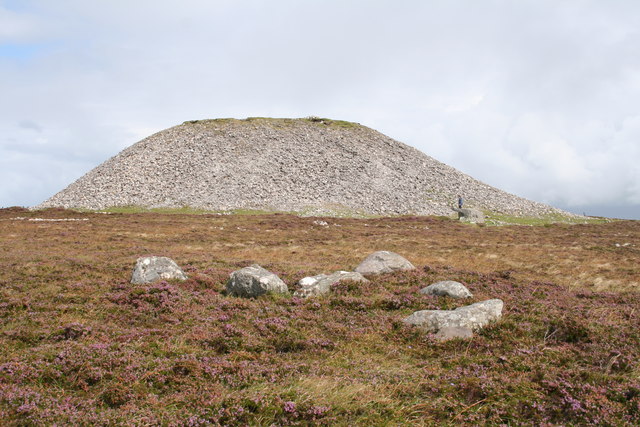
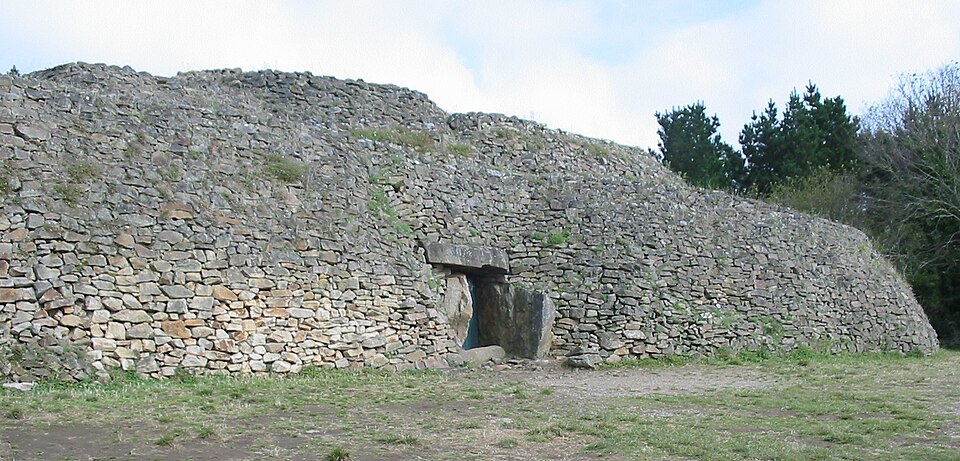
Maeve’s Cairn, the biggest one in Ireland, Knocknarea from geograph.org.uk © Bob Embleton. Shared under Wiki Commons.

Gavrinis cairn, Brittany, France © Many vyi. Shared under Wiki Commons.

Ancient cairn, ruins of Qa’ableh, Saraag, Somalia. © Abdirisak Shared under Wiki Commons

Stones were used because of their durability. The Ancient Greeks believed that using stones to mark graves would ward off evil spirits and they also symbolised the soul’s eternal nature as they didn’t change over time. They associated them with the god, Hermes. However, stones and their associations with burials have been known to many ancient cultures especially Ireland, Scandinavia North Africa, the Middle East and Asia amongst others where they used them to mark sacred territories where communities would gather to honour their dead. Also the  Neolithic and Bronze periods in Europe in particular. Stones were used to create cairns.  These are usually placed on top of graves as markers and to protect the dead from predators.  In the Bronze Age they may have believed that the stones would stop the dead from rising as in the Jewish faith. Some of these still stand. The word ‘cairn’ comes from the Irish ‘carn’ with the plural being ‘cairn’ . In Scottish Gaelic ‘càrn’ translates to ‘heap of stones.’

They were also seen as a method of defence in that it would ward off predators from the burial site.

However, more recently, there has been controversy regarding the building of cairns on certain sites. This is due to the environmental damage that they can cause. Both the Hawaiian Volcano Observatory and the US National Park Service have complained about visitors prying off pieces from important geological features to make them as well as interfering with existing cairns and the destruction of important trail markers.  In the Peak District one man has made his mission to kick down the dozens of stacks that he finds. BBC News reported that:

‘Many have been created by taking stones from an old wall which may have damaged the habitats of the small creatures that live inside the wall and may have long term effects according to the National Trust who will also disassemble any stacks.

The stacks are seen as :

…. not to mark any burial sites or act as markers but just create unnecessary stacks for aesthetic purposes forgetting their original purpose as wayfinding tools and symbols rather than decorations.’

Stones taken to build stacks along the Great Wall were taken from an old wall which now looks like this. © Stuart Cox

The stones that have been left behind on the little seawall shrine, have presumably, come from the beach below and are a poignant symbol of remembrance signifying that the departed has been visited. The stones emphasise the enduring nature of memory and ite sbaility to enable the departed to live on. He is not forgotten by those who knew him and he died at one of his favourite places. RIP.

©Text and photos Carole Tyrrell unless otherwise stated

Why Jews Put Stones on Graves | My Jewish Learning

Why Do People Put Stones On Graves? Here Are 5 Reasons

Visitation stones – Wikipedia

Why Do People Put Rocks on Gravestones

Cairn – Wikipedia

The History of Cairns: Marking Paths, Memories, and Sacred Spaces – Magnolias + Fluff

Why I kick down Peak District stone stacks – BBC News

Please don’t stack rocks on your next hike. Here’s why. – Lonely Planet

An opportunity to support the latest book from Loren Rhoads, a renowned and respected taphophile!

Loren Rhoads is a US based committed taphophile or cemetery enthusiast, and has written several brilliant, informative books on cemeteries, in the US and further afield.   These include:

  • 199 Cemeteries to see before you die
  • 222 Cemeteries to see before you die
  • Wish you Were Here: Adventures in Cemetery Travel
  • Death’s Garden Revisited, Personal Relationships with Cemeteries

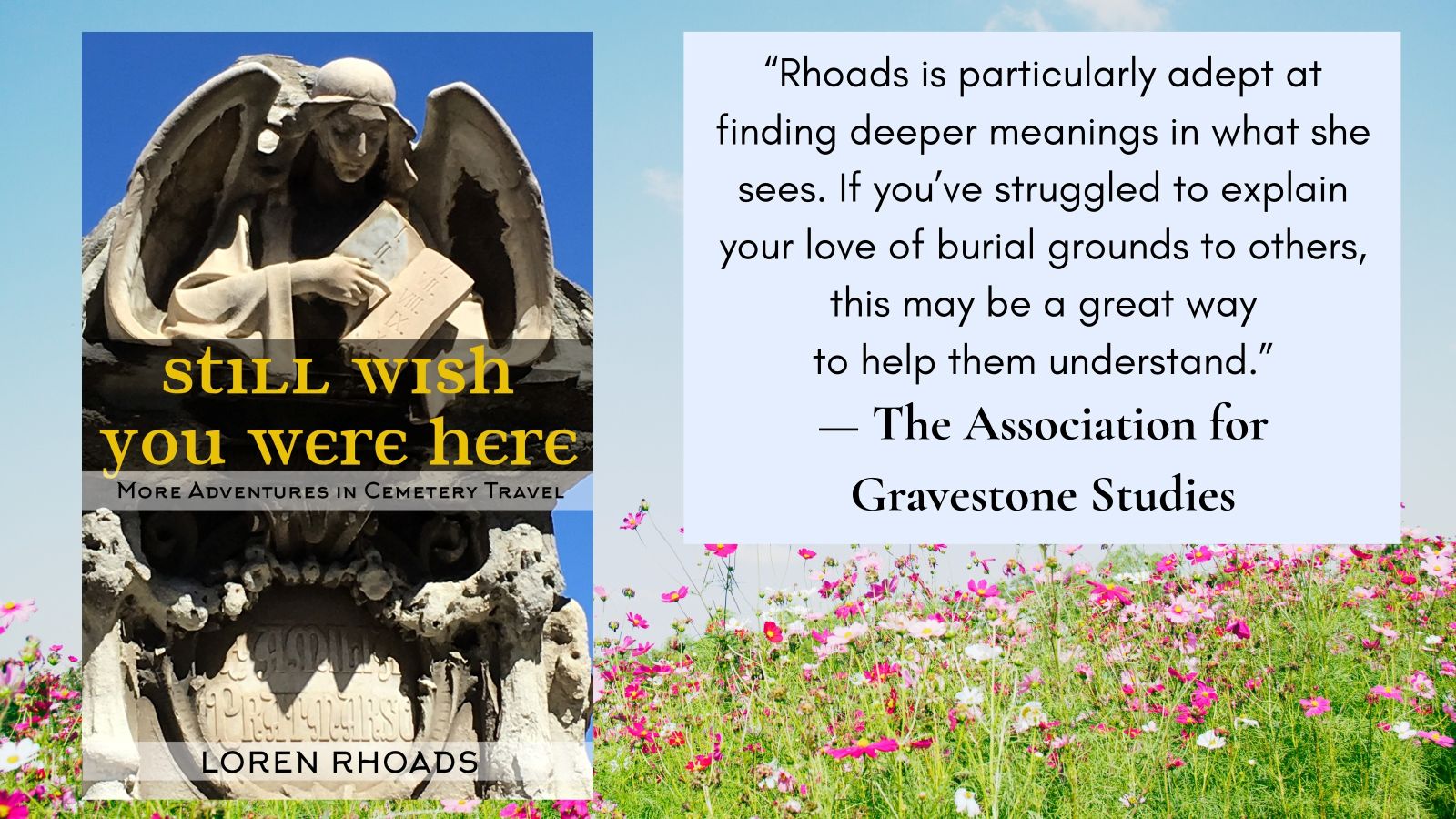
She is an absolute doyenne in the taphophile world and Loren’s latest, ‘Still Wish you Were Here: More Adventures in Cemetery Travel’ is being crowdfunded on Kickstarter.  The backing has already exceeded the requested amount which means that Loren can achieve even more with her book.

In her accompanying video Loren describes ‘Still Wish You Were Here’ as being:

‘part travel memoir, part cemetery history with 36 graveyard travel essays written for various organisations and publications.’ 

She visited 50 burial sites from Michigan, to London, Singapore, Barcelona, Tokyo and more and has confessed to ‘absolutely loving cemeteries and their stories.’ She finds cemeteries as inspiring as I do .  Check out her video at:

Still Wish You Were Here: More Adventures in Cemetery Travel by Loren Rhoads — Kickstarter

I was one of the people who were invited to take part in  ‘Death’s Garden Revisited: Personal  Relationships with Cemeteries’ which was also successfully funded on Kickstarter.  It was a fabulous looking book and I was proud to be part of it and to read other essays by fellow taphophiles.  So, I have every faith in Loren creating another terrific book on cemeteries and have backed it myself!  But don’t take my word for it – this is what the Association for Gravestone Studies have said:

Every little helps and there are several ‘rewards’ for different levels of backing including a cemetery party!   So please, if you are a fellow taphophile and are able to , please consider supporting Loren’s book – if anyone can do it she can!

Symbol of the Month – The Mass Dial

In light of the mass dial found at St Mary’s In the Marsh, I thought it might be timely to repeat the 2021 Symbol of the Month about them. Easily missed as they are not always where you expect to find them, they are survivors from a time where there were no time keepers such as clocks. People rose with the sun and went to bed at sunset which is why they were so important to villages and their inhabitants.

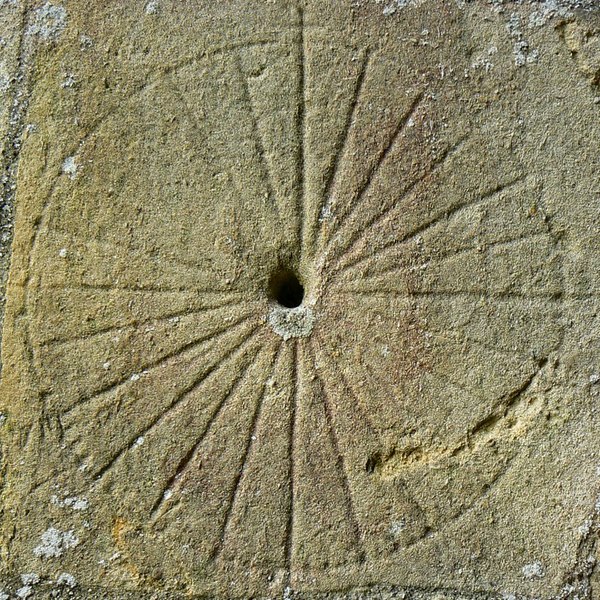
Mass Dial set into a wall at St James’s, Cooling, Kent. © Carole Tyrrell

Despite the somewhat dispiriting summer, I was determined to escape from the house and see at least one or two local churches.  My little part of Kent is known as Charles Dickens country (I’m not sure that he knows about this) and there are several buildings and churches associated with him. 

One of these is St James’s church at Cooling.  Although closed for services, it is still kept open by local people on most days. The Churches Conservation Trust take care of it and it’s in an isolated spot which borders onto marshes.  It’s also a fair walk from the nearest town, Cliffe.  I didn’t see any signs of much of a village there although there is a 14th century ruined castle nearby. St James’s is the end of a terrace of houses appropriately named Dickens Walk. 

l’ll talk more about St James in a later post as it inspired one of Dickens most atmospheric scenes in ‘Great Expectations’ with the childrens graves in the churchyard.  But while I was there, I found a symbol set within a wall that I had heard of but had never previously seen an example – this was the Mass Dial.  I have to admit that if it hadn’t been pointed out on a display board within the church that I might have missed it as it’s set into an outer wall of the church.  Not many have survived and Victorian restoration may have meant that they are found in odd places.

Mass dials are rare survivors and were a way of telling time before the invention of mechanised clocks and timepieces in the 14th century. 

It was the Anglo-Saxons who established the dials.  There had been confusion with all the different calendar systems such as the Lunar and Julian, and with a largely illiterate population, a visual way of telling the time was necessary.

It was the Anglo-Saxons who established the dials.  There had been confusion with all the different calendar systems such as the Lunar and Julian, and with a largely illiterate population, a visual way of telling the time was necessary.

According to the Building Conservation website:

the Anglo Saxons divided night and day into 8 artificial divisions known in Old English as Tid or Tides.  The 4 daylight divisions were called:

Morgen – 6am – 9am

Undern – 9am to noon

Middaeg – Noon to 3pm

Geletendoeg – 3pm to 6pm. 

Morning, noon and evening are still in use as the last remnants of this division still in use today as are moontide, yuletide and shrovetide.’

But, throughout the Middle Ages, the Catholic church emphasised the reciting of prayers and fixed times during the day as pre-Reformation Britain was still a Catholic country.  These were known as the Divine Offices and were:

Matins – pre-dawn

Prime (6am)

Terce (9am)

Sext (12pm)

None (3pm)

Vespers (sunset

Nocturnes (after sunset) 

However, these were not set as the sun might not shine for a few days and if a mistake was made then the parish priest might end up celebrating certain feasts on different days from a neighbouring parish. 

Mass Dial, St John’s church, Devizes, Wiltshire – note that it still has the marker in it showing how it worked.© Brian Robert Marshall under Geograph Creative Commons Licence.

They were a form of medieval sun dial and originally the hole in the centre of the dial would have contained a horizontal wooden or metal rod that cast a shadow.  This was known as a ‘gnomon’ which is pronounced as No Mon.  These may well have been the local community’s only way of telling the time although medieval life revolved around getting up at sunrise and going to bed at sunset.

According to the British Sundial Society,

‘mass dials can be found on the south side of many churches.  They are usually small and often located on the walls, buttresses, windows and doorways of a church.  However, they can also appear in more unlikely places such as inside churches and on north walls where the sun rarely shines. But they have also been found in porches suggesting that the porch was built sometime after the dial was made.’

The Society goes onto suggest that this may be

 ‘due to the stone blocks having been re-used in the rebuilding of the church.’ 

The location of the Cooling one may indicate that it’s been moved.

Again, according to Building Conservation:

‘if a mass dial is found anywhere other than a church and other than the south elevation of a church, this usually means that it has been moved from its original location often as part of a Victorian restoration.  In such cases, the dials were sometimes rebuilt into the fabric upside down, making them unreadable.’

The positioning of mass dials is important and can vary.  They may be on the smooth cornerstone or quoin of a tower, nave or chancel, above a porch or on a door or window jamb.  Often they are set at eye level and in one church it is cut into a window ledge.

Mass dial, All Saints.Oaksey, Wiltshire. © Brian Robert Marshall. Shared under Wiki Creative Commons

Mass Dial, St Michael & All Angels., Heydon, Lincs. ©Richard Croft. Shared under Wiki Creative Commons

Mass dials also vary in their design as:

‘Some have either a few or many radiating lines, {others} have ‘hour’ lines within the circles or semi circles and others are constructed with a ring of ‘pock’ marks drilled into the stone.’  

British Sundial Society

There are also variants in the way that the hour lines are numbered as they may have Roman numerals or even Arabic ones.  They’re also known as scratch dials as

‘many are quite crudely scratched into the stone.’ British Sundial Society

A full circle version, All Saints, Yatesbury. ©Brian Robert Marshall Shared under Wiki Creative Commons

The 14th century brought mechanical clocks that created a regulated 24 hour time period.  As a result, medieval life changed as it was no longer so reliant on daylight.  However, mass dials were still in use but now they were a complete circle with lines radiating from the central gnomon to simulate the 24 hour clock.  But by the 16th century they had fallen out of use.  Sundials and mechanical locks had overtaken them and it was no longer the Roman Catholic church that dominated after the Reformation.

Mass dials are of great archaeological and historic importance.  However, many of them are now indecipherable due to erosion and vandalism and people may not even realise what they are or their significance.

© Carole Tyrrell Text and photos unless otherwise stated.

References and further reading

https://sundialsoc.org.uk/dials_menu/mass-dials/

https://www.buildingconservation.com/articles/mass-dials/mass-dials.htm

http://massdials.org.uk/links.htm

A Spring saunter in the footsteps of E Nesbit – Part 2 – The last resting place and final home.

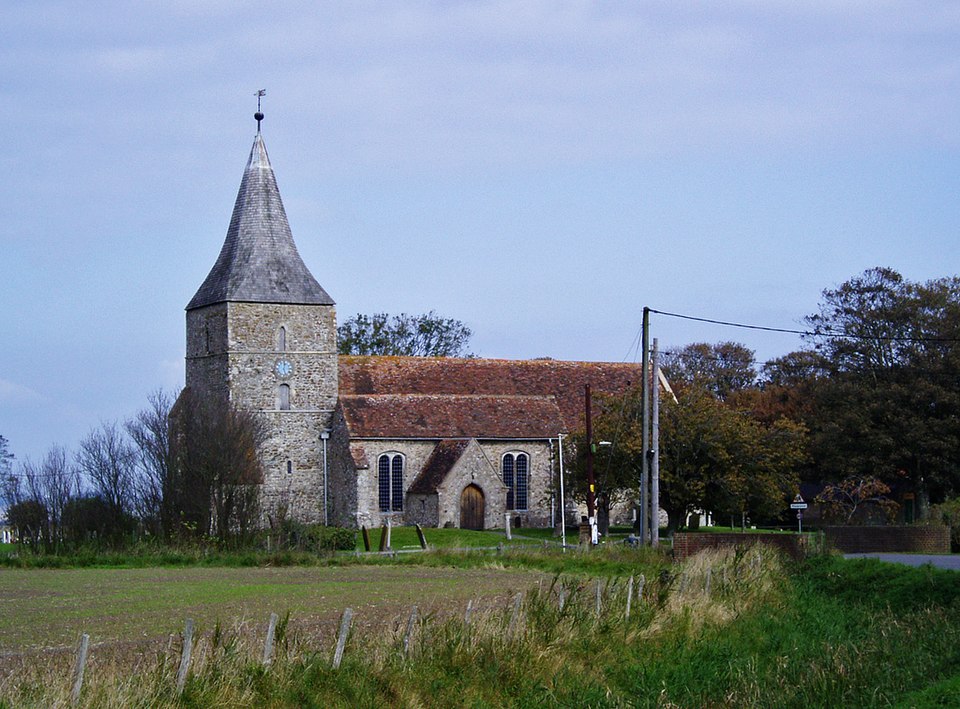
St Mary’s in the Marsh Shared under Wiki Commons

Edith Nesbit is buried in the churchyard of St Mary in the Marsh which was our next church. We left Brenzett and its attractive cats to travel through the wonderful Kent countryside. Blossom foamed over the hedgerows and the fields and marshes seemed to stretch on forever. There was a sense that Nature was beginning to stretch herself and come back to life after the winter.


Early bluebells nodding in the breeze, St Mary’s in the Marsh ©Carole Tyrrell

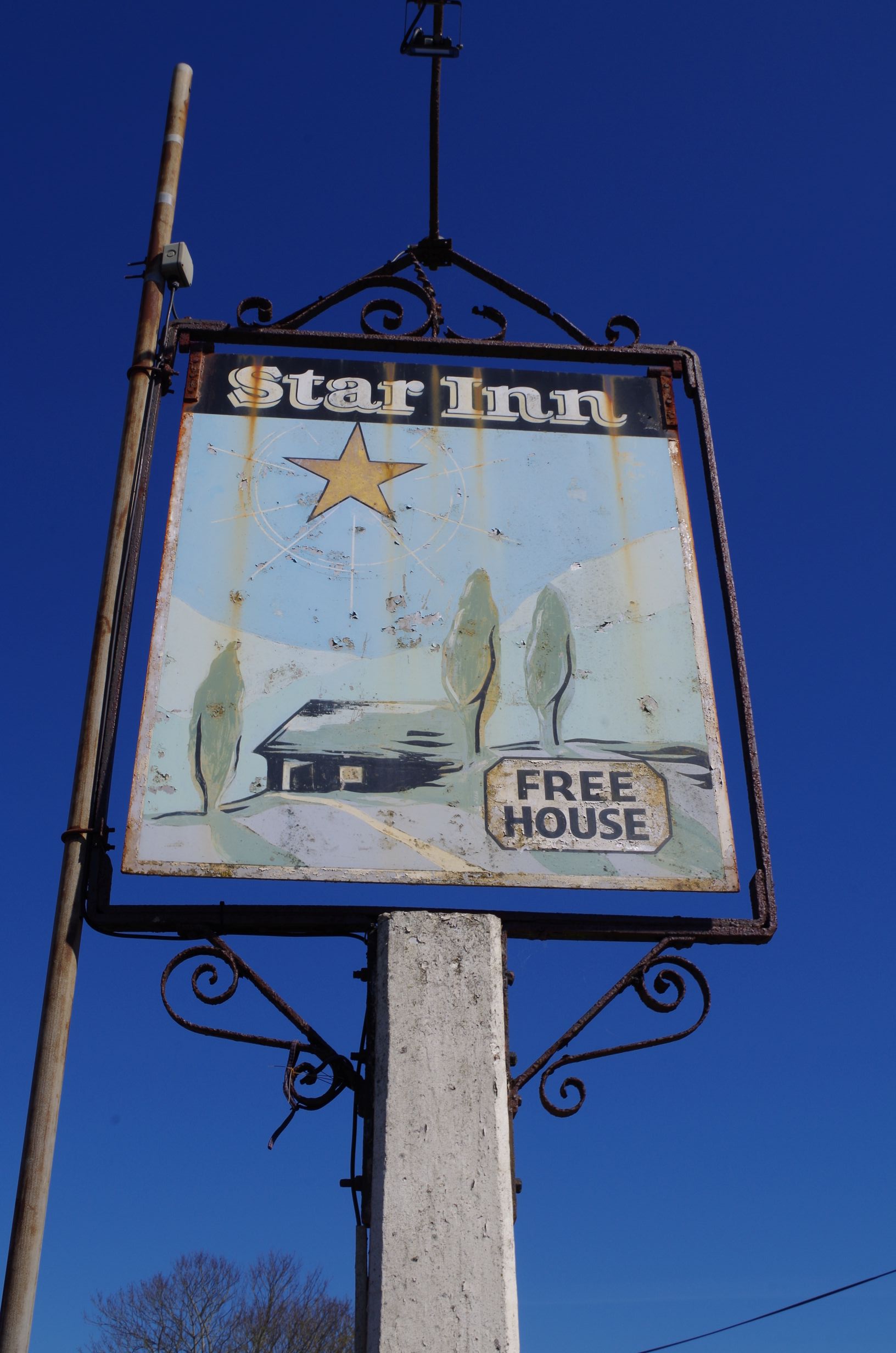
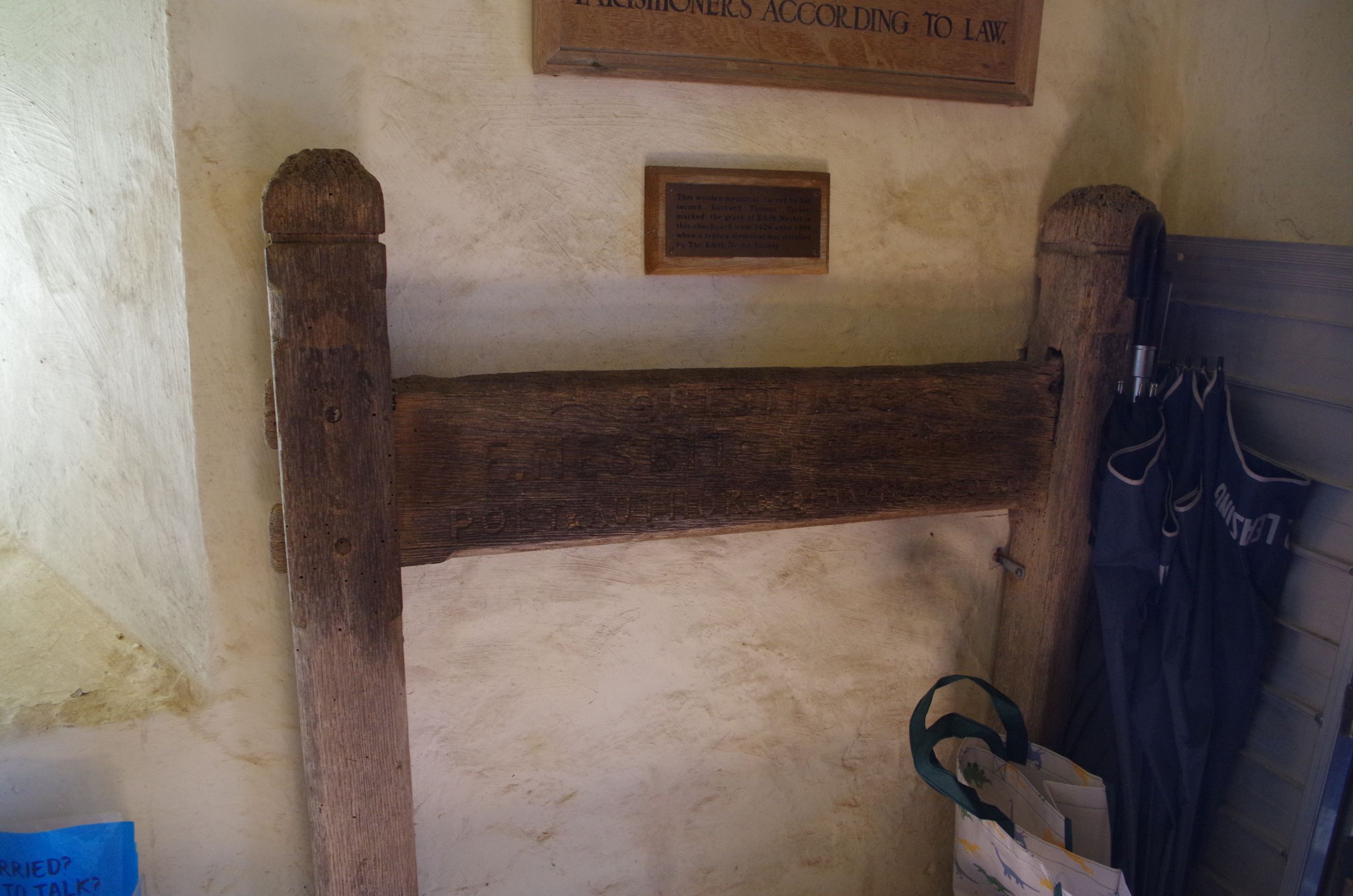
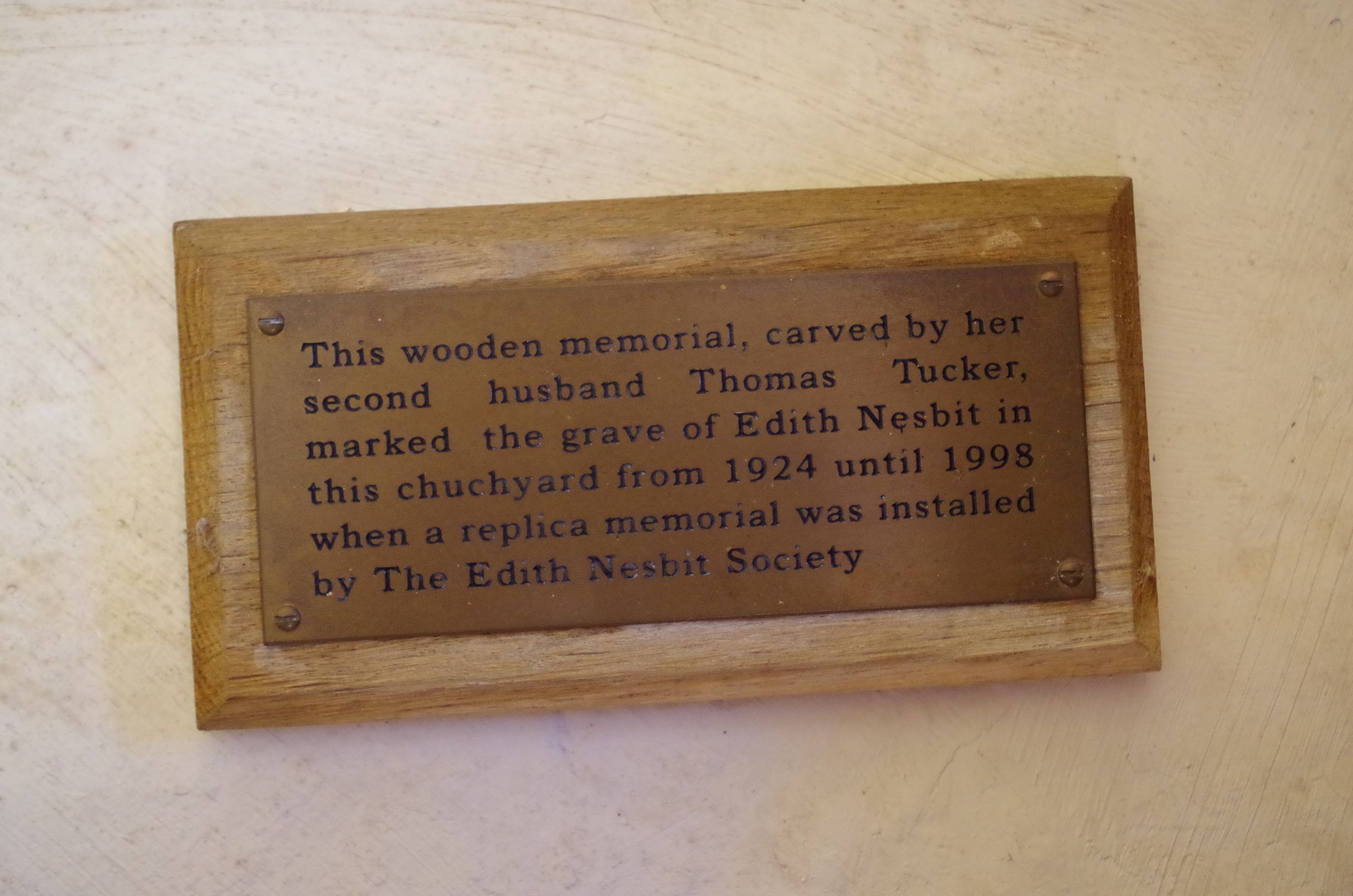
St Mary in the Marsh was a more substantial church and we were greeted by the Star Inn which ‘would have been Edith’s local’ but is now a private house. It’s a large, rambling building and was opposite the church. We soon found her last resting place in front of St Mary’s lying under the morning sun and with a simple wooden rail as a marker. It was Tommy, her second husband, who erected the first wooden rail commemorating Edith. This has suffered over the years and is now inside the church porch with a small plaque.  The one in the churchyard today is a replacement put up by the E Nesbit Society.  

E Nesbit grave marker.©Carole Tyrrell

The original grave marker now in St Mary’s church porch. ©Carole Tyrrell

Plaque above E Nesbit’s grave marker. ©Carole Tyrrell

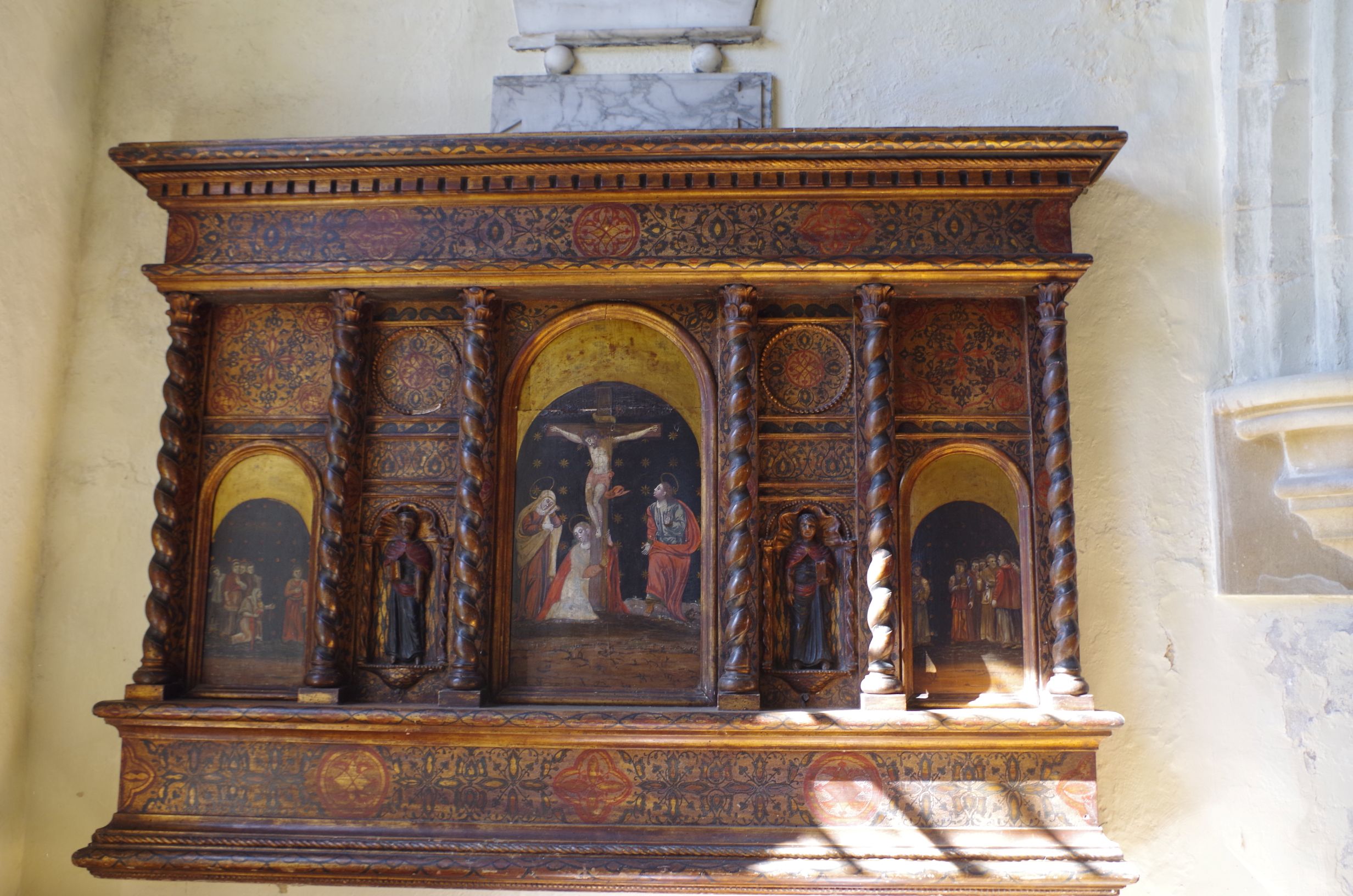
St Mary’s was less plain inside than St Eanswith although there were still box pews and whitewashed walls.  There was a magnificent triptych on one wall and another little plaque inside the nave dedicated to Edith. Three pairs of eyes were watching us as we explored. There were two small heads attached to two pillars of a sedilia by the altar and another, larger one at the base of a column.

Two ancient faces watching from the sedilia by the altar.©Carole Tyrrell

Another watching face from the base of a column. All four images ©Carole Tyrrell

Outside early bluebells nodded in the breeze and we found a medieval mass dial set into a wall. (please see Symbol of the Month – The Mass Dial published 18/10/21)

Medieval mass dial set in wall. ©Carole Tyrrell

Afterwards we went on to explore churches and other places associated with Russell Thorndike and his famous creation whose exploits took place on the Marshes, Dr Syn.

Our final port of call was St Mary’s Bay in Dymchurch where we saw the house known as ‘The Jolly Boat’ which was E Nesbit’s final home which she are with Tommy. It is now a holiday home and is situated at the end of Nesbit Road appropriately enough.  As we admired it, we were lucky enough to see a steam train from the Romney and Hythe railway come puffing past as it steamed into the station nearby.  In the town one of our party had spotted a blue plaque on a house called ‘The Cottage’ which commemorated its famous residents: the painter Paul Nash, Noel Coward and Edith all stayed there. We did wonder if it had been at the same time and one of our party commented that ‘it must have been quite a party!’

The Jolly Boat, April 2025. ©Carole Tyrrell

Nameplate of ‘The Jolly Boat’©Carole Tyrrell

A steam train came puffing past! ©Carole Tyrrell

Blue plaque outside The Cottage, Dymchurch. ©Carole Tyrrell

E Nesbit had a fascinating life with her strong Socialist views and published over 60 books, some of which are still in print today. The film version of ‘The Railway Children’ is a much loved classic although her ghost stories are less well known.  They were reprinted last year in ‘The House of Silence’ by Handheld Press.

It was a wonderful day travelling the marshes and understanding how they inspired Edith where she is still remembered with such affection.

©Text and photos Carole Tyrrell unless otherwise stated

References and further reading:

Brenzett, Church of St Eanswith — Romney Marsh Historic Churches Trust

St Eanswith’s Church, Brenzett, Kent

The Project Gutenberg ebook of Grim Tales, by E. Nesbit.

https://edithnesbit.co.uk  The Edith Nesbit Society

E. Nesbit – Wikipedia

A Spring saunter in the footsteps of E Nesbit – Romney Marshes, Kent Part 1- Man size in Marble

St Eanswith, Brenzett © Carole Tyrrell

The churches of the Romney Marshes are isolated and you’ll need your own transport to visit them. But there are hamlets and villages here and there and I could imagine how it must feel in mid-winter with dark short nights.

However it has long been one of my ambitions to explore the churches that are on the marshes. So when I was offered the chance I didn’t hesitate.  It was a wonderful Spring day, sunny and bright, and we were all eager to explore the Marshes.

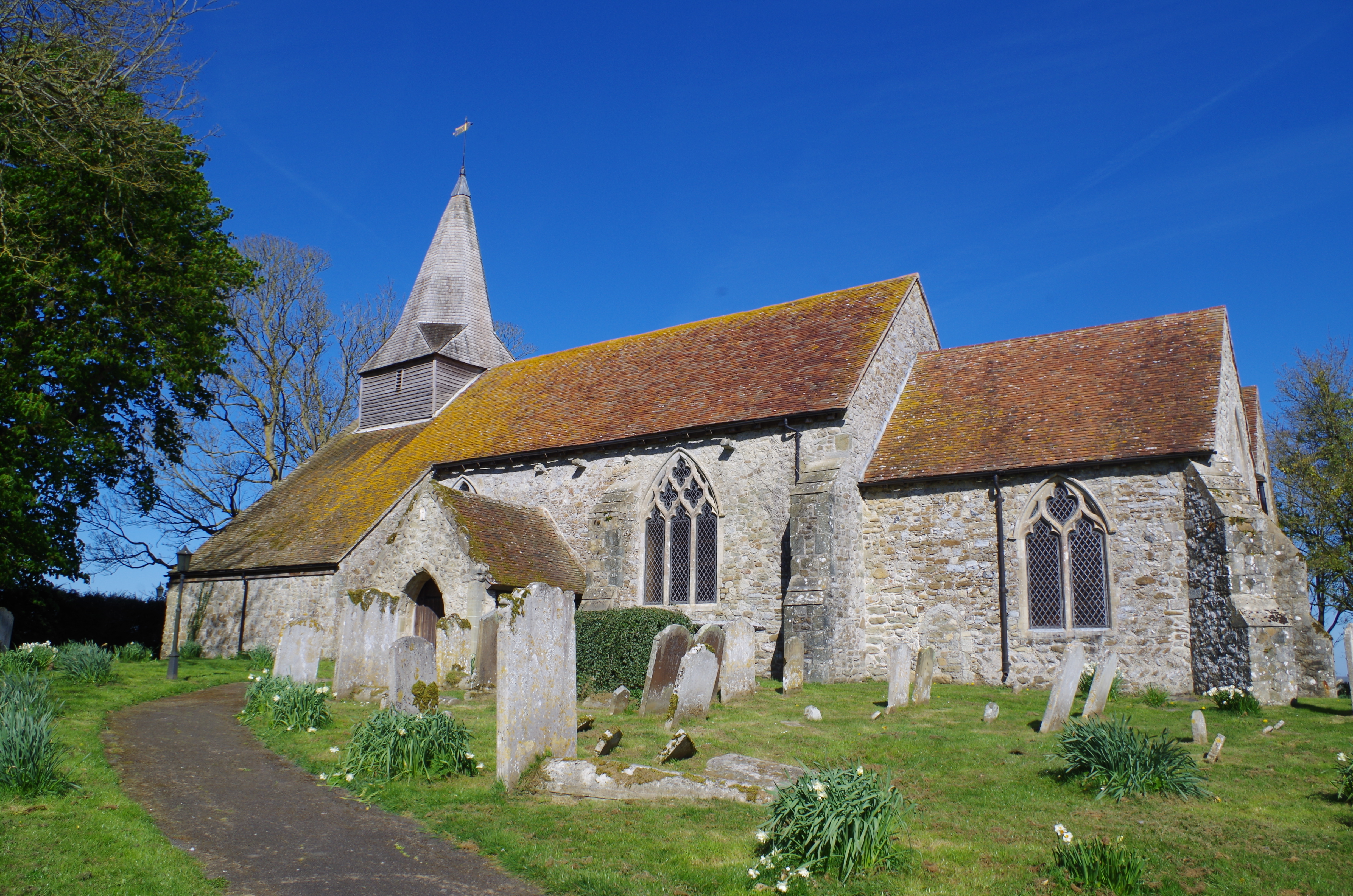
Our first church was St Eanswith in Brenzett. This was a plain little church with a candlesnuffer steeple on top of a small slope and was surrounded by a small churchyard dotted with daffodils. There was an azure blue sky and a hare was spotted racing across a bare field at the back of the church. It’s one of the smallest churches on the Marshes and is dedicated to a 7th Saxon princess who founded a nunnery in Folkestone in 630AD. There is now nothing left of the Saxon building and the present church can only be dated back to the 12th century when the Normans rebuilt it.

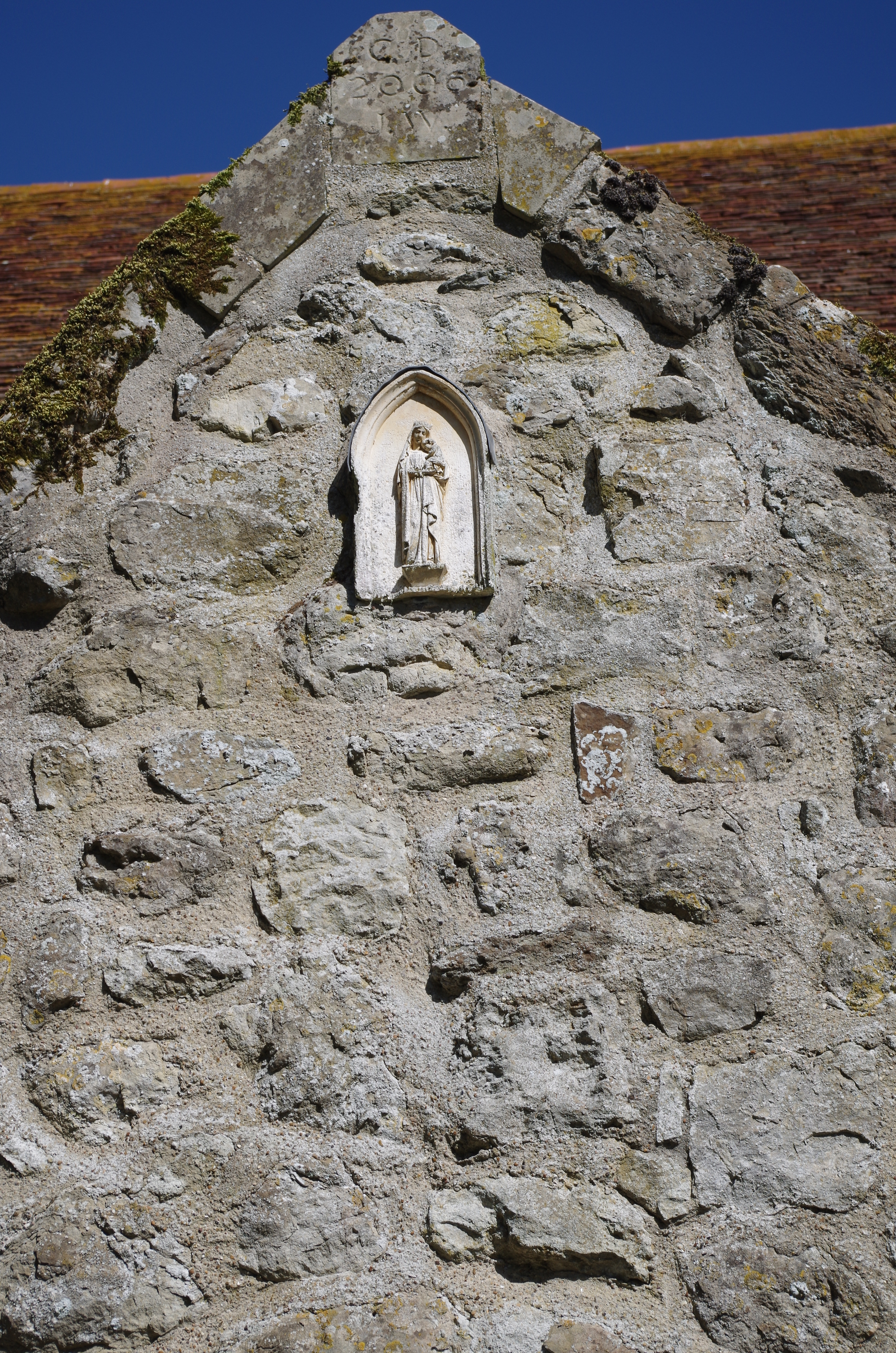
A small statue of St Eanswith over the top of the porch. © Carole Tyrrell

A large Maine Coon cat, who was obviously returning from a night out through the churchyard to its home in the little straggle of houses nearby, caught sight of us and tried to hide by running from patch after patch of daffodils. Then its owner came out of the house that it ran into with another Maine Coon cat!

Hide and seek © Carole Tyrrell

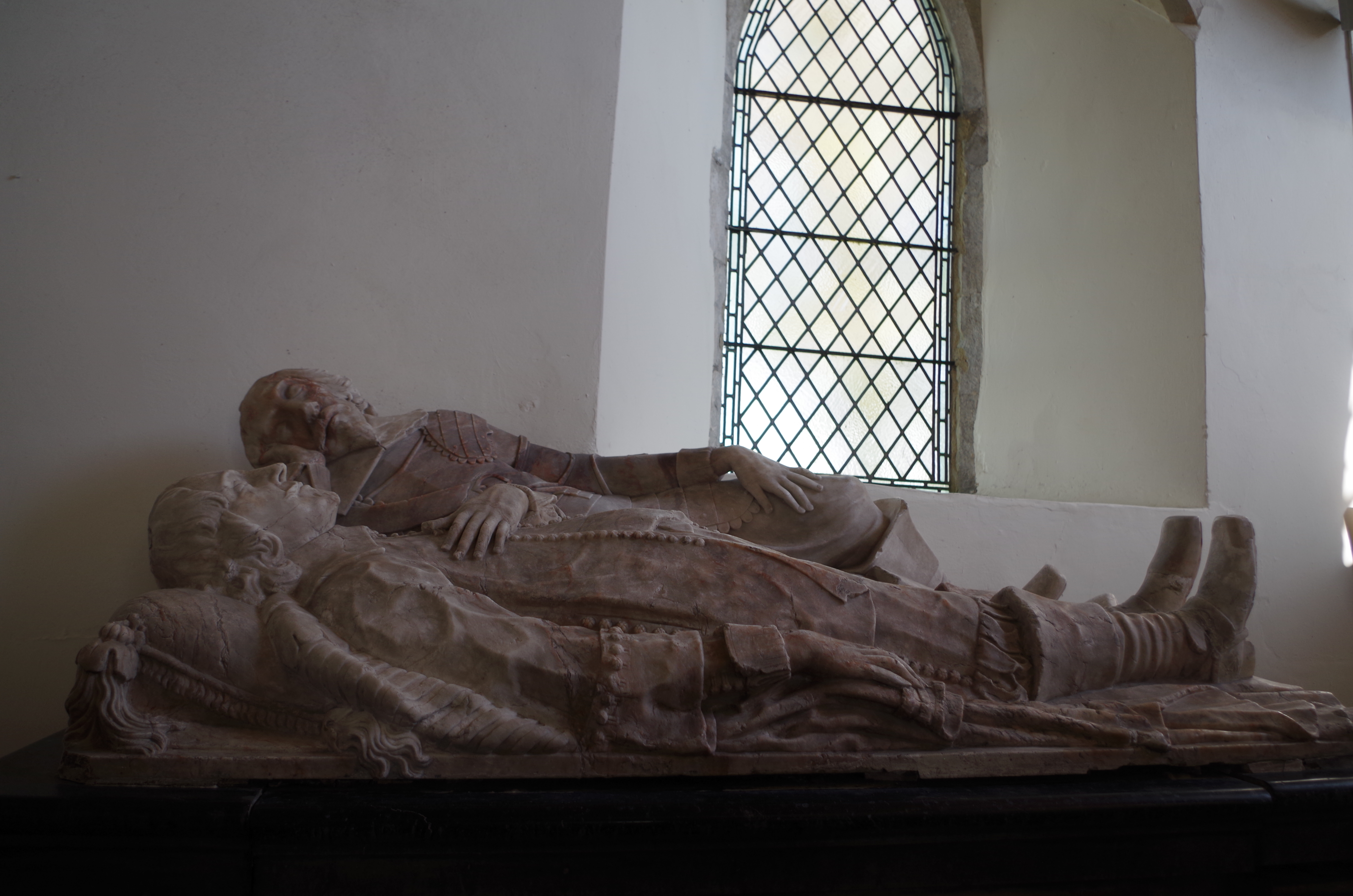
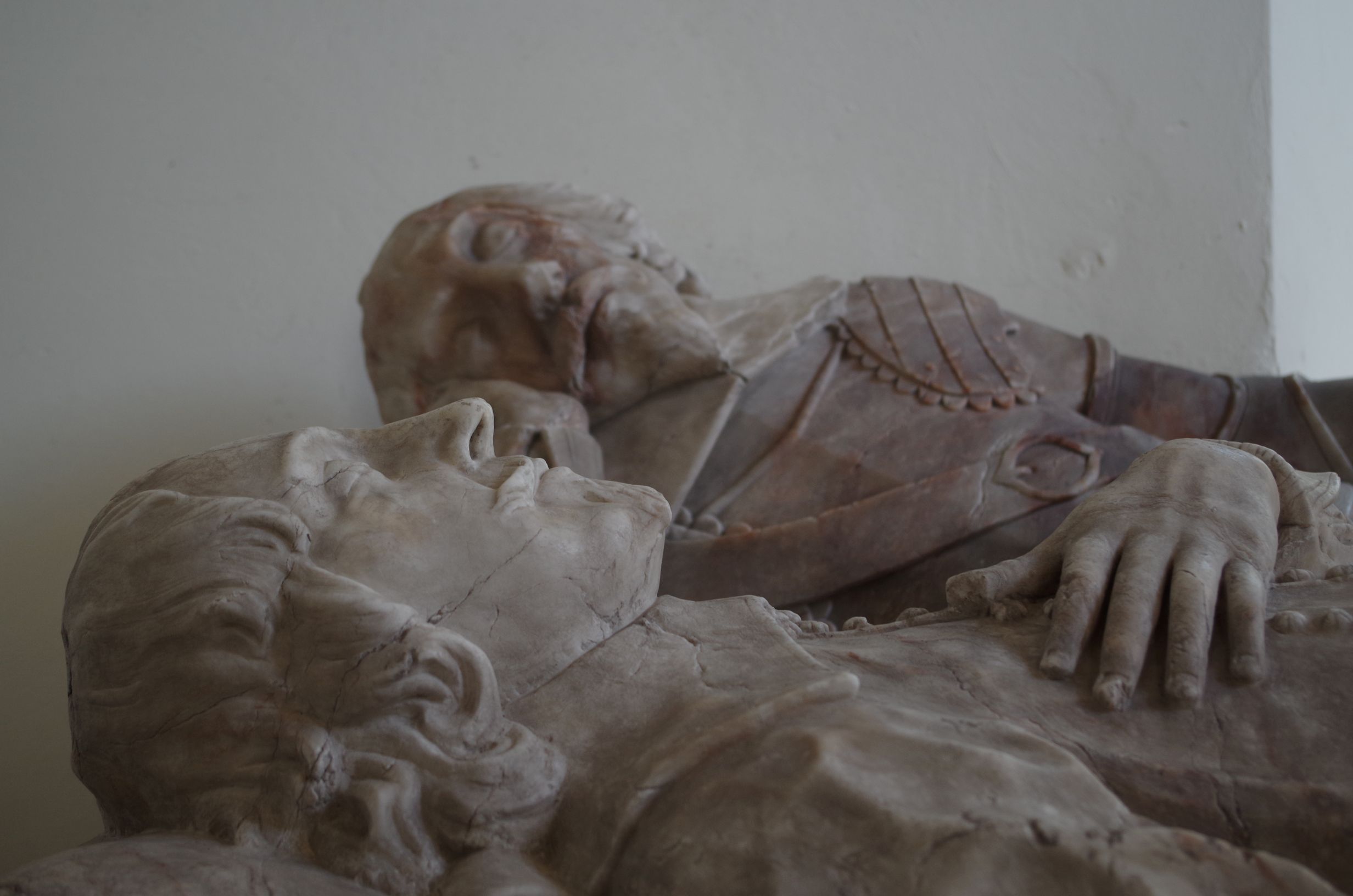
Inside St Eanswith it was plain, with white washed walls and dark wood pews. The pulpit had a raised roof panel which I’d not seen before and at the altar end of the church was the table tomb that we had come to see. This was the Fagge monument and is the only monument in the church. It is dedicated to a father and son, both confusingly called John, and it is a pair of alabaster sculptures of two men in fashionable 17th century clothes. The man in the foreground is portrayed as lying on his back on a sculpted cushion with his left hand on his chest while the man behind is lying on his elbow with his right hand under his chin and his left hand on his left leg. There are visible cracks and damage with repairs which you would expect over the centuries. They are beautifully sculpted. There are small coats of arms beneath the figures at corners which bring a small splash of colour. John Fagge the elder died in 1639 and his son and heir died in 1646.

The Fagge monument, St Eanswith. © Carole Tyrrell

Close up of the Fagge monument. © Carole Tyrrell

Close up of hands showing the ravages of time. © Carole Tyrrell

Epitaph to the Fagges and one of their coat of arms.© Carole Tyrrell

This is the monument that inspired one of E Nesbit’s most famous stories, ‘Man Size in Marble’ which was adapted by Mark Gatiss for the 2024 BBC Christmas ghost story and retitled ‘the Stone Woman’.  A young married couple have moved to the country and their housekeeper tells them of a certain night when something walks from a local church to their house. They take no notice of this but when the husband is called away and leaves his wife alone in the house….you can read the story here:  The Project Gutenberg ebook of Grim Tales, by E. Nesbit.

This is English folk horror clashing with modern reasoning and belief. Nesbit creates the dark countryside so well and also the central characters incredulity at what they are being told. They are still in love with endearments such as ‘wifie’ and ‘dearest’ which makes the ominous events that are about to happen all the more shocking.

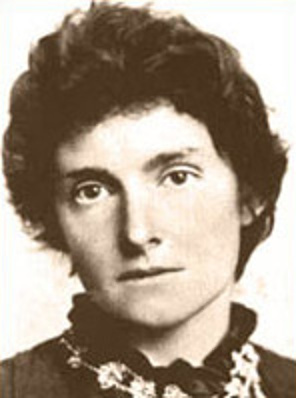
E Nesbit c. 1890 Shared under Wiki Commons

E Nesbit (1858-1924)  is most known for ‘The Railway Children’ which was first published in 1905 and has never been out of print. It was also a classic and well loved childrens film. Some of her other children’s stories have also been adapted for TV.  But she also wrote ghost stories, some of which were recently published by Handheld Press in the collection ‘The House of Silence.’

She was only 4 when her father, an agricultural chemist, died. Edith’s sister, Mary, suffered from ill health and as a result the family travelled in the UK and France. She died in 1871 of tuberculosis after becoming engaged to the poet Phillip Bourke Marston.  After Mary’s death, Edith and her mother lived in Halstead Hall, Halstead in Kent which is considered to be a possible location for ‘The Railway Children’.  When she was 17 they moved to Elswick Road in Lewisham. 

She married Hubert Bland on 22 April 1880. They met when she was aged 18 and at 21 and 7 months pregnant they tied the knot. It was a difficult marriage to say the least as he was always being unfaithful. Edith had 3 children by him and adopted 2 more from one of his long term affairs. It was a complicated family.  She and Hubert were both fervent socialists and joined the Fabian Society, jointly editing its journal ‘Today.’ But this work often took second place to Edith’s writing as she became more successful. The Fabian Society ultimately became part of the Labour party.

From 1899-1920 she lived at Well Hall Eltham. The house is long gone but the garden remains as a public park. She also had a second home at Crowlink, Friston, East Sussex when she entertained.

Bland died in 1918 and she married her second husband, Thomas ‘the Skipper’ Tucker in Woolwich where he was the captain of the Ferry.  They both lived at St Mary’s Bay, Dymchurch at their house ‘The Jolly Boat’ where she died on 4 May 1924. It may have been from lung cancer as she was a great smoker.  Tommy died at the same address on 17 May 1935. To read more about Edith and her life please visit: https://edithnesbit.co.uk

It was such a privilege to see the Fagge monument in the flesh so to speak and also a writer’s inspiration. I could easily imagine Brenzett on a winter’s night, the little terrace of houses with their curtains drawn and lights out as something stirs and moves within the small church and suddenly the top of the tomb is empty and something that shouldn’t be is walking…..

A Spring Saunter in the footsteps of E Nesbit Part 2 her late life on the Marshes

© Carole Tyrrell photos and text unless otherwise stated

Brenzett, Church of St Eanswith — Romney Marsh Historic Churches Trust

St Eanswith’s Church, Brenzett, Kent

The Project Gutenberg ebook of Grim Tales, by E. Nesbit.

https://edithnesbit.co.uk  The Edith Nesbit Society

E. Nesbit – Wikipedia

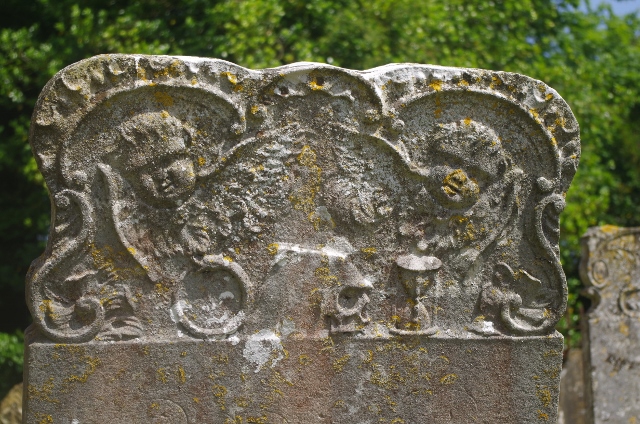
Symbol of the Month – The Winged Soul

A lovely example of a winged soul from St Peter & St Paul, Shoreham, Kent.
©Carole Tyrrell

The skull and crossbones was one of the central motifs of 18th century Memento Mori and intended to be a stark and macabre reminder of the viewer’s inevitable destination.  They would be all that would remain of you after death.

However it wasn’t a very comforting message to either the loved ones left behind or to the living.

But fashions and tastes change, even in funerary symbolism, and the skull and crossbones had served their purpose.

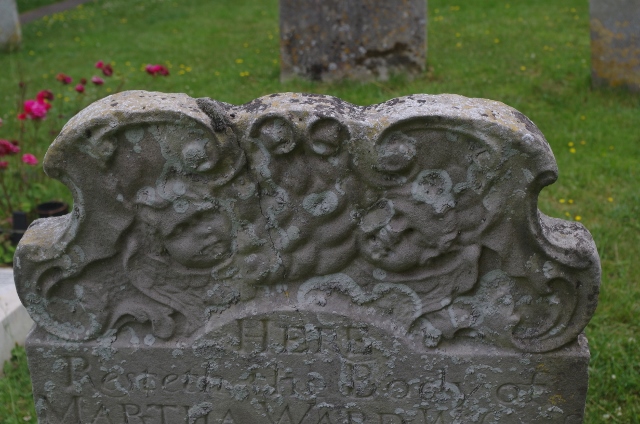
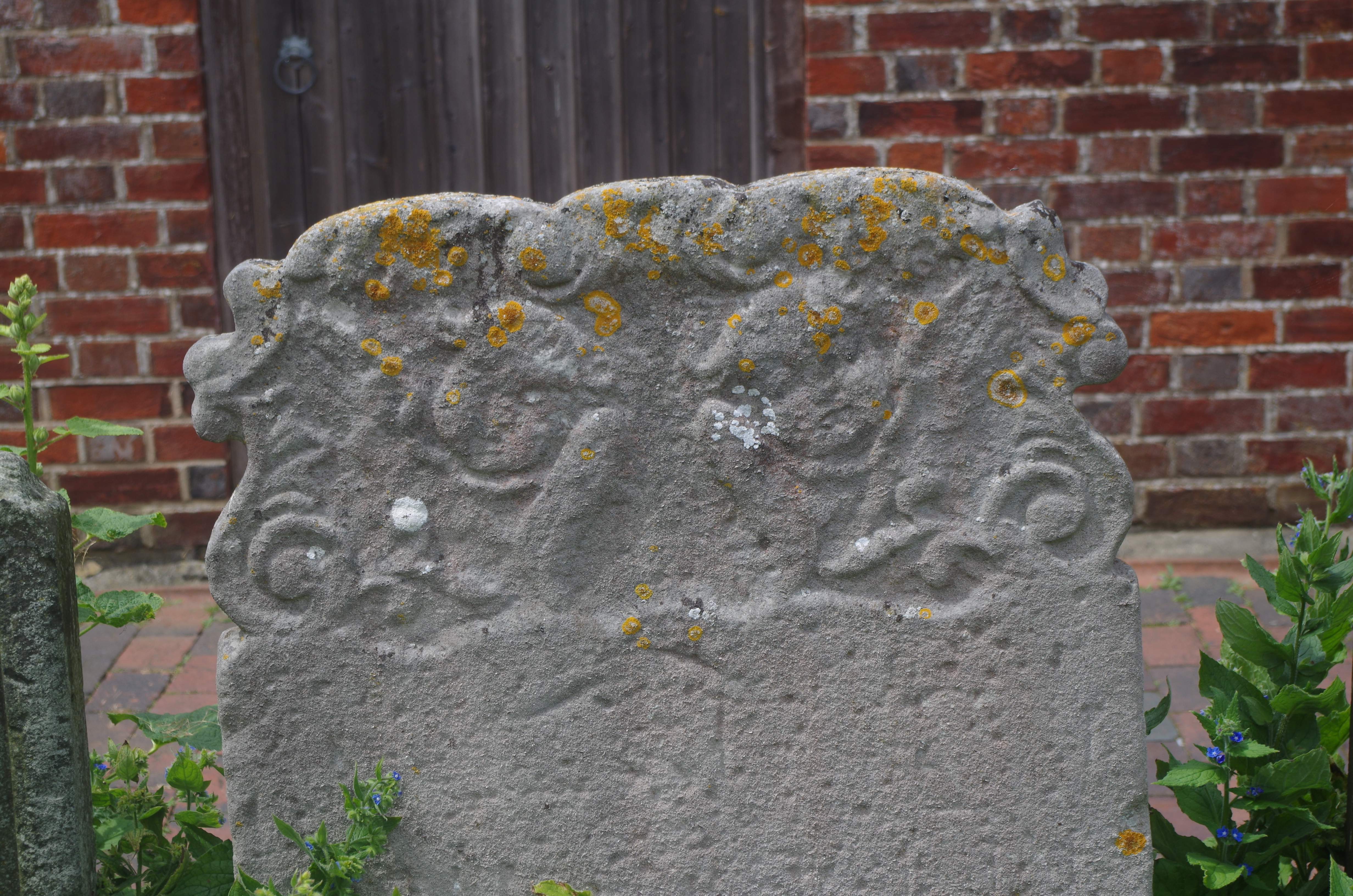
Instead they were replaced by the winged soul. This consisted of a small child’s head flanked by a pair of wings or a garland of leaves.  They have the faces of babies with big, round eyes, plump cheeks and pouting lips and resemble Renaissance putti which are child-like.  Putti represent the sacred cherub as they are known in England.

The winged soul may have been intended to be a more comforting image as the wings represented the soul of the deceased ascending to heaven.  This could also give hope of a resurrection to those left behind.  According to headstone symbols:

‘In the USA the winged soul is known as a soul effigy.’

It was immensely popular and in my explorations of medieval Kent churches and their churchyards I found many examples. In fact, in one or two churchyards they outnumbered the skull and crossbones symbol. They mainly had one winged soul on a headstone but there were sometimes  two or three clustered together as in these examples:

They can also appear in several combinations with other classic memento mori symbols as here:

2 winged souls apparently in mid flight with clouds between them. St Martin of Tours, Eynsford, Kent.
©Carole Tyrrell


The winged soul’s head looks more like a skull with a fine pair of wings. St Peter & St Paul, Tonbridge, Kent ©Carole Tyrrell
2 winged souls in mid-flight, St Peter & St Paul, Tonbridge, Kent ©Carole Tyrrell
One of my personal favourites! Another stylised winged soul with skull and crossbones beneath and a cloud above as well as a pair of bones. St Peter & St Paul, Seal, Kent on the grave of a widow. ©Carole Tyrrell
A combination of memento mori symbols and a winged soul with one wing almost furled as if in mid-flight, St Peter & St Paul, Seal, Kent. ©Carole Tyrrell
A pair of winged souls with their wings almost in mid-flight with other memento mori symbols. St Peter & St Paul, Seal, Kent. ©Carole Tyrrell

In addition, every mason seemed to have his own interpretation of feathers as they can be carved as typical fluffy feathers, to resemble broad leaves or be very stylised.

With wings in general they are an important symbol of spirituality.  They express the possibility of flying and rising upwards to heaven.  For example, in the Hindu faith, they are:

the expression of freedom to leave earthly things behind…..to reach Paradise.’

New Acropolis

However, as the full flowering of the Victorian language of death in the 19th century began to appear the emblems of memento mori were retired. Although a couple, such as the hourglass and ouroboros, were revived.  

A modern interpretation of the winged Soul on a headstone from 1996, St Martin of Tours, Eynsford, Kent. ©Carole Tyrrell

But I did find two modern examples of the winged soul in the churchyard of St Martin of Tours in Eynsford, Kent and one is featured above. For years I had always thought of the winged soul as being a more general symbol and merely a decorative feature.  I called them winged cherub heads or death heads and never considered that they might have had a specific meaning or purpose.  It was exciting to see so many variations and interpretations, sometimes within the same churchyard.  But it depended on the skills of the mason as to how well they were carved and whether they were 2 dimensional or 3 dimensional.

But, as a message of comfort, it is one of the most poignant in memento mori. The other central motifs emphasise time running out and what will be left behind. The winged soul suggests an eternal life and a more uplifting message.

©Text and photos Carole Tyrrell unless otherwise stated

References and further reading:

http://www.thecemeteryclub.com/symbols.html

https://headstonesymbols.co.uk/headstone-meanings-and-symbols/deathheads/

https://stoneletters.com/blog/gravestone-symbols

https://www.boston.gov/departments/parks-and-recreation/iconography-gravestones-burying-grounds

https://en.wikipedia.org/wiki/Funerary_art_in_Puritan_New_England

http://www.speel.me.uk/gp/wingedcherubhead.htm

https://www.sacred-texts.com/lcr/fsca/fsca11.htm

A 200th birthday and an unsolved murder – Part 3 The parson detective comes on the scene – a visit to St Werbergh, Hoo, Kent

20th century headlines about the murder. © Carole Tyrrell

This is where Rev Jordan came in and he became known as the parson detective.  Such was the feeling in the community that he became determined to find the murderer and bring them to justice. So he set about disproving George White’s alibi.

At the time, George had claimed to have met one of his father’s employees, Joseph Green, who he had invited him to come with him. But a few yards away from the house, George had said that he had to return home to fetch his handkerchief. As a result, he was gone at least ten minutes which would have given him enough time to put the hurdle in place for the perpetrator’s gun to rest on. Joseph attested that the hurdle had not been standing at the pantry window during the day. Afterwards they had walked to the Chequers pub and Joseph said that it was the last time he saw George that night. Joseph had added that he had seen George ‘sitting up about upon the stiles’ near the murder scene before it was dark. Even more damning was that George didn’t get the handkerchief that he had said he went back home to get as, when everyone was assembled in the house after the murder, he hadn’t got one and had to go and find one.

A gun had been found in a clover stack near William’s house about a month prior to the murder and an employee called Francis Smith had put it in the hayloft. A short time afterwards he couldn’t find it and was told by George that William had taken it away, destroyed it the stock and lock of it and thrown the barrel into a lumber room.

Rev Jordan meanwhile had preached a sermon on the matter and opened a book, asking everyone in the congregation and village to write down exactly where they were at 8pm on that fateful Sunday evening.

Rev Jordan persuaded George to make a vestry statement and a meeting was then held to clear him of suspicion. So, he stood before 40 people on Easter Monday, 3 April 1809 after a dinner at the Five Bells Inn. After the parish accounts were settled, Rev Jordan insisted that George make a public statement. He told the audience what George had said in his vestry statement and demanded that George bring in witnesses to confirm that they had seen him at any time between 7.45-8.15 to which he said that he couldn’t as he hadn’t seen anyone at that time. Some of the audience questioned him and none were satisfied with his answers.

The Five Bells Hoo from Facebook photographer unknown

The Rev was able to prove that George had not bought a bag of nuts at 7.45pm as a witness had said that he had seen him cracking and eating them at 7.40pm. Also, George had claimed to be standing at the Five Bells Inn when the hulks guns were fired at 8.15pm but it had actually happened at 8.00pm. He had been seen coming from the farm at 8.20pm with laboured breathing when he reached the vicarage door. He had had enough time to murder his father and then double back to the village.

So what happened next?  Nothing. No one was ever charged with William’s murder and the case is still unsolved. George emigrated to Australia and that is the end of his story. There seems to be nothing more on the auction or the fate of William’s children.  I could not find an image of William or of Cookham Farm House.

The only reminders are the newspaper reports in florid Victorian language such as;

‘Dastardly murder.’

And, of course, the headstone.  It’s a reminder of an event that happened over 200 years ago which shocked a community. It’s not recorded if Rev Jordan went on to do more sleuthing but I think that he made a convincing case against George. William’s grave is situated 20 yards east of the main North church door and not faraway from Thomas Aveling’s resting place.

©Text and photos Carole Tyrrell unless otherwise stated.

Aveling and Porter – Wikipedia photos of steamrollers

Thomas Aveling Society

Thomas Aveling – Graces Guide

Celebrating the lifeNotable People – Hoo Parish Council Hoo, Rochester, Kent – Hoo St Werburgh and Chattenden Parish Council, Hoo, Rochester and legacy of Medway pioneer Thomas Aveling | Medway Council

Murder of William White 1808

 North Wales Gazette December 22 1808

Extracts from The Kentish Gazette

Monumental Inscriptions of St Werburgh Church, Hoo — Kent Archaeological Society

http://www.whitehousefarm.eclipse.co.uk/wwhite – a good selection of newspaper reports and Rev Jordan’s activities.

William Walter White (1751-1808) – Find a Grave Memorial

The Dastardly Murder of William – this site contains Victorian newspaper reports of the murder including 2 in London papers.  Also Rev Jordan’s thought on the murder and possible perpetrators.

GRIM HISTORIES: Premeditated Murder in South East England’s Medway Towns by Janet Cameron