
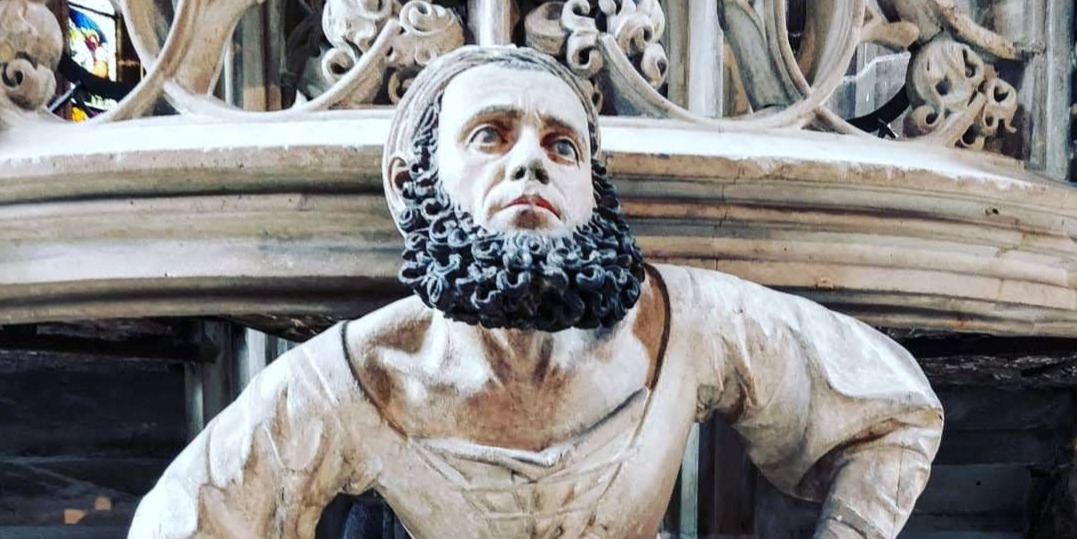
Self portrait of Adam Kraft Photo © Helen Grant
Stonemasons from the middle ages can often be anonymous. They may have left a name carved on a headstone, although I’ve not been lucky enough to find one yet, or there may be a payment to one in a dusty parish register. It means that so often their work has to speak for them.
As I said in my 2022 post, ’A Medieval stonemason’s selfie!’ the churchyard of All Saints, Maidstone has two graves of stonemasons from the 19th century and there is also a 17th century monument to a one in Faversham’s St Mary of Charity burial ground. But these days you are far more likely to discover the name of the monumental masons employing the stoneworker at the back of a headstone than the man or woman themselves.
But a friend recently visited Nuremberg in Germany and the church of St Lorenz in particular. It was there that she found a sculpted self portrait of one of the most celebrated medieval local stonemasons. It’s carved from sandstone and still has colour on it. This is on his beard, his eyes and there are traces on his apron. Kraft carries his tools, a hammer and chisel, and is in his working clothes. He looks out at visitors from the base of one of his most celebrated pieces of work, the Tabernacle. It dates from the 1490s which is when most of his documented work began. It’s an important piece of sculpture as:
‘ It has been suggested that this figure marks the period where the artist’s status was transitioning from anonymous craftsman to recognised individual master.’ http://www.identifier
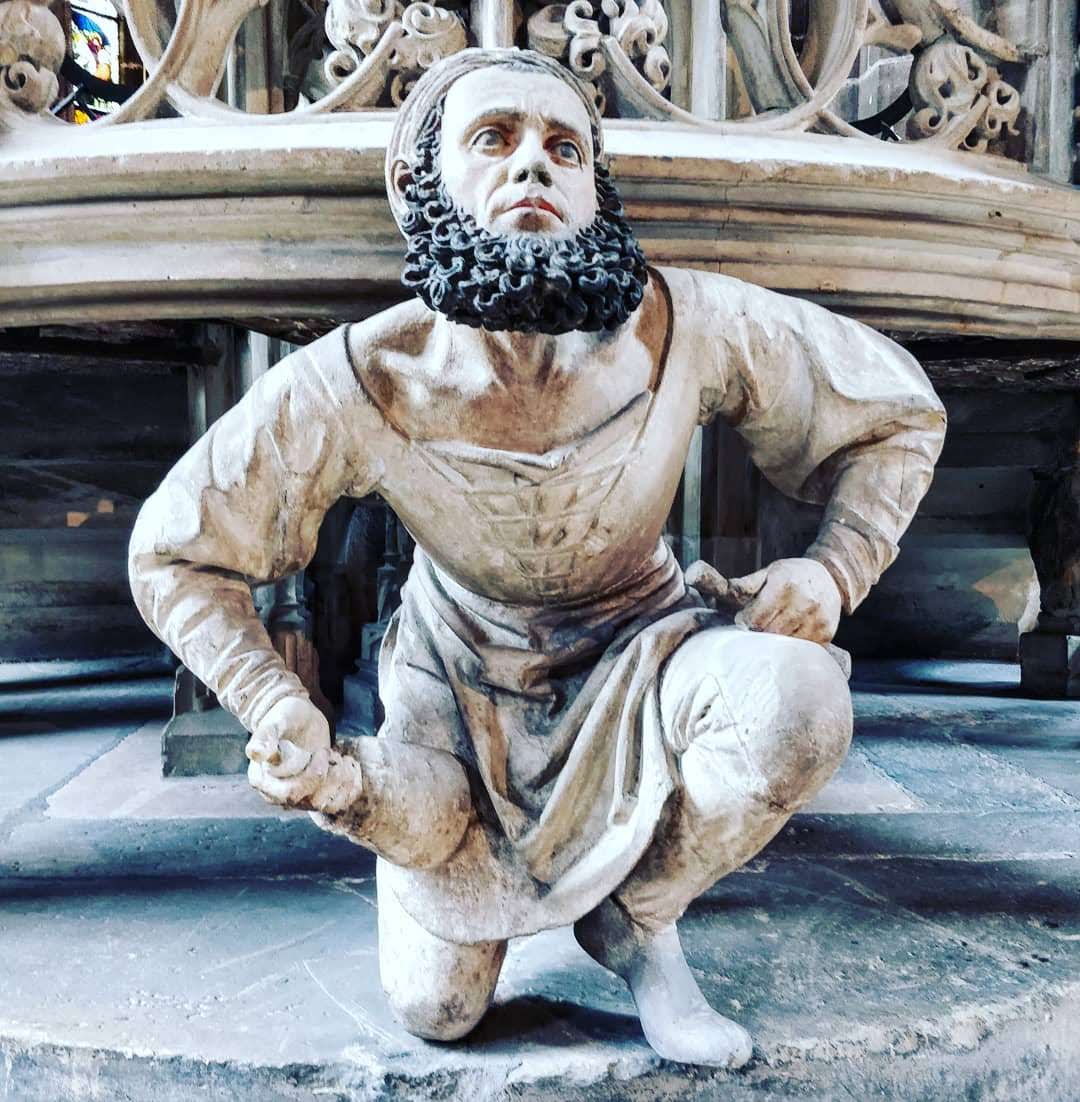
Full view of the statue. © Helen Grant
The mason’s name is Adam Kraft, (1460’s – Jan 1509) and he is considered to be one of the most important stonemasons of the German late Gothic period. Adam is believed to have been married twice but it’s not known if he had any children and is buried in the nearby town of Schwabach.
He was chiefly employed by religious institutions and wealthy patrons of the town. In addition, he worked on local public buildings such as Nuremberg’s Imperial stables, epitaphs and reliefs such as coats of arms. Much of this work can still be seen.
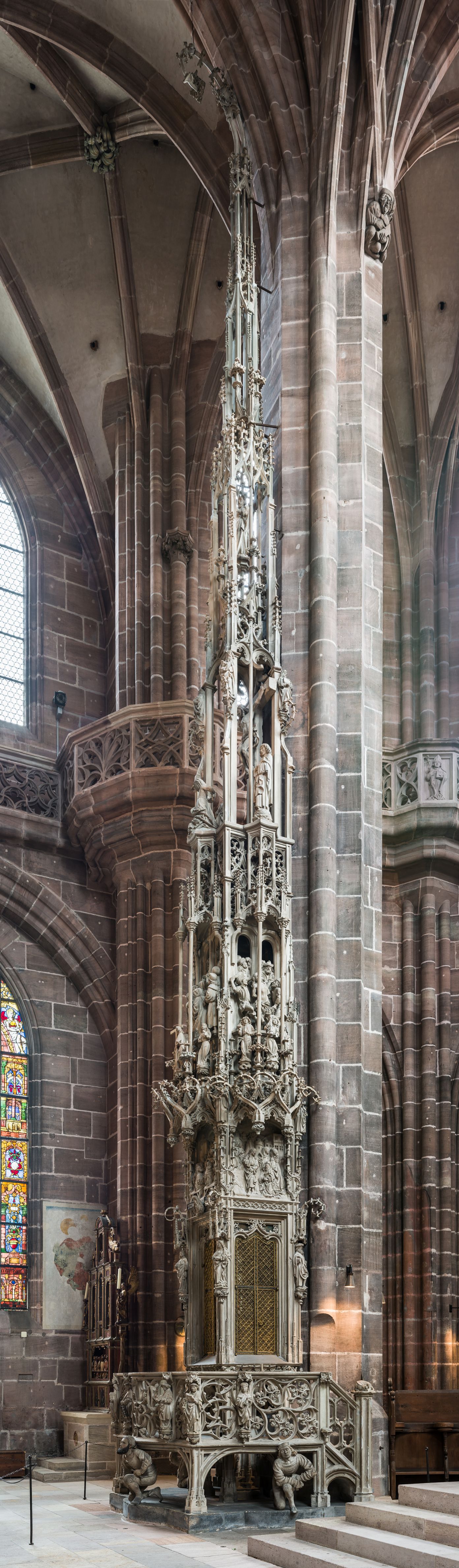
The Tabernacle, St Lorenz church, Nuremberg if you look carefully Adam Kraft’s statue is at the bottom left.© Uocie1 Shared under Wiki Creative Commons
As I said earlier, his self portrait sits at the base of his masterpiece, the 18.7 metres (61 feet) high tabernacle with St Lorenz church. According to Wikipedia:
‘It resembles a gothic tower reaching up into the church’s vault and is created from tracery interspersed with figurative scenes from Christ’s Passion. It was commissioned in 1493 by Hans Imhoff, a patrician from Nuremberg.”
The tabernacle was slightly damaged during World War which led to restoration.

Detail of monument from Nuremberg with a self portrait of Kraft on right hand side from V & A Museum. © Stephen C Dickson Shared under Wiki Creative Commons
A nearby local church, St Sebaldus, has another of Kraft’s significant works on its exterior. This dates from 1490-92 and depicts the Crucifixion, Entombment of Christ and the resurrection of Christ. If you look closely at one of the panels, you will see what is reputed to be a self portrait of Kraft supporting the crucified Christ as he is taken down from the Cross. A cast of these panels can be seen in London’s Victoria and Albert Museum’s Cast Courts.
Kraft worked in Nuremberg and surrounding areas for nearly 20 years from 1490 – 1509 with a small team of two or three assistants. He depended on wealthy patrons and the Church for commissions. This, I feel would have been true, of most stonemasons of the time. It was the wealthy who could afford headstones and monuments when they had to be buried in the churchyard after the churches ran out of space. There are still medieval items to be found in churches despite the Victorian zeal for restoration.
Simon Kraft wanted to be remembered, not only for his magnificent work, but as a professional craftsman and I feel that his sculpted figure represents all stonemasons.
©Text Carole Tyrrell unless otherwise stated.
References and further reading:
Adam Kraft | sculptor, stone mason | Artists | Virtual museum of Nuremberg art (has examples of his work)
Adam Kraft | Renaissance, Nuremberg, Altarpiece | Britannica
The Schreyer-Landauer Monument | Kraft, Adam | Rotermundt, Jacob | V&A Explore The Collections
Nuremberg | Population, History, Trials, Castle, Map, & Facts | Britannica

