Butterfly season has now begun in earnest and I have already whiled away several hours in my local park watching them flitting about in the summer sun. Bright, dancing summer jewels dancing on the breeze. But I have seen also seen more permanent butterfly visitors in cemeteries and churchyards – the kind that are perched there for eternity. They are much more than a brightly coloured insect and are symbols of transformation and rebirth

copyright Carole Tyrrell
So far I’ve only discovered two of this particular species which were both in London. One was in Brompton and the other was in Kensal Green. But I have also seen others online in American cemeteries.
But I’m surprised that the butterfly symbol isn’t more widely used as it is a deep and powerful motif of resurrection and reincarnation. It has fluttered through many cultures which include Ancient Egypt, Greece and Mexico.


reincarnation. copyright Sailko (Own work) [CC BY-SA 3.0 (http://creativecommons.org/licenses/by-sa/3.0)%5D, via Wikimedia Commons
There is also the celebrated Neolithic ‘butterfly stone’ found at the Ness of Brodgar which I saw at the British Museum’s ‘Stonehenge’ exhibition in 2023.
In classical myth, Psyche, which translates as ‘soul’, is represented in the form of a butterfly or as a young woman with butterfly wings. She’s also linked with Eros the Greek God of love. The butterfly is also a potent representation of rebirth which is why the the Celts revered it. Some of the Ancient Mexican tribes such as the Aztec and Mayans used carvings of butterflies to decorate their buildings as certain butterfly species were considered to be reincarnations of the souls of dead warriors. The Hopi and Navaho tribes of Native American Indians performed the Butterfly Dance and viewed them as symbols of change and transformation.
In Christianity the butterfly is an archetypal image of resurrection in and this meaning is derived from the 3 stages of a butterfly’s life. These are: 1st stage = the caterpillar, 2nd stage = the chrysalis and 3rd and final stage = the butterfly. So the sequence is life, death and resurrection. The emergence of the butterfly from the chrysalis is likened to the soul discarding the flesh. It has been depicted on Ancient Christian tombs and in Christian art Christ has been shown holding a butterfly.
Butterflies also feature in Victorian mourning jewellery and there is a fascinating article on this with some lovely examples at:
Butterfly Symbols and 19th Century Jewellery – Art of Mourning
They also appear in vanitas paintings. This is the name given to a particular category of symbolic works of art and especially those associated with the still life paintings of the 16th and 17th centuries in Flanders and the Netherlands. In these the viewer was asked to look at various symbols within the painting such as skulls and rotting fruit and ponder on the worthlessness of all earthly goods and pursuits. They are also invited to admire the artist’s skill in depicting these. Butterflies in this context can be seen as fleeting pleasure as they have a short life of just two weeks. In the 20th century, butterflies appeared in the flowing, organic lines of Art Nouveau and often featured in jewellery and silverware.

https://commons.wikimedia.org/wiki/File%3ALille_Hemessen_vanitas.JPG. Note the butterfly wings being worn by the central figure.
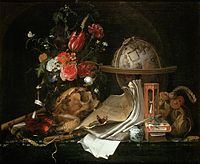
Maria van Oosterwijck [Public domain], via Wikimedia Commons

Vanitas by Antonio de Pereda (painted during 1632-1636) shared under Wiki Commons
Butterfly traditions
There are many superstitions and beliefs associated with butterflies. They are often regarded as omens, good and bad, or as an advance messenger indicating that a visitor or loved one is about to arrive. In Japan, they are traditionally associated with geishas due to their associations with beauty and delicate femininity.

copyright Xü Xi (Scanned from an old Chinese book) [Public domain], via Wikimedia Commons
The Chinese see them as good luck and a symbol of immortality. Sailors thought that if they saw one before going on ship it meant that they would die at sea . In Devon it was traditional to kill the first butterfly that you saw or have a year of bad luck as a result. In Europe the butterfly was seen as the spirit of the dead and, in the Gnostic tradition, the angel of death is often shown crushing a butterfly underfoot. In some areas in England, it’s thought that butterflies contain the souls of children who have come back to life. A butterfly’s colours can also be significant. A black one can indicate death and a white one signifies the souls or the departed. It’s also a spiritual symbol of growth in that sometimes the past has to be discarded in order to move forward as the butterfly sheds its chrysalis to emerges complete. So it can indicate a turning point or transition in life. There are also shamanistic associations with the butterfly’s shapeshifting and it has also been claimed as a spiritual animal or totem.
Brompton Cemetery, tomb unknown
This example with its wings outstretched is from Brompton Cemetery in London. Alas, the epitaph appears to have vanished over time even with vegetation die back in winter I still couldn’t find out who it it was. Note the wreath of ivy that surrounds it. Ivy is an evergreen and is a token of eternal life and memories.


copyright Carole Tyrrell
The Gordon monument, Kensal Green
The second one is perched on the tomb of John Gordon Esquire, a Scotsman from Aberdeenshire who died young at only 37. As the epitaph states:
‘it was erected to his memory as the last token of sincere love and affection by his affectionate widow’.
Gordon came from an extended family of Scottish landowners who had estates in Scotland and plantations in Tobago amongst other interests. The monument is Grade II listed and is made of Portland stone with a York stone base and canopy supported by the pillars. There was an urn on the pedestal between the four tapering stone pillars which was stolen in 1997.
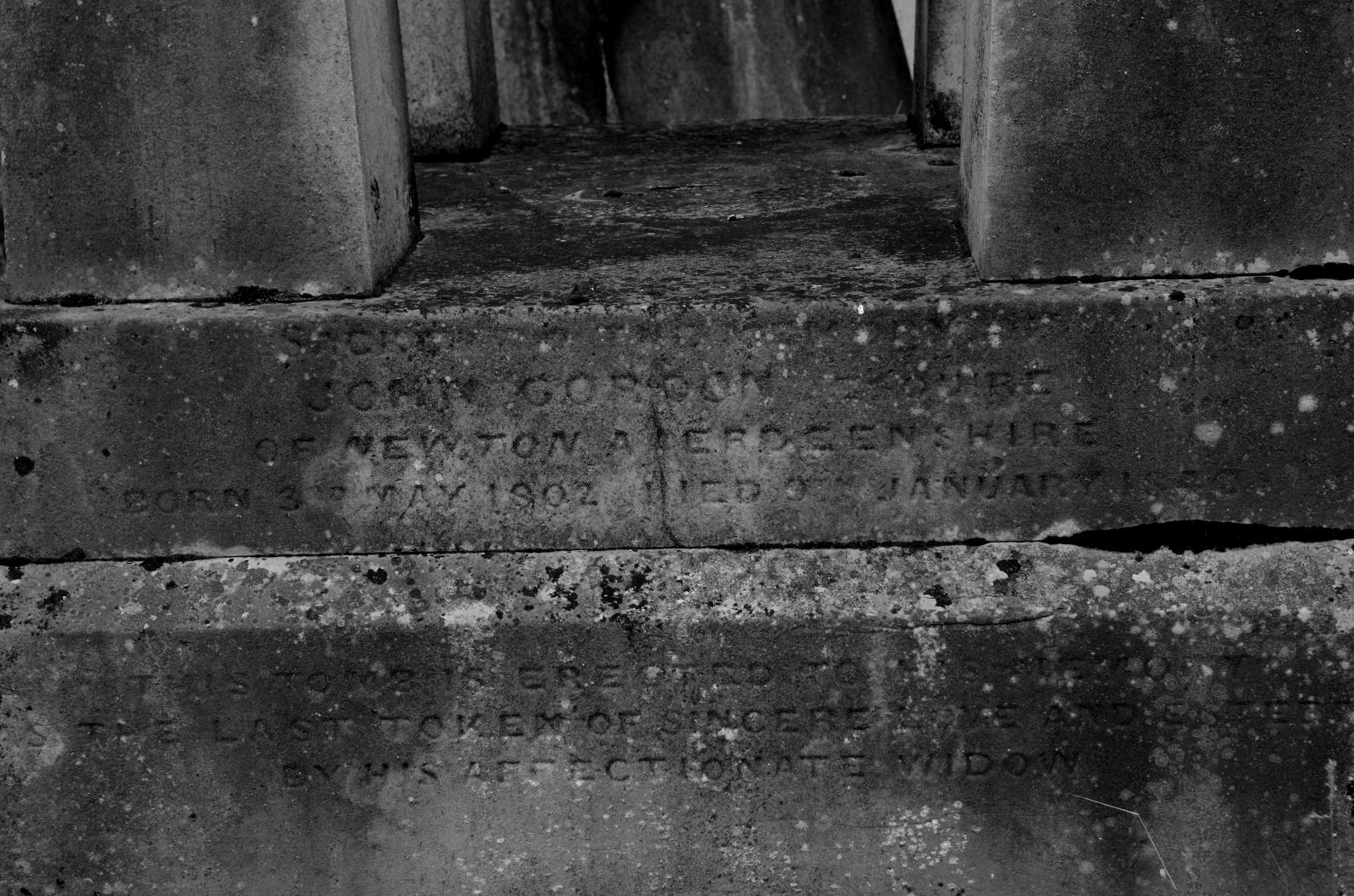
copyright Carole Tyrrell
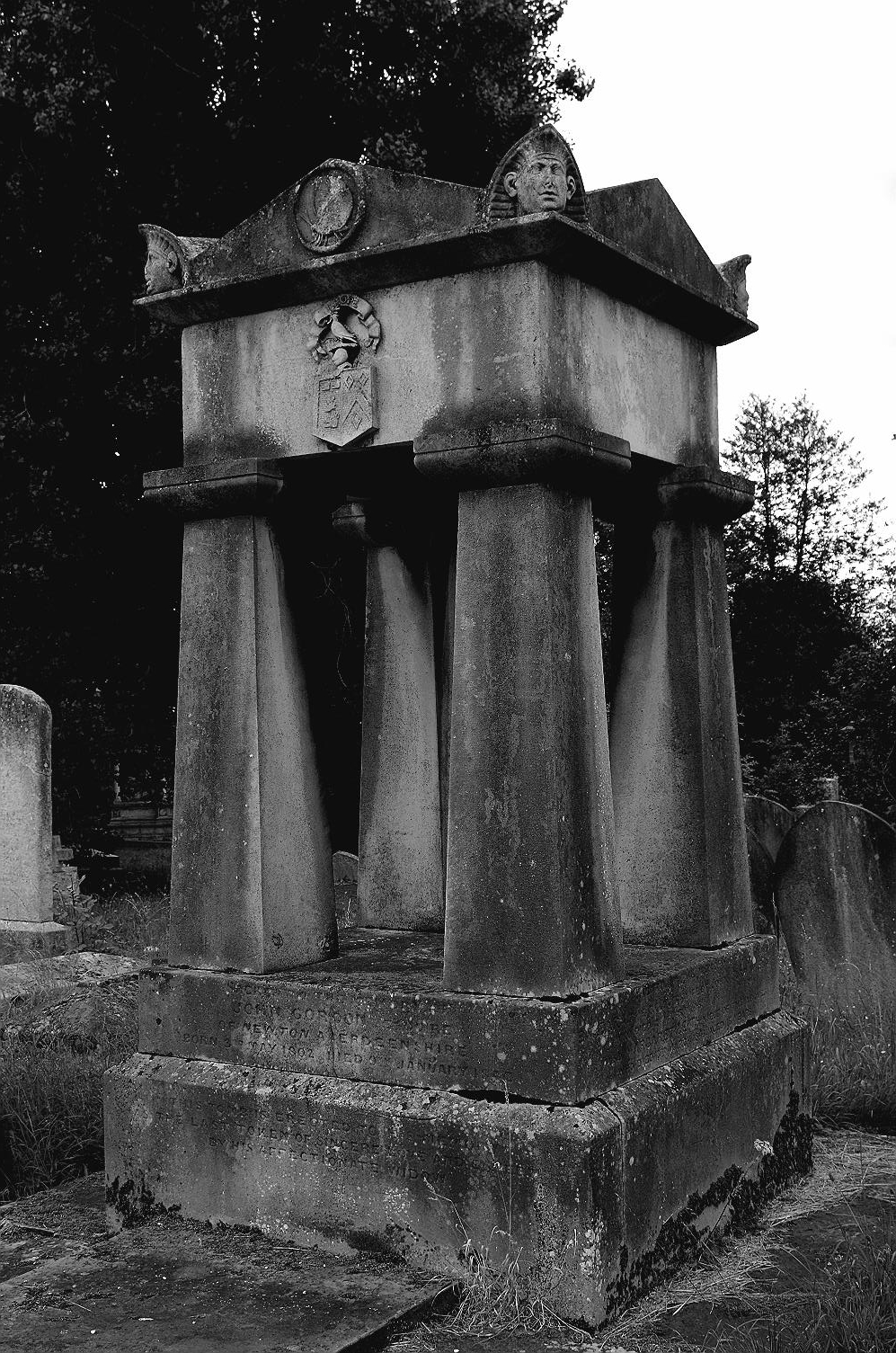
copyright Carole Tyrrell
The butterfly also has an ouroboros encircling it which is a symbol of eternity. This is the circle created by a snake devouring each its own tail. So the whole sculpture is of a butterfly indicating resurrection within an eternal circle of life, death and rebirth.

copyright Carole Tyrrell
The pharaonic heads at each corner are Egyptian elements within an ostensibly classically inspired monument are known as acroteria.. Acroteria, or acroterion, its singular definition, are an architectural ornament. The ones on this monument are known as acroteria angularia. The ‘angularia’ means ‘at the corners’.
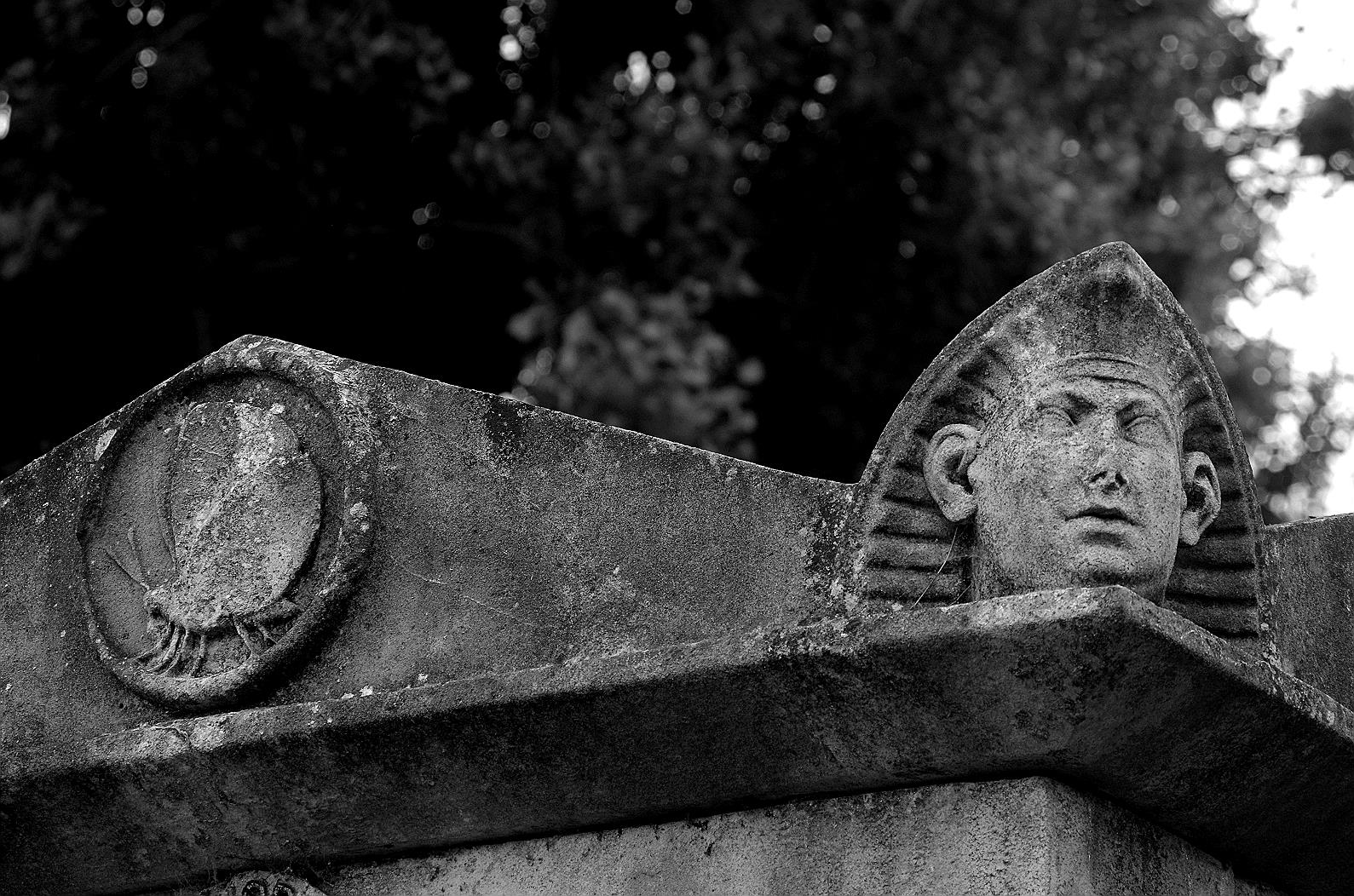
copyright Carole Tyrrell

copyright Carole Tyrrell
The entire monument is based on an illustration of the monument of the Murainville family in Pugin’s Views of Paris of 1822 and also on Moliere’s memorial which are both at Pere Lachaise in Paris. The Gordon memorial incorporates elements of the Egyptian style and symbolism that influenced 19th century funerary monuments after the first Egyptian explorations. Kensal Green contains many significant examples and there are others to be found in Brompton, Highgate and Abney Park. The Victorians regarded the Egyptians highly as their religion was a cult of the dead.
So when you next see a butterfly fluttering on the wind or even perched on a memorial for eternity remember its importance within the tradition of symbols, religions and cultures. Who knows it might be one of your ancestors…..
© Text and photos Carole Tyrrell unless otherwise stated.
References:
http://www.gardenswithwings.com/butterfly-stories/butterfly-symbolism.html
http://www.whats-your-sign.com/butterfly-animal-symbolism.html
http://www.spiritanimal.info/butterfly-spirit-animal/
http://www.pure-spirit.com/more-animal-symbolism/611-butterfly-symbolism
http://www.bbc.co.uk/london/content/articles/2005/05/10/victorian_memorial_symbols_feature.shtml
http://www.thecemeteryclub.com/symbols.html
https://stoneletters.com/blog/gravestone-symbols
https://www.reference.com/world-view/butterfly-symbolize-cf9c772f26c7fa5
https://www.reference.com/world-view/butterflies-symbolize-19a1e06c9c98351c?qo=cdpArticles
https://en.wikipedia.org/wiki/Butterfly
https://en.wikipedia.org/wiki/Vanitas
https://en.wikipedia.org/wiki/Acroterion
https://historicengland.org.uk/listing/the-list/list-entry/1191024
Behold the ‘Butterfly Stone’ – The Ness of Brodgar Project
Clare Gibson, How to Read Symbols, Herbert Press 2009
Douglas Keister, Stories in Stone, A Field Guide to Cemetery Symbolism and Iconography, Gibbs Smith, 2004
J C Cooper, Illustrated Encyclopaedia of Traditional Symbols, Thames & Hudson 1978.