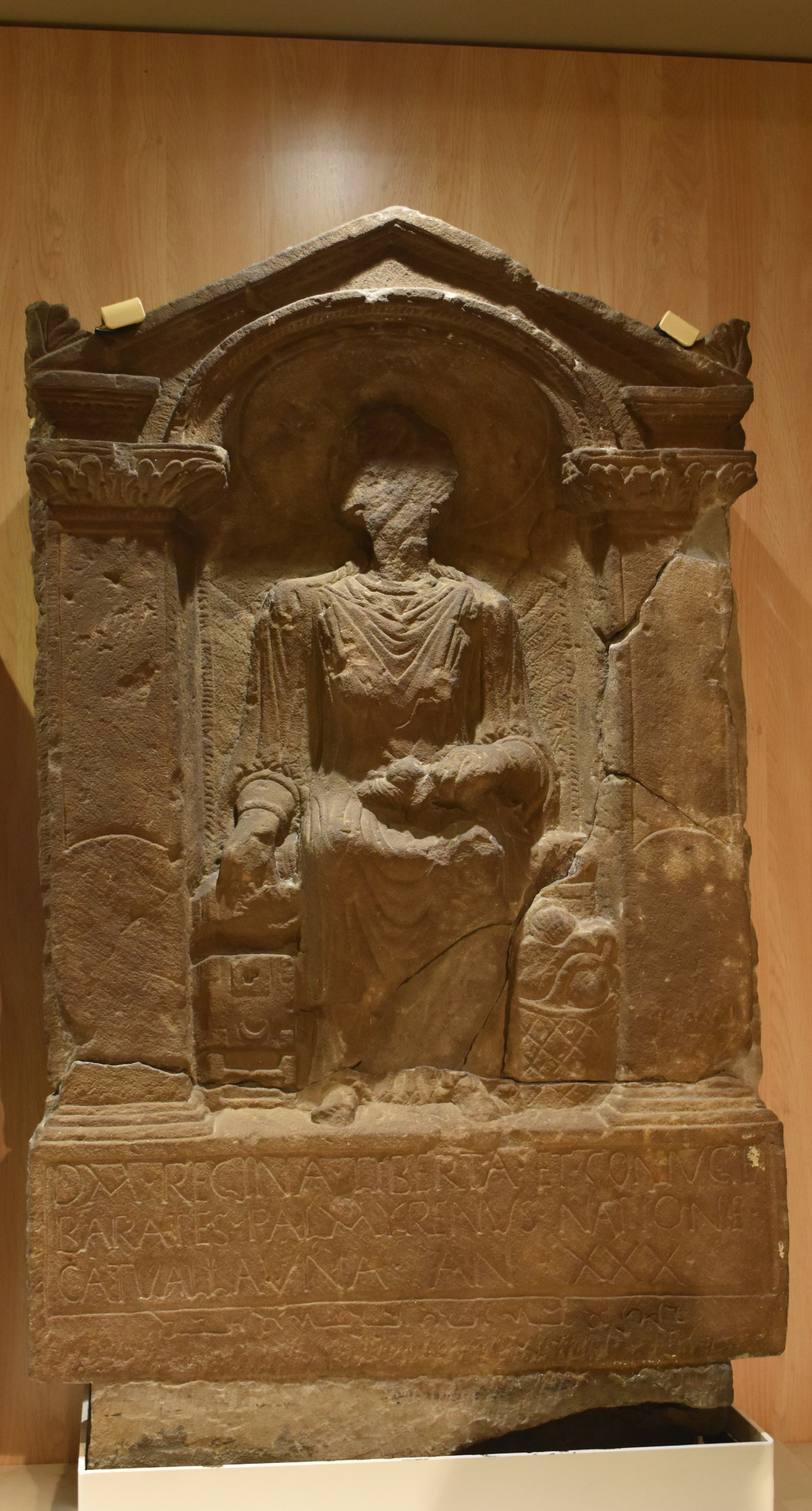
How Syria and Rome came to Tyneside- the tombstone of Regina.

The tombstone of the former slave Regina in the Arbeia museum, South Shields.© Carole Tyrrell

Earlier this month I went on a Roman Britain holiday in the North East of England. We stayed in South Shields which may be a little faded now but still offered enticing beach walks and a road of restaurants to explore.  But, in ancient times, when the Romans were in occupation, it was a large port and a major supply base with many people travelling through it from other parts of the Empire.  Some of them came from Syria and there is a connection between them and the headstone that I will write about in this post.

We visited two excavated Roman forts: Wallsend or Segedunum which is its Latin name and Arbeia which was surrounded by Victorian terraces.   Wallsend is so called as its at the Eastern end of Hadrian’s Wall. At the nearby Metro station all the official signs were in English and Latin which showed real attention to detail. It’s a large site with a 360 degree viewing platform.

The granaries and in the top left hand corner, the reconstructed West Gate.© Chris McKenna user name: Thryduulf. Shared under Wiki Creative Commons

The recreated West Gate, Arbeia. © Carole Tyrrell

Arbeia was a short walk from the hotel and has been partly excavated and partly recreated.  Replicas of the West Gate and the Commanding Officers house were waiting for us to explore.  I would hazard a guess that the Romans were glad of having underfloor heating! The Victorian streets all had a Roman flavour to their names: Vespasian Avenue, Caesar’s Walk and Claudius Court were among them.  More attention to detail which I liked. Some of the houses were built over the site until the local council realised what treasures might lie beneath and they were demolished. There is a small museum which contains finds from the site and information about Roman customs.  A selection of altars were on display which were used to pray and make offerings to their gods. They were rumoured to have been found in nearby back gardens. Perfect bird baths perhaps?

Roman altars on display, Arbeia museum.© Carole Tyrrell

But the pride of the museum in my opinion were the two beautiful headstones on display. They were dedicated to two people who were former slaves but were given their freedom. One, a young woman called Regina, was British and the other was a young man, Victor, who originally came from North Africa. Both of the headstones were apparently found in car parks so we are lucky that they have survived at all.

Regina became a free woman after her marriage to a Syrian man called Barates. She came from a tribe called the Catuvellaumi who came from what we now know as Hertfordshire.  Barates came from the trading city of Palmyra in Syria which is situated 215 miles north east of Damascus, the Syrian capital. It’s an ancient city and archaeological finds dating back to the Neolithic period have been found there. It became part of the Roman empire during the first century. Palmyra was an extremely wealthy city due to trading caravans and colonies along the Silk Road and throughout The Roman Empire. The Silk Road may also have been how the Black Death spread. In 1400, it was destroyed and became a minor settlement, its past glories forgotten. In 1932, under French rule, its inhabitants were moved into a new village and it became an excavation site. Islamic State destroyed large parts of the city until the Syrian Army recaptured it on 2 March 2017. In December 2024, after the fall of the Assad regime, the Syrian Free Army captured it.

Peristyl House, Palmyra Syria copyright Xvlun-commons-wiki

Palmyra, Syria Senate House copyright Maria Millella shared under Wiki Commons

There is a cemetery outside the Arbeia site as it was Roman custom to bury the dead outside city walls. The dead could be burned on a wooden funeral pyre and some of their remains collected to be buried in a pot which was known as cremation. They could also be buried and laid out in a grave or rectangular pit which was known as inhumation. In addition, they could have a wooden coffin or cloth shroud and have some of their personal possessions buried with them.

It was the Romans who introduced the practice of having an inscribed headstone.  The inscriptions reveal all sorts of information about a person such as name, age, nationality and familial relationships. They make the deceased into real people again!

Both Regina and Victor’s tombstones resemble other examples of Romao-British stones in shape and general design. But as one interpretation board said:

‘…in their carving there are strong parallels with other examples found at Palmyra which led to a fusion of styles.’

Both Regina and Victor died young. She was 30 and he was 20. But Regina enjoyed the lifestyle and status that she had as a free woman and her elegant headstone reflects this in the symbols used on it. She wears the fashionable provincial dress of the day and sits in a Roman style high backed chair facing the viewer.  It’s sad that her face is has been damaged but I would imagine that it would have been carved to resemble fashionable Roman women of the time and not a portrait of her.

Roman society was very traditional and women had very limited roles. A memorial like Regina’s would have emphasised her domestic duties. She holds a distaff and spindle for spinning wool and there is a basket of spun balls of wool beside her chair and these would have been included to demonstrate that she was an industrious, dutiful wife. She is opening a treasure box with her other hand. There is a herringbone pattern on her necklace which has been seen on other depictions of Roman women and reflect the conventions of the time.  Regina’s headstone is unusual in that, although the inscription is in Latin, it also has a line of Arabic beneath it. It has been suggested that it was carved by a Syrian which may indicate a small community in the area or a someone just passing through. It’s written in Palmyrene text in Arabic which is similar to ancient Hebrew.
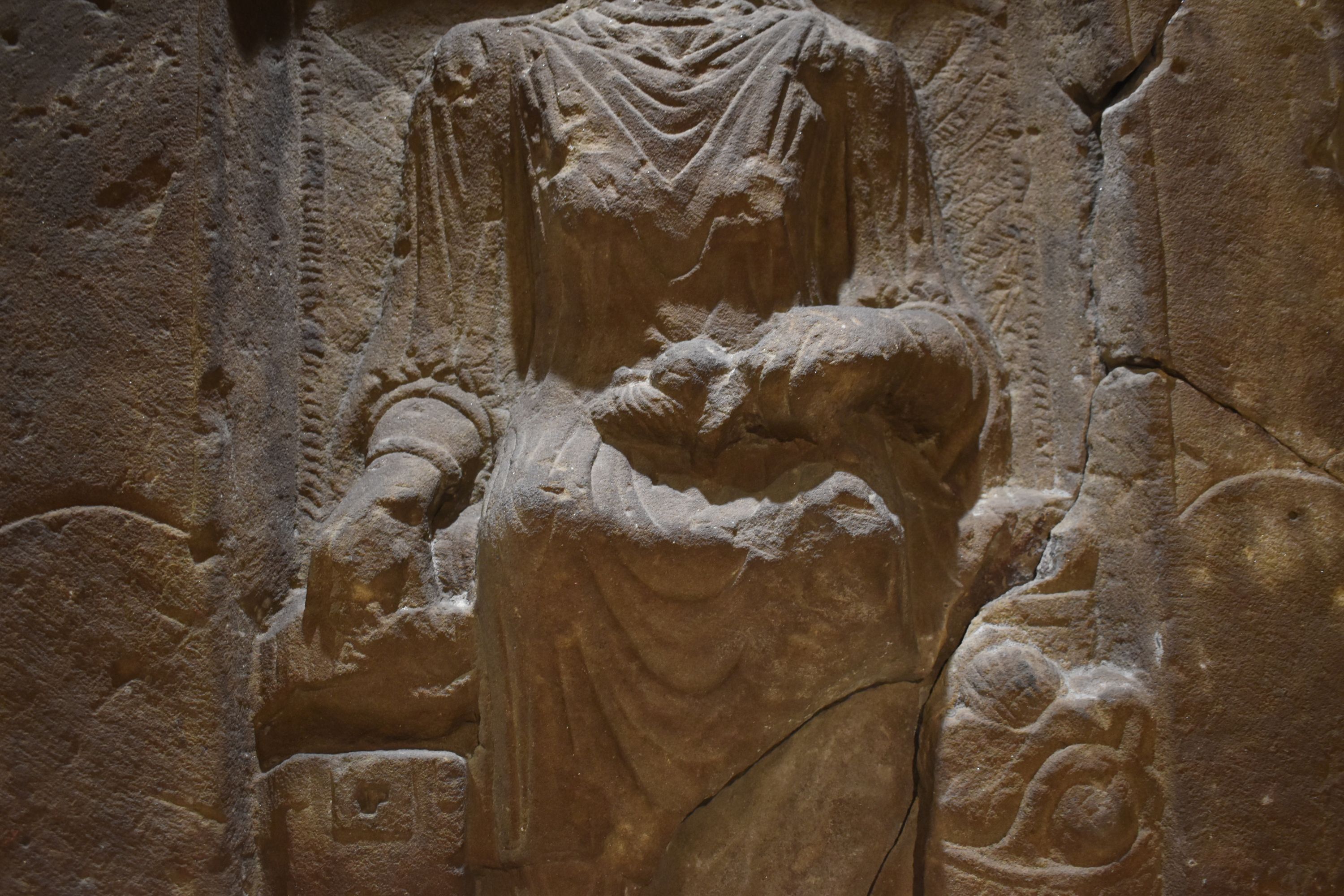
Closer view of Regina holding her distaff and spindle and the balls of wool beside her. copyright Carole Tyrrell
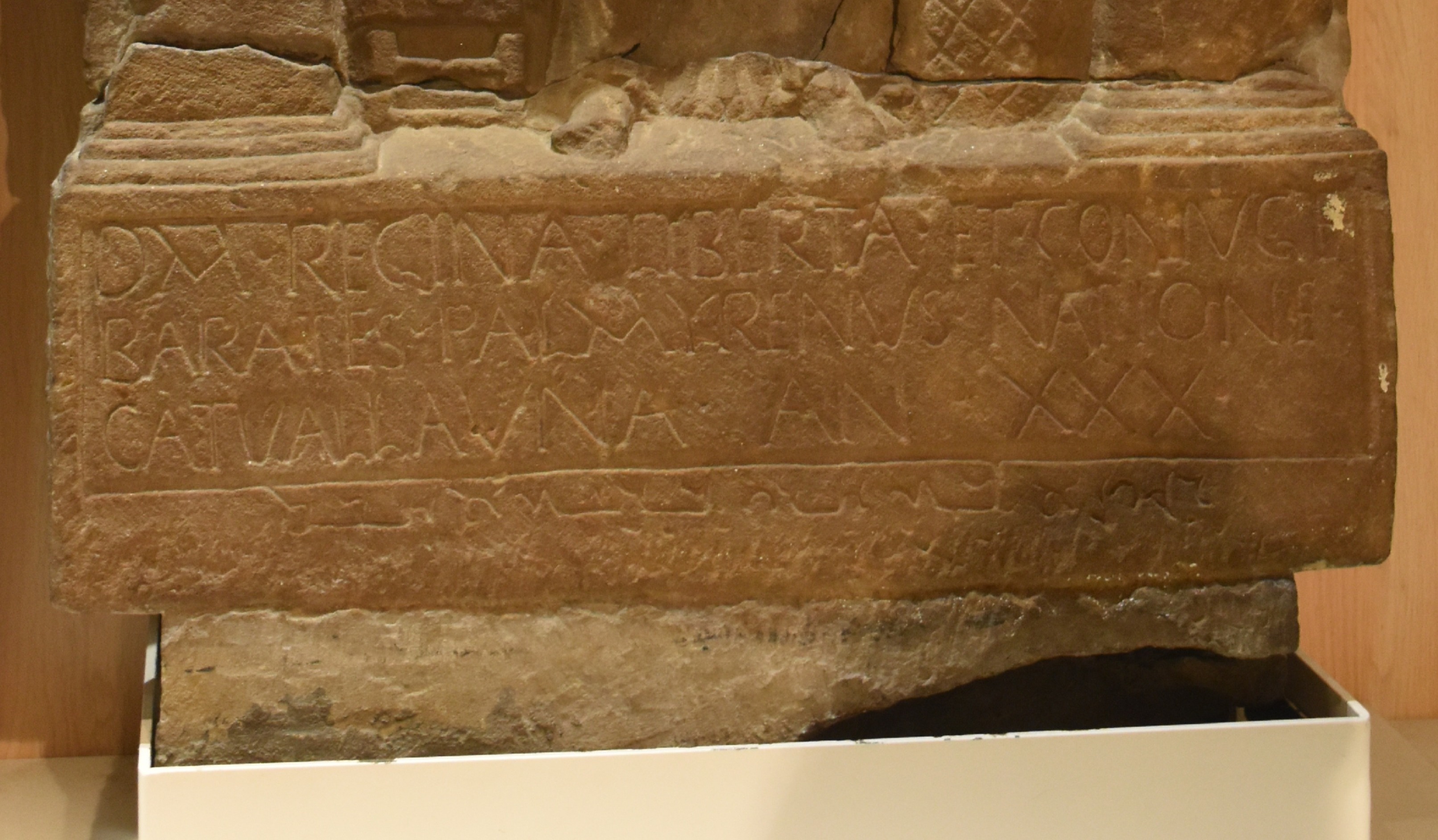
Closer view of Regina’s epitaph in Latin and below in Palmyrene text. Copyright Carole Tyrrell

The Latin inscription reads:-

‘D(IS) M(ANIBUS) REGINA LIBERTA ET CONIUGE

BARATES PALYMENUS NATIONE

CATULLAUANA AN(NORUM) XXXX’

Which can be translated as:

‘To the spirits of the departed (and) of Regina,

Freedwoman and wife of Barates of Palmyra

Catuvellauni by birth died aged 30.’

The line of Palmyrene text below the Latin reads:

‘RYGN’BT HRY BR ‘T’ HBL’

Which translates as:

‘Regina, freedwoman of Barates, alas

It’s a real shame that Regina’s head is missing but if a sculpture is going to be damaged, it’s generally the head that goes first. It’s interesting to think that a port in the North East of England attracted so many people from other lands and how Barates and Regina actually met. A beautiful tribute to a much loved wife.

Part 2 – Victor’s headstone

©Text and photos Carole Tyrrell with grateful thanks to Tyne & Wear County Council.

References and further reading:

Palmyra – Wikipedia

Arbeia, South Shields Roman Fort – Experience life on the edge of the Roman Empire

Women in ancient Rome – Wikipedia

Lion mask – Wikipedia

Symbol of the month – the butterfly

Butterfly season has now begun in earnest and I have already whiled away several hours in my local park watching them flitting about in the summer sun. Bright, dancing summer jewels dancing on the breeze. But I have seen also seen more permanent butterfly visitors in cemeteries and churchyards – the kind that are perched there for eternity. They are much more than a brightly coloured insect and are symbols of transformation and rebirth

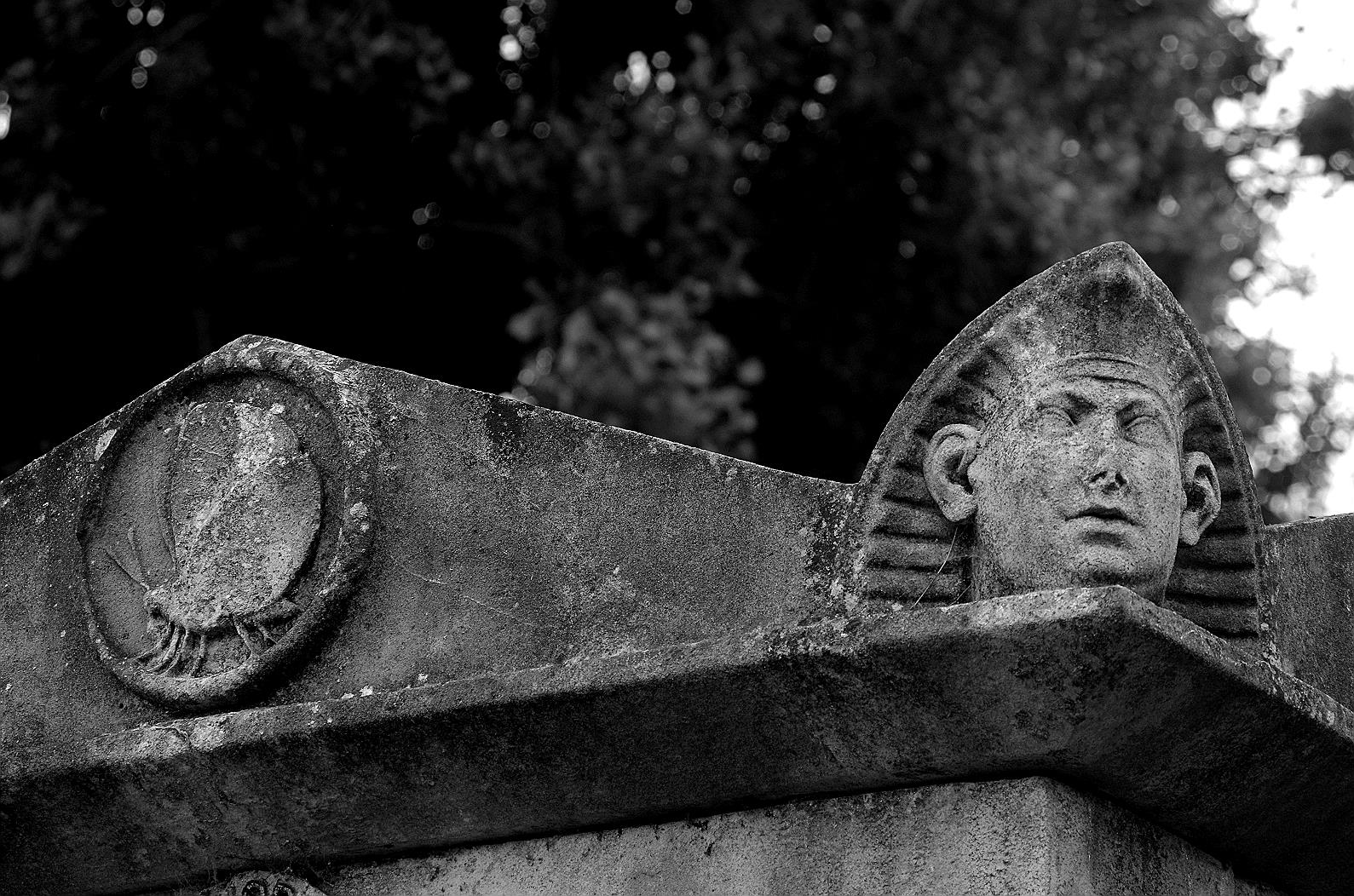
The Gordon monument butterfly motif in all its glory. Kensal Green Cemetery.
copyright Carole Tyrrell

So far I’ve only discovered two of this particular species which were both in London.  One was in Brompton and the other was in Kensal Green.  But I have also seen others online in American cemeteries.

But I’m surprised that the butterfly symbol isn’t more widely used as it is a deep and powerful motif of resurrection and  reincarnation.  It has fluttered through many cultures which include Ancient Egypt, Greece and Mexico.

Gold disc found at Myceanae near Greece – possibly dating from 1350 BC
Ancient Egyptian relief sculpture 26th Dynasty Thebes 664-525 BC
reincarnation.  copyright Sailko (Own work) [CC BY-SA 3.0 (http://creativecommons.org/licenses/by-sa/3.0)%5D, via Wikimedia Commons

There is also the celebrated Neolithic ‘butterfly stone’ found at the Ness of Brodgar which I saw at the British Museum’s ‘Stonehenge’ exhibition in 2023.

In classical myth, Psyche, which translates as ‘soul’, is represented in the form of a butterfly or as a young woman with butterfly wings.  She’s also linked with Eros the Greek God of love.  The butterfly is also a potent representation of rebirth which is why the the Celts revered it.  Some of the Ancient Mexican tribes such as the Aztec and Mayans used carvings of butterflies to decorate their buildings as certain butterfly species were considered to be reincarnations of the souls of dead warriors.  The Hopi and Navaho tribes of Native American Indians performed the Butterfly Dance and viewed them as symbols of change and transformation.

In Christianity the butterfly is an archetypal image of resurrection in and this meaning is derived from the 3 stages of a butterfly’s life.  These are:  1st stage = the caterpillar, 2nd stage = the chrysalis and 3rd and final stage = the butterfly.  So the sequence is life, death and resurrection.   The emergence of the butterfly from the chrysalis is likened to the soul discarding the flesh.  It has been depicted on Ancient Christian tombs and in Christian art Christ has been shown holding a butterfly. 

Butterflies also feature in Victorian mourning jewellery and there is a fascinating article on this with some lovely examples at:

Butterfly Symbols and 19th Century Jewellery – Art of Mourning

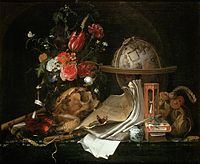
They also appear in vanitas paintings. This is the name given to a particular category of symbolic works of art and especially those associated with the still life paintings of the 16th and 17th centuries in Flanders and the Netherlands.    In these the viewer was asked to look at various symbols within the painting such as skulls and rotting fruit and ponder on the worthlessness of all earthly goods and pursuits. They are also invited to admire the artist’s skill in depicting these.  Butterflies in this context can be seen as fleeting pleasure as they have a short life of just two weeks. In the 20th century, butterflies appeared in the flowing, organic lines of Art Nouveau and often featured in jewellery and silverware.
Vanitas Jan Sanders Van Hemessen 1535 – 1540.
https://commons.wikimedia.org/wiki/File%3ALille_Hemessen_vanitas.JPG. Note the butterfly wings being worn by the central figure.
Vanitas Still Life – Maria van Oosterwijck (1630-16930
Maria van Oosterwijck [Public domain], via Wikimedia Commons

Vanitas by Antonio de Pereda (painted during 1632-1636) shared under Wiki Commons

Butterfly traditions

There are many superstitions and beliefs associated with butterflies.  They are often regarded as omens, good and bad, or as an advance messenger indicating that a visitor or loved one is about to arrive. In Japan, they are traditionally associated with geishas due to their associations with beauty and delicate femininity.

Butterfly & Chinese wisteria by Xu Xi Early Sing Dynasty c970.
copyright Xü Xi (Scanned from an old Chinese book) [Public domain], via Wikimedia Commons

The Chinese see them as good luck and a symbol of immortality. Sailors thought that if they saw one before going on ship it meant that they would die at sea .  In Devon it was traditional to kill the first butterfly that you saw or have a year of bad luck as a result. In Europe the butterfly was seen as the spirit of the dead and, in the Gnostic tradition, the angel of death is often shown crushing a butterfly underfoot. In some areas in England, it’s thought that butterflies contain the souls of children who have come back to life. A butterfly’s colours can also be significant. A black one can indicate death and a white one signifies the souls or the departed. It’s also a spiritual symbol of growth in that sometimes the past has to be discarded in order to move forward as the butterfly sheds its chrysalis to emerges complete. So it can indicate a turning point or transition in life. There are also shamanistic associations with the butterfly’s shapeshifting and it has also been claimed as a spiritual animal or totem.

Brompton Cemetery, tomb unknown

This example with its wings outstretched is from Brompton Cemetery in London.   Alas, the epitaph appears to have vanished over time even with vegetation die back in winter I still couldn’t find out who it it was.  Note the wreath of ivy that surrounds it.  Ivy is an evergreen and is a token of eternal life and memories. 

An example of a stylised butterfly on a tombstone in Brompton Cemetery in London. Unfortunately the epitaph is now unreadable. copyright Carole Tyrrell
Another view of the Brompton Butterfly surrounded by an ivy wreath.
copyright Carole Tyrrell

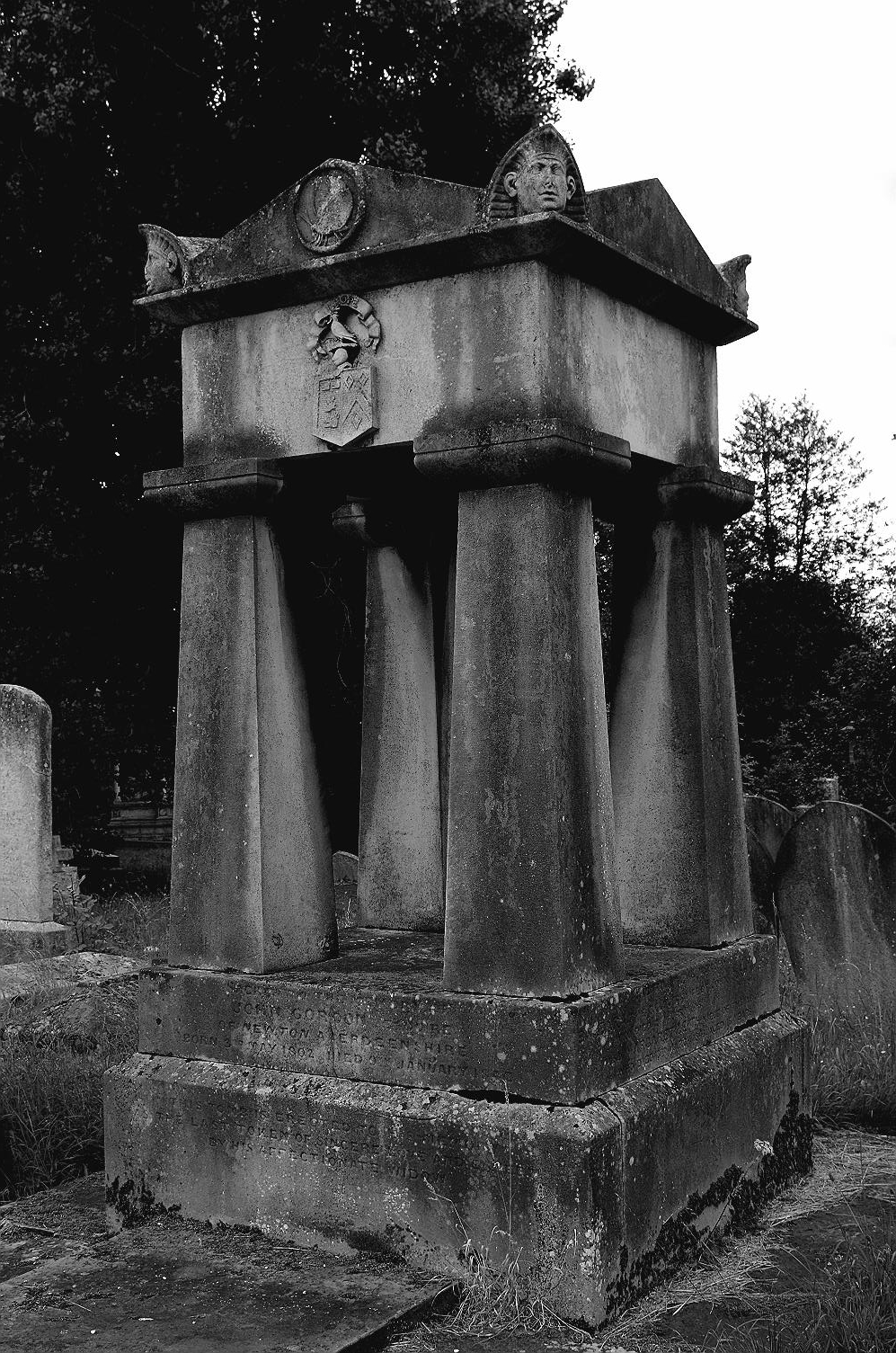
The Gordon monument, Kensal Green

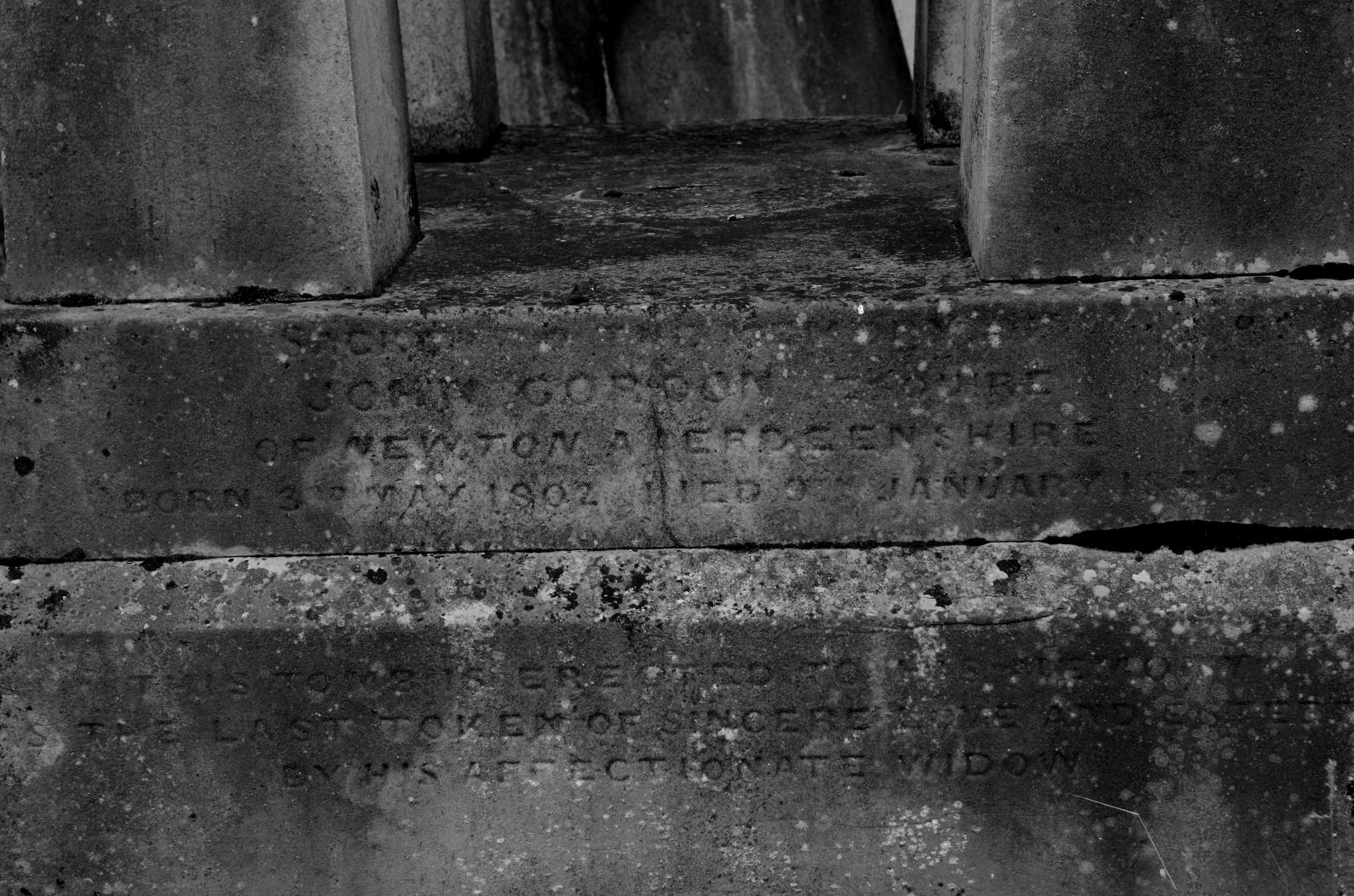
The second one is perched on the tomb of John Gordon Esquire, a Scotsman from Aberdeenshire who died young at only 37.  As the epitaph states:

it was erected to his memory as the last token of sincere love and affection by his affectionate widow’.  

Gordon came from an extended family of Scottish landowners who had estates in Scotland and plantations in Tobago amongst other interests.  The monument is Grade II listed and is made of Portland stone with a York stone base and canopy supported by the pillars.  There was an urn on the pedestal  between the four tapering stone pillars which was stolen in 1997.

John Gordon’s epitaph Kensal Green Cemetery.
copyright Carole Tyrrell
The Gordon Monument in Kensal Green Cemetery. There are traces of something once being in place – perhaps an urn – on the platform between the pillars.
copyright Carole Tyrrell

The butterfly also has an ouroboros encircling it which is a symbol of eternity. This is the circle created by a snake devouring each its own tail. So the whole sculpture is of a butterfly indicating resurrection within an eternal circle of life, death and rebirth.

The ouroboros symbol surrounding the butterfly symbol of the roof of the Gordon monument Kensal Green Cemetery.
copyright Carole Tyrrell

The pharaonic heads at each corner are Egyptian elements within an ostensibly classically inspired monument are known as acroteria.. Acroteria, or acroterion, its singular definition, are an architectural ornament.  The ones on this monument are known as acroteria angularia. The ‘angularia’ means ‘at the corners’.

Detail of the roof of the monument – note the Pharaonic head, one at each corner, and another glimpse of the butterfly. Kensal Green Cemetery
copyright Carole Tyrrell
Close- up of one of the four Pharaonic heads on the Gordon monument. Kensal Green Cemetery
copyright Carole Tyrrell


The entire monument is based on an illustration of the monument of the Murainville family in Pugin’s Views of Paris of 1822 and also on Moliere’s memorial which are both at Pere Lachaise in Paris. The Gordon memorial incorporates elements  of the Egyptian style and symbolism that influenced 19th century funerary monuments after the first Egyptian explorations. Kensal Green contains many significant examples and there are others to be found in Brompton, Highgate and Abney Park.  The Victorians regarded the Egyptians highly as their religion was a cult of the dead. 

So when you next see a butterfly fluttering on the wind or even perched on a memorial for eternity remember its importance within the tradition of symbols, religions and cultures.  Who knows it might be one of your ancestors…..

© Text and photos Carole Tyrrell unless otherwise stated.

References:

http://www.gardenswithwings.com/butterfly-stories/butterfly-symbolism.html

http://www.whats-your-sign.com/butterfly-animal-symbolism.html

http://www.spiritanimal.info/butterfly-spirit-animal/

http://www.pure-spirit.com/more-animal-symbolism/611-butterfly-symbolism

http://www.shamanicjourney.com/butterfly-power-animal-symbol-of-change-the-soul-creativity-freedom-joy-and-colour

http://www.bbc.co.uk/london/content/articles/2005/05/10/victorian_memorial_symbols_feature.shtml

http://www.thecemeteryclub.com/symbols.html

https://stoneletters.com/blog/gravestone-symbols

https://www.reference.com/world-view/butterfly-symbolize-cf9c772f26c7fa5

https://www.reference.com/world-view/butterflies-symbolize-19a1e06c9c98351c?qo=cdpArticles

https://en.wikipedia.org/wiki/Butterfly

https://en.wikipedia.org/wiki/Vanitas

https://en.wikipedia.org/wiki/Acroterion

https://historicengland.org.uk/listing/the-list/list-entry/1191024

Behold the ‘Butterfly Stone’ – The Ness of Brodgar Project

Clare Gibson, How to Read Symbols, Herbert Press 2009

Douglas Keister, Stories in Stone, A Field Guide to Cemetery Symbolism and Iconography, Gibbs Smith, 2004

J C Cooper, Illustrated Encyclopaedia of Traditional Symbols, Thames & Hudson 1978.

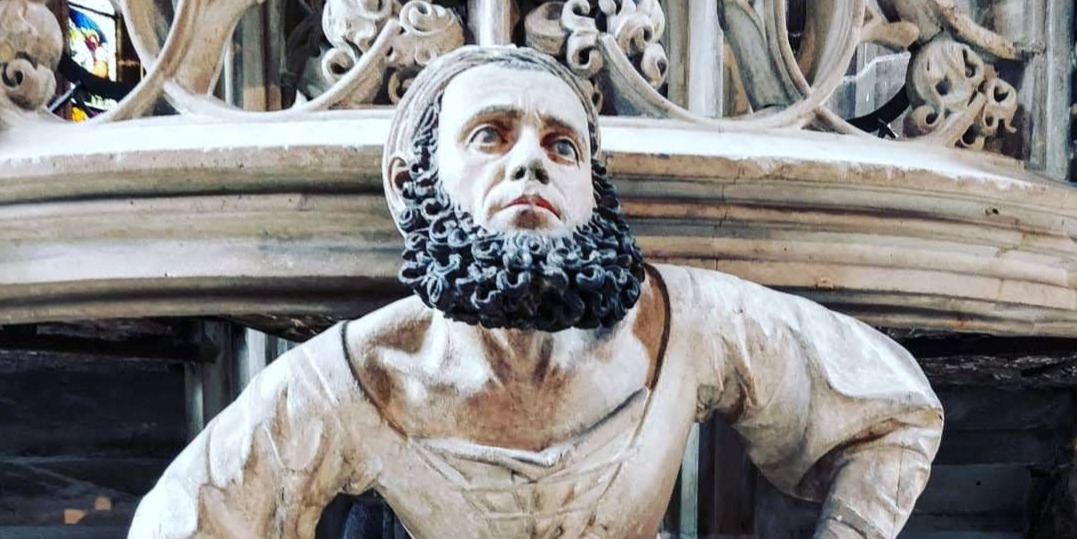
A medieval stonemason steps out from the Dark Ages

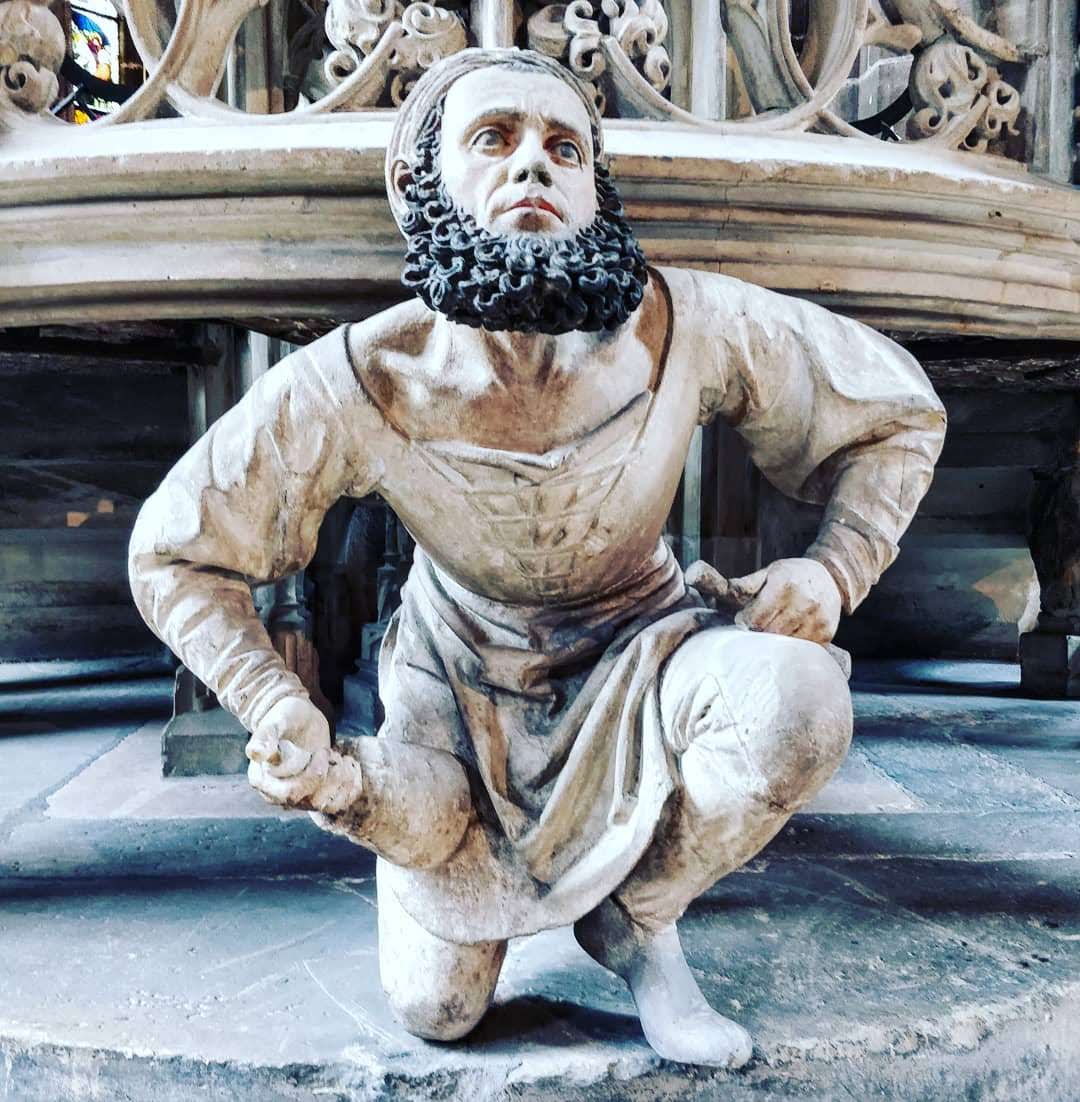
Self portrait of Adam Kraft Photo © Helen Grant

Stonemasons from the middle ages can often be anonymous.  They may have left a name carved on a headstone, although I’ve not been lucky enough to find one yet, or there may be a payment to one in a dusty parish register.  It means that so often their work has to speak for them.

As I said in my 2022 post, ’A Medieval stonemason’s selfie!’  the churchyard of All Saints, Maidstone has two graves of stonemasons from the 19th century and there is also a 17th century monument to a one in Faversham’s St Mary of Charity burial ground. But these days you are far more likely to discover the name of the monumental masons employing the stoneworker at the back of a headstone than the man or woman themselves.

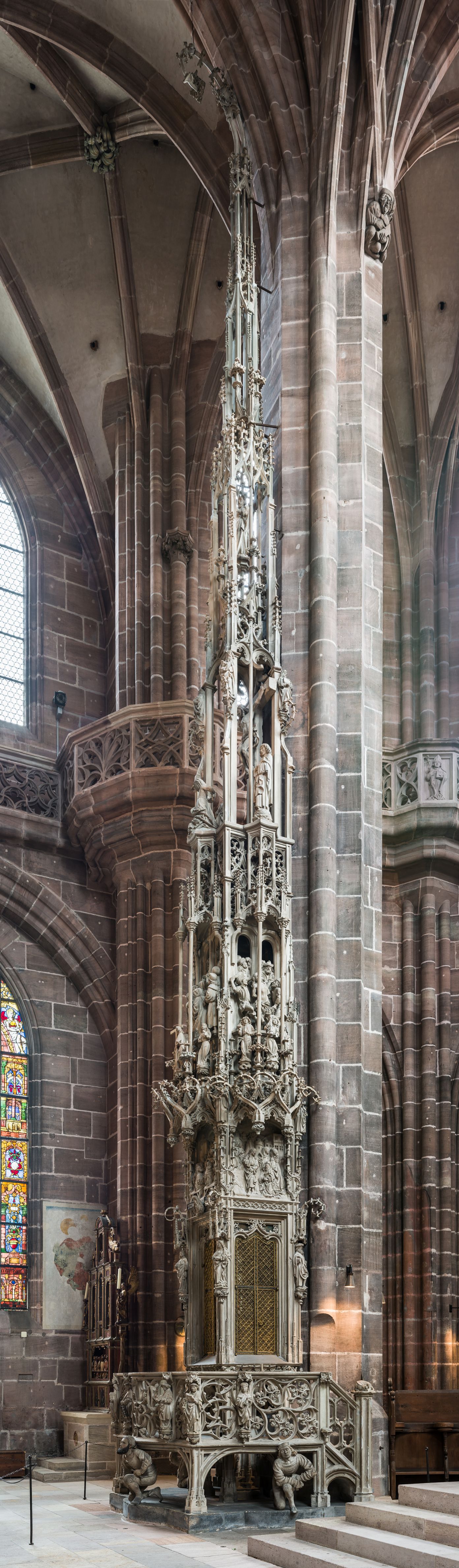
But a friend recently visited Nuremberg in Germany and the church of St Lorenz in particular.  It was there that she found a sculpted self portrait of one of the most celebrated medieval local stonemasons. It’s carved from sandstone and still has colour on it. This is on his beard, his eyes and there are traces on his apron. Kraft carries his tools, a hammer and chisel, and is in his working clothes. He looks out at visitors from the base of one of his most celebrated pieces of work, the Tabernacle. It dates from the 1490s which is when most of his documented work began. It’s an important piece of sculpture as:

‘ It has been suggested that this figure marks the period where the artist’s status was transitioning from anonymous craftsman to recognised individual master.’  http://www.identifier

Full view of the statue. © Helen Grant

The mason’s name is Adam Kraft, (1460’s – Jan 1509) and he is considered to be one of the most important stonemasons of the German late Gothic period.  Adam is believed to have been married twice but it’s not known if he had any children and is buried in the nearby town of Schwabach.

He was chiefly employed by religious institutions and wealthy patrons of the town. In addition, he worked on local public buildings such as Nuremberg’s Imperial stables, epitaphs and reliefs such as coats of arms.  Much of this work can still be seen.

The Tabernacle, St Lorenz church, Nuremberg if you look carefully Adam Kraft’s statue is at the bottom left.© Uocie1 Shared under Wiki Creative Commons

As I said earlier, his self portrait sits at the base of his masterpiece, the 18.7 metres (61 feet) high tabernacle with St Lorenz church. According to Wikipedia:

‘It resembles a gothic tower reaching up into the church’s vault and is created from tracery interspersed with figurative scenes from Christ’s Passion. It was commissioned in 1493 by Hans Imhoff, a patrician from Nuremberg.”

The tabernacle was slightly damaged during World War which led to restoration.

Detail of monument from Nuremberg with a self portrait of Kraft on right hand side from V & A Museum. © Stephen C Dickson Shared under Wiki Creative Commons

A nearby local church, St Sebaldus, has another of Kraft’s significant works on its exterior.  This dates from 1490-92 and depicts the Crucifixion, Entombment of Christ and the resurrection of Christ. If you look closely at one of the panels, you will see what is reputed to be a self portrait of Kraft supporting the crucified Christ as he is taken down from the Cross. A cast of these panels can be seen in London’s Victoria and Albert Museum’s Cast Courts.

Kraft worked in Nuremberg and surrounding areas for nearly 20 years from 1490 – 1509 with a small team of two or three assistants. He depended on wealthy patrons and the Church for commissions. This, I feel would have been true, of most stonemasons of the time. It was the wealthy who could afford headstones and monuments when they had to be buried in the churchyard after the churches ran out of space. There are still medieval items to be found in churches despite the Victorian zeal for restoration.

Simon Kraft wanted to be remembered, not only for his magnificent work, but as a professional craftsman and I feel that his sculpted figure represents all stonemasons. 

©Text Carole Tyrrell unless otherwise stated.

References and further reading:

Adam Kraft | sculptor, stone mason | Artists | Virtual museum of Nuremberg art (has examples of his work)

Adam Kraft – Wikipedia

Adam Kraft | Renaissance, Nuremberg, Altarpiece | Britannica

Self-Portrait of Adam Kraft (at the base of the Sakramentshaus) – Adam Kraft (Nuremberg, c. 1455-1509) | Art Identifier

The Schreyer-Landauer Monument | Kraft, Adam | Rotermundt, Jacob | V&A Explore The Collections

Nuremberg | Population, History, Trials, Castle, Map, & Facts | Britannica

Symbol of the Month – the Agnus Dei

Close-up of Agnus Dei symbol on tombstone. Sadly the epitaph is no longer visible so I can’t confirm if it is to a child or young person.
©Carole Tyrrell

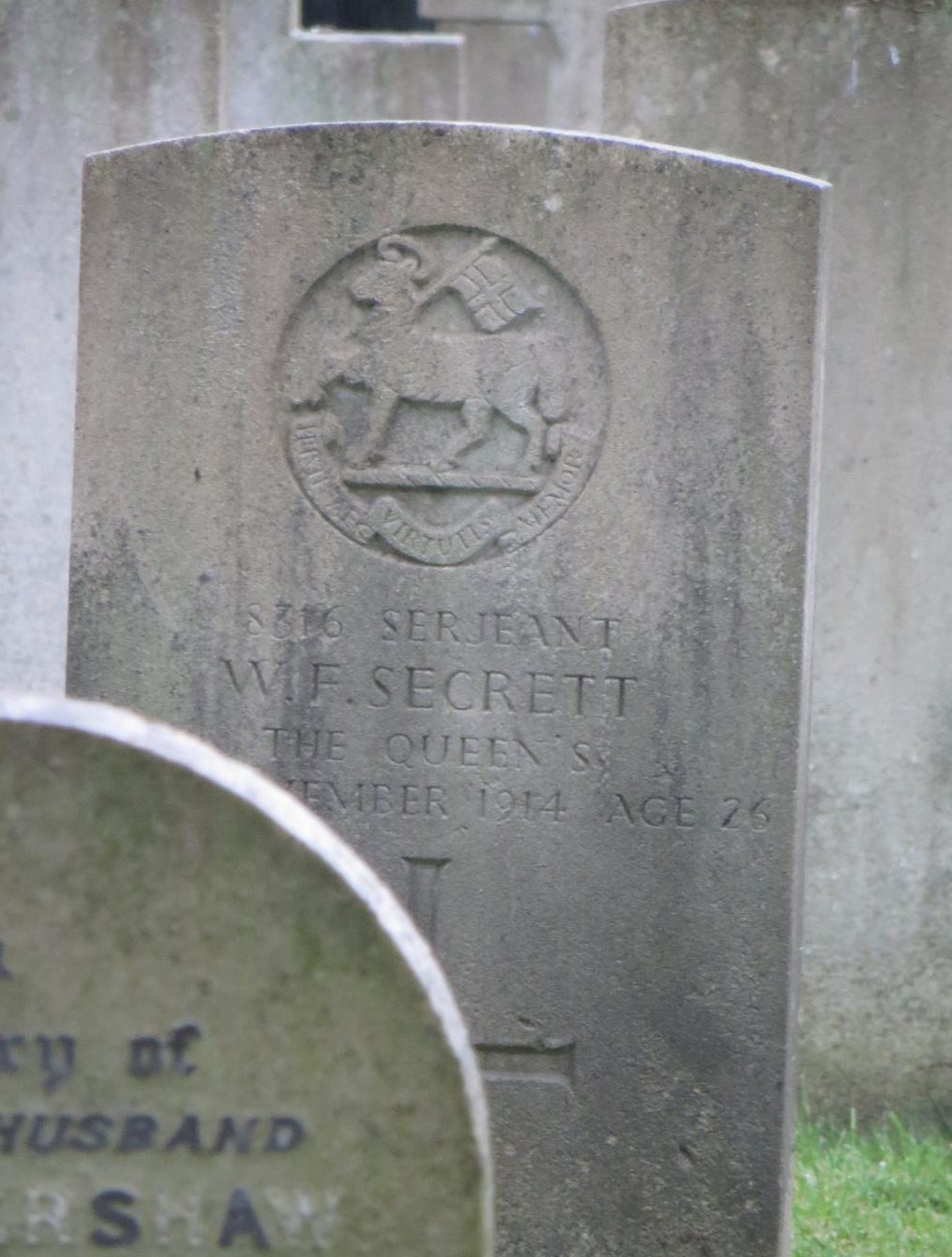
This month’s symbol is the Agnus Dei, which is a Latin term and can be translated as The Lamb of God.  The Lamb is usually portrayed sideways on and is often depicted with a variety of accoutrements such as a cross, a banner and a halo or a combination of these elements.  In the example above, the Lamb is carrying a cross which represents the Crucifixion as well as a banner which, according to J C Cooper, is an emblem of the Resurrection.  It has also be depicted with other motifs such as a shepherd’s crook, Chi-Rho crosses and the alpha/omega.

I have seen The Lamb several times as it is common throughout Christian art and I saw a fine example within a stained glass window in Augustus Pugin’s private chapel at his former home at Ramsgate, Kent.  William Morris also created a memorable one, now sadly faded, in a window at St Martin’s church, Scarborough.  The Agnus Dei is known as a Paschal Lamb within heraldry and is the regimental emblem of the Queens Royal Surrey Regiment.  I found this example in the military war graves section of a London cemetery..

The Agnus Dei on a military tombstone. This is the regimental symbol of the Queens Royal Surrey Regiment in the military graves section of a London cemetery.
©Carole Tyrrell

But the origins of the Lamb go back much further into antiquity. In John 1:29, it’s seen as a direct allusion to Jesus:

‘The next day John seeth Jesus coming unto him, and saith, Behold the Lamb of God, which taketh away the sin of the world.’

This verse emphasises Christ’s sacrifice for humanity’s sins and there are several references in the Old Testament to lambs as sacrificial objects.  For example, the Israelites sacrificed one as a representation of a human sinner.  In this way, its death signified the absorbing of original sin. This  painting, The Sacrificial Lamb, is by the 16th century artist, Francisco Zurbaran. 

Francesco Zurbaran (1598 – 1664) The Lamb of God, Prado Museum, Madrid
shared under Wiki Commons

Sheep have been also been worshipped as deities by several ancient civilisations including he Sumerians. The Bible contains numerous references to sheep with God being seen as the shepherd of a vast flock of sheep that represents humanity.

But as a funerary symbol within cemeteries and graveyards the Lamb represents gentleness, innocence and the unblemished life of the deceased.  In this context, it is supposed to mark the grave of an infant or child.  However, the epitaph on the example that I found in Brompton Cemetery had completely vanished which made it difficult to disprove or support this theory. However, I particularly like this one with its black background emphasising the light rays emanating from the Lamb.  These highlight its divinity within the unusual lozenge shaped tombstone.  But it’s a real shame that we don’t know whose buried there.

The Agnus Dei in an unusual lozenge shaped headstone.
©Carole Tyrrell

The Lamb is also associated with resurrection and there is an example at the back of the Doulton mausoleum in West Norwood Cemetery.

I’m surprised that it doesn’t appear more often within cemeteries and graveyards and I will be looking out for more examples.  Although I was aware that the symbol was called the Lamb of God I didn’t know of its association within major religions  and civilisations. It has been fascinating to research this.

© Text and photos Carole Tyrrell unless otherwise stated.

References and further reading:

Stories in Stone; A Field Guide to Cemetery Symbolism & Iconography, Douglas Keister, 2004, Gibbs Smith

An Illustrated Encyclopaedia of Traditional Symbols, J C Cooper, Thames & Hudson 1979 reprinted 1983.

https://www.verywell.com/headstone-symbols-lamb-sheep-or-agnus-dei-4006520

http://www.religionfacts.com/agnus-dei

https://en.wikipedia.org/wiki/Lamb_of_God

https://symbolsproject.eu/explore/animals/real-insects-birds–saved-soul-the-soul-leaving-the-body-water-animals-terrestrial/lamb-agnus-dei.aspx

http://www.lsew.org.uk/funerary-symbolism/

http://www.jesuswalk.com/lamb/lamb-agnus-dei-artwork.htm

http://www.druidic.org/camchurch/churches/croydon.htm

https://wordsonstone.wordpress.com/category/symbolism/page/4/

http://friendsofstmartins.co.uk/images/ChapelWindows/AgnusDeiSymbol.html

http://www.masonic-lodge-of-education.com/masonic-lamb.html

A gathering of 18th century symbols – St Nicholas, Strood, Kent

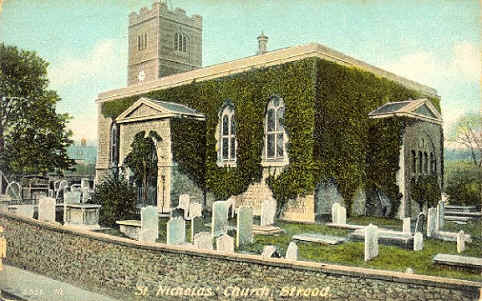
St Nicholas church front entrance, Strood, early 20th century prior to clearances. Courtesy of Kent Archaeological Society

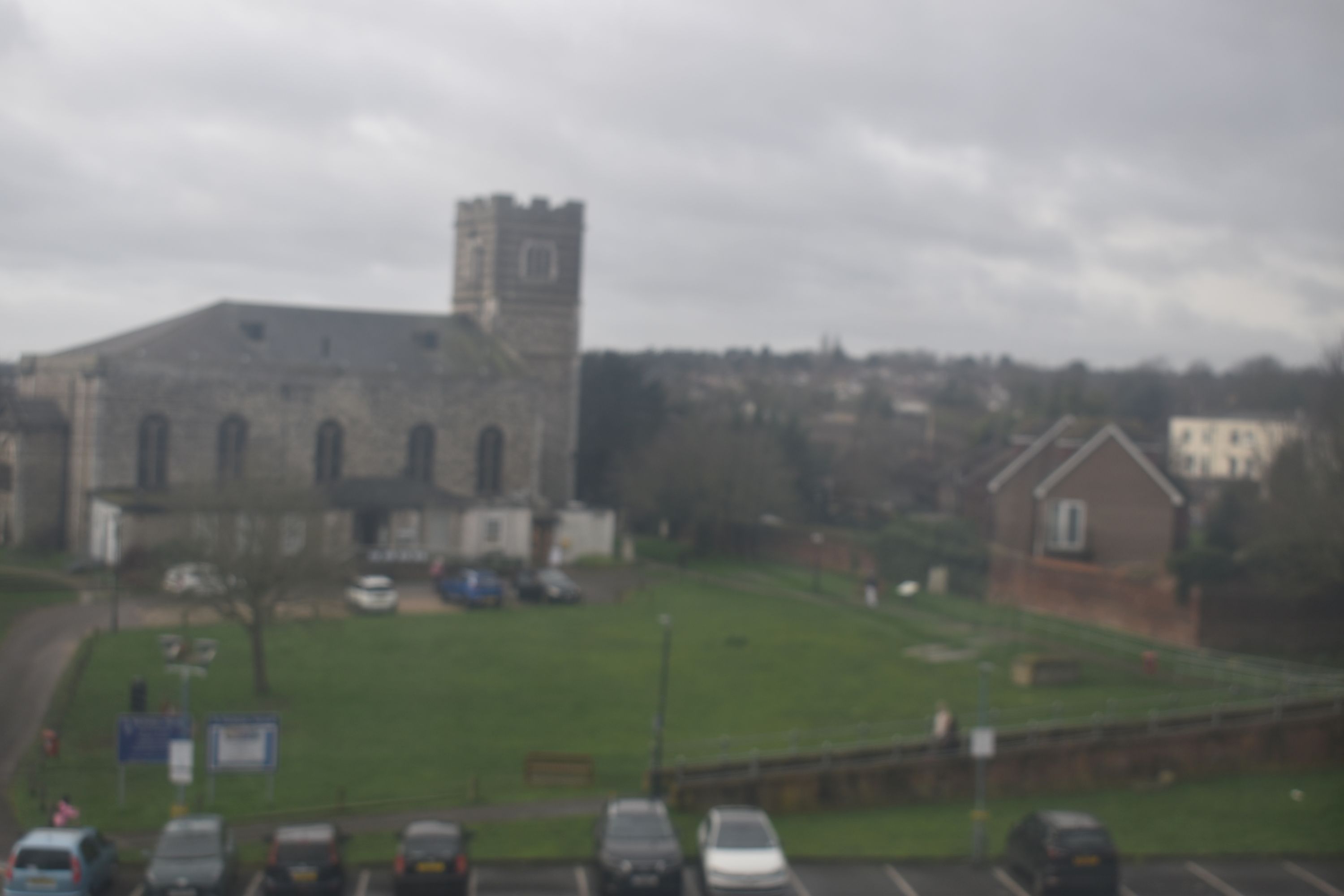
St Nicholas church, which sits in Strood town centre, once boasted a full churchyard of headstones, memorials and monuments as you can see from the above image. It was taken during the early 20th century and may include the original resting place of one or more of the little group now marooned in the South Western corner. It was during the 1960’s that the churchyard was cleared and, instead of a good selection of memorials to explore, there is now an expanse of grass with a few isolated monuments. There has been a suggestion that this wholesale clearance may have been to make the churchyard ‘easier to mow’ but I couldn’t comment on this. It’s just sad to think of what has been lost.

St Nicholas back entrance taken from train, apologies for the quality. This would once have been full of memorials.© Carole Tyrrell

It reminded me of another great cemetery clearance of the time, West Norwood Cemetery, in South West London where 10,000 memorials, headstones and monuments were cleared by Lambeth Council who had compulsorily purchased it due to it having become overgrown and neglected. The clearance was stopped by the Southwark Consistory Court in 1991. No records were kept of what was being destroyed and there was no acknowledgement that relatives might have been upset by it.

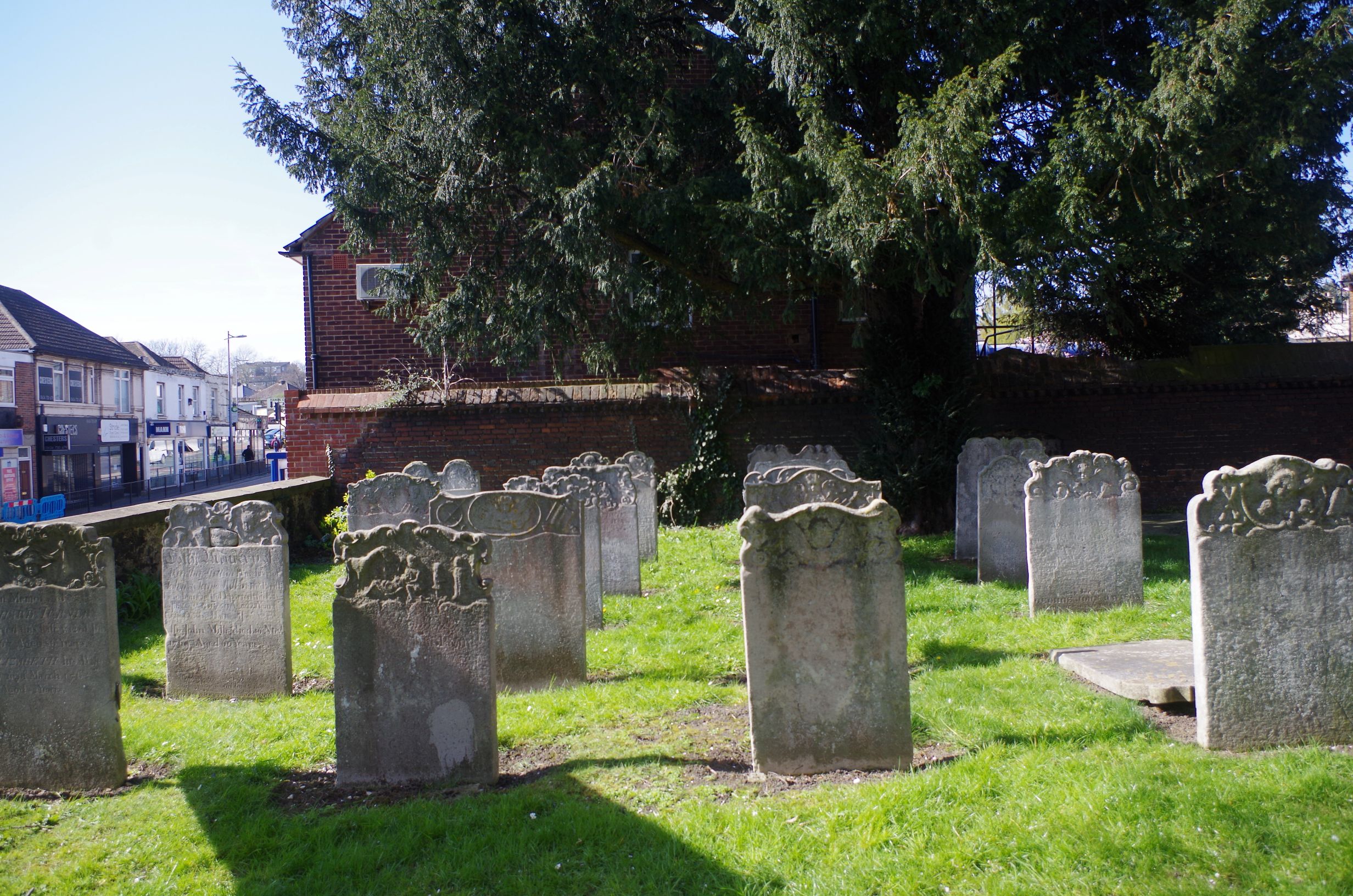
Group view of the 18th century headstones. © Carole Tyrrell

But near the entrance of St Nicholas is a small gathering of eighteen 18th century headstones which have been preserved under yew trees. However, it is undoubtedly not where the permanent residents that they commemorate are actually buried as they could be anywhere within the churchyard. The epitaphs may not be as crisp as they once were and the symbols on the stones may have eroded over time but they are a fascinating collection. My particular interest is funerary symbols and so this was a wonderful collection to explore.

This post features a small selection from the group. These photos were taken in 2020 so they may have deteriorated further since then as they are near a busy road.

It’s an assortment of familiar motifs such as winged souls or messengers, trumpets, skulls and also pictures. The latter are testament to the stonemason’s skill in that they have survived in such good condition. The men, their wives and their families that are remembered on the stones were well to do tradesmen, one was a former Mayor of Rochester, and several left substantial wills and bequests.  The trades represented are: two House Carpenters, a Fisherman, a Dredgerman, a Gentleman, a Yeoman, a Blacksmith, and a Tailor.  A Dredgerman was an oyster fisherman and a Yeoman was historically a free man who owned and cultivated his own land and had a social rank between peasants and the gentry.

I am indebted to the Kent Archaeological Society for their monument records pertaining to St Nicholas churchyard and also the epitaphs and information about related wills and bequests

WILLIAM PORTER

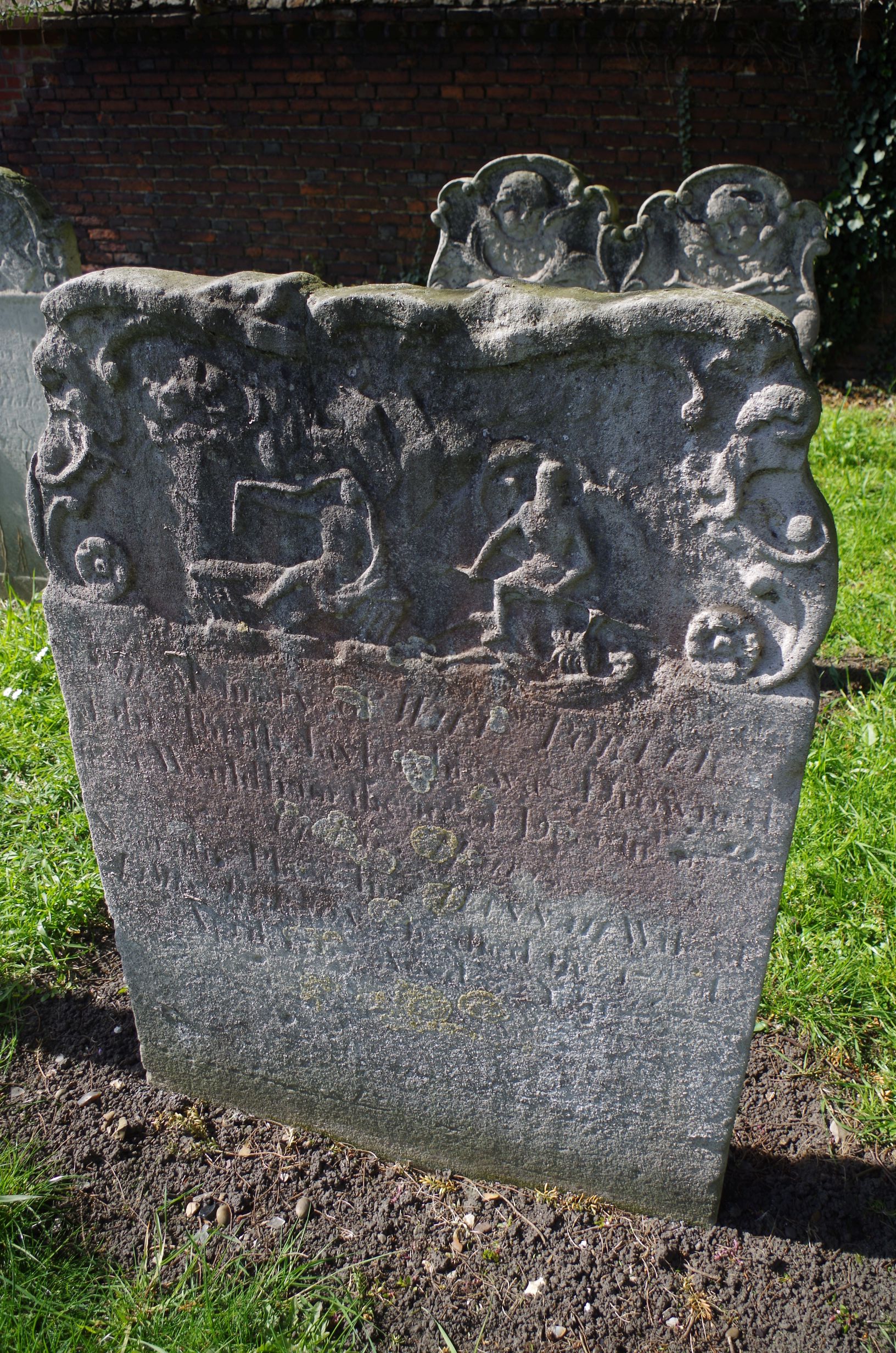
Full view of William Porter’s headstone. © Carole Tyrrell

Closer view of the Porter headstone. © Carole Tyrrell

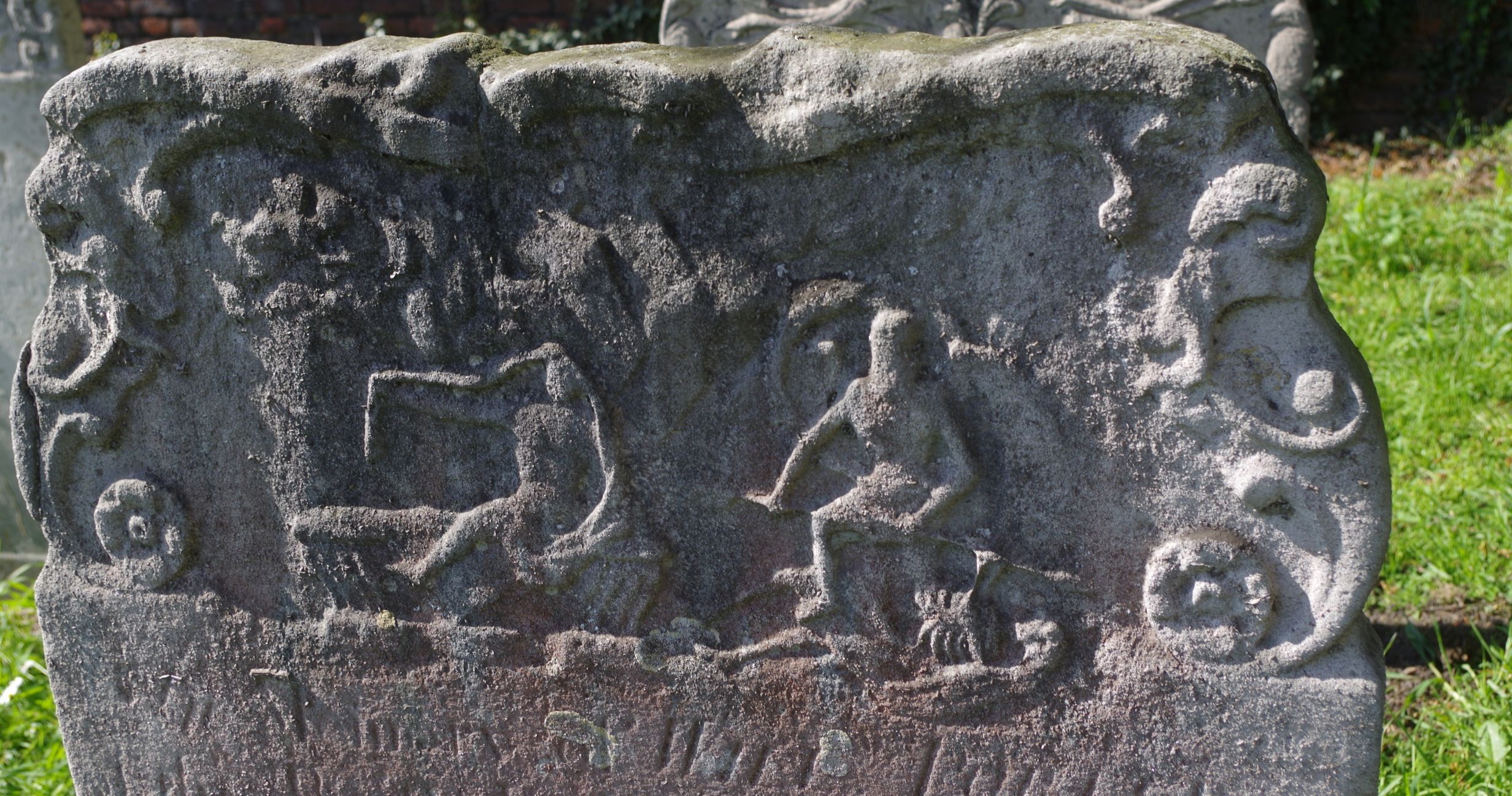
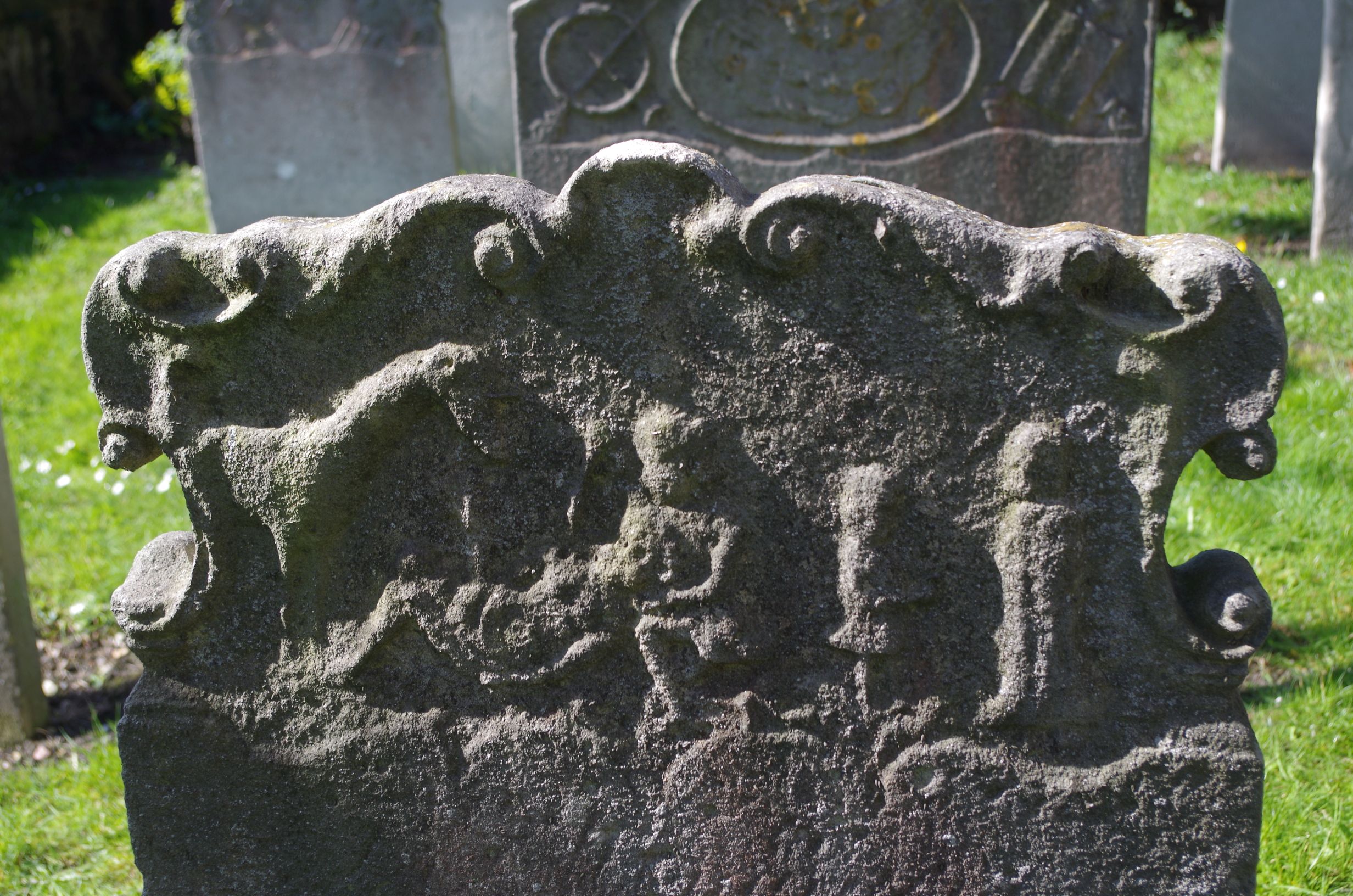
The first one I noticed was ‘The Choice’ which is a familiar one in Kent churchyards. I first saw it in All Saints, Staplehurst, Kent and the scene is almost like a miniature Doom painting.  My interpretation of it is that it’s Judgement Day, the deceased has awoken from their eternal slumber and they are throwing off their grave clothes. As you face the stone, the King of Terrors is to your right brandishing ‘Death’s Dart’ while standing on top of a skeletal rib cage.  However, on the other side of the awakening person is a blank space except for some stylised clouds at the top. This is where I would expect to find an image of Heaven with perhaps an angel. However, it may have eroded completely.  It is a popular image. I found five versions of it in the churchyard of St Mary the Virgin in Newington, Kent.  One of the pleasures of exploring churchyards is following a stonemasons work. I may never know who they were but they have left their work as an example of where they have been.

The image itself may have come from a painting, a Bible or even one of the pattern books of the time. However, please bear in mind that the King of Terrors would have been on the deceased’s left hand side which is known as the ‘sinister’ side.  There are also rosettes and decorative swirls surrounding the image.

‘The Choice’ is dedicated to William Porter who drowned at Wouldham, Kent on 19 December 1773.

The epitaph reads:

IN MEMORY OF WILL. PORTER

OF THIS PARISH TAYLOR HE WAS DROWNED

AT WOULDHAM DIED 19TH [DECEMBER 1773]

AGED [  ] YEARS

ALSO HANNAH HIS WIFE

WHO DIED THE 17TH ? OF April 17[76]

Aged [     ]

In William Porter’s will he left all of his estate and effects to his wife Hannah for ever. She was also directed to give £100, (a sizeable amount at the time) to Hannah Robson, daughter of James Robson of Strood who was a fisherman. However, Hannah Porter renounced her role as executor of the will and it was subsequently undertaken by three creditors who were bound by a bond of £800 to administer the estate. Hannah herself left a will dated 27th September 1775 in which she left all of her personal estate after the usual expenses to James Robson, mariner, for ever.

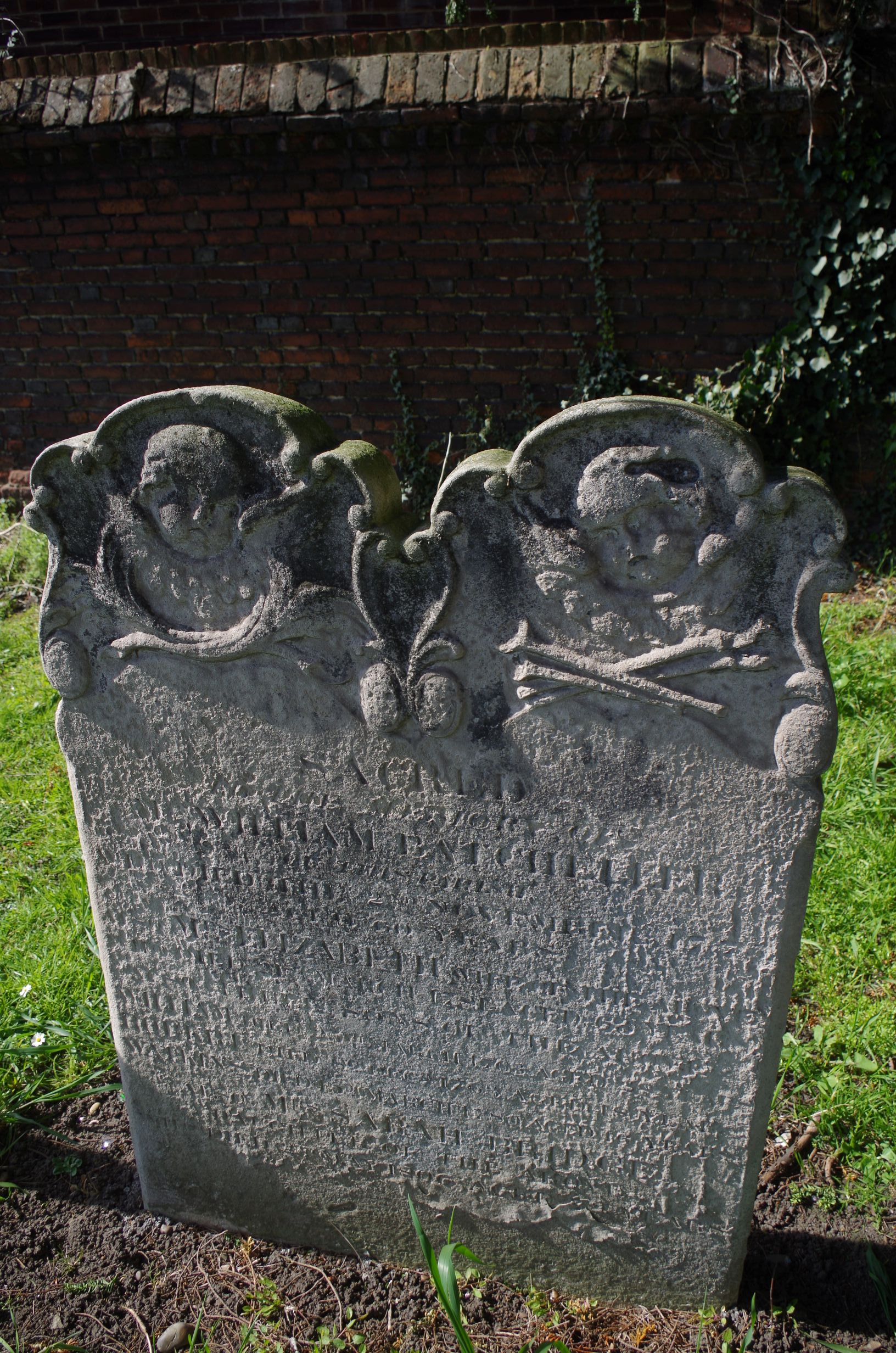
William Batcheller’s headstone is behind the Porters and can also be seen in the photos.

WILLIAM BATCHELLER

Full view of William Batcheller’s headstone. © Carole Tyrrell

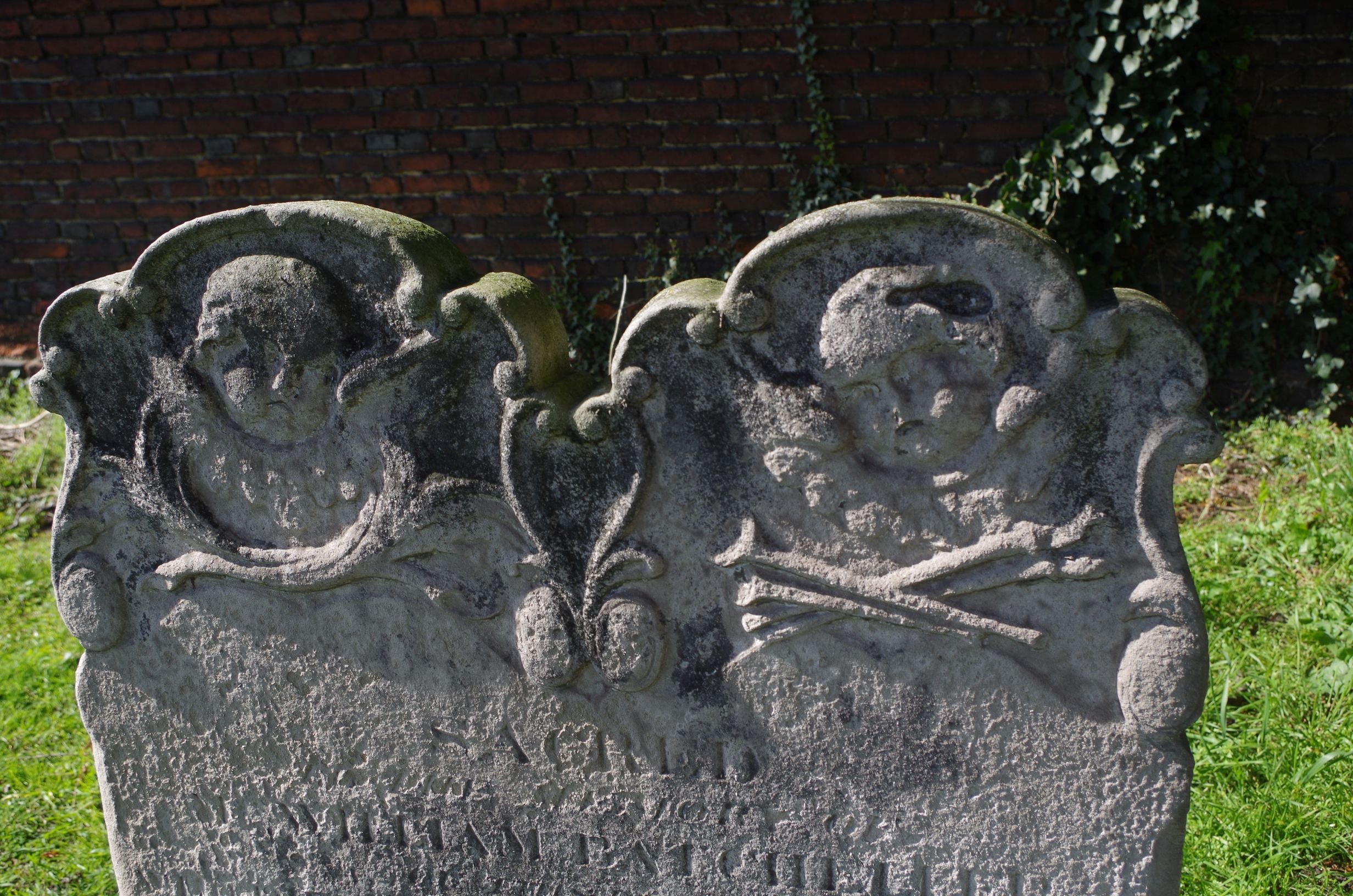
Close up view of William Batcheller’s headstone. © Carole Tyrrell

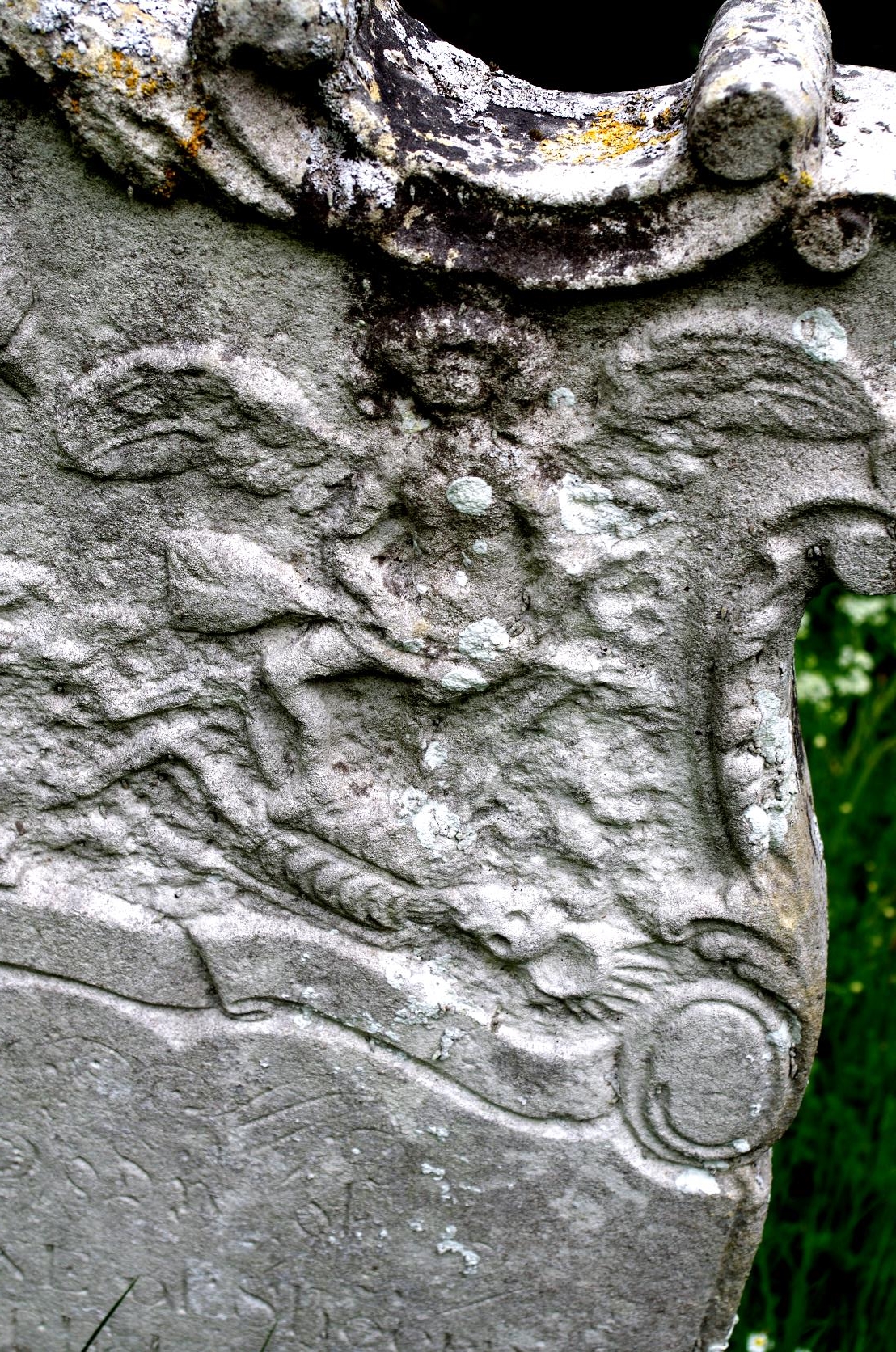
This headstone is dedicated to William Batcheller and his family. There are two winged messengers or souls which are a sign of resurrection. On the right hand side there appears to be a palm leaf beneath one and on the other side there are trumpets underneath. I thought at first glance that they were crossed bones, but, on a closer glance I could see that they were in fact trumpets. This is a reference to the Day of Judgement where the angel Gabriel would blow a trumpet to bring the dead back to life. The palm has many associations in ancient cultures. For example, in Egypt it represented immortality and it was a sign of victory in ancient Greece and Rome. It is most associated with Palm Sunday in Christianity.  This is when palm branches are distributed to a congregation for them to take home. The stone mason has also added decorative touches such as swirls and cartouches to enhance the design which is something that I haven’t seen in other churchyards or cemeteries. The epitaph reads:

SACRED

TO THE MEMORY OF

MR WILLIAM BATCHELLER

OF THIS PARISH

WHO DIED THE 2ND OF NOVEMBER 1776

AGED 60 YEARS

ALSO ELIZABETH WIFE OF THE ABOVE

WHO DIED 21ST? OF MARCH 1781 AGED 68 YEARS

ALSO CHILDREN OF THE ABOVE

WILLIAM DIED 26TH MARCH 1781 AGED 28? YEARS

WATKIN DIED 15th [   ] 17 [      ] AGED 16 YEARS

ALSO MRS SARAH BRIDGE

DAUGHTER OF THE ABOVE

WHO DIED [   ]  MAY 1806 AGED 7 [  ]  YEARS

William Batcheller left a will dated 14th January 1765 in which he left all his household goods, plate, linen etc to his wife, Elizabeth, who was also his executor. In addition, he wished his wife to have any money from lottery tickets that he bought in 1773.

Sarah, his daughter, also left a will dated 11 November 1805.

In it, she bequeathed various sums of South Sea annuities to three recipients totalling £3,750 and three months after her death they were to be transferred to other recipients including her servant. Any remaining ‘residue’ of her ‘personal estate after funeral expenses, etc.’ was to go to James Bridge.

There was also a codicil to the will, dated the same day, in which she states that ‘a bequest of £500 old stock’ was to go Mary, wife of James Bridge. Sarah had empowered him to buy £100 of old South Sea stock for herself on 11th November 1801. However, she had discovered that a further sum of £100 in this stock had been purchased in the names of James Bridge and his wife ‘contrary to her wishes.’ James Bridge was then told to alter the bonds into her name. and also ‘if he does not, in her lifetime’ then she would revoke his legacy given to Mary Bridge. In lieu of this she gave her £300 of the stock, ‘and no more’ The rest of the will was ratified.  A formidable lady.

JAMES BURR

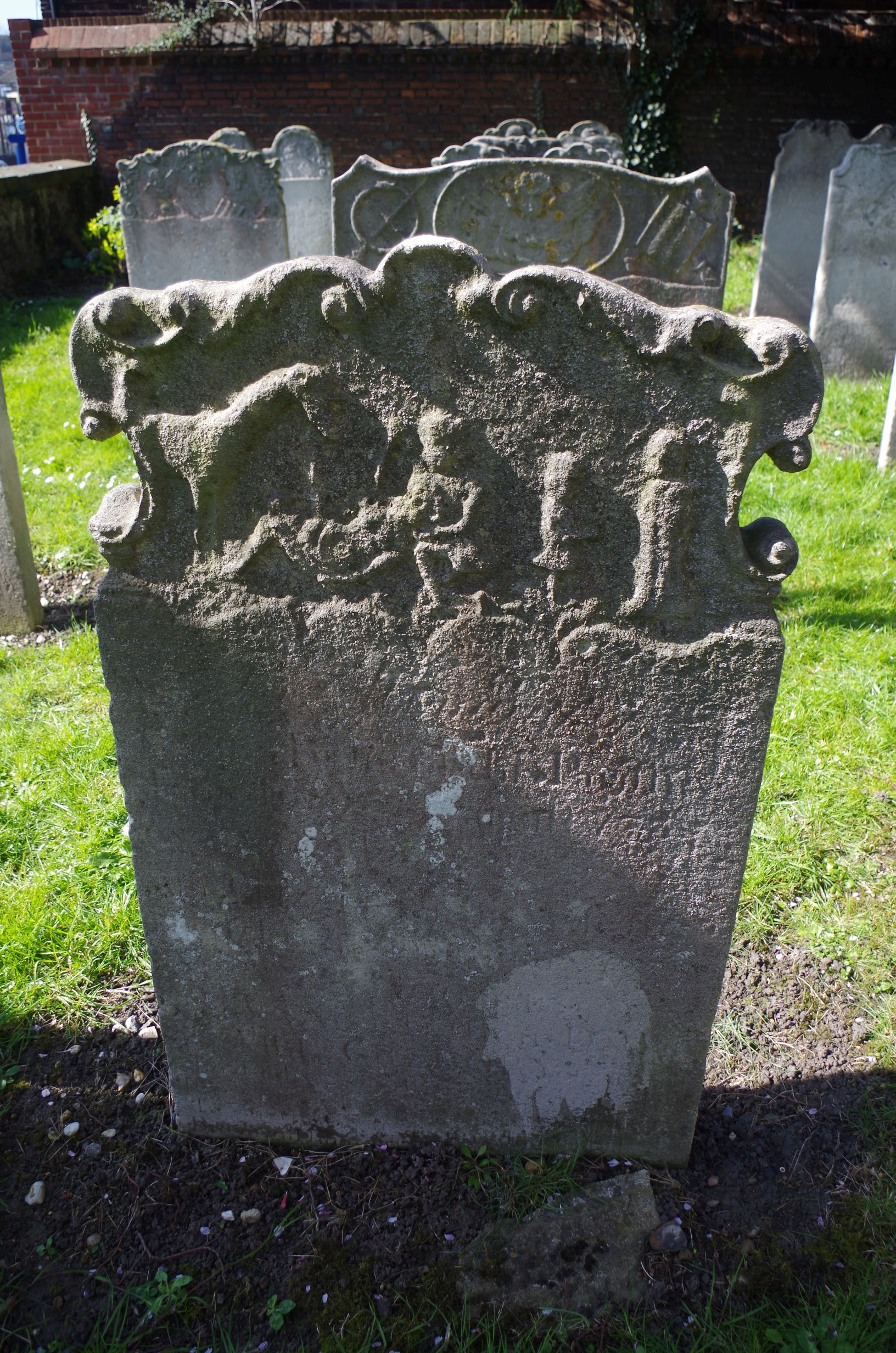
Full view of James Burr’s headstone. © Carole Tyrrell

Closer view of James Burr’s headstone. © Carole Tyrrell

This is an image of the Good Samaritan and very similar to the example that I first encountered in St Margaret’s churchyard in Rochester. The Good Samaritan appears in the King James Bible Luke 10:25.37:

‘But he, willing to justify himself, said unto Jesus, And who is my neighbour?

And Jesus answering said, A certain man went down from Jerusalem to Jericho, and fell among thieves, which stripped him of his raiment, and wounded him, and departed, leaving him half dead.

And by chance there came down a certain priest that way: and when he saw him, he passed by on the other side.

And likewise a Levite, when he was at the place, came and looked on him, and passed by on the other side.

But a certain Samaritan, as he journeyed, came where he was: and when he saw him, he had compassion on him,

And went to him, and bound up his wounds, pouring in oil and wine, and set him on his own beast, and brought him to an inn, and took care of him.

And on the morrow when he departed, he took out two pence, and gave them to the host, and said unto him, Take care of him; and whatsoever thou spendest more, when I come again, I will repay thee.

 Which now of these three, thinkest thou, was neighbour unto him that fell among the thieves?

And he said, He that shewed mercy on him. Then said Jesus unto him, Go, and do thou likewise.’

In this image the observer can see the victim being helped by the Samaritan whose horse is looking on. Two figures, presumably the priest and the Levite, appear to be moving away from the scene on the right hand side

It is dedicated to James and Elizabeth Burr and their daughter Sarah.  The epitaph reads:

IN MEMORY OF

JAMES BURR OF THIS PARISH

WHO DIED [  ]  AUGUST 17[  ]

AGED 36 YEARS

ALSO ELIZABETH HIS WIFE

WHO DIED 27TH OF JANUARY 1777

AGED 90 YEARS

ALSO SARAH THEIR DR

OF WILL. GREGORY OF YS PARISH

WHO DIED YE 2nd of July 1778

AGED 64 ? YEARS

However, James Burr does not appear in the Burial Register.

Sarah Burr, his daughter, married William Gregory in the same year as her death. Elizabeth Burr, her mother, left a will dated 25 June 1776 in which she left all her estate to her daughter.

An interesting selection of stones, not only in their symbols and images, but also what they tell us about a section of the local 18th century community’s life and occupations.

Text and photos© Carole Tyrrell unless stated otherwise

References and further reading:

Palm branch – Wikipedia

Monumental Inscriptions of St Nicholas Church, Strood — Kent Archaeological Society part of Churchyard, Strood. Recorded by D.E.Williams 2014

West Norwood Cemetery | London Museum

West Norwood Cemetery – Wikipedia

https://tedconnell.org.uk

Symbolism of cemetery plants: How flowers, trees and other botanical motifs honor those buried beneath

Symbol of the Month – the yew tree

A few fine yew trees in St Margaret’s churchyard, Rochester. © Carole Tyrrell

They are the sentinels of the silent cities, standing tall and spreading out their branches to shade the last resting places of the permanent residents.  Yew trees can often be older than the churches which they nestle beside in the churchyard and may predate Christianity as many churches were built on pagan sites of worship. In fact there are reputed to be at least 500 yew trees of this vintage!  And incredibly, there are 10 yew trees in Britain that are believed to predate the 10th century.

These venerable trees have many associations and traditions.  I will try and concentrate on a few but they are usually associated with churchyards and burial grounds. The most common one is that they are nourished by the decaying bodies beneath them and, as they can grow up to 20 metres high, this could seem plausible.  Another tradition states that yews were planted on plague victims graves to protect and purify them – if this were true than some churchyards would resemble a forest!

Another common tradition is that they were planted to prevent ‘commoners’ from grazing their cattle on church ground.  This was because yews are very poisonous to livestock.  The needles are deadly, and Shakespeare used this in Macbeth when the three witches conjure up a deadly brew that contains, amongst other unpleasant ingredients:

‘Gall of goat, and slips of yew
Silver’d in the moon’s eclipse,’

However, the Celts saw the yew as a symbol of immortality, death and resurrection. The yew’s drooping branches are able to root and form new trunks where they touch the ground.  The one at St James in Cooling was living inside its dead ancestor which demonstrates its ability to renew itself.

Ancient yew tree in St James, Cooling, Kent © Carole Tyrrell

Another ancient yew with a new tree growing inside the old one. © Carole Tyrrell

In fact, they are one of the most long lived trees in Western Europe but are not considered ancient until at least 900 years old.  The oldest tree in Scotland, and possibly Europe, is the magnificent Fortingall yew in Glen Lyon.  It has been suggested that it is over 2000 years old and maybe even 9000 years old.  It has numerous legends attached to it and in 1769 was reputed to have a girth of over 56ft.  In 1854, funeral processions were reputed to be able to pass through the arch formed by its split trunk.  The yew in St Cynog’s churchyard in Wales is a mere stripling at a reputed 5000 years old. One of the world’s oldest surviving wooden artifacts is a yew spear head which is estimated to be around 450,000 years old. They are evergreens with red berries which although are edible, the seed in the berry is extremely dangerous.

Fortingall Yew in 2011 ©Paul Hermans. Shared under Wiki Creative Commons

A trunk of the Fortingall Yew. ©Mogens Engelund Shared under Wiki Creative Commons

One of my favourite churchyards is that of St Marys in Painswick, Gloucestershire.  It has 99 clipped yew trees but according to Roy’s blog post, attempts to grow a 100th tree have always failed.  They are a dramatic sight to see!

The scenic avenue of 99 yew trees at St Mary’s Painswick ©Carole Tyrrell

I must admit that I would feel disappointed if I visited a churchyard and didn’t see a tall, majestic yew or two keeping watch over the dead as potent symbols of resurrection and immortality.

© Text and photos Carole Tyrrell unless otherwise stated

References and further reading

https://www.woodlandtrust.org.uk/blog/2018/01/ancient-yew-trees/

https://tree2mydoor.com/pages/information-trees-tree-directory-yew-trees

https://en.wikipedia.org/wiki/Taxus_baccata

https://en.wikipedia.org/wiki/Fortingall_Yew oldest yew tree in Britain.

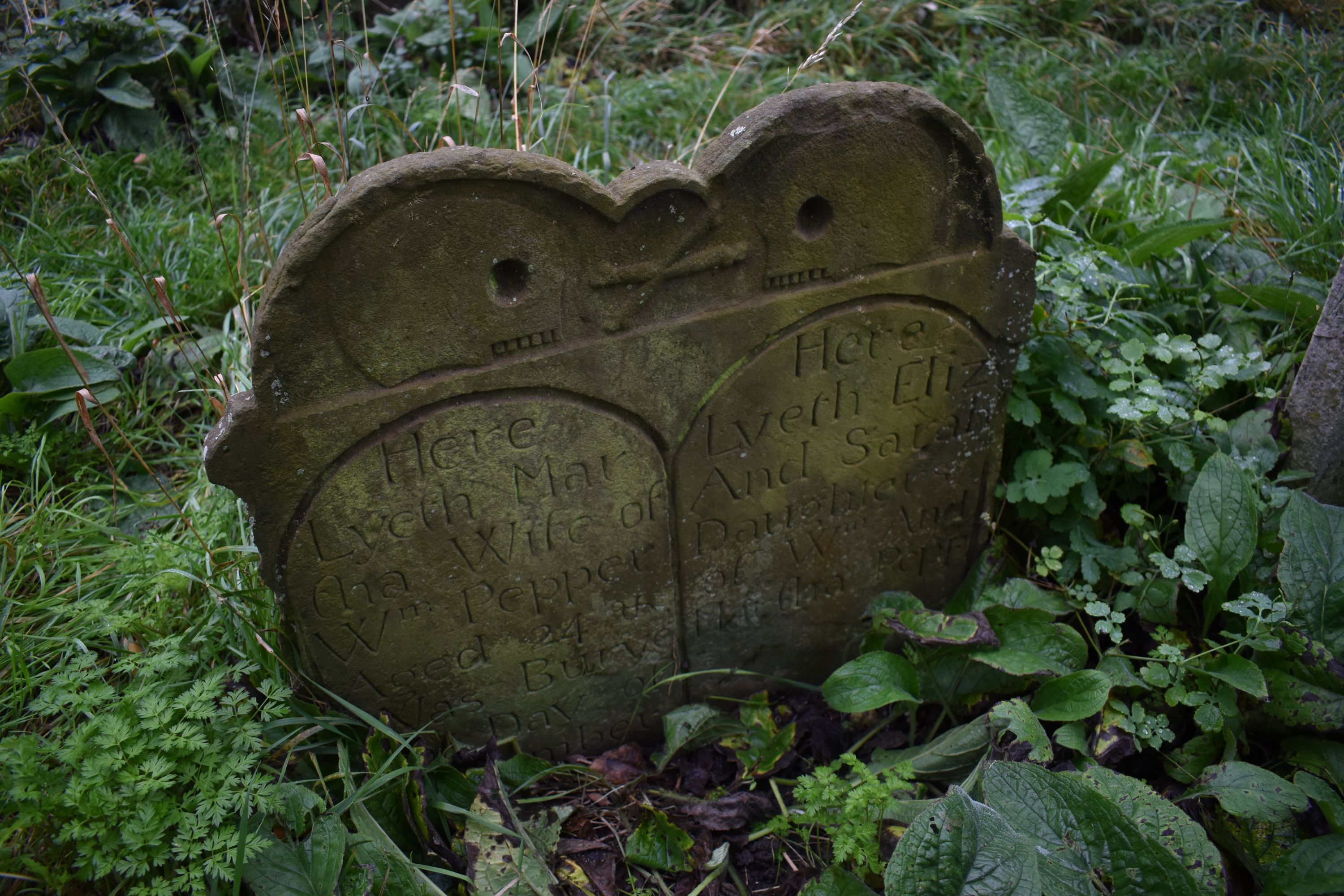
A little beauty! – the Pepper family, St Laurence in Thanet, Ramsgate, Kent

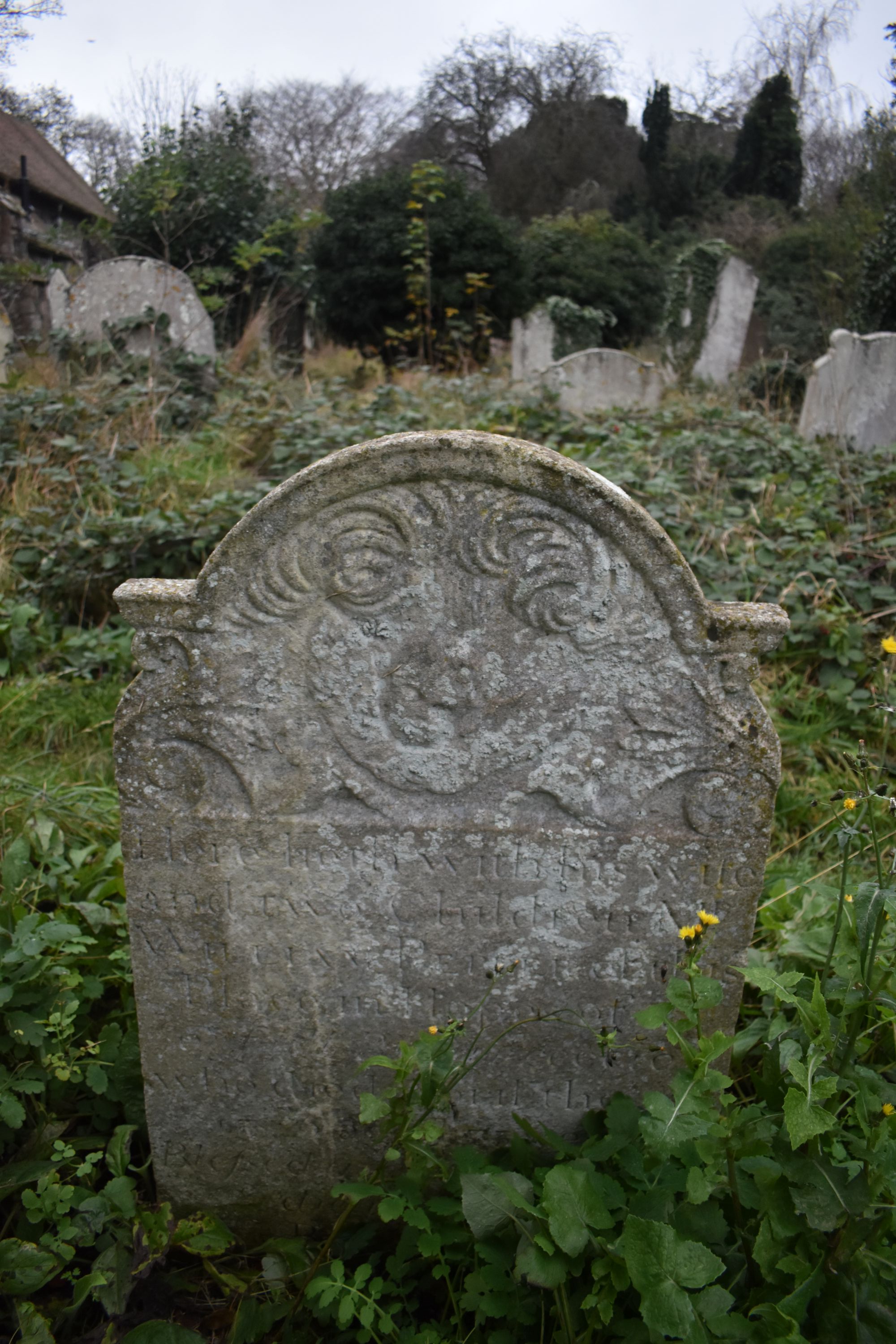
The headstone dedicated to Mrs Martha Pepper and her two daughters, Elizabeth and Sarah. © Carole Tyrrell

Firstly, Happy New Year to you all! Winter is always a good time to explore cemeteries and churchyards due to the winter die back of vegetation and last November was no exception.

Now, a word of warning, never assume when you’re out exploring churchyards that all headstones are facing in a certain way.  I have visited this churchyard several times, saw this headstone and had dismissed it as being weathered and unreadable.  How wrong I was! I had thought that it was facing me when in fact the opposite was true.

On this visit, it was a terrible November day, cold and wet, and the evening chill was beginning to close in as the evening began to draw on. The winter die back had revealed headstones along the churchyard’s front wall and boundary wall that I hadn’t previously able to previously see displaying a multitude of ‘winged souls’.  

Headstones placed along a boundary wall displaying ‘winged souls’. © Carole Tyrrell

These have featured in a previous Symbol of the Month dated 29 April 2025. But as I was gingerly stepping over wet leaves to look at them more closely by the front entrance, I looked down and saw this one!

The women of the Pepper family. © Carole Tyrrell

It  is actually facing the churchyard wall and I had been looking at its back on my other visits. It still looks as crisp and clear as when it was carved with two stylised skulls and bones facing each other displaying teeth.

On the right hand side there is a dedication to:

‘Here lyeth

Martha, wife of Wm Pepper

Aged 24 Was Buryed on

11th day of November 1705’

On the left hand side there is another dedication is to their two daughters:

‘ Here lyeth Eliz {abeth}

and Sarah

daughters of

Wm and Martha Pepp’

I couldn’t see any dates but they may be obscured by damp vegetation.

What’s interesting about this headstone is, that if you look closely, you can see that the stonemason has run out of space with some of the letters and had to put the rest of them on the next line.  This happens with ‘Martha’ and also ‘Pepper’ on the left hand side near the bottom when both words become split. I haven’t seen this before on a headstone although I knew that it did happen.

Full view of William Pepper’s headstone. © Carole Tyrrell

William Pepper is also buried in the churchyard but I couldn’t find his tombstone on this visit. Instead, I had to consult Charles Cotton’s 1895 book, ‘History and Antiquities of the Church and Parish of St Laurence (Lawrence) Thanet (Ramsgate) which I found on the Kent Archaeological Society website under their Monumental Inscriptions page.

As a result, I did make a return visit to the churchyard and located William’s tombstone which is beside Martha’s. As you can see it is much larger with a winged soul at the top and what I assume to be clouds above that.

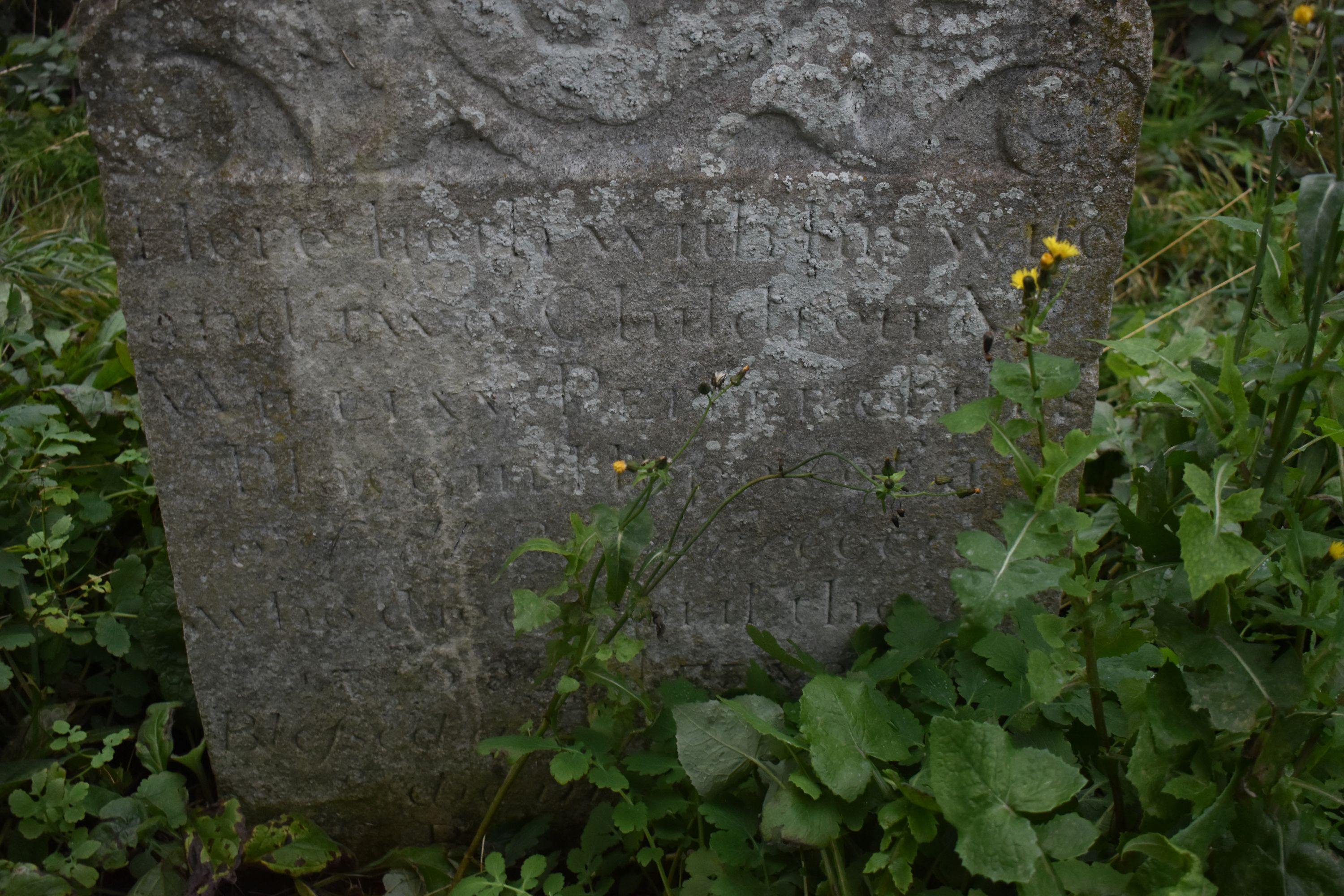
A full view of William Pepper’s epitaph. © Carole Tyrrell

There is also a more fulsome epitaph although much of it wasn’t readable. What I could read said:

‘Here lyeth with his wife

and two Children

Wm Pepper…..the rest is illegible

who died on the 15th April 1746 aged 73 years….the rest is illegible.’

It may be easier to read on a better day. The headstone seems to have been more professionally carved but of the two I do prefer his wife’s.

But Martha’s tombstone had been such a wonderful find on such a terrible day weatherwise and it was good to be able to find her husband’s headstone as well to complete the family group.

The two tombstones encapsulate the change that took place in churchyard symbols during the 18th century. It began with the very stark reminder of death with the skull and crossbones to a more comforting message for those left behind towards the end of the century. This emphasised that there might be eternal life on ‘the other side’ as the soul flies heavenward.

©Text and photos Carole Tyrrell unless otherwise stated.

References:

History and Antiquities of the Church and Parish of St Laurence (Lawrence)Thanet (Ramsgate) – reference taken from the Kent Archaeological Society website under Monumental Records, Charles Cotton 1895.

Symbol of the Month – The King of Terrors!

The King of Terrors headstone, St Larence in Thanet, Ramsgate. © Carole Tyrrell

It was in the churchyard of St Laurence in Thanet, Ramsgate that I found this gleeful skull wearing a crown. The churchyard has a plethora of winged souls or children’s heads with wings but there is also a scattering of fine skulls as well.  This particular skull has bat wings on either side of its head but more on these later.  I consider it to be a personification of The King of Terrors which is another name for Death.

The left hand side of the headstone showing the word ‘Mary’. © Carole Tyrrell

The words on the righthand side of the headstone are unreadable. © Carole Tyrrell

The headstone is very weathered and most of the epitaph has now gone. According to the 1895 book published by Charles Cotton on ‘St Lawrence (Laurence), Thanet (Ramsgate)’, it could be either the last resting place of:

‘Mary, wife of Cornelius Martin, died 15th December 1728 aged 57 years’

Or

‘Mary, wife of George Martin, died 10th January 1727 aged 38 years.’

On closer inspection, the name Mary can still be seen but what remains on the right-hand side of the headstone is illegible although I did spot an ‘i’. This is what led to my supposition that it might be one of these ladies who is buried there.

On first glance it doesn’t look like a very comforting symbol with its stark representation of death. There is a very sobering verse written by the Rev. George Crabb (1754-1832) in which he mentions the King of Terrors:

‘Death levels man – the wicked and the just,

The wise, the weak, the blended in the dust,

And by the honours dealt to every name,

The King of Terrors seems to level fame.’

This reminds the reader that Death makes all men and women equal despite their rank when alive.

The King of Terrors is usually depicted as a skeleton brandishing a scythe, an arrow, a spear or a dart.  This magnificent example comes from Cralling Old Parish churchyard in the Scottish Borders. It’s a gleeful skeleton holding a scythe which is the symbol most associated with death.

The King of Terrors, Crailing Old Parish Churchyard. © Walter Baxter shared under Creative Commons Licence Geograph NT6820

Also in Scotland, Greyfriars Cemetery in Edinburgh abounds with macabre symbolism on its monuments and is well worth a visit if you’re ever visiting the city. I have seen it for myself and it is an amazing place.  The lively skeleton depicted on the headstone of Surgeon James Borthwick is known as ‘the dancing skeleton’ and is very impressive. Please follow the link below and scroll down to see it.

Greyfriars Kirkyard, Edinburgh: The Ultimate Guide | My Macabre Roadtrip

The monument is large and measures 4m x 2m so you won’t miss it and is the largest one in Greyfriars.  The skeleton is not only holding the Book of Destiny but also a large scythe. It is ultimately a ‘memento mori’ which is Latin for ‘Remember you must die.’

There is also one in the celebrated Rosslyn Chapel, near Edinburgh (don’t be put off by the Dan Brown associations) as it is such a fascinating place to visit.’

Click on this liGenealogy Tours of Scotland: A Month of Scottish Gravestones – The Dance of Death

All of these images emphasis the role of The King of Terrors as the King of Death or the Grim Reaper.  For what else could Death be but a terror as it’s the unknown.

However, in this detail from Alice Stone’s headstone in the churchyard of All Saints, Staplehurst, Kent, a winged figure, presumably the Devil, is triumphantly holding a dart, is standing over a fallen skeleton whose crown has fallen from his head.  Has the Devil beaten Death? Is the incumbent doomed to a life in hell?

The Devil holding Death’s Dart standing over a skeleton that’s lost its crown. Could it be the King of Terrors? ©Carole Tyrrell

The King of Terrors is also a psychopomp. This comes from the Greek word, ‘psychopompos’ which means ‘the guide of souls.’ They appear in many religions and forms such as spirits, angels, demons and gods to guide the deceased to the afterlife.

Anubis and the King – tomb of Horemheb 1323-1295 BC Metropolitian Museum of Art. Shared under Wiki Creative Commons

Charon and his boat on a funerary relief ca 320s BC shared under Wiki Creative Commons.

The most obvious examples are Anubis, the ancient Egyptian god of the underworld, Charon the Greek ferryman, the Goddess Hecate and the Norse Valkyries amongst a host of others.  The psychopomp is also a personification of death and often represented with a scythe and given the title of ‘The Grim Reaper’ – the reaper of souls. This is one of the earliest images of him and dates from 1460.

One of the oldest paintings with conventional ‘Grim Reaper’ elements, a skeletal character with a scythe (circa 1460 by Jean Fouquet) shared under Wiki Creative Commons.

The King of Terrors first appears in the Bible in the Book of Job 18:14:

‘His confidence shall be rooted out of his tabernacle, and it shall bring him to the king of terrors.’

This is part of a chapter emphasising destruction and death for those who do not keep to the righteous path. However, I am indebted to the vastpublicindifference blog for the next earliest use of the name in a printed pamphlet. He is mentioned in William Prynne’s ‘Perpetuite of a Regenerate Man’s Estate’ in 1626:

‘If once you have the smallest dram of time and saving grace, you need not feare the very King of Terrors, hell and death, you need feare the most that men or divells (devils) can do to you. They cannot seuer (sever) you from the love of God, which is Christ Iesus (Jesus) your lord, not yet disturbe you from the state of Grace.’

He also appears in nearly 200 books in English pre-1700.

However, the King of Terrors, the Grim Reaper or whatever you choose to call him is not a very comforting image for those left behind. So, it’s no wonder that, as the years went on, these very stark symbols began to be replaced by the ‘winged souls’. They gave a more hopeful image of another life after death. There’s also the batwings on either side of the skull to consider.

Bats were considered to be the spirits of the dead and associated with evil as the Devil traditionally had the same type of wings. Sometimes the skulls are given two different types of wings; on one side they are feathered and on the other is the batwings.

Bats can also be seen as guardians between physical and spiritual worlds. They were supposed to guide souls through transformation or metamorphosis: renewal, death and rebirth.  So, the use of them is very appropriate on a funerary monument. In China, for example, they are seen as symbols of good luck, longevity and rebirth.

So, within this one symbol there are two meanings.  One is that the person has encountered the Grim Reaper and has died whereas the other suggests that they are going to be reborn to everlasting life. It was an interesting symbol to see on my churchyard visit although the skull does look a little too enthusiastic!

Text and photos © Carole Tyrrell unless otherwise stated

References and further reading

The History and Antiquities of the Church and Parish of St Laurence (Lawrence), Thanet (Ramsgate) Charles Cotton, 1895 via Kent Archaeological Society

King of Terrors | Gravely Speaking

King of Terrors Gravestone © Walter Baxter cc-by-sa/2.0 :: Geograph Britain and Ireland

Vast Public Indifference: Death: “King of Terrors”

Greyfriars Kirkyard, Edinburgh: The Ultimate Guide | My Macabre Roadtrip

The King of Terrors takes a rest | Gravely Speaking

Psychopomp – Wikipedia

Job 18 KJV – Then answered Bildad the Shuhite, and – Bible Gateway

Genealogy Tours of Scotland: A Month of Scottish Gravestones – The Dance of Death

Bats, a funerary fascination

What’s The Meaning Of Bat Symbol? – Ourspiritanimal.com

Symbol(s) of the Month – Ritual Protection Marks

Cross, St Nicholas at Wade, Kent © Carole Tyrrell

Imagine if you will a medieval church.  Inside it would be brightly painted and very colourful in contrast to the whitewashed interiors that we are familiar with today. Faded vestiges of these colours can sometimes be seen on monuments or pillars. The church porch might be used for other activities besides keeping out of inclement weather.  They were used for ceremonies such as marriages or the ‘churching’ of women and churches were often the hub of community life. But they also had a dark side as they were seen, surprisingly,  as places where evil lurked. In fact, it was believed that the Devil and his horde lived within the church on the ‘north’ or sinister side.  

The medieval world was often harsh and the forces of evil were supposedly everywhere. A bad harvest, plague or fires were all attributed to them. Witches were also believed to be real.  Meanwhile the Church taught that the world was full of evil spirits who were always looking for unwary souls to tempt or possess. 

Even churches needed protection despite priests performing blessings and masses and so the local parishioners took action into their own hands and relied on the use of apotropaic symbols.  This is a Greek word that comes from ‘apotrepein’ which means ‘to ward off’ i.e. ‘apo’ = away and ‘trepein’ = ‘to turn.’ It was a secret language which its medieval creators firmly believed could protect them from evil. They were a way of their creators taking back control  over their world. The marks  were often inscribed near vulnerable places such as doorways, windows, fireplaces and even fonts. In other words, wherever an evil presence might try to enter. But they were not confined to churches as they also appeared in other historic and ancient buildings.

Daisy wheel on fragment of a demolished house in Essex, Southend Central museum. © Carole Tyrrell

But by the 18th century, belief in protective marks had declined. However, they were inscribed into buildings and churches up until the 19th century and have been described as ‘folk magic’ or superstition. But in rural areas the tradition continued and was handed down through generations.

I have seen many medieval survivors of the 17th century iconoclasts in Kent churches such as wall paintings at Selling and a Doom painting at Newington but more recently I have been finding the most enigmatic survivors of all, ritual protection marks. You have to know where to look as they are often well hidden.  I did wonder if the priest knew what was going on and turned a blind eye. But we will never know. However, this is a huge subject and I can only scratch the surface. I’m just intrigued by them and their variety.  In this post I am giving you a selection of what I’ve found so far and possible meanings. I have visited 3 churches so far: St Nicholas, Sturry, St Nicholas at Wade and Hoo St Werberga who all have these marks. As you might imagine crosses feature heavily.

Figure on pillar, St Nicholas, Sturry.© Carole Tyrrell

I first found marks in St Nicholas church, Sturry, near Canterbury in 2023. The churchwarden pointed them out as they’d just had someone in to do a survey of them. There were crosses on pillars near the entrance and on the other side of the church. So, I made a return visit this year and this time found a figure which may be the Virgin Mary as it seems to be wearing a skirt and has a halo.

However, there was a Facebook post dated 27 December 2025 on the Ritual Protection Marks and Ritual Practices page in which they say that this particular mark may be a Golgotha mark which represents the site just outside Jerusalem where Jesus was crucified. I can’t put a link to it but if you visits the page it’s easy to find. This is an interesting page and they know what they’re talking about.

There was a little note on a pillar indicating a M or Marian mark but I couldn’t find it and then I was distracted by a cream tea.  I also saw circles which appear to have been appear to have been drawn with a compass as well as dots. The small circles are also referred to as hexafoils and are the most common.

Circle, St Nicholas, Sturry, © Carole Tyrrell

According to their information leaflet on the marks;

‘They can range from simple circles, to six petalled flower designs and highly complex geometric designs which are known as daisywheels.’

They are usually small as at St Nicholas, but they can be up to a metre across. It was originally believed that they were created by the masons who built the churches but there are too many for them to be attributed to one trade. It has been suggested that:

‘they may have been created in order to trap the demons that roamed the world within their complex structure by quite literally pinning them to the walls.’ Information leaflet, St Nicholas, Sturry.

Also at Sturry , there are five ‘dots’ on a pillar which could easily be missed but they have significance:

Dots on pillar, St Nicholas, Sturry. © Carole Tyrrell

‘the dots appear to follow numerical values, being found in generally uneven numbers, and commonly in groups of three, five, seven and nine. Certain uneven numbers had considerable significance in the medieval church, such as the Trinity and the seven sacraments, and numbers were also regarded as powerful within aspects of medieval magic’.  Information leaflet, St Nicholas, Sturry

But this is only one interpretation and, as with most ritual protection marks, there can be several and it’s not possible to say definitively which is the correct one.

I visited St Nicholas at Wade at Easter 2025 and the church was bustling as it was being decked with flowers for the celebrations. They very proudly showed me their ‘daisy wheel’ on a pillar. 

Daisy Wheel, St Nicholas at Wade. © Carole Tyrrell

A daisy wheel is a stylised flower pattern and according to English Heritage ‘

‘they are the most easily recognisable. They have been found in early medieval English buildings from the early medieval period right up to the 19th century. Followers of Wicca see them as sun symbols’

Histories and Castles describe them as:

‘geometric rosettes, often with 6 petals that symbolised eternity and divine protection. The medieval mind believed that evil travelled in straight lines and so could be trapped by circular forms, the looping unbroken line of a hexafoil was thought to confuse evil spirits or trap them in an endless journey.’

I previously visited Hoo St Werberga in September 2024. But this time I was looking specifically for ritual protection marks and found them despite being led astray by another excellent cream tea. This time I found a large ship on a pillar which is possibly a reference to St Werberga’s position on the River Dee and the lantern in its tower to guide shipping. My photo did not come out too well although the body of the ship can be seen. So, I attach a copy of a far better photograph that was displayed on the local history desk with their kind permission.

Ship on pillar, Hoo St Werberga. © Carole Tyrrell

In fact it was one of the local history people who proudly indicated one of the most enigmatic and mysterious marks I’ve seen so far. It was a bullseye on a pillar.  It was partly obscured by the organ and other pieces of church furniture and so I might have missed it.   He told me that they know nothing about it and it’s certainly an unusual item to find in a church. .  However, the circles inside each other may have been another method of trapping demons.

Bullseye, Hoo St Werberga. © Carole Tyrrell

I will undoubtedly find more as I explore other churches in Kent especially as I now know where to look for them. They are the traces of a medieval belief system of protection from the threat of unknown demonic forces from which no one was safe not even the rich and powerful. They were seen as holding protective powers and were a way of empowering their creators.

They are a fascinating glimpse into the world and beliefs of our ancestors.

©Text and photos Carole Tyrrell unless otherwise stated.

References and further reading:

392 WITCH MARKS v2.indd (the Fortean Times article on witches marks from 2019)

Witch marks: Medieval graffiti for protection

Witches, Carpenters & Masons – what’s in a mark?

What Are Witches’ Marks? | Historic England

APOTROPAIC / RITUAL PROTECTION MARKS – GAUDIUM SUB SOLE . SUNDIALS . MEDIEVAL TO MODERN

Witch Marks and Secret Symbols: Discover Medieval Witchcraft Protection in England’s Castles and Churches

Apotropaios – Home (one of the best sites on these marks.)

Magical House Protection – the archaeology of Counter-Witchcraft – Brian Hoggard, Berghahn, 2019

Information leaflet, St Nicholas, Sturry, Kent

A Cheshire cat grin from out of the darkness – St John the Evangelist, Margate

Close up of head, ‘monumental’ brass, St John the Evangelist, Margate. ©Carole Tyrrell

It was dark in the chancel as I explored St John’s and then five small figures set into stones in the floor glinted at me.  Four of them were dressed in the clothes or armour of their time and one depicted a former priest, Sir Thomas Cardiff who was in post from 1460-1415. In fact Kent has the largest number of remaining monumental brasses depicting the human form than any other county. These total 400. But one in particular caught my eye.  How could I resist its smiling, gleeful face?

A knight in full armour, St John’s the Evangelist, Margate. ©Carole Tyrrell

Monumental brass of a priest in his vestments, Sir Thomas St John’s the Evangelist, Margate.©Carole Tyrrell

View of skeleton showing depiction of bones.©Carole Tyrrell

It was a skeleton, standing upright and tall with its arms at its sides facing the viewer, and a label underneath in Latin. This was the language of the church pre-Reformation.

The inscription reads:

‘Orate pro anima Ricardi Notfelde qui obiit penultimo die mensis marcii anno domini millesimo ccccxlvi.’

which translates as:

‘Pray for the soul of Richard Notfelde, who died on the last day of March 1446 AD

 The skeleton’s creator has some knowledge of anatomy as the ribs have been sketched in and there are also leg and arm bones. There is a rubbing of the brass in the Wellcome Collection that dates from 1880 and depicts the bones much more clearly.

Wellcome Collection rubbing of the skeleton. Shared under Wiki Commons Brass rubbing by F.Q. Hawkes Mason, 1880.

But it was its face that caught my attention. That grin! The little eyes and nose! It’s obviously not intended to resemble a proper skull but the effect was impressive. As the brasses are in such a dark place within the church, when I stood over the skeleton to take my photos, my shadow fell on it and the grin would disappear. So it was quite difficult to take a decent picture of any of the brasses.

The skeleton is a memento mori which derives from the Latin, ‘remember you must die.’  It is intended to remind the viewer that the skeleton is all that will remain of them after death. Rich or poor, high or low, all will be the same.  

According to the guide on duty, the brasses and their labels have been moved and it’s not known where they originally were within the church. But they also have a secret.  They’re not actually made of brass. Instead, they were made from a cheap alloy called ‘Latten’.  The guide helpfully reminded me of Chaucer’s Pardoner’s Tale in which he sold fake relics to simple, innocent people to extort money from them.  These included a cross made of ‘Latoum’ a cheap alloy that he pretends is made of gold.

Latten was an alloy that

‘contained varying amounts of copper, tin, zinc and lead which gave the characteristics of both brass and bronze.’   Wikipedia.

These alloys were used for monumental brasses in churches, decorative effects on borders, rivets or other metalwork details as on armour for example. They were also used for livery and pilgrim badges. Canterbury Museums have the largest collection of pilgrims badges in the UK so please follow the link to see a selection.

Pilgrim Badges – Canterbury Museums & Galleries

The skeleton was an unexpected find on a Heritage Open Day and I enjoyed making its acquaintance. A rare survivor in any church although I have seen other brasses made from Latten when visiting other Kent churches.

In this case, all that glitters is not brass!

© Text and photos Carole Tyrrell unless otherwise stated.

References and further reading

Latten – Wikipedia

Latten: The Definition and Meaning

Monumental Brasses in Kent — Kent Archaeological Society

Richard Notfield, St John’s, Margate, Kent, 1446. Brass rubbing by F.R. Hawkes Mason, 1880. | Wellcome Collection