
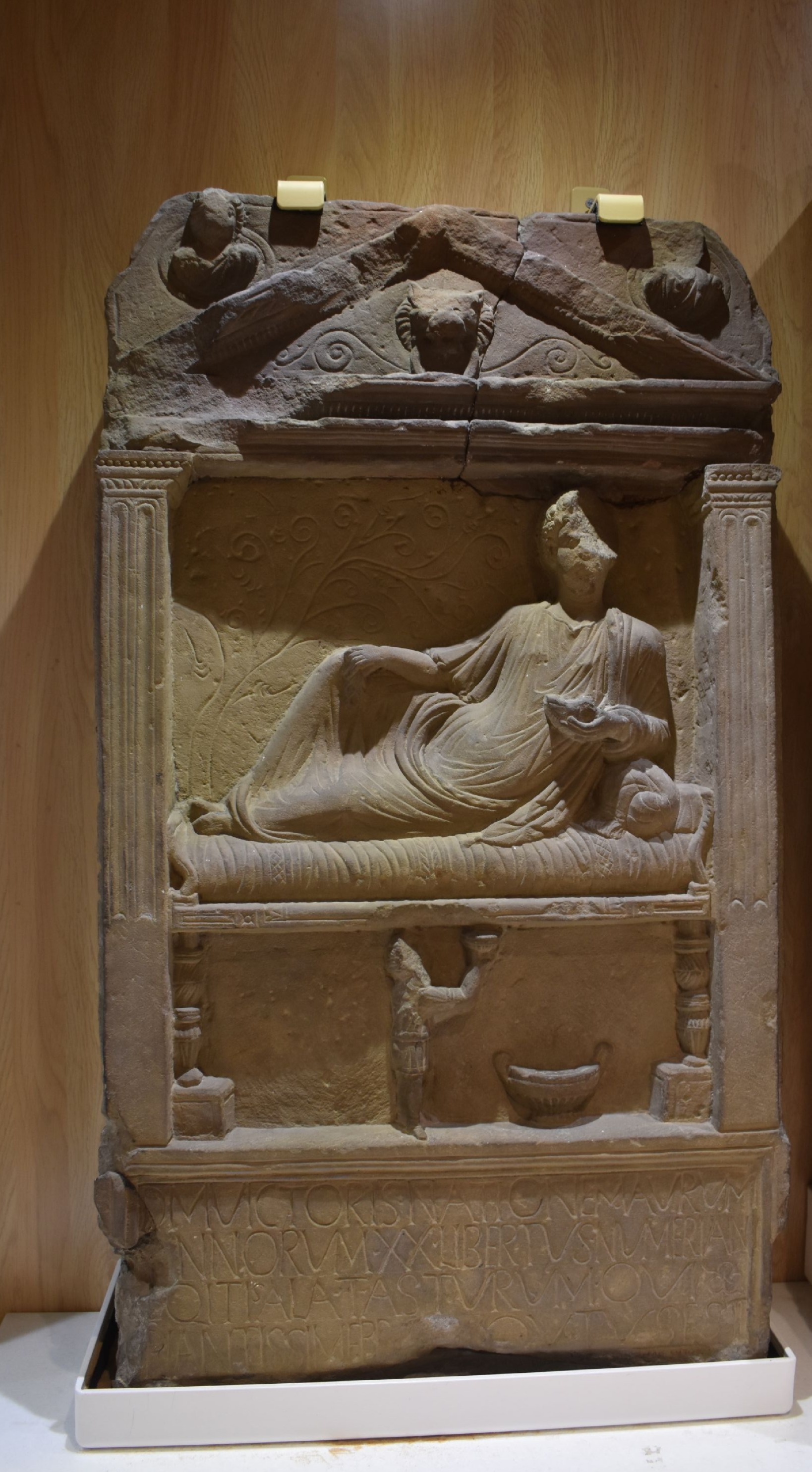
Victor’s tombstone, Arbeia museum. © Carole Tyrrell
This tombstone commemorates Victor, a Moor or black man who came from North Africa. He was originally a slave and belonged, for want of a better word, to Numerianus, a cavalry soldier who served with a unit raised in Spain.
However, by the time he was 20 Victor was a free man.
The interpretation board suggests:
‘that it was possible that Victor and his ex-master were passing through Arbeia on their way to join Numerianus’s regiment stationed at Benwell, west of Newcastle.’
The tombstone is unusual due to its quality and wording of the inscription. Its style of carving suggests that, like Regina’s tombstone, it may have been made by a Syrian stonemason.
Closer view of Victor’s epitaph. © Carole Tyrrell
Victor rests on a mattress and pillow wearing Roman dress and the folds of cloth are beautifully carved. He appears to hold a cup in one hand and the other one holds up a swathe of cloth. Behind him a tree is lightly sketched out indicating perhaps that it’s outside.
Beneath him a figure, possibly intended to be Numerianus himself, holds up a cup, possibly in tribute to Victor, and a double handled urn is beside him. There are two small busts at the very top which are damaged. They may just be decorative or representations of gods. A lion’s head is in the centre which is an ancient symbol of strength, courage and majesty. This is known as the lion mask. It derived from ancient Roman furniture decoration and is still popular as a door knocker. In this context it may emphasise Victor’s qualities as a man and comrade.
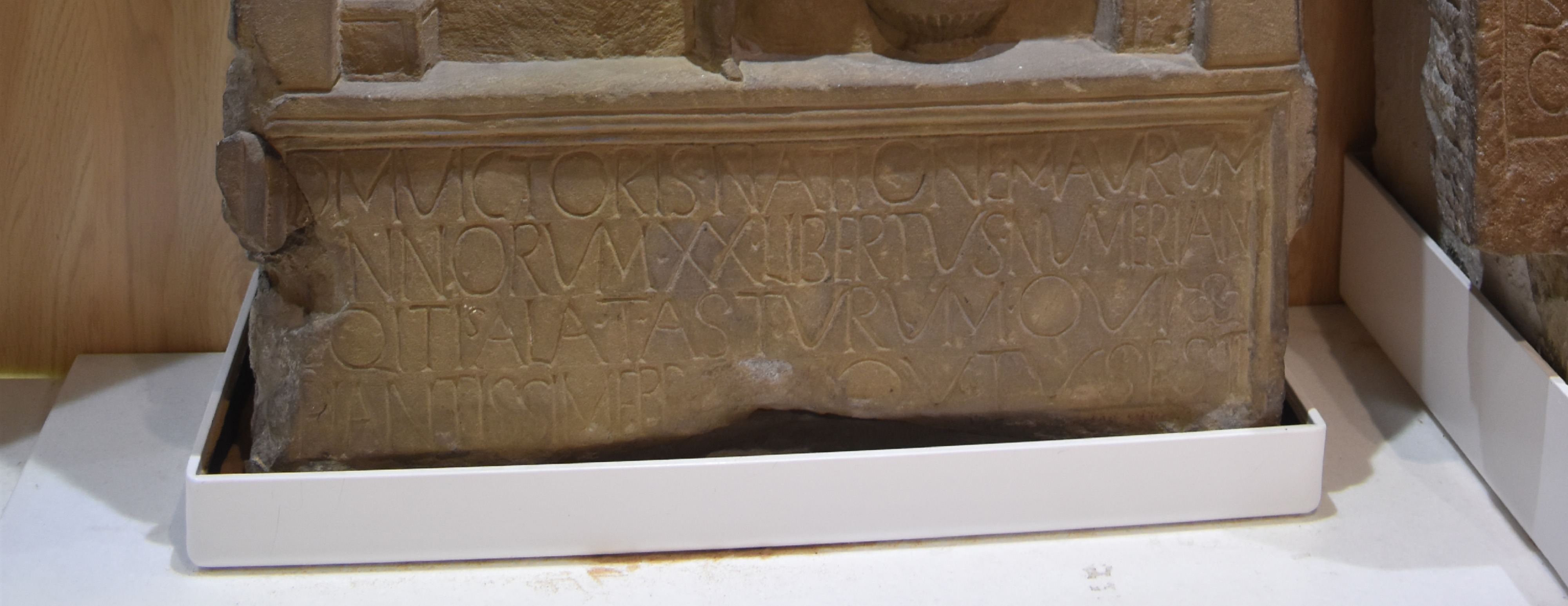
In this closer view, Victor’s hair has been carved in a fashionable snail shell style.
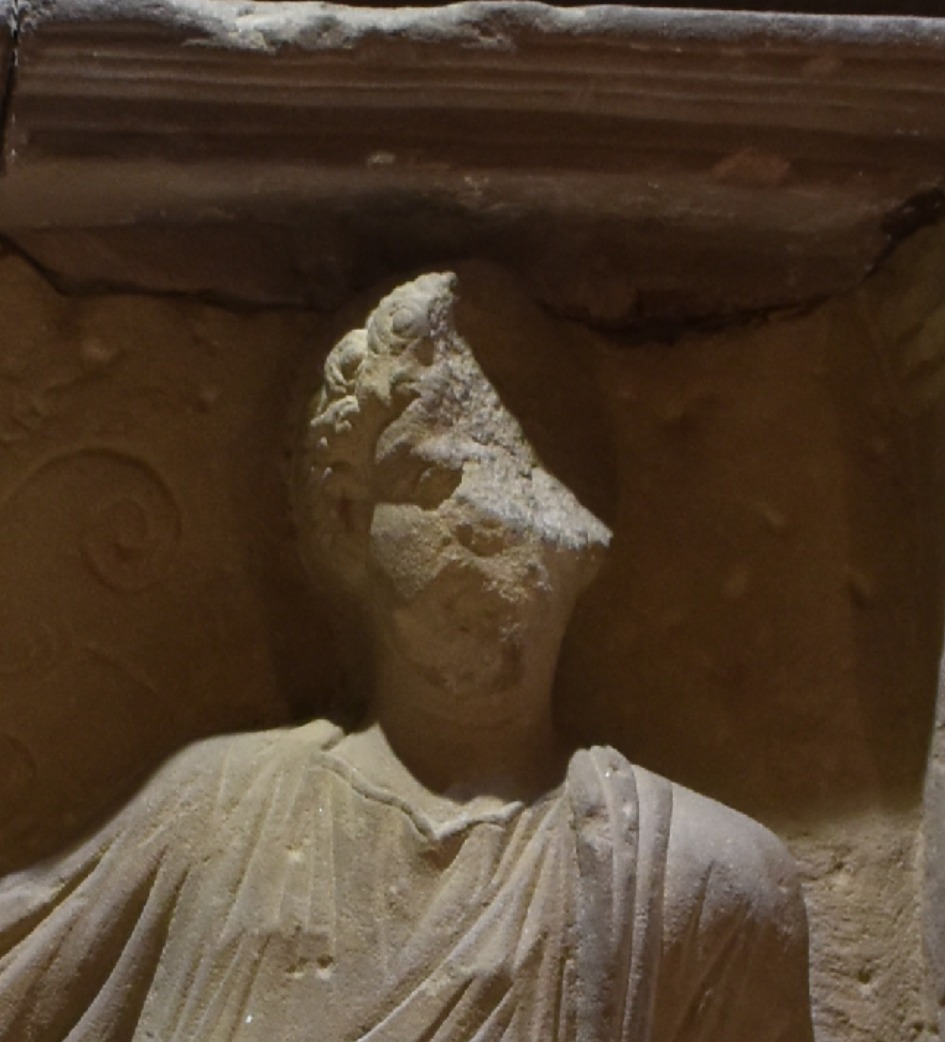
The Latin inscription reads as:
D(IS) M9CANIBUS) VICTORIA NATIONE MAURUM
[A] NNORUM XX LIBERTUS NUMERIANI
[E] Q (U) IT IS ALA (E) I ASTURUM QUI PIANT ISSIME
PR [OSE] QU (U) TUS EST
Which translates as:
‘To the spirits of the departed (and) of Victor, a Moorish
Tribesman, aged 20, freedman of Numerianus, trooper
Of the First Calvary Regiment of
Asturians, who most
devotedly conducted to the tomb.’
An affectionate tribute to someone who was perhaps more of a comrade.
As another interpretation board stated:
‘Syrian stonemasons had combined the stye of portraiture they had learnt back in their homeland with the form of memorial tombstone used in Britain.’
This is how different styles from different cultures end up being assimilated into graveyard architecture including memento mori. It was a privilege to see two such fine examples on display.
©Text and photos Carole Tyrrell with grateful thanks to Tyne & Wear County Council.
References and further reading:
Arbeia, South Shields Roman Fort – Experience life on the edge of the Roman Empire

