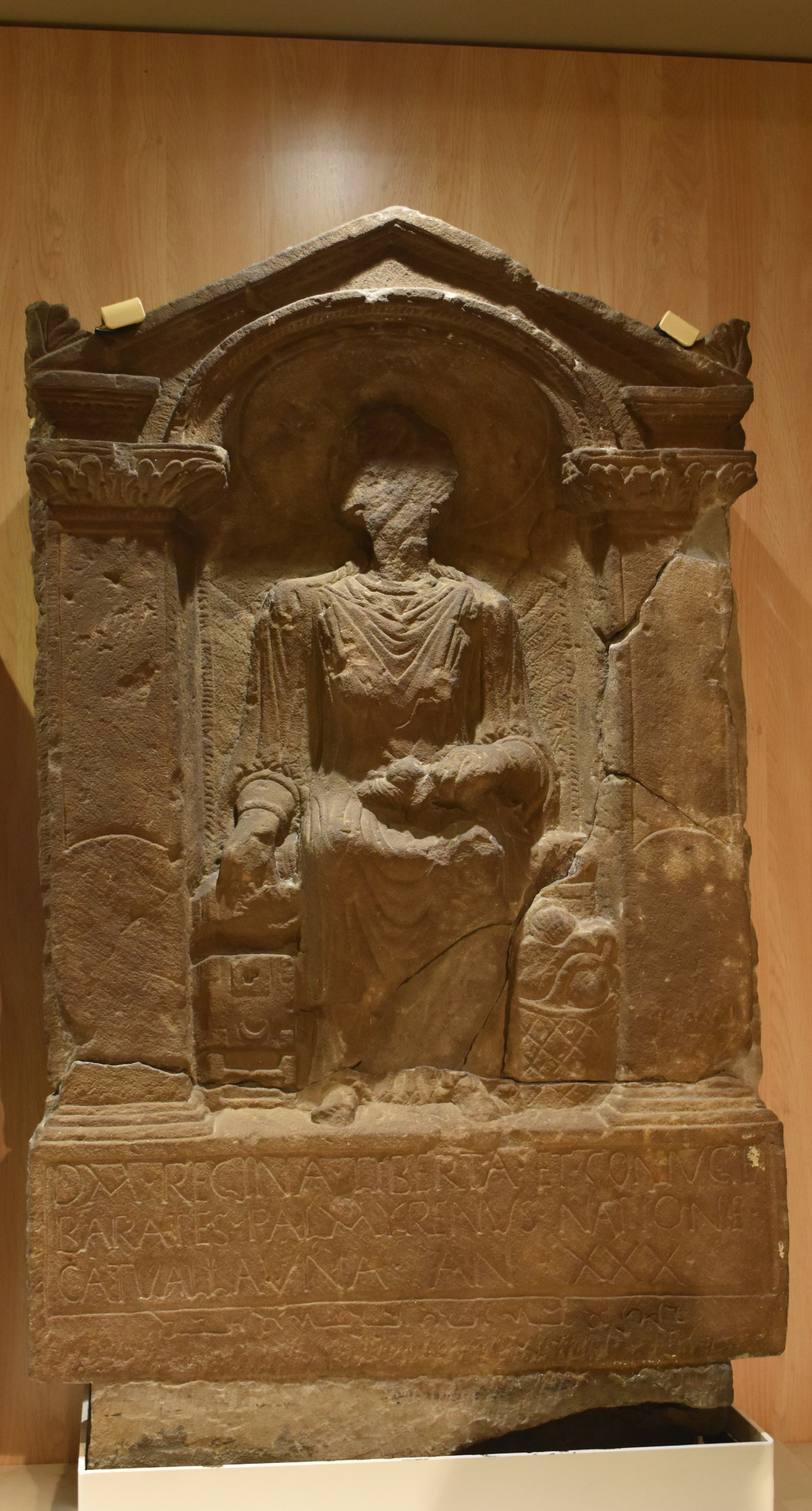
The tombstone of the former slave Regina in the Arbeia museum, South Shields.© Carole Tyrrell
Earlier this month I went on a Roman Britain holiday in the North East of England. We stayed in South Shields which may be a little faded now but still offered enticing beach walks and a road of restaurants to explore. But, in ancient times, when the Romans were in occupation, it was a large port and a major supply base with many people travelling through it from other parts of the Empire. Some of them came from Syria and there is a connection between them and the headstone that I will write about in this post.
We visited two excavated Roman forts: Wallsend or Segedunum which is its Latin name and Arbeia which was surrounded by Victorian terraces. Wallsend is so called as its at the Eastern end of Hadrian’s Wall. At the nearby Metro station all the official signs were in English and Latin which showed real attention to detail. It’s a large site with a 360 degree viewing platform.

The granaries and in the top left hand corner, the reconstructed West Gate.© Chris McKenna user name: Thryduulf. Shared under Wiki Creative Commons

The recreated West Gate, Arbeia. © Carole Tyrrell
Arbeia was a short walk from the hotel and has been partly excavated and partly recreated. Replicas of the West Gate and the Commanding Officers house were waiting for us to explore. I would hazard a guess that the Romans were glad of having underfloor heating! The Victorian streets all had a Roman flavour to their names: Vespasian Avenue, Caesar’s Walk and Claudius Court were among them. More attention to detail which I liked. Some of the houses were built over the site until the local council realised what treasures might lie beneath and they were demolished. There is a small museum which contains finds from the site and information about Roman customs. A selection of altars were on display which were used to pray and make offerings to their gods. They were rumoured to have been found in nearby back gardens. Perfect bird baths perhaps?

Roman altars on display, Arbeia museum.© Carole Tyrrell
But the pride of the museum in my opinion were the two beautiful headstones on display. They were dedicated to two people who were former slaves but were given their freedom. One, a young woman called Regina, was British and the other was a young man, Victor, who originally came from North Africa. Both of the headstones were apparently found in car parks so we are lucky that they have survived at all.
Regina became a free woman after her marriage to a Syrian man called Barates. She came from a tribe called the Catuvellaumi who came from what we now know as Hertfordshire. Barates came from the trading city of Palmyra in Syria which is situated 215 miles north east of Damascus, the Syrian capital. It’s an ancient city and archaeological finds dating back to the Neolithic period have been found there. It became part of the Roman empire during the first century. Palmyra was an extremely wealthy city due to trading caravans and colonies along the Silk Road and throughout The Roman Empire. The Silk Road may also have been how the Black Death spread. In 1400, it was destroyed and became a minor settlement, its past glories forgotten. In 1932, under French rule, its inhabitants were moved into a new village and it became an excavation site. Islamic State destroyed large parts of the city until the Syrian Army recaptured it on 2 March 2017. In December 2024, after the fall of the Assad regime, the Syrian Free Army captured it.

Peristyl House, Palmyra Syria copyright Xvlun-commons-wiki

Palmyra, Syria Senate House copyright Maria Millella shared under Wiki Commons
There is a cemetery outside the Arbeia site as it was Roman custom to bury the dead outside city walls. The dead could be burned on a wooden funeral pyre and some of their remains collected to be buried in a pot which was known as cremation. They could also be buried and laid out in a grave or rectangular pit which was known as inhumation. In addition, they could have a wooden coffin or cloth shroud and have some of their personal possessions buried with them.
It was the Romans who introduced the practice of having an inscribed headstone. The inscriptions reveal all sorts of information about a person such as name, age, nationality and familial relationships. They make the deceased into real people again!
Both Regina and Victor’s tombstones resemble other examples of Romao-British stones in shape and general design. But as one interpretation board said:
‘…in their carving there are strong parallels with other examples found at Palmyra which led to a fusion of styles.’
Both Regina and Victor died young. She was 30 and he was 20. But Regina enjoyed the lifestyle and status that she had as a free woman and her elegant headstone reflects this in the symbols used on it. She wears the fashionable provincial dress of the day and sits in a Roman style high backed chair facing the viewer. It’s sad that her face is has been damaged but I would imagine that it would have been carved to resemble fashionable Roman women of the time and not a portrait of her.
Roman society was very traditional and women had very limited roles. A memorial like Regina’s would have emphasised her domestic duties. She holds a distaff and spindle for spinning wool and there is a basket of spun balls of wool beside her chair and these would have been included to demonstrate that she was an industrious, dutiful wife. She is opening a treasure box with her other hand. There is a herringbone pattern on her necklace which has been seen on other depictions of Roman women and reflect the conventions of the time. Regina’s headstone is unusual in that, although the inscription is in Latin, it also has a line of Arabic beneath it. It has been suggested that it was carved by a Syrian which may indicate a small community in the area or a someone just passing through. It’s written in Palmyrene text in Arabic which is similar to ancient Hebrew.
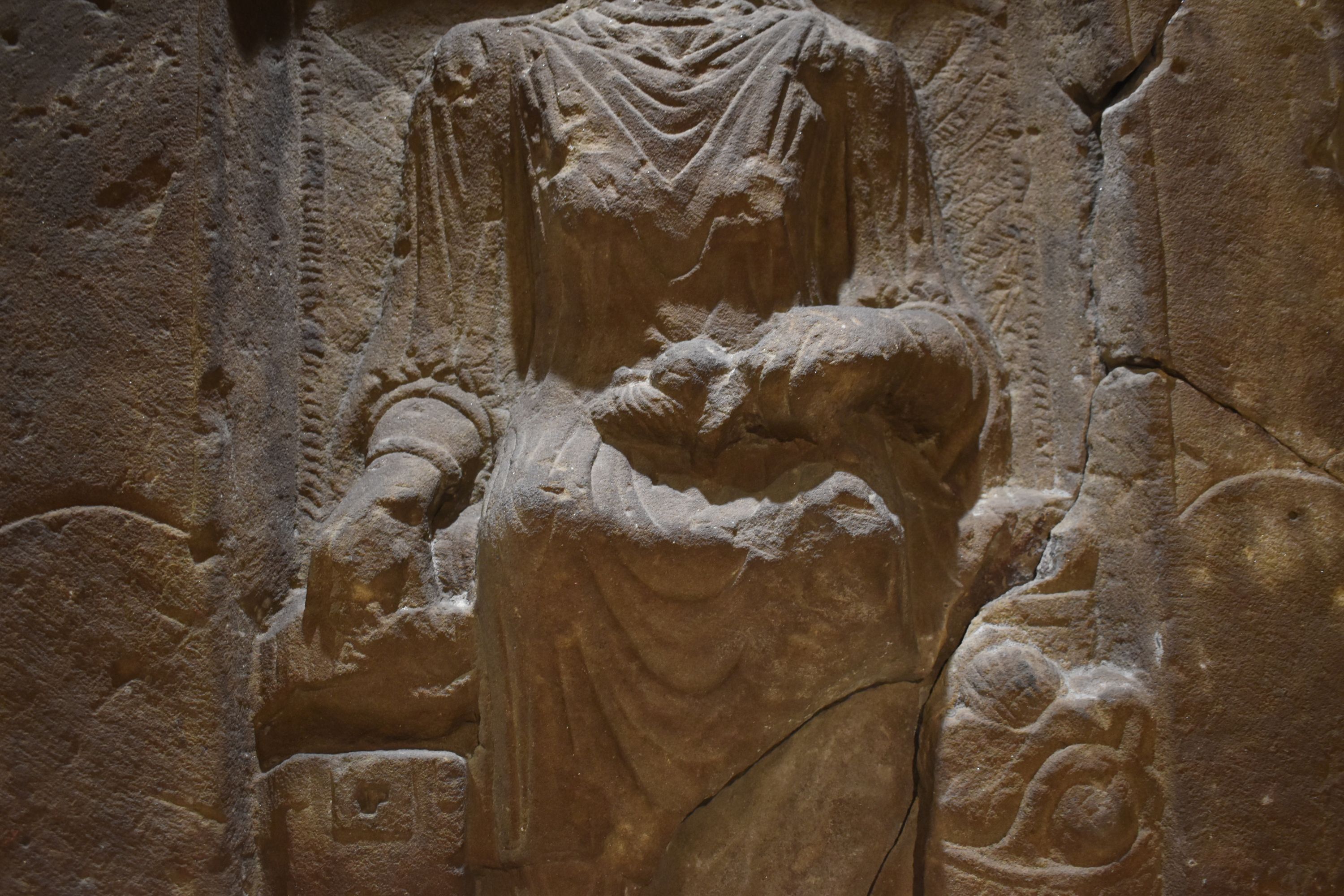
Closer view of Regina holding her distaff and spindle and the balls of wool beside her. copyright Carole Tyrrell
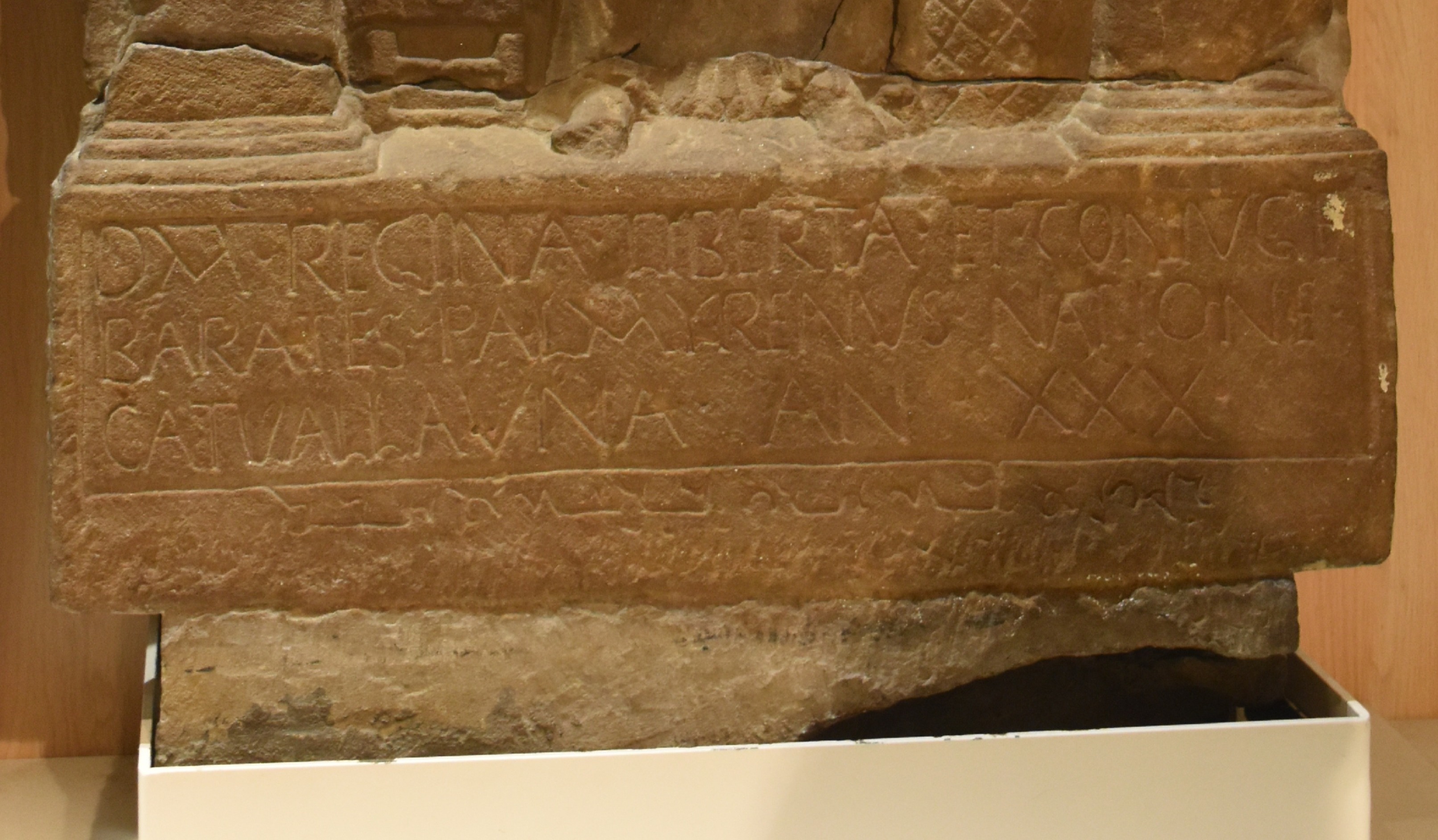
Closer view of Regina’s epitaph in Latin and below in Palmyrene text. Copyright Carole Tyrrell
The Latin inscription reads:-
‘D(IS) M(ANIBUS) REGINA LIBERTA ET CONIUGE
BARATES PALYMENUS NATIONE
CATULLAUANA AN(NORUM) XXXX’
Which can be translated as:
‘To the spirits of the departed (and) of Regina,
Freedwoman and wife of Barates of Palmyra
Catuvellauni by birth died aged 30.’
The line of Palmyrene text below the Latin reads:
‘RYGN’BT HRY BR ‘T’ HBL’
Which translates as:
‘Regina, freedwoman of Barates, alas‘
It’s a real shame that Regina’s head is missing but if a sculpture is going to be damaged, it’s generally the head that goes first. It’s interesting to think that a port in the North East of England attracted so many people from other lands and how Barates and Regina actually met. A beautiful tribute to a much loved wife.
Part 2 – Victor’s headstone
©Text and photos Carole Tyrrell with grateful thanks to Tyne & Wear County Council.
References and further reading:
Arbeia, South Shields Roman Fort – Experience life on the edge of the Roman Empire