

©Carole Tyrrell
This month’s symbol is the Agnus Dei, which is a Latin term and can be translated as The Lamb of God. The Lamb is usually portrayed sideways on and is often depicted with a variety of accoutrements such as a cross, a banner and a halo or a combination of these elements. In the example above, the Lamb is carrying a cross which represents the Crucifixion as well as a banner which, according to J C Cooper, is an emblem of the Resurrection. It has also be depicted with other motifs such as a shepherd’s crook, Chi-Rho crosses and the alpha/omega.
I have seen The Lamb several times as it is common throughout Christian art and I saw a fine example within a stained glass window in Augustus Pugin’s private chapel at his former home at Ramsgate, Kent. William Morris also created a memorable one, now sadly faded, in a window at St Martin’s church, Scarborough. The Agnus Dei is known as a Paschal Lamb within heraldry and is the regimental emblem of the Queens Royal Surrey Regiment. I found this example in the military war graves section of a London cemetery..
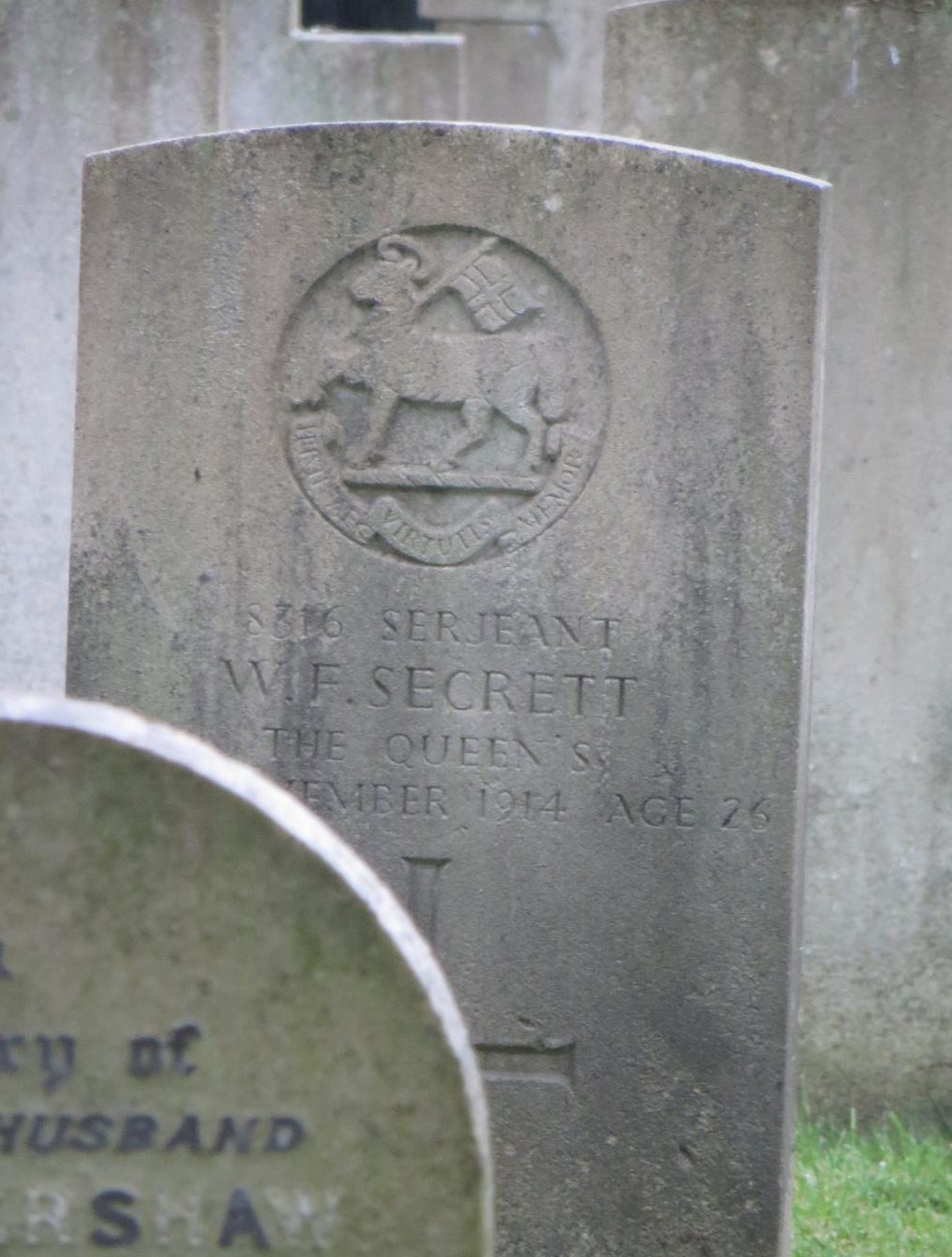
©Carole Tyrrell
But the origins of the Lamb go back much further into antiquity. In John 1:29, it’s seen as a direct allusion to Jesus:
‘The next day John seeth Jesus coming unto him, and saith, Behold the Lamb of God, which taketh away the sin of the world.’
This verse emphasises Christ’s sacrifice for humanity’s sins and there are several references in the Old Testament to lambs as sacrificial objects. For example, the Israelites sacrificed one as a representation of a human sinner. In this way, its death signified the absorbing of original sin. This painting, The Sacrificial Lamb, is by the 16th century artist, Francisco Zurbaran.

shared under Wiki Commons
Sheep have been also been worshipped as deities by several ancient civilisations including he Sumerians. The Bible contains numerous references to sheep with God being seen as the shepherd of a vast flock of sheep that represents humanity.
But as a funerary symbol within cemeteries and graveyards the Lamb represents gentleness, innocence and the unblemished life of the deceased. In this context, it is supposed to mark the grave of an infant or child. However, the epitaph on the example that I found in Brompton Cemetery had completely vanished which made it difficult to disprove or support this theory. However, I particularly like this one with its black background emphasising the light rays emanating from the Lamb. These highlight its divinity within the unusual lozenge shaped tombstone. But it’s a real shame that we don’t know whose buried there.

©Carole Tyrrell
The Lamb is also associated with resurrection and there is an example at the back of the Doulton mausoleum in West Norwood Cemetery.
I’m surprised that it doesn’t appear more often within cemeteries and graveyards and I will be looking out for more examples. Although I was aware that the symbol was called the Lamb of God I didn’t know of its association within major religions and civilisations. It has been fascinating to research this.
© Text and photos Carole Tyrrell unless otherwise stated.
References and further reading:
Stories in Stone; A Field Guide to Cemetery Symbolism & Iconography, Douglas Keister, 2004, Gibbs Smith
An Illustrated Encyclopaedia of Traditional Symbols, J C Cooper, Thames & Hudson 1979 reprinted 1983.
https://www.verywell.com/headstone-symbols-lamb-sheep-or-agnus-dei-4006520
http://www.religionfacts.com/agnus-dei
https://en.wikipedia.org/wiki/Lamb_of_God
http://www.lsew.org.uk/funerary-symbolism/
http://www.jesuswalk.com/lamb/lamb-agnus-dei-artwork.htm
http://www.druidic.org/camchurch/churches/croydon.htm
https://wordsonstone.wordpress.com/category/symbolism/page/4/
http://friendsofstmartins.co.uk/images/ChapelWindows/AgnusDeiSymbol.html

