Woman seeks designer to make dress of dead mother’s hair
Image copyrightHAIR DRESS DESIGNImage captionThe woman wants the sleeves, trim, collar and bodice of the dress to feature her mother’s hair
A woman is searching for a dressmaker who can create a garment featuring her dead mother’s hair.
She says she had been collecting the hair for four years before her mother died in August and will pay £15k for a replica of her mother’s wedding dress.
The 61-year-old from Bristol, who wants to remain anonymous, posted the request on the fashion manufacturing website Sewport.
So far, no designer has volunteered to take on the task.
‘Special memento’
In her post, the woman writes: “I’m looking for someone to recreate my mother’s wedding dress from 1953, which she wore when she married my father.
“My mother passed away recently and I’d like to create a special memento of her life.
She wrote: “I found out my mother was ill in 2014 and from that point onward I began to collect her hair.
“At the time I wasn’t sure why I was collecting it, however, now I think I do.”
She acknowledges the task is “admittedly quite weird” but says she is keen to have the finished piece ready in time for the anniversary of her mother’s death next August.
Mourning fashion – a Victorian tradition
It was usual for Victorian mourners to wear lockets and rings containing a lock of hair from a dead person.
Queen Victoria is said to have regularly worn a locket of Prince Albert’s hair from his death in 1861, up until her own 40 years later.
The preparation of hair for mourning jewellery was a professional occupation in the 19th Century.
At the same time in the US there was a trend for making wreaths out of loved ones’ hair.
Wreaths intertwining the hair of dead and living relatives were viewed as objects to signify the family tree.
Details of how to shape and create a hair wreath are included in the Self-Instructor in the Art of Hair Work published in 1867, and a catalogue from the National Artistic Hairwork Company.
Leila Cohoon’s Hair Museum in Independence, Missouri, displays more than 400 wreaths and more than 2,000 pieces of jewellery made out of human hair.
Image copyrightSEWPORT
The ideal design she says, would feature hair sewn into the sleeves, trim, collar and bodice of the ballroom-style dress.
She has sketched out a design and says she would like it to be as “authentic” as possible and feature the box of hair she started collecting in 2014.
Boris Hodakel, founder of the Sewport website, said most design requests were typically snapped up by manufacturers within six hours.
He said: “We deal with quirky and wonderful designs every day – that’s fashion.”
I haven’t posted on here this month as I am moving house…..to Sevenoaks which has a church dedicated to St Nicholas. It’s a fine old church with a fascinating churchyard. It has a fine array of headstones and monuments with symbols on display that I hadn’t previously seen.
I knew instantly that I’d found a good place to live. (if I can survive climbing the hill to reach it.)
I will be offline during the move but hope to be posting August Symbol of the Month over the bank holiday.
The remarkable discovery of a stone sarcophagus in Lant Street, Southwark last year spurred the Museum of London to collate forty years of work into one exhibition. How did Roman London commemorate death and what can we learn from what they’ve left behind?
Exhibition curators Jackie Kiely, Rebecca Redfern and Meriel Jeater have put together a collection that looks at the Roman way of death and Britain’s place on the edge of the Roman Empire.
The sarcophagus was the starting point in demystifying the extraordinary life of its occupant. The lid was slightly ajar and was probably grave-robbed…
As part of its major restoration project , Brompton Cemetery held a short series of free walks around the cemetery last month to discuss future plans. I joined one which was led by Nigel Thorne, Project Manager and Halima Khanom, Partnership and Community Engagement Officer for the Royal Parks..
The weather had been dull and overcast all day but, as we gathered at the South entrance project office, blue sky suddenly burst through the clouds and it became a lovely golden summer evening bathing the chapel and monuments in a soft glow. A relief really as we were out in the open throughout. Nigel was very enthusiastic and knowledgeable and began by revealing that Brompton had received an impressive grant of £6.2 of which £4.2 had come from the Heritage Lottery Fund (your £1 lottery ticket does something useful after all even if it doesn’t make you a millionaire) and the rest had come from Parks for People.
He added that he saw cemeteries as another form of public space which I’d not previously considered and an aspect that maybe isn’t emphasised enough. Brompton is already well used as a cut through with joggers much in evidence and people on the edge of the group huddled in so as not to be entangled with cyclists.
South entrance.
This was to be updated. Apparently it hadn’t existed when Brompton had opened and had been just been land owned by British Gas. The ex -assistant cemetery manager’s accommodation and the Friends base was now the Project Office.
Almost opposite was a bijou sized building which had been, of all things, a police box dating from when the Royal Parks had had their own police force. It was now hiding behind a temporary fence.
Monument restoration
Nigel stopped by the Robert Coombes monument. This is dedicated to a champion sculler and the upturned boat on top of it with his waterman’s coat draped across it had once had a set of oars attached. These were now long gone and so, sadly, were the heads of the four statues, one at each corner. Cemetery vandals always seem to go for the heads of statues.
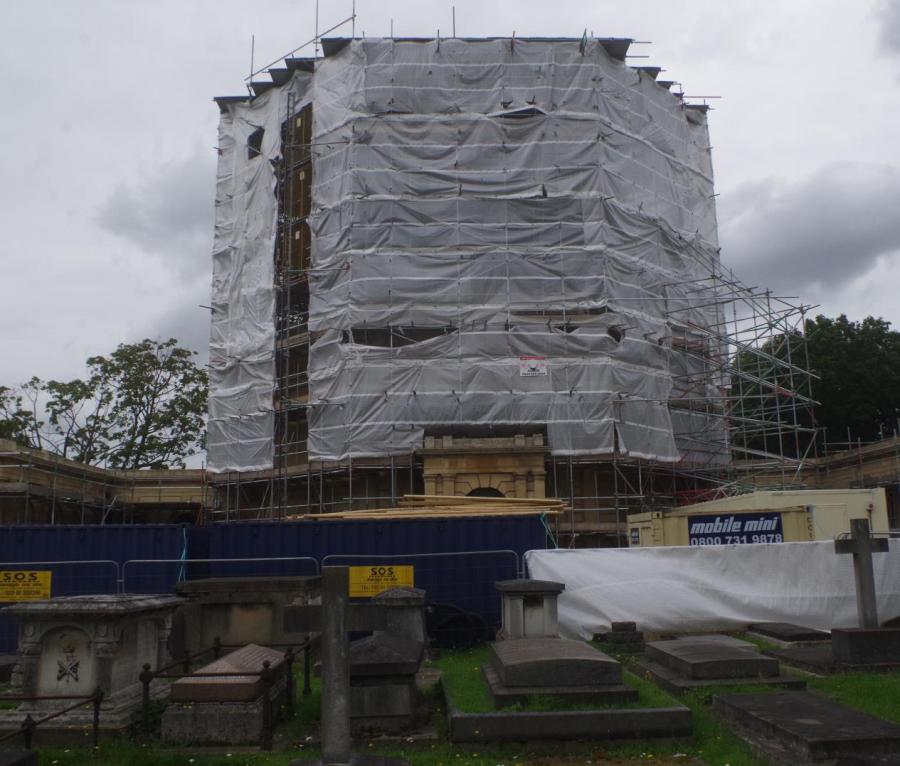
Nigel revealed that this monument was to be restored at a cost of around £40k. However, although the HLF grant included £140k for monument restoration, a substantial legacy would instead pay for Mr Coombes. We noticed that there was a tabletop grave very near to Coombes which was being propped up by blocks of wood.
Nigel almost shuddered as he related stories of the horrors of 1970’s restoration. ‘They would have been better off leaving it alone!’ he said with feeling. There is a gap between the inner and outer dome which is accessible but a tight squeeze apparently. A good opportunity I thought , to explore and record areas not normally accessible. It’s envisaged that the Chapel will be open more often once restoration is complete and visitors to a recent art exhibition were very pleased to have an additional opportunity to go inside.
There would be a disabled visitors’ ramp at the chapel entrance to increase access.
Nigel pointed up at the crumbling Bath Stone visible along the top of the East wing’s roof. ‘Very soft.’ he explained.
Two huge basements had been found under each of the East and West wings. The latter was originally the cemetery supervisor’s office. But there was a surprised in the West wing as there were no stairs making it inaccessible.
Another secret had been discovered when investigating the floor. It had always been assumed that it had been made from poured concrete but this was revealed to actually be lino. When that was taken up there was a lovely flagstone floor in a radial pattern – something to see when the chapel is reopened.
Nigel indicated where Brompton’s original owners had run out of money and the lonely cupola above a colonnade marked the spot.
The Western catacombs:
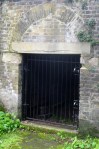
These were never used as catacombs but they form part of the boundary walls facing onto the rail and tube line. A gated and blocked entrance at either end still remains with a far grander one in the centre. Originally it had a promenade over the top on which visitors could walk and admire the fields and canal on the other side but these are obviously long gone. Parts of the promenade still remain but I wouldn’t fancy walking on it now. Some of the wall is now supported by buttresses and one end of the catacombs is now in the new Horticultural team’s area.
When opened the catacombs were found to full of spoil which took a year to dig out. This had to be done as it was pushing out the wall that faced onto the railway line.
Nigel told us that all of Brompton’s current paths are made of tarmac. This leads to a uniformity of paths that can be confusing for a visually impaired visitor. As a result, one blind woman had no idea where she was in Brompton. It was now hoped to have a hierarchy of paths to counteract this.
Cemetery maintenance:
We paused by a rampant area of long grass and wildflowers (or weeds depending on your point of view). Nigel commented that the area needed a tidy up and that grave owners in the area had been given Brompton’s policy and their obligations at the time of burial – no vertical tombstones or planting.
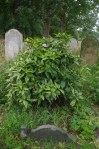
A perennial problem was the planting of small trees and shrubs on graves which are now huge. According to Nigel they reduce light and space as well as damaging and obscuring memorials and monuments. He indicated a somewhat spindly rose bush which looked very untended.
A huge laurel plant had had its lower branches lopped but regrowth had already started. There was a monument just underneath it which we could hardly see. I found others examples such as the Mary King grave by the chapel.
There’s a debate between those who like cemetery to look messy to encourage wildlife and those who don’t. I personally like wild areas to encourage this as Brompton is known for its large crow population and I’ve disturbed the odd sunbathing fox. The large bramble stands, in Nigel’s opinion, were of benefit only to the foxes as hiding places.
Garden of Remembrance:
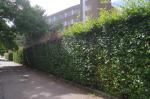
The tall hedges surrounding it are to be reduced in size as they encourage anti-social behaviour. Visitors can buy a 1m memorial tablet under which up to 4 urns can be buried.
Work on the visitors centre and café is well on schedule – I’ve been pleasantly surprised by the speed at which they are being built. Nigel added that the café was intended to be a social enterprise and not another outpost of one of the chains. It would be staffed by local people and use local produce (blackberry jam anyone?). The visitors centre opposite had all sorts of exciting plans such as allowing visitors access to Brompton’s records of the 200k people buried within it.
A fascinating walk – our thanks to Nigel and Halima – which covered not only Brompton’s ambitious restoration plans but also some of the problems of cemetery maintenance and restoration.
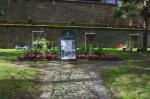
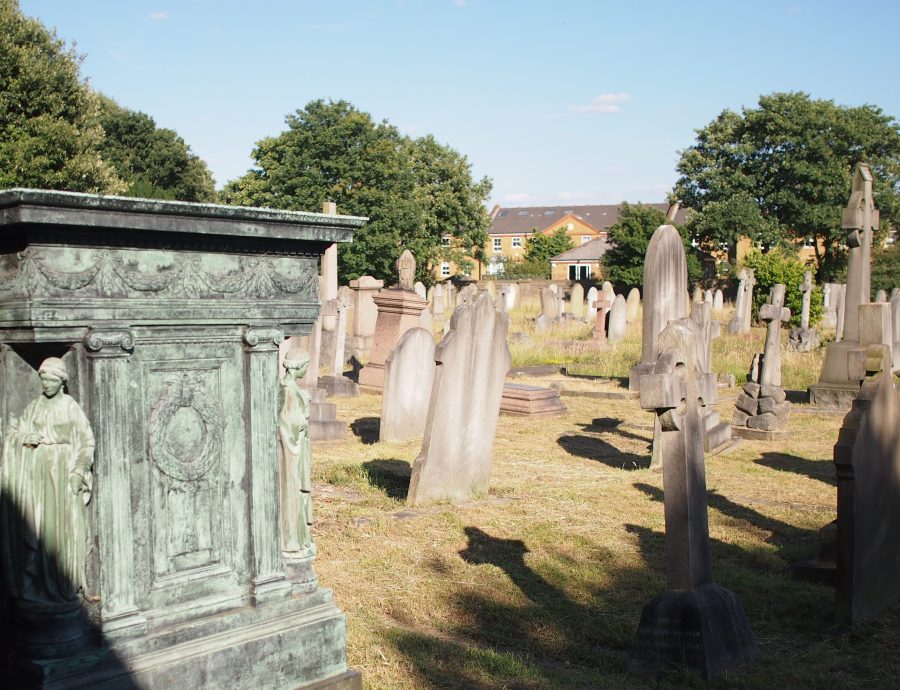
Chiswick Old Burial Ground is a large extension to the old churchyard at St Nicholas, Chiswick, close to the River Thames in west London. The Georgian graves clustered closest to the church (including the grand tomb of the artist William Hogarth) give way to Victorian and more modest headstones, filling a site that’s just under 7 acres in size. Unlike some of London’s larger Victorian cemeteries, most of the memorials here are fairly modest in scale and ornamentation, made from stone or occasionally marble. But one incongrous memorial catches the eye, despite being tucked away near the cemetery’s northern boundary wall: a striking copper tomb turned green by the passing of the years, which marks the burial place of two artists.
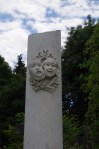
The two masks of comedy and tragedy, or Sock and Buskin as they are also known for reasons I’ll explain later, are not often found in cemeteries. And as you might expect, when they are there’s a theatrical association.
But what is the history behind this two faced symbol and how did these icons from Ancient Greece come into Victorian cemeteries?
It began with the custom of actors wearing masks, an essential part of the performance, in early Greek theatre. It was a vital part of Greek culture and civic pride. However, Comedy and Tragedy were viewed as completely separate genres and no plays ever combined them.
Tragedy
This genre began in Athens around 532 BC with Thespis, the earliest recorded tragic actor. He was known as ‘Father of Tragedy’ and it has been suggested that his name inspired the English term, thespian, for a performer.
Muse of Tragedy:
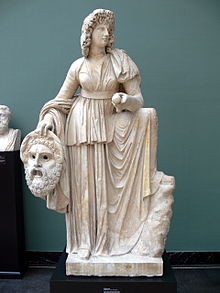
Melpomene is the Muse and is often depicted holding the Mask of Tragedy. She often also holds a knife or club and also wears the ‘cothurni ‘or buskin boots that elevated her above other actors. She was a daughter of Zeus and Mnemosyne as was Thalia, the Muse of Comedy, and there were also 7 other daughters who were all Muses.
After the defeat of Athens by the Spartans in the Peleponnesian War and the subsequent decline in its power, comedy became more important than tragedy. I imagine that people wanted some relief after a protracted war and these were comic episodes about the lives of ordinary Greek citizens. Maybe they were similar to today’s comedy sketches. Greek comedy is reputed to have had a major influence on Roman humour as well. Perhaps they had an early version of Up Pompeii…..
Muse of Comedy:
She is called Thalia but can also be sometimes spelled as Thaleia and is depicted holding the Mask of Comedy in one hand. She’s generally depicted as a young woman crowned with ivy. Thalia wears the thin-soled shoe known as the ‘sock’ from the Latin soccus. It may seem strange but it’s the footwear of the two Muses that led to them being called ‘sock and buskin’.
Thalia, Muse of Comedy – Louise-Michel Van Loo (1707-1771) Domain USA Licenced under Wikipedia Creative Commons 2.0
And so both Comedy and Tragedy became two sides of the theatre world.
Tragic Comic masks Hadrian’s Wall mosiac 2nd Century AD. Domain USA . Located in Capitoline Museum, Rome, Italy. Licenced under wikipedia Creative Commons 2.0
Masks:
They were seen as one of the iconic conventions of classical Greek theatre and date back to the time of Aeschylus (525-456 BC) commonly considered to be the father of Greek tragedy. The Ancient Greek term for mask is ‘prosopon’ or face. There are paintings on vases, such as the 5th century BC Pronomos vase, depicting actors preparing for performance with masks. However none have survived due to the organic materials from which they were created such as stiffened linen, leather or cork with wigs of human and animal hair. After the performance they were dedicated at the altar of Dionysus.
It was mainly the chorus that used masks on stage of which there could be up to 12-15 members. Masks created a sense of unity when representing a single character or voice. They always created a sense of mystery and were also a method of disguise. The actor would use the mask to totally immerse himself in his role and become someone else. It also allowed him to appear and reappear in several different roles instead of only being seen as one character. The exaggerated features of the mask also enabled audience members who were sitting at a distance to see characters emotions.
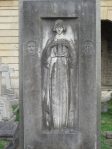
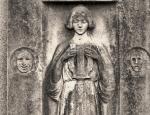
I have found four monuments featuring Tragedy and Comedy each in differing styles, in London Victorian cemeteries: Fred Kitchen in West Norwood Cemetery with a link to Charlie Chaplin. There are two in Brompton Cemetery: Gilbert Laye and Augustus Henry Glossop Harris’s elegant monuments and the exuberant Andrew Ducrow tomb in Kensal Green.
Fred Karno 1018 – unknown photographer. Licenced via Wiki Commons.
The graceful Kitchen memorial was recently restored by the Music Hall Guild of Great Britain & America in March 2016 with the Heritage Lottery Fund’s support. It almost dazzles under a summer sky. Both Fred and his father, Richard (1830-1910) rest here and note the broken column on which the Sock and Buskin are placed. This denotes that the head of the family as a broken column indicated that the support, or head of the family, rests here.
Fred came from a theatrical family in that his father, Richard, was the Ballet Master and Dancer at the Theatre Royal Drury Lane. Fred worked mainly in the music halls which were considered a low form of entertainment but many famous comedians learned their craft in them. He was discovered by the legendary impresario, Fred Karno, while playing in a production at Glasgow’s Princess Theatre. It was the stuff of showbiz legend, or cliche depending on your point of view, as Fred was standing in for the chief comedian and so, as a result, a 50 year career theatrical career began. From 1897-1910 Fred was a member of Fred Karno’s Army along with such legends as Laurel and Hardy and Charlie Chaplin. Kitchen had a unique style which featured a splayed walk as he had flat feet and scruffy costume. Chaplin later admitted that this had influenced or he had simply ‘borrowed’ it for his iconic tramp character. In 1913 Fred appeared in a Royal Command Performance for King George V and continued to work until 1945 aged 73. But the music hall circuit was beginning to vanish but his son, Fred Kitchen Jr, continued the family tradition in film and theatre.
This is a striking memorial with ‘Comedy & Tragedy’ of either side of a stylised young woman who is holding what appears to be a lyre. There isn’t much known about Gilbert Laye, the incumbent, and I could only find one credit for him online. This was as the director of ‘My Lady Molly’ at Daly’s Theatre on New York’s Broadway. It was a musical comedy and opened on 5 January 1904 and closed on 16 January 1904. He was also briefly the manager of the Palace Pier in Brighton. Both he and his wife, Evelyn Stuart were known as struggling minor actors/ However, she was known as a respected provincial Principal Boy. However, it was their daughter, Evelyn Laye (1900-1995) who became a huge star on stage in musical comedy roles. She made her stage debut in 1915 and acted until well into her nineties. Evelyn worked with Noel Coward and made her first appearance on Broadway in 1929 in his Bitter Sweet. However, her parents disapproved of her first marriage to
actor Sonnie Hale in 1926 which ultimately ended in divorce when he left her for actress Jessie Matthews. Evelyn attracted public sympathy over this with the divorce judge branding Matthews ‘an odious creature.’
Augustus Harris By Henri Brauer (1858-1936) – Joseph Uzanne, Figures contemporaines tirées de l’Album Mariani, Librairie Henri Floury, Paris, vol II, 1896, Bibliothèque nationale de France, Public Domain, https://commons.wikimedia.org/w/index.php?curid=3181870
This is a very sophisticated monument with a barefoot mourning woman in robes and her hair tied back resting one outstretched arm on the cenotaph. In vintage photos, the other is raised towards a bust of Harris which tops the plinth. However, the bust is no longer in place and neither is the hand that seemed to stroke it. There are three people commemorated on the monument: Augustus himself, his wife Florence Edgcumbe and their daughter, Florence Nellie Cellier. None of them appear to be buried in Brompton as Augustus died at Folkestone and Florence’s ashes were scattered elsewhere. Florence remarried after Augustus’s death so she may actually be buried with her second husband.
Augustus was a British actor and impresario who came from another theatrical family. Born in Paris his father was a dramatist, Augustus Glossop Harris, and his mother was Maria Ann Bone, a theatrical costumier. The Brompton Augustus Henry was known as ‘the Father of British pantomime’. He co-wrote and produced scripts for large scale pantos that were performed at the Theatre Royal Drury Lane every Christmas. They attracted a popular cast including the legendary Dan Leno. Augustus was also involved in local politics and, in 1890, represented the Strand division in the London County Council. In 1891 he was appointed a sheriff and was also knighted. He married Florence Edgcumbe Rendle in 1881 and after his death she remarried and died in 1914.
Florence Nellie Harris Cellier was their daughter. She married Frank Cellier in 1910 and divorced him in 1925. He was an actor who both appeared and directed in numerous plays and acted in Hitchcock’s ‘The 39 Steps’ in 1948.
‘Comedy and Tragedy’ lie beneath a laurel wreath and violin on top of a carved cloth at the base of the cenotaph.
On one of the most desirable and prominent plots in Kensal Green Cemetery lies Andrew Ducrow. To call his blue painted tomb flamboyant is an understatement although the 19th century magazine ‘The Builder’ described it as a piece of ‘ponderous coxcombry‘ . It was supposedly created for his first wife but as the epitaph states
‘Within this tomb erected by genius for the reception of its own remains are deposited those of Andrew Ducrow’
It’s a feast of symbols ranging from 4 Egyptian style 4 sphinxes and columns on the mausoleum and a Greek style roof. A relief over the door depicts Pegasus, the winged horse and a weeping woman in Grecian dress with ‘Comedy and Tragedy’ beside her on clouds.
A pair of gloves and hat lie almost just discarded waiting for their owner to don them again on part of a broken column. There’s also beehives, shells, flowers and downturned torches. Two angels flank the now bricked up entrance which are the closest to any Christian symbolism.
However, Pegasus and an urn decorated with horses heads and garlands are not just mere emblems but direct references to Ducrow’s profession which was as a renowned circus performer. He was known as the ‘Father of British Circus Equestrianism’. Modern day horse acts owe a huge debt to him as he created many horse feats and acts that are still in use today. For example, his most famous act ‘Courier of St Petersburg’ is still performed to this day at equestrian events. In this a rider straddles 2 cantering horses while other horses bearing the flags of the countries through which a courier would pass on his way to Russia passed between his legs.
Ducrow owned a circus called Astley’s Amphitheatre and had learned his skills from his Belgian father who had emigrated to England in 1793. However, Ducrow also had another act that attracted and thrilled audiences. This was the ‘plastique’ or physique performances in which he and his sons would wear ‘fleshings’ or flesh coloured body stockings and pose on white stallions as they carried them around the amphitheatre several times. It must have been quite a sight to see under the lights and it’s a shame that no-one has yet attempted to revive it. There was a black performer in the company called Pablo Fanque who is mentioned in the Beatle Sgt Pepper Lonely Hearts Club Band track, ‘Being for the Benefit of Mr Kite’ which is one of my favourites.
As you can imagine Ducrow and his company were incredibly popular but bad luck dogged him. The Amphitheatre burned down 3 times and after the last one in 1841 he had a nervous breakdown. He died soon after in 1842 and the Amphitheatre and circus were taken over by others who had worked with him.
A memorial from West Norwood Cemetery. copyright Carole Tyrrell
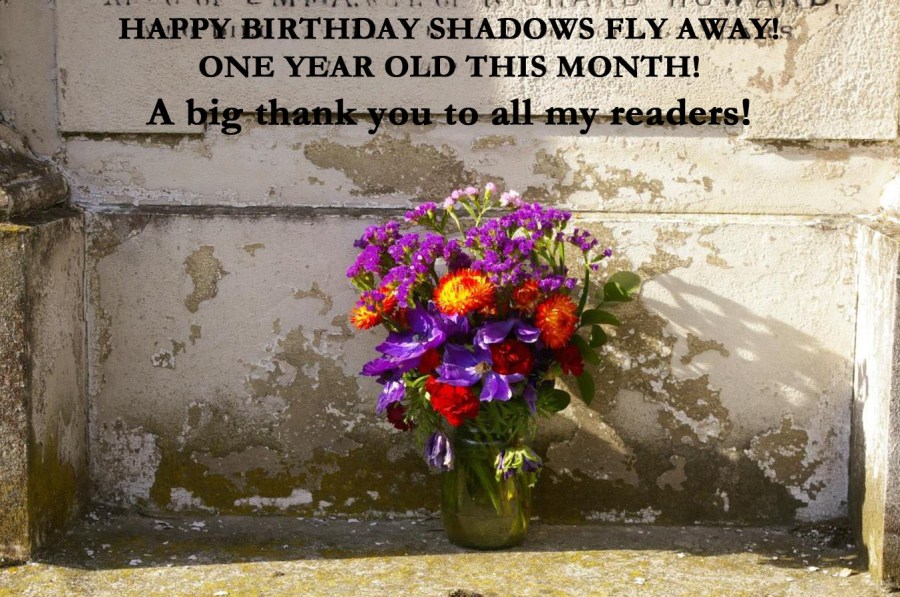
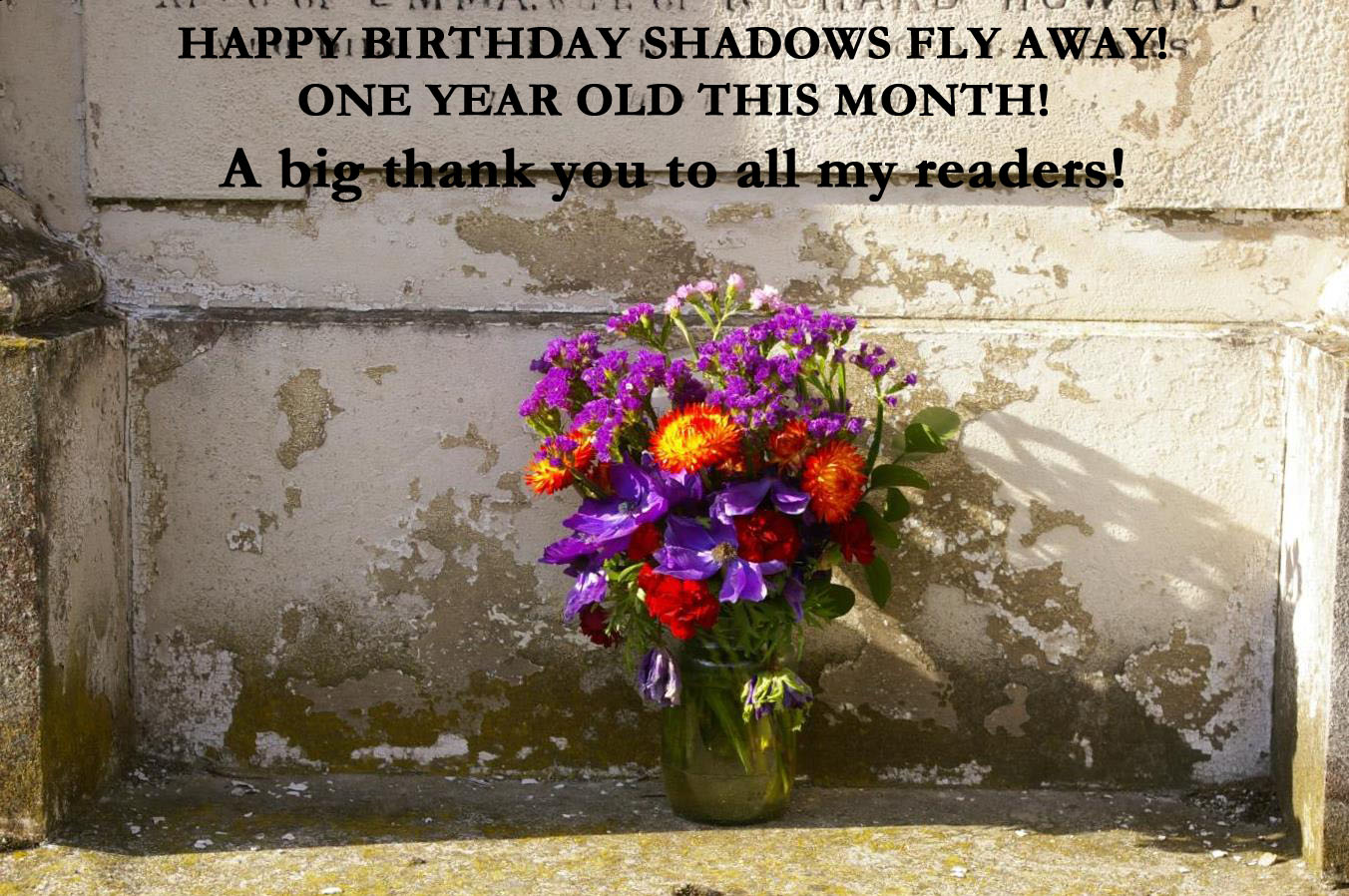
Yes shadowsflyaway is one year old this month!
I’ve really enjoyed researching, writing and posting my entries – it’s been wonderful to have an opportunity to immerse myself in history again and to meet other interesting cemetery enthusiasts via cyberspace. Please keep sending your comments.
So let’s raise a glass, cup or mug and celebrate and revel in being taphophiles. After all everyone has to have a hobby….without cemeteries where would all those eager Pokemon Go enthusiasts go?
This photo was taken in West Norwood Cemetery near the Columbarium – every time I visit there is is always a glass jar or vase containing fresh flowers placed on the shelf. I thought it looked appropriate.
I was in Hoop Lane, Golders Green for an organised visit to Golders Green Crematorium which had been organised by the Friends of Nunhead Cemetery. But I had arrived early and so decided to explore the Jewish cemetery that was opposite its gates. Golders Green has a large Jewish community and so I wasn’t surprised to find such a large cemetery. I’ve never visited one before and thought that it would be an interesting contrast to the Crematorium.
The Jewish Cemetery is an imposing, large space, bordered on three sides by suburbia and on the fourth the Lane. It’s owned jointly by the West Synagogue of British Jews and the Spanish & Portuguese Jews Congregation and managed on their behalf. The first burial was in 1897 and it’s still in use today.
Overview of the East Side of the cemetery – very plain without flowers.
copyright Carole Tyrrell
A view of the West side of the cemetery with its upright stones are.
copyright Carole tyrrell
When I visited I noticed that in one large section, the East side, that all the tombstones were horizontal and on the West side that they were all upright. It wasn’t until doing the research for this piece that I discovered that the East Side belongs to the Spanish and Portuguese Jews and the West Side uprights are the province of the West London Synagogue.
The cemetery is one of the few London Sephardic Jewish cemeteries and this is a form of Judaism particular to Spanish and Portuguese Jews. There are some very well know names buried here which include Jacqueline du Pre the cellist, Jack Rosenthal the playwright, Marjorie Proops the doyenne of agony aunts and Erich Segal author of the tear-jerking 1970’s best seller, ‘Love Story’. Although I didn’t have much time to explore it fully I did find two famous names inscribed on a horizontal tombstone – Saatchi and Saatchi.
Two familiar names from the world of advertising and art. copyright Carole Tyrrell
The cemetery also contains 24 Commonwealth Service Personnel graves here which are maintained by the Commonwealth War Graves Commission. There’s 10 from the First World War and 14 from the Second World War. I didn’t see them on this visit but next time I will make sure that I have more time to look round.
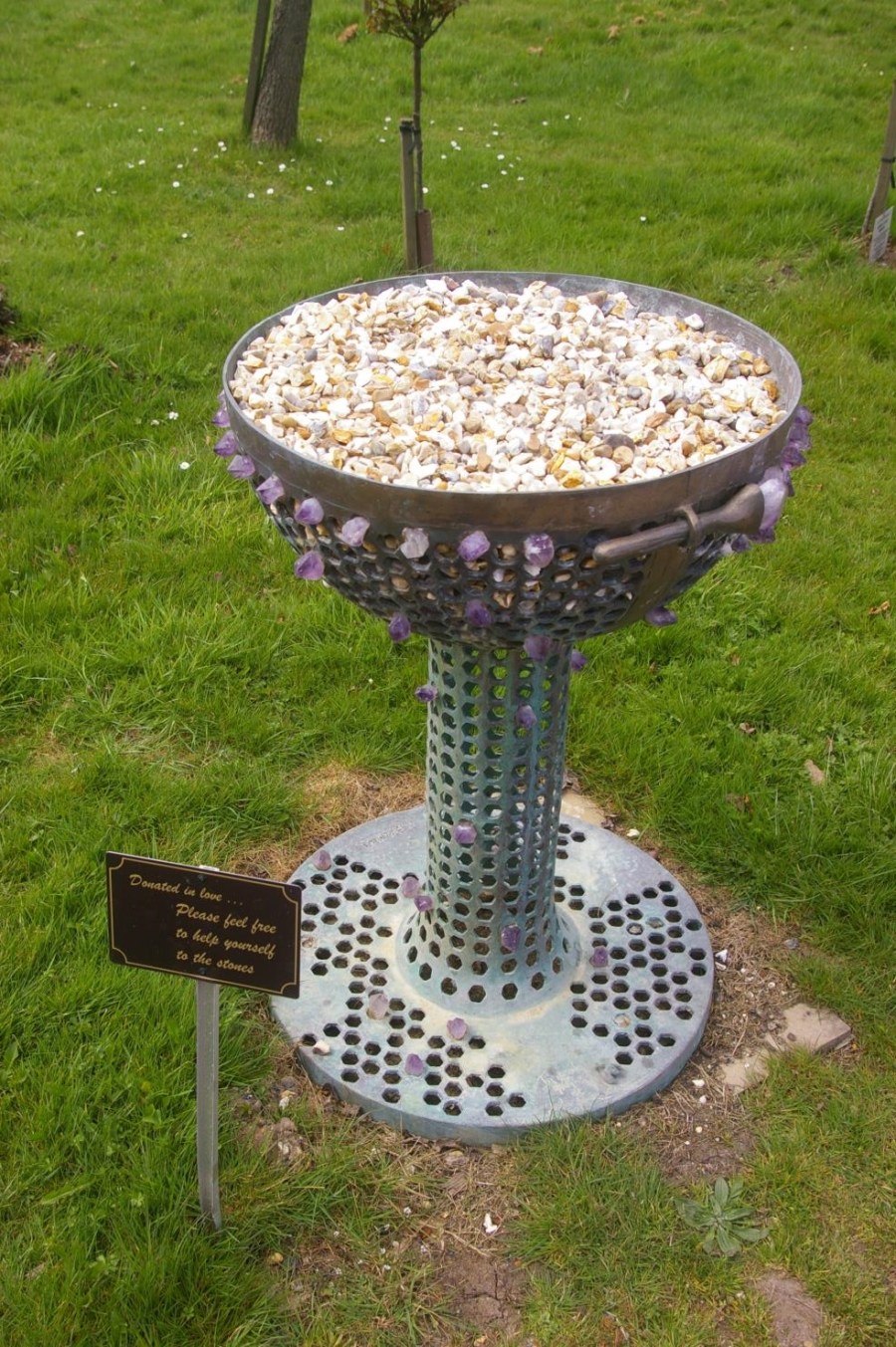
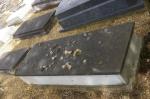
Near the entrance I noticed a bowl on a stand which contained small stones and pebbles. These are for visitors to place on their loved one’s grave. It’s part of the Jewish faith and it’s customary for people to leave small stone on a grave. I had already noticed several placed on various graves as I’d walked around the cemetery. The protocol is for the visitor to position the stone on the grave using his or her left hand. This demonstrates to other visitors of family members that a grave has been recently visited and that the deceased hasn’t been forgotten.
A horizontal tombstone on the East Side with stones placed on it in remembrance.
Copyright Carole Tyrrell
Another East Side tombstone with several stones on it. This indicates a well visited grave.
copyright Carole Tyrrell
‘Donated in love – Please feel free to help yourself to the stones.’
copyright Carole Tyrrell
The bowl of stones near the entrance.
copyright Carole Tyrrell
There is a small building just inside the cemetery, near the entrance, which contains two halls for burial services but it wasn’t open when I visited. It seemed a very plain cemetery without many floral tributes in evidence but I always find it fascinating how other cultures and faiths bury and remember their dead.
I visited here in 2013 and despite my intentions to return I haven’t done so – yet.
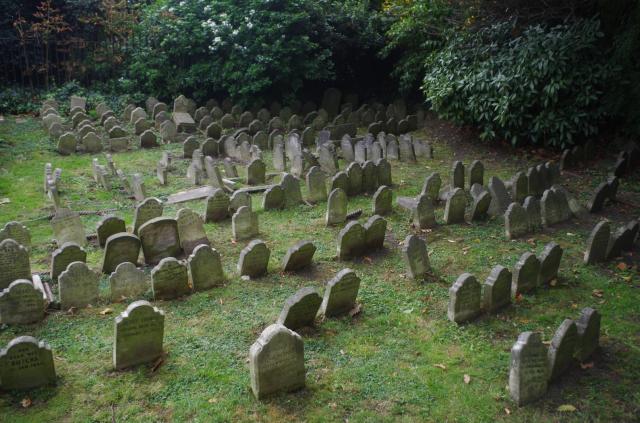
Alongside the busy Bayswater Road, on the way down from Marble Arch, there is a secret place behind one of the gate lodges. It’s protected by an iron railing and thick hedges and the casual passer-by wouldn’t know what lies behind them. But this is a special place where 300 much loved pets sleep in an eternal slumber. Curio, Ruby Heart, Prince and Ba-Ba are just some of the names of the family pets that are commemorated on the Lilliputian tombstones. This is the tiny Victorian Hyde Park Pet Cemetery.
300 little burials copyrights Carole Tyrrell
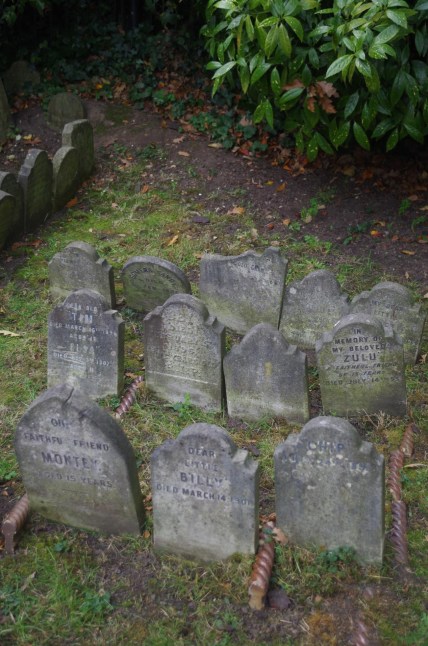
It was a burial space for the local residents and their beloved animals It’s mainly dogs that are buried here as they often fell victim to the Park’s horse riders hooves. However, there are also three small monkeys as well as several cats and birds. The first burial, Cherry, a Maltese terrier, was in 1881. Cherry belonged to the Lewis-Berned family who lived nearby. They were frequent visitors to the Park and knew Mr Winbridge, the lodge gatekeeper. Mr and Mrs Lewis-Berned approached him after Cherry had died of old age and enquired if Cherry could be buried in what was his back garden at the lodge. He and his employer agreed and Cherry’s tombstone reads ‘Poor Cherry. Died April 26 1881.’ Word must have got round as, before long, other local families were also having their deceased pets interred in the lodge’s back garden and it soon became an unofficial pets cemetery. There is even a royal dog there. This is a Yorkshire terrier which belonged to the wife of HRH Prince George, the Duke of Cambridge, who lived in Mayfair. ‘Poor Prince’ was crushed under a carriage wheel and actually died in the Lodge. The subsequent burial was recorded in the Duke’s diary on 29th June 1882 and made Prince the second incumbent in the cemetery. In contrast, there were also low-lifes in there and I am indebted to the London-In-Sight blog for the background information on a police dog, Topper, who is buried within the cemetery. He was obviously a dog with attitude and was described as being: ‘insufferably vulgar, a snob of the lowest kind and most contemptible, a bad strain in him which seems to have run through very line of his character.’ He died of over-eating. I have to admit that I would have liked to have met Topper to see if he lived up to his description. When you first enter by the side gate the first thing that really impresses you is how many of them there are in the little garden and how poignant some of the epitaphs on the small headstones are. Who has owned a pet, loved it dearly, and not wanted to commemorate its life and passing like other family members? The little plots are arranged in rows, each with an area bordered by rope edge tiles to allow the families to place flowers if they wished.
A smaller group nearer the Bayswater Road side copyright Carole Tyrrell
We visited the cemetery as part of a tour arranged by London Month of the Dead and had roughly thirty mins inside which didn’t leave much time to explore the epitaphs. I can only show a few of them here. But it was a good introduction to the cemetery. So next time we may book an hour long tour. We didn’t find Cherry’s grave despite looking for it. . One of our guides did point out that at the time of the first burials the average expectancy of a working man was forty or less.
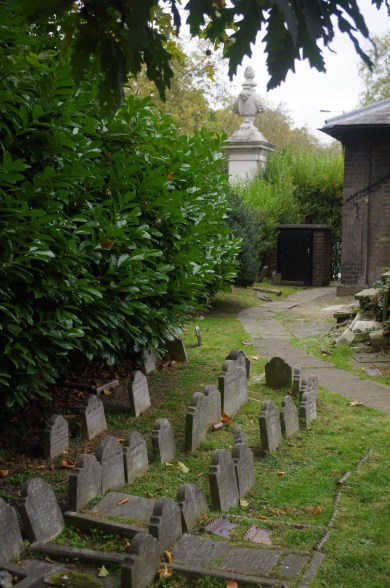
View towards Victoria Lodge copyright Carole Tyrrell
The gate was locked behind us as the little residents slumbered on. Access is limited for obvious reasons and needs to be booked via The Royal parks website; http://www.royalparks.org.uk. Tickets cost £50 +VAT for a visit lasting one hour for up to 6 people. Text and photos copyright Carole Tyrrell
Sources and further reading:
Barking Blondes – Will you book a grave plot for your dog? The Independent blogs 18/01/14
Fun London Tours – The Victorian Pet Cemetery of Hyde Park, 20/10/11
London-In-Sight blog, The Pet Cemetery of Hyde Park, 06/10/10
Below is a selection of the epitaphs
Spot’s last resting place copyright Carole Tyrrell
Snow and Smut Two cats buried there copyrght Carole Tyrrell
The epitaph to Snip says it all – note the little border so that owners could leave flowers. copyright Carole Tyrrell
A lovely and poignant epitpah copyrights Carole Tyrrell
Prince and Scum 0 imagine calling that out at night copyright Carole Tyrrell
Just inside the entrance – a touching epitaph copyright Carole tyrrell
A noble name indeed – Pepys copyright Carole Tyrrell
A sad ending for a much missed dog – Monty copyright Carole tyrrell
I would have loved to know what Curio looked like. copyright Carole Tyrrell
two long lived companions – Zeno and Clytie copyright Car9ole tyrrell
A perfect pug Chin-Chin copyright Carole Tyrrell
A much missed pet – Ba-Ba copyright Carole Tyrrell
A much missed local resident – Jack copyright Carole Tyrrell


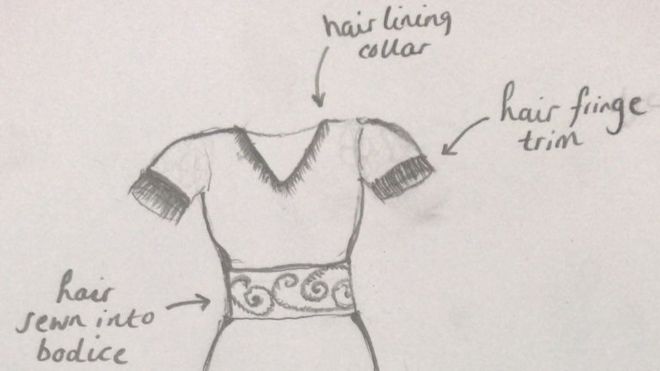 Image copyrightHAIR DRESS DESIGN
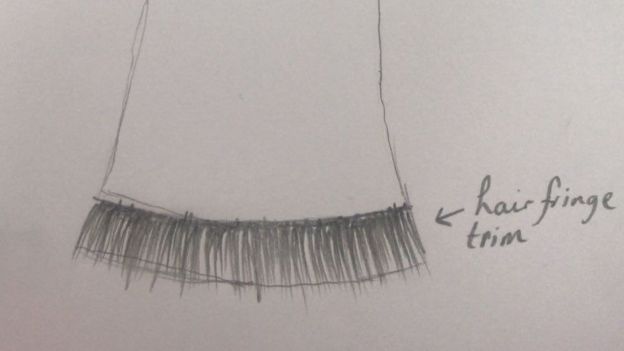 Image copyrightSEWPORT

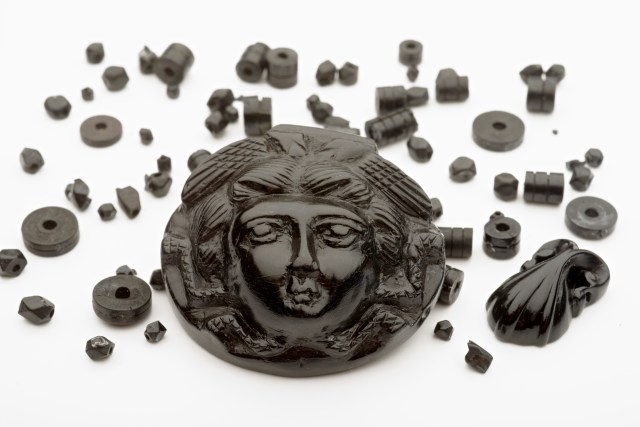 A Jet Medusa Pendant found in the burial of a woman from Hooper Street, Tower Hamlets. Jet was frequently used as a material for burial goods; It was thought to have magical properties and protected the dead as they journeyed to the afterlife. © Museum of London, 2018.





























_1935.jpg)